Review: Mother Clap’s Molly House (New Theatre)

Venue: New Theatre (Newtown NSW), Feb 11 – Mar 7, 2015
Playwright: Mark Ravenhill
Music: Matthew Scott
Director: Louise Fischer
Cast: Debra Bryan, Bradley Bulger, Stephanie Begg, Steve Corner, Andrew Grogan, Patrick Howard, Deborah Jones, Chantel Leseberg, Tess Marshall, Brendan Miles, Thomas Pidd, Garth Saville, Dave Todd
Photographs © Bob Seary

Theatre review
Mark Ravenhill’s writing is wild and exuberant. He uses theatre to express parts of life that are passionate, fun, taboo and brutal. In Mother Clap’s Molly House, Ravenhill places gay life under scrutiny, examining its relationship with capitalism, and the implications of an increasingly liberated community that loses its way in the struggle for freedom and acceptance. The play’s in-depth look at the subculture may not be accessible to general audiences, but it is a necessary and unflinching reflection at a significant segment of modern societies. Louise Fletcher’s direction addresses the political aspects of the play, as well as the deeply carnal flavour of its live experience. The production begins in an abundance of confused frivolity, but takes shape when its more serious themes set in and when the cast becomes more vibrant in its endeavour.

Mother Clap is played by Deborah Jones, who takes her character through drastic transformations over the course of two-and-a-half hours. As the narrow-minded version of Clap in early scenes, Jones is less convincing, but upon emancipation in the production’s second half, Jones is a spirited and confident performer, who delivers an interesting allegorical embodiment of queer empowerment. Steve Corner’s portrayal of Princess Serafina is complex and delightfully intriguing. His thoughtful approach is balanced nicely with an enthusiasm for broad comedy, although the actor can benefit from slightly less restraint. Chantel Leseberg brings a professional polish to the show, impressive in two dynamic and diverse roles, Amy and Tina. Her understanding of her parts is thorough, and her execution is consistently creative and exciting. The cast brings a warmth to the stage, and there is a charming intimacy that many of them share, but performances in general can be sharper and tighter for a greater sense of urgency, and while comic timing is not poor, there is room for improvement.

The term “molly” referred in the past, to male homosexuals and transvestites. Today, the word connotes recreational drug use. Ravenhill’s script is concerned with the evolution of gay identities, and the way societal permissiveness and the profit motive have encouraged a false sense of freedom, where men are made to believe that the pleasure principle equates to liberation and happiness. The show does not pass harsh judgement on “misguided” individuals, but it is critical of how gay communities can sometimes view themselves. To elucidate his point, Ravenhill makes a dichotomous relationship out of money and love. Of course, there is no need to think of them as essentially oppositional concepts, and we can expect to have both in our lives, but finding the right balance in moderation, as always, is key.

www.newtheatre.org.au

Review: Short+Sweet Theatre 2015 Top 80 Week 2 (Short+Sweet)

shortsweetVenue: New Theatre (Newtown NSW), Jan 14 – 18, 2015
Festival Director: Pete Malicki
Image by Sylvi Soe

Theatre review
Week two of 2015 Short+Sweet Theatre features a wealth of talent. There is exciting writing, clever direction, inspired acting, and sharp costuming to be found peppered through the night. Although no single work is able to be outstanding in every creative capacity, memorable moments are many, and the event continues to be an important one for Sydney artists and audiences alike.

Robert Renshaw’s Chat To Death teeters on the precipice of pornography, but the dangerous eroticism he explores is thrilling and beautiful, although quite explicit. The context he builds is not perfectly resolved, but his use of language more than satisfies. In Ryan Pemberton’s Business Meeting, a macabre and very quirky take on what happens in corporate boardrooms is beautifully directed by Pemberton whose sense of humour is odd, unique and very appealing. Direction is also a highlight in Rachel Welch’s So Says The Sea. James Hartley finds nuance in a deceptively simple script, and portrays surprising depth in just ten minutes. His cast is a strong one, especially Petrie Porter and Aleks Mikic who both impress with committed and meaningful interpretations of what could have been quite plain characters.

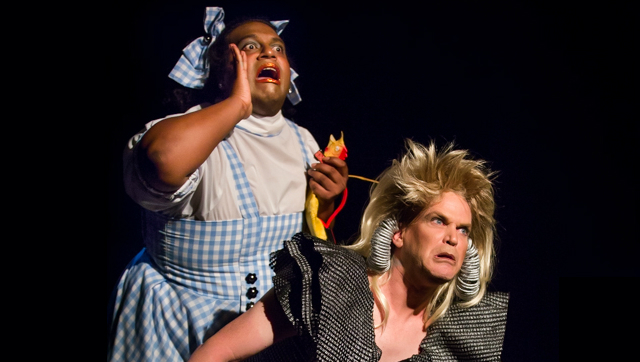
Other fabulous performances include Matthew Friedman, whose own piece The Least Impossible Thing That Happened This Evening opens the programme with vibrant energy and genuine enthusiasm. Equally buoyant is Jo Ford’s Chance You Can Dance, whose outrageously camp actors Hilary Park and Drew Holmes deliver irresistible laugh out loud sequences with their charming references to familiar cultural archetypes. Gavin Vance’s Screamers! The Wizard Of Aussie! Aussie! Aussie! (pictured above) stars the unforgettable Joseph Chetty who plays an Australian version of Dorothy Gale, blending drag comedy with a bawdy cabaret approach to present a scathing critique of the Abbott government, culminating in a live rendition of ‘Somewhere Over The Rainbow’ that is thoroughly and utterly electrifying. Dorothy’s call for a better national leader is a convincing one, and for a quick minute, she makes us believe in the pot of gold that lies at the end.

www.shortandsweet.org

Review: Short+Sweet Theatre 2015 Top 80 Week 1 (Short+Sweet)

shortsweetVenue: New Theatre (Newtown NSW), Jan 7 – 11, 2015
Festival Director: Pete Malicki
Image by Sylvi Soe

Theatre review
Sydney’s Short+Sweet Theatre festival features around 160 different 10-minute plays over 8 weeks. It is an excellent opportunity for talents of all experience levels to experiment, and a way for a myriad Australian stories to be told. The festival takes the form of a competition, with winners selected by judges and audiences, to be announced in March. The contest environment might encourage participants to only create crowd-pleasing works, but the event is actually quite varied in style and substance. On each night, ten plays are presented by a wildly diverse group of artists with no discernible unifying theme, which means that the likelihood of any audience member enjoying every piece in the program is slim, but discovering a couple of works that would appeal is certainly not difficult.

Short plays are challenging to performers who need to provide depth to characters who appear only fleetingly. They have less scripted pages to rely on, so ingenuity becomes central to their process. Ally Morgan plays Stephanie Tamara Anderson, a terminally ill teenager in Bokkie Robertson’s Wish (pictured above). Morgan’s confidence and conviction is a joy to watch, and the playful enthusiasm she brings to the stage is thoroughly captivating. In Jeffrey Hampson’s Wherefore Art Thou Oh Writing Inspiration, Hampson plays the role of William Shakespeare in an imagined struggle to create a new play, tentatively titled ‘Juliet and Romeo’. His performance finds focus after a shaky start, and endears to the crowd with a humorous take on the creative process.

Choose by Sam Jenkins is an intelligent work that entertains and amuses its audience, with a daring and fresh approach to theatre-making. Jenkins’ creation seems to be partly improvisational and partly scripted, but there is no way to tell for sure. The only person we see is a volunteer who reacts to Jenkins’ voice which provides prompts and narration. There is an element of Choose Your Own Adventure to its structure, and it relies heavily on Jenkins’ brilliant sense of humour and lightning fast responses to keep us excitedly engaged. A great strength of the piece is its unpredictability, and its success is evident in how much we wish to see it again, with a different unsuspecting subject steering Jenkins in different directions.

The Short+Sweet brand has expanded across the globe, and is now “the biggest little play festival in the world”. It provides excellent context for community involvement and unparalleled exposure, and is a crucial part of the Australian theatrical landscape that unearths impressive talent and inventive ideas. An event of this scale will have moments of disappointment, and patience will be tested, but with the bad, comes the good, and when the good shines through, all else is forgotten.

www.shortandsweet.org

Suzy Goes See’s Best Of 2014

sgs-best2014

2014 has been a busy year. Choosing memorable moments from the 194 shows I had reviewed in these 12 months is a mind-bending exercise, but a wonderful opportunity that shows just how amazing and vibrant, theatre people are in Sydney. Thank you to artists, companies, publicists and punters who continue to support Suzy Goes See. Have a lovely holiday season and a happy new year! Now on to the Best Of 2014 list (all in random order)…

Suzy x

 Avant Garde Angels
The bravest and most creatively experimental works in 2014.

 Quirky Questers
The most unusual and colourful characters to appear on our stages in 2014.

♥ Design Doyennes
Outstanding visual design in 2014. Fabulous lights, sets and costumes.

♥ Darlings Of Dance
Breathtaking brilliance in the dance space of 2014.

♥ Musical Marvels
Outstanding performers in cabaret and musicals in 2014.

♥ Second Fiddle Superstars
Scene-stealers of 2014 in supporting roles.

♥ Ensemble Excellence
Casts in 2014 rich with chemistry and talent.

♥ Champs Of Comedy
Best comedic performances of 2014.

♥ Daredevils Of Drama
Best actors in dramatic roles in 2014.

♥ Wise With Words
Best new scripts of 2014.

 Directorial Dominance
Best direction in 2014.

♥ Shows Of The Year
The mighty Top 10.

♥ Suzy’s Special Soft Spot
A special mention for the diversity of cultures that have featured in its programming this year.

  • ATYP

End

sgs-best2014a

Photography by Roderick Ng, Dec 2014

End

Best of 2018 | Best of 2017 | Best of 2016Best of 2015Best Of 2013

Review: Sweeney Todd (New Theatre)

Venue: New Theatre (Newtown NSW), Nov 18 – Dec 20, 2014
Music & Lyrics: Stephen Sondheim
Libretto: Hugh Wheeler
Director: Giles Gartrell–Mills
Cast: Josh Anderson, Erin Bogart, Briony Burnes, Jamie Collette, Justin Cotta, Daisy Cousens, Courtney Glass, Michael Jones, Jaimie Leigh Johnson, Lucy Miller, Carl Olsen, Joel Paszkowski, Steven Ritchie, Chelsea Taylor, Aimee Timmins, Simon Ward, Byron Watson
Photographs © Bob Seary

Theatre review
We all love a musical that has everything; humour, drama, talent, surprise and great music. All this is found in Giles Gartrell-Mills’ production of Sweeney Todd for the New Theatre, along with a good deal of ingenious low budget innovation, and a healthy dose of morbidity. It appears that Stephen Sondheim’s famous work can be staged without complex set designs and special effects, as long as gifted individuals are committed to presenting the best of their abilities, and an astute director is at the centre orchestrating an amalgamation that features all the strengths of each collaborator.

With Sweeney Todd, Gartrell-Mills shows that he is a man of excellent taste who has a brave approach to the theatrical arts. The emotions are big in his musical, as are the characters and their singing, but everything converges to tell a fascinating story that grips and entertains us, while making the many outrageous scenarios seem entirely believable. He has a wonderful team of seventeen performers at his disposal, and is careful to position each one in the most flattering light, so that the best singers can deliver breathtakingly powerful notes, and the strongest actors can impress with their delicious flair and intensity.

Justin Cotta plays the Demon Barber of Fleet Street with a grand and magnetic madness. The agility in his body and face, along with a professional awareness of how his character is perceived with every subtle shift in gesture and look, contribute to a performance that is precise, polished and very delightful. His voice is not perfectly suited to the material, but he sings it all with exuberance and accuracy. Similarly, Lucy Miller is not the best singer in the world for the role of Mrs Lovett, but the abundance of skills she displays, brings to life one of the stage’s most interesting and complex figures. Miller is charming, strong and instinctual. The several startling twists her character reveals are brilliantly performed, and her star quality shines brightly in the production. We cannot keep our eyes away from everything she presents, and she deserves every ovation awarded for her work in this production.

This review will not discuss every performer’s work but the entire support cast is truly fabulous. In the role of the Beggar Woman is Courtney Glass, who steals the show at each small appearance, with her sublime vocals and meticulous acting. Glass’ part is a smaller one, but she is flawless at every turn. Byron Watson does not have the right physicality for Judge Turpin but his voice is a highlight of the production. His deep and tremorous baritone brings an operatic sensibility to Sondheim’s music, and we lose ourselves in the beautiful baroque flavour of the compositions.

Liam Kemp’s achievement as musical director and pianist cannot be understated. He has condensed the score to an absolute minimum, with just himself, plus a violinist and a double bassist providing accompaniment for the whole show. The three-piece outfit pulls off an unbelievable feat, creating a soundscape that is dynamic, emotional and theatrical, culminating in a Bernard Herrmann inspired moment where Sweeney Todd meets Norman Bates, and the suspense becomes almost too much to bear. Also outstanding is the set design, comprised of three simple pieces in a hundred configurations, exposing Gartrell-Mills’ imagination to be wildly remarkable. His use of space is quite extraordinary, and one cannot resist imagining what he may be able to achieve with a more substantial design budget.

Musicals are best consumed sentimental, and Gartrell-Mills delivers this dark tale with a big emotional punch. Many of the characters are deplorable and nasty, yet we are seduced into connecting with them, and sometimes even identifying with them. They live in a world far removed from our realities, but we understand their desires and motivations, and we invest heavily into their stories of revenge and murder. We do not think of independent theatre as the best platform for the majestic, opulent musical, but on this occasion, David has emerged seemingly out of nowhere, to slash the throat of Goliath in awesome splendour.

www.newtheatre.org.au

5 Questions with Justin Cotta

justincottaWhat is your favourite swear word?
“Fuck Me In The Face With A Chainsaw Gently”.
It’s not a singular swear word, as per the question, yet run together at a rate of knots… Actually, wait.. no… that just ends up sounding like an in-flight announcement on Aerolineas Argentinas… Say it slow to medium fast depending on the context. And don’t just say it when you’re angry. Try mixing it up a little. Use it in a moment of quietly suspended disbelief. Or, here’s a good one; when you run into someone unexpectedly like an old friend, you can go with..
“Well fuck me in the face with a chainsaw gently!!! If it isn’t Such ‘n Such from Such ‘n Such!?!”
Follow your gut and play with it. And don’t be harsh on yourself if you mess it up the first few times. Like anything, it’s a process. Trust me, you’ll start to dig it.

What are you wearing?
My skin.

What is love?
Shakespeare’s Sonnet 116. Franz Liszt’s Consolation #6. My sweetheart asleep on my chest. Creating the space for someone to be exactly who they are without judgement. The Collingwood Football Club. Curry. My Ducati. My family and My friends.

What was the last show you saw, and how many stars do you give it?
The Motherfucker With The Hat at Eternity Playhouse. Rating: 6 out of 5. Absolutely brilliant. Adam Cook is such a magnificent director. The entire cast blew me away. Our Sweeney Todd will be richer for having seen this show.

Is your new show going to be any good?
I said yes to this role because it feels almost insurmountable. I honestly don’t know if I can pull it off Suzy. At times the demands of Sweeney have left me quivering in my boots. Sondheim is mocking me and bullying me as an actor and as a singer and as a musician. I am scared. To the core. I am filled with doubt. I am questioning myself and my choices in the rehearsal room. I want to run away. Particular songs break my heart. The story breaks my heart. No one wants to have their heart broken. That’s terrifying enough in and of itself… And yes of course, as actors we would be lying if we didn’t say that some of the discomfort is about the ego not wanting to be adjudged to be the giver of a poor/average performance. Aah those reductive and selfish thoughts! However, the fact that I am experiencing so much fear is a positive sign that I am invested in and care deeply about this production. I care deeply for the characters. I care for and respect the team that I am working with. Our wonderful director Giles Gartrell-Mills has assembled a stellar cast. And our MD, Liam Kemp, is a supremely talented musician/pianist. And so, to the question! Will it be any good? I can only guarantee you our passion and commitment. But as a cheeky indulgence, let me also answer you this way… If I weren’t pervaded by undercurrents of fear and doubt in week 3 of rehearsals for a production of Sweeney Todd, I would say, “Don’t bother going. The guy playing Sweeney doesn’t get it.”

Justin Cotta is starring in Sweeney Todd, at the New Theatre in Newtown.
Show dates: 18 Nov – 20 Dec, 2014
Show venue: New Theatre

Review: Harvest (New Theatre)

newtheatre2Venue: New Theatre (Newtown NSW), Oct 7 – Nov 8, 2014
Playwright: Richard Bean
Director: Louise Fischer
Cast: Nick Bolton, Sarah Carroll, Alex Chalwell, Xavier Coy Peter Eyers, John Keightley, Dave Kirkham, Annie Schofield, Isabella Tannock, Abi Rayment, Benjamin Vickers, Bishanyia Vincent, Steve Vincent, Jeremy Waters
Photograph © Bob Seary

Theatre review (of a preview performance)
Nostalgia can be ineffectually sentimental, but in Richard Bean’s Harvest, it is a telescope through which some of our contemporary social concerns are examined. The Harrisons are farmers in Yorkshire of England, and through their evolution over the last century, the deterioration of community and drastic alterations of market forces come into sharp focus. There is a definite pining for the past in Bean’s text. Even the villains of yesteryear seem quaint by comparison. Modern developments of civilisations are obviously not completely deplorable, but the play does put forth convincing arguments that pay reverence to bygone notions of honour, and the debate it inspires on alternative modes of progress is interesting.

Direction by Louise Fischer provides dramatic poignancy with an earnest approach to the script’s political positions, but the production’s tone is uncomfortably subdued in its first act. Early scenes require greater levity and chemistry between actors to deliver bigger laughs before the play’s deeper meanings emerge. The show begins to take flight at the introduction of the character Titch, played with exuberant confidence by Benjamin Vickers. His broad style of comedy finds a delightful harmony with Bean’s writing, and he creates the most memorable of the host of supporting roles on stage.

Leading man Jeremy Waters impresses with a consistently charming and dynamic portrayal of a character who grows from very young to very old. His colourful and entertaining work is a reliable central focus of the production, with scenes working best when his colleagues are able to locate points of ignition with his talents. There are moments when Waters’ diction proves slightly challenging for the audience (partly due to the distinctive Yorkshire dialect), but the actor’s physical expressiveness discloses sufficient plot detail to compensate for the shortfall. The role of Laura has a similarly vast age range for actor Bishanyia Vincent to explore, and she certainly rises to that challenge, shining especially brilliantly at the older stages. Vincent’s presence is unassuming but solid, and she surprises with increasingly captivating instances of creativity as the plot unfolds, culminating in a surprisingly riveting final scene.

Bethany Sheehan’s set cleverly converts the vast stage into a more concentrated and intimate performance space, with a backdrop that helps with the cast’s volume levels. Transformations to reflect the passage of time are necessary but set changes can sometimes lack elegance, as do several entrances and exits that see actors venturing off the stage, and into the auditorium. Nevertheless, Fischer’s work as director is defined by the conviction and power she injects into the moral of the show’s story. Bean’s writing seems to glorify the good old days with a dose of convenient selective amnesia, but Fischer turns his concepts into thought-provoking characters and events that move us. It is true that we are always ready to abandon the old in favour of all that is shiny and new, and while obsolescence should be improved upon, we must always be careful to separate the archaic from that which is eternal. Nothing lasts forever but many things endure further than a single generation’s lifetime.

www.newtheatre.org.au

5 Questions with Louise Fischer

louisefischerWhat is your favourite swear word?
Bumshitfart – it’s a good one, ask my father.

What are you wearing?
A red frock. It’s our Theatre Manager’s significant birthday and I intend in wobbling that tailfeather.

What is love?
The thing that gets you into and out of trouble.

What was the last show you saw, and how many stars do you give it?
The Matilda Waltz at New Theatre as part of the Fringe Festival, lots of stars. Written by the Assistant Director of Harvest and a lovely slice of Australian history following a matriarchal line.

Is your new show going to be any good?
God this is tough to answer without sounding like a wanker. It will be good because I was lucky enough to get the cast I wanted and a design team I adore. It means I can sit back and collect wine fines* and let them do all the work.

*Wine fines are the punishment meted out to actors for any infringement including being late for rehearsal, giving cheek to the director or hamming it up. This type of behaviour modification hits actors where it hurts and provides the director with a nice supply of Pinot Noir (hint to actors of Harvest who may read this).

Louise Fischer is directing Harvest, at the New Theatre in Newtown.
Show dates: 7 Oct – 8 Nov, 2014
Show venue: New Theatre

Review: The Matilda Waltz (New Theatre)

newtheatreVenue: New Theatre (Newtown NSW), Sep 19 – 27, 2014
Director: Sam Thomas
Playwright: Deborah Mulhall
Cast: James Bean, Adrian Adam, Carla Nirella, Morgan Powell, Michael Sutherland, Sonja Donohoe, Adam Gray, Katrina Rautenberg, Roberto Zenca

Theatre review
The Matilda Waltz is the story of five generations of women in Australia, commencing with siblings Vera and Ida Templeton in 1894. We follow a series of their love lives, which all result in daughters being born (yes, they are all heterosexual and, spoiler alert, they all choose Caucasian husbands). The play is narrated by icons of Australian-European literature and fine art, Banjo Paterson and Russel Drysdale, but it is unclear how much of the piece is a work of fiction. The women are not weak characters, they all have purpose and some even display ambition, but Deborah Mulhall’s writing defines each of them against the men who they chance upon. Romance and reproduction is big with the Templeton ladies, it seems, but in the space of a hundred years, they do not come in contact with any indigenous characters or later migrants from non-European regions. We do however, see one of the women venture into “Nam” to almost get killed by the Viet Cong.

It can be frustrating watching actors play different roles and not realising that fact until several scenes later. Chronology in much of the first half is also unclear. Sam Thomas’ direction is not without flair, but important details are neglected, which makes for a confusing experience. Fortunately, there is good work to be found in the revelation of each narrative that unfolds. Characters are not explored with much depth (the play is abridged for the Sydney Fringe schedule), but they are interesting and quite colourful. Virtually every scene features two characters in dialogue, and Thomas creates good chemistry on the stage between all cast members.

The actors are attractive and committed, but the script does not offer them enough to exhibit great skill or talent. The young men of the cast are utilised like boxed up Ken dolls, all gorgeous to look at but without space to flex their acting muscles. We only get to see powerful emotions from a couple of the women but those moments are so fleeting, they seem almost frivolous. Carla Nirella is animated and humorous as the uptight Ida, providing some laughs in the early sequences. Also charming is Sonja Donohoe who manages to find some range and subtlety in her scenes. Adrian Adam plays Drysdale and the American diplomat Richard with a confident presence, and he works hard to bring some fire to the production.

Encapsulating a century into 70 minutes is challenging. To create short stories out of entire lifetimes is not meaningless, but requires greater imagination and innovation. Australia’s recorded history is by some accounts, the longest in the world and we have much to choose from, and our persistent obsession with the recent European settlement needs to subside.

www.newtheatre.org.au

Review: Desperately Young At Heart (New Theatre)

roberthofmannVenue: New Theatre (Newtown NSW), Sep 23 – 27, 2014
Director: Stuart Maunder
Cast: Robert Hofmann, Cherie Boogaart, Tommaso Pollio
Image by John Marshall

Theatre review
Robert Hofmann’s work Desperately Young At Heart features the singer in various guises, performing humorous renditions of jazz and musical theatre classics. The show’s title reveals the fun-loving approach taken by Hofmann, but it serves also as a warning that nothing particularly poignant transpires. The songs are linked by a performance that sees Hofmann transform with wigs and costumes, although no obvious narrative connects each incarnation. Its sense of pageantry feels at home in the cabaret format, and while not terribly original, the show does afford an amusing glimpse into the creative mind of its author.

Hofmann’s baritone voice is accomplished and confident, with shades of opera that give his singing an enveloping power. The gender diversity of his characters is a key feature of the show, but Hofmann’s liberal use of falsetto is less effective. Mezzo-soprano Cherie Boogaart’s appearance is brief but memorable. Her comic abilities are competent, but it is her voice that truly delights. Pianist Tommaso Pollio is the unsung hero of the piece, single-handedly controlling the many mood transitions with ease and flair.

The presentation tries to be loud and outrageous, but it is the quieter moments when Hofmann works with more subtlety that resonate better. Desperately Young At Heart strength is the matured skill of its performers, whose expertise is clear to see. It is an opportunity for the artists to practise a genre of theatre different from their usual vocations, and results are mixed. It is not an enormously adventurous venture, but their enthusiasm in presenting a labour of love is quite infectious.

www.facebook.com/robert.hofmann.singer