Review: She Rode Horses Like The Stock Exchange (Rocket Productions)

Venue: Kings Cross Theatre (Kings Cross NSW), Oct 20 – Nov 11, 2017
Playwright: Amelia Roper
Director: Nell Ranney
Cast: Nikki Britton, Tom Anson Mesker, Matilda Ridgway, Dorje Swallow
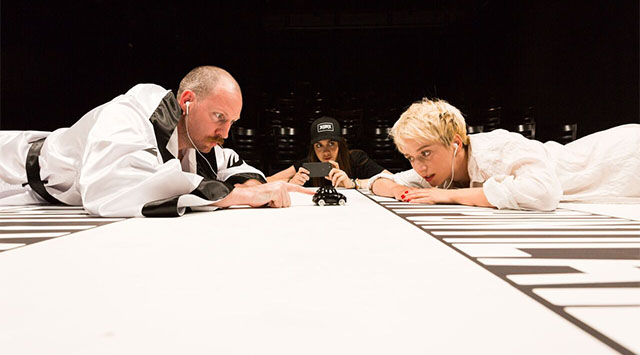
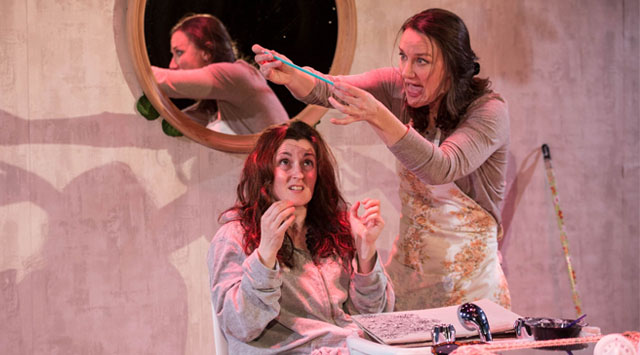
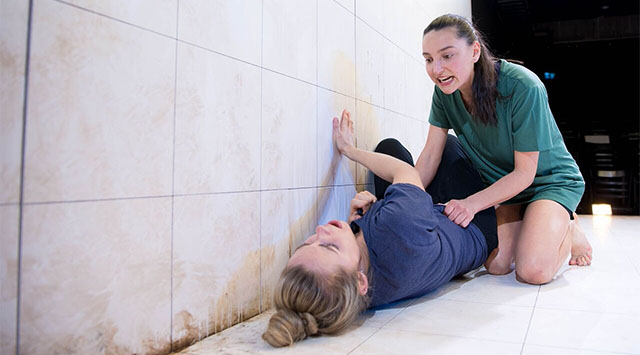
Image by Clare Hawley

Theatre review
A couple attempts to have a pleasant Sunday picnic, but investment banker Amy’s mind is preoccupied with work. She obsesses about money and power, unable to enjoy her day in the park, even as she is immersed in the glorious sunshine, with her beau Henry by her side.

Amelia Roper’s She Rode Horses Like The Stock Exchange examines our propensity to dwell on materialism and narcissistic conceptions of success, whilst ignoring the better things in life. Its characters pursue hollow dreams, making big sacrifices that amount to nothing. For all of us who participate in societies defined by commodification and consumption, that inability to find fulfilment and happiness can only ring true.

For all its pessimism, the play is humorously written, in a style that charms with its idiosyncrasy. Speech patterns are a delight in Roper’s piece. The production, helmed by director Nell Ranney, is correspondingly quirky, made memorable by Isabel Hudson’s attractive set and costume design. Early moments struggle to resonate, but the show recovers wonderfully when a second couple joins the stage.

Nikki Britton and Dorje Swallow are a vivacious pair, bringing necessary acerbity to the black comedy being performed. Their housewife and executive stereotypes are personalities we want to laugh at, and the actors allow us that opportunity by presenting those roles in a crisp, uncomplicated manner.

Tom Anson Mesker and Matilda Ridgway have more complex concerns, and although less funny with their interpretations, what they bring to the table is equally meaningful. Ridgway is especially effective in moments when we deal directly with issues of professional sexism, cuttingly salient with what she wishes to impart.

Amy and Sara may have diverse strategies in surviving patriarchy, but both are serving and preserving its dominance. The career woman plays by every rule at work, but finds herself discarded. The wife does all that is expected of her at home, then loses everything. They wager all that they have, on systems designed to fail them, and remain oblivious to the quandary that has them confined. We are taught to be good, and we spend years of our lives behaving appropriately, until a day comes when we realise our own freedom to establish a personal sovereignty.

http://www.kingsxtheatre.com

5 Questions with Grace Lauer and Tobias Manderson-Galvin

Grace Lauer

Tobias Manderson-Galvin: You’ve come all the way from Dresden, Germany (via L.A) to be in Puntila/Matti and I wonder as it is the structure of a classic joke: did anything funny happen to you on the way to the theatre? PS it doesn’t have to be funny haha.
Grace Lauer: I had a crazy experience/crazy apparition while driving. 10.30pm so it’s dark. I’m on a part of the autobahn that has no speed limit so I am going quite fast, there is nothing around, no infrastructure, nothing, just road and all of a sudden lit by my headlights I see these white legs in massive heels flash up on the side of the road really close to me like right there .. and then they are gone just as quickly. Or I passed. I’m not sure. I was so perplexed.. and creeped out somehow. A prostitute? The ghost of a prostitute, the legs of a ghost of a prostitute, my imagination? I drove even faster hoping it, they wouldn’t follow me, the ghost legs of the autobahn prostitute, yes that they wouldn’t follow me or it wouldn’t follow me, my imagination – yes that my imagination wouldn’t follow me, leaving it in the dust or better on the tarmac of the autobahn near the spot of the legs of the prostitute the autobahn legs. When I spoke to my brother he offered up the information that street prostitution is very illegal in Germany so neither she nor her legs should have been there really. I didn’t succeed. My imagination is right here with me.

Driving… you play Matti the chauffeur, in Puntila/Matti, so you, I didn’t know this but so you have a licence to drive?
Only a German one. I’ve only driven in Australia a couple of times, I don’t think I’m allowed to. Somehow I got pulled over one of these times and I was so nervous, and I gave him – the policeman – the German licence and he wanted to do the test- the alcohol test. I was giggling uncontrollably and he said ‘Have you been drinking m’am’; and I was really really nervous so I wasn’t blowing properly and then I said, ‘I think I ate an orange yesterday maybe it fermented in my stomach’. And then my mother – who was in Australia, she was in the passenger seat – said “it’s my daughter’s first breathalyser can we take a photo please,” I failed three more times to do the breathalyser test and my mother wouldn’t stop taking photos so the policeman let us go.

The ghost on the street is that the only ghost you’ve ever seen?
One other time. I was running a race in year four. And I got teamed up with a guy. And the guy- so the girl were running the race. And the guys were side lined supporting you as cheer squad. So I got teamed up with this guy I was MASSIVELY in love with. And I remember running and being in front but Deborah K. was running next to me and she was much taller and had longer legs than me and so like I recall running and then the gym teacher was like ‘come on guys support your girl’ and this guy was cheering so loud and I was like ‘I NEED TO WIN THIS’ and then it wasn’t like a prayer or something but in my head I was like ‘please please run faster’ and I just shot off and won this race by like metres and metres and so that was my first encounter with a ghost. Or even the ghost.

Did you win your sweetheart’s affection?
Not until years later and we went out for quite a while. We ‘dated’. I never told the boy about the ghost though and it didn’t last. The crazy thing and I was talking about this to some filmmakers in a sauna in LA. At least they said they were filmmakers. And also it seemed like everyone has their own radio station or podcast in L.A. So anyway they seemed to subscribe to this proto-Freudian, cult-like concept that everyone has an experience between the ages of like 5 to 8 years old that defines your whole life. For me it was winning that race.

But you became an actor not a runner. So how is this your defining moment?
It was a moment of realisation- no believing, let’s say, that there is this potential for a greater benevolent force. So I’m not sure I’m totally 100 percent comfortable with Matti killing Puntila at the end. We can give spoilers here right?

Tobias Manderson-Galvin

Grace Lauer: Have you ever seen ghosts?
You know we’re in Puntila/Matti, not Ghosts at Belvoir right?

I’m asking the questions. So have you?
Once I saw a dragon. I was visited by the Patron Saint of Telemarketing. I’ve communed with angels. I can travel my soul into other people’s bodies and control them like puppets. I can manifest balls of pure energy and all four elements. I can know anyone’s deepest desires by hearing only their cough. There is a spirit panther that follows me sometimes. But no I’ve never seen a ghost.

Speaking of Freud, have you ever seen a psychologist?
A psychiatrist/therapist actually; I went for 12 weeks. Each week she (the doctor) would say ‘I’m really sorry my office is being used by a colleague so we need to use this other room today I normally use for children. So we’d meet in this room full of stuffed toys. She said get comfortable so I arranged all the toys on the couch with me; with a fluffy anaconda around my neck as a scarf. She’d ask questions and sometimes the toys would answer. At the end of the twelve weeks I said to her: ‘So what’s wrong with me doc?’ She said nothing but I was very entertaining and she felt guilty that she’d been the one getting paid for the time. I never returned.

We had 14 walk outs on the second preview; does that bother you?
Once I did a show with an audience of 5. I didn’t like the attitude of three of them so I kicked them out. The show is not for everyone. Tolerance has its limits. I bumped into the three on the street later that night and they said ‘you’re the worst comedian we’ve ever seen’. I said ‘You didn’t see me.’ Turned out one of the two people that I left in the audience was a reviewer. Five stars.

There’s a fair bit of play between yourself and the audience that you didn’t tell me about in rehearsal. Does that happen when you go to other people’s shows?
Only if it feels appropriate. I once threw a show at punk hardcore luminary Henry Rollins’ spoken word concert (at Rollins himself), and he seemed pretty chill with it, but then beat me up in the carpark afterwards while his manager shouted ‘take a photo and post it on the internet, punk, no-one will ever believe you’. So I pick my battles now. But still- F*** you, Rollins.

Grace Lauer and Tobias Manderson-Galvin are performing in Puntila/Matti, part of Sydney Fringe 2017.
Dates: 25 Sep – 14 Oct, 2017
Venue: Kings Cross Theatre

Review: Puntila Matti (MKA Theatre / Doppelgangster)

Venue: Kings Cross Theatre (Kings Cross NSW), Sep 25 – Oct 14, 2017
Playwright: Tobias Manderson-Galvin (after Bertolt Brecht and Hella Wuolijoki)
Director: Tobias Manderson Galvin
Cast: Antoniette Barboutis, Grace Lauer, Tobias Manderson-Galvin
Image by Rupert Reid

Theatre review
We are told that the show’s departure point is Brecht’s 1940 script Mr Puntila And His Man Matti, but not much else can be certain in anyone’s reading of Tobias Manderson-Galvin’s Puntila Matti. Its deliberately bewildering enactment of a chaotic aesthetic, places us in a theatre that is less about stories, and more about experience and experiment, with time as a foregrounded instrument of its artistic practice. We look at a juxtaposition of bodies within time (and space) to garner meaning from any work of theatre, and in the case of Puntila Matti, we are challenged to find a way to appreciate and to comprehend all the riotous action, when its creators intentions seem to be to obfuscate the original narratives on which the show is built.

Manderson-Galvin acknowledges the European history so intimately entangled in the Western art of Australia. If Bertolt Brecht is present in every official form of theatre education disseminated on our land, then this relationship we endure, with a distant past from a faraway region, has to be interrogated. We can try to ignore old Europe’s stifling domination, and pretend to create new voices that are transparently offshoots of that heritage, or we can examine it with irreverence and subversion, as is done in Puntila Matti. Manderson-Galvin reframes Brecht in his own words, then makes them distorted and unintelligible, almost Dadaist in style. This is not a play about dependable dialogue and consistent characters. It is about the establishment, and how we can confront it.

The centrepiece is Manderson-Galvin himself, an imposing figure, wildly energetic and disarmingly intuitive as live performer. A fearlessness in his approach provides assurance of a man in charge, but it also keeps us on our toes, compelled and vigilant in the absence of the fourth wall convention. Grace Lauer provides a sense of anchor to proceedings, a necessary counterbalance that gives texture and dynamism to the presentation. Antoinette Barboutis is on the periphery, playing disoriented narrator with remarkable comedy, consistently, and delightfully, stealing the show from under the key performers.

When we come to recognise the bad in our inheritance, the brave will seek reparation. If our art is broken, it only makes sense that the most innovative of us, will attempt to find solutions. Reacting to the racist, sexist, homophobic, classist (you get the drift) systems in which we have to operate, requires that all participants, practitioners as well as audiences, must learn to face up to the new. It will be awkward, perplexing, even distressing, but those are sensations inherent in any true and radical emancipation. We may never be able to entirely abandon the past, but in rejecting the familiar and the comforting, we know that a genuine progression is in process.

www.mka.org.auwww.doppelgangster.com

Review: American Beauty Shop (Some Company)

Venue: Kings Cross Theatre (Kings Cross NSW), Aug 25 – Sep 16, 2017
Playwright: Dana Lynn Formby
Director: Anna McGrath
Cast: Charmaine Bingwa, Caitlin Burley, Amanda Stephens Lee, Jill McKay, Janine Watson
Image by Clare Hawley

Theatre review
The times might be a-changin’, but the American Dream goes on strong. Sue is a hairdresser who runs a small business in the town of Cortez in Colorado, and although she lives hand to mouth, her dreams of escaping poverty never fade. Dana Lynn Formby’s American Beauty Shop is about an underclass of the USA, that believes in hard work as deliverance. They may or may not understand the systematic oppression that they suffer under, but they focus only on labour and enterprise, without any attention placed on political action. Sue accepts her place in society, and plays by the rules, thinking that a commitment to drudgery is her only way out.

Amanda Stephens Lee is an affable presence as Sue. We understand her struggles, and wish the best for her, but let down by lacklustre direction, the women’s stories in American Beauty Shop fail to move us. The production feels under-rehearsed, and although most of the cast is able to demonstrate a good grasp of their individual roles, we are kept waiting for sparks that never fly. The stakes are high for the characters, but dramatic tension is sorely missing from this stage. Conflict and altercations are rarely convincing, as though we sense that all will be good in the end. It is a false sense of security, and the desperation of the Cortez poor, remains an abstract, and distant, concept.

The system is broken, but it was always designed to fail the vast majority. It is an illusion that all who have wealth are deserving of it, implying that those without, are wholly responsible for their own misfortune. The women in American Beauty Shop have ambition and the appropriate fortitude to push for better days, but the cards are stacked firmly against them. They know only to participate in a game that gives them miserably poor odds, and as we watch their fates unfold, it is the lack of fairness in our increasingly capitalist worlds that must leave an impression.

www.facebook.com/somecompanyproductions

5 Questions with Charmaine Bingwa and Janine Watson

Charmaine Bingwa

Janine Watson: All five characters in American Beauty Shop are female, ranging from seventeen to eighty. If you were casting the film version, and you could cast any five female actors (dead or alive), who would you cast in each role and why?
Charmaine Bingwa: Great question. I’d cast Viola Davis as Meg, no explanation required. Her back up option in case negotiations went south would be Aunjanue Ellis who can convey unfathomable heaviness without words; one to watch for sure. Hilary Swank as Doll, her rawness and ability to authentically play the underdog has always cemented her as a favourite of mine; would love to see her bring a little Million Dollar Baby magic. Sue, I would cast Julianne Moore, for her sensitivity; that degree of skinlessness is my favourite trait in actors. Meryl Streep as Helen. And Emma Stone as Judy for girlish charm and charisma. That is a pretty damn fine cast if I don’t mind saying so myself!

Your character ends up on the receiving end of some very uncool over-the-counter racism. Have you ever experienced anything like this in real life? If so, do you mind telling us about it?
Yes, sadly. I’ve had people assume I’m the shopkeeper, people call me the help – all sorts. To be honest I actually find the covert incidents worst, as it’s so insipid and hard to pinpoint or call out. But this is what gives my acting ambitions and career purpose. I feel it’s my duty to add to stage & screen diversity. I am often drawn to historical stories about persecution of racial minorities, because as a society I don’t think we have learnt the lessons of the past and it’s important to re-tell these cautionary tales.

Thinking back as far as you can, what’s the biggest beauty mistake you’ve ever made? Did you ever rock a side pony, for example?
Several! As an adult the extent of my beauty routine mastery is limited to applying foundation, blush and eyeliner – so I probably make several beauty faux pas. But yes, if you must know, in the Nirvana days there was purple lipstick, blue army pants and chokers. Before this I rocked blonde hair, which I’m happy to own. I dyed it black for Doubt: A Parable and have kept it that way ever since.

What’s your favourite thing about working with Janine Watson?
Everything! Her level of commitment, her attentiveness… she even comes to rehearsals she isn’t scheduled for just to observe. She is open, giving and all about the work, which is my favourite trait for collaborators. She can access such depth and uses her instrument masterfully.

Your character Meg has big dreams of starting a hair product line. Other than becoming an incredible actor, (nailed it!) what other big dreams have you had or do you still have?
Absolutely. My dream as an actor is to create incredible work on a global stage.

Janine Watson

Charmaine Bingwa: All five characters in American Beauty Shop are female, ranging from seventeen to eighty. If you were casting the film version, and you could cast any five female actors (dead or alive), who would you cast in each role and why?
Janine Watson: Mmmmm …. the options!!! Charmaine has nailed the casting already!! Lemme see – Jodie foster circa The Accused – Doll, Kate Winslet – Sue, Kerry Washington – Meg, Betty White – Helen, Winona Ryder circa Mermaids – Judy.

Your character Doll has a very sentimental attachment to the children’s story book Good Night Moon. What was your favourite story book as a child and why?
I had a book called The Big Book Of Fairytales and it opened with a really spooky intro of a little girl talking to the old wooden rocking chair that her grandmother used to sit in. She’d say ‘Chair of my grandmother, tell me a story…’ and lean on the rocking chair which would tell her the more obscure, sad and scary fairytales by Oscar Wilde, the Brothers Grimm, and Hans Christian Andersen. I loved the book. I loved all the outsiders in those darker stories.

Let’s do some character analysis. Your character is named Doll. Is that short for Dolores or is it because she was conceived to a Dolly Parton song? If it is the latter, which song was it?
Let’s pretend it’s the latter and of course then it would be “Why’d You Come In Here Lookin Like That?!”. But really I’ve decided Doll’s name is actually from Dorothy… Doll was a popular abbreviation of Dorothy and it has a more mid-west Anglo connotation and we’re in the mid-west, rather than Dolores which would be from Irish or European derivation.

What’s your favourite thing about working with Charmaine Bingwa?
Charmaine is just spectacular. I saw her in Doubt and was bowled over by her emotional access and truth. She has gravitas, and infuses even the tiniest moments with great nuance. Plus she’s funny, very cool and can do a lot of push ups.

Doll’s a bit of a black sheep. Who’s the black sheep in your family?
In truth, in my family we’re all black sheep who found our flock… both blood family and extended and beyond.

Charmaine Bingwa and Janine Watson are appearing in American Beauty Shop, by Dana Lynn Formby.
Dates: 25 August – 16 September, 2017
Venue: Kings Cross Theatre

Review: Dry Land (Mad March Hare / Outhouse Theatre Co)

Venue: Kings Cross Theatre (Kings Cross NSW), Jul 28 – Aug 19, 2017


Playwright: Ruby Rae Spiegel
Director: Claudia Barrie
Cast: Sarah Meacham, Michelle Ny, Patricia Pemberton, Julian Ramundi, Charles Upton
Image by Marnya Rothe

Theatre review
Teenage years are but a flash in any lifetime, yet they are the most formative, and in many cases, offer the most exciting of experiences and memories. Before we are tamed into adults, and before we understand the price to be paid for every decision, the teen is a new person unleashed from childhood, ready to explore all that had been previously prohibited. In Dry Land, Ruby Rae Spiegel writes about the locker room at a girls’ swim squad, except where we expect banter, we discover some very hard truths being learned. Amy and Ester are in the process of figuring out the women they want to be, and with the bravery and fortitude they had gained from training in elite sport, they put themselves through the most brutal loss of innocence.

These fearless characters see the immensity of the world and rush head-on to devour its every promise, limited only by that same flesh and blood that is determined to keep each of us contained. It is a story about the spirit of youth, and how every person has to come to terms with their own corporeal limitations, as well as those psychological and social. Ester is fighting tooth and nail to excel in her swimming, while Amy exploits every resource to obtain an abortion without parental consent. They know what is best for them, regardless of our judgements, and Spiegel’s ruthless need to put on display every explicit detail of their confronting endeavours, makes Dry Land an extremely edgy work of theatre that challenges our personal and collective values.

It interrogates notions of youth and gender, and seeks to dismantle bourgeois constructs that dominate discourse in Western art. Claudia Barrie, as director of the piece, demonstrates a real passion for those subversive and feminist ideals, in her creation of a work that is absolutely uncompromising and forceful with what it has to say about our realities, and their accompanying structures of artifice, pretence and hypocrisy. Collaborative outcomes with designers are perhaps slightly predictable, but their efforts are undeniably effective in the production’s ability to manufacture atmosphere and pace, keeping us completely engaged with its narrative.

Barrie’s strength as guiding light for actors, shines brilliantly in Dry Land. All performances, including Julian Ramundi’s very small part as the apathetic Janitor who has seen it all before, are deeply evocative and resonant. No stage moment is allowed to go to waste, and we are thus enthralled. Sarah Meacham’s explorations as the ambitious Ester are as exhaustive as they are delightful. A character study that feels utterly intelligent and inventive, Meacham elevates the show from one that can easily be monotonously dark and serious, to something that is unexpectedly very funny, and overwhelming with compassion. Her comedy sits mischievously under every expression of trauma, giving Dry Land a unique quality of tragicomedy that brings perverse joy to those who can stomach it. Amy is played by Patricia Pemberton, whose resolute refusal to portray a simplistic victimhood, compels us to interpret her grievous circumstances beyond its instance of desperation. It is an extraordinarily rich and defiant personality that Pemberton presents, one who demands admiration over pity, and who reinforces the female as gloriously sovereign and interminably powerful.

When we look back at the salad days of one’s youth, it is with contradictory feelings of pride and embarrassment, exhilaration and regret. No matter how we choose to regard the past, there is no denying that the tougher the lessons, the greater we are today in every aspect of being. We have to try always to protect our young, but allowing them to face difficulty in every mishap and blunder will, as they say, build character. The young women we encounter in Dry Land are caught in a snapshot of suffering and struggle, but their futures are not diminished, only emboldened and bright.

www.madmarchtheatreco.com | www.outhousetheatre.org

5 Questions with Sarah Meacham and Patricia Pemberton

Sarah Meacham

Patricia Pemberton: Describe Dry Land in five words.
Sarah Meacham: Courageous. Honest. Bold. Uncomfortable. Necessary.

What attracted you to the role of Ester and the play initially?
It is such a dream, as an actor, to come across a text that explores such complex, honest and dense stories of young women. It is such a juicy text in that sense. The women have agency and are so interesting respectively. Ruby creates these characters and fills them with a shipping container full of life and truth. Jeremy and Claudia have done the Sydney independent theatre scene such a blessing by putting their story on a stage. In terms of Ester herself, I just fucking love her – no words.

Ahh the teenage years. Tell me about a classic ‘teenage moment’ you’ve had that makes you laugh.
One time I got really wasted with my friend in Albury. We went to this pub, Paddy’s I think it was called, and I remember feeling really close to losing it. I went outside and sat on the curb for about an hour. Then it was time to make tracks and my friend’s cousin picked us up. Then I have this blissful memory of opening the car window and feeling the wind on my face but then coupled with spewy mcgee all over the car door (inside and out) down my dress and on the floor. I woke up the next day with dried vomit in my eyelashes.

What has been the most unexpected moment of the process so far?
Realising the full scope of potential in the elasticity of a swimming cap.

Where should we get dinner – Ruby Tuesday’s or Denny’s?
Ruby’s. Duh.

Patricia Pemberton

Sarah Meacham: What’s your favourite food? I’ve heard you hate protein bars.
Patricia Pemberton: Hands down Nutella. If I could bathe in Nutella I would. Introduce me to a Nutella protein bar that doesn’t taste like a protein bar and you’ll have my attention.

As an actor, what is the greatest part of the rehearsal process?
Actually it’s the point of delirium at the end of a full day’s or week’s rehearsal. That’s either where the best epiphanies happen or you are all in stitches of laughter, both are equally great!

What’s the most embarrassing thing you’ve done on stage?
Once I was in an interpretive dance where I was the sperm that won the race and was dressed in a form fitting white ensemble flailing about on stage? Not sure if that’s counts though, because I just think that’s funny.

Ruby Rae Spiegel discusses a lot of confrontational components that can come to play among puberty for young women, what do you think has distinguished this piece of writing from others in regards to the way she presents the voices of women today?
When I first read the script, I remember closing it and staring at the ceiling for a few minutes- processing and relating with my own experiences. The voices of these young women are universal in their high school setting, their coded lingo and journey of trying to find their place. I think what separates Ruby’s work from other works is that it is relentless in how emotive and cruel not only puberty but life can be. Nothing is off limits. It’s very ‘in yer face’, but who doesn’t love a bit of that?

We’re part of a pretty crazy independent theatre ‘power couple’ with Mad March Hare and Outhouse Theatre coming together. What are you most excited about in staging Dry Land?
Mad March x Outhouse is definitely the Beyonce & Jay Z of indie couplings. I’m so incredibly grateful to be working with the creatives that I am, that’s the most exciting part for me. That they saw something in me that they wanted to collaborate with and vice versa.

Sarah Meacham and Patricia Pemberton are appearing in Dry Land, by Ruby Rae Spiegel.
Dates: 28 July – 19 August, 2017
Venue: Kings Cross Theatre

Review: Before Lysistrata (Kings Cross Theatre / Montague Basement)

Venue: Kings Cross Theatre (Kings Cross NSW), Jul 10 – 22, 2017


Playwright: Ellana Costa
Director: Saro Lusty-Cavallari
Cast: Ellana Costa, Alex Francis, Michaela Savina
Image by Zaina Ahmed

Theatre review
We know Lysistrata as the one who convinces the women of Greece to deprive themselves of sex, in order that their men would cease fighting each other in the Peloponnesian War. In Before Lysistrata, playwright Ellana Costa imagines a scenario that leads up to that audacious act. Lysistra and Lampito are the first ladies of Athens and Sparta, each representing a different side of politics.

It is the left and right wings of society, again at loggerheads. Whether 400 BC or 2017 AD it seems, we are determined to make enemies of one another, unable to be at peace with the idea of disagreement. The men go to war, determined to quash the other side, so that the world only needs contain one uniform ideology. With the death of sons that inevitably result, the ladyfolk band together, and hatch a plan to end the atrocities.

At points where the lines of good and evil are blurred, when us and them are disrupted, the show becomes refreshing. Its message can however, feel simplistic, as do its characters and dialogue. Wit and drama can be found in Costa’s well-meant text, but performances are unfledged, and the production never really builds enough tension that would allow sparks to fly. Few artistic risks are taken that will offer elements of surprise or intrigue. Its political interest holds court, central and singular.

Where there is solidarity, great things can be achieved. For each generation that experiences increasing social fragmentation, the idea of organised processes of action becomes correspondingly alien. That we can be unified, must not only be an abstraction, but how we get there, is more bewildering than ever before.

www.montaguebasement.com

5 Questions with Ellana Costa and Michaela Savina

Ellana Costa

Michaela Savina: Who do you believe is the most effective ancient Greek villain?
Ellana Costa: My favourite villains are the Sirens from the story of Jason And The Argonauts. I love that their power can be felt from a distance. I love the idea that these women play into the stereotype of the beautiful, mysterious woman that all men want, only so they can lure these men to their deaths. I also love the image of Jason, so desperate to see and hear the Siren song, that he ties himself to his ship. Talk about a glutton for punishment.

How do you find it performing your own writing?
I think every writer should be forced to perform that own writing at least once. It changes the way you see the writing process. I’ve always enjoyed working in a collaborative way and I’ve noticed a lot of changes I’ve decided to make from the script, to my character particularly, have come out of a realisation that the way I think doesn’t always translate well to the page. The exciting thing, however, about performing a character I’ve created, is that I really feel like I know Lampito. I feel like I understand her and why she is making the choices she’s making.

What’s your favourite thing about Lampito?
I think Lampito is incredibly strong, but I think what I love most about her is the way she shows her strength. She lives in a society where she is often looked down on because she is a women, but when she sees something she thinks is wrong, she say something. Even though she knows it will result in pain for her. She has a real moral backbone that I think is beautiful.

How would you define strength?
I define strength as resilience. To be strong doesn’t mean never falling, or never being upset, or never feeling like you can’t do it. For me, strength is feeling those things, acknowledging them, and then taking the steps you can to get back up. You can’t be strong without vulnerability, and when you are vulnerable you’re able to show your strength.

Who do you call to serve on your utopian action squad?
Well, it would be a combination of fictional and real world bad ass ladies. Let’s start with the obvious one: Wonder Woman. She is a n Amazonian goddess and will obviously be leading our party. I would then request Beyonce for soundtrack, general inspiration and fierce moves. I would also ask Black Widow from Avengers (for DC/Marvel mashup) and then I think I’d end with Geena Davis. That woman is an Olympian archer and super hilarious. Couldn’t image a better crew.

Michaela Savina

Ellana Costa: If you could be any one (or anything) from an ancient Greek myth, who would you be and why?
Michaela Savina: I think I would have to go for Circe because she’s got all of this badass magical power. Also in Odyssey she turned all the men in to pigs which is a move I really endorse.

Who is your feminist role model and why?
It’s like picking a favourite child this question, I think I’m going to go with Joan Didion as basically half my actions in life are just trying to make myself more like her.

What is the most interesting element of Lysistrata’s story for you?
In our adaption I think we’ve really drawn out the idea of sacrifice and what exactly that looks and feels like on a human level. I think understanding that sometimes the same sacrifice can land very differently for people is quite interesting.

What is your favourite thing about playing Lysistrata?
I really love playing her personality quirks, even though she has all this expertise and intelligence her emotional intelligence and social skills are quite lacking and that’s always fun to play. She really does mean well but she just slightly misses the mark.

Dead or alive, who is present at Lysistrata’s symposium on 21st century politics?
Ruth Bader Ginsberg, Arundati Roy, Yassmin Abdel-Magied, Georgia O’Keefe and Patti Smith, I’m kind of thinking about the post symposium drinks, my god that’d be some fascinating conversation.

Ellana Costa and Michaela Savina can be seen in Before Lysistrata by Ellana Costa.
Dates: 10 – 22 July, 2017
Venue: Kings Cross Theatre

Review: Jatinga (Bakehouse Theatre Company)

Venue: Kings Cross Theatre (Kings Cross NSW), Jun 9 – 24, 2017
Playwright: Purva Naresh
Director: Suzanne Millar
Cast: Sapna Bhavnani, Karina Bracken, Claudette Clarke, Jarrod Crellin, Faezeh Jalali, Sheila Kumar, Suz Mawer, Bali Padda, Monroe Reimers, Trishala Sharma, Teresa Tate Britten, Amrik Tumber
Image by Natasha Narula

Theatre review
In the north-eastern region of India, a tourist hot-spot exists in the village of Jatinga, known for the mysterious phenomenon of birds plunging to their death, every year after the monsoon season. In Purva Naresh’s play Jatinga, it is the phenomenon of “runaway girls” that takes focus. Journalist Madhumita discovers five young women escaping harrowing fates, and in her efforts to publish a story that draws attention to their plight, she finds herself thinking like villagers hungry for tourism dollars, deciding whether to resort to sensationalism, in order that the greater good can be served.

The play is purposeful, and undeniably powerful. Addressing issues of poverty, Jatinga is relevant to audiences of all nations, at a time when economic inequality is a serious social concern. We may not suffer the same symptoms in the developed world, but the fact that the refugee crisis is unsolved and escalating, and that we continue to obsess over “terrorist threats”, show that persistent disparities, that our first-world systems thrive on, are creating problems that have landed us in a state of emergency. The rich will always want the poor separate and contained, but the poor can often break through the barriers of money. Radical action is always an option, when people have nothing to lose.

The women in Jatinga tell simple stories, but the production is strangely convoluted. Shifting timelines and interweaving narratives provide a sense of theatricality, but unnecessary confusion often gets in the way of our empathy. The show must be lauded however, for not turning to “disaster porn” to keep us engaged. The women are victims, but they are also spirited and strong individuals. Director Suzanne Millar’s resolve in portraying them as such, is certainly admirable.

An excellent cast, wonderfully cohesive, perform a colourful work replete with vigour and sincerity. Suz Mawer is captivating, and tremendously persuasive, as the journalist Madhumita. Her thorough authenticity holds the piece together, even though the stakes are admittedly lowest for the character she portrays. Also noteworthy is Nate Edmondson’s work on music, transportative and transformative in its effect, from scene to scene.

When the birds take to suicide, we wish for it to be an act of nature, and convince ourselves that things stay in balance with their sacrifice. Murmurs of the birds actually being killed by villagers, are disregarded by the tourists who wish to witness something romantic and extraordinary. We bury the truth, in order that our fabricated realities can be sustained. We want to think that refugees have proper channels to seek asylum, and we want to believe that terrorists are mentally ill. We insist that the poor only need work harder to create better lives, and we sweep the truth under carpets, sit back and watch as towers are burnt to ashes.

www.bakehousetheatrecompany.com.au