Review: Clybourne Park (Ensemble Theatre)

clybourneparkVenue: Ensemble Theatre (Kirribilli NSW), Mar 13 – Apr 19, 2014
Playwright: Bruce Norris
Director: Tanya Goldberg
Actors: Paula Arundell, Thomas Campbell, Briallen Clarke, Nathan Lovejoy, Wendy Strehlow, Richard Sydenham, Cleave Williams

Theatre review
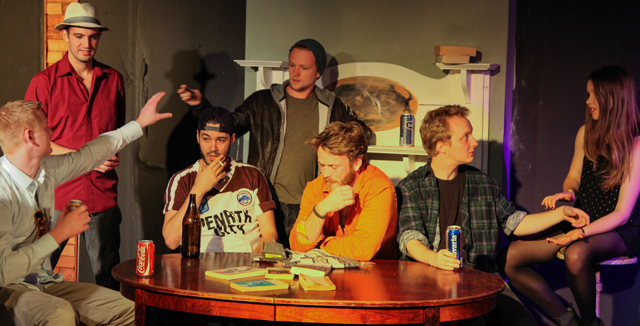
Bruce Norris’ multi-award winning play is a stunning work about racism and its manifestations in American neighbourhoods. By looking at the formation of communities and the process of home acquisition over the last 50 years, Norris captures the evolution of attitudes regarding ethnic diversity and political correctness in the USA. It is a script that is dynamic, entertaining and funny, while maintaining a complexity that reflects the intricately divergent beliefs we hold on the subject. We all accept that racism is not to be tolerated, but it is our individual and differing definitions of the concept that gives Clybourne Park its dramatic exuberance.

Direction by Tanya Goldberg for this production by the Ensemble Theatre is exciting and impressive. Goldberg’s work is full of intellectual depth but also gleefully entertaining. She relishes in the dark and sometimes sardonic humour of the script, making us laugh at every opportunity but always keeping us aware of the precariousness of the topics being discussed. We are never sure if our laughter is appropriate, and we are constantly required to assess the political correctness of our responses to what unfolds on stage. Goldberg’s achievement in creating an electric piece of theatre, while presenting some of the bravest and most contentious points of view on race, is truly remarkable.

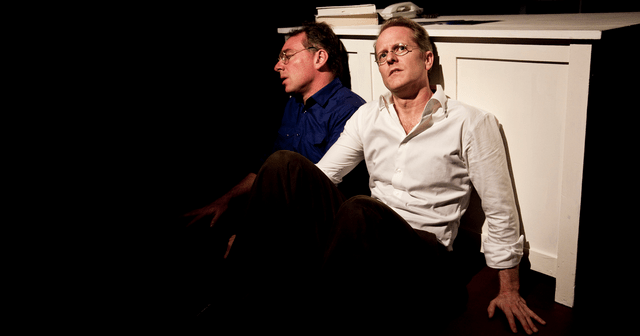
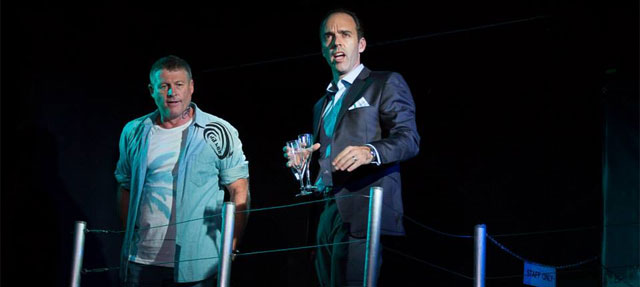
This cast of seven is magnificent. Each player takes on two roles (except Thomas Campbell who adds an extra one at the end), and every character we see is thoroughly explored and colourfully executed. The chemistry between all is playful and powerful. It is quite incredible to see a stage full of infallible actors with so much confidence and surety in their undertaking. Nathan Lovejoy’s impeccable timing is showcased well without his comic abilities overwhelming the deeper meanings being communicated. Several scenes involving Lovejoy’s characters speaking with varying degrees of offensiveness are delivered with a poignant irony that is dangerous and delicious. Briallen Clarke is animated and vivacious, with a natural ability at commanding attention. She is a charming and funny actor who creates endearing characters effortlessly. Richard Sydenham brings charisma and gravity to his roles. The dramatic tension he creates as Russ is absolutely enthralling theatre. Paula Arundell has two very different roles but introduces the same amount of passion into both. Her dignified performance in Act 1 transforms into something more unexpected and complex in the second half. Her characters are interesting and challenging, giving the play a sense of daring edginess.

There are things in life that are difficult to articulate due to the many valid yet conflicting perspectives that apply. Politics is distilled by the media into simple, black and white sound bites, and our minds and thoughts are shaped accordingly. Clybourne Park is a reminder that our world is infinitely large, and perpetually evolving. In our navigation through different lives and communities, rules and social norms are constantly in flux. Our minds need to always be developing because nothing ever stays the same, least of all the sensitive needs of human beings.

www.ensemble.com.au

Review: Hilt (Mirror Mirror)

hiltVenue: Old 505 Theatre (Surry Hills NSW), Mar 12 – 30, 2014
Playwright: Jane Bodie
Director: Dominic Mercer
Actors: Alexandra Aldrich, Joanna Downing, Stephen Multari, Sam O’Sullivan

Theatre review
Jane Bodie’s script seduces with intrigue and structural complexity. Her characters divulge little of themselves, but we witness their interchanges at close range. At play is the way these contemporary Australians interact with each other, and we see how connections are formed in our modern lives. Bodie sets up what at first seems to be unconventional relationships, but over the course of her storytelling, we begin to question whether these are exceptional cases that we witness, or actually, a rare confession of common experiences.

Direction and performances tend towards naturalism, which makes Hilt “audience friendly”, turning challenging ideas into digestible concepts. Director Dominic Mercer succeeds in creating believable characters and communicating details of their stories, but could benefit from taking a little artistic license in expression. Real life sometimes needs sprucing up for the stage.

Mercer’s cast is a focused one, and all have clear trajectories with their individual motivations and destinations. Alexandra Aldrich plays Kate with a lot of graveness, which is an accurate depiction of the dark world in which she dwells, but prevents some of the dialogue from being more dramatic and punchy. Stephen Multari is effective in highly emotive scenes that require anger and frustration. Both actors seem constrained by the subtle and minimalist setting. Supporting actors Joanna Downing and Sam O’Sullivan provide excellent support and necessary lightness, helping add variety to the show’s palette of moods.

This is an Australian story that is as valid as any. It does however, have an unexpected sophistication in the incisive way it talks about family, marriage and sex. Nothing in the twenty-first century can truly be claimed as being unique to any cosmopolitan city, but Hilt certainly articulates a lot about what life today is like in Sydney, Melbourne, Brisbane, etc. It provides a mirror into the things we do. Its accuracy and originality might be disorientating, but good art is known to do that.

www.venue505.com/theatre

Review: Monkey (Creative Practice Lab UNSW)

rsz_monkey-505Venue: UNSW Io Myers Studio (Kensington NSW), Mar 11 – 15, 2014
Director: Ben Winspear
Playwright: Les Winspear (based on the traditional Journey To The West)
Actors: Students from UNSW School of the Arts & Media

Theatre review
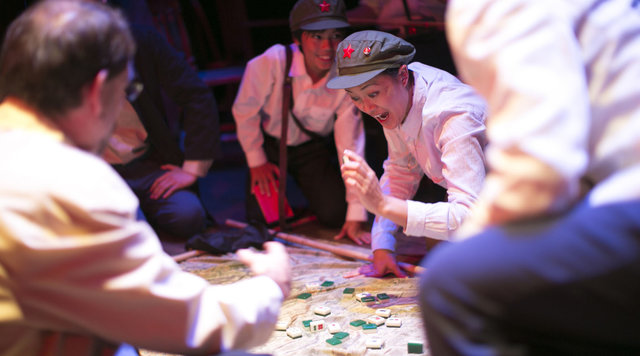
The enduring tale of Journey To The West is one of enlightenment and aspiration. It is also about mentoring, development and progression, all of which come together to make Les Winspear’s contemporary retelling of Monkey a natural thematic choice for a production involving young people. The characters in the story are mischievous, imperfect and unafraid of failure. This serves as great catalyst for students to approach their play with a sense of playfulness and daring.

Director Ben Winspear’s style is brave and bold. He is faithful to the story, but is audacious in vision. Rules are made to be broken, and one is tempted to conclude that rule-breaking is a method he cherishes when creating magic in the theatre. Or perhaps, it is simply his outrageous imagination that reaches beyond convention and the predictable, into a space that feels refreshing and original for contemporary audiences. Indeed, the director’s ability at materialising the fantastical details of Monkey, not only gives us a work that is dynamic and highly amusing, it provides a safe and spacious springboard for his student actors to experiment and perform. The wildness of this world they create, encourages lively expression but also comprises a healthy protection for those who need it. This is a stage so full of colour and vigour that nothing can look out of place.

Design is excellent. All aspects, from costume and props, to set, sound and lighting are thoughtful, inventive and confidently executed. It is by no means a show about polished production values, but what this crew achieves with a minuscule budget in the most basic of venues, is impressive. It is a beautiful collaboration of disciplines that works together to tell a story with clarity, wonder, and a lot of fun.

All performers appear to be students. It is a big cast, with varying degrees of ability, but unified by a common level of enthusiasm and commitment. Some seem to be appearing on stage for the very first time, and others are brazen and ambitious. Most are allowed their moment in the sun, and each bask in their own, in idiosyncratic, joyful ways. There are performers who impress with their use of voice, and some with their dance. Actors who charm us with comic timing, as well as those with outstanding physicality, and presence so strong, they steal our attention for a second or two.

Although Monkey and his friends reach a penultimate moment of glory, what we remember most after all the dust has settled, are his qualities of mischief and joy. We often forget the importance of the light, for the weight of darkness makes for easy victories, especially in the arts. It is unimportant what the scriptures at the end of Monkey may contain, if the journey that is taken fills itself with all that is gallant, and good.

https://sam.arts.unsw.edu.au

Review: Seven Kilometres North-East (Version 1.0)

rsz_7km_ss_3Venue: Seymour Centre (Chippendale NSW), Mar 8 – 22, 2014
Devisor and performer: Kym Vercoe
Singer: Sladjana Hodzic

Theatre review
Kym Vercoe’s Seven Kilometres North-East is structured like the travels she has been on. Adventurous and purposefully vague, we don’t really know what is happening until we get there. The experience of exploring unfamiliar terrains is replicated in Vercoe’s work. We are at times bewildered and anxious, trying to make sense of everything that is exotic, alien and strange; and at other times, we discover people who tell fascinating stories and places that narrate histories, beautiful and horrific.

The plot of the piece takes us on winding roads, and bumpy rides. It is not the most comfortable of journeys, with challenges appearing at almost every turn. Vercoe does not aspire to make things easy to stomach. Instead, she places emphasis on authenticity, and a sense of reverence for all that she had met during her time in the Balkans. Her performance style is dynamic and colourful, which keeps us engaged. She has a warm enthusiasm that asks for our trust, and we stay on with her, subconsciously aware that our guide is peeling layers off an onion with a core that will be worth the trek. Indeed, the concluding moments of the show is as dramatic and powerful as any work of fiction that aims to hit you like a ton of bricks.

At tonight’s performance, three people walked out. The third chose to leave at a particularly heightened and tense section towards the end. The stage is on ground level, and at that moment, the performer was standing close to the audience and near the exit. The departer got out of her seat and walked deliberately in front of Vercoe and headed our of the theatre. It looked like a protest. Perhaps there are nuances in the politics of the region that are too complex for an 80 minute performance to encapsulate, or maybe Vercoe is making a statement that is shocking to some. For those of us who are afar, and frankly, only mildly familiar with the travesties in recent Bosnian history, Seven Kilometres North-East seeks to appeal on a humanist level. What Vercoe shares comes from the personal and it speaks to us personally. Larger contexts are not required, when telling tales of murder and genocide.

PS (10 Mar 2014): Some information has come through about the walkouts after the review above was published. The producers say that one relates to urgent work matters and another was the result of an audience member texting during the show and being asked to stop by someone else.

www.versiononepointzero.com

Review: Stop Kiss (Unlikely Productions / ATYP)

rsz_gxmphotogrpahy2014-1-3Venue: ATYP (Walsh Bay NSW), Mar 5 – 22, 2014
Director: Anthony Skuse
Playwright: Diana Son
Actors: Olivia Stambouliah, Gabrielle Scawthorn, Aaron Tsindos, Ben McIvor, Robert Jago, Kate Fraser, Suzanne Pereira
Image by Gez Xavier Mansfield

Theatre review
One of the main things explored in theatre is emotion. We ask, what are these different things we feel, how do we create these feelings, how do we differentiate between cheap and authentic sentiment, and how do they affect our lives as individuals and collectives? Stop Kiss leaves its audience with such emotional intensity that these questions come to the fore. Diana Son’s script tells the simplest of stories, but its unique structure in terms of a non-linear timeline, and an unusual depiction of romantic love, keeps us enthralled, and speaks deeply to the most basic humanity in us all .

Under Anthony Skuse’s wonderful direction, Stop Kiss is both theatrical and sincere. There is masterful use of space, which gives the production a sophisticated aesthetic. In spite of budget constraints, the show is a handsome one. Set design is thoroughly considered, and elegantly executed by Gez Xavier Mansfield, and lighting by Sara Swersky is subtle yet varied and effective. The many scene transitions are established with elegant flair. We jump around in time and space with minimum fuss and maximum efficiency.

The love story and its romance are managed with restraint. Skuse deliberately downplays a lot of the drama, so that its powerful concepts work overtime in our heads. Like a striptease, we are only ever given just enough information so that our minds can conjure up all the salacious details on their own. The cast benefits from this sense of inhibition, as it allows for a somewhat ironic magnification of their inner worlds. We seem to obtain a better insight into what people are thinking and feeling when they are prevented from doing too much.

Gabrielle Scawthorn’s performance as Sara is marvelous, culminating in a final scene that can only be described as heartbreaking. The character she has created is not only believable, we find ourselves in constant need of seeing more, and knowing more. Her work is equally committed whether playing light or dark, and she tells her character’s story with careful compassion that is beautiful to watch. The connection Scawthorn makes with her audience is as intense as Sara’s falling in love in the story.

Olivia Stambouliah plays Callie with vivacity and complexity. Her energy keeps the show uplifted and dynamic, and her focus is magnetic. There is a steely determination in her performance that is at times impressive, but at others, slightly distracting. The actor sometimes works too hard but her final moments onstage are truly remarkable, and intelligently crafted. Ben McIvor has two memorable scenes as Peter. He finds a balance between tenderness, frustration and despondency, and portrays a character that is empathetic and immediately affable.

It is probably not a rare occurrence that tears are shed in the theatre, but the emotions in Stop Kiss are exceptional. We cry because we understand that true love is precious and rare, but we also cry in the knowledge that homophobic violence is widespread and alive. The play ends in a dark place, but it thankfully leaves us with a morsel of hope. Tears can be self-indulgent, but they are also the beginning of every important and necessary change in the places we live. This play may not be obviously political, but one hopes that its gentle approach would have an effect on those who have yet to be converted by our more strident preachers.

www.facebook.com/unlikelyproductionspresent

Review: Everything I Know I Learnt From Madonna (Tunks Productions / Sydney Independent Theatre Company)

rsz_1899685_623939144321658_1856255859_oVenue: Old Fitzroy Theatre (Woolloomooloo NSW), Feb 18 – 22, 2014
Playwright: Wayne Tunks
Director: Fiona Hallenan-Barker
Actor: Wayne Tunks
Image by Katy Green Loughrey

Theatre review
Madonna, the pop star, means many things to many people. Like many brassy women in the public eye, she is regarded by gay communities as an icon. An outspoken proponent of the gay movement since the early 1990s, it is understandable that her place with LGBT people has endured the years. In this one-man play by Wayne Tunks, he talks about his obsession with Madonna in the introduction, then goes on to share with us his stories of coming out and relationships with various men, liberally quoting lyrics by his hero at every available opportunity. His script is an interesting one. It is almost as if Tunks is unable to verbalise his thoughts and feelings without the aide of Madonna songs, so her words keep appearing in his monologue, sometimes seamlessly, sometimes a little forced, but it is no doubt that his admiration is beyond skin deep, and that her work actually provides a space of solace. It looks a lot like religion.

Tunks is an actor full of vigour. He appears on stage and is determined to seize your attention, and for the entirey of his performance, we pay close attention to his stories. It helps that Tunks’ voice is commanding and versatile. It is naturalistic acting but there is definitely not a hint of mumbling, everything is said loud and clear, which is fortunate as the bareness of the staging and minimal direction of the near two hour work, leave nothing else for Tunks and his audience to hold on to.

The show overflows with earnestness. For a seemingly shallow premise of pop star fandom, it contains no irony and very little frivolity. We are presented love stories with a string of men, Sean, Warren, Guy, Jesus, and (presumably) Brahim. They are not particularly colourful events, in fact, slightly mundane. There isn’t really a set up of context, just a man keen to share with a captive crowd, and we are inspired by his fighting spirit that never gets dampened by failed relationships. He keeps getting back in business as though nothing’s better than more because ultimately, what can you lose?

“You’re never gonna see me standin’ still, I’m never gonna stop ’till I get my fill” (Over And Over, Madonna 1984).

www.tunks.com.au

Review: The Night Larry Kramer Kissed Me (Lambert House Enterprises)

rsz_1796028_10202558976807602_539984011_oVenue: Ginger’s Oxford Hotel (Darlinghurst NSW), Feb 19 – 27, 2014
Playwright: David Drake
Director: Kynan Francis
Actors: Ben Hudson, James Wright

Theatre review
American playwright and actor David Drake’s 1994 one-man play is revived to coincide with the Sydney Gay & Lesbian Mardi Gras 2014 season. This time, Australian director Kynan Francis casts two actors, makes several updates to the script, and chooses a cabaret style venue to stage a radical re-telling of a piece of radical writing. Drake’s work from the post-ACT UP era was fresh and optimistic, arriving at a time when the shock of the AIDS epidemic had begun to subside, and communities were galvanised and empowered. A new gay identity had emerged, characterised by a buoyancy that had previously remained elusive. The Night Larry Kramer Kissed Me is an important work that represents this transformation. It remembers the horrors of a time of closeted secrecy and overt persecution, but articulates a vision of the future of equality and emancipation.

Ben Hudson is the more sure footed of both actors. He exhibits a close affiliation with the themes of the work, with a performance that is stirringly passionate and authentic. There is no question that Hudson would have been able to carry the show on his own, but Francis’ decision to partner him up is not an unwise one. While James Wright is less experienced, he holds his own. Like a young brother following closely behind, he completes the picture, and adds more to the production that is immediately evident. Both are brave yet vulnerable, and both understand the weightiness of the material they have taken on. There is a lot of careful reverence and sensitivity in this production, giving it an uplifting and beautiful spirituality.

Francis’ direction is deep and meaningful. His thorough familiarity with the script and its contexts ensures that every scene, moment and nuance is depicted with emotional accuracy and poignancy, and with political impact. The use of two actors effectively portrays the bonds between gay men, as brothers, lovers and compatriots. Some of this work is very moving. There is also technical brilliance on show, particularly with the performance of an extended section set against music. For a production of such small scale, it is surprisingly, and impressively, well rehearsed.

In 1994, the idea that all adults will one day be able to marry equally in the eyes of the law was hard to imagine. Our battles today might feel arduous and frustrating, but The Night Larry Kramer Kissed Me shows just how far our society has progressed. The play ends in the year 2020, when Oklahoma becomes the final USA state to legalise same-sex marriage. We are now 6 years away from that fictitious moment, and things seem altogether more hopeful and brighter than ever before.

www.facebook.com/…

Review: Once In Royal David’s City (Belvoir St Theatre)

rsz_auditorium-onceinroyaldavidscityThis review first published in Auditorium Magazine (Spring 2014)

Venue: Belvoir St Theatre (Surry Hills NSW), Feb 8 – March 23, 2014
Playwright: Michael Gow
Director: Eamon Flack
Actors: Helen Buday, Brendan Cowell, Maggie Dence, Harry Greenwood, Lech Mackiewicz, Tara Morice, Helen Morse, Anthony Phelan

Theatre review
Michael Gow’s latest work is about political theatre. In both content and form, it explores the meaning of the very concept by delving into the life and writings of Bertolt Brecht, and by telling the story of Will Drummond, a Sydney theatre practitioner dealing with the impending death of his mother. Drummond is invited by a high school to speak to its students on the very topic of political theatre, revealing to us Drummond’s strong feelings about the education system and his passion for his vocation.

Gow’s play consists of a string of monologues by Drummond, either addressing the audience directly, or his sick mother who sleeps through his speeches. Minor characters appear sporadically to assist with plot trajectories, but they exist mostly to illustrate Drummond’s points of discussion. This is essentially a one-man show, where Gow’s own ideas and ideals are thinly veiled as his protagonist’s. It is clear that he has things to say, and he resolves to say them in the most straightforward way possible.

Brendan Cowell is the leading man, and the success and effectiveness of the production rests firmly on the quality of his performance. Cowell possesses the lethal, and contradictory, combination of unassuming looks and enigmatic magnetism. He plays the down-to-earth regular guy with ease, but has a star quality that is persistently captivating.

Cowell plays up his character’s theatricality. We accept that Drummond is going through great turmoil with his mother’s illness, and coupled with an outspoken and flamboyant personality, opportunities open up for impassioned and extravagant rants about the state of the world as seen by both character and writer. Things could easily become grim and repetitive but Cowell’s conviction in every line is impressive, and believable. The actor has an obvious connection to the text, and it is his love for the material that makes us listen, and judging by some of the stirrings in the audience, possibly even persuasive.

A key subject of the play, is the notion of Brecht’s famed “alienation effect” from the original “verfremdungseffekt”, and the popular misunderstanding of that concept to imply an emotional disengagement. Drummond, in his school lecture, expounds that Brecht had actually believed that passion and emotion are in fact important, as it is only through a sense of anger that action will be taken. He further elaborates that apathy and despondency are precisely the sentiments that need to be avoided, and that theatre needs to move away from a state of powerless depression, toward one of questioning and empowerment.

Director Eamon Flack adopts the Brechtian and Marxist influences of Drummond’s life, and stages a production that is carefully and self-awaredly minimal in distraction, and strident with its ideology. Visual design elements are pared down. Lighting is fairly sophisticated, but costumes, sets and props are basic, and only engaged when necessary. Actors are required to be still, only moving when relevant. The “fourth wall” is removed for many of Drummond’s monologues, and songs are sung during scene changes as direct reference to some of Brecht’s documented techniques.

Once In Royal David’s City is an interesting exercise in the relationship between emotion, theatre practice, and political action. We see a theatre director gradually becoming more socially active through his work, as his personal circumstances turn increasingly emotional. This is not entirely convincing as a storyline, but what is most striking about the production is the assertive volume at which Michael Gow’s own ideologies are pitched. His perspectives have clearly influenced Flack, Cowell and others in the cast, but the extent to which their performance will affect Belvoir’s audience can probably never be certain.

www.belvoir.com.au

Review: Privates On Parade (New Theatre)

rsz_1069838_594783037267230_490878940_nVenue: New Theatre (Newtown NSW), Feb 11 – Mar 8, 2014
Playwright: Peter Nichols
Music: Denis King
Director: Alice Livingstone
Choreographer: Trent Kidd
Actors: Matt Butcher, Jamie Collette, Peter Eyers, David Hooley, Morgan Junor-Larwood, James Lee, Henry Moss, David Ouch, Diana Perini, Martin Searles, Gerwin Widjaja
Image by Bob Seary

Theatre review
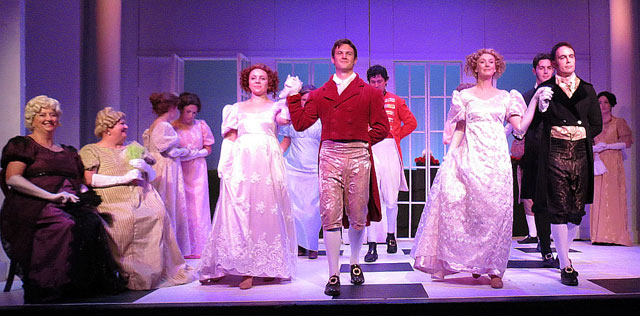
Written in 1977, this “play with music” appeared just two years before the inaugural Sydney Gay & Lesbian Mardi Gras parade. It contains some of the earliest progressive depictions of same sex relationships, and is an excellent choice for the New Theatre to present it in conjunction with the Mardi Gras festival this year. The work comes from a time before political correctness, and includes many references to ethnicity, gender and sexual preference that could make contemporary audiences cringe, but director Alice Livingstone is mindful of the change in context and deals with those awkward moments shrewdly and with sensitivity.

Livingstone’s decision to add a prologue featuring the “Boogie Woogie Bugle Boys” is a stroke of genius. Gerwin Widjaja, Henry Moss and David Ouch play a trio of drag queens in cheongsams inviting the audience to 1948 Singapore, and providing a side of the fictitious SADUSEA (Song And Dance Unit South East Asia) that is missing from Peter Nichols’ show. More importantly, it showcases the talents of Widjaja and Ouch, who would otherwise have been completely mute as the multiple “oriental men” in the original work.

The greatest strength of this production is its cast. Diana Perini in particular rises to the challenge, and does almost everything one could possibly ask of a performer. She plays comedy and tragedy, sings in ensemble and solo, dances en pointe and on tap heels, gets her top off, and does a mean Indian accent. Her role is not terribly interesting, but she sure makes a jaw-dropping one-woman tour de force out of it. James Lee plays Terri Dennis, the most flamboyant character imaginable. He masters all his song and dance routines, and endears himself as a crowd favourite from his very first appearance. Lee is also very effective in creating chemistry, always bringing out the best in his co-actors when appearing together. There is an effortless warmth to this man that most performers can only dream of. David Hooley is polished and disciplined as Steven Flowers. He seems slight in stature but his singing is big and confident, and his tap dancing is thoroughly impressive. His dreamy “Fred and Ginger” style sequence with Perini is most memorable.

Politics shift constantly, and ideologies evolve. Old works of art can be left behind and buried, but creativity can unearth and shine new light on them. We need not be afraid of mistakes past, if we learn to deal with them at every developed age. A 1977 comedy about British forces in 1948 Singapore, has crossed many borders, time and geographical, to reach this point. It is with refreshed enlightenment and a sense of progressiveness that should mark our approach to it today.

www.newtheatre.org.au

Review: Sweet Charity (Luckiest Productions / Neil Gooding Productions)

rsz_sc_0005_bps4219Venue: Hayes Theatre Co (Potts Point NSW), Feb 7 – Mar 9, 2014
Book: Neil Simon
Music: Cy Coleman
Lyrics: Dorothy Fields
Director: Dean Bryant
Choreography: Andrew Hallsworth
Musical Direction: Andrew Worboys
Actors: Verity Hunt-Ballard, Martin Crewes, Debora Krizak, Lisa Sontag

Theatre review
Bob Fosse directed and choreographed the iconic Sweet Charity, on stage and on film, in the late 1960s. The dance sequences are some of the most striking moving images ever seen, so one of the main challenges in staging the work today would be the treatment given to the re-creation of those scenes.

The current production at Hayes Theatre Co, helmed by director Dean Bryant and choreographer Andrew Hallsworth straddles between faithfulness and innovation. There is an acknowledgment that times and audiences have changed, but also an awareness that the immortal is a hard act to follow. Bryant’s adaptation uses the theatre’s spacial limitations to his advantage, and turns the work into an intimate and emotionally rich experience. There is a sense of things being scaled down, but for the most part, he achieves a good intensity on stage that results from the distillation of something conceptually grander. Hallsworth’s thankless task of re-interpreting Fosse’s choreography is surprisingly effective, even if the numbers “Hey Big Spender” and “Rich Man’s Frug” do leave us pining desperately for the film.

Visual elements are especially noteworthy. Ross Graham’s lighting is varied, dynamic and sensually appealing, providing the minimal set an aura of tragic beauty. It also gives logic to time and place, making the innumerable scene transitions happen flawlessly. Tim Chappel’s costumes and Ben Moir’s wigs are thoughtful and impactful without being overwhelming. They tell the story of the characters even before they begin to speak.

Martin Crewes plays a trio of Charity’s men, and delights with every role. The energy he brings to the stage is staggering, and he possesses a headstrong determination that is seductive and commanding. Crewes impresses with his powerful and creative song interpretations, and is responsible for both the funniest and saddest moments of the show in his role of Oscar. Debora Krizak shines as Nickie, one of the more jaded dance hall hostesses, and is easily the raunchiest and most colourful of characters. Krizak’s ability to portray earthiness and pathos is a real highlight. Verity Hunt-Ballard is the star of the show, with a vocal talent that makes Charity’s songs more meaningful than ever. The comic elements of the role are difficult (it’s not the funniest of scripts), but Hunt-Ballard is deeply moving at every tragic turn.

Sweet Charity can be thought of as pre-feminist. It constantly defines its women in terms of their relationships with men, and depicts their work in the adult industry as unquestionably pessimistic. All efforts are made for them to appear vivacious and intelligent, but their desires are left unexamined and unevolved. Unlike Fosse’s film, this production does not leave you with thoughts of glitz, glamour and glossy dance routines. Instead, it makes you ponder the big questions in our lives… and the meaning of love.

www.hayestheatre.com.au


www.facebook.com/luckiestproductions


www.goodingproductions.com