Review: Is It Time (King Street Theatre)

emuprodVenue: King Street Theatre (Newtown NSW), May 25 – Jun 5, 2016
Playwright: Martin Ashley Jones
Director: Barry Walsh
Cast: Lauren J. Jones, Denise Kitching, David Luke, Sarah Plummer, Ross Scott, Sylvia White
Image by Thomas Adams

Theatre review
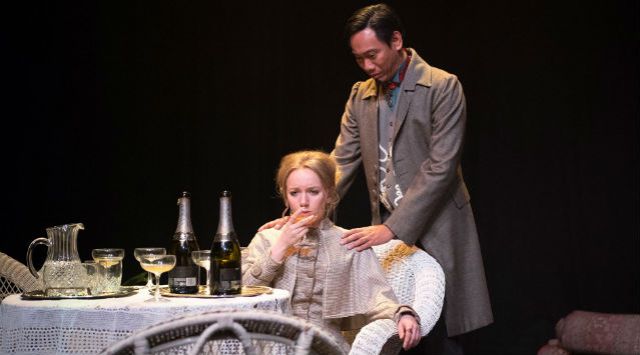
Discussions about end-of-life decisions are invariably dynamic. Each of us has a stake in the topic, and our points of view tend to be fiercely adversarial, even though the matter is contentious precisely for its manifold ambiguities. Martin Ashley Jones’ Is It Time makes a courageous proposition about the way we should be allowed to be in control of our own deaths. It makes a pro-euthanasia argument, but avoids cliché with some of its more radical ideas that are rarely presented in public discourse. Jones’ story is confronting and controversial, with well-crafted characters and vibrant dialogue that will facilitate healthy debate on the subject. The script can be further finessed, especially in passages where diatribes become too obvious, but it is a passionate work that will encourage thoughtful and spirited interaction in its audience.

Direction by Barry Walsh brings excellent lucidity, in emotional and logical terms, to the play’s ideas. There is little doubt as to what Is It Time wishes to say, but the show can often lack nuance in its representations. The issue is a complex one, but we jump to its conclusions almost too easily. Walsh’s pace is admittedly enjoyable, but it also feels rushed at points, and important details become lost in the process. Performances are characterised by clarity and enthusiasm, and even though a greater sense of moral struggle would add drama to the piece, the production succeeds in engaging us by asking important, burning questions. Sylvia White and Ross Scott lead the cast with heartbreaking honesty and beautiful chemistry. Their control over poignant sections of the play is considerably stronger than in moments of comedy, and we do take time to warm up to their personalities, but they get us to an ending that is ultimately very satisfying.

Fighting over the right for a dignified death is problematic for many reasons, including the fact that many who argue against euthanasia have not encountered terminal illness at close proximity. For those who only see death as a distant and abstract concept, taking away a suffering individual’s final cardinal choice is a not a difficult task. Is It Time demonstrates that art has the unique capacity to provide space for the issue to be explored, in a way that is humane and sentimental, but simultaneously objective and pragmatic. There are few opportunities for us to come face to face with our mortality, but at the theatre, where it is secure and sacred, we can interrogate the inevitability to reach a deeper understanding of that sunset we will all see one fateful day.

www.kingstreettheatre.com.au

Review: Bad Jews (Vass Theatre Group)

badjewsVenue: Seymour Centre (Chippendale NSW), May 18 – Jun 4, 2016
Playwright: Joshua Harmon
Director: Gary Abrahams
Cast: Maria Angelico, Simon Corfield, Anna Burgess, Matt Whitty

Theatre review
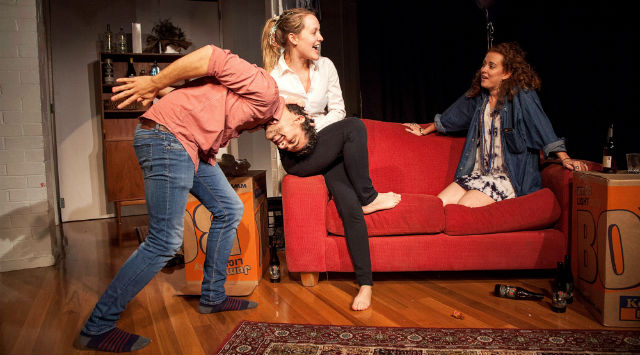
Joshua Harmon’s Bad Jews explores authenticity of the self in relation to religion, ethnicity and history. At opposite ends of a spectrum are the religiously observant Daphna and her atheist cousin Liam, both Jewish by genealogy but each relating to their backgrounds in vastly different ways. They fight over what constitutes right and wrong, constantly and fervently berating each other for their conflicting life choices. At its best, Harmon’s writing is deliciously cutting, with characters verbally attacking each other at the most vicious degrees imaginable. The words are brutal, but they ring true, even as they emerge in contradiction from opposing sides of the argument.

The play’s comedy is not always refined but director Gary Abrahams injects a confident energy into the production to ensure that chutzpah makes up for the occasional shortcomings of the text. Abrahams’ eye for detail delivers a very tight production that insists on being compelling at every moment, and rich with thrilling resonance whenever it delves into more meaningful proclamations.

Excellent performances by the cast of four make Bad Jews a memorable night at the theatre. Daphna is played by Maria Angelico with extraordinary gusto. Dangerous, funny and vulnerable, she goes through the gamut of human emotions for a portrayal of what seems an oddity but in fact translates with intimate accuracy. We may not be able to identify with her world of religious righteousness but her very human expressions of desperation are universally accessible. In the role of Liam is Simon Corfied, animated and passionate with great conviction, giving life to an uptight scholarly type who although represents the voice of reason, is comically unable to quell his shortness of temper for his adversary. Supporting actors Anna Burgess and Matt Whitty are both accomplished and precise with their depictions. Burgess in particular, impresses with her capacity to turn every brief opportunity in the limelight into a delightful showcase for her comedic genius.

For all its talk about religion, and the varying extents to which its individuals practise the beliefs that they inherit, Bad Jews makes a convincing point about love being the overriding factor that helps determine how we live. We cannot decide who we truly fall in love with, much like we do not choose who we are born to. Liam is accused of sacrilegious desecration by the pious Daphna, but the play makes us understand that anything that would come between real love to be erroneous. Liam revels in the purity of his romantic relationship, while Daphna experiences purity in her religious orthodoxy. They are concurrently right, even if in a state of war.

www.badjewstheplay.com

Review: As We Forgive (Griffin Theatre Company / Tasmania Performs)

griffinVenue: SBW Stables Theatre (Kings Cross NSW), May 11 – 21, 2016
Playwright: Tom Holloway
Director: Julian Meyrick
Cast: Robert Jarman

Theatre review
Forgiveness is complicated and unstable, and where it is most needed, its difficulty is at its greatest. In Tom Holloway’s As We Forgive, three monologues featuring an older man demonstrate the purpose of forgiveness, as it relates to a self that needs to find emancipation that can only be derived from an act of absolution. When we realise that life is short, the urgency for deliverance becomes even more pronounced, and Holloway uses the mechanism of age in his storytelling to amplify the poignancy of his message.

The writing is sublime, with evocative and powerful imagery that connect on levels of emotion, spirituality and intellect. Actor Robert Jarman does an exquisite job of the words, sensitively articulating each sentence so that the text communicates with richness and lucidity. Although quiet in presence and at times too gentle with his approach, Jarman is a charismatic personality effective at conveying profound sentimentality. There is an elegance to his work that is memorable for its simplicity, as well as an inner authenticity that contributes to the cogency of the play’s concepts.

The production is melancholic, beautifully so, but a more dynamic atmosphere would perhaps provide an experience that is more engrossing. Lisa Garland’s photo projections and Raffaele Marcellino’s music add tender dimensions to an already delicate staging for an overall effect that is undoubtedly appealing, but for its eighty-minute duration, greater fluctuations in energy levels is required.

The men in As We Forgive are consumed by vengeance, hatred and remorse. Their stories are dramatised but we perceive their feelings to be familiar and true. All our lives parallel, and no matter the obstacles we face, our humanity binds us, allowing us to recognise each other’s wounds and suffering. We may not all be lonely people, but finding forgiveness is a solitary task, and those who succeed are the luckier ones.

www.griffintheatre.com.au | www.tasperforms.com

Review: The Events (Belvoir St Theatre)

belvoirstVenue: Belvoir St Theatre (Surry Hills NSW), May 12 – Jun 12, 2016
Playwright: David Greig
Director: Clare Watson
Cast: Johnny Carr, Catherine McClements, Pitt Street Singers, Wycliffe Singers
Image by Luke Cowling

Theatre review
There are probably no issues more pressing than those pertaining to immigration, terrorism and mass shootings. Trying to make sense of these realities has become an everyday fixation in many of our lives, and David Greig’s The Events is a timely and sensitive expression of those concerns. Claire is a priest and choir leader whose life and faith is shattered by a traumatic incident that transforms the complexion of all that she knows. Fractured and struggling to find coherence, Greg’s writing is a reflection of the protagonist’s state of being. The play is not an easy ride, but it provides valuable insight for all of us who are part of this contemporary and complicated discussion on nationhood and security.

The play’s structure lends itself to intrigue and tension, which director Clare Watson manufactures well, but its restrained emotional dimension prevents the show from creating the same resonances that we have come to expect when dealing with its themes. There is no shortage of television coverage on these matters, and they are almost without exception, full of cheap sentimentality and irrational fear, which The Events does not replicate, but what it delivers instead can feel underwhelming and uncomfortably tepid. Perhaps its intention is to guide viewership to a more cognitive response for its deliberations, which is a challenging task that it accomplishes at varying degrees.

Catherine McClements is impressive with the thorough authenticity she introduces to the stage, and the ease with which she is able to convey the magnitude and intricacy of Claire’s psychological condition. The aforementioned disinclination for melodrama is disappointing, but understandable. The actor tells the story well, and we learn all there is to know about her character and the circumstances, even if we are not engaged on a more emotive level. Johnny Carr plays a variety of roles opposite the leading lady, engrossing but not always distinct (probably a comment on Claire’s disillusionment with the world), with an energetic approach that we rely on for a propulsive sense of momentum.

Claire has the strength to move forward but she needs time. When disasters strike, we can try to forge ahead in blindness but the scars and stains they leave behind do not disappear without effort. In The Events, we are urged, in times of trouble, to humanise individuals when all our instincts want is for perpetrators of violence to become demonised. It is a story about forgiveness, the truth of its emancipatory effects and the difficulty of its embrace. The problems we face are hard, they may even be thought of as insurmountable, but life persists in spite of it all and we must negotiate its good and its evil the best we know how.

www.belvoir.com.au

Review: Telescope (Montague Basement)

montageubasementVenue: Leichhardt Town Hall (Leichhardt NSW), May 12 – 21, 2016
Playwright: Charles O’Grady
Director: Charles O’Grady
Cast: Shevvi Barret-Brown, Caillin McKay
Image by Omnes Photography

Theatre review
Experimentation often happens behind the scenes. A wealth of weird and wonderful things must happen in rehearsals before an audience is introduced to the mix. For Telescope, the experiment happens before our eyes but without us knowing. Each night, actors in the two-hander swap roles, which means that most would only ever see half of the picture. Charles O’Grady’s script is interested in the meanings of gender as experienced at home, and the surprising extent to which it pervades every corner of family life, insidious but unintended. Joss and Vic have a child going through early stages of gender transition. We do not meet Jem, but his presence is felt through the play, like a dark cloud that hangs over the living room in which all action is set. Sequences of mundanity and theatricality combine to form a plot that attempts to demonstrate the turbulent effect of gender coming into consciousness, and to explore the subtleties of how gender informs our relationships.

In between engaging scenes of argument and conflict, the production’s efforts at representing the banal can be overly indulgent. It takes a lot of time to cut to the chase, but while the audience desires drama, Telescope is interested in what happens in quiet moments. Joss and Vic are a very regular couple, but we are not allowed to disregard the minute conventionalities that inform us of their identities. We look for signs and gestures, usually hidden and ignored but sonorous on this stage, to come to an understanding of their relationship. We need to know who is the wife, who is the husband, but in that process of misgendering and determination, question the necessity of that very information. With our discovery of their respective genders, we consider its relevance to the story that unfolds, and indeed its machinations in real life outside of the auditorium.

Performances by Shevvi Barret-Brown and Caillin McKay are uneven, but effective when they find passion and when they are able to demonstrate hints of connection. There is a sense of detachment on the stage that, although challenging for a two-hour show, helps us observe human intimacy from an unusually critical standpoint.

Joss and Vic are unable to live and let live. They struggle to come to terms with Jem’s deviation, and are tormented by his self-determination. Their emotions are true, but also absurd. Vic and Jem are in a tug-of-war at opposite ends of the gender conceit, both insistent on what they deem irrefutable and real. Telescope not only makes us examine that binary, it leads us to its dissolution. The characters in the play speak only in terms of female and male, but what O’Grady puts on stage is a disruption of those simplistic and myopic ways of approaching life. Like feminism that works for the elimination of patriarchal systems, a revision to how we understand, practise and enforce gender in society would lead to greater equity, but that revision is of immense complexity, and we are only at the dawn of that political movement.

www.montaguebasement.com

Review: My Name Is Asher Lev (Eternity Playhouse)

asherlev1Venue: Eternity Playhouse (Darlinghurst NSW), May 8 – 29, 2016
Playright: Aaron Posner (from the novel by Chaim Potok)
Director: Moira Blumenthal
Cast: Annie Byron, Tim McGarry, John O’Hare
Image by Blumenthal Photography

Theatre review
We meet Asher Lev from the time he discovers a talent for drawing, and follow his journey from prodigy to established artist. It is a short time getting to success, but the lessons he learns are profound, and writers Aaron Posner and Chaim Potok do an excellent job of sharing those wisdoms in the story. The theme is one that we all have to grapple with, some more often than others, but it is nonetheless universal; we must identify a true and authentic self, and live accordingly. Young Lev’s sense of authenticity is frequently at odds with the life his parents had envisioned for him, but it is that negotiation between forces that allows him to thrive as an artist and more significantly, develop into an independent autonomous being.

Direction by Moira Blumenthal is tender and melancholic, with detailed attention placed on family dynamics that are central to Lev’s experience of the world. The characters are believable and we relate to their psyches easily, but the production needs greater dynamism with its rhythm, and a more pronounced sense of humour to achieve variances in mood and tone between scenes. The role of the young artist is played by John O’Hare who although lacks the adolescent energy required, depicts acute emotional accuracy in order that we understand all the nuances of his conflicts and challenges. More compelling is Tim McGarry in a range of paternalistic parts who brings colour and surprising vibrancy to the show. Annie Byron is convincing as Lev’s mother, and chemistry between all three is beautifully forged for a show that makes a poignant statement about the complexities of family, history and individual fulfilment.

Whether we grow up to be copies of our parents, or turn out to only be partially similar to family members, there is no doubt that blood ties have a deep influence on the people that we become. As a child turns into an adult, they should be given choices and importantly, the strength to make them. We wish the best for our offspring, but they must become their own persons, and there comes a time when father no longer knows best. The world evolves, and it develops in directions that may not always be pleasing. When things become unbearable, we can call upon faith, and trust that something bigger than our own minds has great designs in mysterious ways, beyond our ability to currently comprehend.

www.encounters.edu.au

Review: Black Jesus (Bakehouse Theatre Company)

bakehouseVenue: Kings Cross Theatre (Kings Cross NSW), Apr 29 – May 21, 2016
Playwright: Anders Lustgarten
Director: Suzanne Millar
Cast: Jarrod Crellin, Belinda Jombwe, Dorian Nkono, Elijah Williams
Image by Nick McKinlay

Theatre review (of a preview performance)
Parochialism is a problem that many of us can fall into, no matter where we live. We are citizens of the world but rarely acknowledge that fact, choosing instead to identify with narrow constructs of identity, based on immediate interests and geographic restrictions. When we talk about Australian stories, it is easy to make mistaken assumptions about what our collective thinks we are. In choosing to stage Anders Lustgarten’s Black Jesus, the audience’s perspective is broadened. The characters and situations are oceans away, but we cannot divorce ourselves from their concerns. We have to realise that our roots extend to unexpected places, and stories from foreign lands are relevant not only for our migrant histories, but also for the plain fact that humanity is ultimately unifying, even if man insists on perpetual combat.

After every war, people find themselves picking up the pieces as the dust begins to settle. Black Jesus is about investigations into abuses by the Mugabe government after its fictional fall in Zimbabwe. Gabriel is a young man accused of many atrocities while in a position of leadership, and Eunice is appointed to determine the truths of Gabriel’s story in the midst of confusion and ambiguities. The play explores the vulnerability of innocence in times of trouble, to question the culpability of individuals when fighting to survive. They are all grey areas, even if the bloodshed and brutality is irrefutable.

Lustgarten’s writing is confronting, vivid and often powerful, but plot details are not always clearly defined. Even though it is unnecessary to have a thorough understanding of every context in order to appreciate all its main themes and ideas, it is a challenge not to feel distracted by moments of confusion while trying to follow its narrative. Direction by Suzanne Millar is energetic and very animated. The production is passionately expressive in its portrayal of every personality and their intentions, fuelled by the enchanting live drums of Alex Jalloh.

Leading man Elijah Williams impresses with his immense agility in both physical and emotional terms. It is a vigorous but measured performance, magnetic in its allure, and disarming in its authenticity. Williams’ ability to engross with an extravagant sense of theatricality while keeping us convinced of the psychological accuracy that he depicts, is the highlight of the show and delightfully thrilling to witness. Equally dramatic is Dorian Nkono, full of colour in his interpretation of the unscrupulous government official Moyo. Humorous and deeply charming, Nkono’s confident and creative approach to his work is remarkable, and very entertaining indeed.

As we spend our days fretting over Sydney property prices and closing times of our watering holes, Black Jesus arrives to wake us to a bigger reality. We are grateful to be spared calamities that other nations have to endure, but cannot help but recognise the connections we share as a species regardless of borders and circumstances. Like many tragedies we hear about in our advanced state of information plenitude, we can only respond with despair and helplessness. We may not yet have answers to world peace, but ridding ourselves of ignorance is the crucial starting point.

www.kingsxtheatre.com

Review: The Maids (Phable Productions)

phableVenue: The Depot Theatre (Marrickville NSW), Apr 27 – 30, 2016
Playwright: Jean Genet (translated by Bernard Frechtman)
Director: Angelo Samolis
Cast: Jessica Saras, Chantelle Von Appen, Louise Harding

Theatre review
The women are suffering an acute case of cabin fever. They are maids who live and work in their employer’s home, cut off from the world, with only bitter resentment as company. Fuelling each other’s appetite for destruction, they go about their days imagining scenarios of retribution towards their Madame, a lady of leisure whose narcissism makes her increasingly unbearable to the weird sisters.

Jean Genet’s ideas in The Maids are provocative, but Bernard Frechtman’s translation, although poetic is not particularly theatrical. The language’s floridness does not lend itself easily as dialogue, and even though director Angelo Samolis ensures that meaning is conveyed in a broad sense, it is a challenge trying to find nuance in the text. We follow the plot, but are unable to explore its controversial concepts at much depth. The three actors are energetic and focussed, with an adventurous approach to physicality that provides buoyancy to the production. Design aspects are simple but thoughtful, with an appealing visual aesthetic achieved through a fairly minimal touch.

There is good work in how the show conveys emotions, but we receive little in terms of psychology. The women go on outlandish rambles without providing sufficient insight to hold our interest. The maids do not appear to have a hard life, but their jealousy has become overwhelming. Without resources or ability to withdraw themselves from their predicament, their journey becomes a downward spiral into disaster. People can create lemonade out of lemons, but we can also make the worst out of any situation. We observe the characters in the play make poor decisions, but also wonder how else they could have lived.

www.facebook.com/PhableProductions

Review: Spring Awakening (ATYP)

atypVenue: ATYP (Walsh Bay NSW), Apr 27 – May 14, 2016
Book and Lyrics: Steven Sater (based on the original by Frank Wedekind)
Music: Duncan Sheik
Director: Mitchell Butel
Cast: James Raggatt, Jessica Rookeward, Josh McElroy, Alex Malone, Patrick Diggins, Kate Cheel, Joe Howe, Bardiya McKinnon, Henry Moss, Caitlin Rose Harris, Taylor Howard Anthony, Alexandra Fricot, Julia Dray, Lochie Kent, Julian Kuo, Thomasin Litchfield, Richard Sydenham
Image by Tracey Schramm

Theatre review
Teenagers discovering sex is among the most intense experiences that a person can go through. It is simultaneously delightful, frustrating, embarrassing and intractable, full of complexity and obsessive power in the way it dominates one’s body and mind. Adolescence is difficult and the consequences of sexual miseducation can be catastrophic, yet offering appropriate guidance and accurate information remains a challenge. Recent debates over the “Safe Schools” initiative to broaden the consciousness of high school students beyond a heteronormative scope and traditional religious values, have revealed conservative and harmful beliefs about sex that persist in Australia today. The story of Spring Awakening is over a century old but is based on those same tensions that still exist in our inability to be honest with the young about the pleasures and responsibilities associated with their sexualities. This 2006 musical incarnation is an edgy expression of the subject that exposes how we fail the young and the dire consequences that follow.

It is a spirited production, helmed by promising young performers. Watching them explore ideas around sex with exuberant openness, without a modicum of coyness or shame, is a truly remarkable experience. Each individual brings a confident presence and as a group, the ensemble delivers a passionate and bold staging that demonstrates their enthusiastic appreciation for the themes of discussion. Jessica Rookeward impresses as the naive Wendla, with a convincing and tender performance made prominent by a strong singing voice. The cast is emotionally compelling, but the overall standard of singing is adequate at best, which tarnishes their otherwise strong work. Choreography is effective in its ability to bring energy and excitement, but can sometimes be overbearing for the intimate space. Set design is kept minimal, with lights employed to do all the heavy lifting of conveying time and place. Damien Cooper and Ross Graham, co-lighting designers, contribute greatly to the vibrancy and variety of visuals. Direction by Mitchell Butel highlights all that is appealing about his zealously youthful actors, and creates a show with great optimism in spite of its dark narrative. There is a tendency to favour pathos over humour, which makes the production feel excessively heavy, but it achieves a beautiful authenticity that helps with the story’s poignancy.

The talents in Spring Awakening are in control. They surprise us with their maturity and their strength of resolve in taking over a stage to communicate what they believe to be real and valuable. We must never underestimate the capacities of our youth, and we must certainly never forget that much of our weaknesses have not yet befallen them. They need our protection but they deserve the truth. Our social problems, especially those pertaining to discrimination, are a product of ignorance that we continue to harness through false information and archaic belief systems. Spring Awakening represents the struggle against oppressive orthodoxies, and for the truth that sets us free.

www.atyp.com.au

Review: The Cherry Orchard (New Theatre)

newtheatreVenue: New Theatre (Newtown NSW), Apr 26 – May 28, 2016
Playwright: Anton Chekhov (adapted by David Mamet)
Director: Clemence Williams
Cast: Alex Bryant-Smith, Sarah Chadwick, Finn Davis, Miranda Daughtry, Bella Debbage, Jasper Garner Gore, Brett Heath, Cecilia Morrow, Nicholas Papademetriou, Eliza Scott, Josephine Starte, Sam Trotman, Benjamin Vickers
Photography © Bob Seary

Theatre review
Ranevskaya is at the brink of losing her family estate. She is understandably distressed but does nothing to prevent the worst from happening. All her people go about their usual petty business, unable to find ways to remedy the situation. In David Mamet’s adaptation, the aristocracy’s complacency is a representation of lives not irrelevant to how we live today, especially in our era of unprecedented wealth. Our fearless leader very famously said not too long ago that “there has never been a more exciting time to be an Australian,” indeed we are a nation that finds itself in possession of so much, yet we are no longer known to be a progressive people; we are stuck in old ways, overrun by new waves of conservatism.

It is a big cast of characters in The Cherry Orchard, and in this case, depicted by individuals with diverse strengths that never seem to find cohesion. They all tell their own stories, but insufficient attention is paid to appropriate tensions for its central concerns to engage. The show is often a confusion of personalities and intentions that never become interesting, and we find ourselves left struggling to make sense of who these people are and what they are trying to say. It is acceptable that plays can involve portrayals about the meaninglessness of existence, but they should at least find a point and drive it through with some level of conviction. Nevertheless, it is a good looking presentation, with Jonathan Hindmarsh’s set and costumes bringing to the stage an air of wealth and decadence, and Benjamin Brockman’s lights providing structure to sequences that would otherwise bleed into one another with little rhyme or reason. It must be noted however, that the use of sound is counter-intuitive and completely confounding in the way it works against the emotions and energies that actors try to harness. Even though pleasantly performed, the music is almost always a bothersome distraction.

Firs is the very old servant, senile but charming, played memorably by Nicholas Papademetriou who, with accidental irony, brings the most lively presence to a lustreless experience. His decay symbolises the dismantling of the old Russian order, but also serves as reflection on how we think of the poor today. Although at the very bottom of the pecking order, Firs had felt part of the family and was reliant on their care all his life, but eventually finds himself forgotten and abandoned. His plight is a poignant indictment of Australian society today, where we seek to diminish the indispensable ones who prop up the rich and the glorious. We continually find ways to redistribute money away from the have nots, blissfully unaware of the damage caused by advanced capitalism, but as the roots are left to rot away, it is only a matter of time before the magnificent plantation begins to crumble.

www.newtheatre.org.au