Review: Ladies In Black (Sydney Lyric Theatre / Queensland Theatre)

ladiesinblackVenue: Sydney Lyric Theatre (Sydney NSW), Jan 3 – 22, 2017
Book: Carolyn Burns
Music & Lyrics: Tim Finn (based on Madeleine St John’s novel, “The Women In Black”)
Director: Simon Phillips
Cast: Kate Cole, Carita Farrer, Bobby Fox, Natalie Gamsu, Madeleine Jones, Kathryn McIntyre, Sarah Morrison, Ellen Simpson, Greg Stone, Trisha Noble
Image by Lisa Tomasetti

Theatre review
There is no question that the world needs more stories about women and our solidarity. Examples of how we tear each other down are aplenty, but the ways we offer love and support need to be better envisioned in art and in life, so that we may begin to subvert systems of patriarchy that rely on our disunity to thrive.

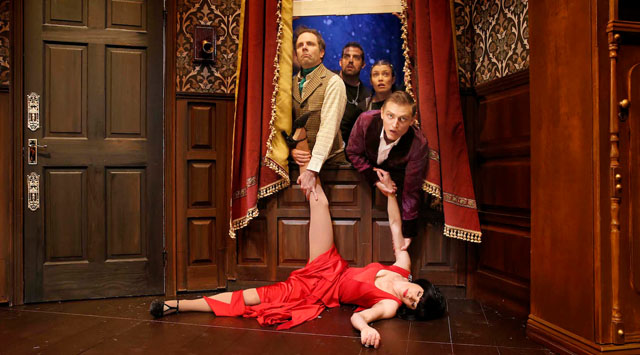
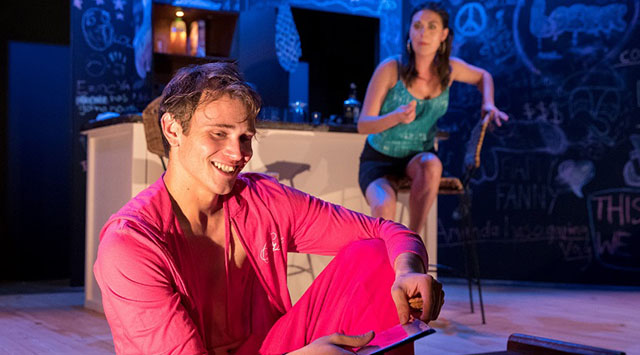
Ladies In Black features a group of “shop girls” at a Sydney department store in the 50’s, each of them consummate professionals, all of whom get on remarkably well. There however, is little else to enjoy about the musical. Thoroughly lacklustre, unable to deliver the exuberance and glamour it wishes for its characters to portray. Its humour is underwhelming, with narratives that fail to resonate, and even though Tim Finn’s songwriting could be admired for its slightly unconventional take on the musical theatre format, much of it is uninspiring and forgettable.

For a show that makes fashion one of its central interests, the production is designed with little imagination or innovation. Choreography never offers anything more than the bog-standard, and the cast rarely looks to be challenged or excited by what they have to present. Occasional appearances by Natalie Gamsu, Greg Stone and Bobby Fox as “continental migrants” introduce moments of exhilaration, but they are few and far between.

Young Lisa confronts parochial Australia in Ladies In Black. She is at a crossroads, encountering choices that stoke her passions, versus others that feel easy and normal. We observe a blandness that can take hold, and ways of living that can pale our existences into insignificance. The women go to work everyday, and in their camaraderie, attempt to find deeper meanings to their existences, but the struggle to prevent their black clothed power from fading into a repugnant beige is ever-present, and often defeated.

wwww.queenslandtheatre.com.au

Review: Babes In The Woods – Australian Purity Defil’d (Don’t Look Away Theatre Company)

dontlookawayVenue: Old Fitzroy Theatre (Woolloomooloo NSW), Dec 13, 2016 – Jan 21, 2017
Playwright: Phil Rouse
Music: Phillipe Klaus
Director: Phil Rouse
Cast: Annie Byron, Gabriel Fancourt, Sean Hawkins, Alex Malone, Eliza Reilly, Ildiko Susany
Image by Ross Waldron

Theatre review
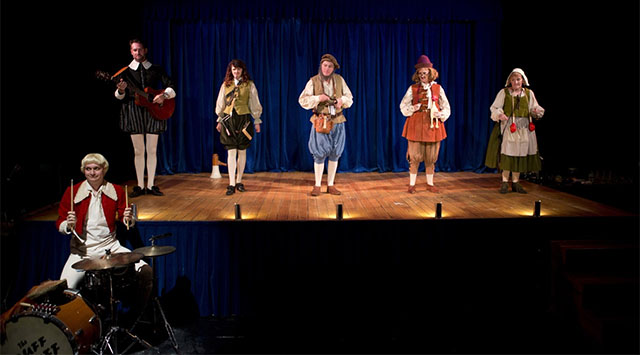
It is Christmas time, and in Australia, we go absolutely bonkers. Phil Rouse’s pantomime take on Babes In The Woods is a wild, wacky jaunt that marks the end of 2016, celebratory in tone but fiercely castigating of our ever-frustrating sociopolitical climate. If the show is a summation of the way we were, these 12 months are, once again, nothing to be proud of.

Rouse’s production however, is a triumph. Exuberant, inventive, poignant, and very funny, his creation is both frivolous and meaningful, targeting issues that concern us all, but always in the right shade of humour, no matter how dark the subject. The big and brash style of presentation allows the worst of our behaviour to be put on display, all in the name of comedy, but its need to keep things frothy can seem to diminish the severity and gravity of what is being discussed. Nevertheless, it is an admirable effort that does not forget the downtrodden, as we indulge in the unrestrained merriment and mirth characteristic of our silly season.

Phillipe Klaus’ spirited work as composer and musical director keeps the show structured and cohesive. Not all performers are impressive with their singing, but Eliza Reilly is delightfully memorable as the powerfully voiced Angel of White Privilege, allowing white children Australia-wide to act recklessly, and delivering more than a few laughs to her captive audience. Sean Hawkins is hilarious and shameless as Jack the himbo lumberjack, flexing muscles, both comedic and anatomic, to get us going. It is a remarkable cast, infectiously enthusiastic and impressive with their uninhibited creativity and imagination.

The final musical number in Babes In The Woods lampoons the lip service we often pay to the less fortunate. It makes fun of the $50 we might give to charity each month for absolution from the first-world evils that we commit. Theatre is a powerful medium, but it can also be ineffectual. Our art should always aim to do more, but if catharsis is the best we can manage on the night, there needs to be an accompanying sense of enlightenment that would take us to brighter days. A happy new year is incumbent upon how much we are able to learn from yesterday, so that tomorrow can be made better.

www.facebook.com/dontlookawaytc

Review: Route Dash Niner (Re:group Performance Collective)

merrigongVenue: Giant Dwarf (Redfern NSW), Dec 13, 2016
Written and performed by: Jackson Davis, James Harding, Mark Rogers, Steve Wilson-Alexander, Carly Young

Theatre review
We meet a group of Australian astronauts as they prepare to travel light years into deep space. It is a formal set up, something like a press conference perhaps, where we are furnished with information on this monumental undertaking. Route Dash Niner is a very droll, very stoic work of comedy. There are certainly moments where the audience laughs out loud, but the show seems more interested in simply keeping us amused, with a sense of humour that is about a captivating subtlety, rather than relying on a standard formula of delivering one punchline after another.

The performers are incredibly serious within their deadpan approach, and coupled with the gravity of the context being manufactured, we find ourselves in a curious situation where nothing is believable, yet everything feels real. Our reaction to the details of their absurd journey oscillates between laughter and logic. We participate as audience at a comedy show for half the time, and serious journalists participating in a sombre occasion the other half. It is an unusual theatrical experience, unnerving at times but ultimately, and surprisingly, compelling.

The quiet confidence of Route Dash Niner‘s unusual humour wins us over. Its science fiction may not feature remarkable intellect, but the creators’ refusal to underestimate their audience’s level of receptiveness, as many comics are want to do, gives the show a certain sophistication. The astronauts are expected to return in six months. What happens at the next symposium is anybody’s guess, but smart money is on something funny and more than a little odd.

www.regroupperformancecollective.orgwww.routedashniner.com

Review: The Taming Of The Shrew (Montague Basement)

montaguebasementVenue: PACT Centre for Emerging Artists (Erskineville NSW), Nov 29 – Dec 10, 2016
Playwright: William Shakespeare
Director: Caitlin West
Cast: Travis Ash, Tel Benjamin, Robert Boddington, Sam Brewer, Hannah Cox, Jane Watt
Image by Zaina Ahmed

Theatre review
Shakespeare’s The Taming Of The Shrew is about society’s need to subjugate women. The play takes issue with Katherine, characterising her as headstrong and troublesome, a young woman to be brought under control. The plot is kept basically the same under Caitlin West’s direction, but comedy is turned into tragedy in her version of events.

The production is a heavily edited, compressed revision of the, now objectionable tale. A more detailed approach to Katherine’s and her beau, Petruchio’s perspective backgrounds would allow us to feel more involved in the story, but the main concern here is the argument between West and Shakespeare, between where we are today and how we had been yesterday. The ideas are simple but powerful, and although the methodology would benefit from finding more nuance in its expressions, the resultant show is nonetheless, an exciting one.

There is good conviction from the actors who take the stage. The rapidity of their performance keeps things enjoyable, but by the same token, we are prevented from getting to know any of the characters very well. Robert Boddington and Hannah Cox are combustive as the lead couple, both passionate for the work, and able to achieve a valuable volatile connection that gives the show its dangerous, astringent quality.

We can leave the past behind, but have to acknowledge its influence on how we think and behave. In order to move forward, we must look back and address history. This cyclical concept of time requires that the scars we carry are being attended to, in order that progress may be found. Much of Shakespeare’s legacy involves the ugliness of humanity. Each generation of theatre makers that comes along will have amongst them, those who fall for the Bard’s words, and who must bear the burden of his failures.

www.montaguebasement.com

Review: Hiding Jekyll (Mon Sans Productions)

monsansVenue: King Street Theatre (Newtown NSW), Dec 6 – 10, 2016
Playwright: Liviu Monsted
Director: Liviu Monsted
Cast: Wills Burke, Nic D’Arrigo, Jordan Gallegos, Nathanael Hole, Dale Johnson-Green, Liviu Monsted, Jordan Rafter, Vitas Varnas

Theatre review
It is the Jekyll & Hyde story turned pantomime. The protagonist’s infamous condition is clearly fertile ground for comedy, so there is no surprise that Liviu Monsted (writer, director and lead actor) has identified it appropriate for lampooning. The sense of humour in Hiding Jekyll is very specific, and not to everyone’s tastes, but the production is certainly full of passion in its bid for a style of presentation, that had gone out of fashion when Mel Brooks ended his directorial career more than 20 years ago.

The jokes are cheesy, and the gags hammy, but the cast looks to be enjoying their experience. One person’s meat is another person’s poison, and it is probably true that there is no one thing that is universally funny. The cast is energetic and committed, but chemistry is lacking and timing poorly measured, with strange pauses between lines that prevent the show from ever gaining momentum. Performer Dale Johnson-Green however, leaves a good impression in the role of Enfield, with one of the more naturally animated, yet sensitive, approaches in the show.

The Jekyll & Hyde conceit will forever be relevant, and is therefore always primed for a retelling. The uncontrollable evil that resides within, is deeply familiar but also a mysterious and neglected stranger. We may not all share a common funny bone, but what is irrevocably true is our understanding that human nature comprises both good and bad, and it is important that we know when the bad guy takes over.

www.monsansproductions.com

Review: Girl Asleep (Belvoir St Theatre)

belvoirstVenue: Belvoir St Theatre (Surry Hills NSW), Dec 2 – 24, 2016
Playwright: Matthew Whittet
Director: Rosemary Myers
Cast: Ruby Burke, Sheridan Harbridge, Amber McMahon, Martha Morgan, Ellen Steele, Matthew Whittet, Dylan Young
Images by Lisa Tomasetti

Theatre review
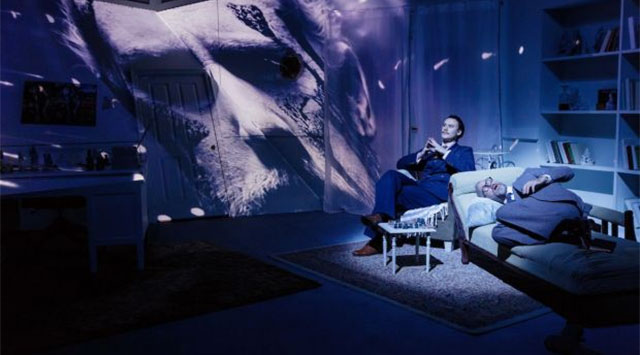
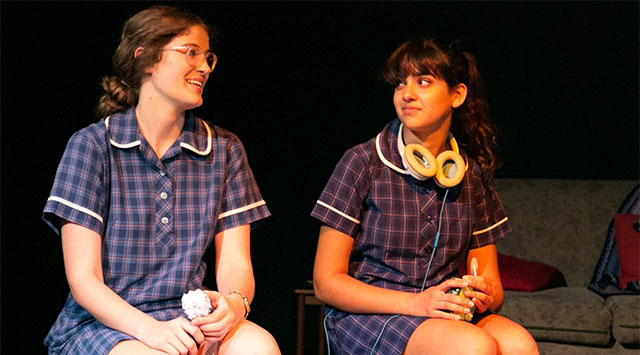
Alice and Dorothy are young ladies who travel famously into their subconscious, for memorable stories that have shaped generations. In Matthew Whittet’s Girl Asleep, Greta joins the list, for an exploration into teenage anxiety as it relates to all things social, familial and sexual. Like her predecessors, we meet Greta when she is in a moment of confusion, but our new heroine seems stronger, more independent and wilful, as we watch her battle the demons to emerge with newfound wisdom.

The play is often funny, but its explorations do not go deep enough for us to derive much more than what is presented on the surface. As the show becomes more surreal, we expect harder truths to reveal themselves, but what we get instead are elaborate effects (courtesy of a very impressive team of designers) that fascinate our senses without much intellectual engagement. Music by Luke Smiles and Harry Covill, along with Richard Vabre’s lights and Jonathan Oxlade’s set and costumes, are truly commendable, for the many dimensions they add to what is essentially a static stage.

Ellen Steele brings an admirable dignity to Greta, choosing to portray the girl with grit and pluckiness, without a hint of twee. Her relationships are established with authenticity, most notably her friendship with Elliot, played by the very charming Dylan Young, who brings a valuable quality of joyful innocence to the production. The actor’s irresistible comedy is certainly one of the strongest assets of a show memorable for its sense of humour.

Greta is not quite ready to grow up, but there are forces determined to hurry her into womanhood. Nature has a way of taking us places against our will. Just as we learn to be content with how things are, disruptions inevitably come upon us, and we have to fasten those seat belts again for yet another bumpy ride. Childhood may be a wonderful time, but the promise of better days is always palpable, and in our every breath, we anticipate new gifts from the great unknown.

www.belvoir.com.au

Review: Lighten Up (Griffin Theatre Company)

griffinVenue: SBW Stables Theatre (Kings Cross NSW), Dec 2 – 17, 2016
Playwrights: Nicholas Brown, Sam McCool
Director: Shane Anthony
Cast: Katie Beckett, Nicholas Brown, Vivienne Garrett, Julie Goss, Sam McCool, Bishanyia Vincent
Image by AH Imagery

Theatre review
John thinks that he is white, but people keep telling him that he looks Indian. In his efforts to make his appearance fit his sense of self-identity, he scrubs his skin with pumice stone, and owns a collection of contact lenses in green and blue. To make things even more problematic, John is an actor, whose looks are his meal ticket, but also a constant source of judgement and frustration to be endured virtually every day. Nicholas Brown and Sam McCool’s Lighten Up is about racism, that complex and fraught topic of discussion Australians love to fight over. We never seem to be able to agree on what it means to be racist, and every individual’s unwillingness to own up to their prejudices means that we are rarely able to get to the truths of the matter. Often, the best we can do is agree to disagree, which unfortunately fixes none of our problems.

Brown and McCool’s play however, is brutally honest in its social commentary. There are no surprises in its depiction of our culture of colonialism, but what it says about ethnic minorities helping to perpetuate our own subjugation is fascinating. The issues it raises are clearly concerning, but the show is a funny one, often uproariously so. The playwrights’ acerbic wit gives Lighten Up an edginess that is as startling as it is entertaining, and even though several of its plot devices are slightly dubious, the show’s power is undeniable. Its politics may not be everybody’s cup of tea, but its refreshing approach makes for exciting theatre that will amuse any audience type.

As director and dramaturg, Shane Anthony brings excellent illumination to the play’s important nuances. His show is bright and bubbly, but always determined to make its point. In its tenacious effort to drive home its message, the staging can sometimes feel less than elegant, with awkward transitions in terms of mood and character dynamics, but its overall effect is very rewarding indeed.

The cast is wonderfully accomplished, and tremendously likeable, with writer Brown taking on the lead role and inhabiting perfectly the essence of John and his story, proving himself to be a precise and dynamic performer who communicates with surprising depth and impressive charm. Similarly compelling is supporting player Julie Goss, memorable for an alluring exuberance that fluctuates playfully, and provocatively, between sincerity and sarcasm. Bishanyia Vincent is an outrageous presence whose every entrance is greeted with sparkling laughter. Her ability to find comedy in every line is a major contribution to the show’s deceptive but pertinent congeniality.

The worst people in Lighten Up are the ones who hate themselves the most. We often explain racism to be a hatred of others, but in the play, it is clear that that compulsion arises first for the self. When we are unable to accept perceived flaws or weaknesses in ourselves, we often turn that disdain outwards, scapegoating convenient targets to manufacture a kind of psychological and emotional balance. When the world tells us that we are not enough, it is easy to use that same barometer to chastise others. Compassion is our hope to better communities, but it needs to begin with a greater internal kindness. Love can only be true, if the one who gives it knows it well.

www.griffintheatre.com.au

Review: Relatively Speaking (Ensemble Theatre)

ensembleVenue: Ensemble Theatre (Kirribilli NSW), Nov 18, 2016 – Jan 14, 2017
Playwright: Alan Auckbourn
Director: Mark Kilmurry
Cast: Jonny Hawkins, Tracy Mann, Emma Palmer, David Whitney
Image by Clare Hawley

Theatre review
It is a very serious case of mistaken identities in Alan Ayckbourn’s Relatively Speaking, and the hilarity that ensues is rarely surpassed. It is about Ginny leaving one lover for another, but the story is hardly important in how the play is remembered. There is no throwaway line of dialogue, with each word calibrated to a staggering precision in order that we may experience the greatest amplitude of comedy possible. The 50-year-old work may not bear any trendy trimmings or indeed, political relevance to how we now live, but its theatrical structure and language specificity still remains outstanding in our age of perpetual mobile amusement.

The four riotous roles are performed flawlessly by a cast that can only be described as magnificent. Cohesive in tone and style, but each one idiosyncratic and independently captivating, their creations are all unforgettable, but it is the chemistry they manufacture for this ensemble piece that really delivers the goods. Ginny is played by the vivacious Emma Palmer, exuberant and dignified in her interpretation of a young woman in the swinging sixties. Jonny Hawkins is her adorable beau Greg, unbelievably animated and entirely compelling. David Whitney is the other man, spectacularly charming, knowing and droll as Philip, while his wife Sheila is brought to life by the truly extraordinary Tracy Mann with understated flair and impressive confidence.

It may all seem deeply familiar, but director Mark Kilmurry’s realisation of Relatively Speaking feels as though we had never actually seen a show of this genre executed with quite as much panache. His thorough engagement with the material and its particular form, ensures that the laughs are ceaseless for all of its two hours, and that we never tire of whatever he chooses to present. Life is never this much fun, but at the theatre, we sparkle eternal.

www.ensemble.com.au

Review: iDNA (PACT Centre for Emerging Artists)

pactVenue: PACT Centre for Emerging Artists (Erskineville NSW), Nov 16 – 26, 2016
Created & performed by: Bonnie Cowan, Emily Dash, Alison Eaton, Alex Ford, Cheryn Frost, Jorjia Gillis, Cath McNamara, Keila Terencio, Anna Thomsen, Sam Wang, Natalie Wilson
Directors: Fred Copperwaite, Katrina Douglas

Theatre review
Whether cyclical, linear or however else we wish to conceive of time, being human will always require that we look at the past in order to achieve an understanding of the phenomenon that ensnares us today. The investigation into who we are, will always be deemed necessary. Being human is a constant process of philosophical reflection, and art is one of its best manifestations.

iDNA is a series of meditations on identity, as inspired by the very contemporary interest in DNA. The science of DNA promises to reveal things about us that we yearn to know. It might be thought of as a kind of religious text that we access, a form of knowledge that seems to exist outside of our bodies, that informs on our very corporeality. Science and religion is how we talk about ourselves, by reaching out, if only for a moment, to discover what it is that feels like truth.

There are eleven performers in the piece, each with a distinct personality, each given space to articulate something personal about identity. The resultant work struggles to find cohesion, but its fractured nature communicates an important notion of diversity, that although our instincts wish for us to see the self in everybody else, we must come to an acceptance that each creature who walks the planet is an individual, and our survival depends upon an understanding, that much as we wish, difference will never be obliterated from our essence. We have to live together somehow, flora and fauna, water and earth. The science shows us unequivocally, that we exist means that we are all connected, but how we prevent destruction inside and outside of our species, is the key to a good life, natural as that annihilation may seem.

www.pact.net.au

Review: The Screwtape Letters (Clock & Spiel Productions)

clockspielVenue: Seymour Centre (Chippendale NSW), Nov 22 – Dec 10, 2016
Playwright: C.S. Lewis (adapted by Hailey McQueen)
Director: Hailey McQueen
Cast: Yannick Lawry, George Zhao
Image by John Leung

Theatre review
Based on the novel by C.S. Lewis, The Screwtape Letters follows the correspondences of senior demon, Screwtape, as he mentors his nephew Wormwood, who is learning the ropes of the devil’s business from his evil uncle. There is a “patient” in question, a case study if you will, and the heat is on, to lead him to temptation, and away from God. Contrary to popular belief that immorality is easy, the troublemakers have a difficult time, and we are challenged by notions of good and evil as they relate to our impulses and tendencies.

Having been adapted directly from Lewis’ writing, the play demonstrates that the efficacy of words is reliant on the context within which they are presented. At the theatre, we are not able to glance back at previous sentences, or look away to let meanings merge with imagination at a pace of the reader’s choosing. Words that had been designed for one purpose, might not necessarily translate conveniently for another, and in The Screwtape Letters, the challenge of adapting a novel for the stage, is bravely taken on by Hailey McQueen who also doubles as director. Although unable to repurpose the text entirely satisfactorily, McQueen delivers a charming show that holds appeal for those of us with a wicked streak .

It is a beautifully designed production, with Isabella Andronos’ set and costumes providing appropriate sharpness of style to Screwtape’s world of decadent luxury. Chris Page’s elegant lighting helps us move through scene transitions effectively, and his careful calibration of mood changes keeps us visually fascinated. Music and sound design by Adam Jones is very impressive. Much of how the audience responds and what it feels for The Screwtape Letters is controlled by Jones, who significantly elevates this theatrical experience with admirable precision and creativity. Actors Yannick Lawry and George Zhao are a well-rehearsed duo that puts on a presentation with professional polish. Zhao’s comic physical inventiveness is especially memorable. The two men are warm, likeable personalities, but we wish to see something much darker and menacing. We want the fiction to take us to a place unthinkably taboo, somewhere so close to hell that we can only react with the extremities of either being frightened away or helplessly seduced in, but Screwtape seems too much of a gentleman to afford us that pleasure.

www.clockandspielproductions.com