Review: The Long Forgotten Dream (Sydney Theatre Company)

Venue: Sydney Opera House (Sydney NSW), Jul 23 – Aug 25, 2018
Playwright: H Lawrence Sumner
Director: Neil Armfield
Cast: Jada Alberts, Wayne Blair, Nicholas Brown, Brodi Cubillo, Melissa Jaffer, Ningali Lawford-Wolf, Wesley Patten, Justin Smith, Ian Wilkes
Images by Heidrun Löhr

Theatre review
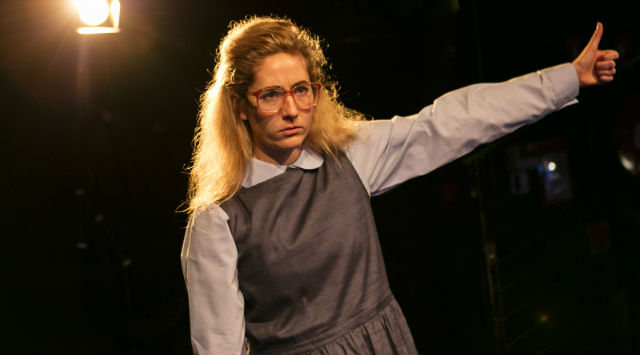
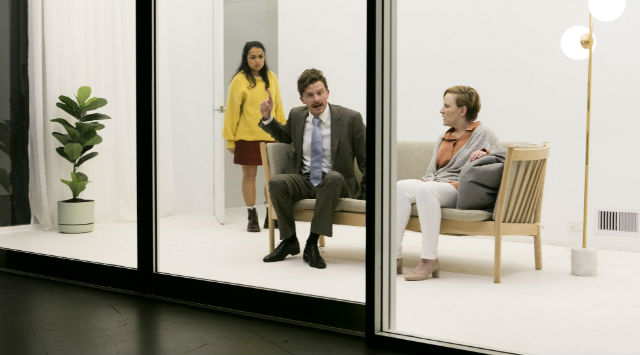
King Tulla’s remains are being flown back to Australia, after having been detained in England for three generations. His grandson Jeremiah is required to preside over the welcome home ceremony, but the prospect of having to deal with buried trauma and lost family histories, sees him unravelling, as he comes to grips with all that his emotions have struggled to face. There are few stories as profound and important for us today, as H Lawrence Sumner’s The Long Forgotten Dream. It explores the crippling effect of colonialism, on our Indigenous peoples, as well as the paradoxical urgency of their need to recover, to foster a brighter future. Sumner is marvellously revelatory of the Aboriginal experience, splendid in his clarity of language and of thought, for a piece of writing extraordinary for the power it dispenses, and for the wisdom that it contains.

Director Neil Armfield brings palpable life to this tale of lost souls and transposed dimensions. We are moved by the production’s remarkable tenderness, evident in every delicate aspect that it presents on stage. Live music by William Barton is ethereal but incredibly precise, with a spiritual quality that has us responding in accordance with each of its enigmatic inclinations. Jacob Nash’s set design keeps us enthralled, speaking to us as though on a visceral or perhaps instinctive level, in varieties of shapes and proportions, carrying us from space to space. Mark Howett’s sensual lighting style is relied upon to add warmth to the family drama, and gravity to our national concerns. Technical elements of The Long Forgotten Dream are inventive in their conception, and sumptuously executed.

It is an exquisite cast that takes the stage, with leading man Wayne Blair delivering phenomenal intensity and poignancy, to anchor the show in an unyielding point of pertinence. He couples vulnerability with dignity, ensuring that we are moved by Jeremiah’s circumstances and more vitally, by all the wider injustices implied in the depiction of his suffering. It must also be noted that Blair’s whimsical approach to humour is deeply endearing, and a crucial factor in allowing us to identify with a personality that can seem a world away from most of our daily realities. Also very charming is Ningali Lawford-Wolf, who plays Jeremiah’s sister Lizzie, a sassy, bold presence dependable for introducing a vibrant luminosity with every entrance. Jada Alberts is suitably subtle and thoroughly convincing as Jeremiah’s daughter Simone, and Melissa Jaffer is captivating in a somewhat surprising way, when she conveys so effortlessly, the romantic secrets of a 102-year-old woman.

The refusal to listen, may be our biggest pitfall. We can make repetitive and incessant claims of good intentions, but our inability to actually prioritise the needs and demands of Indigenous communities, will only serve to sustain these unacceptable state of affairs. When we think about Aboriginal and Torres Strait Islander ancestral remains and sacred objects being controlled by colonising forces and their institutions, it becomes obvious the degree to which Australia denies the sovereignty of its First Nations. The inequity and, in some cases, inhumanity, they have had to tolerate, can only begin to find atonement when we are able to place their welfare at the very forefront of the national agenda, on equal footing with, if not ahead of, our selfish and exclusionary obsessions.

www.sydneytheatre.com.au

Review: Cry-Baby (Hayes Theatre)

Venue: Hayes Theatre Co (Potts Point NSW), Jul 20 – Aug 19, 2018
Book: Thomas Meehan, Mark O’Donnell (based on the John Waters film)
Songs: David Javerbaum, Adam Schlesinger
Director: Alexander Berlage
Cast: Brooke Almond, Hayden Baum, Christian Charisiou, Beth Daly, Blake Erickson, Bronte Florian, Alfie Gledhill, Aaron Gobby, Joel Granger, Manon Gunderson-Briggs, Amy Hack, Laura Murphy, Ashleigh Rubenach, Ksenia Zofi
Images by Robert Catto

Theatre review
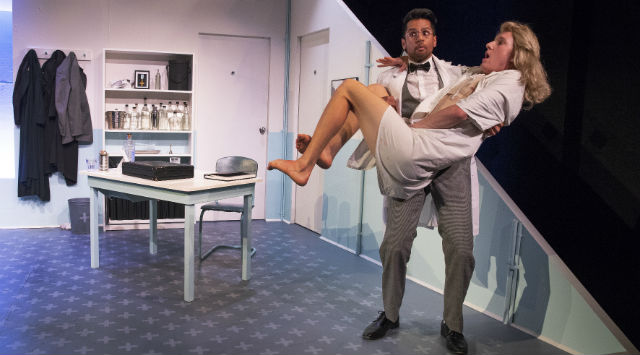
It is 1950s Baltimore, in Maryland, USA, and the township is split into the straitlaced “squares” and their arch nemesis, the delinquent “drapes”. Cry-Baby is an Elvis-type drape singer who has won the heart of Allison, queen of the squares, for a tale of forbidden love and culture clashes, in the tradition of Romeo And Juliet, West Side Story, and Grease. Originally a 1990 film by the King of Bad Taste, John Waters, this 2007 musical is a spruced up, dumbed down version as though the squares have co-opted Cry-Baby, for a retell of the story in their own style and aesthetic. This is, essentially, John Waters for the mainstream.

An exceedingly sharp and polished production, designed by Isabel Hudson (set) and Mason Browne (costumes), Baltimore is on this occasion, turned into a dazzling candy-cane Disney theme park, where even the poor looks camera-ready for the pages of Vogue. Director Alexander Berlage proves himself adept at manufacturing atmosphere and energy for the stage, but is unable to find for the piece, any emotional or intellectual depth that will allow for a more substantial experience, beyond an appreciation of all its very enthusiastic display of light and froth.

Christian Charisiou and Ashleigh Rubenach lead the cast, both Ken-and-Barbie-perfect in all that they bring, complete with the exhilarating singing of very high notes, that we have come to expect of the genre. Most memorable is Laura Murphy, incredibly delightful as Lenora, the only subversive element of the show, gleefully representing the cult of Waters in exquisite form. Other standouts include Amy Hack who embodies an assertive libidinal power that reminds us of the show’s queer origins, and Blake Erickson who amps up the camp factor in all his multi-gendered parts, to our immense satisfaction.

When overzealous french kissing is the dirtiest thing in a show, we know that it has deviated far, far away from the John Waters milieu. It is true that we can be polite when making art, that there is no need for the crude and obscene to surface in everything we put on stage, but Waters’ devotees will encounter an air of sacrilege at the Cry-Baby musical that is perhaps unbearable.

For others however, it is a wonderful reprieve from the daily humdrum, of colour, movement and a fantastic pop sensibility, that champions the optimism and vitality of youth at its best. The younger we are, the easier it is to demolish attitudes of prejudice and hate. There is no question that the differences between tribes, drapes and squares and so forth, can be reconciled, when we realise that the amount we have in common are infinitely greater, than the things we dream up to keep us apart.

www.hayestheatre.com.au | www.laurenpetersdesign.com

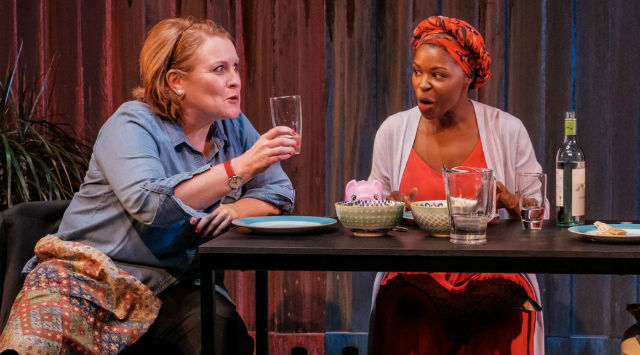
Review: A Taste Of Honey (Belvoir St Theatre)

Venue: Belvoir St Theatre (Surry Hills NSW), Jul 21 – Aug 19, 2018
Playwright: Shelagh Delaney
Director: Eamon Flack
Cast: Taylor Ferguson, Thuso Lekwape, Genevieve Lemon, Josh McConville, Tom Anson Mesker
Images by Brett Boardman

Theatre review
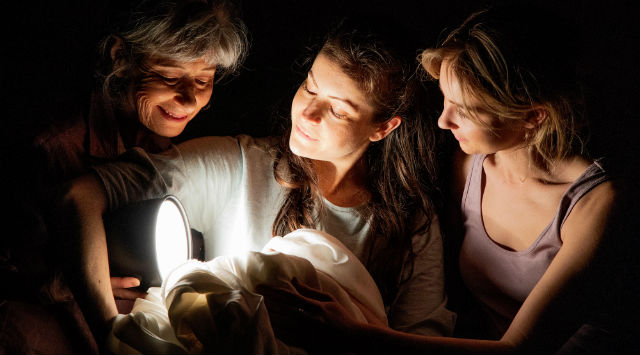
Jo is at the end of her teenage years, but there seems little she can look forward to in adulthood. Jo wishes to be independent of her mother, but Helen has taught her few skills, having spent her life dependent on lovers that never stayed the long haul. British playwright Shelagh Delaney wrote her first piece A Taste Of Honey at the age of 19, expressing youthful angst as it had meant in 1958. Her frustrations with the world, as encapsulated here, is likely a universal quality that recurs with each generation, but it is doubtful that the play’s temporal concerns have been able to retain much resonance.

Delaney’s depiction of negligent parenting in A Taste Of Honey is reliant on the denigration of the maternal character, with a criticism of her promiscuity in Act One that is no longer dramatically efficacious in 2018. In the absence of a persuasive villain, our empathy for the protagonist is compromised. The action happens almost entirely in a small apartment, with only a hint of the outside world evident in Jo’s troubles. The impact on young lives by social dynamics of the time are alluded to, but insufficiently examined. Our contemporary sensibilities look for commensurate details, but the work struggles to deliver more than cursory relevance.

Leading lady Taylor Ferguson is an endearing and compelling presence, with a wonderfully meticulous approach, ensuring that Jo is convincing at every juncture. Genevieve Lemon is a very entertaining Helen, delightfully vivacious in her portrayal of an intriguing personality. The surrounding men (Thuso Lekwape, Josh McConville, Tom Anson Mesker) are individually charming, with each performer able to introduce a greater sense of dimension to their roles than what is perhaps prescribed. The cast does a good job of sustaining our attention, and we stay with them until the end, but it is arguable if the production is able to convey much that is of lasting interest.

Young women today have so much to live for. Certainly, there are disparities between the sexes that are yet to be resolved, but the freedoms we enjoy in the West are hard fought for, and unprecedented. Girls no longer have to grow up into their mothers. Great examples of womanhood are everywhere, and it is no longer unimaginable to choose a courageous path. Jo’s pessimistic circumstances may not be entirely a thing of the past, but the opportunities for abandoning them today, are infinitely greater.

www.belvoir.com.au

Review: Håmlet – A New Australian Play (Bondi Feast)

Venue: Bondi Pavilion Theatre (Bondi NSW), Jul 24 – 25, 2018
Playwright: Antoinette Barboutis
Director: Victor Kalka
Cast: Antoinette Barboutis, Matt Castley, Philip D’Ambrosio, Amanda Maple-Brown, Linda Nicholls-Gidley, Gemma Scoble, Alexandra Stamell, Alana Stewart

Theatre review
Shakespeare can be considered the foundation of how we do theatre in the West, and is hence the master we study and seek to emulate. He, of course, is not the only male of our species who has shaped and dominated an art form, that had for many centuries disallowed participation by women. Even today, there remains only one female working as Artistic Director at a Sydney main stage theatre company.

Antoinette Barboutis’ Håmlet – A New Australian Play is a radical exercise of deconstruction, of Shakespeare and therefore of the very notion of how we do theatre, under deeply entrenched patriarchal structures. In tandem are personal expressions about the aftermath of sexual assaults. Ophelia is killed off by Shakespeare, but Barboutis endeavours to work her way out of the wilderness. Both projects, to dismantle theatre and to recover from rape, are fraught and highly complicated, resulting in a show that feels unequivocally avant garde.

The play is concerned with identifying and rejecting existing mechanisms, in hope of locating something progressive. The artist succeeds gloriously in tearing apart what might be considered “the establishment”, but it is uncertain what is installed in its place. It is likely that the newness of what is achieved, escapes labelling, but it is undeniable, that what we find accompanying the strangeness of the experience, is an alarming quotient of pain and sorrow.

It is a work of comedy, extremely caustic in tone, and subversive to the core. Director Victor Kalka brings to fruition Barboutis’ ideas, whilst crucially retaining a pervasive rawness that beautifully represents the spirit of Håmlet. The show is at its best when it is at its least polished; unnerving and confusing, it disturbs us in the moment, and leaves us frazzled after, quite possibly in a masochistically satisfying way. Not all will be able to piece together every bizarre fragment, but its control over our visceral responses is clearly very powerful.

Barboutis is a formidable presence, edgy, with a quiet aggression that translates irresistibly on stage. Her wanton disregard of the fourth wall requires that her audience is self-aware, and therefore reflective, of how we are implicated in its ideas. She is determined to not let any of us sit back and get away with creating distance between her world and ours. Linda Nicholls-Gidley and Amanda Maple-Brown are more conventional in performance style, both delivering memorable scenes in their embrace of a wild vision. Four other players, all in black and interjecting at opportune occasions, function as a modern chorus of sorts, bringing energy to the stage when the air of depression becomes unbearable.

Håmlet – A New Australian Play is extraordinary, in what it wants to say, and how it wants to say it. Its artistic integrity is unparalleled, and the way it sticks to its guns, moves us in ways that are unpredictable, and confounding. Some are likely to find it a difficult work to enjoy, or chastise it for being insufficiently entertaining, but the uniqueness of its approach, and the staunchness of its convictions, feel singularly rare and profoundly valuable. We need to react against a way of life that seems determined to keep us parochial, narrow-minded and fearful. Art of this calibre is the inspiration that can help set us free.

www.bondifeast.com.au

5 Questions with Mick Bani and Kire Tosevski

Mick Bani

Kire Tosevski: List three words that best describe King Of Pigs.
Mick Bani: Intense. Thrilling. Unpredictable.

The abuse of women at the hands of men is an important theme throughout the play. What do you think audiences are most likely to walk away with after experiencing the show?
I think they’ll walk away with a better understanding on how much pressure society place upon us men. With the play focusing on surface issues, hopefully this will give the audience an opportunity to reflect and talk about the causal issues instead.

How do you connect with the character that you’re playing?
When I auditioned I said to Steve and Blazey, “this character reminds me of my former self.” Ex footy player, career cut short through injury, worked at dead end jobs, and fell into depression. But the important thing now is I connect to the character knowing full well that there is hope (for everyone) at the end of the tunnel.

What do you feel you’ve learned about yourself from being involved in this production?
I’ve learned so much of myself than as an actor since rehearsals began. The cast & crew are amazing. The stage has and will give me a platform to not only showcase my talent but to express (in a controlled environment) what most men do behind closed doors.

If you had the opportunity to play another character featured in the play, who would it be and why?
I would actually play Man 1 because he’s amongst all the drama. To me, Man 1 plays a vital part in each of the character’s lives. With his professionalism he sees each person eye to eye, and supports each of them throughout their ordeal.

Kire Tosevski

Mick Bani: List three words that best describe your character.
Kire Tosevski: Sensitive; weary; thorough.

What’s the biggest challenge about taking on this role?
I’ve often been cast to play larger-then-life characters – villains, overtly passionate eccentrics – and this man is a departure from that. He’s much more contained. He also spends a lot of time being a silent observer to the often intense interactions between other characters. Building and maintaining a complex inner-life that can be easily read by the audience, especially during such moments, can be quite challenging.

What’s going to surprise people about this show?
How quickly events can turn; how slippery the proverbial gates that lead relationships towards crisis are. That, and how the rearing of boys cannot be overlooked in dealing with issues of male-on-female violence.

Due to the theme of this production, how have you had to prepare for it?
My character is the one who talks to both the victims and perpetrators of the violence, so simply watching the other scenes play out becomes a simple and direct way to stimulate the imagination. Plus there’s no shortage of literature and media content on the subject. It can all be quite confronting and it naturally leads you to look at yourself as a man. I definitely spent some time thinking back on some past relationships with women.

Based on the contents of the play, what advice would you give to your younger self?
As often as possible, try to make choices based in love, not out of fear.

Mick Bani and Kire Tosevski are appearing in King Of Pigs, by Steve Rodgers.
Dates: 1 Aug – 1 Sep, 2018
Venue: Old Fitz Theatre

Review: Love Song Dedications (Without Richard Mercer) (Ten Tonne Sparrow / PACT)

Venue: PACT Centre for Emerging Artists (Erskineville NSW), Jul 19 – 28, 2018
Playwrights: Tom Hogan, Bonnie Leigh-Dodds
Directors: Tom Hogan, Bonnie Leigh-Dodds
Cast: Tom Hogan, Bonnie Leigh-Dodds

Theatre review
Love Song Dedications was a longstanding radio program featuring classic romantic pop music, alongside real life accounts of love won and love lost. Tom Hogan and Bonnie Leigh-Dodds’ show is a tribute of sorts, using a combination of triple-threat disciplines to create a work of comedy, that is ostensibly about finding the greatest love song of all time. A prominent characteristic of the radio show was its unabashed earnestness, completely devoid of irony and therefore deeply cringe-worthy, and here, Hogan and Leigh-Dodds play with that raw human openness, almost as an antidote for modern art’s obsession with being too clever, to bring focus away from the head and into the heart.

It is an exercise in honesty, of placing the authentic within the inevitable conceits of a theatre piece that must have a beginning, middle and end. Storytelling will always contain verisimilitude, but degrees of fiction seem fundamental to how things work on stage. Hogan and Leigh-Dodds are best friends, and like those on the airwaves speaking via telephones about matters of the heart, they are here to talk about their relationship. We discover how having an audience would affect this process of connection between the two. Turning a friendship into an artistic partnership could be a precarious exercise, but if art is where they communicate best, then perhaps understanding their relationship through a form like this, is their best bet.

Hogan and Leigh-Dodds are intelligent and effervescent, both youthful specimens, full of beans and big ideas. A good command of their bodies, and of space, ensures that we are held attentive for the 70-minute duration. They create a plot trajectory that is surprisingly varied, manufacturing with considerable ingenuity, a multifaceted approach for what seems a very simple point of departure. There are brief moments of energetic dissolution, but we never lose interest in the overarching project of finding that best song.

Creativity, even at its most commercial, evades objective judgement. Beauty is in the eye of the beholder, and for Hogan and Leigh-Dodds the best song from the 104 in their shortlist, is the one that holds the greatest amount of meaning, and of nostalgic value, to their private selves. Their love story informs their selection, but judging from the warmth radiating from the audience, the popular consensus is that their show is very well-liked indeed.

www.tentonnesparrow.com.au

Review: My Carer (Walk Now Productions)

Venue: Hellenic Art Theatre (Marrickville NSW), Jul 19 – 22, 2018
Playwright: Sam Cosentino
Director: Sam Cosentino
Cast: Maria de Marco, Helen Kim, Jacob McLean
Image by Katt Gao

Theatre review
Rebecca endures a lonely and hopeless existence. Having dedicated everything to a career in law, she finds herself at retirement age with nothing but a house and a cleaning lady as companion. Her husband has passed, and their son is estranged, living in a distant city, resentful of his mother’s neglectful behaviour.

Sam Cosentino’s My Carer talks about family discordance, and explores the challenges we face when trying to mend those bridges. The piece is thoughtfully written, mature and insightful with observations that will doubtless strike a chord. As director, Cosentino’s approach is oversimplified, for a production that can feel too basic and pedestrian, but the strength of his text keeps our attention firmly engaged with its characters and themes.

Also captivating is Maria de Marco in the role of Rebecca, offering a powerful depiction of a woman with more than a few regrets, and a prideful obstinacy to accompany them. The nuanced intensity de Marco brings to the stage is sheer theatrical delight. Helen Kim and Jacob McLean are not quite as compelling, but the young performers exhibit a conviction that is nonetheless infectious.

Some apron strings can only be cut with a great deal of ruthlessness. In order that her son may become his own man, Rebecca has to experience a rejection that is as humiliating as it is cruel. What happens in the aftermath proves just as difficult, when a new harmony is sought by both parties, each having to negotiate uncharted terms of their reconciliation. When love is not enough, the choice to take on the hard work that will mend the fissures, is rarely an easy one to make.

www.walknowproductions.com

Review: You Got Older (Mad March Hare Theatre Company)

Venue: Kings Cross Theatre (Kings Cross NSW), Jul 13 – Aug 4, 2018
Playwright: Clare Barron
Director: Claudia Barrie
Cast: Alex Beauman, Harriet Gordon-Anderson, Ainslie McGlynn, Sarah Meacham, Gareth Rickards, Steve Rodgers, Cody Ross
Image by Clare Hawley

Theatre review
Mae has come home, to care for her father as he undergoes cancer treatment. Clare Barron’s You Got Older is a look at that moment, of suddenly becoming keenly aware of one’s parents’ mortality. In every process of healing, of trying to make someone better, is the salient reminder that life is fragile. Mae is strong for her father, but in the privacy of her own thoughts, anxiety and grief manifest in fantasies of sexual masochism. Role playing is after all, how we are able to get through most of our days.

The subject matter may be heavy, but like the resilience of our human spirit, the show is determined to keep buoyant and optimistic. Director Claudia Barrie brings excellent humour to the production. Although not exactly lighthearted, we are surprised by the delight and joy that the play brings, through its very enjoyable and richly authentic explorations of love and family dynamics. There is no angsty drama here, only a father and his beloved children grappling with the pain of inevitable separation.

A very solid cast takes us through this universal tale. Harriet Gordon-Anderson is entirely convincing as Mae, with all her contradictions and vulnerabilities, but the actor is particularly successful at conveying a strength that is neither heroic nor exceptional, but that is nonetheless profound in its representation of the good that we are capable of. The paternal character is played by a confidently understated Steve Rodgers, who introduces just enough pathos to have us engaged, leaving us grateful that no emotional blackmailing takes place in this presentation. Contributing to the somewhat unexpected elegance of You Got Older are its supporting actors, each one charming and funny, and as a group, perfectly timed and wonderfully captivating.

When someone close is suffering ill health, those on the sidelines might be left feeling helpless, but we also understand that fundamental to the patient’s well-being, is the spiritual care and support we are required to provide. In times of hardship, fear can easily overwhelm, but courage often appears, allowing love to do its job.

www.madmarchtheatreco.com

5 Questions with Katie Beckett and Kamahi Djordon King

Katie Beckett

Kamahi Djordon King: How do you feel about playing back on home turf at the Seymour centre with a different actor in the role of Dad?
Katie Beckett: I am so excited to be playing back in Sydney. I love Sydney. The west and the inner west are my hoods. I was born out in Western Sydney, went to primary school there in north St Mary’s. Moved to QLD, then moved back. And as an adult lived around the inner west, Redfern, Newtown, Enmore, Glebe and now Lilyfield. So Sydney holds a special place in my heart. The last time I did the show in Sydney it was part of the Sydney Festival at Belvoir and we smashed it out of the park. Sold out with an extra week. 

I love working with Kamahi as Dad. My dad even loves Kamahi as playing him. Kamahi brought a breath of fresh air to the character, love and comedy to the role. Professional and easy going to work with. It’s been a dream having him.

Has the end result of the work surpassed your expectations on how the work is received by audiences?
Yes!! I’m surprised for me it was just a little family yarn. A way of healing and coping with dad’s fifth heart attack. So I write with heart. And it’s beautiful seeing the audience take it.

Question to the writer. What are three things you would change about your character and why?
Considering it’s my first play and I now have a bit more experience of writing I would change my character to be softer in moments. And make her grow up a bit more. I find her annoying and childish at times. But I also did that to get the comedic elements to work with the dad.

What did you see yourself doing at this age twenty years ago?
I saw myself working in the camera department in film and tv industry. I dreamed of being a cinematographer. But here I am an actor and writer for theatre, film and tv.

What has the impact been on you as an actor with a new person stepping into the dad role? 
The impact has been fantastic and I found things I discovered before in my character. I have a different connection with Kamahi so it’s easier to do.

Kamahi Djordon King

Katie Beckett: Were you worried about coming into a role that has already been played by another actor?
Kamahi Djordon King: I was a little at the start until I figured you and Rachael were not expecting me to be exactly the same as the other actor. 

What made you say yes to taking on this role?
It was going to be my first tour with an Ilbijerri produced play and I though it would be nice to work on a tour again.  Especially a long tour like this.  Plus it was an affirmation that I was getting older and playing someone’s dad is the best thing for that, as an actor challenge-wise I mean. 

I’m impressed with you learning the script in 2 weeks. Can you share your secret to learning and developing your character in a short time?
Yes, the honesty and truth of the character comes from the physicality of the actions.  The memories are created by rehearsing the script up on the floor.  It is almost like muscle memory with dancers.  After a while the lines sink in together with the actions of the character and a memory is created so that when you are doing the play, the memories become your inner monologue and you deliver your lines with their actions creating honesty or truth.  I learned this from The Actors Workshop in Brisbane with Lynn Kidd.

I hear you are close to Constantina Bush. Any chance she will pop up along the tour? Has she said anything about the show?
Yes, we are close although very much in competition with each other all the time.  I think she said she is popping in to do shows in Mildura and Canberra. She reckons she will try to catch the show at one of those places although I wouldn’t count on it.  She has never once seen one of my shows.  Nor I hers for that matter… 

You are a true artist… writer, actor, singer, dancer, painter, female impersonation. And do it all incredibly well. And always in demand. How do you manage to balance all your artistic ventures?
The balance seems to happen naturally, very rarely do I double book, although it has happened. The art is something that keeps me busy when either of us has no work.  The visual art side of things is something that I have been doing for a long time and it does sell which keeps me in money when the performance side is quiet.  I come from a family of artists so that is natural. The performance is something that i have had to learn and perfect though and I only get better with everything that I do and take on such as this play.  It will be great for when I have to play someone’s dad again, haha.

Katie Beckett and Kamahi Djordon King can be seen in Which Way Home , by Katie Beckett.
Dates: 24 Jul – 4 Aug, 2018
Venue: Seymour Centre

Review: Stupid Fucking Bird (New Theatre)

Venue: New Theatre (Newtown NSW), Jul 12 – 28, 2018
Playwright: Aaron Posner
Director: Warwick Doddrell
Cast: Lloyd Allison-Young, Gil Balfas, Brendan Miles, Mansoor Noor, Megan Smart, Annie Stafford, Kaitlyn Thor
Images by Bob Seary

Theatre review
It is a wonderful world that the characters in Stupid Fucking Bird inhabit. Consumed by love and art, their lives might seem frivolous to some, but to those of us tired of the daily grind, their romantic mashup of 21st century Australia and 19th century Russia, suggests an imaginary existence where only the exciting things matter.

Aaron Posner’s rendition of Chekhov’s The Seagull retains the original’s narratives and personalities, but radically transforms the way in which the stories are told. Chekhov enshrined in his play, a wish to establish new theatrical forms, so it is appropriate that artistic liberties are taken. We are also entirely grateful for Posner turning the antiquated piece into something much more entertaining, and relevant to our times.

Director Warwick Doddrell presents a stunning production; gripping from the start, relentlessly amusing, compelling and vivacious, for a very unlikely experience of the venerated classic. Doddrell’s dramaturgical excellence is accompanied by an experimental spirit that permeates all faculties of the show, and we see all its cast and creatives deliver some truly outstanding work on this stage.

Set design by Jeremy Allen offers simple solutions for a highly effective transformation of space. Original songs by Jim Fishwick are replete with wit and charming vibrancy. Ben Pierpoint and Mary Rapp’s sound design is thrilling in its urgency, with an exuberant contemporariness that provides an air of irresistible edginess. Lighting designer Veronique Bennett is similarly striking in approach, creating alluring and refreshing imagery, demonstrating valuable proclivities that are sensitive yet vivid.

Seven actors, individually delightful, prove themselves a formidable ensemble in Stupid Fucking Bird. Mansoor Noor’s memorable athleticism and emotional vigour as Conrad, form a reliable centre for the show’s quality of interminable liveliness. Megan Smart is a splendid Nina, with a bewitching authenticity that accompanies every delicious melodramatic turn. The iconic Emma Arkadina is played by a fierce Kaitlyn Thor, seductive and powerful as the grandiose matriarch.

Lloyd Allison-Young and Annie Stafford are gifted with arresting presences, both captivating performers with a knack for making everything look effortless. Gil Balfas and Brendan Miles offer exquisite balance to the extravagant goings-on, both able to bring confident subtlety, at junctures where nuance is required but unexpected. Stupid Fucking Bird represents a rare theatrical occasion, where brilliance emanates from all its participant components.

Characters in the story suffer unrequited love and artistic jealousy. Their personal sense of inadequacy feels familiar, but also strange, if not completely bizarre, should we choose to evaluate their behaviour closely. The disquiet that overwhelms the privileged can be seen to be counter-intuitive, although it is clear that money does not solve all problems, least of all, our narcissism. When Conrad is told to “try loving something more than yourself,” the key to his salvation is succinctly and perfectly awarded, but predictably, left direly unheeded.

www.newtheatre.org.au