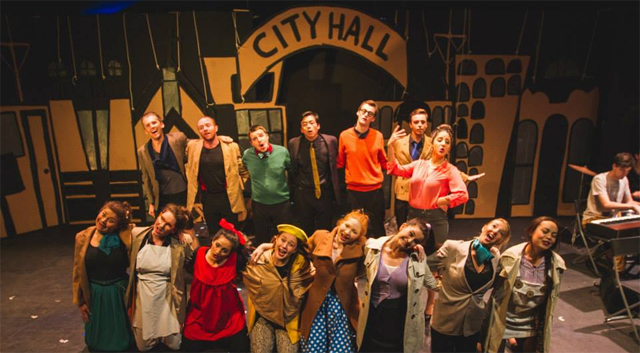
Review: Anyone Can Whistle (Sydney University Musical Theatre Ensemble)

museVenue: King Street Theatre (Newtown NSW), Oct 15 – 25, 2014
Book: Arthurs Laurents
Music & Lyrics: Stephen Sondheim
Director: Olivia Aleksoski, Alexander Andrews
Cast: Dani El-Rassi, Sarah Gaul, Curtis Gooding, Jordan Shea, William Wally Allington
Image by nick&nick Photography

Theatre review
Stephen Sondheim’s 50 year-old musical still works. Its themes of corrupt governments and the gullibility of humankind remain relevant, and the farce constructed around those societal issues make for scenarios that are amusing yet meaningful. Sydney University Musical Theatre Ensemble’s production might be an amateur one, but it features the vibrancy and enthusiasm of its young members that impress despite inadequate training and an overall lack of sophistication. The five-piece band headed by Music Director Douglas Emery delivers scaled down but punchy accompaniment that delights us with a sparkling joyousness, even if accuracy and cohesion can be improved.

Choreography by the ambitious Louise Flynn is loud and exciting, with the cast’s varying levels of dance ability utilised intelligently. Flynn has a keenness for theatricality and a lot of fun, which manifests effectively on a stage that is consistently colourful and dynamic. India Cordony as Police Chief Magruder takes every opportunity to inject comedy into her dance, and the results are outrageously memorable. Aidan Kane’s physical discipline pays off with a polish and professionalism that helps him stand out from the chorus line.

Dani El-Rassi and Jordy Shea are fiercely committed in their roles, and both present moments of brilliance that will further improve with greater confidence. William Allington as Treasurer Cooley is also engaging, with an effortless charm that keeps his performance buoyant. The show’s biggest parts are demanding, and not satisfactorily created on this occasion. Their love story is a substantial piece of the plot but the desperate shortage of chemistry between actors is quite painful to watch.

The work is directed by Olivia Aleksoski and Alexander Andrews who have used their wonderful troop of stars cleverly. Each personality is given room to shine, and although the show’s plot is not always clear or affecting, the energy that bubbles on stage is always refreshing. The miracles that happen in the story might have been fabricated, but it should be remembered that most artists are also faking it… until they make it someday.
www.museatusyd.com

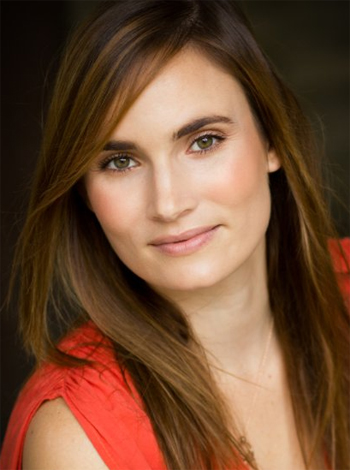
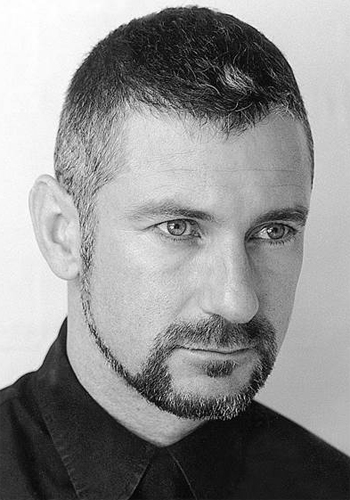
5 Questions with Garry Stewart

garrystewartWhat is your favourite swear word?
Gosh!

What are you wearing?
Billions of bacteria and a few grams of body hair.

What is love?
A complex neurochemical and hormonal process.

What was the last show you saw, and how many stars do you give it?
Hofesh Shechter’s Sun. I don’t believe in a rating system for art.

Is your new show going to be any good?
You be the judge.


Garry Stewart’s new work Choreography, presented as part of NIDA Student Productions.
Show dates: 21 – 28 Oct, 2014
Show venue: Carriageworks

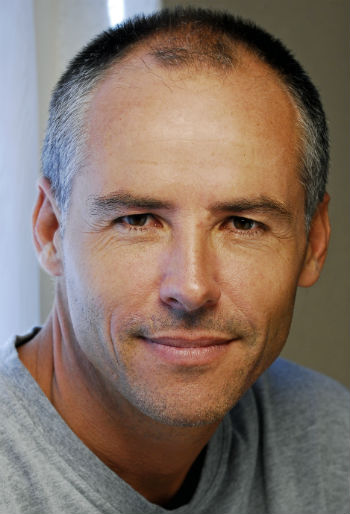
5 Questions with Gerry Sont

gerrysontWhat is your favourite swear word?

Bugger.

What are you wearing?
Blue sweat shirt, jeans and sneakers.

What is love?
My wife! (I have to say that or she’ll kill me…)

What was the last show you saw, and how many stars do you give it?
The Maids at the STC, 4 stars, mainly for Elizabeth Debicki’s outstanding performance.

Is your new show going to be any good?
Does a bear shit in the woods? (Yes)

Gerry Sont is appearing in Leaves by Théâtre Excentrique and Emu Productions.
Show dates: 18 -29 Nov, 2014
Show venue: King Street Theatre

In Rehearsal: 1790: A Tale Not Often Told

Rehearsal images above from 1790: A Tale Not Often Told by Founding Modern Australia.
At Darling Quarter Theatre, from Nov 13 – 15, 2014.
More info at www.foundingmodernaustralia.com.au

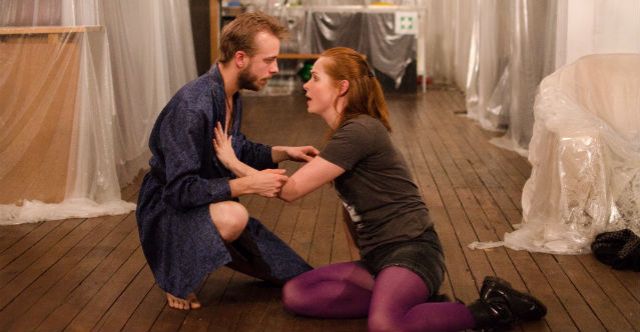
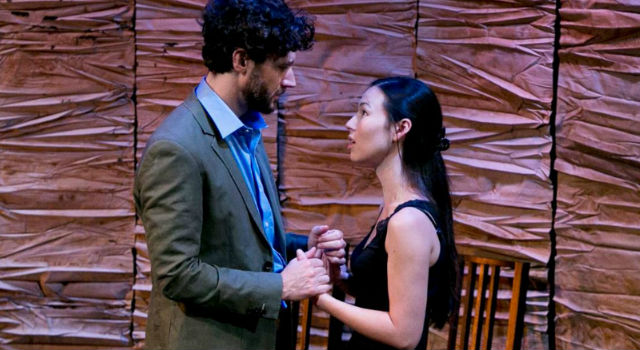
Review: Kryptonite (Sydney Theatre Company)

sydneytheatrecoVenue: Wharf 1 Sydney Theatre Company (Walsh Bay NSW), Sep 11 – Oct 18, 2014
Playwright: Sue Smith
Director: Geordie Brookman
Cast: Ursula Mills, Tim Walter
Image by Lisa Tomasetti

Theatre review
Through an international love story, Sue Smith’s Kryptonite examines the relationship between the personal realm and our wider circumstances. When Lian first met Dylan at an Australian University in pre-Tiananmen 1989, she was a new immigrant from China and Dylan had looked every bit the quintessential middle class Australian preoccupied with surfing and student protests. Over the years, Lian returns to Dylan for a series of brief but dramatic encounters, and by 2014, they are almost entirely different people, and we question if the countries from which they emerge, have evolved correspondingly, into virtually unrecognisable entities.

Freedom, idealism and innocence are put through the wringer in Smith’s play, in which we witness the ravages of time on the beauty of youth. Growing old is a tragedy, but not because of the inevitable deterioration of flesh. It is what happens to the heart and soul as time wears on, not just for each person, but also for the worlds in which we dwell. We cannot travel back in time, and our nations will never revert to a purer state. Indeed, the past is painted as though through rose-coloured glasses, but it is a persuasive picture that Smith creates. In Kryptonite, the loss of our innocence is certain, and sad. Smith’s work is emotional and powerful, with a perspective of our recent histories that feels accurate and is deeply perceptive.

The character Lian is particularly well-written, with an authenticity in speech and sense of humour that is quite outstanding. Performed by the brilliantly astute Ursula Mills, the role becomes thoroughly familiar, even though realistic Chinese women are rarely seen on our stages. She is surprisingly funny, and her motivations in each sequence are concise, keeping us engaged with her storytelling in a plot that can be a little convoluted at times. Mills is required to speak and sing in Chinese languages over the course of the show, but proficiency is lacking although her conviction remains strong. There is an oversimplification in some of Lian’s darker moments, but the actor never fails to bring a delicious fire to the drama when required. Also captivating is Tim Walter who is yin to Mills’ yang. Chemistry between the two are not quite exceptional, but they find a harmonious balance that brings great elucidation to the play’s themes and concepts. Walter’s work is thoughtful and confident, but the lightness in his presence, while delightful for the younger Dylan, is a hindrance in several of his graver moments. His depiction of a jaded politician in his late forties is not entirely convincing, but as a young man confused and enchanted by the object of his affections, Walter is charmingly captivating.

Geordie Brookman’s direction retains the challenging nature of the plot’s non-chronological timeline, but provides a good sense of clarity to the narrative. He succeeds in manufacturing a believable romance out of a complex framework of dramatic shifts in time and spaces, but some of the script’s political details are subsumed by his emphasis on pace and rhythms. The show is an enjoyable one. Its scenes are dynamic and unpredictable, always introducing fresh elements to ensure a gripping experience. Design aspects are not greatly ambitious, but they help tell the story with efficiency and elegance.

Kryptonite talks about how we have changed as nations of people, but its views of China are more exacting than how it sees its own country. The Australian play shows the evolution of a foreign land through its distinct junctures of transformation, but it is less brutal with its self-reflection. Yet again, we find meaning through the definition of an other, but this time, we move focus from our perverse European obsession to a place closer to home. China is a significant trading partner, with an astronomical rise in recent times that sees its influence spread across the world, not only in monetary terms, but also cultural and social. The first officially recorded Chinese migrant arrived in 1818 and today, Australians with Asian heritage number at 2.4 million. While we still seem to avoid it like a comic hero avoids a mythical adversary, the importance of finding a way to articulate that experience and relationship is impossible to overstate.

www.sydneytheatre.com.au

5 Questions with James Wright

jameswrightWhat is your favourite swear word?
Fuckery.

What are you wearing?
A jacket over a hoodie over a shirt because I’m in Melbourne.

What is love?
An addictive but glorious mixture of total comfort and mild paranoia which turns you into a happy idiot.

What was the last show you saw, and how many stars do you give it?
The Last Confession.

Is your new show going to be any good?
Yes, as long as I remember all those bloody lines/lyrics/directions.


James Wright is appearing in November Spawned A Monster, with Fly-on-the-Wall Theatre.
Show dates: 28 Oct – 15 Nov, 2014
Show venue: The Old Fitzroy Hotel

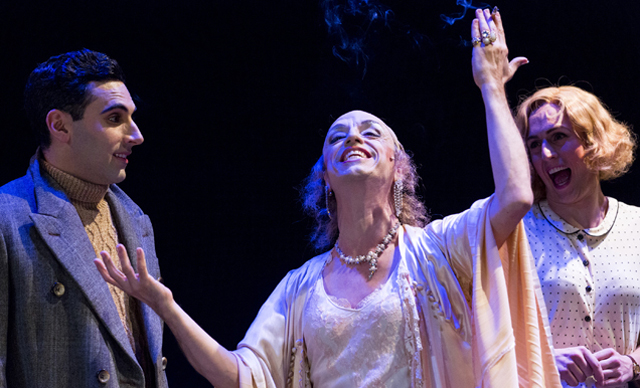
Review: Calpurnia Descending (Sisters Grimm / Sydney Theatre Company)

sistersgrimmVenue: Wharf 2 Sydney Theatre Company (Walsh Bay NSW), Oct 9 – Nov 8, 2014
Playwright: Ash Flanders, Declan Greene
Director: Declan Greene
Cast: Paul Capsis, Ash Flanders, Sandy Gore, Peter Paltos
Image by Brett Boardman

Theatre review
Calpurnia Descending borrows heavily from the 1950 Hollywood films, All About Eve and Sunset Boulevard. With an exploration into the evolution of show business and media, we observe that artifice and female rivalry persist as dominating themes that shape our consumption of popular culture through the years. Ash Flanders and Declan Greene’s script is a decadent high camp romp that exercises its creators’ eccentric and original vision, with a resulting beast that is more about heresy and iconoclasm than it is about entertainment or storytelling. In spite of its meaningful central ideas, the work does not aim to deliver poignancy but is interested instead, in unusual perspectives of theatre and innovative modes of experiencing live performance.

Half of the show is seen on a cinema sized screen. We can hear sounds from the live action emanating from behind the projection, so we know that the actors are creating the show in real time, but the significant length of the filmic portion means that it feels strangely close to being at the movies. It is understandable that Greene, as director, chooses the video format to discuss our obsession with screens big and small, but placing the production in a theatrical context is a curious decision, given the obvious affiliation with film and its possibilities. Nevertheless, Greene’s work is vibrant, colourful and thoroughly quirky, often with an air of vaudeville permeating the atmosphere. He is sensitive to energy levels, and although the show’s sense of humour is specific, he maintains a pace that is tight and lively, ensuring an amusing experience for most audiences.

Paul Capsis does his best Norma Desmond in the role of Beverly Dumont, a star of the Broadway stage poised to make a sensational comeback at the ten-year anniversary of her misreported death. Capsis brings a drama and grandiosity that the part requires, along with excellent comic timing and a gripping presence. The role is simple, but the actor’s work is beautifully complex, adding gravitas to something that is determined to revel in its silliness. Calpurnia Descending‘s version of Eve Harrington is the duplicitous Violet St Clair, played with mischievous exuberance by Flanders whose wide range of camp extends from delightful to macabre. The actors form a strong and balanced team in their portrayal of a malevolent sisterhood, but not much is made of the inevasible drag element. There is no obvious commentary that arises from the casting of male performers, and the production would not present too differently without it, so perhaps a point is made about the irrelevance of gender in the narratives we weave.

At a time when some of us can spend virtually every waking moment in front of a screen of some description, the production should be able to provide some resonance with its interest in the way we relate to mass media and its celebrities, but its preoccupation with depicting shallowness prevents us from connecting in an authentic way. Be that as it may, the show is memorable for being adventurous and rich with original thought, and it is the artists who dare to push the boundaries that we must value the most.

www.sydneytheatre.com.au | www.sistersgrimm.com.au

5 Questions with Lasarus Ratuere

lasarusratuereWhat is your favourite swear word?
Slutface.

What are you wearing?
10.Deep and Rick Owens.

What is love?
Love is… rolling around in bed with fresh sheets, a fresh grilled fish salad, glasses with the umbrellas in ’em and my family.

What was the last show you saw, and how many stars do you give it?
The Effect, I gave it 4 out of 5 stars.

Is your new show going to be any good?
It’s gonna be a spectacular ride of heart, laughter and landscape.


Lasarus Ratuere is appearing in 1790: A Tale Not Often Told, with Founding Modern Australia.
Show dates: 13 – 15 Nov, 2014
Show venue: Darling Quarter Theatre

5 Questions with Eliza St John

elizastjohnWhat is your favourite swear word?
Fuck.

What are you wearing?
Shortie pyjamas.

What is love?
A belly full of laughter.

What was the last show you saw, and how many stars do you give it?
Wicked the musical. Ten thousand green stars!

Is your new show going to be any good?
100% guarantee or your money back babay!


Eliza St John is appearing in V.D., with Copanirvana Theatre Co.
Show dates: 28 Oct – 15 Nov, 2014
Show venue: The Old Fitzroy Hotel

Review: Kill The PM (Unhappen)

unhappenVenue: Old 505 Theatre (Surry Hills NSW), Oct 8 – 26, 2014
Playwright: Fregmonto Stokes
Director: James Dalton
Cast: Nicholas Hiatt, Zoe Jensen, Michael McStay, Lily Newbury-Freeman
Image by Lucy Parakhina

Theatre review
We must not take our democracy for granted. It is a key element to meaningful lives, as it insists that every person and their liberties are included. The ideal is a world in which everyone has an equal say, even if we end up with a messy and inconvenient state of affairs, but today’s reality sees a grave inequality of power and influence. As Australia becomes increasingly capitalistic, previous notions of a classless society are quickly eroded, acquiescing to the dominance of the 1%. Our leaders are still democratically elected, but there is no camouflaging the fact that prevailing ideologies of government are disproportionately geared towards the benefit of the wealthiest. One person may still receive one vote, but our voices do not carry the same weight, and the loudest have proven themselves to be the most selfish.

Fregmonto Stokes’ Kill The PM is inspired by the fantasy of the masses, and begins with the most simplistic of ideas. The assassination of a leader is a proposition symptomatic of the disquiet that citizens experience, but the play does not indulge extensively in that premise. Instead, it explores the absurdity of the suggestion that the murder of one person is all the revolution that is required to cause an effective change in the way our nation carries on its business. Stokes’ writing has a sense of wildness that is dramatic and exciting, with surrealist aspects that keep us intrigued. There are unexpected ambiguities which make the script rich and thoughtful, but its narrative structure falters at certain junctures when a more poetic approach takes over. Stokes’ work is thought-provoking, but it has an uncomfortable gentleness that contradicts its powerful subject matter.

Direction of the piece by James Dalton suffers the same shortage of aggression. The characters are blinded by passion but what happens on stage is oddly subdued. The cast does not portray sufficient conviction for the story to take hold, and their relaxed disconnection from the plot (and each other) is frustrating. This is a story that should speak to anyone who is even remotely interested in politics, but none of the players manage to find points of resonances for the contentious issues being discussed.

Fortunately, the production shifts gears in the middle, giving up its unsuccessful naturalism for a spectacular theatricality in a series of dreamlike sequences. Dalton’s strengths with visual aesthetics and his talent at manipulating atmosphere rescue the show to some extent, although its core messages would benefit from greater elucidation. It is the formidable design team that shines in this production, with Dylan Tonkin’s set leaving the greatest impression, having given the venue an extreme transformation with daring innovation, excellent taste and a sophisticated flair. Benjamin Brockman’s lights are another highlight, cleverly adapting to the theatre’s unconventional facilities, and using gadgets that function charmingly as set pieces in addition to providing interesting illumination.

Kill The PM suggests that the elimination of any single person or group would not be advantageous, regardless of how blood thirsty our primitive selves can be. We see the importance of community in the process of affecting policy changes, but also the difficulties in locating ways that people can unite to find strength and commitment. Having a voice in any political climate is challenging, and it is only as collectives that we will be heard. The theatrical arts are fundamentally collaborative, and we must value the egalitarianism that allows individuals to come together to create and to speak. Regimes come and go, but art endures, and at the theatre, the subversive can find expression, and sometimes, have an impact.

www.unhappen.org