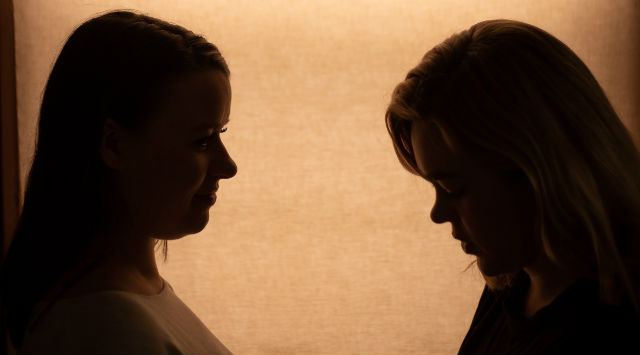
Review: She Loves Me (Hayes Theatre)

Venue: Hayes Theatre Co (Potts Point NSW), Aug 24 – Sep 15, 2018
Book: Joe Masteroff
Music: Jerry Bock
Lyrics: Sheldon Harnick
Director: Erin James
Cast: Caitlin Berry, Zoe Gertz, Joel Granger, Jay James-Moody, Tony Llewellyn-Jones, Kurt Phelan, Suzanne Steele, Georgina Walker, Rowan Witt
Images by Noni Carroll
Theatre review
Balash and Nowack have been exchanging anonymous love letters, unaware that they are colleagues, both working at the same cosmetics store. Based on Miklós László’s 1937 play Parfumerie, the musical She Loves Me first appeared 1963 on Broadway, and although a terribly old-fashioned story, its songs are utterly and eternally charming, still able to delight audiences today. Its characters are perhaps no longer believable, and they present little that we can relate to, but the show would most certainly appeal to those seeking a healthy dose of nostalgia in their entertainment.

Musical direction for this revival, is executed wonderfully by Steven Kreamer, who breathes new ebullient life into these half-century-old songs. His team of musicians, along with David Grigg’s sound design, deliver for our ears, an unexpectedly rich and exciting experience. Choreography by Leslie Bell, too, is enchanting, bringing to the stage a sense of extravagance that consistently fascinates our senses.

Much of the comedy in She Loves Me is outdated, but several big laughs are had when supporting player Jay James-Moody occupies centre stage; his comic inventiveness is an absolute godsend. Caitlin Berry and Rowan Witt are the leads, both excellent singers, with strong presences that manage to sustain our attention, even when the story wanes. Director Erin James keeps the production active and energetic, but the plot’s flimsiness seems impossible to rectify.

The nature of romance changes with time. In the Tinder age, we are encouraged to always anticipate the next better thing. Unlike us, people of Balash and Nowack’s generation were more likely to believe in that one true love, at a time when moving mountains to find them, had seemed a completely reasonable thing to do. The stakes are significantly lower now, as we become increasingly independent and pragmatic, able to attain fulfilment without narrow definitions of success and love. Many have been let down by dreams of happily ever after, but if we are able to appreciate the things that are, and not hanker only for what could be, chances are that heaven, is already here.

www.hayestheatre.com.au

5 Questions with Rizcel Gagawanan and Joy Gray

Rizcel Gagawanan

Joy Gray: Why did you want to be a part of this production?
Rizcel Gagawanan: First of all, “all-female production”, enough said. Second, I’ve always wanted to act in a Shakespeare play. Growing up I wasn’t exposed to a lot of theatre but everyone knew Shakespeare or at least knew of it. These days to get my Shakespeare fix I watch National Theatre Live at the cinemas. The performances are so amazing but what would be even more inspiring would be to see more POC actors on a Shakespeare stage. So here I am!

Why did you want to be an actor?
My mum put me in the ‘Johnny Young Talent School’ when I was 4 because I was a handful, so I guess from a young age I started to love performing but mostly it was because I had no shame. However, I’ve only come back to acting in the last 4 years and it’s the same things that brought me back, loving to perform (and having no shame), but also the passion to create and tell stories. More specifically telling stories that matter to me and represent me. As I was growing up it was rare to see someone who looked like me on TV or on stage. These days that’s starting to change but we have a long way to go. I believe that my work as an actor is helping change that.

What are your hobbies?
I run long distance, I recently ran City2Surf, 14km in 95 minutes! I’m hoping to finish a half marathon some day (…some day). In my spare time I’m either sketching in an art gallery or having embroidery dates with friends, and Netflix is a hobby too right?

If you could be in any movie, what character would you play?
I think TV shows beat films in terms of great badass female lead characters. I’d like to play an action hero like a spy/assassin character like Maggie Q’s Nikita and Jodie Comer’s Villanelle in Killing Eve but with the comedy antics of Ali Wong. If only I could do my own stunt work.

What are your top 5 movies?
In no particular order: Crash, Coming To America, Crazy Rich Asians, Get Out, and all the Harry Potter movies.

Joy Gray

Rizcel Gagawanan: Who has influenced you the most in your life?
Joy Gray: I would say my older sister has influenced me the most because she has always put me on a pedal stool and has consistently been the positive voice in my head when it comes to loving who I am, and going for my dreams. She has also influenced my decisions in occupations, as I am often in a care giving type of work environment, having followed her lead in life.

How has working with only women in the rehearsal room impacted the creative process for you?
Women can be great to work with in this capacity because we tend to have great emotional and intuitive intelligence. This intelligence can create an atmosphere of sincere relationships. Having sincerity on stage is important for the creative process because it allows an easier space to fully realize the way in which the actions and reactions given by your fellow cast mates are affecting the words being said and their meaning.

What was it about the play that made you want to audition?
I wanted to audition for this play because I wanted to do Shakespeare and I liked the idea of doing an all-female show. I also liked the musical aspect of the show. I auditioned because I wanted to challenge myself and gain experience as an actor. It was icing on the cake that this play is embracing women who want to destroy the status quo, and She Shakespeare is doing this by keeping all the unique elements of the play intact, but also keeping the characterizations that make women unique and beautiful.

What made you want to become an actor?
I have always been interested in how people communicate with each other, whether their through words, or the many kinds incremental gestures with their face and body. This fascination led me into the study of psychology and neuroscience. Underneath that academic attraction, I have also have a need to break out of my interior and exterior shell, and acting is the embodiment of changing who you are. I know I would rather just stay safe inside my head, inside my living room, with a Virtual Reality headset, but acting forces me to be social, to think about, and be in different scenarios; and it’s tough! On a lighter note, I grew up in a family who loved to go to the cinema, who loved music, dancing and technology. I married a man who is a musician and a philosopher, who also appreciates a myriad of live performance such as opera, spoken word, and of course stage acting.

What’s the worst movie you’ve ever seen?
The worst movie I have ever seen is Tommy Wiseau’s The Room. It is also the funniest movie I have ever seen. I loved going to see it at a cinema full of people armed with plastic spoons for throwing, who are yelling the phrase “because you’re a woman!”. I liked the cringe worthy sex scenes that looked completely wrong and sounded hilarious to a repetitive cheesy, 90’s jazz music score. The absolute best thing about the movie is the horrendous acting and dialogue. It is infamous!

Rizcel Gagawanan and Joy Gray can be seen in Macbeth , by William Shakespeare.
Dates: 29 Aug – 8 Sep, 2018
Venue: PACT

Review: The Harp In The South (Sydney Theatre Company)

Venue: Roslyn Packer Theatre at Walsh Bay (Sydney NSW), Aug 16 – Oct 6, 2018
Playwright: Kate Mulvany (from novels by Ruth Park)
Director: Kip Williams
Cast: Joel Bishop, Luke Carroll, Tony Cogin, Jack Finsterer, Benedict Hardie, Emma Harvie, Anita Hegh, Ben O’Toole, Lucia Mastrantone, Heather Mitchell, Tara Morice, Rose Riley, Rahel Romahn, Jack Ruwald, Guy Simon, Bruce Spence, Helen Thomson, Contessa Treffone, George Zhao
Images by Daniel Boud

Theatre review
When Margaret Kilker met Hugh Darcy in 1920, life in rural Trafalgar was idyllic but inert. The couple, both Irish-Australian, young and hopeful, soon headed to Sydney for a brighter future, setting up home in Surry Hills, where they found community, and formed the foundations of a legacy never intended or even imagined.

The Harp In The South is a six-and-a-half hour epic, in two parts, by Kate Mulvany, based on two of Ruth Park’s novels from the 1940’s and another from 1985. Composed mainly of migrant perspectives as experienced by three generations of Irish women, the play offers contemporary audiences a version of our city’s recent history that feels counter-cultural, one that is derived not from contrivances of the establishment, but from stories told by the poor and disadvantaged. All the wonderful things we associate with this city, are built upon the fortitude of those who bear injustice and genuine hardship. Instead of hearing once again about the great white forefathers who take every credit, The Harp In The South restores the voices of forgotten individuals, and places them in the mythical centre of Sydney’s eminence.

Mulvany’s adaptation is exhilarating and witty, replete with irresistible drama, and brimming with inspiration. A palpable soulfulness informs her every manoeuvre, revealing a deep love of the subject and the material, that proves to be completely and profoundly affecting. Although concerned with a cultural specificity, Mulvany’s play contains a sensibility of inclusiveness, that understands the diverse realities of those to whom this story is relevant. The Kilker-Darcy household leads the action, but their truth can only resonate within a context of multiculturalism, and the accompanying portrayals of Indigenous, Chinese, Greek and Italian characters provide not only a degree of ethnological accuracy, they also make an important statement about the way we have, for a long time, sought to share space in harmony.

Director Kip Williams’ vision is exquisite, for a production extraordinary in what it achieves, not only in aesthetic terms, but even more valuable is its promise to galvanise society, through highly persuasive, and sentimental, depictions of our common past, involving all the complexities in our endeavours to be good families, friends and neighbours. Even though the events that unfold are from a different era, every scene rings true, with a familiarity that emanates from its absolute honesty. The Harp In The South is tremendously soulful, and it speaks to all who have an intimate connection with Surry Hills and its surrounds.

Flawlessly designed, the show looks and sounds magnificent. David Fleischer’s sets, Nick Schlieper’s lights and Renée Mulder’s costumes, form an impeccable collaboration delivering theatrical grandeur, with a pervasive and melancholic nostalgia best described as beautiful. Music by The Sweats and sound design by Nate Edmondson, combine new with old, real with abstract, seamlessly cajoling us from one dimension to another, making us laugh and cry at will. The songs we choose to sing, are the truest indication of who we are, and the many melodic renditions of The Harp In The South are like spiritual disclosures, engineered to touch us in the heart and in the mind.

A large cast of actors, play a very large number of characters, each one fabulously evocative, no matter how brief their appearance. Contessa Treffone, marvellous as both Josie and Dolour, is onstage for a substantial portion of this durational challenge, persistently impressive with her spirited and delightful comedy, and triumphant with the integral vulnerability she brings to the show. Margaret and Hugh are brought to life by Anita Hegh and Jack Finsterer, both reliably poignant, but also cuttingly humorous when appropriate. Heather Mitchell too is splendid, and thoroughly amusing, as the matriarch Eny Kilker.

Unforgettably funny, are Benedict Hardie and Rahel Romahn in all their innumerable guises, although Helen Thomson is a clear favourite, unequivocally outstanding with an incomparable volume of laughs, particularly wonderful as the bawdy brothel madam Delie Stock. Lesbian nuns Theopilus and Beatrix are a thrilling pair, performed playfully yet tenderly, by Lucia Mastrantone and Tara Morice, endearing as a sisterly set, and independently formidable in an astonishingly varied range of personalities.

We can proclaim to know ourselves, but art can often surprise with new epiphanies. There is no end to how humanity can understand itself, and it is imperative that we are committed to finding ever greater truths, if we should continue to believe in better tomorrows. We may not be direct descendants of the people in The Harp In The South, but they show us so exhaustively, who we are, as Sydneysiders, as Australians. The shoulders we stand on were not always solid, but all our strength today must be attributed to that past.

www.sydneytheatre.com.au

Review: Constellations (Chippen Street Theatre)

Venue: Chippen Street Theatre (Chippendale NSW), Aug 23 – Sep 1, 2018
Playwright: Nick Payne
Director: Victor Kalka
Cast: Alice Birbara, Henry Hulme
Image by Omnes Photography

Theatre review
In Nick Payne’s Constellations, parallel universes converge in conventional theatrical time, to tell a simple love story. Moments shared by Marianne and Roland, are presented on stage in multiple contradictory manifestations, toying with ideas that disrupt the linearity of our existence, to imagine a nature that is more complex than the typically singular perspectives of how we experience the world.

Director Victor Kalka places appropriate emphasis on the production’s depiction of time, with precisely calibrated lighting and sound cues (executed by a very diligent stage manager, Christopher Starnawski) that provide absolute clarity to how the plot unfolds. There is however, an unfortunate monotony to proceedings, even though the writing provides ample opportunity for a more playful and variable approach to how each scene is performed. Actor Henry Hulme delivers a sense of authenticity with his understated presence as Roland, but a lack of exuberance keeps us alienated. Alice Birbara’s portrayal of Marianne is more animated and inventive, although a greater exploration into the play’s comedy would provide a more satisfying result.

As individual beings, we have little control over how the planet spins, but to believe that fate is beyond manipulation, is to render humanity meaningless. Even if one thinks that all choices we make are predestined, to absolve oneself of responsibilities, is analogous to giving up on life. It is true that we are but a speck in the great scheme of things, and all our successes and failures are ultimately no more than a question of vanity, but if those ephemeral concerns are all we have that would allow our participation in this time and place, then being human is an indulgence we must engage in, with the utmost relish.

www.chippenstreet.com

Review: Me And My Mother, Singing (Blood Moon Theatre)

Venue: Blood Moon Theatre (Potts Point NSW), Aug 22 – 30, 2018
Creator and Performer: Oleg Pupovac
Image by Roman Wolczak

Theatre review
In Oleg Pupovac’s one man show Me And My Mother, Singing, we are invited into a dreamlike consciousness, a waking meditation perhaps, about the creator’s Yugoslavian and Serbian roots. Stories of his past feature heavily, in this work about identity, demonstrating the inextricable relationship between our memories and daily existence. A new dawn always arrives, but we move into each day with personal histories that can be contained but is rarely erased.

Pupovac seeks refuge in art, reaching for his father in paintings of snow, and his mother in folk songs. Trauma is addressed indirectly, for a healing process that can never be hurried, and love is rekindled, if only in the realm of the soul, for a solace that is necessary but that can never completely assuage the experience of loss and longing. It is a satisfying presentation, with multimedia elements offering insight into the most intimate recesses of Pupovac’s mind, and the performer’s own warm charm facilitating an empathy in the audience, even when scenarios turn obscure.

In the creation of his own art, Pupovac manifests a closeness with loved ones, that in turn inspires an appreciation for the complex ways, in which each of us thinks of family and roots. People can seem so different from one another, but underneath the surface are inevitable points of connection that can only endorse our kinship. We like to think ourselves special, and even though individual trajectories are always unique, the infinity of our sameness can never be denied, including, sadly, our age-old propensity to divide.

www.thetwopeas.com

Review: Mum, Me & The I.E.D. (Collaborations Theatre Group)

Venue: The Depot Theatre (Marrickville NSW), Aug 15 – Sep 1, 2018
Playwright: James Balian, Roger Vickery
Director: Kevin Jackson
Cast: Matilda Brodie, Martin Harper, Elaine Hudson, Philippe Klaus, Joshua Shediak
Images by James Balian

Theatre review
Mary Ellen has been an avowed pacifist since the Vietnam war, but still she was unable to prevent her son from aspiring to become a soldier. When we first meet them, Rob is undergoing treatment for PTSD, as part of the discharge process upon leaving Afghanistan. Mum, Me & The I.E.D. by James Balian and Roger Vickery, is an uncompromising look at the psychological damage inflicted on those we send away to war. The play’s anti-war sentiments are unambiguous and passionate, almost too blatant with their chastisements. Early scenes can feel repetitive, but its latter half turns dynamic, becoming more emotionally involving, as we tune in to Balian and Vickery’s reflections on casualties and their politics.

Director Kevin Jackson demonstrates creative use of space, in this story about intersecting dimensions. The protagonist’s mind is a convergence of confused realities, that Jackson’s staging renders coherent for our benefit. Lighting design by Martin Kinnane proves invaluable in conveying, with remarkable clarity, the many unusual spacial and temporal transformations required of the production.

Actor Philippe Klaus turns up the intensity for the show’s various points of heightened drama, but his performance of Rob’s trauma and suffering can seem slightly affected. His portrayal of a young man’s severe mental deterioration resulting from experiences in the battlefield, are full of conviction, but it is the authenticity in his depictions of family discord and the accompanying anguish, that we find convincing. Mary Ellen is played by Elaine Hudson who delivers a compelling and meaningful sense of depth to the character’s tribulations. Her work feels honest and accurately realistic, often with a surprising restraint that makes things even more believable.

The disadvantaged and the naive are perennially targeted for carrying out the devil’s work, and the world can be a shockingly dangerous place for those poised for independence. We want our young to understand that life is for taking chances, but we fear the irreversible consequences of their mistakes. Mary Ellen and her fierce conscientiousness were no match for the narrative of heroic patriotism that all nations rely on. The heartache that her family has to endure, is a phenomenon centuries old, that we seem determined to perpetuate.

www.facebook.com/CollaborationsTheatreGroup

Review: Ich Nibber Dibber (Sydney Opera House)

Venue: Sydney Opera House (Sydney NSW), Aug 15 – 19, 2018
Playwrights: Zoë Coombs Marr, Mish Grigor, Natalie Rose
Director: Zoë Coombs Marr, Mish Grigor, Natalie Rose
Cast: Zoë Coombs Marr, Mish Grigor, Natalie Rose
Images by Jacquie Manning

Theatre review
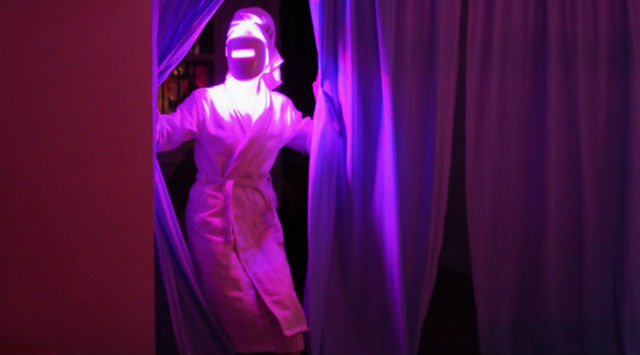
Three goddesses are afloat in white robes, eternal but not quite ethereal. Zoë Coombs Marr, Mish Grigor and Natalie Rose’s Ich Nibber Dibber features quick-fire conversations between old friends, natural and very candid, as though a verbatim recreation of private moments, collated over two or so decades. Confidences between close friends that are never meant for public consumption, bawdy and reckless, occupy centre stage to claim a position of dominance for the oft-neglected notion of female subjectivity. It is an exercise in rejecting the gaze, and of women asserting a perspective that is wholly about self-determined existences.

Audacious in its imagination of a post-feminist era, its accompanying politics are confident but subdued. Instead of overt investigations into meanings of gender, the play emphasises its comedy, and through that brazen attitude of subversive recalcitrance, Ich Nibber Dibber encourages us to laugh on our own terms, and by inference, to laugh at patriarchy. The show is thoroughly amusing, with its creators proving to be highly persuasive presences, as they jubilantly perform their defiance.

The women are unequivocally real, but they are also otherworldly, with a circularity to their experience of time that offers a glimpse into a future universe beckoning us to catch up. Michael Hankin’s set and costumes, along with Fausto Brusamolino’s lights, orchestrate this magical encounter between profane and divine, presenting imagery that reminds us of the transcendence we are all capable of. Music and sound by James Brown facilitate our connection with the storytellers, and then disturb our peace to keep us thinking.

It is believed that male desire in all its forms, have determined how we conceive of ourselves, but what had seemed inescapable, can now be put through a process of reconditioning. To extricate our own desires from those of the other, is likely an inexhaustible task, and because a woman’s work of resistance is never done, it is that ongoing project of continual redefinition and ever new formations of identities that can lead us to greater autonomy.

www.postpresentspost.com | www.sydneyoperahouse.com

Review: Moby Dick (Sport For Jove Theatre)

Venue: Seymour Centre (Chippendale NSW), Aug 9 – 25, 2018
Playwright: Orson Welles (based on the novel by Herman Melville)
Director: Adam Cook
Cast: Danny Adcock, Rachel Alexander, Mark Barry, Badaidilaga Maftuh-Flynn, Jonathan Mill, Wendy Mocke, Thomas Royce-Hampton, Francesca Savige, Vaishnavi Suryaprakash, Bryden White-Tuohey
Images by Marnya Rothe

Theatre review
Ahab’s war on nature in Moby Dick seems altogether too familiar yet tragic. The eternal discord between humankind and our environment, is the site on which we can examine the disquiet of who we are as a species, especially in relation to our curious inability to be at one, and in peace, with nature. We are determined to extricate ourselves, always asserting a superiority that can never be. Orson Welles’ adaptation of Herman Melville’s classic, is abstract, often impenetrably so, but its concerns about our adversarial relationship with nature lay appropriately at its centre.

It is essentially a fight with the self that Ahab has to go through, and our vantage point allows his story to function as a sort of introspective interrogation, in order that we may recognise that futile struggle that we too, resolutely participate in. Director Adam Cook’s show is a vibrant cornucopia of activity that brings to energetic life, the whaling obsession that Ahab and his crew of sailors embark on. Their dialogue may confuse, but the production is a rich tapestry from which our creative minds can detect symbols, decipher language and find meanings.

A very accomplished merger of design talents help sustain a sense of magical fascination. Set and costumes by Mark Thompson are handsome, evocative and grand. Lights are industriously assembled by Gavan Swift, who manufactures a surprising beauty for the story. Sound designer Ryan Patrick Devlin keeps things lively with exciting music, much of which is thrillingly performed on stage by percussionist and actor Tom Royce-Hampton.

Danny Adcock leads the cast, suitably rhapsodic as Ahab, with an impressive presence that proves to be highly persuasive, in this mad man’s tale. Rachel Alexander is compelling as Pip, particularly memorable in a powerful scene with Ahab discussing things political and esoteric, then proclaiming with theatrical histrionics, “death to whiteness”. The role of Queequeg is beautifully portrayed by Wendy Mocke, who introduces valuable glimpses of emotional authenticity to a slightly too distant universe.

We send rockets out into the ether looking for life, trying to find points of connection with all that we deem to be alien. Back on earth, we go to great pains to alienate ourselves, in a never-ending project of division and of segregation. We have convinced ourselves that we are inexorably distinct from flora and fauna, and further, have formed an interminable habit of creating power structures and hierarchies within all our human societies. The albino whale swims in peace; its violence is only ever a result of provocation.

www.sportforjove.com.au

Review: Nell Gwynn (New Theatre)


Venue: New Theatre (Newtown NSW), Aug 8 – Sep 8, 2018
Playwright: Jessica Swale
Director: Deborah Jones
Cast: Lloyd Allison-Young, Kate Bookallil, Debra Bryan, Steve Corner, Aimee Crighton, Susan Jordan, Simon Lee, Naomi Livingstone, Steven Ljubovic, Peter Mountford, Genevieve Muratore, Rupert Reid, Eleanor Ryan, Shan-Ree Tan, Adam Van den bok, Bishanyia Vincent
Images by Chris Lundie

Theatre review
Jessica Swale’s Nell Gwynn tells the rags to riches story of its eponymous 17th century English actress, charting her rise from common prostitute to becoming one of the first women to ever take to the professional stage, and eventually finding her way into the courts as King Charles II’s most favoured mistress. It was a short but eventful life, that Swale takes great care to frame as a modern feminist parable, featuring a young woman who uses beauty and brains, to battle against all odds, and make it all the way to the glass ceiling. Fascinating biographical information is transformed into effective drama, placed alongside contemporary observations and commentary about womanhood.

Actor Bishanyia Vincent is marvellous in the title role, spirited and intelligent, for an interpretation that is as inspiring as it is entertaining. There is a lightness to the character that endears, but Vincent takes every opportunity to imbue complexity and depth, offering insights that are emotional, or sometimes political, making Nell Gwynn a tale that is unmistakably relevant to our times. Equally memorable is Lloyd Allison-Young as the king, wonderfully flamboyant in his comical expressions that represent perfectly, our perspectives of the aristocratic classes. Both are deeply charming personalities, who insist on keeping us delighted at every turn. It is a strong cast overall, with each performer proving themselves accomplished and inventive in their individual parts.

Musical aspects of the show are whimsical and amusing; Laura Heuston as musical director and Clare Heuston as music consultant, bring a gratifying effervescence to their interludes. Virginia Ferris delivers lively but simple work as choreographer, in clever accompaniment to direction by Deborah Jones that focuses earnestly, on the craft of acting. Visual elements are raw, slightly too basic, or perhaps too straightforward, in configuration and imagination.

As a woman of the lowest class, Gwynn was able to rise through the ranks, with a serendipitous combination of talent and luck, to reach heights that had allowed her a taste of greener pastures. She was never liberated of course, from that dependence on men and their libido, and ultimately succumbed to syphilis, but there is no denying that she was able to ensure wealth and status for all her subsequent generations. Womanly wiles are still a currency today, but for most of us, how we transact is now chiefly a matter of our own discretion.

www.newtheatre.org.au

Review: King Of Pigs (Old Fitz Theatre)

Venue: Old Fitzroy Theatre (Woolloomooloo NSW), Aug 1 – Sep 1, 2018
Playwright: Steve Rodgers
Director: Blazey Best
Cast: Mick Bani, Wylie Best, Christian Byers, Ashley Hawkes, Ella Scott-Lynch, Kire Tosevski
Images by John Marmaras

Theatre review
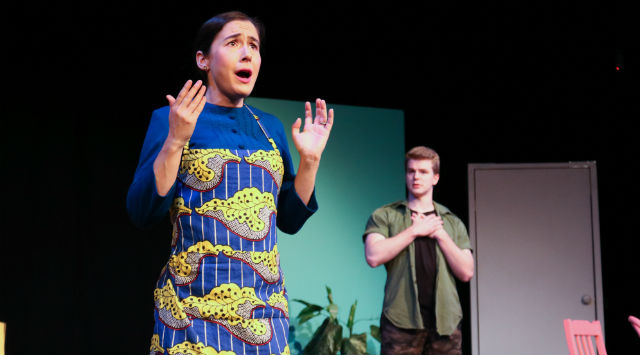
Actor Ella Scott-Lynch plays several characters, in this work about men’s violence against women. She embodies different personalities, but what they encounter in Steve Rodgers’ King Of Pigs, are essentially the same. The current climate of fervent interrogation into matters relating to gendered abuse, requires the male of our species to confront hard truths about their behaviour. It is a time of reflection and re-evaluation, and the play speaks directly to their conscience, asking them to examine the imbalances inherent in heterosexual dynamics.

It is an earnest work, perhaps too simplistic and obvious in style, but the urgency to make a point is certainly evident. Stories in King Of Pigs are very familiar, and although predictable, they still are able to have an impact. Direction by Blazey Best is suitably grave in tone, with a meticulousness to its naturalism that holds our interest. Isabel Hudson’s set and Verity Hampson’s lights collude to offer a sense of theatricality for the intimate situations under scrutiny, both effective in conveying a quality of ominous danger to the plot.

Scott-Lynch is convincing in all of her roles, each one thought-provoking, with little reliance on sentimentality. Kire Tosevski and Wylie Best provide strong partnership in family scenes that offer momentary consolation, through their warm rendering of a loving home, placed precariously alongside damaging relationships. Mick Bani, Christian Byers and Ashley Hawkes play the three perpetrators, each with memorable instances of character vagaries that point to pertinent questions about masculinity.

It is never easy to have those who hold power understand the depravity that results from their dominance. For sexism to be quelled, men have to participate in the feminist project, which although ultimately benefits all, many will perceive to be a threatening relinquishment of power. A world without the problems of gender requires a great number of processes, all of which can only be initiated by epiphanies derived from opportunities like King Of Pigs.

www.redlineproductions.com.au