Review: Harry & Liv (Glebe Justice Centre)

harryliv1Venue: Glebe Justice Centre (Glebe NSW), Sep 3 – 6, 2014
Writer: Charlotte Kerr
Cast: Charlotte Kerr, Evan Kerr

Theatre review
Charlotte and Evan Kerr are siblings, and they portray Harry & Liv (also siblings) in this cabaret/musical theatre piece. Harry has been staying over at Liv’s home, causing the place to look a real mess. Harry enjoys being the thorn in his sister’s side, and his constant jibes irritate her as much as the clutter he has unleashed upon her living room. Their sibling rivalry is charming and their banter is entertaining, but the greatest consequence of their squabbles is the music they create around Liv’s exquisite grand piano.

As a work of musical theatre, Charlotte Kerr’s script is delightfully witty, but it would benefit from a narrative that develops more substantially. As a cabaret act, the duo is eminently likeable with very accomplished musical abilities. Charlotte Kerr’s confident and emotive voice has excellent range that sings with humour and beautiful sensitivity. Evan Kerr is a dynamic pianist who keeps the show lively and animated. Song choices can be a little obscure for those of us who are not connoisseurs of the genre, but they are delivered brilliantly, and we cannot help but be impressed by the artists’ thorough familiarity with the material.

It is the simplest of shows, but Harry & Liv is thoroughly enjoyable. The set is economically but effectively arranged and intimately lit, creating a comfortable homely feeling so that the audience is at ease and involved. Indeed, the Kerrs’ hospitality is warm and their company is wondrous. Their talent is the kind that cannot be adequately represented by recorded media, you really do have to be there.

www.facebook.com/harryandlivcabaret

Review: Oedipus Rex (Belvoir St Theatre)

belvoirVenue: Belvoir St Theatre (Surry Hills NSW), Aug 21 – Sep 21, 2014
Dramaturg: Paul Jackson
Director: Adena Jacobs
Cast: Peter Carroll, Andrea Demetriades
Image by Pia Johnson

Theatre review
Sophocles’ Oedipus Rex is a classic tragedy remembered for its themes of fate and incest. Adena Jacobs’ sequel is a vision haunted by a blind and elderly Oedipus in throes of despair, suffering a living hell. His daughter, and sister, Antigone is his carer and companion, but the play features little conversation and no writer is credited. It is poetic and visual theatre, with influence from installation and performance art. Designer Paul Jackson’s creation is a bare clinical space that evokes the cruel agony of hospitals and bureaucratic offices. Ugly false ceiling panels with strategically positioned fluorescent tubes and halogen bulbs provide spine-chilling illumination that emphasise the horrific existence of the man who had been king. The 70-minute experimental work owes more to the paintings of Edvard Munch and Francis Bacon than it does Greek stage traditions. Meaning is created through imagery and sound, with spoken languages taking a back seat. Max Lyandvert’s involvement as composer and sound designer is not always prominent but his efforts are tremendously affecting, and when he does take centre stage, there is no hesitation to grab us by our core to deliver moments of astonishment.

The abstraction in Jacobs’ piece allows for numerous interpretations but the detailed and confronting depiction of an old man under palliative care addresses our universal mortality. The presence and sight of veteran actor Peter Carroll’s bare flesh resonates deeply. Our bodies unite us, and his vulnerable thinness is a visceral reminder of every person’s imminent and inevitable deterioration. The play’s muted narrative opens up the ways in which we can relate to Oedipus. When we no longer see him only as a man with specific circumstances, we are able to recognise more intimately the pain he embodies, and his torment speaks to us all, for true suffering requires no context to connect.

Oedipus Rex is the tour de force of a remarkable actor. Carroll’s performance is powerful and mesmerising, with more depth than any audience can deplete. There is enough drama in every fibre of his being to render narratives gratuitous. His director’s wisdom has allowed the production to strip back on storytelling and rely instead on the actor’s charisma and skill to impress upon us, the essence and soul of this artistic triumph. Carroll’s work is fearless, authentic and assertive, with a sense of traditional Asian theatre forms that focus on the craft of performance itself, rather than using it as a vehicle for saying something else. In this case, we are utterly enthralled by the man on stage, but also aware of the text’s subliminal messages. Antigone is played by Andrea Demetriades who provides solid support. The chemistry between both actors is outstanding, and the palpable trust they have harnessed is the source of many instances of frisson that occur throughout this thoroughly fascinating show.

We indulge in tragic stories because there is an intense beauty that resides in the darkness that befalls the innocent. There is an understanding that bad things can happen to good people, and as much as we strive for goodness, what results may not always be guaranteed. Life is dangerous, because it is uncertain. The ambiguity and risk in Adena Jacobs’ work puts her art in a position that challenges her audience, as well as the state of art production in our communities. Theatre often becomes too predictable and too lazy, and we need agents provocateur like Jacobs and Oedipus Rex to keep it alive.

www.belvoir.com.au

5 Questions with Scott Lee

scottleeWhat is your favourite swear word?
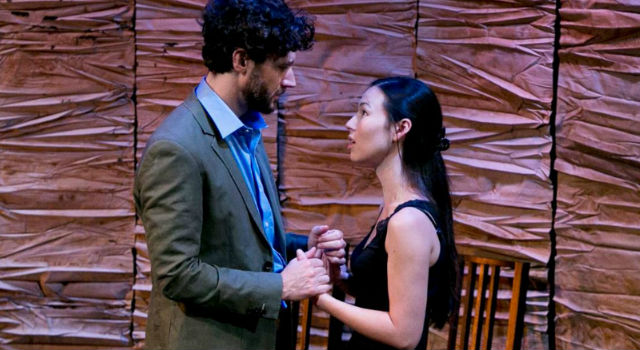
The C-bomb… but only in the confines of my car so know one can actually hear me say it.

What are you wearing?
A green hoodie I stole from my twin brother cause I’m a knob, and the only pair of pants I own (which conveniently has a massive hole in the crotch).

What is love?
I don’t know if I’ve fully figured that one out yet. For me I think it’s the moment when you let all those silly walls we all build down and have the freedom to be yourself (which in my case is being a bit of a nut).

What was the last show you saw, and how many stars do you give it?
Rebels With a Cause directed by Simon Doctor. Was a cool little showcase at NIDA with a whole bunch of scenes from Shakespeare, Chekhov, Harold Pinter, Clifford Odets and other pieces I didn’t recognise but it was great fun and I’d give it 4 stars.

Is your new show going to be any good?
I bloody reckon it will be! 🙂 It’s such a fun play that, I think, already has a massive following. Kenneth Lonergan’s writing is mental! It’s so spot on and human and we are all having a ball rehearsing. The play really speaks to me as a young adult and hopefully will to those who come and see it… but at the very least it’s a hilarious play and I think everyone who sees it will have a giggle, maybe even a laugh out loud.

Scott Lee stars in This Is Our Youth, part of Sydney Fringe 2014.
Show dates: 17 – 21 Sep, 2014
Show venue: TAP Gallery

5 Questions with Megan O’Connell‏

meganoconnellWhat is your favourite swear word?
Cunt. (Sorry, mum. Sorry, Sister Bernadette.)

What are you wearing?
Trackies and ugg boots. The Blacktown uniform. But I’m at home so it’s OK.

What is love?
A well timed cup of tea comes pretty close.

What was the last show you saw, and how many stars do you give it?
We’ve just had a baby, so my brain has gone to pudding. But I’m sure whatever it was, I enjoyed it.

Is your new show going to be any good?
Yes. I almost wish I wasn’t in it so I could see it myself. Almost. (Please don’t fire me).

Megan O’Connell‏ is appearing in The Motherf**ker With The Hat, from Darlinghurst Theatre Company’s 2014 season.
Show dates: 19 Sep – 19 Oct, 2014
Show venue: Eternity Playhouse

5 Questions with Narek Arman

narekarmanWhat is your favourite swear word?
I use the phrase “fuck that shit” quite a bit…

What are you wearing?
Underwear. Too cool for school, I know.

What is love?
Shrek is love, Shrek is life.

What was the last show you saw, and how many stars do you give it?
To be completely honest, I don’t recall the name of the last show I saw but I thought it was worth 3 and a half stars.

Is your new show going to be any good?
Oh you bet it’s going to be good!


Narek Arman plays the role of Aaron in Sugarland. Read Suzy’s review here.
Show dates: 27 Aug – 13 Sep, 2014
Show venue: ATYP

Review: Sugarland (ATYP)

atypVenue: ATYP (Walsh Bay NSW), Aug 27 – Sep 13, 2014
Playwright: Rachael Coopes, Wayne Blair
Director: Fraser Corfield, David Page
Cast: Narek Arman, Michael Cameron, Rachael Coopes, Elena Foreman, Hunter Page-Lochard, Dubs Yunupingu
Image by Tracey Schramm

Theatre review
Sugarland is a work about teenagers in Katherine, a remote town in the Northern Territory. The play is performed by young actors, aged 17 to 21, but written by adult artists who have studied the youth of the region over a two-year period. Rachael Coopes and Wayne Blair’s script is powerful in its authenticity, with controversial elements that resonate with a disarming honesty. The truths it reveals, both beautiful and ugly, would be challenging for any audience. Like most memorable work about teenagers, from Puberty Blues (Gabrielle Carey and Kathy Lette) to Kids (Larry Clark), it is the shocking transgressions they depict that leave an impression, and it is precisely the taboo nature of what is being discussed that makes these texts significant and valuable.

Directed by Fraser Corfield and David Page, the production is unexpectedly elegant and subdued. The confronting issues it tackles are not sensationalised. Instead, they are presented in a quietly pragmatic way so that we are prevented from feeling any sense of alienation from its characters. We are seduced into a deceptively cosy world, which in fact contains many aspects that disturb our middle class notions of conventions and acceptability. Corfield and Page’s achievement is in their creation of a political theatre that chooses to speak rationally, rather than to appeal with overblown emotion and hysterical expression. Their gentle approach allows the play’s message to seep through, and to strike a chord where dismissive delusions usually reside.

Performances are not always accomplished, but every actor’s creation on this stage is thoroughly fascinating. The teenage characters seem familiar, but we are provided rare insight into a depth that habitually evades public scrutiny. Dubs Yunupingu plays Nina, a disenfranchised high school girl of indigenous background. Yunupingu has a sensitive quality that we connect with, and a fragility that secures our empathy. The lack of pretension in her craft is refreshing and often very moving. The unhinged Jimmy is portrayed by Hunter Page-Lochard whose impressive presence gives the show a dangerous edge. Page-Lochard is an exuberant performer who brings an exciting unpredictability to his every appearance. Narek Arman is a jovial and charming actor, and his interpretation of the recent Iraqi migrant Aaron is a delightful contrast to the other moodier personalities.

The beginning of political action is awareness, and awareness begins at giving a voice to the disadvantaged. The isolated inhabitants of Sugarland cannot see the privileged lives of its Sydney audience, but their stories and adversities are told to us without ambiguity. They do not seem angry or claim to be desperate, but we know that every young Australian deserves more. The distinction between the haves and the have nots in this lucky country is an unequivocal disgrace, and the journey towards greater equity must be accelerated.

www.atyp.com.au

Review: The God Of Hell (Mophead Productions / Sydney Independent Theatre Company)

mopheadVenue: Old Fitzroy Theatre (Woolloomooloo NSW), Aug 26 – Sep 13, 2014
Playwright: Sam Shepard
Director: Rodney Fisher
Cast: Vanessa Downing, Jake Lyall, Ben McIvor, Tony Poli
Image by Gareth Davies

Theatre review
Sam Shepard’s The God Of Hell portrays patriotism as a dangerous concept. In the name of national pride, morality is distorted and human rights are nullified for the benefit of an abstract higher power. The meaning of citizenry is subversively explored, against the backdrop of a traditional and idyllic farm, where residents live honest existences without the need for labels of jingoistic identification. Emma and Frank live quietly in Missouri, with cows and plants occupying their attention, and they want for nothing. Their lives are simple but complete, and we admire their wholesome day-to-day routine, which the play presents at some level of glorification. Complications emerge when characters appear to disrupt their peace, and we observe scenes of destruction transpiring as a result of narcissism, greed and ignorance.

Helmed by Rodney Fisher who serves as director and designer, the production is inventive, exuberant and sophisticated. It is a very good looking show, with an ambitious set that is perfectly proportioned and elegantly executed, communicating a sense of rustic purity that is immediately endearing. Together with Ryan Shuker’s lighting, Fisher has materialised a blissful vision that represents an ideal we cannot bear to see tainted. Also successful is sound designer Max Lyandvert’s work, which provides a beautiful dimension of rural domesticity that eventually develops into something much more sinister.

Fisher’s direction is lively and precise, with a surprising clarity that always places emphasis on the narrative. It is very accomplished storytelling that constantly introduces fresh elements of interest to maintain a connection with the audience. Even when Shepard’s script becomes alienating or abstruse, the plot continues to be excitingly coherent. Fisher achieves a balance between naturalism and theatricality that makes The God Of Hell fascinating and enjoyable. The smell of bacon cooking on a stove top is both an ordinary occurrence and a flamboyant stage flourish. The four actors too, are impressively believable, while being quite dazzlingly entertaining.

Emma is played by Vanessa Downing who keeps us anchored in a place of reality while the play escalates to dramatic heights. Downing is charming, funny and entirely likable, so we identify with Emma readily, even if her life is probably quite unlike anybody’s in Sydney. She provides an authenticity that allows an understating and affiliation, and we form an important emotional bond with that character. Her husband Frank is equally charismatic, thanks to Tony Poli’s vibrant stage energy and immense presence. Jake Lyall as Haynes has extraordinary focus, giving valuable gravity to a mysterious role, and Ben McIvor’s playful interpretation of the villainous Welch is critical to the dynamic and buoyant quality of the production.

It is easy to be fatigued by arguments about politics, terrorism, torture and military power. Thirteen years have past since the September 11 attacks, and no one is any closer to winning either the real or metaphysical wars against terror. Governments are unable to provide effective solutions, and every form of media bombards with incessant information that we can only, at best, struggle with. These themes have become bewildering, and like Emma, we can only attempt to not be lured into convenient modes of ideology and behaviour. It is a challenge to preserve a clear conscience and a pure heart, but it is the human spirit that will always hope for Emma to stay uncontaminated, regardless of the insurmountable odds she faces at the play’s end.

www.sitco.net.au | www.mophead.com.au

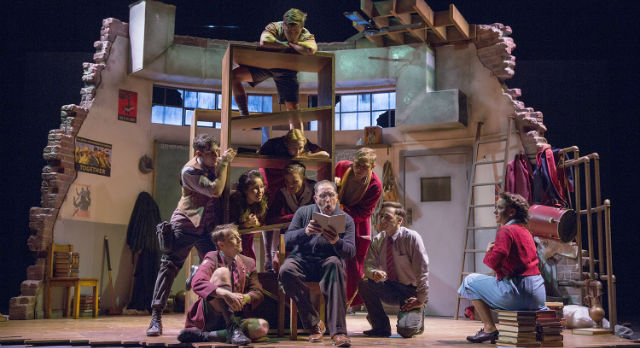
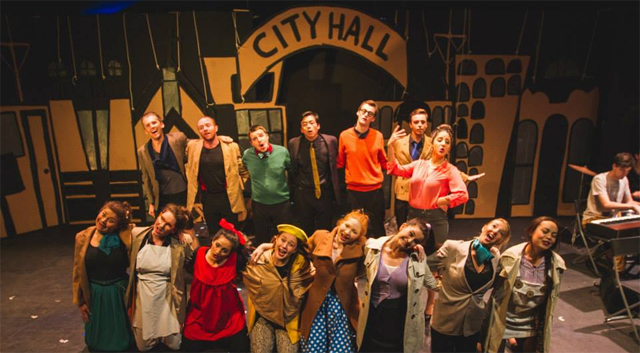
In Rehearsal: Sugarland

Rehearsal images above by Gez Xavier Mansfield and Kar Publicity from Sugarland,
by Rachael Coopes and Wayne Blair.
At ATYP, from Aug 27 – Sep 13, 2014.
More info at www.atyp.com.au

5 Questions with Megan McGlinchey

meganmcglincheyWhat is your favourite swear word?
Bullshit.

What are you wearing?
Jeans.

What is love?
Zero zero in tennis.

What was the last show you saw, and how many stars do you give it?
Constellations and I would give it 5 stars.

Is your new show going to be any good?
Yes, sir.


Megan McGlinchey stars in Gruesome Playground Injuries, part of Sydney Fringe 2014.
Show dates: 24 – 28 Sep, 2014
Show venue: TAP Gallery

Review: Danny And The Deep Blue Sea (Little Spoon Theatre Co)

littlespoonVenue: Roxbury Hotel (Glebe NSW), Aug 22 – 30, 2014
Playwright: John Patrick Shanley
Director: Fiona Hallenan-Barker
Music: Ed Gain
Cast: Wade Doolan, Karli Evans

Theatre review
Love and human connection are sacred. They come easily to some, but remain elusive to others. John Patrick Shanley’s Danny And The Deep Blue Sea shows us two downtrodden souls Roberta and Danny, both desperate and lonely. We witness their efforts at discovering a life beyond their personal darkness, commencing with a chance meeting at a depressed bar in the middle of a poor Bronx neighbourhood. They find hints of contact, but each meaningful moment perishes, and every brief instant of radiance dissolves back into gloom.

The production is staged in a makeshift theatre at the Roxbury Hotel, located just outside of Sydney city. The space is quartered, so that performances take place along two channels that intersect in the room’s centre. It is an unusual location, so it makes good sense to resist creating a conventional proscenium aspect, but the actors’ faces are often obscured and losing that precious perspective is disappointing. Fortunately, both actors Karli Evans and Wade Doolan, are intense and focused, and they conspire with the venue’s intimacy to manufacture a beautifully transportative experience that takes us to spheres of secrecy and revelation.

Evans and Doolan are individually captivating, and their chemistry is excellent. Scenes of conflict later in the piece are dynamic and daunting at close range, but less effective are earlier sections that require a lighter, more humorous touch to allow greater identification from the audience. Their stories are dark, and we need to be invited into their worlds with a little more warmth. There probably will always be a sense of alienation to this story, but it needs to capture our emotions more firmly at the start before it unleashes its tumultuous dramatics.

Tales of hope and salvation are important for art and the society to which it belongs. Artists find inspiration, so that they can themselves provide inspiration to their public. Roberta and Danny represent the sadness and regret that persist in our lives, but more significant is the unexpected bravery that surfaces from their interaction. Who knows what it truly means to love, but when two people collide and engender a wonderful joy that had been hitherto impossible, that phenomenon feels quite a bit like magic.

www.littlespoontheatre.com