Review: Little Borders (Old 505 Theatre)

Venue: Old 505 Theatre (Newtown NSW), Jul 4 – 15, 2017
Playwright: Phillip Kavanagh
Director: Dominic Mercer
Cast: Lucy Goleby, Brandon McClelland
Image by Kate Williams

Theatre review
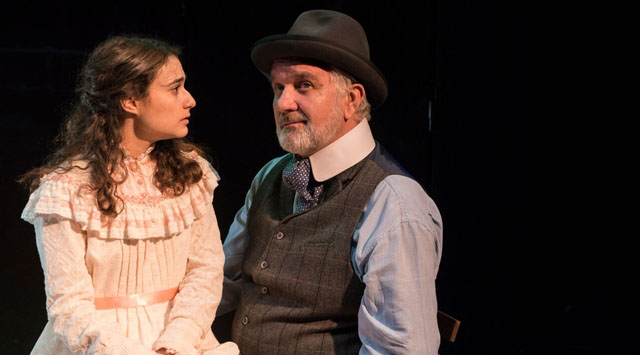
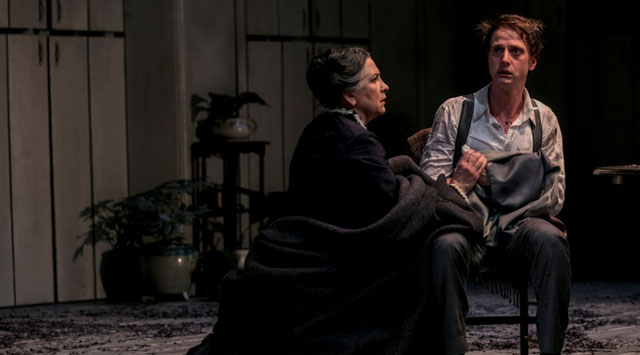
Elle and Steve are moving houses, because they have convinced themselves that their Middle Eastern neighbour is a terrorist. Little Borders by Phillip Kavanagh, is about the paranoid, fearful and narcissistic people that many of us have become, in a confused world that has us believe that things will go wrong in an instant, and that other people are to blame.

The young couple is bestowed every social and economic privilege that could give them the best opportunity at a comfortable existence, yet they are full of volatility and hostility, obsessed with the idea that their lives are going to fall apart at any given moment. Their self-destructive behaviour is depicted with biting astuteness by Kavanagh, who reveals the insidious nature of hate in our contemporary communities.

The production is suitably dark, if slightly too predictable in its despair. The important messages of Little Borders are given remarkable elucidation by director Dominic Mercer, and we leave shaken by our disastrous reflection, but the show has a tendency to feel too safe and slightly unambitious in its interpretations of Kavanagh’s bold writing. We sense that the words provide room for a greater theatricality, although its minimalism is nonetheless effective, and beautifully executed. Set design by Charlie Edward Davis and Jeremy Allen, is understated but charming, and undeniably memorable.

Actors Lucy Goleby and Brandon McClelland prove themselves to be highly accomplished in the piece. Goleby’s intensity, although quiet and contained, is a captivating study of Elle, a woman gripped by insecurity and irrational anxiety. She keeps us inquisitive, and terrified, by her authentic manifestation of a person that we sometimes find ourselves being. McClelland is a charismatic presence, with immaculate hair and perfect teeth providing disguise for a character that has no redeeming features. His juxtaposition of clean cut suburban wellness against the pure evil of Steve’s words and actions, is chilling, and perversely entertaining.

It is a frightening look at the psyche of our worst neighbours. The play resonates with an alarming accuracy, even though the events that unfold are very dramatic and extreme. It is truthful in what it says about modern life; the interminable feeling of inadequacy, and the need to infringe upon the lives of others, as we proceed to suppress everything that we have no understanding of. We are not told however, how it is that Elle and Steve have become such monsters; Kavanagh’s deliberate omission is provocative. We should really know those reasons for ourselves. These are our middle class lives, and we know these people. All the evidence that would explain their madness must already be in plain sight, if we choose to examine it.

www.old505theatre.com

Review: Cloud Nine (Sydney Theatre Company)

Venue: Wharf 1 Sydney Theatre Company (Walsh Bay NSW), Jul 1 – Aug 12, 2017
Playwright: Caryl Churchill
Director: Kip Williams
Cast: Matthew Backer, Kate Box, Harry Greenwood, Anita Hegh, Josh McConville, Heather Mitchell, Anthony Taufa
Images by Daniel Boud

Theatre review
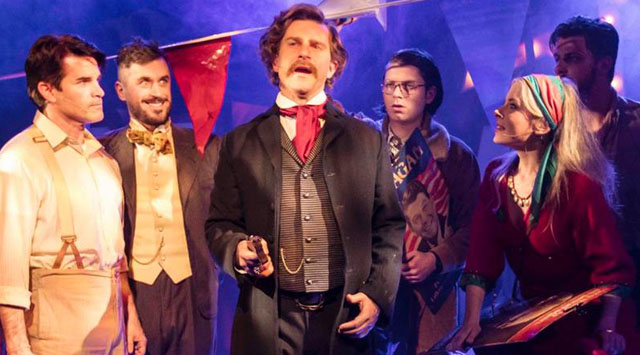
Betty takes a long time to grow up. In fact, it is centuries before she becomes her own woman. In Act I, she lives in Victorian era Africa, having moved from Britain with her husband, a “colonial administrator”. In Act II, we find that not only has she advanced in age, time itself has moved abruptly to the current day.

Caryl Churchill’s Cloud Nine is about the way gender, with all its associated contrivances and constraints, is imposed upon individuals in Western societies, ruthlessly reinforced time and time again, in service of a white patriarchal project that seems to have no beginning and no end. It is a scheme that benefits few, and as we see in the play, no one is left unscathed by its oppressive nature.

The absurdities inherent in the practice of gender and whiteness, are shrewdly re-purposed for all of Cloud Nine‘s outrageous comedy, as well as its very scintillating drama. Churchill’s creation might be near on 40 years old, but its uncompromising boldness remains deeply affecting. Ensuring that the work’s confrontational qualities are retained, is director Kip Williams who pairs a flamboyant theatricality with a keen eye for detail, to deliver a show that is as entertaining as it is challenging, and quite surprisingly, profoundly moving.

Actor Heather Mitchell is phenomenal in the production. Playing Betty in Act II, and Betty’s young son in Act I, she works her magic to elicit our compassion, demanding that we respond with the best of our humanity, even when her characters are going through the most precarious of story lines. Whether playing a woman her own age, or a boy of nine, we believe all that she offers, and allow her to take our emotions on an intense but rewarding ride.

Also very memorable is Josh McConville, effortlessly but uproariously funny, again in dual roles of adult and child. As Betty’s husband Clive, he amuses us without giving access to any empathy for his despicable character, and as little Cathy, we fall for the wonderful innocence and irresistible cuteness he introduces, never mind that he looks nothing like a 5 year-old girl. The show is remarkably well-performed. Each member of the ensemble feels a star, and we connect with every personality being presented.

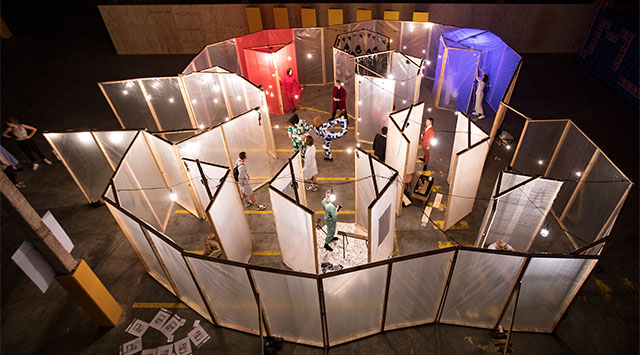
A pristine glass box sits upstage, tightly shut, desperately trying to enclose and protect itself. Representing a Western civilisation that insists on maintaining its incongruity with nature, Elizabeth Gadsby’s set design is a simple concept that speaks volumes. Times can change, and our societies have made progress, but that instrument of containment stays resolutely in place. As our efforts to erode structures of injustice and inhumanity continue, and as we observe transformations occur slowly, we can reach for ourselves, the experience of personal emancipation, so sweet, so wonderful, even if it is actually, no more than a state of mind.

www.sydneytheatre.com.au

Review: The Rover (Belvoir St Theatre)

Venue: Belvoir St Theatre (Surry Hills NSW), Jul 1 – Aug 6, 2017
Playwright: Aphra Behn
Director: Eamon Flack
Cast: Gareth Davies, Andre de Vanny, Taylor Ferguson, Leon Ford, Nathan Lovejoy, Elizabeth Nabben, Toby Schmitz, Nikki Shiels, Kiruna Stamell, Megan Wilding
Image by Anna Kucera

Theatre review
It is mid 17th century, and a bunch of rowdy English tourists descend upon Naples to partake in the masqueraded festivities of Carnival time. Aphra Behn’s depiction of wild revelry may be restricted by mores of the Restoration era, but its spiritedness is nonetheless unmistakable. In its atmosphere of debauchery, the characters talk of love and marriage, preoccupied with the sport of spouse hunting.

The play is conventional, but as the production’s prologue asserts, we cannot ignore Behn’s position as England’s first woman playwright, or the feminine perspective that her work brings to the stage. Although women are again, and literally, divided into virgins and whores in The Rover, they each act with agency, and their desires are provided due significance. Whether nuns or courtesans, we always know what it is that they want for themselves, and we watch them going about procuring what are essentially self-determined lives.

Director Eamon Flack delivers a thoroughly enjoyable work of high octane comedy, playfully inventive in approach, and unabashedly raucous with its expressions. Details can become confused, as the show’s humour takes first priority, but narratives are of slight importance in a show of this nature. It dazzles and it delights, with Mel Page’s brilliant work as set and costume designer scoring high; the imagery presented by The Rover is deliciously colourful and consistently alluring. Lights by Matt Scott are jaunty and energetic, with the inclusion of a “follow spot” enhancing the vaudeville quality of performances.

It is a remarkable cast, unrelenting with their extraordinary exuberance and skill. Flack showcases each of the player’s idiosyncratic sense of humour, while maintaining a cohesion to the comedy style of his creation. Megan Wilding is a standout in dual roles, seductive as the saucy temptress Lucetta, and delightfully foulmouthed as the maid Moretta, but always irresistibly funny and disarmingly magnetic, no matter the personality we encounter. As the charming cad Willmore, Toby Schmitz is a refreshing presence, theatrical but with a striking spontaneity that introduces a hint of danger, to the inevitable predictability of the story.

American comedian Beth Stelling says, “nothing makes a dick go softer than a funny woman.” The fallacious idea of women being less effective in comedy, still persists, but in The Rover, five comical women and five humorous men demonstrate that the funny bone recognises only talent, unconstrained by notions of gender. From Shakespeare to Gogol, and from Chaplin to Gervais, male geniuses have staked their dominance in the field. Spaces in art, like in commerce and politics, continue to be usurped by the masculine, but feminine retaliation is underway, as it has for generations, in this seemingly unending operation. After all, a woman’s work is never done.

www.belvoir.com.au

Review: 1984 (Sydney Theatre Company)

Venue: Roslyn Packer Theatre at Walsh Bay (Sydney NSW), Jun 28 – Jul 22, 2017
Playwrights: Robert Icke, Duncan Macmillan (based on the George Orwell novel)
Directors: Robert Icke, Duncan Macmillan
Cast: Molly Barwick, Paul Blackwell, Tom Conroy, Terence Crawford, Coco Jack Gillies, Ursula Mills, Renato Musolino, Guy O’Grady, Yalin Ozucelik, Fiona Press
Image by Shane Reid

Theatre review
People often look back at calamitous histories, and are grateful that they had emerged unscathed. In Robert Icke and Duncan Macmillan’s version of 1984, dystopia is not only an imagined future, but also a tragic past that its characters are happy to have left behind. When the worst is over, we think that life returns to a state of healthy normalcy. We choose to believe that those who had committed atrocities are wiped away, and all is good in the world again.

In our need to survive, memory has to become elastic. Self-preservation necessitates that we forget the painful, and in the case of 1984, forgive the unforgivable. Facts are erased, so that ideologies can dominate. The play portrays a simultaneous past and future, but its concern is firmly on the now. It believes in an essential sense of truth, along with the human tendency to obfuscate those truths, in order that power may be won and lost.

With obvious parallels with current political events, it is tempting to say that Orwell’s story is more pertinent today than ever before, but societies have never been pure. Certainly, technology does play an important part in how we control one another, but long before the discovery of electricity, men had sought to suppress thought and expression, with the sole intention of gaining influence and authority. Using lies as apparatus and methodology, devious personalities have risen to positions of leadership, while the rest of us are turned complicit, through acquiescence, obedience and silent surrender.

It is a sleek production, conceived and executed with an admirable sophistication. Orwell’s philosophical interests are powerfully presented, translated from book to stage effectively, though not always with great clarity. The protagonist Winston’s existence is a confused one, and on certain levels, we are accordingly, perhaps appropriately, bewildered. Its messages are unambiguous, however, with all of 1984‘s prominent themes and ideas, articulated emphatically, with conspicuous relevance and urgency.

Chloe Lamford’s scenic design transforms Orwell’s original futuristic outlook into a retrogressive frame of reference; after all, we are now looking at the world 33 years ago. Lights by Natasha Chivers and sound design by Tom Gibbons, play integral roles in the brutal depiction of ruthless tyranny. The assault on our senses is indeed severe, with aggressive noises and strobes unrelenting in trying to seize our nerves and inflict terror.

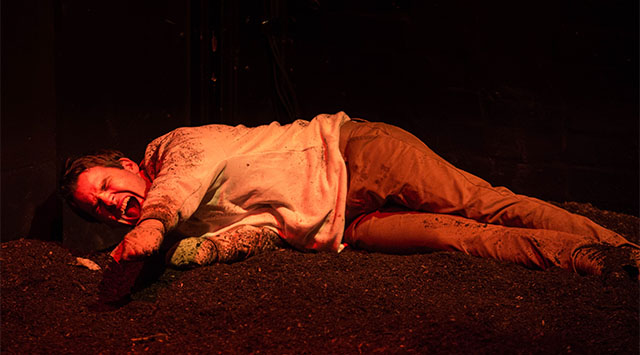
Actor Tom Conroy has the unenviable task of performing Wilson’s extended suffering, including a lengthy scene featuring quite gruesome physical torture. His work is painfully convincing, and the vulnerability he brings to the role, insists that we are affected by all his adversities. Terence Crawford turns up the drama as the frighteningly menacing O’Brien. His operatic approach to the enigmatic personality seduces us, keeps us on edge and captivated, as the play’s savagery escalates.

The deep pessimism of 1984 demands a strong response. It aims to provoke us into radical thought, if not radical action, with its revelations about a world ruled by evil. We think about governments, religions and corporations, the insidious ways in which they impact upon our lives, how they encroach upon our liberties, and the deficiencies of our resistance. Survival requires degrees of submission, but within any submission, the spirit of defiance can always be found, whether minuscule or vigorous, to spark a change that could pivot the course of history, one can only hope, for the better.

www.sydneytheatre.com.au | www.1984play.com.au

Review: Sunset Strip (The Uncertainty Principle / Griffin Theatre Company)

Venue: SBW Stables Theatre (Kings Cross NSW), Jun 14 – Jul 1, 2017
Playwright: Suzie Miller
Director: Anthony Skuse
Cast: Emma Jackson, Simon Lyndon, Lex Marinos, Georgina Symes
Image by Patrick Boland

Theatre review
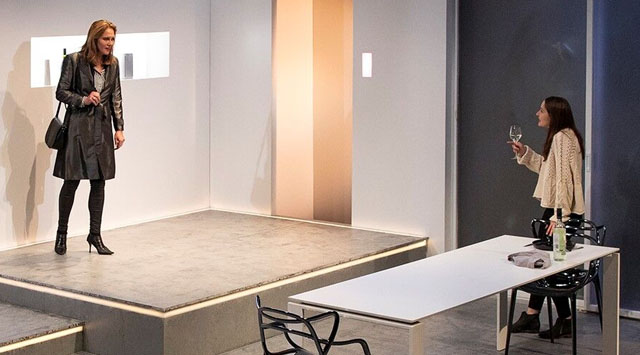
Phoebe has lost custody of her children, due to a history of illicit drug use. Her sister Caroline has been battling cancer, while dealing with a relationship breakup. Their father Ray is suffering dementia. Life is hard, as we well know, but it is not all doom and gloom with these sisters. They are determined to get on with it, making the best of the cards they were dealt.

In Sunset Strip, playwright Suzie Miller brings a family together at a time when they are in desperate need of each other’s support. None of them realises this kindred reliance of course, for it is easy to take these relationships for granted, and like many of us, Phoebe and Caroline have resentments, jealousies and unresolved issues from the past, so their reunion was always going to be precarious.

Miller’s detailing of that delicate balance, between joy and pain in how they love, is full of tenderness, subtle but powerful. Their interchanges are nuanced, splendidly complex, and always with a gentle, familiar ring that will remind us of our own homes. When families talk, it is what we say between the lines that matters most, and Sunset Strip‘s sensitive explication of those dynamics, is what makes it feel like every person’s story.

Director Anthony Skuse’s quiet approach to storytelling is a perfect fit for the play. In this intimate venue, the drama envelopes as it unfolds, and we fall deeper and deeper into its emotional grip. Skuse’s work for Sunset Strip transcends the need for a dominant narrative, getting us to the heart of its characters by simply presenting four individuals who are so thoroughly authentic and vulnerable, that finding a meaningful connection with them is inevitable. This is theatre at its most moving (sans manipulative show tunes and fantastical storylines), made even more affecting by audience members sobbing uncontrollably in neighbouring seats.

Emma Jackson and Georgina Symes play the siblings, both laid bare spectacularly, allowing us to peer right into their fractured souls. The part of their ailing father is performed by Lex Marinos, who has us transfixed in the precision of his approach, and heartbroken by his depiction of a parent who can no longer provide guidance and care. Simon Lyndon is the love interest who offers much more than meets the eye, with an ability to introduce disarming and devastating poignancy, when you least expect it. These actors are truly wonderful.

No amount of love, can prevent people from growing apart, but it is in the capacity to make sacrifices, that the depths of love is revealed. Love is not about holding tight, in fact, it is more often about letting go, but there will come moments where people are required to sit together, maybe to laugh, or maybe to fight, so that love can do its job. When life turns too hard, loneliness will only add fuel to fire. Not every problem will have solutions, but a warm embrace makes everything, miraculously, easier.

www.griffintheatre.com,au

Review: Cyrano De Bergerac (Sport For Jove Theatre)

Venue: Seymour Centre (Chippendale NSW), Jun 15 – 24, 2017
Playwright: Edmond Rostand (adaptation by Damien Ryan)
Director: Damien Ryan
Cast: Andrew Johnston, Barry French, Bernadette Ryan, Christopher Stalley, Christopher Tomkinson, Damien Ryan, Drew Livingston, Francesca Savige, James Lugton, John Turnbull, Julian Garner, Lizzie Schebesta, Madeleine Jones, Melanie Dobson, Thom Blake, Tim Walter, Wendy Strehlow
Image by Phil Erbacher

Theatre review
Women, no matter how intellectual or beautiful, are not to be trusted with their own decisions in Cyrano De Bergerac. Edward Rostand’s 120 year-old play is a romantic fantasy about an ugly man who successfully deceives and misleads the object of his desire, so that his feelings can be reciprocated. His nose, of legendary proportions, clearly does not stand in the way of human vanity.

Roxanne’s lust for the handsome Christian, is presented as foolish and absurd, hence illegitimate, in the old-fashioned play, because of course, the verbosely articulate Cyrano is the appropriate match, if a girl is to experience true love. Women are once again infantilised, and our sexuality subjugated, in order that patriarchal ideals can be presented as superior.

Tiresome ideologies of the original are retained in this recent adaptation, but there is no doubt that Damien Ryan’s remarkable wit and extraordinary talent with words, have polished up Cyrano De Bergerac, rolled it in glitter, and all but blinds us from its inferior politics. Ryan’s work is supremely clever, often very beautiful, and for the many who find enjoyment in its brand of outlandish romance, this is a play that will prove deeply satisfying.

Ryan’s work as actor too, is marvellous. Brilliantly funny, and irresistibly charming, he convinces us that sexual attractiveness is completely irrelevant, and that Cyrano is the only man for Roxanne. Lizzie Schebesta expends her efforts into the side of Roxanne that is repeatedly emphasised to be intellectual, and does all she can to elevate the role from the embarrassing gullibility that is Rostand’s creation. It is a very vivacious cast, relentlessly amusing, and audiences will be held captive for its entire 3.5 hour duration.

There are no big pertinent messages in Cyrano De Bergerac that need our urgent attention. We can certainly be entertained by other much more relevant stories, but this French play continues the perseverate tradition of European occupation of the arts in Australia. For over two centuries, we import these works, as though the purposes they serve are somehow irreplaceable or worse, more resonant than what we can find in the art of our own region. It offers an accurate reflection of the ongoing attitude of colonisation that persists (why else would all 18 actors on this stage be of Caucasian appearance?), even though we wish to think ourselves a modern, progressive and inclusive society.

www.sportforjove.com.au

Review: Slut (Old Fitz Theatre / Edgeware Forum)

Venue: Old Fitzroy Theatre (Woolloomooloo NSW), May 23 – Jun 3, 2017
Playwright: Patricia Cornelius
Director: Erin Taylor
Cast: Julia Dray, Bobbie-Jean Henning, Jessica Keogh, Danielle Stamoulos, Maryann Wright
Image by Clare Hawley

Theatre review
For the girls in Patricia Cornelius’ Slut, nothing is more important than being popular. That hunger to be liked, by all and sundry, is a curious thing that many possess, and in Cornelius’ play, we explore the way teenage girls are socialised to place unparalleled value on attention, admiration and approval. We are at school, and Lolita is the first of five good friends, to bloom. Her breasts develop and the world begins to sexualise her, long before she feels those urges for herself.

She encounters lascivious attention, and learns to reciprocate. There is something powerful in being seen, and the effect of that recognition, and the accompanying scrutiny, becomes all-consuming. Lolita pursues that gaze with a frightful ferocity, quickly learning that her worth resides squarely in her ability to be objectified in that uncompromisingly sexual manner. She comes under attack, predictably, by her peers who consider her a pariah, after having previously marvelled at her new-found power. As a result, she discovers a deep and detrimental shame, and attaches it firmly to her sexual nature.

It is a cruel existence that Lolita has to endure, and director Erin Taylor’s portrayal of that brutality is certainly vivid. The production is rhythmically precise and in its half-hour duration, we are thoroughly captivated by all that it wishes to communicate. All five actors are very strong and the tautness of their performance is highly enjoyable, although it must be said, that the roles are undeniably simplistic. Jessica Keogh’s depiction of Lolita is suitably vivacious yet tragic, perfectly presenting the playwright’s perspective of a victimised and very sad protagonist.

It is unfortunate that Lolita never manages to negotiate between friendships and her sexual dominance. That the play structures the two as being mutually exclusive, is perhaps an accurate observation of what happens in our high schools, but the lack of nuance in this representation creates an impression that can feel overly convenient. The absence of parental figures is also a glaring omission that is never explained. If our young is left in the wild to fend for themselves, we can be sure that disasters will happen, but our society knows its duty of care. Slut talks about the way our girls cause harm to one another, but it is our guidance, not their ignorance, that should be questioned.

www.facebook.com/…

Review: Jatinga (Bakehouse Theatre Company)

Venue: Kings Cross Theatre (Kings Cross NSW), Jun 9 – 24, 2017
Playwright: Purva Naresh
Director: Suzanne Millar
Cast: Sapna Bhavnani, Karina Bracken, Claudette Clarke, Jarrod Crellin, Faezeh Jalali, Sheila Kumar, Suz Mawer, Bali Padda, Monroe Reimers, Trishala Sharma, Teresa Tate Britten, Amrik Tumber
Image by Natasha Narula

Theatre review
In the north-eastern region of India, a tourist hot-spot exists in the village of Jatinga, known for the mysterious phenomenon of birds plunging to their death, every year after the monsoon season. In Purva Naresh’s play Jatinga, it is the phenomenon of “runaway girls” that takes focus. Journalist Madhumita discovers five young women escaping harrowing fates, and in her efforts to publish a story that draws attention to their plight, she finds herself thinking like villagers hungry for tourism dollars, deciding whether to resort to sensationalism, in order that the greater good can be served.

The play is purposeful, and undeniably powerful. Addressing issues of poverty, Jatinga is relevant to audiences of all nations, at a time when economic inequality is a serious social concern. We may not suffer the same symptoms in the developed world, but the fact that the refugee crisis is unsolved and escalating, and that we continue to obsess over “terrorist threats”, show that persistent disparities, that our first-world systems thrive on, are creating problems that have landed us in a state of emergency. The rich will always want the poor separate and contained, but the poor can often break through the barriers of money. Radical action is always an option, when people have nothing to lose.

The women in Jatinga tell simple stories, but the production is strangely convoluted. Shifting timelines and interweaving narratives provide a sense of theatricality, but unnecessary confusion often gets in the way of our empathy. The show must be lauded however, for not turning to “disaster porn” to keep us engaged. The women are victims, but they are also spirited and strong individuals. Director Suzanne Millar’s resolve in portraying them as such, is certainly admirable.

An excellent cast, wonderfully cohesive, perform a colourful work replete with vigour and sincerity. Suz Mawer is captivating, and tremendously persuasive, as the journalist Madhumita. Her thorough authenticity holds the piece together, even though the stakes are admittedly lowest for the character she portrays. Also noteworthy is Nate Edmondson’s work on music, transportative and transformative in its effect, from scene to scene.

When the birds take to suicide, we wish for it to be an act of nature, and convince ourselves that things stay in balance with their sacrifice. Murmurs of the birds actually being killed by villagers, are disregarded by the tourists who wish to witness something romantic and extraordinary. We bury the truth, in order that our fabricated realities can be sustained. We want to think that refugees have proper channels to seek asylum, and we want to believe that terrorists are mentally ill. We insist that the poor only need work harder to create better lives, and we sweep the truth under carpets, sit back and watch as towers are burnt to ashes.

www.bakehousetheatrecompany.com.au

Review: I Love You Now (Darlinghurst Theatre Company)

Venue: Eternity Playhouse (Darlinghurst NSW), Jun 9 – Jul 9, 2017
Playwright: Jeanette Cronin
Director: Kim Hardwick
Cast: Jeanette Cronin, Paul Gleeson
Image by Robert Catto

Theatre review
The stage is disguised as a hotel room, and two actors play out a series of infidelities in short episodes. The fragments are unified by the amorous theme, but how they fit together as a complete entity is the creative, and intriguing, challenge it presents to its audience. Jeanette Cronin’s I Love You Now takes conventional stories and puts them in a poetic structure, so that the telling of an ordinary tale, can lead to the discovery of greater meanings in everyday life.

Things happen, forming chaotic and arbitrary moments, but the human mind has an insatiable need for narratives. We make connections between incidents, and are determined to read into things, as though the urge to understand, is as basic and inexorable as breathing. While we attempt to make coherence of the scenes as they unfold in I Love You Now, we find ourselves beginning to fall in love instead, with transience. Sure, it is possible to formulate a whole of the parts, but it is really the fleeting moments of beauty and genius that gives us nourishment. Our impulse is to dedicate our attention to a big picture, but what is of greater satisfaction, are the minute occurrences that can so easily slip away, if we do not let go of the desire to be master of every situation.

Director Kim Hardwick’s task is to find balance and harmony in the storytelling, so that appropriate weight is assigned to each of the play’s divergent intentions and concerns. The writing presents many possibilities, and Hardwick demonstrates great sensitivity and fortitude, in her ability to mine for resonance in the many unexpected corners of I Love You Now, persuading our minds to find appreciation for the layer upon layer of ideas and observations, that constitute this deeply textured work of art.

A remarkably polished production, with Isabel Hudson’s set design creating a very solid first impression (the hotel room is glamorous and incredibly convincing), and Martin Kinnane’s lights speaking softly but intricately, the visuals are sumptuous but never obtrusive. As though providing accompaniment to singers centre stage, music is performed live, by Max Lambert and Roger Lock, whose instincts compel us to remain engaged with the play, even when it veers off to slightly obtuse places.

Cronin herself takes on the female roles, while Paul Gleeson is the masculine counterpart. Both are fabulously accomplished; impressive with the complexities and elegance they bring to the show, and as a couple, their infallible chemistry is the main drawcard. It is always what happens between them that is captivating, and important. We watch how they treat each other, listen to the way they speak to one another, inside this room of secrets, and through a range of characters and their clandestine intimacies, our own fires of curiosity and passion, are stoked back to life.

www.darlinghursttheatre.com

Review: Djuki Mala (Sydney Opera House)

Venue: Sydney Opera House (Sydney NSW), Jun 13 – 18, 2017
Director: Joshua Bond
Choreographers: Nikki Ashby, Joshua Bond, Lionel Garawirrtja
Cast: Wakara Gondarra, Baykali Ganambarr, Watjarr Garmu, Didiwarr Yunupingu
Image by Daniel Boud

Theatre review
Hailing from north-eastern Arnhem Land in the Northern Territory, Djuki Mala comprises a group of Aboriginal men who showcase their proud Yolngu culture through traditional and contemporary dance. Between the live action, video projections featuring interviews with the dancers and their maternal figures, provide background information that help us contextualise the lives being showcased on stage.

As the show progresses, significant influences from American culture, from Michael Jackson to Gene Kelly, become markedly present. Westernisation is a facet that insists on being incorporated into every Australian existence, but the purity of Yolngu heritage remains, even at the dance’s more colonised moments. Joy will persist, regardless of our oppressors’ intentions and efforts.

Whether the segments are choreographed to be quiet or rambunctious, this magnetic cast of five, bring a sense of celebratory spiritedness to all that they present. It is an enthusiasm that is tremendously infectious, and never fading. The greatest beauty of Djuki Mala lies in the luminous optimism of the people being represented, and the resilience that we witness. Successful Indigenous lives are evidence of a resistance that is ongoing and untameable, and these carefree dancers demonstrate that the best revenge is a life well lived.

www.djukimala.com