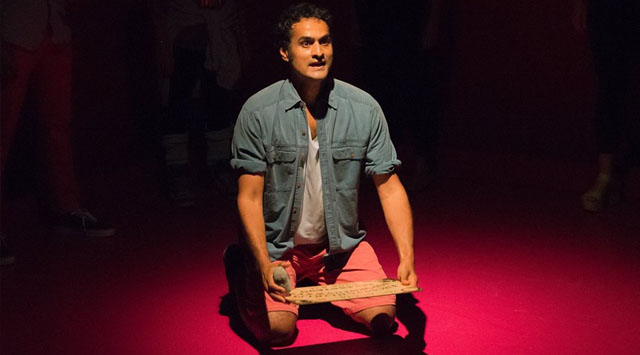
Review: Faith Healer (Belvoir St Theatre)

belvoirVenue: Belvoir St Theatre (Surry Hills NSW), Oct 22 – Nov 27, 2016
Playwright: Brian Friel
Director: Judy Davis
Cast: Colin Friels, Pip Miller, Alison Whyte
Image by Brett Boardman

Theatre review
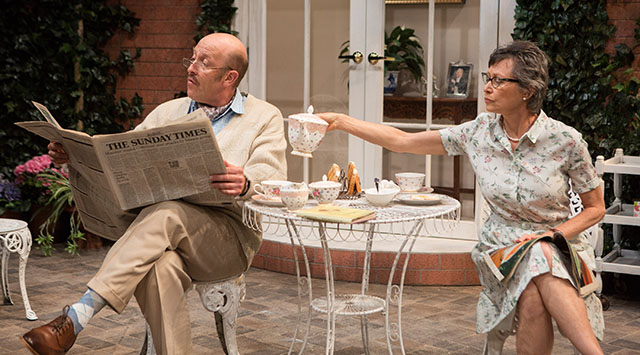
Frank makes his living as a faith healer, travelling all over Britain with a performance that showcases his charismatic arrogance, and sometimes actually, miraculously healing people in the process. There are serious troubles in private however, but none of his energy is put into finding a cure for the suffering at home. Brian Friel’s play is meandering, and often obscure, with its Rashomon style of getting at the truth by taking us through layers of subjectivity and delusions, in a simple format of successive monologues.

Three characters, speaking in distinctive voices, help us piece together a puzzle that is both confusing and intriguing. Talent manager Teddy’s warm candour is endearingly portrayed by Pip Miller, who captivates with a precise and dynamic approach. The vividness of his storytelling is inviting, and contrasts with Frank’s enigmatic style that can often alienate, in spite of actor Colin Friels’ powerful presence. The shamanic showman’s life is occupied by smoke and mirrors, and his penchant for embellishments and denials have us mystified even when his followers are kept mesmerised. In the role of Frank’s wife, Grace, is Alison Whyte, impressive with an extraordinary emotional agility, perfect for a character replete with volatility.

Director Judy Davis insists that we watch closely at the cast, but her stagnant presentation is demanding of us, and probably excessive in its minimalism. Design however, is noteworthy, with a spectacular cyclorama by Brian Thomson depicting a wide variation of cloudy skies, transforming with every one of Verity Hampson’s lighting changes. The weather we see in the backdrop is often the most truthful element on stage.

When Frank’s audience falls into his concoction of fiction and non-fiction, they are willing participants in a show, all wishing to believe. When people turn to the faith business for salvation, it is because tall tales feel more real than reality. The afflicted come to Frank for a cure, but more accurately, what they seek most is certainty. A life of doubt and ambiguity is unbearable, and the allure of faith lies in its ability to turn hope into surety. When the whole world turns cruel, comfort can only come from the extraterrestrial.

www.belvoir.com.au

Review: Othello (Bell Shakespeare)

bellshakespeareVenue: Sydney Opera House (Sydney NSW), Oct 25 – Dec 4, 2016
Playwright: William Shakespeare
Director: Peter Evans
Cast: Ray Chong Nee, Joanna Downing, Alice Keohavong, Edmund Lembke-Hogan, James Lugton, Huw McKinnon, Elizabeth Nabben, Yalin Ozucelik, Michael Wahr
Image by Daniel Boud

Theatre review
As the saying goes, “well behaved women seldom make history”. Desdemona and Emilia are slaughtered by their respective husbands after displaying only wifely devotion, as well as prudent decorum to all and sundry in Othello. It is not a battle of the sexes in the play, for there is nothing that resembles a level playing field, but an examination of tyrannical brutality against women, and the treatment of women, in art and in society, as mere objects and possessions. Toxic masculinity is the villain, and it resides in every one of the play’s male characters. Jealousy and egotism are their driving force, and great drama certainly does ensue, along with observations on some of our ugliest traits as human beings.

It is a remarkably well-rehearsed production, with director Peter Evans’ innovative ideas keeping things fresh and relevant for contemporary audiences. Imagery is often beautifully manufactured; Evans’ efforts at adding visual resonance to Shakespeare’s text is admirable, especially noteworthy in Cassio’s “party scene”, involving strobe lights and levitating cask wine bladders. Lighting design by Paul Jackson is thoroughly adventurous, and relied upon heavily for scene transitions and atmospheric transformations, in the presence of a very minimal set, consisting little more than a big wheely table that is manoeuvred around the stage for a large portion of the show, breathtaking when effective, but unbelievably jarring when at its worst.

The cast is polished and energetic, but the show suffers from portrayals of very big emotions that are not necessarily persuasive. Ray Chong Nee is a stately and handsome Othello, perfect in his depiction of the character’s noble qualities, and enthralling as a romantic figure in the early sequences, but Othello’s descent into darker barbaric emotions is significantly less convincing. Bad guy Iago is powerfully performed by Yalin Ozucelik, charismatic and full of conviction, in a role that gives the plot its strongest propulsive vigour. Although slightly lacking in texture, the actor’s work remains captivating, with a delicious Machiavellianism that makes for excellent entertainment.

It is reported that one woman is killed by her partner every week in Australia. When the women are slain at the bitter end, our attention is drawn squarely onto the behaviour of the perpetrators. We begin to wonder if much has changed over the last four centuries, and are disturbed by the thought that the lowest of our nature continues to persist through aeons of civilisation. Shakespeare’s Othello, is a man’s story for men. It is a tragedy with logic and consequences, where a black man is used, in a highly prejudiced manner, to demonstrate that primordial impulses can lead to catastrophe. Our salvation can lie only in the understanding of our destructive nature, and in every effort to restrain and reshape those instincts. If we choose to improve, life becomes better, but where we take the cowardly alternative, there can only be loss.

www.bellshakespeare.com.au

Review: The Turquoise Elephant (Griffin Theatre Company)

griffinVenue: SBW Stables Theatre (Kings Cross NSW), Oct 14 – Nov 26, 2016
Playwright: Stephen Carleton
Director: Gale Edwards
Cast: Catherine Davies, Maggie Dence, Julian Garner, Belinda Giblin, iOTA (pre-recorded), Olivia Rose
Image by Brett Boardman

Theatre review
The Turquoise Elephant takes place some time in the not so distant future. Temperatures in Sydney have gone up to 48 degrees, and people are still squabbling about how to, and whether to, fix climate change. The right and left wings of politics have gone completely extreme with their demands, allowing nothing to be achieved, and all the common person can do is either to take to the streets in inconsequential protest, or wallow in non-action.

Stephen Carleton’s writing is pessimistic, but also very funny. Madcap characters and outrageous dialogue make the play drip with irony, as it shows us ugly amplified visions of how we are today, as we fail at addressing environmental problems that are already prevalent. The plot is a simple one, by nature of its characters’ stagnation and inability to do anything useful, The Turquoise Elephant does not develop very far story-wise. Director Gale Edwards does spectacular work with her show’s comedy, highly effective in its flamboyant commedia dell’arte influenced approach, but scenes begin to feel repetitious toward the bitter end. The gravity of the play’s core message does not take hold with great vigour, although that could well be a result of the undeniable apathy that we are being accused of.

Actor Belinda Giblin is remarkably vivid in her portrayal of Olympia, the disaster tourist who takes perverse pleasure in witnessing the annihilation of our planet. Giblin is tenaciously larger than life, enthralling even when her character is asleep, making us laugh whether the material is broad or obscure. The cast is hugely charismatic, and uniformly enjoyable. Also remarkable is the production’s visual elements. Emma Vine’s wonderfully wild costumes inject a vibrant, deliciously sinister edge, while Brian Thomson’s set and Verity Hampson’s lights effectively depict decadent wealth with fantastic imagination and marvellous ingenuity.

Our climate calamity is news to no one. If the play says anything useful at all, it is that our habitual social divisiveness can be as destructive as the weather we fight about. As communities become increasingly accepting of class conflicts that come with drastically unequal wealth distribution and fanatical political polarities, we will be less and less likely to know how to solve problems. A lack of social cohesion may not be as dramatic an idea as glaciers melting or islands disappearing under water, but the danger it poses is no less serious.

www.griffintheatre.com.au

Review: The Days Are As Grass (Resource Performance Workshops / Stories About Humans)

depotVenue: The Depot Theatre (Marrickville NSW), Oct 19 – 29, 2016
Playwright: Carol Hall
Director: Jane Edwina Seymour
Cast: Richard Cotter, Christine Greenough, Susan M Kennedy, Kimball Knuckey, Sarah Plummer, Felicity Steel
Image by Clare Hawley

Theatre review
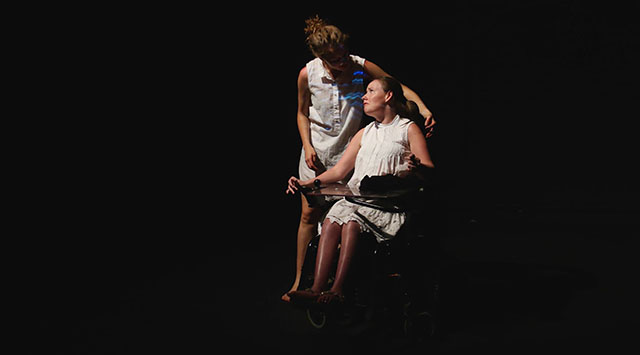
Eight short plays about life as older people, make up the anthology in The Days Are As Grass, covering a range of experiences, from the funny and frivolous, to the more sobering moments of our humanity. Carol Hall writes with humour, wisdom and extraordinary sensitivity, giving voice to Australian seniors, in a style that speaks to audiences of all ages. Its characters are vivid, and their stories refreshing. This collection of short plays is often surprising, yet their subjects always feel authentic (except, it must be noted, for the very unfortunate inclusion of only one person of colour, who ends up a thief).

Director Jane Edwina Seymour keeps the show visually basic, placing emphasis instead on the personalities and relationships that occupy centre stage with excellent conviction. Seymour’s flair for nuance ensures that we engage with the production meaningfully, and that we are charmed by her persuasive cast. Actors Kimball Knuckey and Felicity Steel are especially captivating, playing three roles each, vibrant and movingly vulnerable in every segment. Knuckey consistently delivers poignancy with the most subtle of approaches, while Steel impresses with her physical dynamism and intelligent comedy.

There is no better way to celebrate life, than to celebrate the process of ageing. A linear passage of time ensures that we can always learn from the mature constituents of our communities, if only we take the opportunity to listen. We often dream about foretelling the future, unable to realise that much of our tomorrow already exists in our parents and grandparents. In The Days Are As Grass, it is clear that there are willing participants in the all-important inter-generational dialogue, but those who stand to benefit most, need to pay attention.

www.rpworkshops.com.au | www.facebook.com/storiesabouthumans

Review: E-baby (Ensemble Theatre)

ensembleVenue: Ensemble Theatre (Kirribilli NSW), Oct 13 – Nov 13, 2016
Playwright: Jane Cafarella
Director: Nadia Tass
Cast: Danielle Carter, Gabrielle Scawthorne
Image by Clare Hawley

Theatre review
It is 2015, London-based attorney Catherine travels to Massachusetts and meets her pregnancy surrogate, Nellie. Jane Cafarella’s E-baby takes place over a period of 16 months, during which the two women communicate via the internet and phones. 30 years have passed since the first cases of surrogacy, and controversy around assisted reproductive technology has diminished considerably. We are no longer surprised to hear about people conceiving with medical help, and consequently, the play raises no eyebrows.

There are promising elements in the story, but it insists on shying away from a more explosive sense of drama. Both women’s personality flaws are clearly demonstrated, yet neither are allowed to turn into villains, in a play that tries too hard to always be nice. In its attempts to be fair and compassionate to both mothers, we experience little and learn even less. Catherine is self-absorbed and humourless, while Nellie is naively content within her ignorant and fervent religiosity. The show lets us recognise what motivates them, but struggles to help us care.

Humans do ridiculous things, and often, in our failure to explain why we do what we do, we risk feeling misunderstood and alienated. Catherine is unable to justify her unrelenting desire to procreate, and Nellie’s family is unconvinced that her actions are righteous. There are times in life when we are left isolated, with only personal desires as companion. What drives us, is a great many things, infinitely variable, but all valid, and when we choose whether or not to act accordingly, the consequences that follow must never be neglected. Catherine and Nellie believe that they come from a place of generosity but society will question their decisions in bringing innocent life to the world. We may remain unpersuaded, but there is no doubt that their perseverance is admirable. As we become increasingly cynical, it is important that we appreciate optimism and hope when we encounter it, because good things can sometimes be that needle in a haystack, and life is meaningless if we give up looking.

www.ensemble.com.au

Review: The Bitter Tears Of Petra Von Kant (Mophead Productions)

mopheadVenue: Old Fitzroy Theatre (Woolloomooloo NSW), Oct 11 – Nov 12, 2016
Playwright: Rainer Werner Fassbinder (translated by David Tushingam)
Director: Shane Bosher
Cast: Taylor Ferguson, Judith Gibson, Matilda Ridgway, Mia Rorris, Eloise Snape, Sara Wiseman
Image by Clare Hawley

Theatre review
In Fassbinder’s The Bitter Tears Of Petra Von Kant, we search for the meaning of love. Petra had just ended a marriage, but now finds herself enamoured with another. Through an examination on the nature of unrequited love, the play is an invitation to meditate on one of life’s biggest mysteries, by looking at the space between being in love, and being out of love. Petra has an object of desire, someone she obsesses over, who responds with nonchalance. Her devotion is both voluntary and involuntary, she gives of herself in hope of reciprocation, but continues to invest her all, even when the outcome is not as intended. She thinks only that her suffering bears a purpose of winning favour, but does not realise the masochistic pleasures that envelope the burning sensations of pain she thrives on.

The writing is phenomenally thrilling, and deeply important. Masochism is a pivotal part of our psyche, but we make little acknowledgement of it. In our human inability to be perfect, we all experience on a daily basis, the impulse to do what is not going to deliver the best results. Although we wish for a level of optimal performance in all the things we do, we are not machines, and we know that the instinctive tendencies to jeopardise are always strong. We are expected to be good, but really, we cannot stop from wanting to be bad. Our ethics prevent us from being destructive with the decisions we make at work, at home, in society, but when discussing the romantic and the carnal, destructiveness becomes personal and we have the right to choose how bad we wish to be. In his creation of Petra’s tragicomedy, Fassbinder reveals an honest aspect of humanity, and the inherent darkness of our existences. In our heroine’s pursuit of a very fiery love, she uncovers her true self, perfectly beautiful yet devastatingly vicious.

Sara Wiseman is resplendent in her warts and all portrayal of the title role. Operatic and visceral, it is a stunning performance of a woman in control, and out of control, overwhelmed by infatuation and lust, completely unhinged, motivated only by her own desires. Wiseman unleashes profound emotional and psychological accuracy that makes every debauched plot detail believable, along with a magnetic sensuality that has us entranced from beginning to end. Furthermore, it is not a narcissistic display that she puts on, but a thoroughly nuanced study of dynamics between Petra and the people around her, with the star manufacturing scintillating chemistry with every co-actor for a show that keeps us frothing at the edge of our seats. Also fabulous is Matilda Ridgway, sensational in an entirely speechless role but powerfully present at the periphery of every scene. Marlene is a controversial servant character, made even more confronting by Ridgway’s fierce dedication. It is a hugely impressive study of the only woman on stage who gets everything she wants.

The production looks sophisticated, severe and sexy. Georgia Hopkins’ set is executed with a confident minimalist edge, radiantly glamorous and intimidating in its strict glossy blackness. Shane Bosher’s direction breathes new, electrifying life into a play approaching its fiftieth year, proving that Fassbinder’s ageless legacy continues to be relevant and resonant, especially when it comes to issues of our libido. Bosher’s love of the strong female is magnificently showcased, with every woman bold and alluring in her uniqueness. His fetishistic depiction of Petra as Goddess, allows the show to bewitch and to inspire awe. The temptress and us, breathe the same air, but we are at her mercy, and anywhere she wishes to take us in the theatre, we must surrender, and revel in it.

www.mophead.com.au

Review: After The End (The Kings Collective)

thekingscollectiveVenue: Kings Cross Theatre (Kings Cross NSW), Oct 8 – 22, 2016
Playwright: Dennis Kelly
Director: Michael Abercromby
Cast: Josh Brennan, Grace Victoria
Image by Rupert Reid

Theatre review
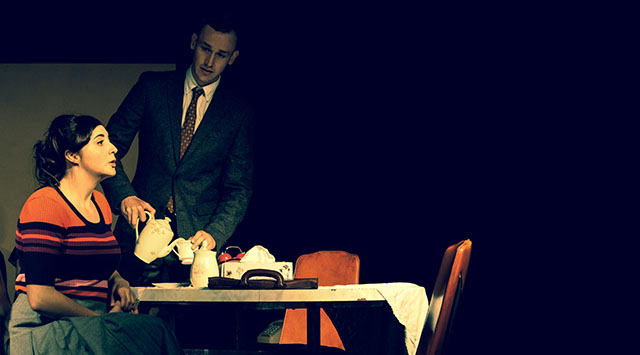
Louise and Mark are locked in a bunker. We are not quite sure how they got there, but we know that it is the male of the pair who is calling the shots. It could be the apocalypse, and the end of the world is a complex matter for those who survive. Dennis Kelly’s After The End is a quirky, but dark, story about the atrocities that happen in a world where nobody thinks that they’re the bad guy.

Although its contexts are dramatic, its plot is simple and unfortunately, a predictable one. There is discernible concerted effort put into creating tension for the staging, but only its later sequences are able to captivate, and when we do become engaged, it is the portrayal of violence that draws us in, rather than inherent ideas that can seem superficial, with insufficient provocative power. Some of the play’s mysteries could be more effectively manipulated, but both performers (Josh Brennan and Grace Victoria) are remarkably focused, well-rehearsed and enthusiastically present.

In After The End, a woman is made victim when she finds herself waking up in an environment completely controlled by a man. Unable to negotiate a renewal of circumstances that will provide a level playing field, Louise is forced into combat for the top dog position, squarely on Mark’s terms. Determined for his desires to dominate their microcosm, Mark’s impositions are a representation of the obstacles that feminists are up against, and reason for the deterioration of advancements that had been made. It is a pessimistic view that the play proffers, but an accurate depiction of a state of affairs where everybody loses, if we perpetuate that status quo.

www.thekingscollective.com.au

Review: Marat/Sade (New Theatre)

newtheatreVenue: New Theatre (Newtown NSW), Oct 5 – Nov 5, 2016
Playwright: Peter Weiss (translated by Geoffrey Skelton and Adrian Mitchell)
Director: Barry French
Cast: Tom Aldous, Kaiya Bartholomew, Andrea Blight, Debra Bryan, Lyn Collingwood, Garreth Cruikshank, Tahlia Hoffman Hayes, Tim De Sousa, Gregory Dias, Patrick Howard, Isaro Kayitesi, Mark Langham, Leilani Loau, Jim McCrudden, Lynn Roise, Emmanuel Said, Irene Sarrinikolaou, Alia Seror-O’Neill, Liam Smith, Peter Talmacs, Annette van Roden, Jacque Vickers
Image by Bob Seary

Theatre review
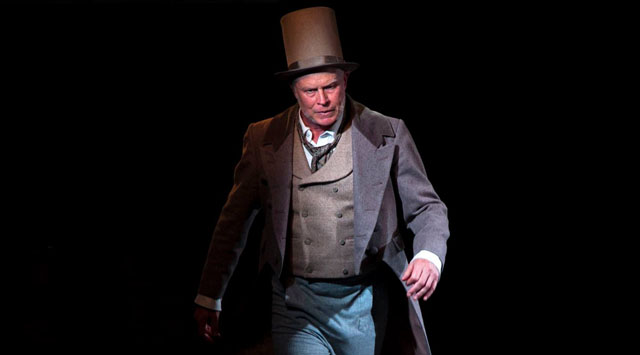
Originally conceived as a work set inside a psychiatric hospital, director Barry French’s version moves the action to a modern day asylum centre, with characters transposed from the mentally ill to asylum seekers who have gone mad from incarceration. A lot of the production makes good sense, with the play’s concerns and motivations proving to stand the test of time, but the text remains a difficult one half a century after its 1964 premiere.

Fragmented and purposefully incoherent, Marat/Sade is a fiercely anti-capitalist work that challenges how we think of society and art, and was never meant to be an easy one to stomach. It relies on the creation of spectacle and a sense of presence unique to the experience of live theatre, to keep the audience intrigued and captivated. French does well at manufacturing a dynamic stage with powerful imagery, featuring excellent design work by Tom Bannerman (set), Spiros Hristias (lights) and Nicola Block (costumes). Further, the incorporation of a very large cast comprising over 20 actors provides a sumptuous visual majesty, but the calibre of performers are highly inconsistent.

Our attention fades in and out, depending on the quality of acting being showcased, and the general sense of visceral energy stirred by the writing’s violent insanity, is only occasionally authentic and seldom severe enough to fascinate or convince. There are however, memorable personalities in the show, including Jim McCrudden as the Herald who demonstrates exceptional flair and nuance in his charming theatrics, as well as Debra Bryan and Leilani Loau whose committed portrayals of tragic hysteria, deliver some of the play’s richer characterisations.

Also noteworthy is Nate Edmondson’s original music, thoroughly creative, with a welcome exuberance adding texture and depth to the staging. Performed to a backing track, we are struck by the beauty of the score’s arrangement, and are left hankering for an opportunity to hear the songs sung completely live in tandem with musicians.

On the surface, Marat/Sade urges the downtrodden to rise up for a revolution, but what it really does, is facilitate discussion on social injustices that have to be rectified. The play talks about the French Revolution of 1808, but with the passage of time, ideas of radical action seem to have lost their lustre. Many of us at the theatre are the complacent middle class, and shows like this aim to help expand our consciousness to include the lives of those who suffer under our oppression, but doing more than providing lip service seems always to remain a challenge. Stories of asylum seekers who ask for our mercy continue to be told, but how we respond is presently inadequate, if all we can do is talk.

www.newtheatre.org.au

Review: Dream Lover (Sydney Lyric Theatre)

dreamloverVenue: Sydney Lyric Theatre (Sydney NSW), Sep 22 – Nov 27, 2016
Original concept and stage play: Frank Howson, John Michael Howson
Dramaturg/Script Consultant: Carolyn Burns
Director: Simon Phillips
Cast: David Campbell, Martin Crewes, Hannah Fredericksen, Bert LaBonte, Marney McQueen, Caroline O’Connor
Image by Brian Geach

Theatre review

In the musical Dream Lover, Bobby Darin is a nice guy with a career to be proud of. Undeniably talented, the Italian-American from New York’s Bronx county made it big in show business in the middle of the twentieth century, leaving behind an impressive catalogue of songs, but an uneventful life story. The show starts off slowly, with characters that take time to connect, and a doggedly polite plot that resists sensationalism, mindful of a need to honour the late star, thereby sacrificing opportunities for a greater sense of theatricality and humour. Our emotions are guided by the quietly simmering narrative, so even though all its musical numbers are strong, the viewing experience only becomes exuberant later in the piece when its dramatic stakes finally gain height.

The jukebox musical format is carefully and cleverly utilised here, with preexisting songs from Darin and his era, assembled and rearranged to form a surprisingly coherent and entertaining show. Set design is striking but inflexible, with an undiminishable glitz distracting from its many sombre scenes, although remarkably effective in its visual demarcation of space. The production boasts an outstanding cast, with quintessential showman David Campbell in the lead, overflowing with extraordinary charm and skill, stealing hearts in every melody. There are moments when Campbell seems restrained and overly cautious in his portrayal of a venerated hero, and occasional issues with sound balance can be disappointing, but his powerful presence, astonishing commitment and infectious passion, guarantee a spectacular night at the theatre. Also noteworthy are Martin Crewes as Darin’s manager Steve Blauner, and Hannah Fredericksen as Darin’s wife Sandra Dee, both captivating personalities who provide solid support with unequivocal artistic brilliance.

Bobby Darin is from a time when we knew to celebrate dignity. There is no dirt in Dream Lover, which will take many of today’s audiences by surprise. Scandalous biographies are where the money is; in entertainment today, whether reality TV, tell-all books or on any other conceivable digital configuration, we consume crudeness as a matter of habit. It is troubling that the kind of career that Darin had enjoyed, could cease to be valued and appreciated in this new economy of vulgarity and gossip on steroids, where music is routinely sold in a package along with celebrity humiliation. Dream Lover may be about the past, but its ability to remind us of better days offers a nostalgic glimmer of hope. It inspires a longing for something purer, and on days like these, it could be the best that we can cling to.

wwww.dreamlover.com.au

Review: Side Show (One Eyed Man Productions)

oneeyedmanVenue: Hayes Theatre Co (Potts Point NSW), Sep 23 – Oct 16, 2016
Book & Lyrics: Bill Russell
Music: Henry Krieger
Director: Richard Carroll
Choreography: Amy Campbell
Musical Direction: Conrad Hamill
Cast: Daniel Belle, Gabriel Brown, Laura Bunting, Kerrie Anne Greenland, Michael Hart, Bree Langridge, Lachlan Martin, Joshua Mulheran, Elenoa Rokobaro, Berynn Schwerdt, Timothy Springs, Hannah Waterman
Image by Kurt Sneddon

Theatre review
Daisy and Violet Hilton were conjoined twins who in the 1930s, caused a sensation in the American vaudeville circuit. We meet them in the musical Side Show, as their ascent to fame begins, and encounter the highs and lows of the women’s irrefutable difference, in a world determined to treat them as anything but normal. Its plot is unconventional, and for a musical to have at its centre an unpredictable story, is remarkably refreshing. Instead of distinct good and bad categories as is common for the genre, characters exist in spaces of grey, resulting in a tale that surprises with its realism. The songs are beautifully composed, with unusual depth and textures that forsake formulaic writing in favour of accurate representations of human emotion.

Laura Bunting and Kerrie Anne Greenland are the splendid twins, with a persuasive sisterly closeness that keeps us firmly on their side. Bunting plays the extrovert Daisy with an alluring effervescence, while Greenland uses an earnest approach to tug at the heartstrings. Both are excellent singers, although Greenland’s very big notes are undeniably scene-stealing. In the role of Buddy is Gabriel Brown, who impresses with nifty footwork, along with a striking presence, for a character memorable for his exceptional charm. Director Richard Carroll successfully introduces a dignified air to the “freak show” context, but the production often seems too stagnant and minimal in its use of space. There is an admirable restraint in Carroll’s rejection of creating scenes that are overly sentimental, but the show would benefit from greater amplification of its more humorous elements.

Side Show is an elegant work that is respectful in its portrayals, but there is a persistent gentleness that can make it feel somewhat distant. Art must always be aware of cliché and do all it can to avoid it, like it does on this occasion, but the temptation to resort to the tried and tested is always present. The musical format has a strong tendency towards the “garden-variety”, mainly due to commercial pressures, but also because of the seemingly inherent limitations of the genre. There are few avant-garde musicals for good reason. It is a theatrical form with rules that cannot be broken, and that insists on subjugation of its artists, but for some of those who do give in, the rewards can be spectacular. True fulfilment might have been elusive, but Daisy and Violet had a taste of fame and fortune by giving the crowds what they want, and that is a level of success many could only ever dream of.

www.hayestheatre.com.au