Review: The Rover (Belvoir St Theatre)

Venue: Belvoir St Theatre (Surry Hills NSW), Jul 1 – Aug 6, 2017
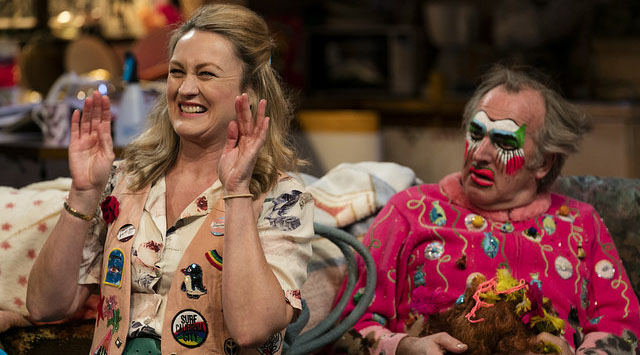
Playwright: Aphra Behn
Director: Eamon Flack
Cast: Gareth Davies, Andre de Vanny, Taylor Ferguson, Leon Ford, Nathan Lovejoy, Elizabeth Nabben, Toby Schmitz, Nikki Shiels, Kiruna Stamell, Megan Wilding
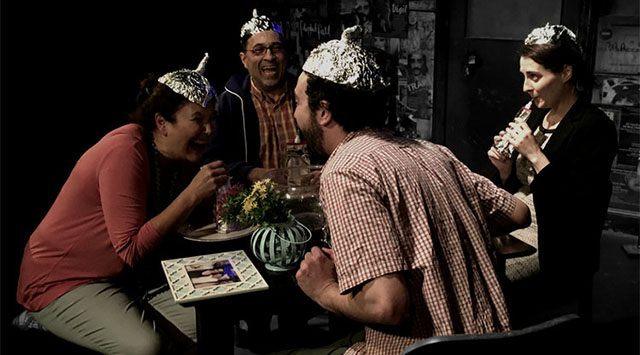
Image by Anna Kucera

Theatre review
It is mid 17th century, and a bunch of rowdy English tourists descend upon Naples to partake in the masqueraded festivities of Carnival time. Aphra Behn’s depiction of wild revelry may be restricted by mores of the Restoration era, but its spiritedness is nonetheless unmistakable. In its atmosphere of debauchery, the characters talk of love and marriage, preoccupied with the sport of spouse hunting.

The play is conventional, but as the production’s prologue asserts, we cannot ignore Behn’s position as England’s first woman playwright, or the feminine perspective that her work brings to the stage. Although women are again, and literally, divided into virgins and whores in The Rover, they each act with agency, and their desires are provided due significance. Whether nuns or courtesans, we always know what it is that they want for themselves, and we watch them going about procuring what are essentially self-determined lives.

Director Eamon Flack delivers a thoroughly enjoyable work of high octane comedy, playfully inventive in approach, and unabashedly raucous with its expressions. Details can become confused, as the show’s humour takes first priority, but narratives are of slight importance in a show of this nature. It dazzles and it delights, with Mel Page’s brilliant work as set and costume designer scoring high; the imagery presented by The Rover is deliciously colourful and consistently alluring. Lights by Matt Scott are jaunty and energetic, with the inclusion of a “follow spot” enhancing the vaudeville quality of performances.

It is a remarkable cast, unrelenting with their extraordinary exuberance and skill. Flack showcases each of the player’s idiosyncratic sense of humour, while maintaining a cohesion to the comedy style of his creation. Megan Wilding is a standout in dual roles, seductive as the saucy temptress Lucetta, and delightfully foulmouthed as the maid Moretta, but always irresistibly funny and disarmingly magnetic, no matter the personality we encounter. As the charming cad Willmore, Toby Schmitz is a refreshing presence, theatrical but with a striking spontaneity that introduces a hint of danger, to the inevitable predictability of the story.

American comedian Beth Stelling says, “nothing makes a dick go softer than a funny woman.” The fallacious idea of women being less effective in comedy, still persists, but in The Rover, five comical women and five humorous men demonstrate that the funny bone recognises only talent, unconstrained by notions of gender. From Shakespeare to Gogol, and from Chaplin to Gervais, male geniuses have staked their dominance in the field. Spaces in art, like in commerce and politics, continue to be usurped by the masculine, but feminine retaliation is underway, as it has for generations, in this seemingly unending operation. After all, a woman’s work is never done.

www.belvoir.com.au

Review: 1984 (Sydney Theatre Company)

Venue: Roslyn Packer Theatre at Walsh Bay (Sydney NSW), Jun 28 – Jul 22, 2017
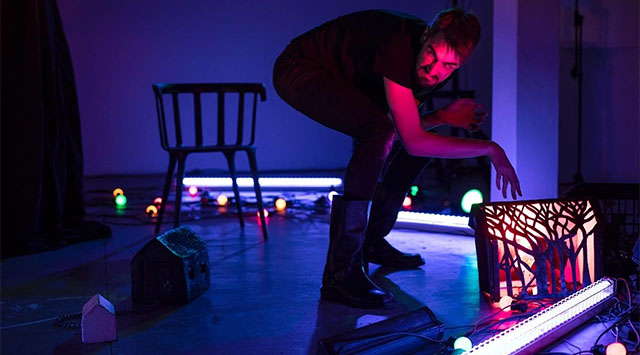
Playwrights: Robert Icke, Duncan Macmillan (based on the George Orwell novel)
Directors: Robert Icke, Duncan Macmillan
Cast: Molly Barwick, Paul Blackwell, Tom Conroy, Terence Crawford, Coco Jack Gillies, Ursula Mills, Renato Musolino, Guy O’Grady, Yalin Ozucelik, Fiona Press
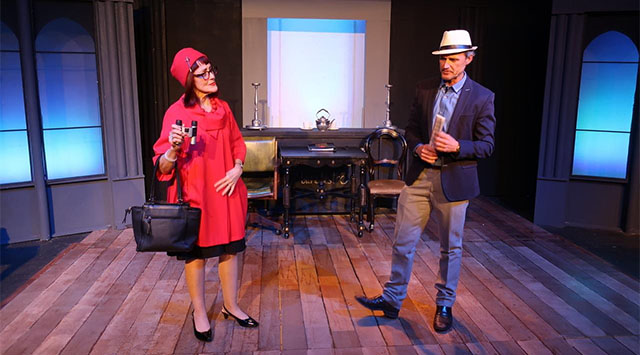
Image by Shane Reid

Theatre review
People often look back at calamitous histories, and are grateful that they had emerged unscathed. In Robert Icke and Duncan Macmillan’s version of 1984, dystopia is not only an imagined future, but also a tragic past that its characters are happy to have left behind. When the worst is over, we think that life returns to a state of healthy normalcy. We choose to believe that those who had committed atrocities are wiped away, and all is good in the world again.

In our need to survive, memory has to become elastic. Self-preservation necessitates that we forget the painful, and in the case of 1984, forgive the unforgivable. Facts are erased, so that ideologies can dominate. The play portrays a simultaneous past and future, but its concern is firmly on the now. It believes in an essential sense of truth, along with the human tendency to obfuscate those truths, in order that power may be won and lost.

With obvious parallels with current political events, it is tempting to say that Orwell’s story is more pertinent today than ever before, but societies have never been pure. Certainly, technology does play an important part in how we control one another, but long before the discovery of electricity, men had sought to suppress thought and expression, with the sole intention of gaining influence and authority. Using lies as apparatus and methodology, devious personalities have risen to positions of leadership, while the rest of us are turned complicit, through acquiescence, obedience and silent surrender.

It is a sleek production, conceived and executed with an admirable sophistication. Orwell’s philosophical interests are powerfully presented, translated from book to stage effectively, though not always with great clarity. The protagonist Winston’s existence is a confused one, and on certain levels, we are accordingly, perhaps appropriately, bewildered. Its messages are unambiguous, however, with all of 1984‘s prominent themes and ideas, articulated emphatically, with conspicuous relevance and urgency.

Chloe Lamford’s scenic design transforms Orwell’s original futuristic outlook into a retrogressive frame of reference; after all, we are now looking at the world 33 years ago. Lights by Natasha Chivers and sound design by Tom Gibbons, play integral roles in the brutal depiction of ruthless tyranny. The assault on our senses is indeed severe, with aggressive noises and strobes unrelenting in trying to seize our nerves and inflict terror.

Actor Tom Conroy has the unenviable task of performing Wilson’s extended suffering, including a lengthy scene featuring quite gruesome physical torture. His work is painfully convincing, and the vulnerability he brings to the role, insists that we are affected by all his adversities. Terence Crawford turns up the drama as the frighteningly menacing O’Brien. His operatic approach to the enigmatic personality seduces us, keeps us on edge and captivated, as the play’s savagery escalates.

The deep pessimism of 1984 demands a strong response. It aims to provoke us into radical thought, if not radical action, with its revelations about a world ruled by evil. We think about governments, religions and corporations, the insidious ways in which they impact upon our lives, how they encroach upon our liberties, and the deficiencies of our resistance. Survival requires degrees of submission, but within any submission, the spirit of defiance can always be found, whether minuscule or vigorous, to spark a change that could pivot the course of history, one can only hope, for the better.

www.sydneytheatre.com.au | www.1984play.com.au

Review: Sunset Strip (The Uncertainty Principle / Griffin Theatre Company)

Venue: SBW Stables Theatre (Kings Cross NSW), Jun 14 – Jul 1, 2017
Playwright: Suzie Miller
Director: Anthony Skuse
Cast: Emma Jackson, Simon Lyndon, Lex Marinos, Georgina Symes
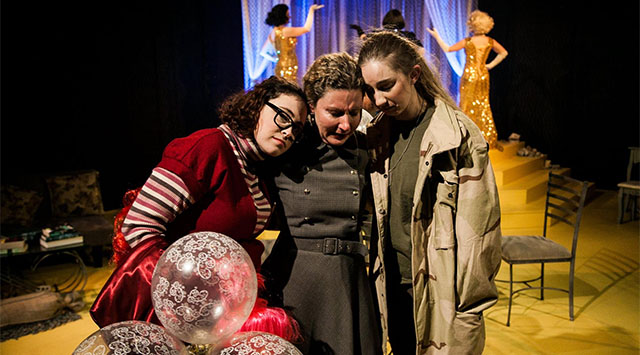
Image by Patrick Boland

Theatre review
Phoebe has lost custody of her children, due to a history of illicit drug use. Her sister Caroline has been battling cancer, while dealing with a relationship breakup. Their father Ray is suffering dementia. Life is hard, as we well know, but it is not all doom and gloom with these sisters. They are determined to get on with it, making the best of the cards they were dealt.

In Sunset Strip, playwright Suzie Miller brings a family together at a time when they are in desperate need of each other’s support. None of them realises this kindred reliance of course, for it is easy to take these relationships for granted, and like many of us, Phoebe and Caroline have resentments, jealousies and unresolved issues from the past, so their reunion was always going to be precarious.

Miller’s detailing of that delicate balance, between joy and pain in how they love, is full of tenderness, subtle but powerful. Their interchanges are nuanced, splendidly complex, and always with a gentle, familiar ring that will remind us of our own homes. When families talk, it is what we say between the lines that matters most, and Sunset Strip‘s sensitive explication of those dynamics, is what makes it feel like every person’s story.

Director Anthony Skuse’s quiet approach to storytelling is a perfect fit for the play. In this intimate venue, the drama envelopes as it unfolds, and we fall deeper and deeper into its emotional grip. Skuse’s work for Sunset Strip transcends the need for a dominant narrative, getting us to the heart of its characters by simply presenting four individuals who are so thoroughly authentic and vulnerable, that finding a meaningful connection with them is inevitable. This is theatre at its most moving (sans manipulative show tunes and fantastical storylines), made even more affecting by audience members sobbing uncontrollably in neighbouring seats.

Emma Jackson and Georgina Symes play the siblings, both laid bare spectacularly, allowing us to peer right into their fractured souls. The part of their ailing father is performed by Lex Marinos, who has us transfixed in the precision of his approach, and heartbroken by his depiction of a parent who can no longer provide guidance and care. Simon Lyndon is the love interest who offers much more than meets the eye, with an ability to introduce disarming and devastating poignancy, when you least expect it. These actors are truly wonderful.

No amount of love, can prevent people from growing apart, but it is in the capacity to make sacrifices, that the depths of love is revealed. Love is not about holding tight, in fact, it is more often about letting go, but there will come moments where people are required to sit together, maybe to laugh, or maybe to fight, so that love can do its job. When life turns too hard, loneliness will only add fuel to fire. Not every problem will have solutions, but a warm embrace makes everything, miraculously, easier.

www.griffintheatre.com,au

Review: Slut (Old Fitz Theatre / Edgeware Forum)

Venue: Old Fitzroy Theatre (Woolloomooloo NSW), May 23 – Jun 3, 2017
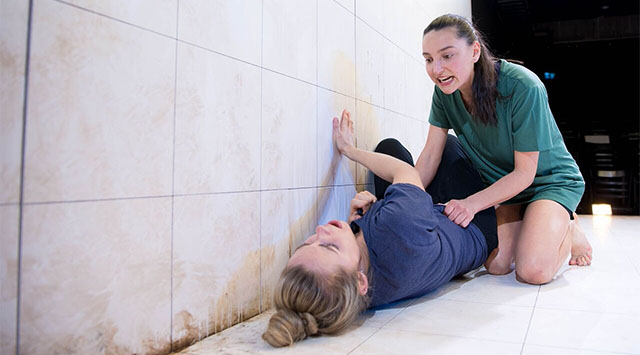
Playwright: Patricia Cornelius
Director: Erin Taylor
Cast: Julia Dray, Bobbie-Jean Henning, Jessica Keogh, Danielle Stamoulos, Maryann Wright
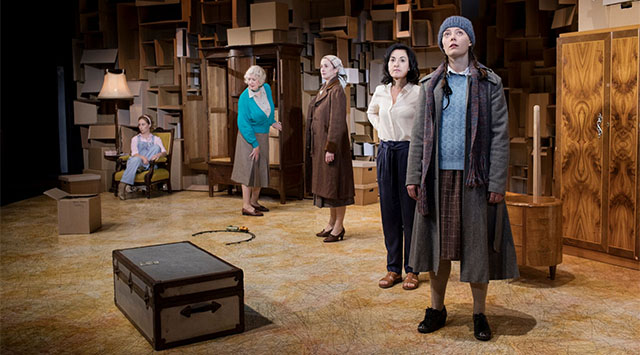
Image by Clare Hawley

Theatre review
For the girls in Patricia Cornelius’ Slut, nothing is more important than being popular. That hunger to be liked, by all and sundry, is a curious thing that many possess, and in Cornelius’ play, we explore the way teenage girls are socialised to place unparalleled value on attention, admiration and approval. We are at school, and Lolita is the first of five good friends, to bloom. Her breasts develop and the world begins to sexualise her, long before she feels those urges for herself.

She encounters lascivious attention, and learns to reciprocate. There is something powerful in being seen, and the effect of that recognition, and the accompanying scrutiny, becomes all-consuming. Lolita pursues that gaze with a frightful ferocity, quickly learning that her worth resides squarely in her ability to be objectified in that uncompromisingly sexual manner. She comes under attack, predictably, by her peers who consider her a pariah, after having previously marvelled at her new-found power. As a result, she discovers a deep and detrimental shame, and attaches it firmly to her sexual nature.

It is a cruel existence that Lolita has to endure, and director Erin Taylor’s portrayal of that brutality is certainly vivid. The production is rhythmically precise and in its half-hour duration, we are thoroughly captivated by all that it wishes to communicate. All five actors are very strong and the tautness of their performance is highly enjoyable, although it must be said, that the roles are undeniably simplistic. Jessica Keogh’s depiction of Lolita is suitably vivacious yet tragic, perfectly presenting the playwright’s perspective of a victimised and very sad protagonist.

It is unfortunate that Lolita never manages to negotiate between friendships and her sexual dominance. That the play structures the two as being mutually exclusive, is perhaps an accurate observation of what happens in our high schools, but the lack of nuance in this representation creates an impression that can feel overly convenient. The absence of parental figures is also a glaring omission that is never explained. If our young is left in the wild to fend for themselves, we can be sure that disasters will happen, but our society knows its duty of care. Slut talks about the way our girls cause harm to one another, but it is our guidance, not their ignorance, that should be questioned.

www.facebook.com/…

Review: Jatinga (Bakehouse Theatre Company)

Venue: Kings Cross Theatre (Kings Cross NSW), Jun 9 – 24, 2017
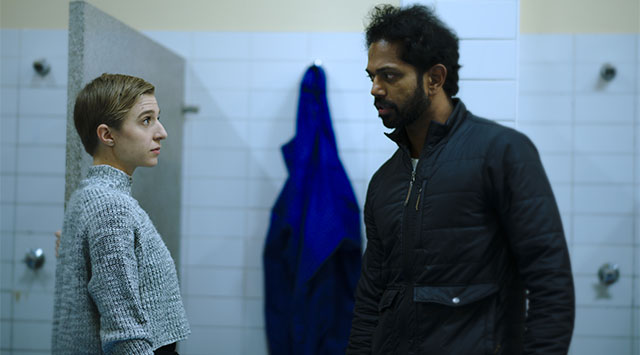
Playwright: Purva Naresh
Director: Suzanne Millar
Cast: Sapna Bhavnani, Karina Bracken, Claudette Clarke, Jarrod Crellin, Faezeh Jalali, Sheila Kumar, Suz Mawer, Bali Padda, Monroe Reimers, Trishala Sharma, Teresa Tate Britten, Amrik Tumber
Image by Natasha Narula

Theatre review
In the north-eastern region of India, a tourist hot-spot exists in the village of Jatinga, known for the mysterious phenomenon of birds plunging to their death, every year after the monsoon season. In Purva Naresh’s play Jatinga, it is the phenomenon of “runaway girls” that takes focus. Journalist Madhumita discovers five young women escaping harrowing fates, and in her efforts to publish a story that draws attention to their plight, she finds herself thinking like villagers hungry for tourism dollars, deciding whether to resort to sensationalism, in order that the greater good can be served.

The play is purposeful, and undeniably powerful. Addressing issues of poverty, Jatinga is relevant to audiences of all nations, at a time when economic inequality is a serious social concern. We may not suffer the same symptoms in the developed world, but the fact that the refugee crisis is unsolved and escalating, and that we continue to obsess over “terrorist threats”, show that persistent disparities, that our first-world systems thrive on, are creating problems that have landed us in a state of emergency. The rich will always want the poor separate and contained, but the poor can often break through the barriers of money. Radical action is always an option, when people have nothing to lose.

The women in Jatinga tell simple stories, but the production is strangely convoluted. Shifting timelines and interweaving narratives provide a sense of theatricality, but unnecessary confusion often gets in the way of our empathy. The show must be lauded however, for not turning to “disaster porn” to keep us engaged. The women are victims, but they are also spirited and strong individuals. Director Suzanne Millar’s resolve in portraying them as such, is certainly admirable.

An excellent cast, wonderfully cohesive, perform a colourful work replete with vigour and sincerity. Suz Mawer is captivating, and tremendously persuasive, as the journalist Madhumita. Her thorough authenticity holds the piece together, even though the stakes are admittedly lowest for the character she portrays. Also noteworthy is Nate Edmondson’s work on music, transportative and transformative in its effect, from scene to scene.

When the birds take to suicide, we wish for it to be an act of nature, and convince ourselves that things stay in balance with their sacrifice. Murmurs of the birds actually being killed by villagers, are disregarded by the tourists who wish to witness something romantic and extraordinary. We bury the truth, in order that our fabricated realities can be sustained. We want to think that refugees have proper channels to seek asylum, and we want to believe that terrorists are mentally ill. We insist that the poor only need work harder to create better lives, and we sweep the truth under carpets, sit back and watch as towers are burnt to ashes.

www.bakehousetheatrecompany.com.au

Review: I Love You Now (Darlinghurst Theatre Company)

Venue: Eternity Playhouse (Darlinghurst NSW), Jun 9 – Jul 9, 2017
Playwright: Jeanette Cronin
Director: Kim Hardwick
Cast: Jeanette Cronin, Paul Gleeson
Image by Robert Catto

Theatre review
The stage is disguised as a hotel room, and two actors play out a series of infidelities in short episodes. The fragments are unified by the amorous theme, but how they fit together as a complete entity is the creative, and intriguing, challenge it presents to its audience. Jeanette Cronin’s I Love You Now takes conventional stories and puts them in a poetic structure, so that the telling of an ordinary tale, can lead to the discovery of greater meanings in everyday life.

Things happen, forming chaotic and arbitrary moments, but the human mind has an insatiable need for narratives. We make connections between incidents, and are determined to read into things, as though the urge to understand, is as basic and inexorable as breathing. While we attempt to make coherence of the scenes as they unfold in I Love You Now, we find ourselves beginning to fall in love instead, with transience. Sure, it is possible to formulate a whole of the parts, but it is really the fleeting moments of beauty and genius that gives us nourishment. Our impulse is to dedicate our attention to a big picture, but what is of greater satisfaction, are the minute occurrences that can so easily slip away, if we do not let go of the desire to be master of every situation.

Director Kim Hardwick’s task is to find balance and harmony in the storytelling, so that appropriate weight is assigned to each of the play’s divergent intentions and concerns. The writing presents many possibilities, and Hardwick demonstrates great sensitivity and fortitude, in her ability to mine for resonance in the many unexpected corners of I Love You Now, persuading our minds to find appreciation for the layer upon layer of ideas and observations, that constitute this deeply textured work of art.

A remarkably polished production, with Isabel Hudson’s set design creating a very solid first impression (the hotel room is glamorous and incredibly convincing), and Martin Kinnane’s lights speaking softly but intricately, the visuals are sumptuous but never obtrusive. As though providing accompaniment to singers centre stage, music is performed live, by Max Lambert and Roger Lock, whose instincts compel us to remain engaged with the play, even when it veers off to slightly obtuse places.

Cronin herself takes on the female roles, while Paul Gleeson is the masculine counterpart. Both are fabulously accomplished; impressive with the complexities and elegance they bring to the show, and as a couple, their infallible chemistry is the main drawcard. It is always what happens between them that is captivating, and important. We watch how they treat each other, listen to the way they speak to one another, inside this room of secrets, and through a range of characters and their clandestine intimacies, our own fires of curiosity and passion, are stoked back to life.

www.darlinghursttheatre.com

Review: The Village Bike (Cross Pollinate Productions)

Venue: Old Fitzroy Theatre (Woolloomooloo NSW), Jun 7 – Jul 8, 2017
Playwright: Penelope Skinner
Director: Rachel Chant
Cast: Kate Bookallil, Sophie Gregg, Jamie Oxenbould, Rupert Reid, Gabrielle Scawthorn, Benedict Wall
Image by Andre Vasquez

Theatre review
Becky is unable to get laid because her husband has irrational fears regarding the baby in her womb. Increasingly frustrated, she finds herself seeking gratification elsewhere. Penelope Skinner’s very riveting The Village Bike makes a powerful statement about marriage and monogamy, and the ways in which these age-old institutions and ideologies continue to form restraints, allowing society to control the lives of individuals, women especially, from the most intimate levels.

It plays almost like a revision of the Aga saga; that genre of slightly camp, English middle-class country life drama. The characters are familiar, and their stories are set, invariably, in an unassuming domesticity. Certainly, the work is critical of the way we conceive of a respectable woman. It challenges the unquestioned rules dictating what is acceptable, and objectionable, of a woman’s sexuality, and also the language we use that gives definition, and weight, to those restrictions.

In mocking that romantic and pedestrian style of storytelling, we see the wildness of Becky’s narrative resist the confines of form. Our protagonist is not playing by the rules, so the rules quickly become visible. In breaking the illusion of happily ever after, we are compelled to study her situation, and because we can relate to Becky’s desires so completely, we have to interrogate the systematic failures that we all have to operate under.

Although political and intellectual, the production is equally stimulating on other fronts. Rachel Chant’s direction ensures each personality we meet is distinct and vividly manifested, so we know exactly what it is that makes them tick (and how they contribute to the play’s tragic circumstances). Sequences oscillate between comedy and drama effortlessly, with moments of breathtaking sexual tension giving an excellent sense of texture and dimension to what we see, hear and feel. Persistent issues with spacial use however, detract from an otherwise polished and very well-rehearsed presentation that is as engaging as it is titillating.

Gabrielle Scawthorne stars as the woman who fucks up. Honest and vulnerable, she keeps us in love with Becky through every transgression. Scawthorne is sensational in the part, thoroughly psychological and physically detailed, turning a confronting role into a beautifully empathetic creature full of charm and disarming authenticity. Supporting actors too, are impressive, each one complex and humorous, all bringing a delicious, and rare, boldness to the telling of an uncompromisingly sexual tale.

By play’s end, Becky is rendered powerless. Entrapped by a world that permits only narrow definitions of motherhood and marriage, she has nowhere to go, but to accept her subjugation. Some have said that bicycling had contributed immensely to the emancipation of women in the 1890s, but today, calling a woman a bike, is to call a woman a harlot, whore, slut, skank; a common and convenient means of suppressing female sexuality, in order that the myth of the weaker sex is perpetuated. There is no greater threat to the patriarchy than a sovereign womanhood that rejects the Madonna/Whore dichotomy. When our sex is no longer tethered to imagined virtues in concordance with family, society and culture, is when a greater liberty can be found, for all the genders.

www.crosspollinate.com.au

Review: The Clean House (New Theatre)

Venue: New Theatre (Newtown NSW), Jun 6 – Jul 8, 2017
Playwright: Sarah Ruhl
Director: Rosane McNamara
Cast: James Bean, Colleen Cook, Mary-Anne Halpin, Alice Livingstone, Keila Terencio
Image © Bob Seary

Theatre review
In Sarah Ruhl’s The Clean House, sisters Lane and Virginia are exemplary women who spend their days obsessing over having to do the right thing. One pursues a fabulous career in medicine, and the other indulges in an irresistible urge to clean houses. Both live in accordance with values our societies deem admirable and righteous, but neither are rewarded with enduring happiness. In fact, the only incidents of true elation in the play, are accompanied with certain death.

The perpetual state of tension between order and chaos, is a succinct way of describing all of human existence. In our desire to put things into structures of subjective logic, we come into conflict with nature, or a conception of nature, that is separate and external to the supreme beings we think ourselves to be. It seems we are the only creations of Mother Earth that insist on agendas that run contrary to the will of all else that makes up the universe.

Ruhl’s magical realism has a feeling of unassuming banality, delivered through its unmitigated look at our relationship with domesticity, yet its imaginative explorations into the often overlooked quirks of simply being, turn the everyday into something endlessly fascinating. The greatest purpose of art, is that it can re-contextualise humanity, so that the unseen is made visible, in order that we may gain new knowledge of the infinitely mysterious self. The Clean House places us firmly inside normalcy, and then reveals what lies beyond its superficial veneers.

The writing is gloriously funny, and under Rosane McNamara’s direction, Ruhl’s humour, along with an undeniable poignancy, are given full illumination. Rich with meaning and amusement, the play is captivating, thoroughly inquisitorial, and McNamara’s subtle approach with its messaging, keeps us keenly intrigued.

The actors tell the story with excellent clarity and conviction, but performance rhythms require finessing for their presentation to communicate at a tighter pace. The impressive Dr Lane is played by Mary-Anne Halpin, focused and decisive with motivations, but slightly lacking in complexity with the interpretations brought to her character. Alice Livingstone is delightful as the decidedly sad Virginia, outstandingly acerbic, and scintillating with irony. The cleaning lady, and aspiring comedian, Matilde is a vivacious presence in Keila Terencio, who delivers impressive theatrical energy, and a powerful sense of purity essential to the work’s ideology.

The personalities in The Clean House are shown for their flaws, but we know that these people cannot help themselves. We can try, and we should try, to be better people, but there is nothing that can turn us invincible. Feelings will be hurt, mistakes will be made, no matter how much we dream up safeguards and assurances. We make it a habit to act as though we are the sole determinants of fate, but there is no certainty to be found in how life wishes to pan itself out. There is however, tremendous satisfaction to be had in the experience of kindness, as we see at the show’s end, and the way acts of compassion are always able to defy regret, is one comfort we can hold on to.

www.newtheatre.org.au

Review: How To Build A Home (Ever After Theatre)

Venue: Balmain Uniting Church (Balmain NSW), Jun 1 – 3, 2017
Contributing Writer: Emily Dash
Directors: Natalie Rose, Alice Osborne, Marnie Palomares
Cast: Kerrie Ann Bezzina, Christine Blanche, Matthew Cutmore, Emily Dash, Glennen Fahey, Sophie Grivas, Tom Hancock, Emma Plant, Roddy Salinas

Theatre review
The idea of a dream home is explored by differently abled performers in How To Build A Home. An opportunity for all to reflect upon concepts such as personal limitations and aspirations, social obligations and privacy, the often abstract work may leave a lot to our imagination, but there is no mistaking the statement it makes about the importance of security and care that we all need in order to have fulfilling lives.

The show is full of spirited whimsy, with an enthusiastic cast offering up vim and vigour, along with a genuine vulnerability that is quite captivating. A collaborative segment featuring Emily Dash reciting a poignant monologue, alongside Tom Hancock on piano establishing an atmosphere of sombre drama, is beautifully, and hauntingly, rendered. Also memorable is Sophie Grivas’ idea of a house with three disco rooms, reminding us that our bodies, whether moving or stationary, are to be loved and pampered.

Visual design by Mirabelle Wouters, and James Brown’s work on sound and music, give the production an excellent sense of polish. The space they have created is glamorous yet unpretentious, a homely environment we find to be simultaneously comfortable and inspiring.

As long as we are alive, every individual has a right to space, and that space must be treated with respect. The home is both mundane and sacred, and recognising it as such, encourages us to honour every breath taken and every second that ticks past. Life is too short for any of us to be perfunctory about the time that we have been gifted. When we realise that every here and now is special, each moment experienced, and its corresponding place, has the possibility to nourish and fulfil, as though always at home, sweet home.

www.everaftertheatre.com

Review: An Unseasonable Fall Of Snow (Ewan Productions)

Venue: The Actors Pulse (Redfern NSW), May 30 – Jun 3, 2017
Playwright: Gary Henderson
Director: Giles Gartrell-Mills
Cast: Alex Ewan, Nico Papademetriou, Randall

Theatre review
The setting looks like an office, for lawyers or the police perhaps, but we never really find out where Arthur and Liam actually are, as we witness the aggressive interrogations taking place. Gary Henderson’s An Unseasonable Fall Of Snow involves two deaths, a mystery that takes the form of an intriguing puzzle, challenging its viewer to discover its secrets before everything is laid bare at the end.

Director Giles Gartrell-Mills orchestrates an enjoyable ride, luring us into the enigmatic qualities of the play with a quiet elegance. Sound and lights are underutilised, so we are not quite spellbound by its flirtations with the supernatural, but the plot is nonetheless effectively relayed for an engaging hour of theatre.

Arthur is played by Nico Papademetriou, who makes us believe that there is always more being hidden away, a convincing mastermind of sorts, and we need to know all the cards that he holds close to his chest. Alex Ewan is impressive as Liam, volatile yet operatic in his portrayal of a young man deep in trouble. It is a performance thoroughly considered, and boldly executed, leading to a result that illustrates some of the more obscure facets of human nature, while providing an exciting sense of high drama to the piece.

When snow falls in springtime, nothing is quite what it seems. We wish for life to adhere to expectations, but the forces in control of existence are far greater than any individual’s volition. If we find ourselves walking into a blizzard, when all we had wanted was a garden of green, there is no changing how nature wishes to be, and we must look to our desires for answers on how the inside can be in harmony with outside.

www.facebook.com/…