Review: Love And Anger (Griffin Theatre Company)

Venue: SBW Stables Theatre (Kings Cross NSW), Jan 21 – 26, 2019
Creator: Betty Grumble
Cast: Betty Grumble
Images by Ryan Ammon, Liz Ham, Dean Tirkot

Theatre review
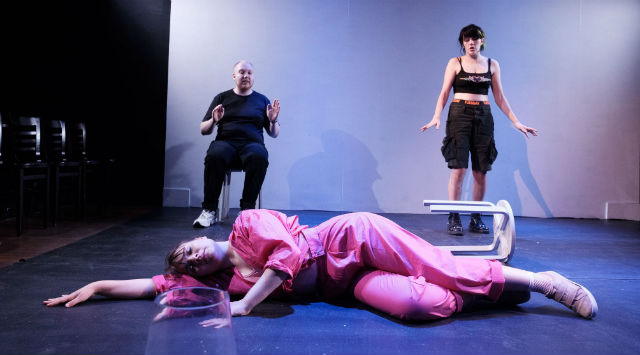
The legendary SCUM Manifesto by Valerie Solanas makes several appearances in the show, but Betty Grumble’s Love And Anger does not try to recruit for the Society for Cutting Up Men. It seeks to unify the human race, and all of the planet, by interrogating (and integrating) the matter from which we are composed. Grumble’s work is about flesh and blood, the only things perhaps that we cannot deny of ourselves. We never fail to imagine our identities to be much more grandiose, and in that process, create endless demarcations and conflicts. The artist devotes her entirety to the demolition of those narratives, making us succumb to the admission and the acceptance of our truest and basest selves, in order that we may renounce the countless structures that ultimately seek to create more harm than good.

Grumble insists that our attention is placed on the here and now, and in a theatre space where all our corporeality is congregated, present and irrefutable, she does marvellous things to her body, with her body, inside and onto her body, so that we may reach an image of ourselves, beyond taboo and outrage, that represents a renewed purity. After Grumble removes all of her clothing, she finds ways to take away all the meanings imposed upon her nudity, and because her words are rarely effective in this exercise, the artist’s strongest statements must be made through physical manipulation. Her performance style almost fits into genres of clowning and cabaret, and as is customary in Australia, difficult messages come in the guise of comedy, and Grumble’s extremely bawdy humour is the bridge that leads us to her subversive epiphanies.

The best thing about Love And Anger, is Grumble herself. When we attempt to isolate the text from the artist, it becomes clear that the persona she has evolved, can offer us everything important irrespective of the context in which we locate her. It is the embodiment of culminated meanings that we come into contact with, that is most virtuous in the performance of Grumble. Those virtues are impossible to condense, but chief components of her expressions include beauty, femininity, masculinity, equality, compassion, joy, peace, and above all, love.

When goddesses unravel, we remain goddesses. Betty Grumble’s act explores the notion of ugliness in her efforts to redefine social and anti-social, but it is impossible that she would be perceived in any other way than benevolent and divine, even in the midst of (simulated) excretion. In Love And Anger, we discover that beauty is much more than skin deep. It exists through the skin and beyond it. We receive her beauty because of who she is, but it is probably a greater truth, that we receive her beauty because of who we are.

www.griffintheatre.com.au

Review: The Weekend (Moogahlin Performing Arts)

Venue: Carriageworks (Eveleigh NSW), Jan 18 – 23, 2019
Playwright: Henrietta Baird
Director: Liza-Mare Syron
Cast: Shakira Clanton
Images by Jamie James

Theatre review
Lara is trying to do the right thing, by working hard in Cairns, trusting that her partner is taking care of their children back home in Sydney. When one of her sons phones up to notify her of their father’s disappearance, Lara takes the first plane home to save the day. The real drama happens after her kids are fed, when she is compelled to go looking for Simon, even though it is not the first time that he makes an unexplained exit from his responsibilities.

Henrietta Baird’s The Weekend is a one-woman action-packed comedy, that sees our heroine brave the enigmatic public housing towers of Redfern, to encounter the lower classes of her Indigenous community, and the harrowing socio-economic challenges that they face. Baird’s writing is full of thrills, brimming with keenly observed humour, and a modern attitude that boldly pushes Australian playwriting into exciting new realms.

Actor Shakira Clanton takes on all ten characters in the play, each one vibrant and richly manifested. Her mischievous approach is deeply delightful, as she turns us into putty in her hands, taking us through every peak and trough of this amazing journey. It is an unforgettable experience, to see and hear hidden facets of our beloved city, to vicariously revel in Lara’s extraordinary weekend of discoveries. Clanton’s is a performance replete with artistic detail, endlessly intricate and dynamic, thoroughly enjoyable.

Directed by Liza-Mare Syron, the show is often edge-of-your-seat exhilarating, and pure unadulterated fun. Supported by a marvellous team of creatives, including lighting designer Karen Norris, and composers Nick Wales and Rhyan Clapham (Dobby), it is a smart production that provides just enough embellishment, so that we can luxuriate in The Weekend‘s colourful dialogue and personalities, to enjoy the best storytelling that the theatrical arts can facilitate.

Much of The Weekend is about the problems that we inherit. When our behaviour is disappointing, or when we simply find ourselves to be lacking in some way, and we try to reason with these dysfunctions, it is necessary that we go back in time, in order that we can locate explanations for deficiencies. For Lara, Australia’s history of colonisation informs a substantial portion of her misadventures, and on a personal level, archaic notions of womanhood too, are crucial to how she had been able to tolerate mistreatment. When we arrive at an understanding of our baggage, tangible and intangible, is when the hard work has to truly begin.

www.moogahlin.org

Review: The Chat (Carriageworks)

Venue: Carriageworks (Eveleigh NSW), Jan 16 – 20, 2019
Creators: J R Brennan, David Woods
Cast: Arthur Bolkas, J R Brennan, Shane Brennan, Ashley Dyer, Nicholas Maltzahn, Ray Morgan, John Tjepkema, Simon Warner, Les Wiggins, David Woods
Images by Prudence Upton

Theatre review
We are informed that some of those performing in The Chat are ex-offenders from the Melbourne area. The work is a collaboration with artists, including creators J R Brennan and David Woods, reenacting performance workshops centred around a role play scenario, in which an ex-offender plays the part of a parole officer. When the show reaches its concluding episode, the audience finds itself in the position of a parole board, and we have to decide if the role player had revealed enough redeeming qualities in order to be set free.

That responsibility bestowed upon us, although fictitious, carries an undeniably enormous weight, making us think about the nature of justice and rehabilitation in our societies, a topic that most of us have the privilege of circumventing. Being in close quarters with characters whose very lives depend on how our rules concerning incarceration are exercised, turns abstract ideas into a palpably distressing process, as we try to make decisions that bear the most serious of consequences on individuals who we have come to know.

Although much of The Chat is, predictably, not performed with a great deal of skill, an invaluable sense of authenticity is introduced by people who have lived through first-hand, these issues we have to wrestle with. Their presence prevents us from engaging the usual intellectual distancing, that makes answering these questions, inappropriately convenient. The production is given polish by Jenny Hector and Steve Hendy’s lighting design, and by Brennan’s sound design, for a presentation that ultimately leaves an impression that is simultaneously simple and sophisticated.

These difficult circumstances, of punishment and banishment, underlie so much of how we operate, yet matters of law and order are rarely interrogated meaningfully by the general populace. We leave them to experts and tradition, trusting that others know better, when in fact, there probably are no concerns more democratic. Those in need of pardon, work hardest for our compassion, but when we have to determine how compassion is being dispensed, people often forget the universality of our fallibility.

www.carriageworks.com.au

Review: Counting & Cracking (Belvoir St Theatre)

Venue: Sydney Town Hall (Sydney NSW), Jan 11 – Feb 2, 2019 | Ridley Centre (Adelaide Showgrounds, South Australia) Mar 2 – 9, 2019
Playwright: S. Shakthidharan
Director: Eamon Flack
Cast: Prakash Belawadi, Nicholas Brown, Jay Emmanuel, Rarriwuy Hick, Antonythasan Jesuthasan, Nadie Kammallaweera, Ahi Karunaharan, Monica Kumar, Gandhi MacIntyre, Shiv Palekar, Monroe Reimers, Hazem Shammas, Nipuni Sharada, Vaishnavi Suryaprakash, Rajan Velu, Sukania Venugopal
Images by Brett Boardman

Theatre review ⭐️⭐️⭐️⭐️⭐️
It was 1983 when Radha first came to Australia, escaping persecution in Sri Lanka during the racial riots of Black July. With her husband killed in the midst of unrest, Radha was left with no choice but to flee alone and pregnant, arriving in Sydney to put down new roots in a foreign land. S. Shakthidharan’s Counting & Cracking is a very big play, ambitious and benevolent, rhapsodic in its attempts to uncover the whole truth about a woman, observed as a maternal figure from the playwright’s vantage point. Shakthidharan’s work is warm and witty, generous in its seismic attempts to explain everything, taking us through half a century of untold stories to reach an understanding about the people we are today.

It is often a gripping production, directed by Eamon Flack who renders marvellously the play’s more domestic and romantic scenes. Relationships are beautifully cultivated, between powerful characters, with a convincing sentimentality that encourages the audience to invest deeply, our attention and our emotions, right from the very beginning. Political dimensions are communicated less lucidly, but we are able to gather sufficient information for the narrative drive to maintain interest.

Designer Dale Ferguson’s transformation of Sydney Town Hall’s colonial interior, into a festively radiant Sri Lankan space of congregation and celebration, is a sight to behold. Majestic and monumental, it embraces our bodies and psyches, holding us firmly inside its milieu, to have us luxuriate in all its extravagant expressions. Contrastingly, acoustics are a sore point for the production, with sound engineering unable to overcome the echoey vastness of the old building, thus resulting in occasional dissipation of dialogue. There are however auditory delights to be had, in the form of Stefan Gregory’s score, performed live by a trio of musicians (Kranthi Kiran Mudigonda, Janakan Raj and Venkhatesh Sritharan) whose expert accompaniment provides us with unparalleled sensuality and soulfulness.

Actors Nadie Kammallaweera and Vaishnavi Suryaprakash share the lead role, both captivating and extremely likeable, allowing us to fall under Radha’s spell for the show’s entire duration. Their combined dynamism gives Counting & Cracking complexity and authenticity, and we find ourselves moved by a tale that is at once unique, yet spiritually universal. Sukania Venugopal is memorable as Aacha, the vivacious matriarch who brings colour and effervescence to the stage with every exhilarating entrance. Radha’s son Siddhartha provides the cultural anchor for this Australian story, performed by a very compelling Shiv Palekar, whose luminous confidence proves to be as impressive as it is alluring.

It is always demanded of migrants that we prove our worth. Counting & Cracking is in some ways an exercise in showing the establishment that we contribute at least as much as the others; it makes a statement about our Australianness, arguing against incessant lies about immigration being nothing but a burden on this society. More valuable is the play’s reclamation of identity, in its insistence that the portrayal of Australian lives must include histories and origins that are routinely excluded and denied. As humans, we must always strive for unity, but cohesion must bear the unequivocal acceptance of difference, hard as it may be.

www.belvoir.com.au | www.co-curious.com

Review: Since Ali Died (Griffin Theatre Company)

Venue: SBW Stables Theatre (Kings Cross NSW), Jan 8 – 19, 2019
Playwright: Omar Musa
Director: Anthea Williams
Cast: Omar Musa (with guest vocalist Sarah Corry)
Images by Robert Catto
Theatre review
Omar Musa imagines himself travelling down a river with Muhammad Ali, both men outsiders, connected by experiences of ostracism. Musa’s Since Ali Died provides insight into how people of colour survive the dogged exclusions of white society. Through poetry, prose and hip hop phraseology, Musa’s extraordinary writing provides access to intense and complex emotions, that relate to a sense of displacement, in an Australia struggling to think of itself as anything other than an illegitimate monolith. It is a work about home, but on how it can disown you, presented in a theatrical context that sees a remarkable talent confront an audience comprising adversaries and allies, all of us relevant and implicated.

As performer, Musa is charisma personified. We are won over effortlessly, by a stage presence naturally confident yet vulnerable, one that showcases an honesty that many will find utterly disarming. Masculinity is portrayed in a delicate light, with director Anthea Williams carefully preventing any sense of alienation that could arise from the motivating fury of Musa’s expressions. It is an exercise in compassion that results, an occasion that welcomes all, one that encourages us to think about the parts we play, as individuals and as collectives, in Musa’s personal stories.

Melancholic and incredibly moving, Since Ali Died is a timely meditation on contemporary Australian life, an undeniable summation of all our unique challenges, whether spiritual, social or political. Black and brown people endure discrimination by white structures that lay fake claim to this land, just as Muslims are relegated impudently, to a status of religious inferiority. Omar Musa’s very body and soul, right before our eyes, is evidence of those injustices that insidiously constitute our harmful way of life. He is thriving, but he suffers. In his music, simultaneously celebratory and indignant, we are able to understand the strength that is required of people like Musa. It is dark but uplifting, refusing to give in to destruction. His energy is ample and indomitable, and although painful to see it expended on coping mechanism, there is plenty left for orchestrating a change.

www.griffintheatre.com.au | www.riversideparramatta.com.au

Review: The Jungle (Outrage Productions)

Venue: Darlo Drama (Darlinghurst NSW), Dec 14 – 18, 2018
Playwright: Louis Nowra
Director: Glen Hamilton
Cast: Gabriela Castillo, Nicole Florio, Gaurav Kharbanda, Jo-Ann Pass, Benjamin Pierce, Timothy Rochford, Hugo Schlanger, Andrew Singh, Romney Stanton, Annelies Tjetjep, Mark Wilson
Images by RMF Photography

Theatre review
A jumble of scenes situated in Sydney, with people that may or may not seem familiar, constitute Louis Nowra’s The Jungle. The stories are from 1995, and sensationalist in a way that was probably trendy for the time. 23 years on, its sleaze and general naughtiness can feel slightly pretentious, but the perspective it provides of an Australian city that is not concerned with the middle class, presents an opportunity to ruminate on the changes we have undergone in just one generation. Not yet nostalgic, but certainly reflective, The Jungle reveals the banal bourgeois values that have, in a relatively short period, taken over our town.

Glen Hamilton’s direction incorporates little in terms of visual design, leaving all of the production’s theatricality to a very hyperbolic ensemble. Their energy is admirable, players such as Nicole Florio and Romney Stanton are particularly animated, and they bring a valuable verve to the stage, but there is an overall lack of nuance that prevents the show from speaking with sufficient depth. Actor Gabriela Castillo does a remarkable job of her roles, turning three hapless girls in a frequently misogynistic piece of writing, into fascinating characters with moments of palpable drama.

It is a relief to see that we are no longer who we once were, for life is change, and stagnation can be dangerous. We might be tempted to say that change does not necessarily represent improvement, but to insist that things were better in the past, is to forget the many deficiencies of yesterday. Sydney may have lost some of its romance and idealism, but for the millions who choose to live here, we choose to believe in its potentials and the bright future that we so faithfully envision. The big clean up bears a momentum that refuses to ever come to a halt, but in our hearts, the memory of a dirty, dingy town still resonates, and the spirit of that old disreputable concrete jungle keeps on pulsating.

www.thejungleplay.com

Review: Crime And Punishment (Secret House)

Venue: Limelight on Oxford (Darlinghurst NSW), Dec 12 – 22, 2018
Playwright: Chris Hannan (from the novel by Fyodor Dostoyevsky)
Director: Anthony Skuse
Cast: Jane Angharad, Hannah Barlow, Tim Kemp, Philippe Klaus, Beth McMullen, Madeleine Miller, James Smithers, Shan-Ree Tan, Charles Upton, Natasha Vickery
Images by Clare Hawley

Theatre review
When deciding to proceed with his plan for murder and robbery, Raskolvikov thinks of his actions as merely an extension of attempts to participate, in an economy he considers to be entirely utilitarian. If one is to survive the world at all costs, and if cost is always a matter of subjectivity, then the concept of morality holds no currency, in a system determined to reward the self-interested. Chris Hannan explores the implications of what might be termed human conscience in his adaptation of Dostoyevsky’s Crime And Punishment. The protagonist wrestles with internal conflicts, emotional and intellectual, trying to escape punishment, from society and from himself.

The bleakness of Raskolvikov’s destitute existence is depicted persuasively under Anthony Skuse’s direction, whose own production design accomplishes an elegant evocation of Russia at a time we associate with the end of the Industrial Revolution, and the rise of urbanisation as we know it. Skuse’s sound design too, is an affecting element, if slightly repetitive in its rendering. Lights by Martin Kinnane bring visual interest, helpful in creating a sense of dynamism for the production. Actor James Smithers is convincing in the leading role, able to prevent us from feeling alienated, so that we stay engaged with the murderer’s narrative. Chemistry between performers can be improved for a more focused sense of storytelling, but individual characters are portrayed with good conviction.

The work posits the loss of religion as a possible equivalence to the loss of morality, thereby giving religion a great deal of credit where it may not be due. In the decades that have past since Dostoyevsky’s 1866 publication of Crime And Punishment, atheism has become a movement undeniable in its ubiquity, and secular societies have demonstrated that our capacity for upholding that which is truly righteous, has surpassed dogmatic and draconian structures that had come before.

There is no doubt that many lives have been improved by religion, but it is important that we recognise the evils that it routinely inspires and sanctions. At the end of 2018, Australian politics is abuzz with the prospect of introducing additional protections for religious practices, thereby safeguarding bigoted portions of those beliefs, and in effect, placing human rights beneath archaic doctrines. Raskolvikov killed people, not because of a loss of faith; the fact remains that the murders had taken place, in spite of all the religion being imposed upon him.

www.secrethouse.com.au

Review: Don’s Party (Chippen Street Theatre)

Venue: Chippen Street Theatre (Chippendale NSW), Dec 6 – 15, 2018
Playwright: David Williamson
Director: Travis McMahon
Cast: Dominic Di Paolo, Lachlan Donnelly, Amber Dyball, Ben Hunter, Ramy Moussa. Andrew Murdoch, Katerina Papasoulis, Evan Piefke, Helen Shoobert, Rachel Slee, Kristen Zinghini
Images by Ethan Hatton-Warham

Theatre review
The setting is a house party in 1969 suburbia, where men are arse holes, and women are bewilderingly whiny. David Williamson’s Don’s Party, now approaching half a century old, offers a bleak look at how a modern Australia might have been imagined. The play wrestles with ideas of a progressive future, as characterised by a new social permissiveness; Don asks all his guests to bring along a pornographic object, as icebreaker or more truthfully, to disrupt the banality of his home life with Kath and their children.

The sexual revolution had begun, and down under, it appears we were deeply confused. All the women had apparently become bitches, and they are referred to in the play as such, on more than ten occasions. Wives and girlfriends were starting to have minds of their own, no doubt as a result of advancements in birth control, and according to Williamson, all of civilisation were basically going to hell in a handbasket.

As the old world disappears, what happens in Don’s Party reveals a paralysing fear of what is to come. There is little question that this attitude still prevails. It was feminism’s second wave then, and we are now in the throes of its fourth. The disquiet that accompanies the promise of equality is palpable, and Williamson’s pessimistic vision, borne out of the anxiety of a patriarchy under threat, can now be seen as pitifully limp.

Travis McMahon’s direction presents a straightforward rendition, allowing us to detect that sense of panic inherent in mid-century masculinity. The ensemble consists of actors with varying abilities, and although not particularly inventive with what they bring, each manages to locate moments of theatricality in the writing, that insist on our attention. The production lacks intellectual rigour, but it is clear that much effort has been put into manufacturing a satisfactory naturalism for their performance.

When women grow strong, our relationships have to be put through a process of reshape. Friends and family, love and sex, all face interrogation, as we learn to shift away from traditions that plainly no longer work. In Don’s Party, men are fearful and women are frustrated. They cling on to the past, unable to come to terms with the tides that push for a brighter future, a mighty force that will not tolerate the status quo.

www.chippenstreet.com

Review: The Club (Belvoir St Theatre)

Venue: Belvoir St Theatre (Surry Hills NSW), Dec 7 – 22, 2018
Playwright: David Williamson
Director: Tessa Leong
Cast: Jude Henshall, Louisa Mignone, Ellen Steele
Images by Marnya Rothe

Theatre review
Hundreds of millions of dollars go through Australia’s sporting organisations, and to view the industry as wholesome and virtuous is, to put it mildly, naive. Yet, we routinely attribute our sports stars and their colleagues, with a glow of reverence, and they in turn, present an image of habitual sanctimony. The men in David Williamson’s The Club are exposed of these hypocrisies. It is a story about white boys spoilt by their talent with an olive-shaped ball, who grow into stunted adulthood, and we watch their clumsy attempts at extending the glory days beyond bygone moments on the football field.

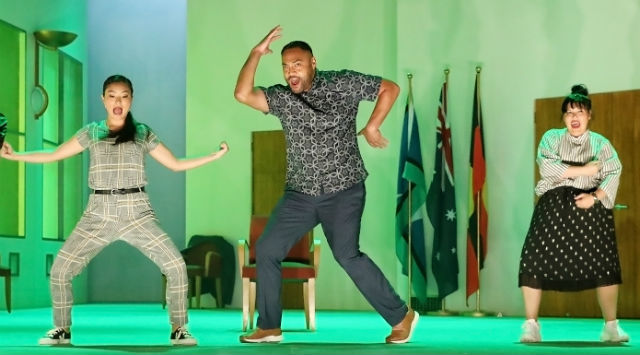
The corrupt and inane behaviour of these self-aggrandising men provide a platform for director Tessa Leong’s discussion of sexism and toxic masculinity, within an archetypal setting of a sporting arena, that conveniently encapsulates our nation’s sense of self-image. Three female performers take on all the roles, playing exaggerated versions of maleness, for a subversive exercise that makes statements about gender, and especially about the misguided adoration of what might be termed traditional masculinity. First half of the production is surprisingly conventional, a one-trick pony with a simple concept that quickly loses steam, but the show picks up furiously after interval, and what had felt gimmicky, turns into something far more complex and provocative.

The production is full of grandiose gesturing, not always powerful, but certainly delivered with extraordinary conviction. Actor Ellen Steele is particularly robust with her comedy, extremely cheeky and acerbic, a consistent delight in this portrait of ugliness. Jude Henshall and Louisa Mignone too, are exuberant performers who bring admirable rigour into their farce, for a rewarding study on the machinations of privilege and ignorance, frequently found in some segments of Australian society.

In sport, we celebrate high achievers not only for their accomplishments, but also for the whole of their persons. We want our heroes to be godlike, and imagine them to be infallible, consequently giving them powers, in the form of money and status, that they often exploit to the detriment of our collective good. It is no coincidence that these powerful are predominantly straight white men. Our institutions are structured to benefit a certain idea of supremacy, one that repeatedly exerts its imperialism over all others, and any action designed to take them down is met with disdain and even violence. Oppression requires concession, with the oppressed made to concede to notions of objectivity and meritocracy, that are demonstrably unjust. It is a survival strategy, to play to these rules, but only those willing to sacrifice can hope to foster a change.

www.belvoir.com.au | www.isthisyours.com.au

Review: The Smallest Hour (Griffin Theatre Company)

Venue: SBW Stables Theatre (Kings Cross NSW), Dec 5 – 15, 2018
Playwrights: Phil Spencer, Susie Youssef
Director: Scarlet McGlynn
Cast: Phil Spencer, Susie Youssef
Images by Brett Boardman

Theatre review
In a city just like Sydney, Chris and Shelley cross paths on several occasions. Each is having an eventful, if not entirely enjoyable night, in this immense love story about the metropolis. Phil Spencer and Susie Youssef’s The Smallest Hour may not be grand in scale or indeed vision, but it captures the essence of that relationship between busy cities and its inhabitants, in a deeply beautiful way, for an expression of an intimacy that frequently borders on the obsessive. We are individuals who think of ourselves as distinct entities, separate from other humans and segregated from place; the observation here is that most of us are nothing without our towns, and Spencer and Youssef’s play is a splendid tribute to that sense of belonging.

The Smallest Hour is also a romantic comedy, and director Scarlet McGlynn’s ability to infuse humour into all of its romance, with place and with persons, ensures a production that will thoroughly delight every typical urbanite. Our imagination is cleverly manipulated, as the action moves from one location to the next, by Veronique Benett’s lights and Steve Francis’ music, guiding us surreptitiously through a series of familiar situations. There are no props and no costume changes to be seen on Tyler Hawkins’ simple stage design, but all the imagery that we receive, in our mind’s eye, is consistently vivid. The playwrights perform the work, mainly as narrators, but also as impeccable stand-ins for our protagonists. Both are remarkably endearing, and although not yet word perfect on opening night, they prove themselves consummate raconteurs, utterly and completely mesmerising with the tale they so adroitly weave.

The Smallest Hour reveals a love greater than Chris meets Shelley. It documents the way we navigate this environment, showing us how we have absorbed the physicality of this city, to live out existences so dynamic and spirited. Unlike boyfriends and girlfriends, we never ask that places give us their perfection; we understand better, our responsibilities as components of communities big and small, of collective identities that hold so much more promise than the insularity of our private selves. The lovers fixate on each other at conclusion, forgetting all the roads that lead them to one another. Their audience however, is left with evocations much more inspiring than petty concerns. We are asked to deal with matters of our heart, that relate not to any one, but to the entirety of this region; a very lucky love that must be cherished.
www.griffintheatre.com.au