Review: The Real Thing (Sydney Theatre Company)

Venue: Sydney Opera House (Sydney NSW), Sep 9 – Oct 26, 2019
Playwright: Tom Stoppard
Director: Simon Phillips
Cast: Johnny Carr, Charlie Garber, Rachel Gordon, Geraldine Hakewill, Shiv Palekar, Julia Robertson, Dorje Swallow
Images by Lisa Tomasetti
Theatre review
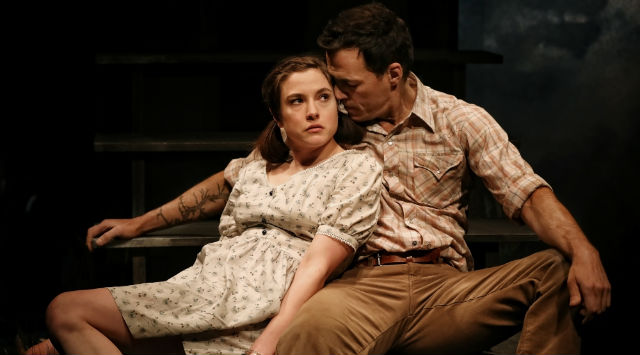
Henry has an excellent relationship with words and philosophy, which is just as well, being a successful playwright much like his creator Tom Stoppard. In The Real Thing however, we discover that his cerebral talents do not extend to matters of the heart. It is that very human conundrum we deal with in Stoppard’s extraordinarily rigorous piece of writing, that it is one thing to be able to know so deeply all that can be intellectualised, yet be unable to have much control over how one loves. People in the play are smart. Their understanding of the world is astute and penetrating, and their talk is very highbrow, but when we observe the way their feelings are being enacted, it seems there is no escaping the fools that we ultimately are.

Couples in The Real Thing wrestle with issues of fidelity. They cheat, they are suspicious, they are apologetic, and they fail repeatedly. They struggle with the need to be faithful, often engaging in discussions about the meaning of love and monogamy, but what they say have little bearing on how they feel. A constant discord exists between logic and emotions, prompting us to wonder if there can be more than one real thing in the human experience, if what we think and how we act are so often not in concurrence.

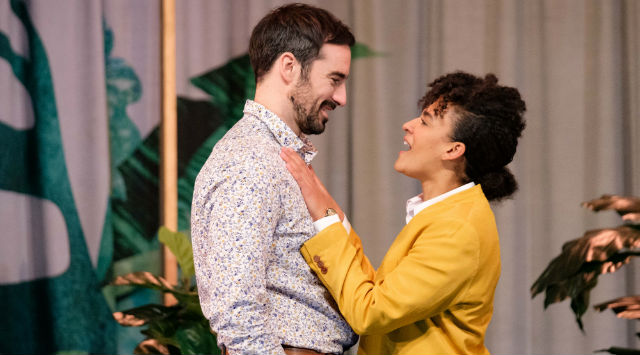
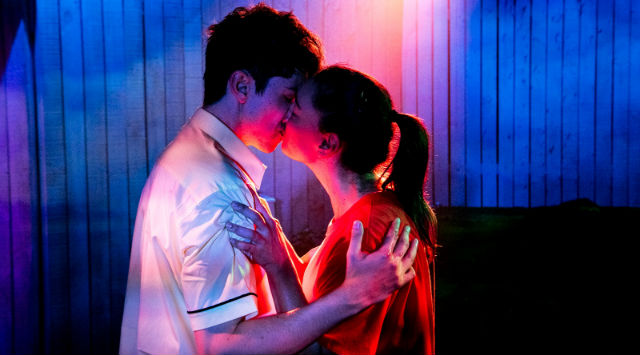
Director Simon Phillips brings remarkable clarity not only to these immediate themes, but also to the many tangential musings that make The Real Thing memorable. The density of the text is translated on stage by Phillips into a luxuriant tapestry of inspiring observations emerging from Stoppard’s brilliant mind. In the role of Henry is the sensational Johnny Carr, bringing a startling truthfulness to dialogue that could very easily be turned, under the wrong hands, highfalutin and empty. The actor’s presence and timing have us captivated, as we find ourselves enraptured, deeply invested in the many meaningful discussions that provide the foundation, for an admittedly bourgeois narrative. Geraldine Hakewill too, is engaging as Annie, a strong counterpoint in the story, effortlessly convincing with the complexity she portrays, whether playing subject or object in this tale about affection and attraction.

Production designer Charles Davis delivers a spectacular set, wonderfully imagined for the revolve stage, to facilitate poetic parallels between words and visions. His costumes are quiet but effective, able to bridge the time disparity inherent in reviving a 37-year-old work. Lights by Nick Schlieper are correspondingly sophisticated, always pleasing with the imagery he manufactures, and exacting in the way he shifts our impulsive responses from scene to scene.

It is likely that one can arrive at the conclusion that realities are multitudinous, yet there is something in our nature that cannot resist the idea that there could be a singular essence to things, that there is a fundamental truth in how we regard the world. It is as though a key exists, that life is only ever experienced as a sort of mystery that requires solving. Henry’s racing thoughts are incessant, and luckily for us, always beautifully articulated, yet we only ever see him carry on like a fool for love, as though knowledge can never live up to its promise of having the answer to everything.

www.sydneytheatre.com.au

Review: Splinter (Griffin Theatre Company)

Venue: SBW Stables Theatre (Kings Cross NSW), Sep 6 – Oct 12, 2019
Playwright: Hilary Bell
Director: Lee Lewis
Cast: Lucy Bell, Simon Gleeson
Images by Brett Boardman

Theatre review
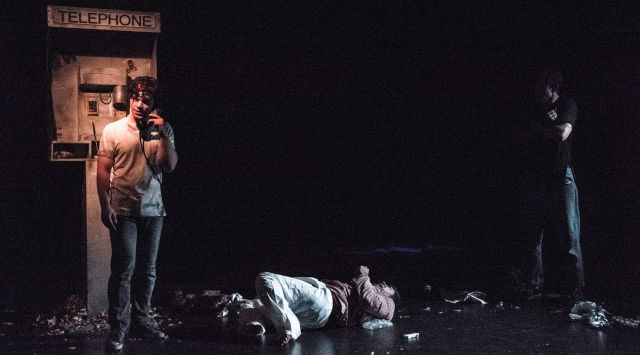
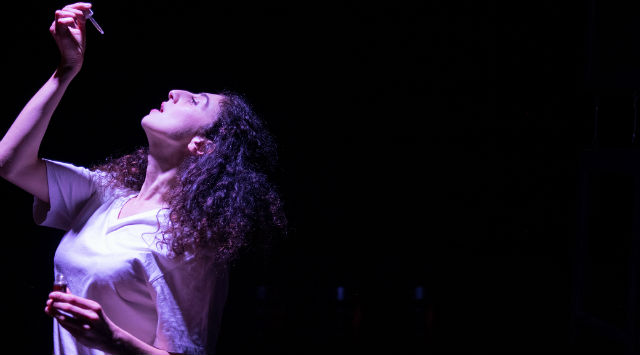
Five-year-old Laura has just returned home, after a nine-month disappearance. Her parents are understandably traumatised, but relieved to have their nightmare come to an end. In Hilary Bell’s Splinter however, we see that the family’s problems do not vanish quite so easily, as questions arise about this sudden reunion. There are only two actors in Bell’s play, with little Lauren an apparition that we all have to conjure up with imagination, which proves a fascinating device for something that positions itself within the genre of psychological thriller. The ideas in Splinter are engaging, but it is arguable if its dialogue and plot structure are always effective in delivering the tension so crucial to this form of storytelling.

The show begins innocuously, perhaps even drearily, as a conventional family drama that overloads the stage with saccharine sentimentality. It takes a considerable while before director Lee Lewis introduces suspense elements that let the entertainment begin, by which time our boredom with the daytime television style of presentation had almost completely taken hold. At just over an hour long, there is little opportunity for us to settle sufficiently into the real substance of the piece, but the intrigue that does eventually manifest, is admittedly chilling.

The late transformation in atmosphere is cleverly manufactured by creatives including Alyx Dennison, whose sound design confirms the gear switch, giving us necessary cues to swiftly change focus in our interpretation of the narrative. Video projections by Mic Gruchy and lights by Benjamin Brockman become increasingly theatrical, thus guiding our minds into more pronounced spaces of fantasy and delusion.

Lucy Bell and Simon Gleeson perform the piece with extraordinary conviction, both bringing admirable intensity to a tale involving unimaginable suffering. Gleeson has the additional dimension of paranoia to help enrich his character, which he utilises compellingly, for several powerful moments of bloodcurdling dread. Bell is given less extravagant material, but nonetheless offers a reliable, self-possessed counterpoint that prevents Splinter from veering away from its central truthfulness.

Genre is infinitely more prevalent in film, because the form deals almost exclusively in illusion, and is therefore perfect for stories that require drastic alterations to reality. Theatre that venture into those territories must be praised accordingly, for even daring to test the possibilities of the live stage. There is a supernatural quality to Splinter that is almost inevitable, in its depiction of psychological disturbance. In those moments, the audience participates in seeing things that are not present, almost like artists who have the Midas touch, able to make something out of nothing, and in the process, giving to their communities a kind of magic that brings elevation to us all.

www.griffintheatre.com.au

Review: U.B.U: A Cautionary Tale Of Catastrophe (Tooth And Sinew)

Venue: Kings Cross Theatre (Kings Cross NSW), Sep 10 – 21, 2019
Playwright: Richard Hilliar
Director: Richard Hilliar
Cast: Tristan Black, Lib Campbell, Rachael Colquhoun-Fairweather, Emily Elise, Sam Glissan, Gideon Payten-Griffiths, Shane Russon, Idam Sondhi, Nicole Wineberg
Images by Ross Waldron

Theatre review
The prime minister has a secret plan to depose the king, and have him replaced by a civilian best described as a lazy idiot, in Richard Hilliar’s U.B.U: A Cautionary Tale Of Catastrophe. PM Fuller Bjullshitt owns mines, and wants to make sure that his personal interests are protected by laws of the land that continue to be neglectful of environmental concerns. Given the preposterous state of politics today, the play’s premise is entirely within the realm of possibility, but written in an absurdist style, we are confronted with the lines between fiction and truth, except there is no hiding the fact that many of the worst things being depicted are no different from the news that we are subjected to in real life.

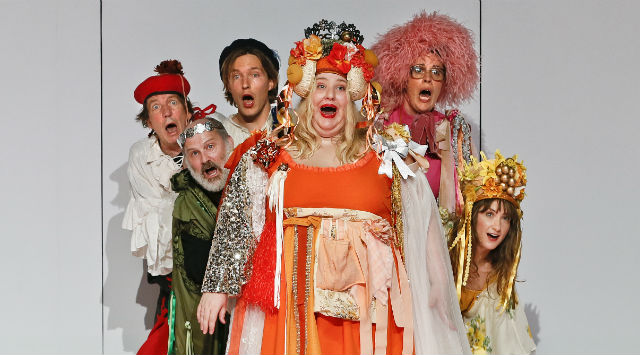
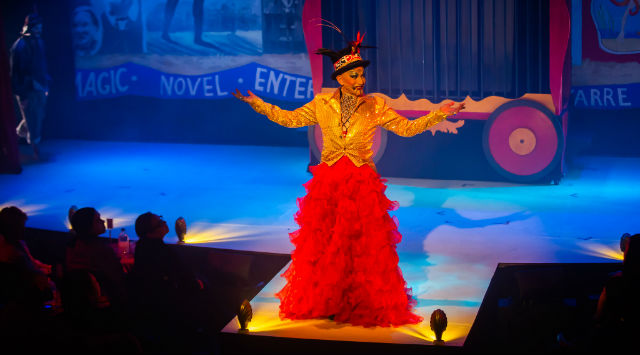
Hilliar’s exuberant consolidation of current affairs and contemporary ideals, is a pertinent representation of Australian culture as it stands, turned satirical by its colourful wit, base but clever, in appropriate alignment with popular notions of our national identity. Having brought his own considerable skills as director to U.B.U, Hilliar’s show is rambunctious, fun-filled and campy, a highly entertaining work that facilitates discussions about doing the right thing, beyond left and right conceptions of politics. Costumes by Tanya Woodland, along with Ash Bell’s hair and makeup design, are a visual feast, powerfully enhanced by Ryan McDonald’s imaginative lights.

Extraordinary passion from all nine of its ensemble cast, makes it an occasion to remember. Sam Glissan and Emily Elise are as mad as each other, playing Pa and Ma Ubu with an incredible wildness that creates a grotesque quality, so reflective of what we feel to be happening right now all over the world. Lib Campbell and Idam Sondhi are another formidable couple, with exquisite timing and chemistry, making us laugh at all the ugliness that we know ourselves to be capable of. Tristan Black’s incisiveness and precision as Bjullshitt ensures that we are attentive to both the meanings and hilarity of U.B.U; his “Mr. Segue’s Song” is an unequivocal highlight.

The show ends with a heavy-handed, earnest call to action. An uncontainable need to appeal to the body politic disrupts the entertainment, as the urgency to make its point finally exceeds its commitment to theatrical magic. Resignation is perhaps too easy, and U.B.U wants to help us avoid it. As we sit and watch everything crumble, the urge to submit to that seemingly inevitable extinction of our kind, can indeed feel irresistible. Humans however will always be defined by our activity and conduct, and for as long as we are here doing something, there is always the inescapable decision between good and bad.

www.toothandsinew.com

Review: The Last Wife (Ensemble Theatre)

Venue: Ensemble Theatre (Kirribilli NSW), Aug 30 – Sep 29, 2019
Playwright: Kate Hennig
Director: Mark Kilmurry
Cast: Emma Chelsey, Emma Harvie, Simon London, Nikki Shiels, Bishanyia Vincent, Ben Wood
Images by Phil Erbacher

Theatre review
In Kate Hennig’s The Last Wife, we watch Catherine Parr make the most of an unfortunate situation when she is forced to marry King Henry VIII. Not content with being wallflower and figurehead, she finds ways to be useful, trying to place herself in a position of power, with mixed results, but hugely instrumental in the reinstatement of princesses Mary and Elizabeth to the line of succession. The play imagines its characters with contemporary sensibilities and a corresponding modern language, each one is given a sense of cheeky sass that renders an entertaining immediacy for their storytelling. Not quite an entirely feminist reckoning of the past, The Last Wife is English history from a new perspective, the reframe of which provides a richer understanding of what had happened, and more importantly, of how women continue to have to navigate the patriarchy.

Directed by Mark Kilmurry, the production emphasises dynamics in these legendary relationships, able to impress upon us the intimate family problems of the royals, that bear reverberations that continue to affect us today. Its discussions about gender politics however, feel rudimentary, as do design elements that are at best adequate. Work on sound (uncredited) in particular is disappointing, often discordant with stage action, and lacking in elegance with how its cues are executed.

Actor Nikki Shiels’ portrayal of the queen is delicate, and although successful with the naturalism she introduces to the show, her Catherine Parr seldom exudes enough power for the narrative to really affect or inspire. The king is played by Ben Wood, whose irrepressible comic impulses prove enjoyable. While the two have a comfortable chemistry as lovers, they lack a cohesion in styles that would help us achieve a deeper appreciation of nuances in their scenes together. A young Elizabeth, the future queen, is made thoroughly enamouring by Emma Harvie, whose immaculate timing and exquisite charm, offer a generous sprinkling of star quality in the support role.

In every tragic victim, an alternate story can likely be written about their strength and ingenuity. Old tales about sad women reflect our conditioned need to see women languish. We are accustomed to an acceptance of women’s suffering, and we have learned to think of her pain as inevitable, as though there is beauty in that resignation. In The Last Wife, we see the women around Henry VIII exercise their autonomy whenever conditions permitted. We have for centuries, made lemonade from the lemons that are given. Adversity figures in many of our experiences, but the accompanying resilience and resourcefulness that get us through hardship need to propel us to something beyond survival.

www.ensemble.com.au

Review: Chorus (Old Fitz Theatre)

Venue: Old Fitzroy Theatre (Woolloomooloo NSW), Aug 28 – Sep 21, 2019
Playwright: Ang Collins
Director: Clemence Williams
Cast: Jack Crumlin, Madelaine Osborn, Nicole Pingon, Ella Prince, Eliza Scott, Chemon Theys
Images by Phil Erbacher

Theatre review
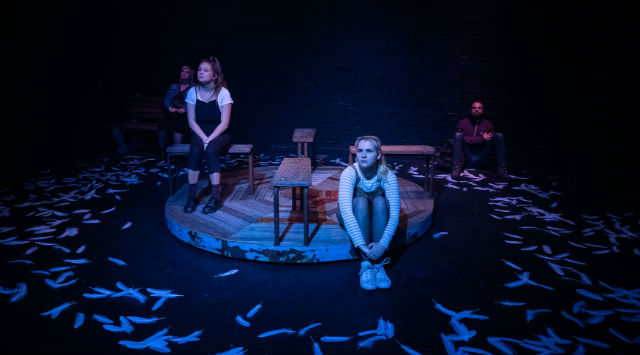
Agamemnon is a pop star enjoying considerable success, but like the mythical king she has named herself after, accomplishments come at a very high price. Ang Collins’ Chorus talks a little about stardom, but is more concerned about a motherhood that never lived up to its promises. The play’s purposeful juxtaposition with the Greek legend also prompts us to think about gendered differences in the way we discuss morality, and how we are more permissive of one gender over the other, especially in matters pertaining to parenthood. It is a powerful context that Collins has formulated, with intriguing characters and exciting dialogue delivering an enjoyable theatrical experience. The story’s climax does however feel slightly underwhelming, due in part to the writing’s subtle approach. In preventing itself from turning exploitative, Chorus unfortunately loses some of its drama when we arrive at the crucial moment of revelation.

Performances are strong, with Ella Prince an appropriately assertive presence in the main role, bringing a wrathful intensity to a personality who has some very serious issues in need of resolution. Chemon Theys is memorable as love interest Cass, and persuasive in her portrayal of an unapologetic Instagram celebrity. The baby’s father is played by Jack Crumlin, marvellously complex and authentic with the emotions he depicts as the deeply conflicted Chris.

Much pleasure is derived from the cast’s wonderfully tight ensemble work, inspired by traditional Greek theatre, but given a contemporary twist, complete with live video projections by Sarah Hadley, that magnify the sense of grandeur introduced by the chorus as stage device. Emma White’s set design is elegant in its minimalism. Lights by Veronique Bennett are dynamic, able to add a hint of extravagance to proceedings. As director and sound designer, Clemence Williams’ sensual calibration of atmosphere makes for an absorbing production that holds us captive for the entire duration.

Agamemnon has every right to reject being defined as a mother, but this does not absolve her of responsibilities. We can be persuaded that love cannot be forced, but not doing one’s best to care for their offspring, is surely unequivocally immoral. We should all be encouraged to dream big, and we should learn to better celebrate those who dare to go out on a limb. Life turns hollow, when one is held back by fear and doubt. To be held back by duty however, is quite another thing.

www.bontom.com.au | www.redlineproductions.com.au

Review: Titus Andronicus (Bell Shakespeare)

Venue: Sydney Opera House (Sydney NSW), Aug 27 – Sep 27, 2019
Playwright: William Shakespeare
Director: Adena Jacobs
Cast: Melita Jurisic, Tariro Mavondo, Jane Montgomery Griffiths, Jayna Patel, Josh Price, Tony Ray Ray, Daniel Schlusser, Grace Truman, Catherine Văn-Davies
Images by Brett Boardman

Theatre review
War is said to have ended, but the violence of man bears a momentum that cannot be halted. Shakespeare’s Titus Andronicus involves bloody revenge between feuding parties, a cyclical phenomenon too powerful it seems, for any single human to defy. More than a fixation on murder, the play draws us into its morbid, almost fetishistic preoccupation with rape, amputation, infanticide and cannibalism. It is that pornographic quality that makes Titus Andronicus one of Shakespeare’s least celebrated work, but exploiting this weakness, it appears, can deliver surprising results.

Under Adena Jacobs’ direction, this ultramodern staging removes all the charade of having to relay a narrative, choosing instead to delve right into the dark obsessions that Shakespeare had rightly identified to be a seductive force behind his storytelling. A tale about kings and queens is constructed to mask the titillation derived from the representation of destruction, blood and gore. Jacobs’ show rids itself of pretence, in order that we may come in direct confrontation with some of our ugliest realities. We have to decide what is pleasurable and what is objectionable, acknowledge the disturbing overlaps, and perhaps most importantly, evaluate our peculiar attraction to horror. If we can understand the appeal of witnessing the grotesque in our art, there must surely be correlations with real world harm that can be identified and demystified.

Flamboyantly macabre, Jacobs’ version of Titus Andronicus is avant-garde theatre at its most enthralling. Every scene a spectacle, as intriguing as they are outrageous. Shakespeare’s characters are portrayed to be as bizarre as they truly are, and in ridding the wolf of sheep’s clothing, we get closer to the essence of these people and of our shared inglorious humanity. Designer Eugyeene Teh does extraordinary work with sets, props and costumes, exhilarating with the freedom he expresses through the manifestation of some very wild visions. Video projections are a crucial element of the production, and Verity Hampson’s ability to seamlessly incorporate live and pre-recorded material with everything else that is demanded of our senses, makes for a series of multimedia juxtapositions that prove to be thoroughly, and unusually, satisfying. Sound design by Max Lyandvert forms a direct link with our nervous system, able to control our visceral responses with tremendous detail, in accordance with the shifting tensions being dramatically rendered.

An entirely splendid cast of performers, each one daring, inventive and spirited, present an experimental venture the degree of which is rarely seen on the big stages in Sydney. Playing Titus is Jane Montgomery Griffiths, whose unfailing emotional intensity provides a dependable anchor for us to navigate the feverishly chaotic action. The maternal quality she brings to the role prevents us from conveniently dismissing violence as par for the course in this story about warriors. Instead, we are compelled to connect with the moral dimensions that accompany each brutal thought and deed. Young actor Grace Truman leaves a marvellous impression with her conviction and focus, demonstrating herself to be an irresistible presence at the tender age of fifteen. Some of the show’s more extreme moments of performative transgression come from a radiant Catherine Văn-Davies, who uses her body to make statements about defilement in a way that is simultaneously vulnerable and defiant. In a piece that talks about people going too far, the inspired Văn-Davies certainly pushes the envelope in terms of what we have come to expect, of artistic establishments that tend to be obstinately conservative.

Amongst all the gruesome atrocities of Titus Andronicus, is something that feels like a transcendent beauty. It is clear that carnage has an alluring power; there is a part of us that loves the dark, that our capacity for cruelty, whether sadistic or masochistic, is undeniable. As audience, we are caught between knowing what is right, and wanting to see the worst. Artists are on hand to engage our imagination, sometimes for a discussion, and sometimes for catharsis. On this occasion, what we witness often seems strange, but its immense resonance demands that we look deeper, so that we find points of recognition within, that we come face to face with aspects of the self that are too hideous to address.

www.bellshakespeare.com.au

Review: Avalanche: A Love Story (Sydney Theatre Company)

Venue: Roslyn Packer Theatre at Walsh Bay (Sydney NSW), Aug 29 – Sep 14, 2019
Playwright: Julia Leigh
Director: Anne-Louise Sarks
Cast: Maxine Peake (with Jethro Jensen, Amy Wahhab)
Images by The Other Richard

Theatre review
Humans have an inexhaustible capacity for obsession. As individuals, we see the world in infinitely different ways, and each of us has our own private passions that can easily be seen as meaningless or bizarre by others. What is of fundamental importance to one, can be interpreted as totally nonsensical by another, yet we all cling on to these idiosyncrasies, often letting them consume and define us.

In the case of Julia Leigh’s Avalanche: A Love Story, an unnamed protagonist spends years absolutely absorbed by the notion of having to bear a child, and subjects herself to expensive and traumatising IVF treatments in hope of falling pregnant. She sacrifices relationships and a prestigious career in film making, to devote all her energies and resources, into the seemingly uncontrollable urge to have a baby. The play comprises scene after scene of one woman’s deep disappointments, and her inability to extricate herself from a suffering that only ever looks to be self-imposed. We watch in amazement, her persistence with this pipe dream, but certainly not all of us will be able to muster up the empathy that the playwright is intent on appealing to.

At best, the show is an honest and painful examination of experiences many have shared, but at its worst, Avalanche: A Love Story is a melodramatic and highly indulgent study of rich people’s problems, manifestly unaware of the way it opens itself to ridicule. The very skilful Anne-Louise Sarks brings, as director, an atmospheric intensity that almost has us forgetting, that the story requires our emotions invest in a kind of torment that can only befall the privileged.

There is no question that the production is adroitly assembled. Everything is considered, purposeful and remarkably polished, with not a hair out of place. Marg Horwell’s spectacular set design is unforgettable. Lizzie Powell’s lights and Stefan Gregory’s sounds are incredibly delicate in their rendering of a woman’s very genuine struggles. The contentious nature of this subject matter notwithstanding, the creative forces have no doubt accomplished a work of theatre replete with technical brilliance.

Maxine Peake too, is precise and inspired as performer of this 75 minute monologue. She holds our attention throughout, and convinces even the most sceptical, of the profound sorrow being expressed on stage. Her efforts are detailed and sensitive, always aiming to communicate at a level of uncompromising accuracy.

It is unlikely that Avalanche: A Love Story can preach beyond those already converted. The character’s anguish is undeniable, but the more that we delve into that narrative of grief, the more we question her choices. A woman can make any choice she so desires, but whether her need for sympathy as a result can ever be satisfied, is quite another matter.

www.sydneytheatre.com.au

Review: Betty Breaks Out (Life After Productions)

Venue: Kings Cross Theatre (Kings Cross NSW), Aug 27 – Sep 7, 2019
Playwright: Liz Hobart (after Maurice G. Kiddy)
Director: Ellen Wiltshire
Cast: Tommy Misa, Annie Stafford
Image by Jasmin Simmons

Theatre review
Betty and Fred are kidnapped, locked up in adjoining rooms to ponder their fate. Both are actors, trying to take control of a situation in which there is little hope of autonomy. Set in 1919 England, when moving pictures were silent, and damsels were always in distress, Liz Hobart’s Betty Breaks Out is a quaint piece that gives voice to characters that were previously one dimensional and mute. Whimsical and experimental, it resists clear narrative structures in favour of something offbeat and playful.

Directed by Ellen Wiltshire, the show is an effervescent, if slightly puzzling, exercise in theatre making. Without a straightforward plot, it is perhaps surprising that the staging takes a naturalistic approach, instead of a more abstract mode of expression, especially with a writing style that seems intent on creating a poetic experience. It is noteworthy however, that music by Alexander Lee-Rekers is an enjoyable aspect of the production, able to enhance mood and rhythm to keep us engaged. The performing duo too, brings a gratifying charm. Tommy Misa and Annie Stafford are delightful presences, even if they do seem somewhat restrained by a presentation that feels insufficiently adventurous.

It is true that much of how we face the public, can be described as performative. We all have to operate within structures that do not always make room for what our individual beings might think to be authentic. We are urged to play along with the game, to adopt pre-determined codes and languages, so that a semblance of harmony can be attained. We rarely feel at liberty to deviate, as ostracism is a threat that few can bear to endure. When it becomes clear that the notion of a greater good, is almost certain to only benefit communities disproportionately, our commitment to obedience must then be questioned. There will always be people who want us to stay in our narrow lanes, but the second that we begin to identify our own complicity in this oppression, is the moment that we begin to set the self free.

www.lifeafterproductions.com

Review: Chicago (Capitol Theatre)

Venue: Capitol Theatre (Sydney NSW), Aug 20 – Oct 20, 2019
Music: Fred Ebb, John Kander
Lyrics: Fred Ebb, John Kander
Book: Fred Ebb, Bob Fosse, John Kander
Director: Walter Robbie
Cast: Natalie Bassingthwaighte, Amy Berrisford, Tom Burlinson, Alinta Chidzey, Andrew Cook, Todd Dewberry, Rodney Dobson, Samantha Dodemaide, Casey Donovan, Mitchell Fistrovic, J. Furtado, Ben Gillespie, Chaska Halliday, Travis Khan, Hayley Martin, Kristina McNamara, Joe Meldrum, Tom New, Jessica Velluci, Romina Villafranca, Rachael Ward, Zachary Webster, Mitchell Woodcock
Images by Jeff Busby

Theatre review
Roxie and Velma are in the slammer, but it would appear that they are having a great time, having learned that in America, it pays to kill. Chicago deals with the subject of the celebrity criminal, and the conventional notion that in whatever realm of achievement, no matter how sordid, we insist always only on having one victor, if the parties involved are women. The story may be approaching a hundred years old, but the enduring musical retains its feeling of thorough modernity, thanks in large part to Bob Fosse’s unparalleled choreography (interpreted by Ann Reinking in 1997), giving the show an air of scandalous edginess that is as yet unsurpassed.

This Australian revival, with resident director Karen Johnson Mortimer at its helm, is sophisticated and sexy, an exceedingly accomplished rendition of one of Broadway’s longest running musicals. Beautifully arranged by musical director Daniel Edmonds, the songs of Chicago are once again vibrantly rousing, proving the timelessness of this legendary work.

The ensemble is unequivocally sensational. Each performer delectable, skilful, and incredibly tightly rehearsed, for a presentation that leaves us breathless from the very get go. Roxie Hart is played by a luminous Natalie Bassingthwaighte, who brings a surprising and highly effective humour to the role, marvellous in her ability to elevate the well-worn campness of her material to something quite unexpectedly exquisite. Alinta Chidzey is impressive with the technical proficiency she brings to Velma Kelly, a consummate professional who hits every mark with admirable precision.

Tom Burlinson is slightly less charming than he needs to be, as the unscrupulous lawyer Billy Flynn, and although able to hold all the notes, Burlinson’s voice is unfortunately quite underwhelming. Rodney Dobson is on the other hand, charisma personified, winning the hearts of every audience member as Roxie’s husband Amos, especially during his much-loved “Mr. Cellophane” number. The part of Mary Sunshine is perfectly sung by J. Furtado, and Casey Donovan is simply divine as Matron ‘Mama’ Morton, replete with superstar quality.

The feuding women come together at the end, after being chewed up and spat out by the patriarchy. Women are told that there is only ever room for one, and so many fight tooth and nail to get to the top, forgetting that a hierarchy will always require the subjugation of entire populations, and that no woman is allowed to stay eternally supreme in accordance with this mode of doing things. Competition may be healthy, but whenever we are made to betray the sisterhood, we must remind ourselves that much as we are seduced by the feeling of attaining personal gain, the real beneficiaries of the system is never us.

www.chicagothemusical.com.au

Review: A Deal (Chippen Street Theatre)

Venue: Chippen Street Theatre (Chippendale NSW), Aug 22 – 31, 2019
Playwright: Zhu Yi
Director: Shiya Lu
Cast: Paul Chambers, Abigail Coffey, Edric Hong, Suzann James, Simon Lee, Katherin Nheu, Simone Wang, Sally Williams, Susan Young, Shi-Kai Zhang
Images by Kelvin Xu (Luky Studio)

Theatre review
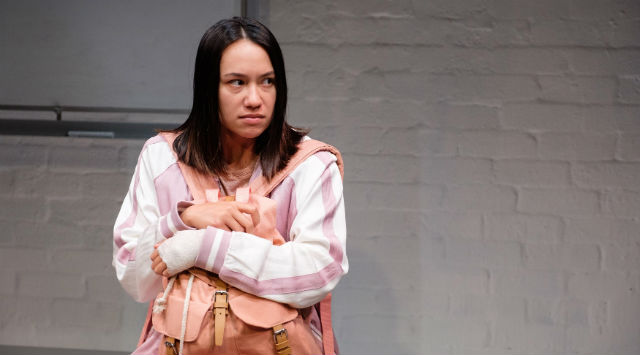
Li Su comes from the middle classes of China, but in her efforts to make it big as an actor in New York, she pretends to be a tragic stereotype, the kind of immigrant that the West likes to think of as a subject of oppression and persecution, victimised by an inferior authoritarian government. When Su’s parents pay a visit, bringing a million dollars in cash to buy her an apartment, the truth becomes a matter of grave inconvenience that she struggles to navigate. Zhu Yi’s A Deal details the experience of a new American, one who chooses to leave the East for the West, at a time when economic power is at an unprecedented equivalence.

The play is a fascinating exploration of timely issues, from a cross-cultural perspective that introduces an unusual complexity to some otherwise hackneyed topics. Directed by Shiya Lu, the production is intellectually engaging, even if pacing does require tightening up at various points. There are compelling performances from its cast, with Shi-Kai Zhang particularly strong as Su’s father, with a combination of heightened drama and understated humour keeping us thoroughly bemused. Also memorable are Susan Young and Edric Hong, both ebullient with the conviction they bring on stage. Su is played by Katherin Nheu, energetic and convincing in the role, although a greater investment into comedy aspects would help provide a more nuanced interpretation of the narrative.

In A Deal, Su’s own desires and ambitions are in constant battle with expectations of her family and those of her new adoptive country. It is almost as if the young woman can never achieve autonomy, even with all that money in the bank. In some ways, we see that she cares too much about external opinion, but we also understand that these are impinging forces that make it difficult for Su to become her own person, on her own terms. Negotiations have to be made, between her authentic self, and the environment in which she lives. If one chooses to pay indiscriminate attention to every source of influence, the demands that can be made of any single person are interminable. Noise that surrounds Su will never cease. It is up to her to recognise which are superfluous, and do away with them.

www.chippenstreet.com | www.flyinghouse.art