Review: Pope Head (Théâtre Excentrique)

r0_3_1200_678_w1200_h678_fmax[1]Venue: Old Fitzroy Theatre (Woolloomooloo NSW), Feb 24 – Mar 6, 2015
Playwright: Garry Roost
Director: Paul Garnault
Cast: Garry Roost

Theatre review
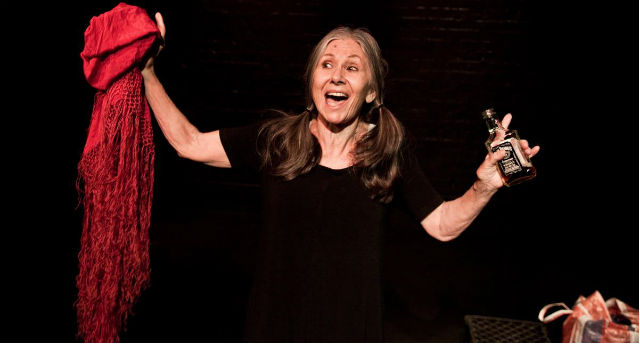
Francis Bacon’s art is among the most revered of the twentieth century. His paintings continue to travel the world’s museums, and his following grows with each year and generation.The power of his work is immediate and compelling, often arousing visceral responses in the viewer before their intellectual, political and historical dimensions can even begin to be explored. Garry Roost’s play is a biography on Bacon that takes cues from stage conventions, as well as from Bacon’s work with its sense of abstraction and energetic expressionism.

Roost’s writing is manic and intense, with a pace and structure that presents a serious challenge to any actor. The unconfined and free-wheeling thought and speech patterns that emerge from the text is frequently incoherent, but fascinating. The words have a definite rhythm that reflects an understanding of the personality it represents, one that is unrelenting, passionate and thoroughly original. An actor usually takes to the stage in order to share narratives and ideas, but Roost is not quite a storyteller on this occasion. His performance focuses on a re-creation of Bacon’s very being that delivers, his idiosyncratic presence and unique mannerisms. We are presented with something of an apparition, accurately imitated and fabulously convincing, but also alienating and at times, puzzling. There is a difference between knowing someone through facts and figures, and gaining insight from observing a creature as it goes about its business, as though from a detached and empirical position. We learn a little about the painter from Roost’s script, but it is from his intuitive portrayal that we acquire a greater appreciation of the man whose legacy has touched many.

We rely on artists to do things differently. It is a thankless task to discover rules and then dismantle them in the public sphere. Audiences need to be disoriented and provoked, even though we prefer to be fed the same formulaic nonsense at every outing. Bacon’s paintings are at their best, upsetting and offensive, and this theatrical manifestation of Pope Head does its best to pay tribute. It is not an easy show to digest, and it is not the most amusing hour of live entertainment, but it does reinforce the memory of a great career and provides the most valuable of all creative endeavours, divine inspiration.

www.theatrexcentrique.com

Review: Playing Rock Hudson (Old Fitz Theatre / Left Bauer Productions)

FEATURE5[1]Venue: Old Fitzroy Theatre (Woolloomooloo NSW), Feb 3 – 15, 2015
Playwright: Cameron Lukey
Directors: Jason Langley, Cameron Lukey
Cast: Paul Dowson, Kim Knuckey, Tyran Parke, Peter Talmacs, Mark Taylor, Grace Victoria, Benjamin Winckle

Theatre review
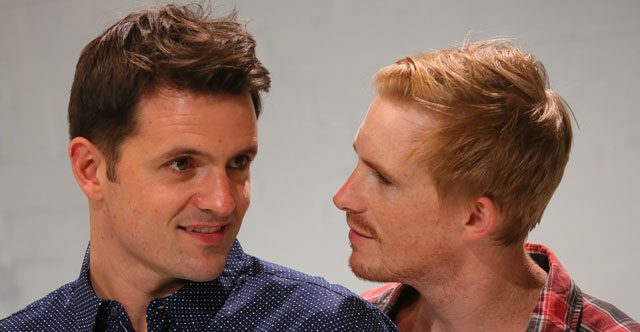
The act of “coming out” by public figures remains a contentious issue. Rock Hudson was a prominent American actor from the 1950s, who had kept his homosexuality a dark secret up to his AIDS-related death in 1985. Playing Rock Hudson offers a look into the star’s final years and his lover Marc Christian’s lawsuit against Hudson’s estate after his passing. Cameron Lukey’s script is detailed and ardent, with shades of tabloid style revelations accompanying passionately political interpretations of events and personalities. It satisfies our need to catch a glimpse of the gay man that had been hidden from view and promotes discussion about the way LGBT history is tainted by deceit, and how it can be amended.

Direction of the work by Lukey and Jason Langley, feels like a nostalgic homage to films of Hollywood’s Golden Age. Scenes are reminiscent of romantic and courtroom classics, achieved by thoughtful costuming (by Georgia Hopkins) and specific acting styles, but the show’s rhythm and energy are consequently slightly lethargic by today’s standards. Sequences are not sufficiently differentiated to prevent a sense of repetition, which also results in a plot momentum that is less than dynamic.

Performances are consistently strong, with a support cast that is especially noteworthy. Grace Victoria is a compelling Elizabeth Taylor, leaving a lasting impression by bringing complexity and humour to a legendary character that most are familiar with. Benjamin Winckle plays multiple smaller roles, but each is distinct, colourful and memorable. Leading men Paul Dowson and Mark Taylor are committed and alluring. Dowson plays Rock Hudson with an astonishing likeness and quiet confidence, and the mysterious love interest Marc Christian is played by Taylor with intriguing ambiguity and charm.

The importance of role models for oppressed minorities cannot be overstated. Those who choose to live in the closet will always have their own reasons, but their actions are an obstruction to efforts for the eradication of discrimination everywhere. Even though he continued denying his sexual orientation from the public, it is believed that Hudson’s announcement of his illness 3 months before death, had had a critically positive impact on funding in the USA for AIDS research. People in positions of power and influence owe a debt to the communities who reward them with privilege and prestige. When acting in self-serving hypocrisy, the debt they owe us all is immeasurable.

www.leftbauerproductions.com

Review: Cock (Old Fitz Theatre / Red Line Productions)

redline2Venue: Old Fitzroy Theatre (Woolloomooloo NSW), Feb 3 – Mar 6, 2015
Playwright: Mike Bartlett
Director: Shane Bosher
Cast: Brian Meegan, Matt Minto, Matilda Ridgway, Michael Whalley
Image by Tim Levy

Theatre review
John is caught between a man and a woman. These relationships cannot co-exist, because the three people believe that the nature of love is monogamous, and more than that, love requires resolute sexual identities. Mike Bartlett’s Cock is essentially a play for the post-gay era. It makes us look at the boundaries and definitions that have come to rule our lives, and to consider their arbitrariness despite their unadulterated and pervasive presence. John has to decide if he is gay or straight, and as the pressure escalates, we become increasingly aware of the absurdity of his circumstance. There are few things in the LGBT world more controversial and dangerous than saying that sexuality and gender are choices that can be made by conscious adults. Cock makes reference to the need for manufactured concepts that serve political purposes, which may not be legitimately applicable to all individuals that they try to protect, and would disintegrate when its purpose is served. Of course, we can understand that no one would choose to be gay in a world that discriminates and persecutes those who deviate from heteronormativity, but if society has progressed far enough, then maybe making a conscious choice to become the “other” is no longer a threatening proposition (if the “other” can still exist in that progressive civilisation). What is discussed in Cock suggests the redundancy of sexuality labels in how we live, even how we love.

Shane Bosher’s direction strips the production of all sets and props. The actors do not make any costume changes, so all they have are words and ideas, bodies and space. The theatre-in-the-round configuration encourages constant movement, and coupled with scenes of incessant fight and struggle, the atmosphere is often electric. Bartlett’s writing is energetic and bold, with humour and drama bulging at the seams, but it is clear that Bosher’s affinity with the play’s graver portions is stronger. Tension on this stage is omnipresent, but jokes are hit and miss. The leading men give exciting performances but lack the versatility to flow persuasively between the light and dark of the writing.

Michael Whalley is John, the young man stuck in a state of confusion. Whalley embodies the frustration and weakness of his character with great clarity, and the play’s difficult themes find a surprising resonance through his performance, but John needs to be more affable in order for the dramatics to have greater efficacy. John’s male lover is played by Matt Minto, who is delightfully flamboyant, but repetitively so. The character is a stubborn one, and we eventually grow tired of his unchanging voice and mannerisms. Conversely, the female lover shows a great range of intellectual and emotional states, and those transformations make Matilda Ridgway’s performance a gripping one. She finds authenticity in a script that is more conceptual than real, and creates the only character we are able to empathise with, even though we are baffled by her devotion to John, the non-hero. Brian Meegan is a last minute replacement for the male lover’s father, so it is entirely understandable that he is yet to have all his lines down, but he does a superb job in later scenes to consolidate the play’s plot and philosophy.

LGBT communities in the West have invested decades to create cultures and identities, in order that oppression may be resisted and subverted. Once those objectives are fulfilled, however, a new stage of evolution will commence. In Australia, that time has not yet come, so John will continue to be forced into conceding an invariable sexual preference, whether it rings true to his personal experiences, or not.

www.oldfitztheatre.com

Review: Bad (Old Fitz Theatre / Red Line Productions)

redline2Venue: Old Fitzroy Theatre (Woolloomooloo NSW), Jan 14 – 31, 2015
Director: Scott Witt
Cast: Penny Greenhalgh, Kate Walder
Image by Yael Stempler

Theatre review
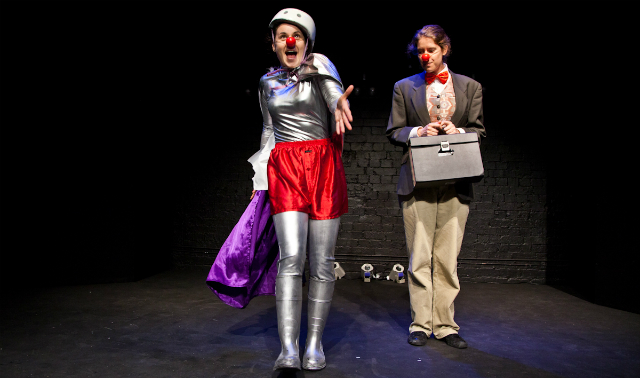
Bad is a show performed by clowns about acting (amongst other things). Along with director Scott Witt, performers Penny Greenhalgh and Kate Walder have devised a work that uses clowning traditions and influences from Commedia dell’arte, to deliver a theatrical experience that is slightly left of centre. Their show is more amusing than it is funny, and their ideas are familiar rather than original, but there is an earnestness and purity to their approach that can be quite charming.

Walder is the “stunt woman” clown who speaks with a French accent, toddling around in a pair of tap shoes. Insisting that she is Cate Blanchett, the Hollywood and theatre star, she goes on to present a show entitled ‘Where’s My Bucket, Mom?’, enlisting the help of Greenhalgh, “philosopher” clown who gradually warms to the idea of being Geoffrey Rush (another star of stage and screen). The plot and story are chaotic and random, but we are always brought back to the theme of performance. Walder and Greenhalgh explore the nature of the theatrical space and the experience of acting using their unconventional methods, with mixed results. The pair is well rehearsed, but the play’s frenzied style and structure require more intense energy levels to provide a sense of abandonment and absurdity to match its concepts. Both actors seem fairly cautious, creating a space that feels safe, where we would prefer a sense of danger and unpredictability.

Not every actor is a clown, but all clowns act. They give us something unique, that can be found in their license to transgress. Clowns do not speak much, because they communicate in better ways. They reach out to us in realms that are beyond words, so that we understand the world from a different perspective. When done right, they impart a kind of wisdom that brings unexpected enlightenment. Bad is not always good, but what’s worse is doing things the same way over and over again. There is a courage at play here, and we need more of it.

www.oldfitztheatre.com

Review: Masterclass (Old Fitz Theatre / Red Line Productions)

redlineVenue: Old Fitzroy Theatre (Woolloomooloo NSW), Jan 14 – 31, 2015
Playwrights: Gareth Davies, Charlie Garber
Directors: Gareth Davies, Charlie Garber
Cast: Gareth Davies, Charlie Garber
Image by Marnya Rothe

Theatre review
Two actors collaborate on a work for the stage, talking about what they know best. Gareth Davies and Charlie Garber’s Masterclass is about the craft and experience of acting, and all the anxieties associated with it. They take the art of self-mockery to great heights by depicting versions of themselves that are flamboyantly theatrical and deeply cynical, to interrogate the nature of their creative beast. An extreme self-consciousness manifests itself in a persistent need to make light of their art form, which delivers gales of laughter effectively, but its attempts to demystify and deconstruct the psychology and process of the actor takes irreverence to a sometimes uncomfortable place, and one begins to question the exasperating disquiet that Davies and Garber seem to feel about their profession. We see their resistance against taking any of their craft seriously, but we see them exploring this iconoclasm, with impressive commitment and skill.

There is a distinct, almost stubborn sense of humour at play, but the pair manipulates pace, rhythm, and plot dynamics to give the work variations in tone that keep us engaged, despite its very simple premise. Garber has a quiet confidence that allows him to portray the wild comedy of Masterclass with relative restraint. His style is often deadpan, but the clarity of intent he brings to every moment gives a surprising coherence to his unorthodox part, and a convincing strength to his punchlines. Davies’ approach is wider in range, and his comedic choices are decidedly riskier. The man’s energy is the foundation of the piece, and his control over spatial atmosphere and his audience’s responses is quite marvellous. We do not necessarily empathise with every idea Davies expresses, but there is certainly a lot to be admired of his ability to entertain, while conveying concepts that can be quite obscure.

Technical design is a crucial element to the structure and timing of this comedy production. Uncredited work on sound and Benjamin Brockman’s lights add much needed sophistication to an otherwise aesthetically challenged show. The play’s context allows for imaginative use of sets, props and costumes, but no investment is placed on those areas, and Brockman is called upon to provide all visual embellishment in the black box to admittedly satisfying results. Also noteworthy is stage manager Nick Foustellis’ precise and elegant execution of cues and changes.

The play concludes with a hint of poignancy that arrives after a long wait. The two young men prove themselves to be brilliant at light entertainment, but they seem to shy away from the inevitable gravitas that any theatrical piece requires. Not every story needs to give you something to think about, but when careless, jokes can leave you feeling empty. The sweet taste of success is for delighting in, and young talent should learn to embrace their gifts, even in the land of tall poppies.

www.oldfitztheatre.com

5 Questions with Shane Bosher

shanebosherWhat is your favourite swear word?
There are three that regularly vie for #1 spot: bullcrap, fuckpuppet and cunting. All almost unspeakable.

What are you wearing?
I go for a simple look: black t, classic blue jeans, black Nike trainers. Consider it my contemporary take on the classic 1970s director garb: black skivvy, leather jacket, cigarette.

What is love?
Love is a wonderful predicament which has been destroying and enriching people’s lives since forever. It’s simplicity, it’s courage, it’s vulnerability, it’s difficulty, it’s joy – it is all of the things. Without it, stories would be rubbish and I’d be out of a job.

What was the last show you saw, and how many stars do you give it?
A touring version of The Sound Of Music in New Zealand. I left after the Mother Superior had climbed every mountain. A gruelling trip up into the Alps with wobbly vibrato and wobblier sets. 2 stars. Am seeing Tabac Rouge tomorrow, so am holding out all hope for that to restore the faith.

Is your new show going to be any good?
It’s a whole lot of crash bang love. Great play, top notch cast, stellar production team and the Old Fitz as you’ve never seen it before. I reckon so.

Shane Bosher is directing Cock by Mike Bartlett.
Show dates: 3 Feb – 6 Mar, 2015
Show venue: The Old Fitzroy Hotel

5 Questions with Gareth Davies

garethdaviesWhat is your favourite swear word?
Swearing is the refuge of thieves and louts, a thinking man with a moderate grasp of the English language needs not swear to display his displeasure. Although the word ‘cunt’ is pleasing to yell out of bus windows.

What are you wearing?
Hopes, dreams, and some loose thai fisherman’s pants.

What is love?
Love, huh? It’s a warm bicycle seat, paella on the barbecue. It’s a short gasp and a long goodbye. Long fingers. Smooth skin. Sticky hearts. Jewels from a dragons trove. It’s smart casual. But what would I know, right? I’m just one more sucker who looks good in a dinner jacket.

What was the last show you saw, and how many stars do you give it?
I don’t see shows because I might pick up bad habits, so, I guess my own? Five stars.

Is your new show going to be any good?
Not our problem.

Masterclass, by Gareth Davies and Charlie Garber.
Show dates: 14 – 31 Jan, 2015
Show venue: The Old Fitzroy Hotel

5 Questions with Charlie Garber

charliegarberWhat is your favourite swear word?
Swear words. My favourite. Hmmm. Well, I’ve always liked *&%^*$$@#%Y. But then there’s *&^. I suppose I’d have to go with ).

What are you wearing?
What am I wearing? What am I wearing?! Jesus! You know, I’ve just trawled Facebook for the last ten minutes. The world is a truly sorrowful place. What am I wearing??!! 2014 has been a ragged year of war, lies, paedophilia and greed… Grey Bonds briefs and a blue and white striped Vanishing Elephant T, all piled languorously on a teal linen doona cover.

What is love?
Love is the chill of a demon baby’s breath glimpsed from an antique pram on a frozen park lake.

What was the last show you saw, and how many stars do you give it?
The last show I saw was Cyrano de Bergerac at STC. I give it five bags of popcorn and five bags of soda.

Is your new show going to be any good?
Masterclass is the show and it’s a steaming pile of garbage.

Masterclass, by Gareth Davies and Charlie Garber.
Show dates: 14 – 31 Jan, 2015
Show venue: The Old Fitzroy Hotel

Review: Belle Of The Cross (Harlos Productions / Sydney Independent Theatre Company)

sitco2Venue: Old Fitzroy Theatre (Woolloomooloo NSW), Nov 18 – 29, 2014
Playwright: Angelika Fremd
Director: David Ritchie
Cast: Gertraud Ingeborg, Colleen Cook
Image by Katy Green Loughrey

Theatre review
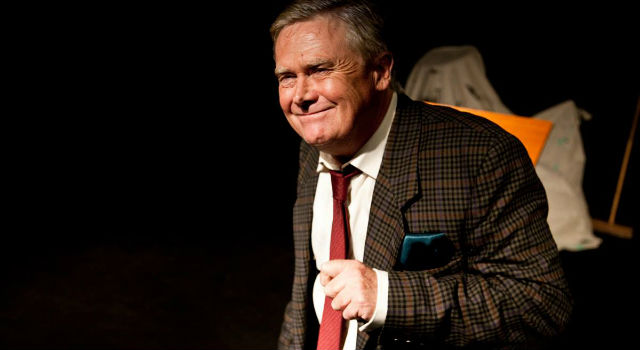
Sydney’s Kings Cross is completely unique. Always controversial, vibrant and newsworthy, the area is a tiny geographical spot, but its infamy reaches far and wide. Residents of the precinct range from the very wealthy to the impoverished, including the homeless who often gravitate towards its parks and colourful alleyways. Angelika Fremd’s Belle Of The Cross is not biographical, but Belle is a composite, created from Fremd’s observations of “streeties” in the neighbourhood during her eight years at the Cross. The play is poetic, atmospheric and emotional, with only a light narrative thread holding scenes together. The writer depicts the extraordinary community with affection and dignity, rejecting contexts of mental illness that might cause a reductive reading of her subject matter.

Direction of the work by David Ritchie is sensitive to the considerations of the script, and he builds a sense of grace into the production, but its unrelenting gentleness prevents sufficient dramatic tension from taking hold. Scene changes tend to be overly subtle, with indistinct shifts in time and mood. Gertraud Ingeborg’s performance in the title role personifies warmth and sincerity. Her focus is impressive, and even though the stillness in her presence gives weight to the show, a lack of tonal variation results in a character that does not seem to develop adequately. Belle is an interesting personality that we have a lot of curiosity about, but the play needs to provide more insight to satisfy our desire to know her.

We all have times of loneliness, but Belle’s struggle is to do with isolation and aloneness. Although she is quite content with her own company, we must question our capacity and willingness as neighbours and community to furnish an environment that is safe and nourishing. Homelessness is a complex issue, one that crosses paths with a society’s stance on human rights and its economic ideologies. Belle Of The Cross gives a voice to the often seen but rarely heard, and is therefore essential and important, if we believe ourselves to be civilised.

www.sitco.net.au

Review: The Les Robinson Story (Type Faster Productions / Sydney Independent Theatre Company)

sitco1Venue: Old Fitzroy Theatre (Woolloomooloo NSW), Nov 18 – 29, 2014
Playwright: Kieran Carroll
Director: Ron Hadley
Cast: Martin Portus, Matt Thomson
Image by Katy Green Loughrey

Theatre review
When a person commits their life to the arts, it is often a conscious decision to go against many societal expectations, and therefore, to become resolutely anti-conformist. Many struggle to make ends meet, and few achieve great critical success, yet there are those who persist through hardship, believing that it is their devotion to their art that provides the greatest meaning. Les Robinson was a Sydney writer who had had only one book published, The Giraffe’s Uncle, in 1933. Between the 1920s and 1960s, the eccentric figure lived a one-man bohemia in shacks and caves around the Sydney harbour, listening to records, fishing and of course, writing.

Kieran Carroll’s lovingly crafted play immortalises a forgotten soul, one whose stories provide us with insight into an unusual life, and a fresh perspective of the city that we love. Carroll’s work is deeply melancholic, but it is also wonderfully inspiring. We hear about iconic artists everyday, but to learn about one of the others, is unexpectedly comforting. The Les Robinson Story could easily be a depressing one, but Ron Hadley’s direction takes care to serve up the joy with the sorrow, always leading us to the light at the end of each dark tunnel. The depiction of time’s passage however, could be made clearer, in order for us to gain a more detailed impression of the character’s evolution.

Martin Portus is not a neglected writer living under a bridge, but the actor certainly makes us believe that he and Robinson are one and the same. The level of authenticity he achieves is the great beauty of this staging. Portus’ presence is strong and sturdy, and his eagerness to share this buried tale is quite moving. As with all great storytellers, we often find ourselves suspended in time with the performer, losing awareness of before and after, completely captivated by right now.

The Les Robinson Story might be about disappointments, loss and regret, but it will be remembered for the man’s spiritedness and his tenacity at living a life of truth and honesty. Robinson never pretended to be anything but his genuine self, and that alone trumps everything else.

www.sitco.net.au