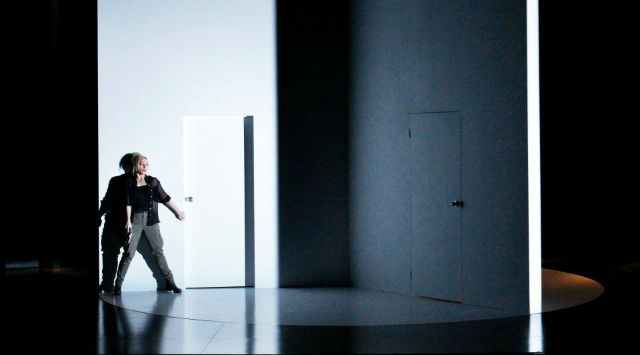
Review: Men (Red Line Productions)

redline1Venue: Old Fitzroy Theatre (Woolloomooloo NSW), Jun 30 – Jul 25, 2015
Playwright: Brendan Cowell
Director: Jessica Tuckwell
Cast: Cheree Cassidy, Sean Hawkins, Ben O’Toole, Jamie Timony
Image by Marnya Rothe

Theatre review
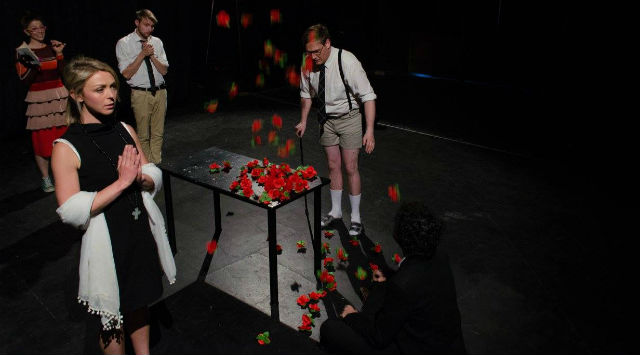
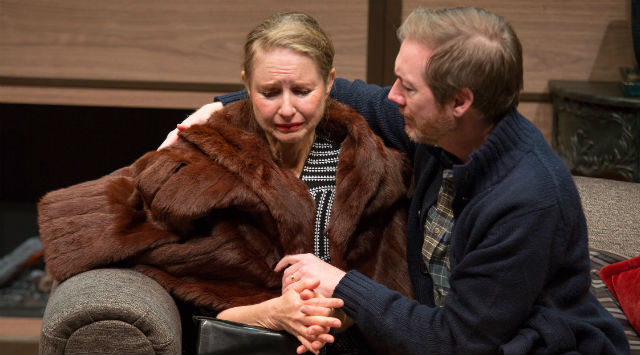
There are three men in the play, each representing a negative aspect of machismo. One is the narcissist, another is the brute, and the weakling makes the trio. Brendan Cowell’s script is filled with insecurity and angst about modern maleness. Set within an indeterminate but claustrophobic context, Jules, Bob and Guy are aggressive expressions of all that we think is wrong with boys and men in Western societies today. It is a real challenge creating a story with no likable characters, but the author’s own presence is strong in the piece, and his self-effacing approach is an appealing one. Cowell achieves a fine balance between manufacturing objectionable scenarios and dialogue, with a critical undercurrent that gives us the freedom to indulge in the often politically incorrect humour. Despite its coarse demeanour and brash tonalities, Men is deeply poetic, with a strange and tragic beauty accentuated by the hopelessness that it depicts.

Jessica Tuckwell’s direction of the work brings a showy brazenness that entertains for the entirety. Energy levels are pitched very high, but we are always conscious of substance and subtexts lying beneath. There certainly is a good amount of depth to the play, but much as we are invited to analyse these young men’s thoughts and behaviours, there seems an unwillingness to delve into the causes of their plight. Comedy is handled with an impressive restraint that shows sophistication, as well as a well-placed confidence in the script. Haizel, the sole female personality on stage is a predictably enigmatic figure, but Tuckwell resists ascribing her with an archetype and her resultant ambiguity adds interest, if slightly unsettling.

All performances are accomplished for the piece, especially that of Sean Hawkins, who impresses as the boundlessly vain Jules. The writing demands of its players loud and fast delivery, which means that characters can appear mono-dimensional, but Hawkins’ portrayal reveals fragility and bewilderment where least expected, and his ability to inject subtle flashes of irony into a world of conceit, is thoroughly delightful. The level of concentration and clarity that each actor displays for their own part, gives the production its electricity, and despite their despicability, we hang on to their every word and action, always eager for more.

There are some spiritual schools of thought that believe in the importance of knowing what it is that one desires, rather than knowing only what is undesired. The production only shows us the troubling parts of being human, but is hesitant at discussing the alternatives. Regardless, Men is hugely satisfying. Deeply interesting questions are brought up that refuse to be ignored, and the sheer visceral excitement derived from its excellent performances is quite exceptional. Men, can’t live with them, can’t live without them.

www.oldfitztheatre.com

Review: Spring Awakening (Kore Productions)

koreproductionsVenue: The Factory Theatre (Marrickville NSW), Jun 15 – 17, 2015
Book & Lyrics: Steven Sater (based on the original play by Frank Wedekind)
Music: Duncan Shiek
Directors: Alexander Andrews, Sam Haft
Cast: Thomas G Burt, Jamie Collette, Abbie Gallagher, Hannah Garbo, Nathaniel Hole, Julianne Horne, Charlotte Kerr, Logan McArthur, Jonathan Nash-Daly, Damien Noyce, Jordan Stam, Mitch Thornton, Kaleigh Wilkie-Smith

Theatre review
Spring Awakening is concerned with how teenagers learn about sex, and how they deal with burgeoning adulthood. The musical is critical of how adults fail to provide adequate or appropriate guidance, and this low-budget production by young enthusiasts, provides an uncanny parallel between that central theme and the state of theatre in Sydney for emerging talents. We have a rich history of show business in this town, that boasts some of the world’s greatest practitioners, but they are missing from this staging. There seems an unfortunate chasm between generations, and on this occasion, a full scale production, although well-meaning, has been created from a wealth of promising but inexperienced individuals, who have naively chosen to tackle a beast much more formidable than they were ever able to foresee.

Sound issues are not chief of its problems, but its frankly shocking deficiencies from beginning to end have rendered the plot incomprehensible, and represents a complete disregard for any semblance of balance to harmonies being attempted by performers. Consolidating all the string sections in the arrangement onto a single violin is probably a matter of financial inevitability, but the results are often painfully lacking.

Efforts at creative spacial use by directors and choreographer help with energy and scene transitions, but execution requires a great deal of finessing. The story’s most crucial event takes place at a position on stage that only the very first rows can glimpse, further demonstrating the need for more experienced management on the project. The cast is a green one, with some discernible ability, but there is no cohesion in their conception of what is being presented. Key characters are sung by unremarkable voices, and the level of acting overall is regretful. One exception is Charlotte Kerr who shines in her solo as Ilse, with a beautiful and controlled voice that brings a moment of sobering polish to the show.

All of the very best have failed spectacularly in the public eye. Creative souls must not sit back and wait for the perfect opportunity before allowing themselves to put their passion into action. Many have perished without leaving a mark for fear of failure. The artistic process is very rarely without episodes of disappointment, but one cannot expect a masterpiece to materialise without first braving the wilderness.

www.koreproductions.com.au

Review: Misterman (Siren Theatre Co / Red Line Productions)

sirenVenue: Old Fitzroy Theatre (Woolloomooloo NSW), Jun 9 – 27, 2015
Playwright: Enda Walsh
Director: Kate Gaul
Cast: Thomas Campbell
Image by Diana Popovska

Theatre review
Enda Walsh’s Misterman addresses the very contemporary concern of fundamentalist religiosity and its place within secular societies. The tension between the private and the public seems to be approaching its breaking point with our obsessive attention on terrorist activity around the globe. The principle of individuals keeping religious beliefs to themselves has always been precarious, and now we see every day, the violent trespass of those beliefs upon the lives of others. Thomas lives in a small Irish town, and like Travis in Martin Scorsese’s Taxi Driver, he becomes increasingly frustrated by the sins he perceives to be thriving around him. Further parallels can be drawn with other “outsiders” like Norman Bates and Carrie, and accordingly, Misterman appeals to our sentimental feelings for the underdog, as well as that undeniable dread arising from seeing the oppressed struggling at the end of their tether.

Beautifully imagined and directed by Kate Gaul, the intimacy of the venue is utilised to enhance the confrontational quality of the text. Her show is a bold one, with an abundance of creative devices invented to provide intrigue, interest and dimension to the monologue format. Subtleties of Walsh’s writing can sometimes be drowned out, but the intensity of what is being presented proves to be arresting, and we engage with the work thoroughly for its entirety. The holistic incorporation of design faculties demonstrates a sophistication that reflects a deep understanding of the nature and capacities of theatre. Set by Gaul, lights by Harley T A Kemp, music and sound by Nate Edmondson contribute much more than atmosphere. The way we understand the protagonist’s environment and his psychology happens through the accomplishments of this formidable design crew, and their exhaustive exploration of space and fantasy.

Thomas Campbell gives the performance of a lifetime in Misterman. His affinity with the material at hand, and the vast amount of depth he has discovered in the text and within himself, have conjured up a tremendous character, rich with life and poignancy. Campbell pushes hard and what he attains is glorious. The focus, energy, sensitivity and intuition he displays, is a rare gift to audiences that we must accept with a gratitude as sincere as what he puts on stage.

The play is about the way we break, and because we are all, to some extent, broken people, the work is accessible in spite of Thomas’ oddness and idiosyncrasies. The isolation and cruelty he experiences is exceptional but also familiar, and through his story, we can perhaps learn about understanding and compassion, which are necessary but often lacking. We don’t need much to survive, but the basic things don’t come easy.

www.oldfitztheatre.com | www.sirentheatreco.com

Review: Mother Courage And Her Children (Belvoir St Theatre)

Venue: Belvoir St Theatre (Surry Hills NSW), Jun 6 – Jul 26, 2015
Playwright: Bertolt Brecht (translated by Michael Gow)
Director: Eamon Flack
Cast: Paula Arundell, Tom Conroy, Lena Cruz, Michael McStay, Alex Menglet, Arky Michael, Robyn Nevin, Anthony Phelan, Richard Pyros, Hazem Shammas, Emele Ugavule
Images by Heidrun Lohr

Theatre review
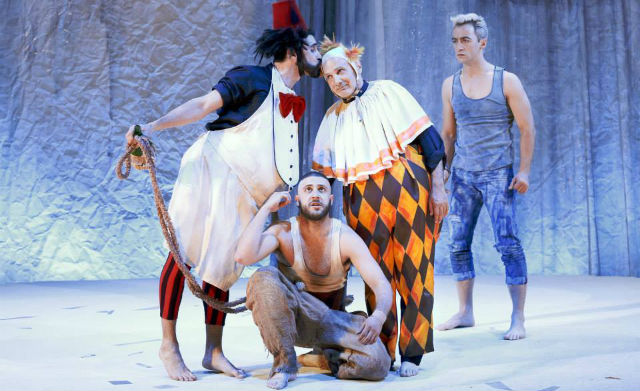
It cannot be denied that war is a part of human nature. We can certainly imagine a world with no battles, but history proves that it is in fact inevitable, that people will fight, over religion, money and land, no matter how catastrophic the results may be. We are however, resilient and optimistic, with a survival instinct that does not easily give in to threats and destruction. Bertolt Brecht made the association between capitalism and war, in his seminal work Mother Courage And Her Children, first staged in 1941, during the Second World War. It is concerned with decisions made by individuals in the face of social upheaval at wartime, and characteristically, Brecht had aimed to encourage a specific way of thinking through the play.

Politics is always crucial to discussions and renderings of Brecht’s legacy. He made theatre with the intention of influencing his public about contemporary issues, and whenever productions are materialised today, it is still imperative that a political message is at the core of whatever transpires. Story and politics are intimately bound, and for Brecht’s writing, separation is quite impossible. Michael Gow’s translation provides a newer cadence to the text, but the poetic style of language requires a delivery that is sensitive to the ears of its audience, and the production fails to find a way to connect with our sensibilities and emotions.

Eamon Flack’s direction leaves us confused for long stretches of the show, with unclear depictions of characters, timelines and narratival details. There is a good focus on theatrics, which provides an energetic and colourful atmosphere, but we are never quite certain what the plot is trying to reveal. The iconic use of Brechtian placards are sorely missed in our periods of perplexity. The players engage confidently with each other, and their presences feel authentic, but not enough effort is put into including us in their interactions, which means that we are never able to gain insight into how and why things are happening. The experience is frustrating as events on stage often seem interesting, but we only have access to surfaces. The lack of depth in our understanding, coupled with an emotional detachment makes it increasingly challenging to pay attention as time passes. At 150 minutes, our commitment to participate as an engrossed crowd is thoroughly tested.

Performances in the piece have a quality of confidence and gravity that give the production an unmissable polish. The cast, including leading lady Robyn Nevin, seems well-rehearsed and they rise to the challenge of a show with complex transformations and frequent scene changes that can be wildly different in tone from one another. For the entire duration, the actors are in powerful command of all that happens on stage, even though they rarely create significant impact beyond that periphery. Speech is presented in a naturalistic manner, which is inappropriate for a script that is quite dense and florid. Without sufficient assistance with nuances of the writing, the lines seem to hurry past our consciousness, and characters begin to sound as though mumbling throughout their lives. Paula Arundell leaves the strongest impression in her role of Yvette, with an appealing vivacity that communicates more than the others. Arundell seems to project her portrayal with greater specificity to allow for audience connection, resulting in one of the more successful elements of the production.

It is an expertly designed show, with Benjamin Cisterne’s lights and Robert Cousins’ set creating both an air of theatrical fantasy and wartime grittiness via a surprising minimal approach. That sophistication extends to Stefan Gregory’s delightfully intricate music compositions, which are probably the greatest achievement of this staging. Evocative of Brecht and Kurt Weill’s distinctive style, each interlude provides an opportunity for us to focus on the state of minds and affairs being explored, as they find articulation at a more lyrical pace.

We are in the midst of war when our governments and communities identify explicit enemies, whether asylum seekers, terrorists, paedophiles or drug dealers. As individuals in democracies, our ethical standpoints must always be examined. Bad things happen when good people do nothing, or if they submit to dominant ideologies that are unconscionable. We live in a time where dubious ethics are encouraged, in the name of things like nationalism, or the profit motive. Capitalism can provide an excuse for unjust behaviour, and fabricate permission for bad things to happen. Mother Courage should not be a divisive personality, but on this occasion, we cannot be sure that the right message is consistently delivered, or whether the spectators can even be concerned at all for the moral of her story.

www.belvoir.com.au

Review: The Diary Of Anne Frank (New Theatre)

newtheatre1Venue: New Theatre (Newtown NSW), Jun 9 – Jul 11, 2015
Playwrights: Frances Goodrich, Albert Hackett
Director: Sam Thomas
Cast: James Bean, Caroline Levien, Rowena McNicol, Jessie Miles, Jodine Muir, Martin Portus, Martin Searles, Geoff Sirmai, Justina Ward, David Wiernik
Photography © Matthias Engesser

Theatre review
Based on Anne Frank’s The Diary Of A Young Girl, this classic play by Frances Goodrich and Albert Hackett premiered 1955 in New York City. It is classic in structure and subject matter, with characters and a narrative that follows all the rules of conventional drama. Even though the work is based entirely on true events, the script is filled with elements that ensure a theatricality that writers of fiction can scarcely dream up. Anne Frank’s story is a significant part of our literary and social history, and although not particularly groundbreaking or trendy by today’s expectations, its resonances are intense and undeniable.

Direction by Sam Thomas is nuanced and sensitive, but also exuberantly dynamic. She has created a rare cohesiveness in a cast that is unified by a vision and tone that aims to tell Anne Frank’s story with clarity and a lot of heart. Thomas’ measured approach is quiet, and her hand is an invisible one. Front and centre are not the egos of artists, but the tragedy of WWII and a young girl’s experiences and understanding of it. All the cruelty and savagery of war, and the catastrophic debasement of Jewish peoples are presented powerfully, with a formidable tension that builds gently and gradually through accomplished design work from all aspects, most notably Heidi Brosnan’s lights and James Ackland’s sound. Costume by Famke Visser, and Allan Walpole’s set both contribute effective and elegant solutions to the expression of time and space, quickly drawing us into life in the now legendary attic in Amsterdam.

All 10 actors involved are perfectly cast, each with an individually memorable presence and all creating poignancy from different perspectives. The chemistry on stage is effortless but unmissable, and we never question the authenticity of their very close relationships. In the role of Anne is Justina Ward, who never quite looks thirteen years-old, but who has us firmly in the palm of her hand, delighting us with an animated personality and a precisely studied interpretation of Anne’s psychological and emotional evolution over the two years. Palpable, joyful and thoroughly adorable, Ward’s work as leading lady in The Diary Of Anne Frank is quite the revelation.

The problem with old stories is that we dismiss them as stale, forgetting what it is that makes them persevere. Sam Thomas and her team have well and truly dusted off every cobweb and revealed afresh, a tale of humanity and hope, that will touch even the hardest of hearts. The work moves us by appealing to our common benevolence, but is never overly sentimental. The characters are simply realistic and genuine, so we cannot see them as anything but our sisters and brothers. The memory of Anne lives on because our belief in justice never fades, and the need to uphold it in our societies never diminishes. The fallibility of human nature means that different groups are persecuted at different times, but there is also a determination in us all that want to do right, and it is to that spirit that this play speaks.

www.newtheatre.org.au

Review: Beyond The Neck (Emu Productions / Epicentre Theatre Company)

kstVenue: King Street Theatre (Newtown NSW), May 28 – Jun 13, 2015
Playwright: Tom Holloway
Director: Markus Weber
Cast: Dana Brierley, Jessica Hobden, David Ritchie, Brayden Sim
Image by Thomas Adams

Theatre review
Not a day goes by that we do not hear about terrorism. The fear of being attacked by enemies is reinforced by our government and media fervidly, but the truth of our experience shows that it is not external forces that have caused us greatest harm, but those within that we consider to be neighbours. The “Martin Place Siege” of just half a year ago shocked the entire nation, and brought back memories of the horrific “Port Arthur Massacre” of 1996, where 35 people were killed and 23 wounded. Tom Holloway’s Beyond The Neck is an expression of a deep grief that is inflicted upon a community after a catastrophe of that magnitude. The play’s intent is to heal, and to explore the nature of emotional and psychological trauma.

The four-actor cast performs most of the piece in individual monologues, with several moments of very brief interaction. Not all are well prepared, in fact some appear to be quite unready for the production, but Dana Brierley and Jessica Hobden work well to portray their characters with a degree of passion and accuracy. There is a misplaced flavour of melodrama to their intensity, but they help to bring variance to the energy on stage.

Music is played fairly loudly in the background for most of the duration, and is almost always a distraction. The mood it creates is often contrary to what the actors try to achieve, and the audience is prevented from connecting meaningfully with the stories being told. Set design seems unnecessarily busy and visually confusing, with levels and colours that do not contribute to the poignancy of the play.

The production is a timely one, considering our interest in the subject matter. Many of us have strong feelings about events of mass terror, and an opportunity for catharsis is undoubtedly welcome, but on this occasion there is insufficient clarity in the execution of its purpose. The issues we face are complex and a lot more is required for those things to begin to make sense.

www.kingstreettheatre.com.au | www.epicentretheatre.org.au/

Review: Neighbourhood Watch (Illuminate Educate)

illuminateVenue: Bondi Pavilion Theatre (Bondi NSW), May 28 – Jun 6, 2015
Playwright: Lally Katz
Director: Susanna Dowling
Cast: Skyler Ellis, Gertraud Ingeborg, Steven Kreamer, Odile Le Clezio, Andrew Lindqvist, Linden Wilkinson, Anne Wilson

Theatre review
In Lally Katz’s Neighbourhood Watch, two women find a special but unexpected connection, and their bond helps them grow into individually stronger persons. The relationship gives their lives greater meaning, and their story is a reminder that the social aspects of our being is crucial to the way we evolve and progress. Ana and Catherine are women who have needed time to find independence and self-worth, and Katz’s writing makes no bones about using them to inspire girls and women. We often define ourselves in relation to men, in fiction as well as in reality, and the play brings focus to how we let that transpire, and then how we can find emancipation.

Direction of the work by Susanna Dowling is very polite. There is a quietness to the production that hinders the wit of the writing, but although energy levels are low, its main characters are vivid enough for the audience to absorb all that the show wishes to impart. The play is set in many different locations, so scene changes are tricky, and not always handled with enough elegance. Spacial use requires greater inventiveness to prevent distractions and plot confusion. On a brighter note, music is beautifully utilised in the production, with composer Steven Kreamer’s work adding a sophisticated and emotional dimension to proceedings

Lead characters are performed well, although disappointingly restrained. The story is about intimacy, but there is insufficient vivacity between personalities, and they never feel close enough for the narrative to become poignant. Ana is played by Gertraud Ingebors, whose dry sense of humour charms the audience. Her work is convincing and evocative, but the actor seems to have trouble finding enough chemistry with colleagues. Anne Wilson is a likeable Catherine, with a warm and tender presence, but some of her depictions of heavier emotions call for greater authenticity. Like Wilson, Skyler Ellis is immediately endearing in the supporting role of Ken. The part is considerably lightweight by comparison, but Ellis steps up to the mark at every opportunity to showcase his excellent comedic abilities.

The characters in the story connect, but the production feels distant. There is enough lucidity for everything to make sense, but in a cool and slightly detached manner. The shattered dreams and broken hearts in Neighbourhood Watch do not translate with great passion and urgency. Although we hear the message, we want also to understand how it feels to be the people on stage. The live medium of theatre bears the right circumstances to affect its captive audience like no other art form can, and it needs to use that rare and uniquely exciting proximity to spark something visceral, so that its revelations can impress even deeper.

www.illuminateeducate.com.au

Review: Shivered (Mad March Hare Theatre Company)

madmarchVenue: PACT Theatre (Erskineville NSW), May 7 – 30, 2015
Playwright: Philip Ridley
Director: Claudia Barrie
Cast: Josh Anderson, Joseph Del Re, Rhonda Doyl, Libby Fleming, Andrew Johnston, Brendan Miles, Liam Nunan

Theatre review
Illusory contours “are perceived where there is no physical luminance, colour or texture difference,” referring to our ability to see things that are not actually there. In the case of Philip Ridley’s Shivered, we form narratives and create meanings from a series of scenes that do not immediately relate to each other, almost as though in a state of delusion. Our human nature is explored not only in the stories being told, but also in the way the audience is encouraged to makes sense of all that is put on stage. Looking at our propensity to interpret events in a way that never strays far from “cause and effect”, it is an examination of logic, which the play suggests is sometimes insufficient, and indeed, futile. Ridley’s work deals with many of the worst things in life, and makes us wonder if we can ever think of our darkest moments as inevitable, and the ethical implications of being embroiled in disappointments and disasters that we do not have direct control over.

These are big philosophical considerations, but individual scenes are melodramatic, almost operatic, in nature. Director Claudia Barrie invests heavily into that duality of intellect and emotion, with a fierce dedication to her stagecraft, and her work here is effective on both those levels. We get caught up in intense family drama not unlike those favoured by tabloid journalism, but the work is unrelenting in placing us at a conceptual distance so that we are always analysing the catastrophic consequences from an abstract perspective, in addition to experiencing the anguish that is being performed. The text is an edgy one, and Barrie takes great care in having Ridley’s words articulated with excellent clarity, but with all the taboo subjects involved, the production often feels tame in its expression when compared to the controversies being discussed.

Light and set design by Benjamin Brockman delivers a sophisticated space that is able to portray abstraction or realism as required, sometimes simultaneously. It accommodates the haphazard timeline of the plot beautifully, and the starkness of his aesthetic matches the brutality of Ridley’s writing very well, but at over two hours, scene transitions become repetitive and predictable later in the piece. The economy of technology Brockman experiments with, though slightly restrictive, is a success story that signals a significant evolution in lighting for Sydney stages.

The cast is detailed and powerful. Every character in the show touches us, despite the outrageous contexts we find them in. Libby Fleming alternates between quite campy humour and palpable rawness, for an enthralling performance that is as fascinating as it is moving. Her impressive ability to portray depths of despair provides a solid core of empathy that keep us anxiously attentive. The connection Fleming establishes with her sons in the play is the crucial ingredient that secures the gravity for its various threads of turmoil. Also wonderfully engaging is Liam Nunan whose presentational style effervesces with extravagance, but with a surprisingly convincing focus that keeps us engaged. Josh Anderson plays the damaged young Ryan with quiet sensitivity, but the threatening intensity he produces teeters close to eruption, and we are fascinated by the complexity he consistently works into his role.

There are horrors around us, and they are by nature absurd, for if they were fathomable, they would also be preventable. Humanity necessitates that we make sense of things, but life often insists on defying logic to demonstrate its dominance over humans. Life is hard, but we are resilient. All the characters in Shivered struggle, and their persistence with survival means that in order to overcome, they have to figure things out, whether possible or not. No one in the play gives up, and that is the moral of the story.

www.madmarchtheatreco.com

Review: Rhymes With Silence (Improvising Change)

rhymeswithviolenceVenue: 107 Projects (Redfern NSW), May 16 – 24, 2015
Playwrights: Alex Broun, Jane Cafarella, Joy Roberts, Kate Rotherham, Loueen Winters, Natalie Banach, Pete Malicki, Suzy Wilds, Vee Malnar
Directors: Chrissy deSilva, Garreth Cruikshank, Glen Pead, Glenn Groves, Kaye Lopez, Lisa Eismen, Margaret Barnaby, Natasha McDonald, Uma Kali Shakti, Vee Malnar, Wayne Mitchell
Cast: Alex Gercsov, Ali Aitken, Angela Gibson, Bendeguz Daniel Devenyi-Botos, Debbie Tilley, Dede Attipoe, Elisa Cristallo, Eliza St John, Garreth Cruickshank, James Belfrage, Joanna Kedziora, Karina Bracken, Katherine Richardson, Katrina Papadopoulos, Kerrie Roberts, Lisa Hanssens, Liz Harper, Liz Hovey, Lynda Leavers, Matt Cowey, Melissa Day, Rebecca Van-Hek, Ros Richards, Sarah North, Tommy Deckard, Veena Sudarshan
Image by John Tsioulos

Theatre review
The programme comprises 13 short plays, unified by the theme of domestic violence against women and girls. The event aims to bring attention to a problem that struggles to find articulation, due to the unthinkable horror of being attacked within the most intimate of relationships. The perpetrators we hear about in Rhymes With Silence are husbands, lovers, fathers. Men who are meant to be our protectors have failed to provide the shield from harm, and their betrayal of trust is of the most severe and devastating kind. Without a doubt, the stories being shared here are dark and often harrowing. There is certainly no shortage of gravitas in spite of the casual presentation style, which simply moves from one basic staging to another with minimal fuss.

Some of the pieces can feel too obvious in their approach, and there is a repetitiveness to the proceedings that makes the two-and-a-half hours slightly challenging, but the earnest and direct way the artists deal with their difficult subject matter is a refreshing experience. The level of honesty we encounter is intimidating, but we are compelled to learn more. The scenarios are shocking but never unbelievable. Joy Roberts’ Regret is one of the few opportunities to hear from a male character, and the revelations of a wolf in sheep’s clothing is enlightening and exasperating. Also intriguing is Good Men Do Bad Things by Suzy Wilds, which features two mothers-in-law in dialogue after the son is sent to prison for killing the other’s daughter. The extraordinary context is fertile ground for explosive interchanges, and the script explores the possibilities beautifully. All the complex emotions are authentic and we relate effortlessly to every plea and confrontation. More than other stories in the collection, this work holds the greatest promise for a very interesting full length iteration.

The inordinately large number of cast members is evidence of the growing concern we have for the issue at hand. Some of the performances might be of an amateur level, but all are committed and serious in attitude. More polished actors include Karina Bracken, who shines in Whirlpools by Alex Broun. Bracken’s style is still but powerful, and her quiet confidence allows us to connect with the works she puts into her character’s thought processes. The fluidity in her interpretation provides a humanity that feels familiar and genuine. Also impressive is Melissa Day in Tara Weldon and Vee Malnar’s I Just Want My Little Family, whose energetic depiction of the single, low-income mother of an infant is as heartbreaking as it is threatening. The actor has a precision that is entertaining to watch, and a unique earthiness that gives her play a strong and individual flavour.

Theatre gives voice to the silent, and the formation of narratives allows us not only to share our experiences, but also works as a vehicle for individual catharsis. The healing process for the most gravely damaged is one that lasts a lifetime, and the artistic journey is also one with no end. The most enduring work comes from a place of truth, and unpacking emotional injuries requires an interrogation into the human condition that has no tolerance for pretence or triviality. There is nothing good that can come out of domestic violence, but many of the worst things that occur can be transposed into a new creativity, so that life can be be reconsolidated along with the art forms being built.

www.improvisingchange.com/

Review: The Merchant Of Venice (Sport For Jove Theatre)

sportforjoveVenue: Seymour Centre (Chippendale NSW), May 22 – 30, 2015
Playwright: William Shakespeare
Director: Richard Cottrell
Cast: Darcy Brown, Michael Cullen, Pip Dracakis, Jonathan Elsom, Lucy Heffernan, Jason Kos, Erica Lovell, James Lugton, Lizzie Schebesta, Christopher Stalley, Damien Strouthos, Aaron Tsindos, John Turnbull
Image by Marnya Rothe

Theatre review
At the centre of Shakespeare’s The Merchant Of Venice is its anti-semitic depiction of the principal antagonist, Shylock, the Jewish moneylender. Productions today face the conundrum of having to adjust their interpretations to fit contemporary sensibilities, while maintaining a level of faithfulness to the author’s original. The script not only demeans Shylock as an individual, it often makes sweeping statements that can only be termed racist.

Richard Cottrell is clearly aware of the problem, as his direction of the work reflects the precariousness of bringing to stage a script that, although well-crafted, is painfully archaic in its representation of attitudes toward Jewish peoples. Cottrell’s show does not hide the outrageously vilifying lines of the text, but subverts them to reveal ugliness of those words. Content that is objectionable by today’s standards, is portrayed as such, so that the company declares its oppositional stance to what Shakespeare had intended. The production is set in pre-WWII, and it encourages us to view the Bard’s vilifications in a context that relates to the rise of Nazism. It is a sophisticated treatment of the material, but the play’s conclusion is preserved sufficiently, so that the story’s distasteful moral is kept intact. It is hard to deny what the work is about, and much as Cottrell is careful with the issue, the show leaves a very bad after-taste. Some are fond of questioning the interminable choice of reviving Shakespeare, but on this occasion, the question is undeniably about the decision to pick this title in particular.

A reason for any interest in Merchant could be that Shylock is among the most spectacularly audacious characters in the Shakespearean oeuvre. Performed by the magnetic John Turnbull, the role is colourful, unpredictable and spine-chillingly dangerous. Turnbull’s work is precise and calculated, but also full of panache and vigour. It is a very stylish performance that is fascinating to watch, and the actor’s ability to present both good and bad sides of his character is complex and quite beautiful. Another star of the production is designer Anna Gardiner, who has created a simple but effective Art Deco set, and a wardrobe of very handsome suits, for an elegant aesthetic that makes the unpleasant goings-on slightly more digestible.

The way we relate to Shakespeare in Australia today is peculiar. We like to think that being suspicious of authority is a crucial part of our identity, yet virtually all quarters readily accept the legitimacy of his genius. The gender bigotry in all his texts is conveniently swept under the carpet, and it appears that we are quite happy as well, to let sleeping dogs lie when it comes to issues of ethnicity and faith. The company has created an entertaining show, and all their individual talents are marvellously present, but we need to take a stronger stand for the things we believe to be true.

www.sportforjove.com.au