Review: Ladies In Lavender (Ensemble Theatre)

ensemble2Venue: Ensemble Theatre (Kirribilli NSW), Jul 3 – Aug 15, 2015
Playwright: Shaun McKenna
Director: Nicole Buffoni
Cast: Gael Ballantyne, Penny Cook, Sharon Flanagan, Lisa Gormley, Benjamin Hoetjes, Daniel Mitchell
Image by Clare Hawley

Theatre review
Shaun McKenna’s Ladies In Lavender is a 2012 stage adaptation of an original short story from 1908, and a more well-known 2004 film. It is a gentle story, with characters of an advanced age taking centre stage, allowing us to take a look at the experience of growing old and learning about a time in life that most of us will arrive at. Janet and Ursula are sisters in an English country town, lonely and isolated, but not without a zest for life and a sense of humour. We observe the nature of desire for the elderly, and consider the differences and similarities between young and old, when dealing with infatuations and relationships in general.

Direction of the piece by Nicole Buffoni is charming and lighthearted, with a respectful attitude towards its senior characters that encourages us to look at them with more complexity than we might usually do. The show is slightly low in energy, with a languid tone that can seem repetitive, but its personalities are endearing, and we follow their journeys with interest. Buffoni makes good use of the text to create a show that is entertaining at many points, although not all moments feel authentic within a presentation style that tends to be fairly surface. Both leading ladies display good commitment on stage, but we require greater dynamism and depth from their performances in order for the production to be more emotionally affecting.

Supporting actors Gael Ballantyne and Daniel Mitchell provide eccentric colour, and both deliver consistent waves of laughter with accomplished comedic skills, keeping us amused and delighted. Benjamin Hoetjes plays Andre, a young man who finds himself stranded and unwittingly, the instigator of some domestic destabilisation. Hoetjes has a convincing innocence that is crucial to the plot’s effectiveness, and his charismatic effervescence helps us understand the affections of the women around him. The actor’s abilities on the violin cannot go unremarked, as the kind of versatility he possesses as a multi-faceted performer is quite extraordinary.

There is something too quiet and mild about this production. We long to witness the passions inferred in the story, but they are portrayed too subdued. Life develops differently for each individual, and every person’s place in the world is never replicated, but one hopes that all who pass through this existence catches glimpses of the many highs it offers. At the theatre too, we want to come in contact with amplified realities and the feelings that come along with them. Ladies In Lavender is essentially about celebrating life and mortality, and we should remember to be overjoyed at being part of it all.

www.ensemble.com.au

Review: Avenue Q (Enmore Theatre)

avenueqVenue: Enmore Theatre (Newtown NSW), from Jul 2 – 18, 2015
Music and lyrics: Robert Lopez, Jeff Marx
Book: Jeff Whitty
Director: Jo Turner
Cast: Shauntelle Benjamin, Julia Dray, Kimberley Hodgson, Madeleine Jones, Owen Little, Matthew Predny, Nicholas Richard, Justin Smith, Riley Sutton, Rowena Vilar

Theatre review
On Avenue Q, everyone is struggling with the challenges of life, and all have quirks that lead them to feeling marginalised by society at some point, but they are a community that provides support to each other, no matter their differences. They embrace the diversity of their street, and never fail to put judgements aside, for a song and a dance, and more than a few laughs. It has been 12 years since the show’s original première off-Broadway, and the bona fide hit is now a well-oiled machine, tuned to perfection. The script is clever and engaging, with punchlines that never fail, and the songs are all witty and extraordinarily catchy.

Jo Turner’s direction for this Sydney run, is lively, mischievous, and surprisingly moving. He is conscious of the brand’s gently subversive nature, and speaks politically at appropriate moments, but it is his emphasis on the show’s joyful comedy and its sentimental poignancies that cuts through strongest. Every moment seems meaningful, and while not always deep, Turner consistently draws from us powerful emotional responses, both light and dark. The stage is kept active and busy, so that our senses are keenly enthralled, but our attention is focused on a tightly woven plot, relayed with crystal clarity, as is its range of characters.

A strong Australian cast is at the production’s helm, with Matthew Predny’s work as vocalist, puppeteer and actor leaving the greatest impression for his two roles, Princeton and Rod. Charming, effervescent and impossibly sweet, we devour everything that he offers up, and are amazed by all that he is capable of. Also compelling is Madeleine Jones as Kate Monster, whose big dreams remind us of forgotten idealism and who touches us with her tender youth and innocence. Jones’ portrayal is passionate, with thrilling vocals that gain control of our emotions with ease. It is a very warm presence that the team brings to the stage, making us all feel like everything’s A-OK, and we want to know how to get to Avenue Q… how to get to Avenue Q.

www.facebook.com/AvenueQSydney

Review: The Dapto Chaser (Apocalypse Theatre Company / Griffin Theatre Company)

apocalypseVenue: SBW Stables Theatre (Kings Cross NSW), Jul 1 – 25, 2015
Playwright: Mary Rachel Brown
Director: Glynn Nicholas
Cast: Danny Adcock, Noel Hodda, Jamie Oxenbould, Richard Sydenham
Image by Robert Catto

Theatre review
Stories can have universal appeal, or they can be culturally specific. The two are not mutually exclusive, but it is a tall order to expect any work of the theatre to be able to explore unusual themes and contexts at great depth, while still being able to speak to everyone. Mary Rachel Brown’s The Dapto Chaser is not a work that can enthral every kind of audience, but it certainly represents a segment of society that is rarely seen on our stages, even if their existence in real life is ubiquitous and undeniable. Four men entrenched in the world of greyhound racing, staking their lives on the ambiguous divide between skill and chance. At its core, the work is about poverty and kinship, and although it can be seen as being critical of gambling, and does portray its addictive qualities as such, great care is taken to provide a sense of accuracy to the lives it depicts. The experiences resonate with a documentary-like truth, but without a watered down presentation, the play is not palatable to all.

Human resilience and the popular notion of the Aussie battler doing it tough, are expressed thoroughly and fluently by director Glynn Nicholas, who brings to the stage a microcosm of a disadvantaged family that is rarely revealed at such powerful and intimate detail. An invisible fifth character, the dog at the symbolic centre of its entire narrative, is given presence by a hint of deftly generated magical realism, but it is the hyper realistic delivery of very domestic scenarios that impress.

Four actors, all perfectly cast, each giving spectacular performances that leave no imaginable room for improvement. Richard Sydenham is flamboyant and wild as Cess Sinclair. He plays the role big and broad, but his comedy is cunningly subtle and genuinely funny. With a less than attractive character at hand, Sydenham brings to the fore unexpected tenderness and humanity at every opportunity, and we cannot help but surrender our empathy to his marvellous work. Jimmy is the younger Sinclair, more vulnerable and much less boisterous. Played by Jamie Oxenbould, whose authenticity on every level is disarmingly incredible. Oxenbould seems to refuse any glimpse of the actor, allowing us only to see the character he embodies. The show is unquestionably heightened in its naturalism, and the actor makes good dramatic use of his lines to highlight the story’s poignancies, but his creation is entirely believable, and at many points, captivating in its emotional sensitivity.

We all know the pain that comes with blood that flows thicker than water, and most of us understand the struggles of falling short at life’s promises, but our stories are not all the same. Diversity in media and the arts is a serious concern, and we must guard against the conformism that comes from a twisted misunderstanding of democracy that is determined to produce a universal blandness. On one hand, our tall poppy mindset persists, and on the other, our middle class aspirations keep our cultural cringes in check. What is generally acceptable, becomes narrower by the minute. Small stories are necessary, because it is in the deep excavation of a singular site, that the most meaningful inspirations can surface, even if they are not immediately accessible to every Tom, Dick and Harry.

www.apocalypsetheatrecompany.comwww.griffintheatre.com.au

Review: An Hour With Kay‏ (Kworks / The Old 505 Theatre)

kayarmstrongVenue: Old 505 Theatre (Surry Hills NSW), June 30 – July 5, 2015
Playwright: Kay Armstrong
Director: Kay Armstrong
Cast: Kay Armstrong

Theatre review
Meanings can be found anywhere, and in anything, but it requires that the observer draws their own conclusions on what, if anything, is being said. An Hour With Kay is abstract and absurd. The fact that time itself is highlighted by its very inclusion within the title of the work, makes us consider how we value those 60 minutes, and whether the artist Kay Armstrong justifies her procurement of the audience’s presence. Indeed, our presence is an important factor in the piece, which is characterised by an unusual freedom in Armstrong’s eagerness in incorporating our bodies and minds into the creation of a kind of theatre that is on some level, about the subversion of passive viewership. A quality of democracy figures heavily in her art. Maybe we are not in control of the action at all times, but we are certainly the ones who have to decide what it is that we experience.

Armstrong is a strong performer with excellent conviction, but she is uninterested in manipulating the resolutions we may or may not attain from participating in her work. It is about the here and now, and those 60 minutes of activity and energy that we are involved with. What happens after, is entirely reliant on our own creativity. The work is fascinating and engaging, with tempo that changes regularly, so that it evades predictability. Armstrong’s ability to surprise at every juncture keeps us intrigued, and a gentle sense of instability demands that we are attentive to what she might unleash upon us next.

An Hour With Kay satisfies with its concoction of all that is weird and wonderful, yet it challenges us, both in terms of our notions of components and definitions theatre and art, and also of our expectations as public consumers of culture. Art has the privilege of being able to take any form, and to break any rule. It is however, required to reconstitute something new in place of what it seeks to dismantle. The new is never easily understandable, but we can hope for it to connect in some way, and Kay Armstrong’s show reacquaints us with joy and wonder, which seem to become increasingly scarce with each passing year.

www.venue505.com/theatre | www.kworks.co

Review: Dining [Uns]-Table‏ (PACT Centre For Emerging Artists)

pact1Venue: PACT Theatre (Erskineville NSW), June 17 – 20, 2015
Choreographer: Cloé Fournier
Director: Cloé Fournier
Cast: Cloé Fournier
Image by Katy Green Loughrey

Theatre review
Events from childhood have the potential to shape a person’s entire life, no matter how innocuous they might seem at the time. Little souls have a kind of sensitivity that adults forget, and things that we do and say can have a lasting effect beyond any of our intentions. Cloé Fournier’s Dining [Uns]-Table is an exorcistic ‏work that draws inspiration from memories of a Christmas party with family members many years ago. Fournier works from a base of dance and physical theatre, but she establishes a definite sense of narrative, to provide her audience with reference points that allow us to connect with the surprising range of emotions that are being expressed. The style of art on stage is experimental and its language is thrillingly original, but all its moments are communicative and we read the unconventional presentation from an instinctive and familiar space of interior intimacy. Fournier’s exploration of her personal memory, is in conversation with our own remembrances, and the commonalities we are able to locate, are divine.

If essential ingredients for theatre are inventiveness and a spirit for adventure, Dining [Uns]-Table scores top marks. Furthermore, it is performed with exceptional gusto and flair, by a dancer whose talents are diverse and irrepressible. Fournier’s physicality is flawlessly employed by her own choreography, which is in turn, always thoughtful and refreshing. Her presence is that of a seasoned actor, with the ability to convey story and sentiments clearly and succinctly, always keeping us enthralled. The artist has a precise approach that leaves no stone unturned, and the show feels exhaustive both in terms of what it wishes to depict, and how it does so. The experience is fascinating and all-consuming, and by the end, we are completely satisfied and leave the space thoroughly impressed.

When we approach a work of art, we hope to see a reflection; not an exact facsimile of selves, but a representation of the human condition that we can relate to. This requires both creator and viewer to take a step forward, and to find a point of contact that will spark imagination and hopefully discover something meaningful. In Cloé Fournier’s work, we get in touch with elements that are fundamental to the construction of our identities, shared or personal. The depth that she leads us to, comes not as a result of the divulgement of details from her own experiences, but from the way she seeks to move us in the space that we temporarily encounter. There is so much power in the meeting of strangers at the theatre, and Dining [Uns]-Table agitates an eruption that brings new definition to how things are made and received on Australian stages.

www.pact.net.au

Review: This Is Not Mills And Boon (Glorious Theatre Thing Co / Old 505 Theatre)

glorioustheatreVenue: Old 505 Theatre (Surry Hills NSW), Jun 23 – 28, 2015
Playwright: Erica J Brennan
Director: Richard Hilliar
Cast: Emma Chelsey, Cat Martin, Diego AR Melo, Dominic McDonald
Image by Liam O’Keefe

Theatre review
Sex is a difficult thing to talk about. It is deeply personal, and social etiquette dictates that we keep it hidden under wraps. What is proffered to be general and common knowledge are invariably narrow definitions of healthy sexual functioning and practice. Maturity is therefore almost always an awkward process that involves young people grappling with unexpected deviations from those preconceived notions of norms, and the turmoil that it precipitates can be quite agonising.

Erica J Brennan’s This Is Not Mills And Boon is about Abigail, a young woman trying to understand her sexual self, through the discovery of sexual diversity in erotic literature. The plot is devised with a creative vision, using well-considered anti-chronological timelines and the meaningful juxtaposition of fantasy with reality, but for what is clearly the most risqué of themes at its centre, Brennan’s approach is uncomfortably polite. The raunchy context requires a certain quality of bluntness, or perhaps a coarser sensibility, in order that its jokes may cut deeper, and its many libidinous situations resonate with greater danger and tension.

Director Richard Hilliar introduces a good amount of theatricality to the staging, with strong support by designers (Ash Bell’s costumes are especially noteworthy) to create a show that is effervescent and fast-paced, but it seems to shy away from the opportunity for an exploration into sex and its boundaries that goes beyond the surface. Occupying centre stage is Abigail’s tedious impassivity, which grows more and more pronounced with time, and its presence is allowed to take over the story without it ever being interesting enough. Emma Chelsey plays the lead with a convincing naiveté and an appearance that easily portrays both girl and woman, but her performance is too plain. Without a sense of complexity that intrigues or titillates, the exercise is one that ultimately feels puerile and overly cautious.

Brennan and her protagonist’s journey from girl to goddess might not be the most compelling tale, but it provides a universal parallel for those of us who have experimented and have found our individualistic inclinations in what could be life’s greatest joy. The revelations that come with the formation of confident sexualities are invariably profound, and it is that kind of poignancy that all work about sexual awakenings have to live up to.

www.venue505.com/theatre | gloriousthingtheatreco.wordpress.com

Review: Legends! (Gordon Frost / Theatre Royal)

781198-f461dc9e-0993-11e5-8dc7-b0c4f7af3b6c[1]Venue: Theatre Royal (Sydney NSW), Jun 18 – Jul 5, 2015
Playwright: James Kirkwood
Director: Christopher Renshaw
Cast: Maxwell Caulfield, David Denis, Leah Howard, Phillip Lowe, Hayley Mills, Juliet Mills

Theatre review
James Kirkwood’s 1987 comedy Legends! is about screen sirens wrestling with the fact that time can be unkind, and that parts of us are considered over-the-hill before we are ready to acknowledge their demise. The script is only 28 years old, but it feels more dated than the characters it portrays. Many of the jokes are tired, and its inclusion of African-Americans only as servants and strippers is clearly inappropriate for today’s milieu. All the personalities are simplistic, and although we recognise them on the level of stereotypes, they are not affecting beyond anything archaic and predictable.

Direction of the work by Christopher Renshaw does not seek to invent a new sense of humour in order to update the tone and feel of the text, but his show is nevertheless, tightly paced and energetic. The plot is relayed with clarity and enthusiasm, but its lack of wit is unable to be disguised. It must be noted though, that Justin Nardella’s achievements as designer on the production is remarkable, with set and costumes in particular, conveying a striking glamour that is quite captivating.

Performances by the show’s stars, Hayley and Juliet Mills, are polished and engaging. Their interpretation of dueling has-beens at the centre of the play is not wicked enough for the show to be much more than amusing, but we are impressed by the thoroughness of their professionalism in what is evidently a very well-rehearsed performance. The Mills sisters have gestures and voices that demonstrate their admirable stage expertise, and even though the story being told is not filled with passion, the duo’s dedication and enjoyment of their art are lovely to behold. Also exuberant are supporting actors Leah Howard and David Denis, who contribute significant luster to a very conventional production. Their impulsive and lively approach provides buoyancy to an otherwise contrived style of presentation.

Legends! is an old-fashioned comedy, which is not to say that it will not find an audience. It holds appeal for certain cultural segments, but is perhaps not a popular choice for the rest of us. What is it that makes people laugh is never a certainty, and the rules are never stable. Time and space, along with humour, are constantly in flux, and what was once hilarious can now be tedious. Sylvia and Leatrice might no longer be relevant to today’s movie-going public, but their voice should still persist, even just to tide with the sands of time in anticipation of trends and tastes to return.

www.legendstour.com.au

Review: Like Me (Mongrel Mouth)

Venue: Merchants House (Sydney NSW), Jun 18 – Jul 11, 2015
Playwrights: Angela Blake, Charles Upton, Duncan Maurice, Moreblessing Maturure, Sharon Zeeman
Director: Duncan Maurice
Cast: Angela Blake, Adam Connelly, Ali Crew, Eli King, Moreblessing Maturure, Latisha Owens, Charles Upton, Ben Scales, Sharon Zeeman
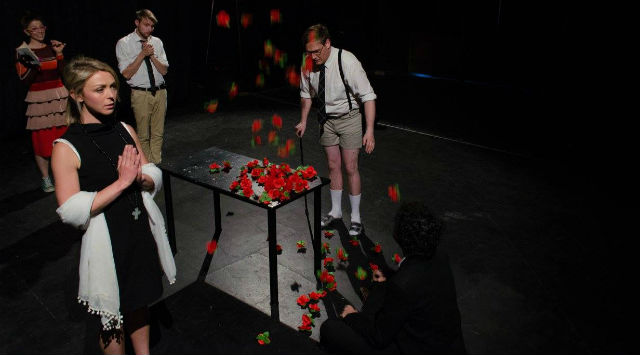
Images by Chris Evans

Theatre review
Social media is probably the truest sign of our times, which means that our awareness of its manifold implications is not yet fully formed. We are overwhelmed by its swift evolutions and embroiled in its persistent intrusions, riding its waves of euphoria without a thorough understanding of what it all means, and more pressingly, its impact upon modern and future lives. Like Me delves into the technological manifestations of our narcissism to explore the worst aspects of our self-obsession, in a surreal language that articulates fluently our emotions and incoherent thoughts about this new slice and era of human history. The show is scathing and critical of selfie culture, finding ways to question its pervasive consumption, and exploring its dangers and famous fatalities. Without ever naming names, it discusses platforms and personalities that fuel the compulsive need for popularity, egomania and greed, thereby creating an updated artistic expression to the way we juxtapose the now classic relationship between capitalism and love.

Duncan Maurice’s direction is interested in the grotesque and morbid, yet a sickening cuteness is omnipresent. His work brings to the fore, a conflation of our deceptive and hypocritical style of contemporary communications, à la Jekyll and Hyde, that presents a very public face that betrays the truth behind our computerised selves. 9 characters, sensationally dressed by Alex PF Jackson to look like Teletubbies at a Comme des Garçons fashion show, frantically and maniacally scamper around us, feeding an absurd need for affirmation, slaves to a non-existing, imagined higher calling that demands their energy and allegiance.

Beautifully and innovatively created by set designers Gemma O’Nions and Louie Diamontaye, and lighting designer Christopher Page, the place is a mad house with players that are intimidating and intrusive, but we do not leave. It is pleasurable and seductive, and we comply. The cast is extraordinarily cohesive with its style, dialect and presence. They are one organism that pulses the same, even though individual personalities are brilliantly cultivated. Latisha Owens is frighteningly bold as Poppy, an ultra vivacious self-styled sex bomb of the internet whose torturous desperation dictates the tone of proceedings. Moreblessing Maturure portrays an adorable innocent Sarah-Jay , pure of spirit but nonetheless entangled and sadly corrupted. The performers are all wide eyed and entranced, intoxicated by tech, but their souls tell a different story, which we hear quite subconsciously in the thrilling soundscapes and music of David Herrero.

Scenes in Like Me can at times be repetitive, and its cataclysmic aura can become predictable, but its resonances catch you by surprise, and they hit home. The work offers a solution to the problems it rants about, but it feels futile. The pessimism we encounter, not only in the show, is overwhelming, but it is truthful. There is no easy answer to our predicament, but what the production does achieve is to put in perspective what our instincts know to be wrong in our culture today. It is complicated and complex, and this is no watered down interpretation of issues. How we progress beyond this point in time is anybody’s guess, but for now, there is no better snapshot on offer, of our online beings, warts and hashtags and all.

www.mongrelmouth.com

Review: The Great Speckled Bird (PACT Centre For Emerging Artists)

pactVenue: PACT Theatre (Erskineville NSW), June 17 – 20, 2015
Playwright: Ryan McGoldrick
Director: Ryan McGoldrick
Cast: Ryan McGoldrick, Claire Stjepanovic, Steve Wilson-Alexander
Image by Sanja Simic

Theatre review
The show opens with three blank panels on the backdrop, and with Ryan McGoldrick talking about the desire to write. In The Great Speckled Bird, we are never quite sure if McGoldrick has anything to say, apart from exploring and putting into articulation, the creative process itself. Perhaps commencing from the conditions of a writer’s block, and then finding liberation as the key to releasing artistic expression (as opposed to the sort forcibly derived from hard toil), what McGoldrick creates is something ephemeral, nonsensical, and thoroughly whimsical. It is also beautiful, with minimal visual embellishment but the artist has a knack for communication that holds our attention with a gentle persuasion. He introduces a spirit of innocence and wonderment that we recognise instinctively, and should we choose to embrace it, represents a re-acquaintance with something that one would hope is universal and pure.

Musicians Claire Stjepanovic and Steve Wilson-Alexander share McGoldrick’s quality of playfulness, and their presence adds a dynamism that helps the work take flight. What they achieve is entertaining and joyful, and the story they tell, while fanciful, inspires personal thoughts about the origin of life, which is clearly a deep meditation no matter how one chooses to approach it. The collaborative efforts here are seamless and full of idiosyncratic character. Stjepanovic and Wilson-Alexander’s music is delightful, and splendidly performed.

Quirky and experimental theatre is the antithesis, and indeed, the antidote for big, serious productions that can often become too caught up in conventions and commercial expectations. Art should be aware of its audience, but it must not imagine a uniformity in its reception. It needs to address a diversity that reflects the social context that it comes out of, and not seek to perform only to one kind of people. There is a confidence in The Great Speckled Bird that believes in the ubiquity of viewers who are not of the mainstream, and it chooses not to speak down to anybody, even if we are only over-sized children caught up in the creators’ fantasy.

www.pact.net.au

Review: Spring Awakening (Kore Productions)

koreproductionsVenue: The Factory Theatre (Marrickville NSW), Jun 15 – 17, 2015
Book & Lyrics: Steven Sater (based on the original play by Frank Wedekind)
Music: Duncan Shiek
Directors: Alexander Andrews, Sam Haft
Cast: Thomas G Burt, Jamie Collette, Abbie Gallagher, Hannah Garbo, Nathaniel Hole, Julianne Horne, Charlotte Kerr, Logan McArthur, Jonathan Nash-Daly, Damien Noyce, Jordan Stam, Mitch Thornton, Kaleigh Wilkie-Smith

Theatre review
Spring Awakening is concerned with how teenagers learn about sex, and how they deal with burgeoning adulthood. The musical is critical of how adults fail to provide adequate or appropriate guidance, and this low-budget production by young enthusiasts, provides an uncanny parallel between that central theme and the state of theatre in Sydney for emerging talents. We have a rich history of show business in this town, that boasts some of the world’s greatest practitioners, but they are missing from this staging. There seems an unfortunate chasm between generations, and on this occasion, a full scale production, although well-meaning, has been created from a wealth of promising but inexperienced individuals, who have naively chosen to tackle a beast much more formidable than they were ever able to foresee.

Sound issues are not chief of its problems, but its frankly shocking deficiencies from beginning to end have rendered the plot incomprehensible, and represents a complete disregard for any semblance of balance to harmonies being attempted by performers. Consolidating all the string sections in the arrangement onto a single violin is probably a matter of financial inevitability, but the results are often painfully lacking.

Efforts at creative spacial use by directors and choreographer help with energy and scene transitions, but execution requires a great deal of finessing. The story’s most crucial event takes place at a position on stage that only the very first rows can glimpse, further demonstrating the need for more experienced management on the project. The cast is a green one, with some discernible ability, but there is no cohesion in their conception of what is being presented. Key characters are sung by unremarkable voices, and the level of acting overall is regretful. One exception is Charlotte Kerr who shines in her solo as Ilse, with a beautiful and controlled voice that brings a moment of sobering polish to the show.

All of the very best have failed spectacularly in the public eye. Creative souls must not sit back and wait for the perfect opportunity before allowing themselves to put their passion into action. Many have perished without leaving a mark for fear of failure. The artistic process is very rarely without episodes of disappointment, but one cannot expect a masterpiece to materialise without first braving the wilderness.

www.koreproductions.com.au