Review: Nine (Sydney University Musical Theatre Ensemble)

museVenue: Seymour Centre (Chippendale NSW), Oct 21 – 24, 2015
Book: Arthur Kopit (based on the Italian by Mario Fratti, after Federico Fellini’s )
Music & Lyrics: Maury Yeston
Director: Jonathan Rush
Cast: Mikhaila Chaplin, Anna Colless, Hannah Cox, Genevieve de Souza, Rielly Dickson, Doug Emery, Jacinta Gregory, Bridget Haberecht, Bronwyn Hicks, Jane Hughes, Gabi Kelland, Lisa-Marie Long, Jos Markerink, Rose McClelland, Olga Solar, Nicole Toum, Stephanie Troost, Sam Wood

Theatre review
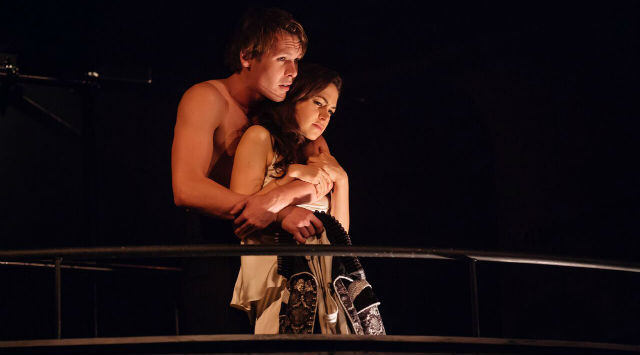
Based on Federico Fellini’s 1963 semi-autobiographical film , this is a musical about a man’s passion for life, work and women. The central character in Nine is Guido Contini, the superstar director under pressure to create a new work. He escapes, procrastinates and reminisces, but we do not see the film being made. His artistic process is not a straightforward one, and we learn that genius manifests itself in unexpected ways.

The songs in Nine are melodic and extravagant, powerfully orchestrated by ten musicians under the supervision of Alexander Norden, who breathes life into Maury Yeston’s 42-year-old compositions. The show is directed with flair and energy by Jonathan Rush, and choreographed intelligently by Natasha Heyward. It is a production that successfully expresses the exuberance of Fellini’s Italy, with all elements finding cohesion in the decadence and wildness of that romanticised world.

There are accomplished performances in the show, most notably Hannah Cox’s turn as Liliane La Fleur, completely stealing the show in her sensational Folies Bergère number, with perfectly pitched humour, rambunctious sex appeal, and a stunning sense of joy. There are major problems with sound in the production, but stronger singers, including Anna Colless and Bronwyn Hicks do manage to overcome them with sheer vocal power. Less fortunate are the show’s leads Doug Emery and Bridget Haberecht, the Continis who find themselves consistently drowned out by musical accompaniment. Nevertheless, their committed and eloquent performances leave a strong impression, and help to deliver a fascinating narrative that is ultimately very satisfying.

This might be a minimal staging, but its imperfections are few. Nine stands the test of time, and this small revival demonstrates the potentialities and pleasures it contains. Inspiration is invaluable, and artists especially must be able to identify them. Fellini’s magnificence is emulated in Yeston’s musical, and this production is clearly touched by the muses, but we do not have to wait for the calling of divinity to be spurred on to create something special; as we see in Guido’s story, greatness is to be found in la dolce vita.

www.museatusyd.com

Review: Blood Bank (Ensemble Theatre)

ensembleVenue: Ensemble Theatre (Kirribilli NSW), Oct 16 – Nov 22, 2015
Playwright: Christopher Harley
Director: Anthony Skuse
Cast: Meredith Penman, Gabrielle Scawthorn, Tom Stokes
Image by Clare Hawley

Theatre review
At a hospital, death is everywhere, but characters in Christopher Harley’s Blood Bank experience life while the palpable presence of time hangs over each of their heads. The script is tender and sensitive, with humour always close at hand in its explorations into our darkest moments of illness. It is an imperfect script, with dubious relationship dynamics and a plot structure that requires further refinement, but each scene is charming, and beautifully rhythmic. Its themes keep the play firmly in a space that is thoughtful and profound. We can all relate to the narratives that unfold; whether light or heavy, its ideas appeal to our deepest feelings relating to the biggest of concerns, love and death.

Blood Bank is a consistently engaging work, buoyed by strong performances. Gabrielle Scawthorn is powerful at both ends of the emotional spectrum. She is an effective comic who identifies every opportunity for laughter, keen to bring a joyous energy to the stage, and does not hesitate to plunge into her character Abbey’s guilt and grief, with a resonant authenticity that can be quite touching. Her counterpart Tom Stokes takes a more subtle approach, but is no less convincing in his portrayal of psychological truths. The part is a sorrowful one, and it is to the actor’s credit that there is little self-indulgence to be found. Instead, Stokes’ honest interpretation creates moments of poignancy, and establishes a brilliant chemistry in the cast that is often the highlight of the production. Director Anthony Skuse magnifies all the nuances of the script so that our experience of the show is a rich and vibrant one. He holds our attention by tapping into our intimate fears, and makes believable what could have been tenuous at best.

There are things that we sweep under the carpet, so that life can move on. It is true that no matter how much philosophising we put it through, death must be, but it is also the awareness that all things come to an end, that gives us the desire to cherish them. Art about mortality therefore serves an important function. In shining a light on the end, we become acutely mindful of the now. Blood Bank talks about the choices we make, when we have little time left. It also reminds us, that time is always scarce, whether we are living or dying. To quote Kurt Vonnegut, “Of all the words of mice and men, the saddest are, ‘It might have been.'”

www.ensemble.com.au

Review: Three Sisters (The Genesian Theatre)

genesianVenue: The Genesian Theatre (Sydney NSW), Oct 16 – Sep 14, 2015
Playwright: Anton Chekhov (translated by Brian Friel)
Director: Timothy Bennett
Cast: Priscilla Bonham-Carter, Martin Bell, Nick Carter, Ted Crosby, Rob Drew, Susan Farrell, Kathryn Hutchins, Lana Kershaw, Elizabeth MacGregor, Tom Marwick, Tom Massey, James Moir, Dominique Nesbitt, Martin Searles, Darien Williams

Theatre review
In Chekhov’s Three Sisters, time moves past its characters to show us the stasis and passivity of their pessimistic lives. The play runs for almost three hours, but few things change for the Prozorovas over the course of its 5-year plot. There is always a sense that things are better elsewhere, but the women never venture very far away. Whether it is circumstance that keeps them bound to their family home, or their lack of resolve that prevents them from finding greener pastures, is ambiguous. Brian Friel’s 1981 translation is a vibrant one, with a subtle humour accompanying the despondency of its scenarios, but Chekhov’s incessant lamenting is certainly left unscathed.

This staging, directed by Timothy Bennett, attempts to be a faithful rendering of the piece. Design aspects are effectively executed, with attention spent on ensuring a period depiction that appears accurate. Correspondingly, performances seem to resist any modernisation. The cast’s preference for a stylistically nostalgic tone is charming, but can also feel stilted and staid. Finding enough depth to express the complexities of Chekhov’s writing is challenging, and on this occasion, the actors’ emphasis on establishing accuracy in affectation and manner, come in sacrifice of character studies that portray psychological and behavioural authenticity. The production provides an impressionistic account of events and personalities, but we desire something more substantial beyond its pleasant surface.

At the play’s end, the sisters once again talk about the future. It is a mixture of hope and hopelessness, and as we ponder their story from a distance of over a century, we wonder if their longing for better days has come to pass. It is important that we understand the shackles that keep the women bound in the play, and the dysfunctions in societies that stand in the way of progress. What prevents the Three Sisters from finding happiness is open to interpretation, and like the introspection required for our own lives to improve, an exercise that will prove to be rewarding.

www.genesiantheatre.com.au

Review: We, The Lost Company‏ (Clockfire Theatre Company)

clockfireVenue: Old 505 Theatre @ 5 Eliza St (Newtown NSW), Oct 13 – 31, 2015
Devisors: Emily Ayoub, Madeline Baghurst, Alicia González, Kate Worsley, Arisa Yura
Director: Emily Ayoub
Cast: Madeline Baghurst, Alicia González, Arisa Yura
Image by Geoff Magee Photography

Theatre review
Since time immemorial, we have danced in honour of the gods that watch over us. It is an acknowledgement of our vulnerabilities and reflects our hopes for better days during this time on earth. We, The Lost Company is an intertextual exploration into our relationship with water, finding inspiration from the paintings of Brett Whiteley to create a work of physical theatre informed by the disciplines of mime and dance. It is gently humorous but wildly imaginative. It touches on subjects of migration, ecology, community and ageing, revelling in the beauty of abstraction but powerfully connecting with its audience, if not in terms of meaning, then certainly with the level of engagement it manages to instil into what is usually a challenging form of performance art.

Music and sound by Ben Pierpoint is complex, evocative and spirited. His work controls our imagination, and leads us to grand and eccentric spaces within our minds that provide a context for the three dancers on stage. Charming anecdotes about water obtained from interviews with mature members of Sydney communities are woven into the soundtrack to anchor the production with a warm authenticity that keeps our shared humanity firmly inside what is being developed.

The dancers’ weird and wonderful physical language is a thoroughly amusing one that sustains a sense of intrigue and holds our attention for its entire fifty-minute duration. Their poetry is whimsical but ruggedly sincere, allowing us to understand its intentions from a drastically unconventional kind of theatrical expression. Arisa Yura’s very memorable but very short monologue in Japanese about childhood, the forces of nature, ice cream and beach balls, extends the theme of memory from the audio recordings, and touches us unexpectedly with its dramatically emotive and nostalgic pseudo drama. The production is full of adventure and sensitive innovation, but its lighting feels inadequate within the extravagance of its multi-disciplinary articulations. The space requires greater depth and colour to achieve a stronger sense of visceral lift off that is always just within reach.

To know something, does not necessitate the ability to put it into words. Call it a feeling, intuition, or a soul thing, art is fundamentally about communication and the modes through which communication happens. We, The Lost Company has vocabularies of its own that are refreshing, unique and dare we say, original, but what it speaks can be understood by all, and like the themes that it is concerned with, we are all embroiled in this mysterious undertaking as one.

www.venue505.com/theatre | www.clockfiretheatre.com

Review: Ghosts (The Depot Theatre)

depotVenue: The Depot Theatre (Marrickville NSW), Oct 7 – 24, 2015
Playwright: Henrik Ibsen
Director: Julie Baz
Cast: Julie Baz, David Jeffrey, Emily McGowan, Zac McKay, Steve Vincent

Theatre review
Themes in Henrik Ibsen’s 1881 play Ghosts remain controversial. We continue to debate over religion, venereal disease, incest and euthanasia; each subject is a divisive one, and placing them all in a play for the 19th century, must have given it an explosive edge. By today’s standards however, its very subtle language communicates obtusely. Measured insinuations for delicate sensibilities of a time past are predictably no longer effective in the same way. We require much more obvious dialogue to evoke a level of drama that would correspond with the issues being explored. Ibsen’s writing is beautiful, but presenting it on a contemporary stage requires extensive adaptation, if not of its words, then all the other visual and aural symbols need to find a way to excite us, or at least introduce a greater sense of intrigue. There is much to engage us in the story of Ghosts, but conveying its ideas so many years later is certainly challenging.

Performances are at best, uneven in this production. Characters are depicted with insufficient depth, and actors are unable to express complexity within their roles. There is very little variation in tone and temperament, creating an impression of oversimplification and therefore, our understanding of their narratives become surface. We try to relate to their humanity but struggle to find points of connection. Steve Vincent is an intense Oswald, injecting energy into an oft too placid atmosphere, but his approach requires greater nuance. Zac McKay’s ability to create an air of foreboding and his daring gestures suggesting illicit sexuality, are some of the more theatrical moments of the show, but the role of Jacob Engstrand is a small one. Director Julie Baz keeps the pace tight, and volume levels high, but her show is not finely detailed, and although we see the big picture, much of the undercurrent goings on are lost.

Ghosts talks about things that haunt us, and the things we inherit. It is about the past, and how we negotiate their restraints as we try to move forward. Australian art is full of ghosts, and European masters like Ibsen have an influence over our artistic landscape, the nature of which is probably best described as a love-hate relationship. It gives us a context with which we can have an international voice that facilitates exchanges with cultural capitals of the world, but it also holds us back with yardsticks that are multifariously archaic. In the making of art, we cannot forget those that have come before, but we must remember that our trajectories can only move to the future.

www.thedepottheatre.com

Review: The Real Thing (New Theatre)

newtheatreVenue: New Theatre (Newtown NSW), Oct 6 – Nov 7, 2015
Playwright: Tom Stoppard
Director: Alice Livingstone
Cast: Peter Eyers, Charlotte Hazzard, Ainslie McGlynn, Christopher Tomkinson, Emily Weare, Benjamin Winckle
Photography © Bob Seary

Theatre review
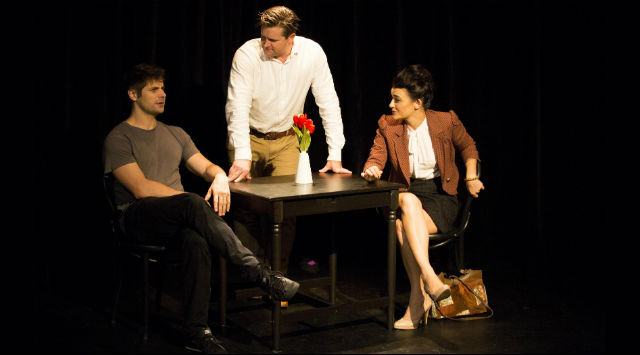
There are two main things being discussed in Tom Stoppard’s The Real Thing; the nature of relationships, and the process of making art. Through several “play within a play” segments, we attempt to get to the bottom of what is most honest, by looking past pretences for a grasp of the real. Monogamy, fidelity and longevity of relationships are dealt with in the most intellectually frank way, and although the play is now well over 30 years old, its propositions are no less refreshing and controversial. The extraordinarily articulate dissection of the creative process, along with the analysis of values that we place upon art, are also full of poignancy and resonance. The play is witty and pointedly intelligent, with challenging concepts and brilliantly delightful use of language that keep us entertained while placing our brains on overdrive.

Director Alice Livingstone is uncompromising with the depth of the text, while simultaneously introducing, quite miraculously, a jaunty pace to a staging that delivers solid laughs alongside a consistently astute level of discourse. The work suffers from a lack of visual imagination that results in stagnant and predictable physical compositions, but its meticulous attention to nuances in dialogue is more than impressive.

Leading man Christopher Tomkinson is the perfect blend of eccentricity, smarts and vulnerability. The actor’s thorough appreciation of the writing offers up an interpretation of Stoppard’s lines that is completely fascinating. He opens up a world of thinking that we rarely encounter; one that seems original yet is able to ring true on a very intimate level. Equally precise is Ainslie McGlynn in the role of Annie, whose embodiment of her character’s conflicts with monogamy and love are thoughtful and provocative. For all the talk about sex, the production’s energy is not particularly libidinous, but chemistry between players is of a good standard. The cast is a cohesive one that tells the story from a unified perspective, and the consequences are often powerful.

The Real Thing is an important work about universal experiences. Love may be hard to define, but it shapes everyone. We chase it constantly but seldom do we stop to reflect on these impulses. Tom Stoppard resists romantic delusions and preconceived notions to locate a truer understanding of that mysterious force underscoring so much of our lives. We want to know what love is, and he intends to show us.

www.newtheatre.org.au

Review: A Flower Of The Lips (King Street Theatre)

flowerVenue: King Street Theatre (Newtown NSW), Oct 6 – 24, 2015
Playwright: Valentino Musico
Director: Ira Hal Seidenstein
Cast: Michelle De Rosa, Marcella Franco, Jamila Hall, Yiss Mill, Kiki Skountzos

Theatre review
Every life has a story to tell. No matter our choices and experiences, narratives can be woven and lessons are to be learned from any being that has walked the earth, but it is up to the storyteller to translate an existence into something meaningful for the listener. Valentino Musico’s A Flower Of The Lips investigates the short life of his great-grandfather, Bruno Aloi of Calabria, Italy a century ago. Aloi’s extraordinary legend has persisted in his village of Pietracupa, and it is understandable that Musico is fascinated by the ancestor and is thus motivated to create a play that immortalises those memories. The work is sincere and earthy, but its pidgin English may be problematic for some. The temporal and social context of the plot may also prove obscure, and reaching an understanding of unfolding events is challenging.

Direction by Ira Hal Seidenstein is stylistically minimal yet energetic and joyful. Early portions of the show would benefit from greater elucidations in order that its distant time, space and characters can communicate more intimately. Performances are committed but the characters are not sufficiently accessible. There is a gulf between them and us that needs to be bridged, so that what we see on stage can find a universality and emotional resonance.

The tales surrounding Bruno Aloi are clearly near and dear to the writer, but those passions are difficult to connect with. Audiences are selfish and need to be shown a way to relate personally to what is being shared. Valentino Musico’s play is an expression of his love of family and of his familial history, which we can appreciate, but from afar.

www.kingstreettheatre.com.au

Review: Pygmalion (UTS Backstage)

utsbackstageVenue: Bon Marche Studio (Ultimo NSW), Oct 1 – 4, 2015
Playwright: George Bernard Shaw (adapted by Joanna Griffiths)
Director: Joanna Griffiths
Cast: Emma Barrett, Ben Chapple, Jack Clark, Elizabeth Collins, Tom Crotty, Remy Danoy, Norah George, Kate Gogolewski, Cameron Hart, Xavier Holt, Blake O’Brien, Mikaela Rundle, Steph Stuart, Adam Teusner, Beattie Tow
Image by Christopher Quyen

Theatre review
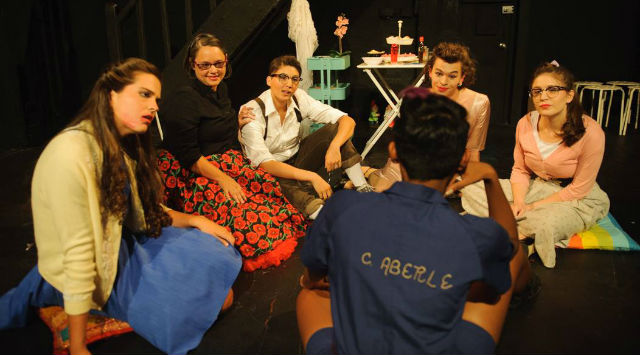
Joanna Griffith’s retelling of George Bernard Shaw’s Pygmalion explores the dark facets of the century old story, bringing to focus issues of race, gender and class that can easily be obscured by its own lighter elements. The production is part traditional, part contemporary, and it is the inconceivable juxtaposition of the two, on the same stage, that gives the show a thrilling edge. The inventive use of symbols and abstraction to accompany the antiquated dialogue provides a refreshing theatrical experience and the messages conveyed are at times, quite powerful.

There is a lot of flair in Griffith’s adventurous approach. Her outlandish flourishes, including several segments of dance, as well as a quirky take on Eliza Doolittle’s original voice (possibly an African accent), uses the medium of performance to communicate passionate ideas in an abstract but surprisingly effective way. Presentation of the show’s more conventional segments require greater sophistication, but solid work by its lead actors Mikaela Rundle and Adam Teusner help to keep us engaged. Rundle’s creativity and exuberance as Eliza provide us with abundance of food for thought, along with delightful entertainment value. Her talents in movement are a highlight and the foundation for the most memorable sequences of the production. Professor Higgins is charmingly portrayed by Teusner who displays a strong understanding of the text and its intentions. His ability to finely balance old-fashioned comedy with contemporary political concerns demonstrates sensitivity and intelligence.

This thoughtful rendition of Pygmalion plays with a range of deeply interesting concepts and presents them in unexpected ways. Its daring impulses fascinate and challenge, but are never simplistic or callow. Technical executions can be fine tuned at many levels, but their design and purpose are beautifully imagined. It is important to think about subtexts and subtle implications of every story we tell, and on this occasion, we discover meaning in everything.

www.utsbackstage.com

Review: Bacon And Eggs (Only Children Theatre Co)

baconandeggsVenue: Old Fitzroy Theatre (Woolloomooloo NSW), Sep 29 – Oct 10, 2015
Playwright: Chris Edmund
Director: Chris Edmund
Cast: Ryan Jones, Tom Dent, Adrian Mulraney

Theatre review
Two actors down on their luck spend the night drinking too much, and stumble upon the ghost of Francis Bacon. When artists struggle with their work, it is important to consult those who have come before, for wisdom, experience and history. Time spent on analysis and self reflection is crucial to the artistic process, especially at those frustrating, but necessary, moments of failure. Chris Edmund’s Bacon And Eggs is a thirty-minute meditation on the greats of European theatre, from Beckett to Shakespeare. Like any artist in any discipline, we study subjects considered to be exemplary, finding appropriate material to inspire and define our personal approaches. Bacon was by any measure, a fascinating figure, but this manifestation of his apparition is particularly straightforward. The play is a very simple one, and even though it does not bear ambitious pretences, there is a monotony to its rhythm and themes that can be challenging.

Performances are quirky but insufficiently varied. Ryan Jones and Tom Dent are strong with their small sections of comedy, but they sustain a singular mode of confusion for a long duration of the work, revealing an overly simplistic understanding of their parts. Adrian Mulraney plays a Bacon who is predictably flamboyant, but there are insufficient dramatic shifts in temperament and motivation to justify a full-fledged standalone production. It is doubtless that interesting ideas can be found in Bacon And Eggs, but at this early stage of its development, many more ingredients are required before the recipe can sizzle.

www.oldfitztheatre.com

Review: Where’s My Money? (Seeker Productions)

seekerVenue: Erskineville Town Hall (Erskineville NSW), Sep 23 – 27, 2015
Playwright: John Patrick Shanley
Director: Laura Pike
Cast: Amelia Beau Kaldor, Eli King, Chris Miller, Jacki Mison, Monica Sayers

Theatre review
Marriage is one of the most traditional customs of any civilisation, and its long established relationship with money and property distribution remains a crucial part of social systems today. In cultures like ours, love and romance are usually the driving force of unions, but the actual and pragmatic experience remains intrinsically tied with financial matters. John Patrick Shanley’s Where’s My Money? is a boisterous comedy about female-male relationships, and the problematic intertwining of love, sex and money. The characters in the play engage in complex and passionate diatribes, always in the mode of a fight, whether or not they are dealing with their partners. They also have to contend with ghosts that make regular appearances to disrupt their attempts at logic, reminding us all of the constant presence of less tangible things like guilt, regret and love.

This production, directed by Laura Pike, is energetic and funny, with charming performances that deliver consistent laughs. A less naturalistic approach could give the text’s ideas greater elucidation, but the pace of Pike’s show is enjoyably brisk. Even though costumes leave a lot to be desired, character types and relationships are clearly defined with interesting dynamics always at play. The cast of five shows excellent conviction, and an enthusiasm for comedy that guarantees a satisfied audience. There is a subversive spirit in Shanley’s writing that encourages a more adventurous, or less straightforward style of presentation. The show is a well-rehearsed one, but greater nuance could be introduced for a more philosophical rendering of the text.

Making relationships work, can be a lot like making art work. We try to identify all its components and then apply our best efforts to ensure that an ideal result eventuates. There are less administrable forces at play that need attention, but flair and other ephemerals require a sophistication that comes from time and sensitivity. Where’s My Money? is appropriately loud and humorous, and like other people’s marriages, it offers up a pleasing veneer, but we wonder what lies beneath the cheerful surface.

www.facebook.com/events/…