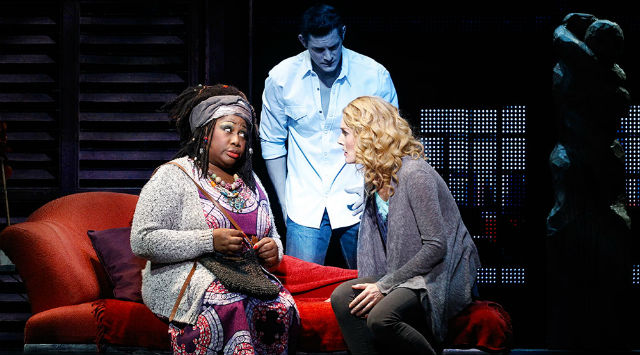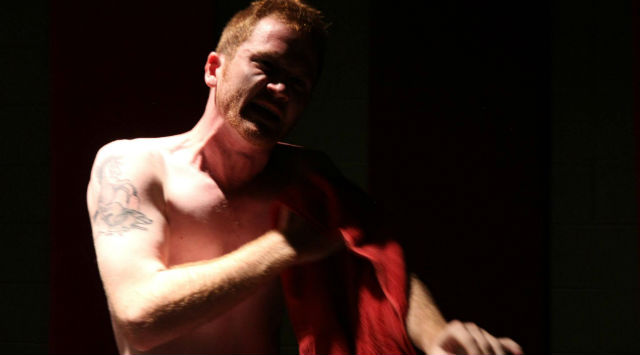
Review: Disco Pigs (Throwing Shade Theatre Company)

throwingshadeVenue: The Factory Theatre (Marrickville NSW), Jan 7 – 9, 2016
Playwright: Enda Walsh
Director: Andrew Langcake
Cast: Jeff Hampson, Courtney Powell

Theatre review
Enda Walsh’s Disco Pigs is a very specific story. It deals with a very particular time in a teenager’s life, and the set of circumstances surrounding its characters is culturally unique. The play does not aim to be universally appealing, but in its passionate exploration of something anomalous, an essence emerges that can reveal aspects of life that we can all recognise. Walsh’s language and narratives are interested in the marginalised youth of Western societies. We are presented with a state of being that needs to be understood, but is often ignored. It deals with the consequences of modernity, and how our young negotiates the dangerous meaninglessness of life at a time when everything can be reduced and diminished. With the commodification of everything in pervasive economic rationalisation, we experience chaotic shifts in ethics and values, and what we impart to our youth is consistently but disappointingly dubious.

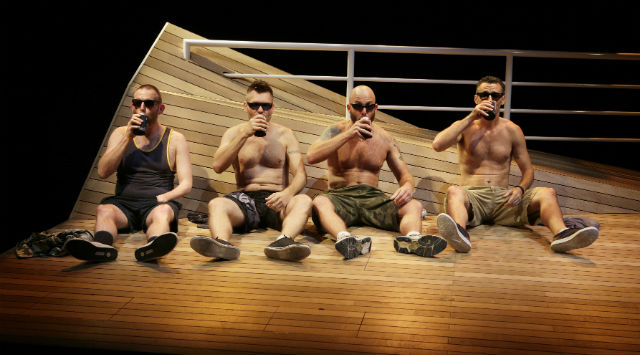
Pig and Runt make their own rules. They have accepted that money is out of reach, and coupled with a disrespect of social mores, their lives are guided by the pleasure principle, with intoxication and violence forming the core of their existence. In their failure to see greater meaning in life, time is spent on the base and visceral, and we wonder how the appetite for progress, advancement or even aspiration have come to be in most of our lives. Direction of the work by Andrew Langcake is simple, but energetic. While not hugely imaginative, the staging is mindful of creating a sense of aliveness for the author’s words, in order that we can reach a more intimate perspective of the characters’ somewhat unusual world through their construction of action, sound and atmosphere. Actors Jeff Hampson and Courtney Powell are well-rehearsed and thoughtful in their approach, but execution can be more precise and confident. These are wild stories being told, and even though they make good attempts at depicting the grittiness of their Irish city, finding authenticity for that harrowing environment proves to be quite a challenge.

Artists must be encouraged to create mountains out of molehills, so that the unusual can be seen. As long as truths can be found, all artistic expression is valid. We don’t have to care about the people in Disco Pigs but they do have something to offer anyone who wishes to listen. When the moral of the story is unclear, the captive audience will find for themselves what they most need to hear.

www.throwingshade.com.au

Review: They’ve Already Won (Belvoir St Theatre)

theyvealreadywonVenue: Belvoir St Theatre (Surry Hills NSW), Dec 8 – 20, 2015
Playwrights: Harriet Gillies, Pierce Wilcox
Directors: Harriet Gillies, Pierce Wilcox
Cast: Harriet Gillies, Pierce Wilcox
Image by Mitch Lee

Theatre review
Art can find a way to represent the state of our collective consciousness as it stands, so that we may achieve an understanding of life, while remaining embroiled within. They’ve Already Won is about the now, and how individuals in societies such as ours, deal with the new face of media and its pervasiveness. It explores the interactivity of technology, and exposes the nature of our participation in the digital world, with all its anxieties and intellectual challenges.

As barriers to information and truth begin to crumble, we are forced to encounter pessimism like never before. Harriet Gillies and Pierce Wilcox’s play is about the way we respond to this incessant profusion of bad news arriving through all our screens, and how it dominates and shapes our culture as it stands today. The show addresses us directly, beginning almost like a lecture with Gillies orchestrating visual projections and sound cues, and Wilcox gesturing to illustrate their assertions, but thankfully, things turns increasingly fluid in style as they proceed. The work is beautifully considered and idiosyncratic, with rich content that will ring true and provoke. There are unusual and refreshing modes of expression in its staging, with a string of amusing scenes and surprising concepts. Execution of ideas could be more polished, but the production is ultimately an impressive one that offers a generous serving of food for thought.

They’ve Already Won can be seen as a political work, but it also allows us to be apathetic. It accurately reflects the confusion of modern life, revealing to us that the more we know, the less we know what to do. It is a feeling of helplessness that co-exists with a passion for betterment, an everyday duality that pulls in different directions. We can leave the show determined to be unfazed, but reality is tumultuous and we will be moved regardless.

www.belvoir.com.au

Review: The Good Doctor (Ensemble Theatre)

Venue: Ensemble Theatre (Kirribilli NSW), Nov 27, 2015 – Jan 17, 2016
Season continues at Glen Street Theatre (Belrose NSW), Jan 19 – 24, 2016
Playwright: Neil Simon
Director: Sandra Bates
Cast: Chloe Bayliss, Adriano Cappelletta, David Lynch, Kate Raison, Nathan Wilson
Images by Clare Hawley

Theatre review
Anything can happen in live theatre. Adriano Cappelletta was engaged to perform the lead role in The Good Doctor less than a week before opening night, replacing Glenn Hazeldine who had unfortunately sustained an injury right before preview performances were due to begin. It is a strange conundrum that happens on stage. We want a sense of danger and aliveness that recorded media is not able to replicate, but we admire the high polish a group of geniuses can cultivate in the flesh. At this early period of The Good Doctor‘s performance season, both are vigorously present.

The show consists of 10 or so short plays, all based on the writings of Anton Chekhov, and woven through a narration provided by Chekhov himself. It is pure entertainment, with some of his politics still recognisable, but Neil Simon’s script certainly does not dwell heavily on the deep and meaningful. Director Sandra Bates takes her cue from Simon and orchestrates a delightful production that makes no bones about playing for laughs. There is excellent and expert comedy in every scene, often nuanced and intricately conveyed, in a confident manner that never feels crude or patronising. For all its spirited frivolity, there is a sophistication to be found in Bates’ approach that reflects skill and flair for this genre of farcical classic comedy.

The Good Doctor boasts a cast of very strong players. Each is given four to six parts, and their versatility is demonstrated with great aplomb. Cappelletta is understandably short on fluency for opening night, but his thorough understanding of the material is frankly astonishing. We see the actor’s memory struggle on a few occasions, but the clarity at which he delivers each intention is commendable, and his natural charm keeps us firmly on his side from the very start. Equally endearing is Chloe Bayliss who captivates in every role. Her humour is sublime, and her presence magnetic. Bayliss is flawless in the production, and we are enchanted by her every appearance. Nathan Wilson plays the less mature men in the show, but his theatrical abilities are well-honed and impressive. There is a quality of exuberant abandonment to his style that appeals, along with a mischievous energy that contributes to the show’s enduring buoyancy.

Chekhov is not every person’s cup of tea, but he is a crowd-pleaser in The Good Doctor, a 40-year-old play that refuses to turn grey. It is true that there is fun to be had in our city’s many theatres, but it is not every day that a show appears, able to make us laugh without insulting our intelligence. It is indeed, very “charming and clever” (Neil Simon’s words), offering necessary respite in our much too serious and dreary lives.

www.ensemble.com.au

Review: Through A Beaded Lash (The Depot Theatre)

depotVenue: The Depot Theatre (Marrickville NSW), Nov 25 – Dec 12, 2015
Playwright: Robert Allan
Director: Julie Baz
Cast: Leo Domigan, Ryan Henry, Emily McGowan, Cherilyn Price, Oliver Rynn, Roger Smith

Theatre review
Robert Allan’s Through A Beaded Lash jumps between today and the early 80’s, to look at the AIDS epidemic and its effect on Sydney’s gay community over the last 30 years. Stories of this nature are in abundance, but published works seem to be predominantly American, and to have a new Australian voice for this issue is not only refreshing, it is deeply important. Our concerns and ideas may not be much different, but we must remember that that period of fear and devastation is a significant part of our local histories, and not just a chain of events that happened only at a distant time and space.

Allan’s script is deliberately light in tone, but its heavy heart is palpable and unambiguous. The play’s nostalgic quality will appeal to many, not only to those who experienced that era first-hand, but also to young ones who recognise their connection with that legacy of pride and pain. As a work of comedy, its wit is not razor sharp and several of its jokes require revision, but its genuine and powerful sentimentality is irresistible. That pathos is effectively orchestrated by Julie Baz, whose direction ensures that not a dry eye leaves the venue. There are issues with chemistry in the cast, and the production is, on the whole, lacking in elegance, but ultimately, Through A Beaded Lash is a remarkably moving play.

Performances are not particularly refined, but Leo Domigan and Roger Smith provide memorable moments that surprise with their extraordinary authenticity. Oliver Rynn creates the most believable character in the show, delighting us with a natural approach that outshines the oft too affected style of several cohorts.

When the worst is gone, we find ourselves grappling with the trauma it leaves behind. People become stronger after horrific events, and they can only do their best to move on, with scars that become invisible over time but the damage will not be eradicated. Dangers exist in our ability to pretend that every dark day is over, and it is on occasions like this, that a truthful story can provide remembrance that will expose the vulnerability that we live with, and we see that the healing process must continue.

www.thedepottheatre.com

Review: Dinkum Assorted (New Theatre)

newtheatreVenue: New Theatre (Newtown NSW), Nov 17 – Dec 19, 2015
Playwright: Linda Aronson
Director: Sahn Millington
Cast: Debra Bryan, Melissa Burgess, Colleen Cook, Emily Crotti, Bodelle De Ronde, Alison Eaton, Sonya Kerr, Denise Kitching, Gemma Laffan, Amanda Laing, Cassady Maddox, Lois Marsh, Patricia McLoughlin, Hannah Raven Smith, Alizon Vosburgh
Photography © Bob Seary

Theatre review
It is wartime 1942, and the fictional Australian country town of Warrabadanga is left with only its womenfolk to fend for themselves. They find plenty to keep busy with, and thankfully, spend little time worrying about the ones who have gone to battle. They are a spectacularly confident group determined to make the most of their situation, and go about their business in fine form. Linda Aronson’s Dinkum Assorted is an idealistic portrait of our country women. Dynamic, fun-loving , resourceful and optimistic, their strengths encompass the best of humanity, and represent an excellent example of how communities should view themselves.

Although written in the late 1980’s, the script is a predictably old fashioned one that feels faithful to language and presentational styles of the time it depicts. It is nostalgic and quaint, with a sense of humour that would appeal to those who have a taste for more traditional types of theatre. Direction by Sahn Millington brings out the vibrant spirit of all its characters, but the show struggles to captivate. The players are raucous but rarely meaningful, unable to deliver nuance or authenticity to help us locate points of identification or emotional involvement.

There are however, smaller scenes that feature pairings of actors that work well to offer glimpses of poignancy. Amanda Laing and Hannah Raven play wannabe showgirls, whose friendship is portrayed with good chemistry, along with a purity that resonates endearingly. Bodelle de Ronde and Debra Bryan create memorable characters who connect in a scene about being outsiders, both thoughtful and sensitive in their approaches.

It is in hardship that the best in humanity shines through. War takes on a different form in the twenty-first century, but we must only face it with that same bravery and positive outlook. The women in Dinkum Assorted are undefeated because they are engrossed in life, and they shun thoughts of demise. They are constructive in their own town, while the ravages of destruction take hold overseas. It is this simple lesson that our real lives need today. The purpose of war is destruction, and we must respond with the most vibrant and spirited ways of living out our each and every day.

www.newtheatre.org.au

Review: Orlando (Sydney Theatre Company)

Venue: Sydney Opera House (Sydney NSW), Nov 9 – Dec 19, 2015
Playwright: Sarah Ruhl (based on the novel by Virginia Woolf)
Director: Sarah Goodes
Cast: Matthew Backer, Luisa Hastings Edge, Garth Holcombe, John Gaden, Jacqueline McKenzie, Anthony Taufa
Images by Prudence Upton

Theatre review
Virginia Woolf’s novel Orlando: A Biography was published in 1928, when discussion of sexuality was made in hushed tones, and inseparable from notions of gender identity. If a person loved a woman, they had to take the form of the masculine, and the reverse was true. The centrepiece of Orlando‘s story is a man’s magical transformation into a woman, wistfully described but scarcely explained, though by simple deduction, one could perceive more than an indication of sexual fluidity, and a desire to explore what is now known as sexual orientation. It would be remiss however, to reduce the work to be simply about sex, for its interest in fluidity extends to the whole of a person’s identity, or how one sees themselves, along with how society conceives of that individual.

Sarah Ruhl’s 2010 stage adaptation can be understood as a feminist piece. Orlando’s life as a man is depicted with an extroversion that is concerned with the character’s appetite and discovery of the world around him, but as a woman, she turns introspective and we are presented with constant interrogations about her place in relation to things as the fairer sex. In other words, maleness is seen as an unquestionable natural state, while the feminine requires persistent justification. In dramatic terms, Ruhl’s work is poetic, sublime theatre that uses all the capacities of language to excite, provoke and enchant, and to tell a fascinating story that is strangely engaging in spite of its contextual distance.

It is a humorous text, gentle in its approach, but always charming and amusing with its renderings. Director Sarah Goodes executes that subtle comedic tone with great sophistication, and although the production is seldom laugh-out-loud funny, her brilliant wit is deeply endearing. There is clever use of space, with a relatively small ensemble establishing an active and visually dynamic stage. Comprising two flights of mobile staircases and concentric revolving platforms, our eyes are kept busy and no time is wasted on scene changes, but the production is not strikingly lavish. It makes occasional reference to the well-known Sally Potter film of 1992, but that extravagant beauty, still fresh in many of our memories, is absent from this staging.

Our focus is placed squarely, and appropriately, on the title role’s narrative, but the show features a charismatic four-man chorus that helps with a lot of heavy lifting. Matthew Backer, John Gaden, Garth Holcombe and Anthony Taufa play a wide range of roles in all gender states, and provide commentary in song and narration that moves the plot along in spirited, gay fashion. Backer in particular, is impressive with his fervent embrace of the show’s vaudeville style of presentation, taking the opportunity to showcase delightful comic timing and a flair for exquisite camp.

In the role of Orlando is Jacqueline McKenzie, keeping us spellbound with a delivery that will be remembered for its intelligence, precision and unrelenting effervescence. It is noteworthy that the actor’s interpretation of Orlando’s personality does not alter significantly with the sensational gender transformation. Whether in male or female costume, McKenzie maintains a singular essence, reflecting a modern and enlightened attitude toward the construction of gendered identities. Her unfaltering energy gives life to two solid hours of stage time, every minute compelling and whimsical, keeping us engrossed in the development of Orlando’s extraordinary narrative with her captivating confidence.

The word “transgender” was recently announced as one of Collins’ dictionary’s “Words of the Year”. As Western societies begin to better understand the way we live out our gendered lives, we can recognise that a new dawn in civilisation is imminent, where people will no longer be persecuted for the way they express their gender, and individuals are free to adopt any form of gender identity they wish to inhabit. Hardly anyone bats an eyelid when Orlando emerges as a woman after living thirty years as the opposite sex. We may not share her aristocracy, wealth and power, but we can appreciate the nonchalance surrounding her transformation, and indeed realise the curious irrelevance of something that convention considers so crucial to how we understand life. Feminism is about achieving equality, and in equality, all that we think separates us, can be vanquished.

www.sydneytheatre.com.au

Review: Roadkill Confidential (Lies, Lies And Propaganda)

liesliesVenue: Kings Cross Theatre Kings Cross NSW), Nov 11 – 28, 2015
Playwright: Sheila Callaghan
Director: Michael Dean
Cast: Alison Bennett, Sinead Curry, Michael Drysdale, Jasper Garner Gore, Nathaniel Scotcher
Image by Emily Elise

Theatre review
Trevor is not a happy artist. She watches the doom and gloom on the news to stay in touch with things so that her very high profile work in the field of visual art may be relevant to her public. In fact, her studio is highly secretive, maybe she is insecure about the unfinished product, or maybe she is trying to control the reaction to her controversial art. Meanwhile, a government agent is investigating her, and everything begins to look sinister. Sheila Callaghan’s Roadkill Confidential is however, no straightforward cop drama. It is an abstract and often surreal piece of writing that celebrates the dramatic art form by prioritising the stage’s unique abilities of relating to its audience. Beyond the use of a narrative to satisfy, the play features sequences that resonate independent of characters and stories. Its free form allows actors to create moments of wonder, in service of theatre and all its possibilities.

Michael Dean’s exuberant direction is concerned with creating an experience that fascinates and intrigues. The show’s plot is not always coherent, and we leave with uncertainty about the moral of the story, but there is much to get involved with at every step of the way. Lights by Richard Neville and Mandylights, along with Benjamin Garrard’s sound are playful and dynamic elements of a production that is determined to deliver whimsy and extravagance. Creativity is in abundance here, and there is little that holds it back from making its ubiquity felt in every nuance.

Performances are suitably colourful, from a committed ensemble, unified in style and tone. The charming Michael Drysdale plays the unnamed agent with a quirky flair, and a confident physicality that brings life to the stage. His work needs better polish to reflect a more precise grasp of the text, but Drysdale’s execution of the show’s anti-realistic scenes are consistently amusing, and memorable. The artist Trevor is depicted with admirable strength and vigour by Alison Bennett who introduces an alluring severity to the mysterious role. Her piteous neighbour Melanie becomes a force to be reckon with under Sinead Curry’s surprising interpretation. The actor’s flamboyant approach and magnetic presence provide her character with excellent entertainment value, and offers good balance to a show that has a tendency to bewilder.

There is no discussion about whether Trevor’s new work will be understood, yet its effects are gravely anticipated. We need to talk about theatre in a similar way; to allow it to do more than just telling stories. There is no fear of abstraction in this production of Roadkill Confidential because it believes in affecting its audience in a more inventive or perhaps, sophisticated manner. At the theatre, we share a space for a couple of hours, and when we go our separate ways, we will depart having grown a little. It is by that amount of extension that we can measure an artist’s worth.

www.liesliesandpropaganda.com

Review: Round Heads And Peak Heads (Actors College Of Theatre & Television)

acttVenue: Bondi Pavilion (Bondi NSW), Nov 5 – 9, 2015
Playwright: Bertolt Brecht
Director: Lex Marinos
Cast: Simon Benjamin, Campbell Briggs, Alex Brown, Cait Burley, Sarah Anne Carter, Abbie Coco, Keegan Fisher, Joseph Hallows, Reilly Anne Keir, Richard Littlehales, Angelika Nieweglowski, Jake Scherini, Amy Shapiro, Romney Stanton

Theatre review
Bertolt Brecht premiered Round Heads And Peak Heads in 1936, when Hitler was leading Germany. The play talks about racial persecution, without specifically naming the Jews, and how ethnic minorities are used as a scapegoat of sorts for people in positions of power. It explores the dynamics between greed and justice in a way that is not far different from discourse today, although its cautious language (as a result of censorship) is certainly much more indirect than we are used to.

The production, directed by Lex Marinos, is an energetic one, with variations in texture that occupy our senses, but a more explicit adaptation to current political climes and social concerns would make it more engaging. Performances are uneven in the 14-strong cast, with some talents outweighing others. Cait Burley is a striking Isabella De Guzman, with intense and raw emotion accompanying a studied physicality that displays a daring adventurous spirit. Romney Stanton and Campbell Briggs have interesting roles that they sink their teeth into, both providing colourful portrayals energised by impassioned creativity. Also noteworthy are Angelika Nieweglowski and Alex Brown, who exhibit interesting presences and excellent commitment to their charmingly idiosyncratic roles.

Life is often not fair. Ability does not guarantee success, and hard work does not always see commensurate returns. We exist in predetermined structures that will identify and subjugate the weak, but fortunately in this lucky country, some semblance of democracy exists, and individuals are able to attain their heart’s desires against all odds. What the secret ingredients are, is anyone’s guess, but it is the very definition of success that needs to be evaluated and re-evaluated every step of the way.

www.actt.edu.au

Review: Duck Hunting (Contemporarian Theatre Company)

contemporarianVenue: King Street Theatre (Newtown NSW), Nov 4 – 29, 2015
Playwright: Aleksandr Vampilov
Directors: Shai Alexander and Toby B. Styling
Cast: Michelle De Rosa, Nicholas Drummond, Paul Gerrard, Louise Harding, Christian Heath, Jessica Saras, Carlos Sivalingham, Anthony Sottile, Joshua Wiseman
Image by Toby B. Styling

Theatre review
Craig’s only passion is duck hunting, but he spends every second of his life avoiding it, preoccupied with all the petty mundanity of a bourgeois existence. He seems full of hatred for his job, his new home, the women around him, and most of all, himself. We see him snorting cocaine and downing copious amounts of alcohol, fantasising about better times, to which he never commits. The eccentric 1976 script by Aleksandr Vampilov is about a small man’s state of crisis. There is hardly anything likeable about Craig, but we do recognise the issues that he grapples with. The play is transposed to a modern day Australian context fairly effectively, but the sheer length of the work at three-and-a-half hours is a challenge. A heavy edit would most certainly make things more dynamic.

Shai Alexander and Toby B. Styling’s highly stylised direction delivers a lot of hits, but also more than a few misses. Their experimental anti-naturalistic mode of presentation is refreshing, with an ability to add surprising dimensions to the text, but the staging needs greater finesse to ensure that its surreality does not fall into pointless gesturing and mere pretence. The tone of performance required for the piece is specific and highly unconventional, using an idiosyncratic physical language that the cast is not always sufficiently au fait with. Michelle De Rosa and Paul Gerrard stand out for their confident embrace of the production’s offbeat nature to create characters that seem strange on the surface, while providing firm logic to their respective narratives. Craig is played by Christian Heath who brings energy and presence, along with an unshakeable conviction to hold our attention. In spite of his character’s faults, the actor’s own vulnerability and his determination to portray fragility in the protagonist’s story, help us gain an unusual, albeit objectionable, perspective of the world.

Duck Hunting is an ordinary tale that the everyman can understand. More interesting is the way it attempts to explore the potentials of the theatrical medium, and how the stage conveys meaning. It is not always successful with its endeavours, but its sense of adventure and pursuit of originality should not be disregarded. We never discover if Craig has any talent at all, but we know that he does not make it to the hunting ponds. For the artist, talent will always be subjective, but as long as self-belief and commitment exist, art will be created, and that alone, is achievement.

www.contemporarian.com.au

Review: Project #Oüahn (Baühs)

bauhsVenue: 46 Foveaux Street (Surry Hills NSW), Oct 21 – 26, 2015
Playwrights: Gabriella Imrich, Christina Marks, Eliza Scott
Director: Christina Marks
Cast: Gabriella Imrich, Eliza Scott
Image by Diana Popovska

Theatre review
On stage are two young women, best described as anxious and frustrated. They speak in symbols, and their art is abstract. What they do is rarely explicitly named, perhaps to avoid things becoming undermined by convenient labels that can never completely address their thoughts. Instead, what we have is a series of physical and verbal enunciations that provide unmistakeable visceral sensations and clear indications about the way we experience our bodies, the construction of identities, and the political forces that dominate and disenfranchise. Project #Oüahn is a subversive work about subversion. The work aims to challenge, and because of our inevitable participation in prevalent ideologies, we do find ourselves in uncomfortable spaces in its 60-minute duration. It is hard to tell if the piece communicates universally, but its intention is not to create an “us and them” dynamic with its microcosm. There are moments of division, but its interest is ultimately about self-determination and self-empowerment. Its message is one of independence, but also of love, even if much of its language is militant and tough.

We do not find a conventional narrative structure, but the two actors Gabriella Imrich and Eliza Scott begin by setting up a visual reference to the madonna-whore complex. Their surfaces appear to be different as day and night, but as they wage war and undertake torment on each other, we soon discover that they are two of the same. It is a representation of the internal dialogues that we have and the socially complicit nature of how we monitor and police our own thoughts and behaviour. There is a precision to the performers’ motivations, that makes sense of the work’s abstractions in spite of their deliberate ambiguity. Chemistry between Imrich and Scott is flawless, and the production forges ahead with a confidence that is assertive and powerfully convincing. Christina Marks’ direction balances mystery and revelation, for a show that intrigues at every point, but is satisfying throughout. Sound design by Enola Gay is to be noted for adding a sophisticated yet dramatic dimension to proceedings.

The final section of the production is as memorable as any theatrical moment can hope to be. A mesmerising sequence that expresses divine beauty and tranquil strength, embodying an affirmation of life, lived with wisdom and courage. The art that we make is never worth more than when it is progressive. Project #Oüahn is a selfless exploration into the meaning of freedom that will touch anyone whom it is able to connect with, but freedom, like all that is worthwhile, will only discharge its magical prowess for those who know to receive it.

www.bauhsbauhsbauhs.com