Review: Sweeney Todd (Life Like Company)

Venue: Darling Harbour Theatre (Sydney NSW), Jun 13 – 16, 2019
Book: Hugh Wheeler
Music & Lyrics: Stephen Sondheim
Director: Theresa Borg
Cast: Anton Berezin, Debra Byrne, Michael Falzon, Jonathan Hickey, Genevieve Kingsford, Owen McCredie, Gina Riley, Daniel Sumegi, Anthony Warlow
Image by Ben Fon

Theatre review
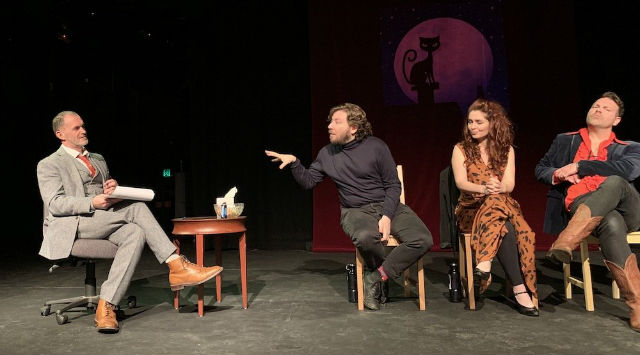
Stephen Sondheim has under his belt, countless celebrated works, and Sweeney Todd is amongst his most popular. It is masterfully crafted, with ample humour and drama to accompany some sensational songs, all guaranteed to please, and to secure bums on seats. The story is macabre, involving a crestfallen old barber trying to murder his way to salvation, and in the process victims are turned into pie fillings fed to an unknowing public. There is meaningful symbolism that could be deciphered, but depending on the quality of a presentation, as on any theatrical occasion, we might prefer to enjoy only the surface, to revel in its song and dance, and ignore any possibility of deeper resonances.

Theresa Borg’s direction may not inspire an experience that is particularly contemplative, but what she assembles is a professional staging showcasing a splendid piece of writing that proves itself virtually fail-safe. Its star Anthony Warlow is certainly a bankable resource, demonstrating his own infallibility, along with an immense likeability, that simply does not allow us to regard anything he offers as less than magical. In the midst of mediocrity, Warlow’s talent is still an exquisite beacon. Mrs. Lovett the baker is played by television icon Gina Riley, whose comedy chops justifies her shared top billing with theatre veteran Warlow; her vibrancy is the saving grace in a presentation needlessly, and strangely, safe and predictable. Genevieve Kingsford and Owen McCredie are the young lovebirds Johanna and Anthony, both performers suitably beautiful in appearance and in voice, able to provide a believable sense of romance to their scenes.

Vanessa Scammell serves as musical director, bringing considerable spirit to proceedings but as a whole, the production never really feels much more than a rudimentary effort. Mrs. Lovett’s customers love her pies. Their satisfaction with her product does not require any explanation about ingredients or methods. Likewise, when art is effective, one is tempted not to ask how things are put together, we simply indulge in the wonder that it delivers, allowing the mystery to wash over us, a transcendental moment likely to be diminished when deconstructed and understood. When art is less than enchanting however, it is perhaps wise to investigate failures, but always remembering to question why anyone should think that they deserve better.

www.lifelikecompany.com

Review: Gloria (Outhouse Theatre)

Venue: Seymour Centre (Chippendale NSW), Jun 6 – 22, 2019
Playwright: Branden Jacobs-Jenkins
Director: Alexander Berlage
Cast: Justin Amankwah, Annabel Harte, Reza Momenzada, Michelle Ny, Georgina Symes, Rowan Witt
Images by Clare Hawley

Theatre review
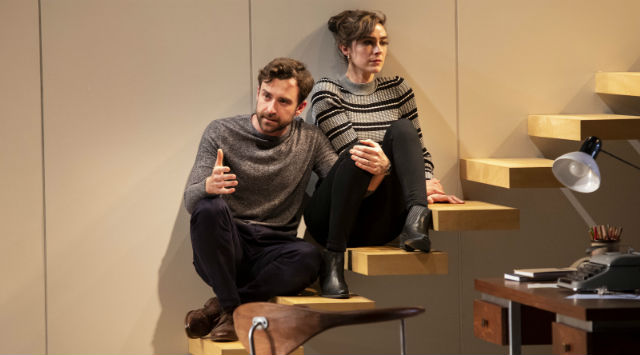
The story happens at the most innocuous of places. In offices and a Starbucks cafe, characters from Branden Jacobs-Jenkins’ Gloria do their best to stay afloat, in what feels like a never ending rat race. These humans are flesh and blood, but we see them caught inside machines, trying to navigate circumstances that are highly unnatural, and failing to do anything with integrity. Almost everyone ends up looking like a bad person, but it is hard for the audience to cast blame on any individual. It becomes clear that it is the environment that is toxic, and collectively we encourage horrible behaviour in one another. Gloria is about culture; the state we are in, and how we are trapped in a quagmire of our own doing, yet unable to figure a way out of it.

Jacobs-Jenkins’ penetrating look at Western civilisation is composed of fascinating dialogue and scintillating diatribes. A passionate expression of the frustrations we experience of city life, Gloria offers in theatrical form, an astute and scathing reflection of the games we play on a daily basis, that only serve to drag us down. The production opens with absorbing exuberance for a first act that portrays regular moments between colleagues at a publishing house. Jeremy Allen’s set design is commendable for its very persuasive insistence on incorporating a conventional proscenium, perhaps as representation of “the establishment”.

Director Alexander Berlage’s rendering of a bitchy workplace, communicates with a mischievous familiarity that many will find irresistible; we laugh at how mean-spirited we can be, with people we see every day, who should be our closest allies and compatriots. Acts 2 and 3 turn much darker, and the show’s energy dissipates slightly. Where it should begin to speak more stirringly, as we get closer to the crux of the issue, the staging struggles to maintain a focus on the essence of what is being said, leading us to a conclusion that feels somewhat cool.

Enjoyable performances include Michelle Ny as Kendra and Jenna, both roles sassy and strong, with the actor’s beaming confidence holding us captive, and head-over-heels dazzled. Rowan Witt is very funny as Dean and Devin, and highly impressive with the inventiveness that he is able to summon in bringing them both to life. Georgina Symes as the diametrically opposed Gloria and Nan, proves herself effective at each end of the hierarchy, powerful whether playing high or low on the social scale.

Like nature documentaries with predictable predator-and-prey patterns of behaviour in all manner of species, Gloria shows us to be a tribe engaging in ruthless activity, as though free will is but a figment of some crackpot imagination. The truth however, is that although there is no question of our causing harm to one another, many of us do think and try to do better. The argument therefore, is about how much control we believe ourselves to possess, and how much each person is able to manoeuvre themselves to try evade these narratives to which we seem to be condemned. If we understand ourselves to have been indoctrinated, we must believe that deprogramming is possible. The nature of culture is that it is pervasive, but history shows that it is never insurmountable. Change happens all the time, and it might as well begin with the self.

www.outhousetheatre.org

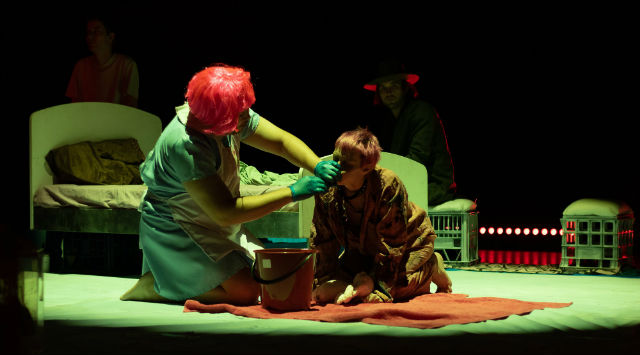
Review: Necrophilia (Jackrabbit Theatre)

Venue: Limelight on Oxford (Darlinghurst NSW), May 22 – Jun 1, 2019
Playwright: Lincoln Vickery
Director: Lincoln Vickery
Cast: Adam Sollis, Ariadne Sgouros, Jack Scott, Emma O’Sullivan
Images by Clare Hawley

Theatre review
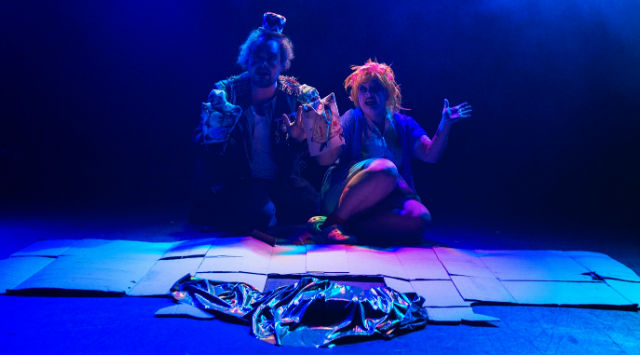
Amanda works as an undertaker, preparing the dead for funerals, but because of her peculiar penchant for sex with cadavers, things get complicated. Lincoln Vickery’s Necrophilia is a comedy that capitalises, predictably, on our awkwardness about the subject. Although thankfully not an exploitative work, Vickery’s focus on the idea of Amanda’s repentance and rehabilitation, seems a lost opportunity for a more philosophical or sociological approach to discussing a taboo of which, on the surface, “nobody gets hurt”.

In spite of the inherently morbid theme, Vickery’s direction gives us a show that feels like a regular romantic comedy. In the absence of intellectual rigour, we are offered instead, some depth of emotion by actor Ariadne Sgouros, whose depiction of Amanda’s struggles brings valuable dimension to the production. Sgouros’ comedy can be slightly obvious at times, but her conviction as performer is admirable. Playing love interest is Adam Sollis, whose ability for nuance in a simple part is noteworthy, able to introduce a quotient of sophistication to the experience. Jack Scott and Emma O’Sullivan round up the cast, both performers effortlessly funny, and confident, in their respective supporting roles.

There seems always to be something unusual about each person’s sexual proclivities; we are all unique beings with individual quirks. Of course, we draw the line at consent, and it is in our incessant arguments about the nature of consent, that the real drama occurs. A dead person is unable to give consent, but a corpse is clearly not the same as a human being. If we think of it as an object, we have to confront the idea that at some stage, it could be treated as less than sacred. We then come to an analysis of whether sex can be anything other than sacred or profane, in these dissections of libidinous activities and body parts. That we can be so uptight and hung up on these subjects only reveals the parts of ourselves that are as yet unevolved, but if we let art do its job, we can be hopeful that it will show the way to enlightenment.

www.jackrabbittheatre.com | www.limelightonoxford.com.au

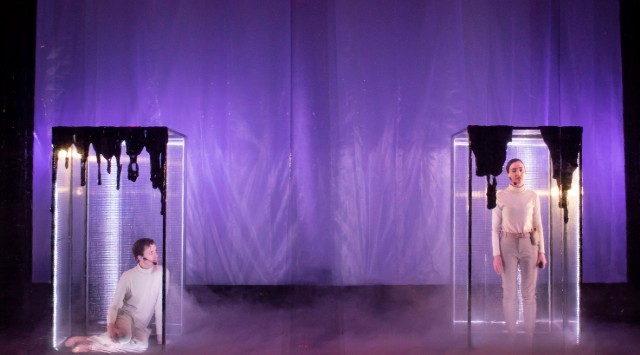
Review: Normal (The Uncertainty Principle / The Old 505 Theatre)

Venue: The Old 505 Theatre (Newtown NSW), May 29 – Jun 15, 2019
Playwright: Katie Pollock
Director: Anthony Skuse
Cast: Chika Ikogwe, Alexandra Morgan, Cecilia Morrow, Finley Penrose
Images by James Balian

Theatre review
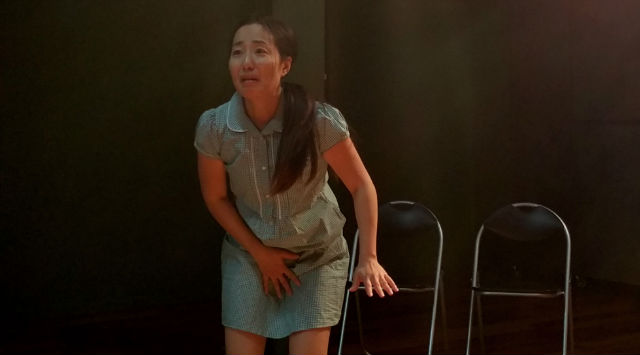
Teenager Poppy’s eyes begin to twitch one day, and before too long her entire being spasms, to the extent that she passes out in public without warning. It appears a disease has taken hold, one of a mysterious nature that compels all around her to formulate narratives, to impose judgement upon the young woman’s body. When the same symptoms are seen in her school friends, this spreading of an unexplained phenomenon, fractures Poppy’s community, with people seeing only difference of opinion, and not what binds them together. Katie Pollock’s Normal is an intriguing work, because it allows for ambiguity, even though its expressions are passionate. Poppy’s resistance of definition, of not wanting to be pinned down, is a tale about female bodily integrity. It refuses to fit into a structure that would make us comfortable, for its autonomy comes before our conventional stipulations.

Normal‘s politics are never obvious, but director Anthony Skuse makes sure that it speaks with an incontrovertible urgency. The ensemble of four conspire to deliver something quite intense, with Alexandra Morgan’s turn as Poppy bringing a satisfying mix of youthful innocence and exuberance to the play. Chika Ikogwe is wonderful in a variety of roles, always a striking presence, yet marvellously persuasive with her naturalistic style of presentation. Cecilia Morrow and Finley Penrose too are effective in the show, both infectious with their zeal and conviction.

The production is cleverly designed, with Kelsey Lee’s lights monitoring proceedings through a combined sense of dynamism and sensitivity, and her set providing an elegant visual cohesion to the many short scenes that comprise the plot. Sound by Cluny Edwards is imaginative, with a distinctive kooky edge, able to facilitate unexpected dimensions for the story and its characters.

One of the most dangerous things that could happen to society as we know it, is for women to reject any attempts to control our bodies. The radical notion that we can do what we want with our lives and with our corporeality, goes against so much of what constitutes the fundamental building blocks of what we are. Old religions and other old patriarchies require our subjugation and capitulation, so to have women take charge of our own destinies, can only mean devastation to life as we know it, which is absolutely a future to look forward to.

www.old505theatre.com

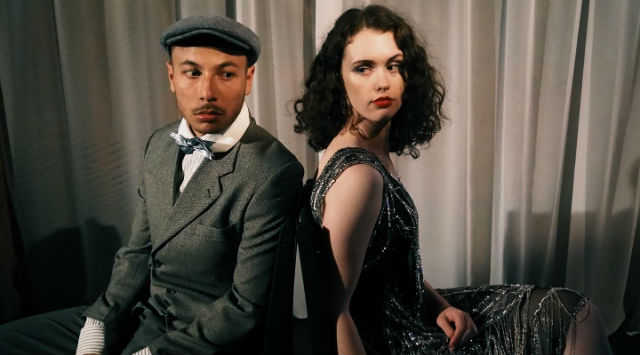
Review: American Psycho (BB Arts & Two Doors Productions)

Venue: Hayes Theatre Co (Potts Point NSW), May 10 – Jun 9, 2019
Book: Roberto Aguirre-Sarcasa (based on the novel by Bret Easton Ellis)
Music & Lyrics: Duncan Sheik
Director: Alexander Berlage
Cast: Blake Appelqvist, Erin Clare, Shannon Dooley, Ben Gerrard, Eric James Gravolin, Amy Hack, Loren Hunter, Julian Kuo, Kristina McNamara, Liam Nunan, Daniel Raso
Images by Clare Hawley

Theatre review
Bret Easton Ellis’ seminal 1991 novel American Psycho encapsulates a kind of sickness that had emerged from 1980’s capitalism. The story of exemplary yuppie Patrick Bateman was a wild indictment of Western culture at the time, one obsessed with prestige and facade, centred around the mythical Wall Street model of success. Evil personified, he served as an icon of all that had hitherto gone wrong, a monster materialising not from supernatural realms, but borne out of economic reality. The book’s detailed and extreme violence sparked great outrage, but the unassailable truths behind Ellis’ extravagant depictions, have made it a classic that remains pertinent three decades on.

Roberto Aguirre-Sarcasa and Duncan Sheik’s musical version is understandably much more tame in comparison, but thanks to the extraordinary characters and narrative it inherits, the show is still able to captivate, even if Sheik’s original songs are at best mediocre. It must be noted however, that musical direction by Andrew Worboys succeeds masterfully, at elevating these show tunes, turning very average melodies and lyrics into genuinely exciting numbers. Visual design too, is remarkable. Isabel Hudson’s revolving stage and butchers-style strip curtains are high gloss and very sexy, and even though slightly noisy at times, their theatrical effect is truly marvellous. The stage management team, headed by Brooke Verburg must be congratulated for their super smooth execution of mind-boggling logistics, most obviously in terms of performers’ complicated entrances and exits, all flawlessly enacted to quite magical results. Choreographer Yvette Lee demonstrates exceptional attention to detail and a highly sophisticated style, that bring the stage to flamboyant life.

Director Alexander Berlage’s lighting design is suitably sleek, and highly evocative. Along with Mason Browne’s costumes, they establish an aesthetic that is as much about contemporary fashion as it is about the 80’s; alluring, colourful and ostentatious, and ambitious like Patrick. Berlage’s direction of the piece certainly corresponds with his protagonist’s love of the surface. First half is all frothy and camp, a queer interrogation into toxic and hyper masculinity, that sits well within the musical genre. American Psycho‘s notoriety means that we know the tale to be terrifyingly macabre, but the production’s obsession with portraying a vacuous culture, can feel more bubblegum than menacing, although at no point is it ever less than fabulously entertaining. Second half becomes much more satisfying, as things get sinister, as we approach the true horror of the story.

Performer Ben Gerrard may not be entirely convincing as the demonic American, but the intelligent commentary he infuses into every line and lyric, every glance and gesture, ensures a resonance that communicates on levels beyond the obvious. We are repulsed by Patrick, but Gerrard’s charm keeps us attentive. Without a moral to its story, American Psycho is only obscene, and our leading man’s admirable efforts at driving home the message, represents the show’s beacon of integrity. Memorable supporting players include Liam Nunan whose turn as Luis, the closet homosexual, proves to be as comical as it is heartbreaking. Loren Hunter has the unenviable task of playing Jean, the dowdy secretary who falls in love with Patrick, a difficult role that she, quite miraculously, makes believable and empathetic.

Patrick, at twenty-seven, is a big fan of Donald Trump. The role models we choose, are a direct reflection of our values. Unable to see past the superficial glamour of the rich and powerful, Patrick invests his entirety to the pursuit of money and status. Morality is irrelevant. Today, Trump is President. It would be erroneous to imagine that all 63 million who had voted for him are devoid of morality, but these numbers tell a symptom that we would be remiss to ignore. Over the course of time, virtues are constructed, and re-constructed. In 1991, American Psycho controversially appeared as a cautionary tale of sorts. In 2019, the yuppies are nowhere to be seen yet we only have to look in the mirror to wonder, if resistance against greed is always futile.

www.bbartsentertainment.com | www.hayestheatre.com.au

Review: Folk (Ensemble Theatre)

Venue: Ensemble Theatre (Kirribilli NSW), May 3 – Jun 1, 2019
Playwright: Tom Wells
Director: Terence O’Connell
Cast: Libby Asciak, Gerard Carroll, Genevieve Lemon
Images by Phil Erbacher

Theatre review
Sister Winnie is planning a folk music night, and enlists Stephen and Kayleigh to help out. We see the nun orchestrating a connection, not only for the purposes of staging an event, but also for the two misfits to form a support network, with and without herself at its centre. Tom Wells’ Folk takes place in Yorkshire, more than ten thousand miles away from Sydney. It may seem that there is little that we have in common, and what should feel sentimental or moving, struggles to translate into much more than something quaint and quite foreign. Its themes are clearly universal, but its characters and language feel overly idiosyncratic, even distant at times.

Terence O’Connell’s direction does not help the work transcend our differences, and even though the viewing experience can often seem sedated, the charming cast is able to sustain our attention, particularly impressive during the play’s several musical numbers. As Winnie, Genevieve Lemon is appropriately kooky and spirited. Libby Asciak performs convincingly the part of teenager Kayleigh, with playful flourishes that reflect an irrepressible creative streak. The musical talents of Gerard Carroll are wonderfully showcased in the role of Stephen, as is his ability to portray an innocence rarely seen in the middle age man.

Winnie is not a preachy nun, but she embodies godliness in the way she conducts her relationships. Her ability to love is admirable, but it is also unremarkable. Without the usual piousness, her personality becomes one that we can readily identify with, and we recognise that love is not only sacred, it is easy. The effortlessness with which she takes care of people, and the significance she places on human connection, are only common sense from the audience’s vantage point, yet we understand that much of Winnie’s modus vivendi, are missing in our daily lives.

www.ensemble.com.au

Review: Playlist (PYT Fairfield)

Venue: Sydney Opera House (Sydney NSW), May 16 – 19, 2019
Director: Karen Therese
Cast: Mara Knezevic, Tasha O’Brien, Neda Taha, May Tran, Ebube Uba
Images by Daniel Boud

Theatre review
Five young women from Western Sydney take the stage, talking about themselves, driving home the point that their stories are not only valid, they are essential, should we wish to examine our lives as egalitarian Australians. For too long, these voices have been subsumed. Not white enough, not middle class enough, and not masculine enough, they have long been relegated to secondary importance in the way our national identity is construed and represented. This is not about a faded mythology; Ned Kelly, Don Bradman and Crocodile Dundee they are not. In Playlist, we encounter a devised work of theatre, that offers a refreshing and pertinent reflection of who we are, in the here and now. It is about creating a new vision of a future that addresses the social imbalances, and injustices, that have plagued us since European settlement. In Playlist, we see ourselves learning to become unapologetic women, more spice than sugar, able to occupy any space we deem appropriate.

The personalities bond through music and dance. It is a cultural discussion that requires each to talk about heritage. With roots in various continents, they gather to connect with traditions that are unfamiliar, and find commonality in popular music, alongside their shared experience of misogyny. Their bodies contain a multitude of meanings, and in Playlist, intersectionality is explicitly discussed, in words and in movement, to interrogate who we are as women, so that we may form progressive and propulsive intentions, to get us, collectively, somewhere better.

Larissa McGowan’s work as choreographer is invaluable in making the show dynamic and entertaining. She allows the expression of spirit to occur powerfully within structures that look disciplined but that feel simultaneously organic. Director Karen Therese does marvellously to bring cohesion to a diverse group of performers, with disparate styles and individual principles. An inspiring sisterhood is established through the harnessing of both similarity and difference, effective in conveying the possibilities that could arise from unions of this nature.

An extraordinarily well-rehearsed cast takes us through an entirely unpretentious theatrical exploration of a modern feminism, one that is useful today, for all Australians. They are humorous, but also disarmingly earnest with their propositions. There is great honesty on this stage, and as a consequence, we regard all they say with open hearts and minds. An immense energy pervades, physical and soulful, aided by a team of designers that join in on the conspiracy of a political presentation. Lights by Verity Hampson, and sound by Gail Priest and Jasmine Guffond ensure that Playlist makes its point every time, whether it chooses to hit us hard or to persuade gently. Also noteworthy are costumes and set by Zanny Berg, whose contemporary simplicity proves effective in helping us elicit a sense of visual resonance, to reach a deeper understanding of the nuances on display.

As migrant women of colour, we have learned to compromise our true essence, in efforts to survive a system that has us positioned low on its hierarchy of priorities. We have had to set aside our authenticity, in order that we can turn ourselves nonthreatening, and be deemed tolerable by the mainstream. In our maturity, we discover that these sacrifices have paid few dividends, so when Playlist stakes its claim on a self-determined womanhood, we can only respond with joy. These artists show us who they are, and in their revelations, we find answers to our own conundrums.

www.pyt.com.au

Review: Small Mouth Sounds (Darlinghurst Theatre Company)

Venue: Eternity Playhouse (Darlinghurst NSW), May 3 – 26, 2019
Playwright: Bess Wohl
Director: Jo Turner
Cast: Amber McMahon, Sharon Millerchip, Yalin Ozucelik, Jane Phegan, Justin Smith, Dorje Swallow, Jo Turner
Images by Robert Catto

Theatre review
The story takes place at one of those spiritual retreats, where people spend days not talking, trying to access a state of deep meditation. Six characters in Bess Wohl’s Small Mouth Sounds gather at one such facility, each with their own set of problems, seeking prodigious revelations that could mean an instant moment of salvation, to release them from considerable pain. These personal tragedies, with all their human vulnerability and desperation, form the basis of Wohl’s comedy. Cynical but also honest, the play is distinctive for its scant dialogue, relying instead on actors’ physical capacities to chart a journey, through their amusing presentation of sequences that alternate between absurd and meaningful.

The show is often funny, always intriguing with its creative renderings of a unique theatrical concept. A clever cast works exhaustively for our entertainment, offering up personalities that are endearing, familiar and believable. While a cohesive team, each performer delivers their own memorable nuances, for a result that is surprisingly textured. Slightly less effective is Jo Turner’s voice playing the part of the unseen Guru, perhaps a tinge too obvious with his humour. As director, Turner’s enthusiasm is more well placed. There is an effervescence to the production that appeals, even if it does take some time to turn persuasive. Early sections have a tendency to feel forced, but our engagement improves incrementally over time, and when it wins us over, Small Mouth Sounds proves an enjoyable ride.

Jeremy Allen’s set and Jasmine Rizk’s lights make for a visually vibrant staging, but it is Tegan Nicholls’ work as sound designer and composer that truly impresses. In the absence of the usual voices that occupy our auditory attention, Nicholls fills ninety minutes with an intricate mix of sounds from nature, as well as an assortment of music and effects, to help manufacture a rich and magical experience of theatre. Our imagination is guided by her detailed ear, for subconscious manipulations that take us through a gamut of emotional responses.

The seekers in Small Mouth Sounds have big issues to wrestle with, but there is little poignancy to be found in their respective narratives. No great transformations occur as a result of their fleeting commitment in the countryside. It is a realistic conclusion to the tale, one that can feel somewhat empty, although its insistent refusal of a happy ending in the form of outlandish miracles, is admirable. There is great value in keeping silent and looking inward, but to expect enlightenment in an instant, is naive. When we hope to heal, we think about returning to an idealistic state of being, before the infliction of damage. It may be however, that all we can ask for, is to be able to move forward, with the minimum of encumbrance, even whilst bearing a soul full of scars.

www.darlinghursttheatre.com

Review: Sensitive Guys (Cross Pollinate Productions)

Venue: Kings Cross Theatre (Kings Cross NSW), Apr 30 – May 11, 2019
Playwright: MJ Kaufman
Director: Blazey Best
Cast: Natasha Cheng, Nancy Denis, Alex Malone, Shell McKenzie, Samm Ward
Images by Clare Hawley
Theatre review
We meet two small groups of students at an American college. One is a Men’s Peer Education Group, and the other a Survivor Support Group comprised of women victims of sexual assault. MJ Kaufman’s 2018 play Sensitive Guys looks at young men grappling with sexual politics, at a time when boundaries seem to be shifting, as the traditionally subjugated learn to push back against injustices of many kinds. In the story are what we might term woke men, but we discover that thoughts and actions do not necessarily correspond, for those who claim to know better. There is excellent humour in Kaufman’s writing, and although didactic in nature, its clarity of intention makes for a political work that feels immediate and digestible.

It is a passionate production, cohesively designed by an efficacious team of creatives, to facilitate a simple depiction of contemporary concerns. Directed by Blazey Best, the show offers an accurate representation of our hopes and anxieties as they stand today, in relation to the development of discussions around sexual misconduct. The show is a consolidation and reiteration of recent ideas from the Twitterverse, no longer fresh but still pertinent. An excellent ensemble of five actors deliver a well-rehearsed performance, earnest but also comical, able to keep us amused as they take on the responsibility of expounding some valuable lessons.

The young men in Sensitive Guys have much to unlearn; their understanding of sex and gender is revealed to be more damaging than they had ever imagined. There is a pleasure in watching bad boys flagellate themselves on stage. We want to see them punished, as well as see them become better people. The moral of this story is incredibly basic, but the truth is that we keep imparting to our children, old values that are harmful to many and beneficial to few. How we teach masculinity and femininity must come under scrutiny, as do our reasons for insisting on those binaries.

www.crosspollinate.com.au

Review: Pygmalion (New Theatre)

Venue: New Theatre (Newtown NSW), Apr 23 – May 25, 2019
Playwright: George Bernard Shaw
Director: Deborah Mulhall
Cast: Colleen Cook, Steve Corner, Tiffany Hoy, Lisa Kelly, Emilia Kriketos, Natasha McDonald, Mark Norton, Robert Snars, Shan-Ree Tan, Sean Taylor, Vitas Varnas, Emma Wright, Tricia Youlden
Images by Bob Seary

Theatre review
The most gratifying aspect of Eliza Doolittle’s story is her refusal to be content with a life of misery, no matter what form it takes. Whether an impoverished flower girl, or a faux aristocrat, she is compelled to break free of shackles, as soon as she identifies an opportunity to do so. George Bernard Shaw’s Pygmalion talks about independence, and dares to place a feminine figure at the centre of speculations, in a work that tries to unpack the implications of class in British society, along with twentieth century notions of personal autonomy. Having coincided with the suffragette movement of the 1910’s, Pygmalion can be seen as a remnant of early feminism, with a female lead determined to discover the conditions for freedom, even if the playwright does put her through an unyielding series of torturous circumstances.

It is a wordy script, that Deborah Mulhall tries to overcome as director, by injecting speed and energy into its rendering. There are no indulgent pauses and few languid moments of sentimentality, resulting in a show full of vim and vigour. Intellectual complexities are occasionally compromised, in the absence of space for meaningful rumination, but the production holds our attention adequately for the duration, perhaps trusting that we would attain some degree of poignancy in the hours thereafter. Mulhall’s steampunk costumes, although well executed, are a curious addition, for a narrative not of any science-fiction or fantasy genre. Tom Bannerman’s remarkable set design is stylish, and cleverly conceived to facilitate dynamic stage action.

Actor Emma Wright is a strong Eliza, playful but firm in her interpretation of the classic role. Technically accomplished, yet an instinctual presence and emotionally rich, Wright’s modern approach is a wonderfully refreshing take of that familiar persona. An impassioned Steve Corner elevates the Henry Higgins character, to someone much more vulnerable than is conventionally depicted, for unexpected layers to the story that prove highly rewarding. Colonel Pickering is less surprising, but nonetheless effectively portrayed by Shan-Ree Tan, who impresses with one of the more sturdy performances from its supporting cast.

At the end, we understand that Eliza wants to be her own person, unbeholden to anyone. We also realise that in England a hundred years ago, spaces for women to thrive independently are not yet widely established. Eliza’s fate was not an optimistic one. With the passage of time, we certainly feel more able to operate in accordance with our individual sovereign wishes. Women are gainfully employed like never before, in areas of work unimaginable a century ago, and access continues to widen as we persist with the dismantlement of barriers. Progress is undeniable. If only we would stop our prejudice and judgement on women who look and sound different.

www.newtheatre.org.au