Review: Cool Pool Party (Bondi Feast)

Venue: Bondi Pavilion Theatre (Bondi NSW), Jul 16 – 18, 2019
Playwrights: Antoinette Barbouttis, Scarlett Beaumont
Director: Riley Spadaro
Cast: Antoinette Barbouttis, Gary Brun, Andrew Fraser, Liam Nunan, Emily Richardson, Shannon Ryan, Jack Scott, Riley Spadaro, Alex Stamell, Alana Stewart, James Thomasson
Images by Clare Hawley

Theatre review
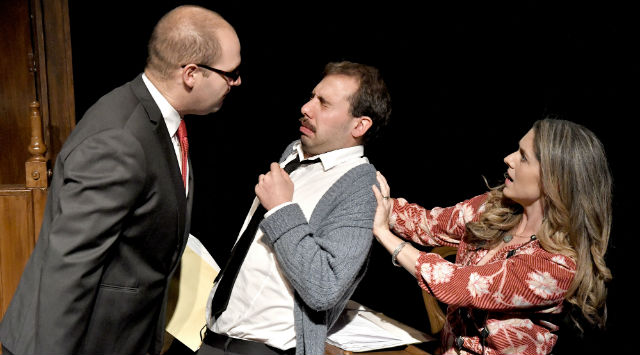
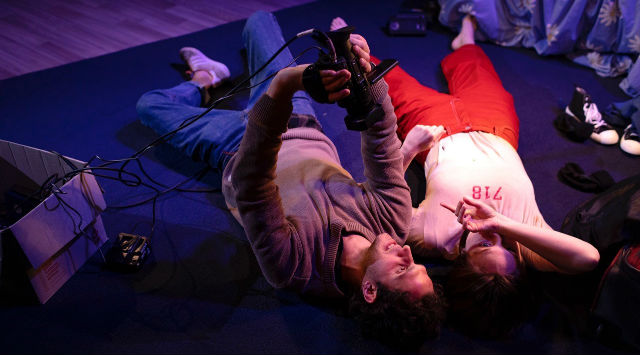
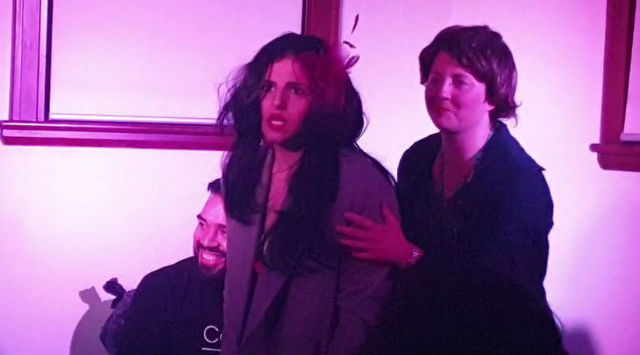
Antoinette Barbouttis says that Cool Pool Party was written in collaboration with 11 year-old Scarlett Beaumont, after the two had struck up a relationship from Barbouttis being hired as Beaumont’s babysitter. The play is predictably childish, inane even, as we see the narrative entirely from Beaumont’s very juvenile eyes. A group of rich teenagers congregate at a pool party, they play truth or dare, and hilarity ensues.

That, fortunately, is only half the story. The production begins with a lengthy pre-show panel, in which Barbouttis and director Riley Spadaro attempt to have a discussion about the show, and about the nature of theatre in general. We quickly discover that the two are not getting along well at all, with Spadaro’s passive aggression coming up against Barbouttis’ obstinate resistance, creating extraordinary tension, and making us respond with cringing laughter. This dramatic conflict, of course, is a ruse that allows us to explore the processes and meanings of the art form, made even more salient by Barbouttis’ highly autobiographical approach, in which she exposes the most vulnerable states of artistic creation. Getting to the truth is, after all, the name of the game.

As performer, Spadaro brings an acerbity that alarms with its honesty, and his irrepressible zeal for causing mischief translates to excellent entertainment value. Barbouttis is a compelling presence, with an anarchic spirit that ensures her audience is kept on their toes at all times. Of the ensemble pretending to be kids, Liam Nunan is a stand out, extravagant and very funny with the multi-layered farce that he presents.

Barbouttis has not found life as an artist to be easy, and she makes no bones about it. There is no disguising the difficulties behind a finished product in Cool Pool Party; there is figurative scaffolding everywhere, and seams are coming apart all the time. The work is unnerving in its modernity. Some will find it unbearably awkward, and others will find it a gleeful delight, but the show insists that everyone who sees it, will have to be intellectually engaged on some level. It talks about the human condition, as the best of art does, but further, its creator puts herself completely on the line, turning her personal condition into the exhibit from which we must observe, appreciate, and learn from.

www.bondifeast.com.au

Review: This Bitter Earth (New Theatre)

Venue: New Theatre (Newtown NSW), Jul 11 – 27, 2019
Playwright: Chris Edwards
Director: Riley Spadaro
Cast: Mitchell Bourke, Michael Cameron, Matthew Predny, Elle Mickel, Sasha Simon, Ariadne Sourgos
Images by Bob Seary

Theatre review
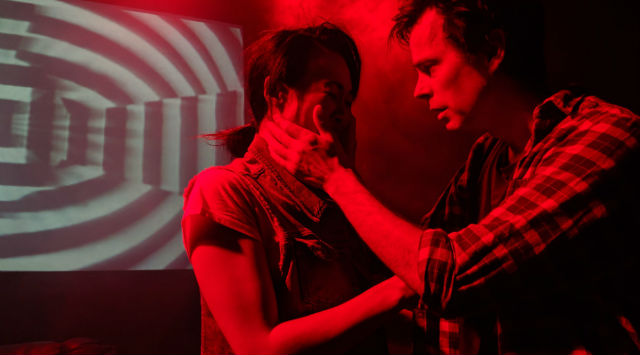
Comprising six scenes, This Bitter Earth by Chris Edwards is essentially a series of short plays about being young, queer and white in Sydney. Although not particularly profound, Edwards’ writing is ultimately insightful, with an absorbing balance of light and dark to keep us intrigued and entertained. A refreshing addition to the legacy of queer playwriting, This Bitter Earth deviates from the tradition of torment and trauma, for a theatre that presents the hardship of coming-of-age as humorous and strikingly natural. The oppressive closet is conspicuously missing in action.

The staging is polished, elegant and very attractive, assembled by an excellent design team, who all but steal the show with their remarkable sense of style. Set and costumes by Grace Deacon are inventive and sophisticated, beautifully considered in each of its spatial transformations between scenes. Phoebe Pilcher and Morgan Moroney’s lights are sensual and poetic. There is a passion in their practice that proves to be quite captivating.

Riley Spadaro’s confident direction gives This Bitter Earth a gravity that helps it sing with purpose. His ability to convey nuance prevents the show from turning flimsy, even at moments when the narrative shifts to frivolous concerns. The show is performed by a charming cast, including an effervescent Elle Mickel whose comic timing is a real asset to the production. Matthew Predny introduces palpable vulnerability to his characters, along with a dynamism that is satisfyingly disarming. Also impressive is Mitchell Bourke, whose portrayal of the classic but tricky combination of camp and despair, resonates with surprising authenticity.

Generations of LGBTQI people have worked hard for today’s social and legal advancements; the equality that we do have are hard-won, to say the least. Watching our young, privileged ones in This Bitter Earth go through their 2019 version of rites of passage, is a joyous exercise, even as we watch them suffer through their growing pains. Coming out stories have dramatically changed, as we had hoped. Our tribe can now begin to experience early adulthood in a way that is no longer exponentially harder than their straight counterparts. Their challenges remain different from the mainstream, but the additional labour of having to deal with structural prejudice, is quickly vanishing. Understanding sex will never be easy, but there is no need for the process to be made more difficult by anyone’s ignorance.

www.newtheatre.org.au

Review: The Cripple Of Inishmaan (Mad March Hare Theatre Company)

Venue: Old Fitzroy Theatre (Woolloomooloo NSW), Jul 11 – Aug 10, 2019
Playwright: Martin McDonagh
Director: Claudia Barrie
Cast: Josh Anderson, Sarah Aubrey, Alex Bryant-Smith, Laurence Coy, Jude Gibson, John Harding, Megan O’Connell, William Rees, Jane Watt
Images by Marnya Rothe

Theatre review
It is the Great Depression, and in the small Irish town of Inishmaan, we meet Billy who has grown up an orphan and with a disability. He is cared for by aunts, and by the town folk who are always in each other’s pockets, but the prejudice that he suffers, although fairly benign, is constant and unrelenting. When Hollywood comes calling, he takes no time at all to pack up and go, certain that greener pastures await. Martin McDonagh’s The Cripple Of Inishmaan is a witty examination of parochial rural societies, looking at the way we can be, when there is little to do but to occupy oneself with other people’s business. In the tension between staying and leaving, Billy demonstrates who we are, as dreamers always seeking something better. Hope is our way out, even if hope does on occasion prove itself empty.

Actor William Rees contributes a gentle innocence to the show. As Billy, his performance is unpretentious, relying only on honest impulses to tell the story. It is an accomplished ensemble. Although not quite as funny as the writing seems to require, there is certainly no lack of authenticity in the personalities they aim to portray. Jude Gibson and Laurence Coy are memorable as a mother-and-son team, with a wicked streak to their dynamic that unnerves and delights. Sarah Aubrey and Megan O’Connell are the aunts, captivating at each appearance with their marvellously sardonic approach, for a couple of sullen pessimists.

Claudia Barrie’s direction depicts a bleakness that accurately conveys the environment under scrutiny, but its lack of vibrancy makes compromises to the play’s humour that can cause the experience to feel underwhelming. Set design by Brianna Patrice Russell is effective in transporting us to a distant time and place, while Benjamin Brockman’s lights bring valuable visual variety to the narrative. Sound and music by Kailesh Reitmans is restrained, with a subtlety that adds a sense of tranquil beauty to the piece.

Sleepy towns are both idyllic and frustrating. They allow us to be slow with nature, but the peace that it promises tends to be short-lived. The corrupting forces so commonly found in urban existences, are not absent when we escape to rustic locales, they simply take on a different form. People will find trouble with one another, no matter where we structure our lives. As long as ignorance persists, and people are unable to recognise their bigotry, or see the consequences of their cruelty, we will struggle to find harmony. We care for Billy, but for him to be well, the world needs to change.

www.madmarchtheatreco.com | www.redlineproductions.com.au

Review: Skyduck: A Chinese Spy Comedy (25A Belvoir)

Venue: Belvoir St Theatre (Surry Hills NSW), Jul 11 – 20, 2019
Playwright: Sam Wang
Director: Aileen Huynh
Cast: Sam Wang
Images by Jasmin Simmons

Theatre review
Chinese agents Chang and Yan have stolen a flight simulator from the Americans, and are surreptitiously turning Skyhawk into Skyduck, to claim illegitimate supremacy in the world of military technology. They come up against good guys from the West; Kendrick is from the USA, and Tucker is Australian. There is also a love interest Little Swallow in the mix somewhere, along with pop star Xiao Peng who makes a short but memorable appearance.

Sam Wang plays all these characters in his Skyduck: A Chinese Spy Comedy, a lampoon of Hollywood action flicks, from Top Gun to Inception, in which nothing is allowed to get in the way of a good time. Wang’s show is imaginative and wonderfully quirky, with an artistic audacity that is highly persuasive; there are lots of outlandish ideas, some of which are completely bonkers, but they all work.

Directed by Aileen Huynh, the production’s idiosyncratic tone is perfectly pitched, for a style of humour that feels one of a kind. A remarkable ingenuity pervades Skyduck. From its clever video projections to some surprisingly elaborate prop making, everything about this staging is a delight.

Performed in Mandarin and English, Wang’s flamboyant take on characters is cheeky and very charming, underpinned by a truly splendid sense of timing. His ability to command attention proves to be quite incredible, as we are kept enthralled for the entirety, thoroughly bemused by what is being offered.

Skyduck is the funniest of contemporary Australian comedies, showcasing an exceptional emerging talent. Sam Wang’s instincts are accurate yet unpredictable. He seems to know better than ourselves, what it is that makes us laugh, and it is in his jocular prowess that we luxuriate. Skyduck pretends to be something it is not. It presents itself as an inferior imitation of blockbusters, and misleads us into thinking that we are laughing at a hack job, but the genius at play is almost furtive, and it is at our own risk that we should ever underestimate it.

www.facebook.com/skyduckandco | www.belvoir.com.au

Review: Van De Maar Papers (Ratcatch / The Old 505 Theatre)

Venue: The Old 505 Theatre (Newtown NSW), Jul 9 – 20, 2019
Playwright: Alexander Lee-Rekers
Director: Camilla Turnbull
Cast: Melissa Hume, Jessie Lancaster, Tom Matthews, Lucy Miller, Nathalie Murray, Terry Serio, Sophie Strykowski, Simon Thomson
Images by Clare Hawley

Theatre review
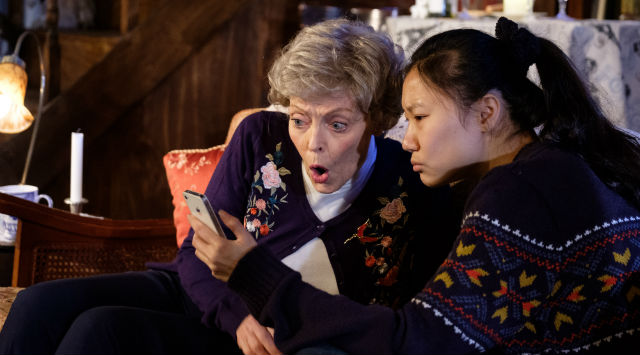
A man of extraordinary wealth and influence has died, leaving behind a secret manuscript that he wishes to get published, now that he is no longer here to face the critics. The family however, will have to suffer the consequences of a book that could well destroy the family name. Alexander Lee-Rekers’ Van De Maar Papers is concerned with ambition. Levi Van De Maar, the deceased, had wanted to achieve something that he only saw possible after leaving this mortal coil. His wife Christine has her own priorities of self-preservation, as does Frank, a nephew trying to make his own mark in a world that only sees him as a surname.

Lee-Rekers’ writing is often fascinating, with an idiosyncratic humour that keeps us amused. The production can however feel too serious and slow, with director Camilla Turnbull placing emphasis on conveying psychological accuracy, and comedic impulses made somewhat secondary. Lucy Miller and Simon Thomson play the main surviving Van De Maars, both actors believable if slightly too subtle in their approach. The role of unscrupulous publisher Ron Huck is depicted with an enjoyable theatricality by Terry Serio, whose relentless vibrancy is a real asset for the show. At times, he seems to be the only one who is in on the joke with the audience.

The obsession with money and status in Van De Maar Papers encourages us to question our own values. Juxtaposed against the inevitability of death, we are struck by the intensity with which the shallow and the materialistic can overwhelm and determine every course of action. We know with absolute certainty the brevity of existence, yet we submit to meaningless pursuits, letting the appetite to outdo one another, take over the entirety of our being. There are better things to do than to invest in keeping up with neighbours; the tricky thing is to be able to identify that which will be truly fulfilling, and stick with it.

www.old505theatre.com

Review: Glittery Clittery: A Consensual Party (Griffin Theatre Co / The Furies)

Venue: SBW Stables Theatre (Kings Cross NSW), Jul 8 – 20, 2019
Playwright: Fringe Wives Club (Victoria Falconer, Rowena Hutson, Tessa Waters)
Director: Clare Bartholomew
Cast: Laura Frew, Rowena Hutson, Tessa Waters
Images by Kate Pardey

Theatre review
It is a rowdy cabaret with three women in sequinned jumpsuits, very excited by feminism, and thrilled at the prospect of preaching to the converted. Christened Glittery Clittery: A Consensual Party, the show is perfectly suited to our current climate of placing centre stage, all things woke and womanly. Devised by Victoria Falconer, Rowena Hutson and Tessa Waters, collectively known as the Fringe Wives Club, the work consists of relentlessly amusing songs, and witty repartee that make for an enjoyable hour. It has a coalescing power, through its comical observations and vivacious representations, that makes us feel like a tribal audience, united in laughter against the patriarchy.

Directed by Clare Bartholomew, the cabaret presentation is intensely energetic, if slightly frenetic and unfocused in parts. Music is one of its indubitable strengths, although sound engineering could be improved to exploit more fully, the rousing pop potentials of the backing tracks. The performers bring a palpable warmth to the space, perhaps too polite in their approach, but all three are earnest personalities who insist on our adoration; Hutson is particularly likeable when temporarily assuming the scintillating part, “Lagoon of Mystery”.

Glittery Clittery is a sweaty, joyous mess; its text accurately expresses the thoughts and experiences of modern women everywhere in the Western world, but more importantly, the bawdy vigour with which its characters conduct themselves, is a marvellous exemplification of a new feminist spirit that we can utilise in conjuring up new feminine identities. This “clitterati” is unlikely to be anything close to what our grandparents had envisioned, and that is a sure sign of the progress that is under way for us all.

/www.facebook.com/fringewivesclub

Review: The Astral Plane (25A Belvoir)

Venue: Belvoir St Theatre (Surry Hills NSW), Jun 12 – 29, 2019
Playwright: Charlie Garber
Director: Charlie Garber
Cast: Eden Falk, Emma Harvie, Julia Robertson, Imogen Sage, Ella Scott Lynch, Michael Whalley

Theatre review
Charlie Garber’s The Astral Plane happens in that space one arrives at before attaining nirvana, where imagination easily turns into reality, or to be more accurate, material. It is all very strange. Depending on personal inclinations, Garber’s sense of humour can be appealing, even in an adventure featuring talking rats and social media influencers that proves to make no sense whatsoever. It is a comedy about nothing, that can leave one feeling quite empty by its end, but there are certainly laughs to be had in every one of its wacky scenes.

An energetic cast, full of conviction, takes us on a spirited ride. They are determined to entertain, and their presence is consistently infectious. In the role of Romi is Imogen Sage, who brings to the stage, an exaggerated effervescence and more than a hint of quirkiness. Julia Robertson is impressive as Deborah, very powerful with an artistic approach that is always daring and robust. Emma Harvie and Michael Whalley are the rats, both performers extraordinarily charming, able to convince us of anything, no matter how farfetched their story.

There is tremendous creativity in The Astral Plane, but its idiosyncrasy will only find appreciation from some. Art can hope to be universal, but it must originate from a personal place if we require it to be honest. Thinking that people are all the same is dangerous, for we are only equal and never replicants of each other. There must be generous allowance for artists to express their individuality, no matter how off-kilter, as long as we are prepared for it to land where we do not predict.

www.facebook.com/theastralplane | www.belvoir.com.au

Review: The Happy Prince (Little Ones Theatre)

Venue: SBW Stables Theatre (Kings Cross NSW), Jun 25 – Jul 6, 2019
Director: Stephen Nicolazzo
Cast: Catherine Davies, Janine Watson
Images by Robert Catto

Theatre review
It is the perfect symbiotic relationship, when the swallow meets the statue and they see deep into each other, not through some mutually obsessive infatuation, but by a shared fervour for bringing peace unto others. In this adaptation of Oscar Wilde’s short story The Happy Prince, we observe selflessness as the ultimate joy and fulfilment. Independently, each entity can do little, but together, they are able to help people in need, and it is only in bringing happiness to strangers, that they themselves are at their most exultant.

Directed by Stephen Nicolazzo, the show is correspondingly generous. Its messages are earnest, fiercely so, and it stringently disallows any room for our customary cynicism. A profound sense of melancholia works almost as its guiding light, taking us down a journey of meditative reflection, to facilitate an examination of the values we use to navigate this thing called life. The swallow and the statue exist in a concurrent state of joy and pain, and we feel every nuanced articulation of emotion depicted by this extraordinary staging. Poetic, with a sublime beauty that transcends all manner of convention, The Happy Prince speaks its truth with remarkable clarity, to deliver an hour of theatre that is as moving an experience as any fairy tale could wish to be.

Music by Daniel Nixon holds us tight, keeping us firmly in the grasp of a show determined to connect with the best of our humanity. Nixon’s work is tender, tremendously stirring, and we respond only with an attitude of pure benevolence. Katie Sftekidis’ lights have a similar effect, drawing us into a sentimental dreamscape, gently pushing away inhibitions so that our capacities know to welcome all the warmth, and wistfulness, of Wilde’s story.

Catherine Davies and Janine Watson are our players, both enchanting and majestically impassioned, full of soul in their performance of a piece that all our broken hearts need to encounter. Watson is the statue, the eponymous Happy Prince who shows us that glory means nothing when left enshrined and static. The actor communicates powerfully, the best of human nature, with a stylistic restraint that barely contains the urgency of what she wishes to convey. Davies takes flight as the swallow, giving us comedy and pathos in equal potent measure, precise at every point in the illustration of her character’s vacillating transformation, from apathetic to spirited. The robust couple is inventive, with an extraordinary charisma that demands our attention. Their sensuality adds a dimension of eroticism to the work, that operates to enhance the theme of compassion, as the play’s central concern.

It is easy to think of sacrifice in terms of loss. In The Happy Prince however, we are reminded that the purpose of sacrifice is to attain something greater, that more often than not, paying a price will lead us to a reward. We watch the statue and her swallow go through considerable suffering, but we are left without doubt as to the immense satisfaction they experience as a result of their pain. Pleasure does not always involve the sting of its cost, but when one is compelled to give until it hurts, what returns is usually from the realms of the divine.

www.littleonestheatre.com.au

Review: Trevor (Outhouse Theatre Co)

Venue: Kings Cross Theatre (Kings Cross NSW), Jun 14 – Jul 6, 2019
Playwright: Nick Jones
Director: Shaun Rennie
Cast: Di Adams, Jemwel Danao, Garth Holcombe, David Lynch, Ainslie McGlynn, Jamie Oxenbould, Eloise Snape
Images by Clare Hawley

Theatre review
Sandra owns a pet chimpanzee, who in Nick Jones’ Trevor, fancies himself a professional performer, having appeared as a younger primate, on stage and screen. Work has dried up, and Trevor is increasingly restless about his career’s downward trajectory. This of course, is all in his own mind, with Sandra completely oblivious about the turmoil that is brewing inside of the animal. Trevor is given his own voice by the playwright, but he talks as though in a monologue, never expecting any of the humans to understand, thus setting up for the play an inter-species disconnect that figures heavily as its ultimate raison d’etre.

Actor Jamie Oxenbould is persuasive as the chimp, with animalistic energy emanating from all of his being, without excessive reliance on physical mimicry. We believe his ambitions and his frustrations as Trevor, and appreciate the dramatic escalations being presented, through every plot development. Similarly convincing is Di Adams as Sandra, whose own problems are revealed at a slower pace, although no less powerful. There is however, a significantly stronger emphasis on Trevor’s experience than there is on Sandra’s, and considering our predictable affinity with the human character, it is a strange choice that prevents us from a closer empathy with the story.

In allowing Sandra to be somewhat subsumed in the production, director Shaun Rennie risks a distance that could result in a degree of emotional detachment for the audience, but it is a show that is relentless lively, and we find ourselves consistently involved, if not always invested. In a similar vein, Garth Holcombe and Eloise Snape both play larger than life, and very flamboyant personalities, who amuse us at every appearance, but who do little in engaging us on more profound levels. Their costumes though, are notably striking, humorously assembled by Jonathan Hindmarsh, who also solves spatial challenges as set designer, with demarcations of the stage that are, by and large, surprisingly effective. Lights by Kelsey Lee and sound by Melanie Herbert too, are accomplished, for an overall theatrical impact that proves gratifying.

It is absurd that a creature like Trevor should ever be kept as a pet. Human environments are barely feasible for our own survival, yet we insist on removing animals from their natural habitats, to put up with what we know is completely impracticable for them. This is the extent of our arrogance and narcissism. We see nature as a resource to be plundered, and fail to consider the consequences of our incessant exploitation. Trevor is about nature fighting back, and a timely work that opens up discussions about extinction, of the human race.

www.outhousetheatre.org

Review: Things I Know To Be True (Belvoir St Theatre)

Venue: Belvoir St Theatre (Surry Hills NSW), Jun 8 – Jul 21, 2019
Playwright: Andrew Bovell
Director: Neil Armfield
Cast: Miranda Daughtry, Tom Hobbs, Matt Levett, Tony Martin, Anna Lise Phillips, Helen Thomson
Images by Heidrun Löhr

Theatre review
Fran and Bob suddenly find themselves in their sixties, and although both have worked hard, there seems little to show for. After having put everything into raising a family, the couple is starting to have to confront their twilight years. With four adult children still struggling to find their own feet, and a marriage that has long lost its lustre, years of sacrifice seems to have delivered little contentment. Andrew Bovell’s Things I Know To Be True is a portrait of one family, in some ways typical of the Australian experience, but certainly not representative of our myriad diversities. More bitter than sweet, this family drama contains excellent humour and a great deal of sentimentality, as though trying to mask the pessimism that it fundamentally contains.

The Price family presents an admirable facade. There is undeniable love, very well depicted by director Neil Armfield, but we are encouraged to question the choices Fran and Bob had made, or more precisely, to question the options they had perceived to be available when deciding to follow the straight and narrow. Fran concedes that she had adopted others’ expectations as her own, that she believed her destiny was to be a mother and nothing else. Now observing her legacy, we see her constantly trying to find satisfaction, usually tenuous at best, with all that she had manifested. The thing about parenthood is that room for regret is virtually non-existent.

The production is incredibly well-crafted, with every faculty operating at levels of excellence, keeping us enthralled from beginning to end. Armfield magnifies all the comedy and drama, for a show determined to entertain, even if its emotional resonances tend to feel highly romanticised. Lights by Damien Cooper warmly lull us into a daze of tenderness, making us a forgiving audience for Things I Know To Be True, almost oblivious to its characters’ flaws and frequent moments of stupidity.

Terribly ordinary people are turned captivating, by a cast of actors brimming with charm. Tony Martin is especially charismatic as Bob, beautiful with the vulnerability that he so effectively depicts, alongside a convincing rendering of archetypal suburban masculinity. The very funny Helen Thomson, who never misses any opportunity to create laughter, plays Fran, a wonderfully complex character, able to sustain our empathy even after some very unkind behaviour. Miranda Daughtry is notable as youngest daughter Rosie, whose unyielding innocence sets the tone from curtain-up, allowing us to see the story with her eyes, often too pure for our own good.

Things I Know To Be True does not intend to be a cautionary tale, but one could be tempted to interpret it as such. Aside from Fran who had worked tirelessly for decades as a nurse, there is no evidence of any great contribution to society or to humanity, in these small, albeit painful, existences. The Prices think about nothing but themselves, and are perhaps unsurprisingly, overwhelmed with frustration and anguish. Fran and Bob were committed to being the best parents, but never found a way to impart a sense of fulfilment to their offspring. If we return to the initial unexamined notion of procreation as an obligatory social and personal imperative, we might be able to draw from Fran and Bob’s story, the consequences of doing things without thinking them through.

www.belvoir.com.au