Review: Homesick (The Old 505 Theatre)

Venue: The Old 505 Theatre (Newtown NSW), Oct 8 – 12, 2019
Playwright: Sally Alrich-Smythe
Director: Claudia Osborne
Cast: Annie Byron, Deborah Galanos, Eliza Scott, Alex Stylianou
Images by Phil Erbacher

Theatre review
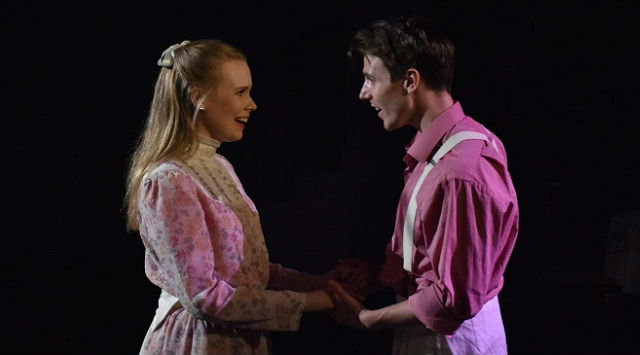
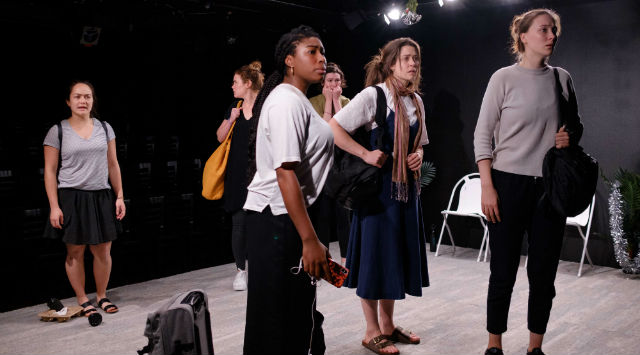
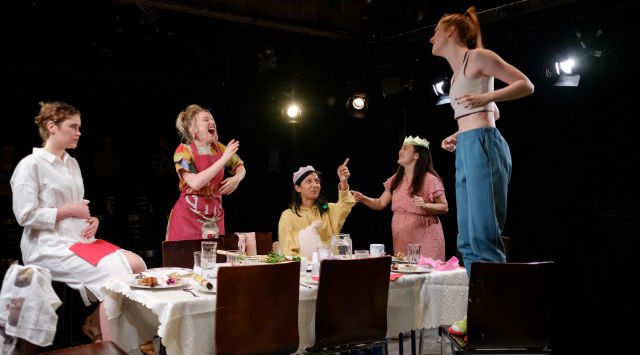
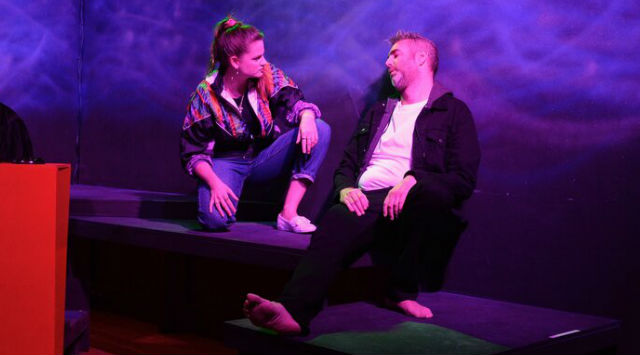
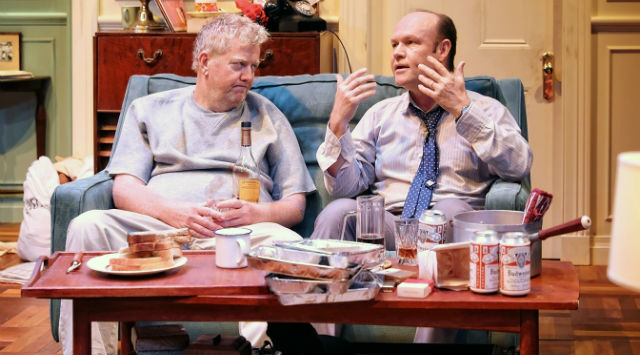
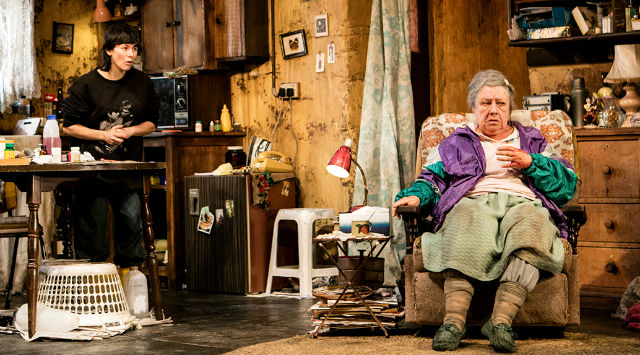
Samantha has suddenly come home to Wallerawang, from New York where she is yet to complete her higher education in music. Things are not well but she is unable to articulate them. In Homesick by Sally Alrich-Smythe, we observe the environment in which the young woman has grown up, that may have contributed to her emotional troubles, although we remain uncertain if those are entirely to blame for her illness. She seems to have identified her mother’s displaced ambition as a cause, but Samantha’s inability to bring adequate expression to her emotions, forms the central mystery on which the narrative of Homesick is built.

Its dark themes notwithstanding, Alrich-Smythe’s play features charming personalities and sparkling dialogue that keep us engaged. A generous measure of video projections (by Lucca Barone-Peters and Suzie Henderson) is used to help tell the story, integrated with a sensitive elegance by director Claudia Osborne, whose minimalist approach proves effective in this investigation into small town Australia.

Actor Eliza Scott offers an understated but compelling naturalism that makes believable, all of Samantha’s hidden struggles. Her mother Rachel is played by Deborah Galanos, whose effortless warmth assures us that the home in question, is loving and not overbearing. Annie Byron is quirky as the inconvenient grandmother Eadie, effective at introducing exuberance to the staging, and Alex Stylianou is memorable as Samantha’s ex-boyfriend Jess, confident with the instinctual comedy he brings to the very relaxed personality.

There are no doctors in Samantha’s story to tell us where her problems are coming from, so we try, as lay people, to arrive at our own diagnosis, which is neither reliable nor satisfactory. Mental health is complex. We may be able to detect feelings, but chemistry is best left to professionals. Samantha keeps her illness hidden, and we see her attempting to get out of the woods on her own, to no avail. It might be wishful thinking that the medical system represents a quick fix, but it bears reminding that help is always available, and even if the healing process turns out to be arduous, it is unequivocal that there is light at the end of the tunnel.

Mental Health Line 1800 011 511

www.bontom.com.au

Review: The Angry Brigade (New Theatre)

Venue: New Theatre (Newtown NSW), Oct 1 – Nov 2, 2019
Playwright: James Graham
Director: Alex Bryant-Smith
Cast: Benjamin Balte, Will Bartolo, Sonya Kerr, Nicholas Papademetriou, Kelly Robinson, Davey Seagle, Madeleine Withington
Images by Bob Seary

Theatre review
John Barker, Hilary Creek, Jim Greenfield and Anna Mendelssohn were sentenced to ten years’ jail for carrying out a series of bombings in London, in the early 70’s. They were home-grown terrorists, university degree holders with a self-righteous streak that had clearly gone out of control. Playwright James Graham completed The Angry Brigade in 2014, at a time when terrorism is routinely presented as a phenomenon akin to foreign invasion, used by politicians and the media to capitalise on our penchant for racial prejudice.

The play demonstrates that it is far more likely to be the disenfranchised within our communities who are drawn to such extremities, that the root of these problems are well within our own purview, and much less likely to emanate from an outside enemy that can only be controlled with further violence. The way our patriarchal capitalistic societies are currently structured, necessitates that a portion of us must face disadvantage, in order that all our hierarchical systems can function. We observe the anarchic activity of The Angry Brigade with a degree of empathy, and although unlikely to agree with their radical methods, their grievances about the Western world, so wonderfully articulated by Graham, are certainly persuasive.

A wonderful passion is introduced by director Alex Bryant-Smith, who assembles a production replete with humour as well as a sense of political urgency. Set design by Sallyanne Facer manufactures distinct spaces for the two acts, each of them evocative and efficient. Lights by Michael Schell add dramatic flourish to the staging, and Glenn Braithwaithe’s work on sound ensures tension is appropriately calibrated from one scene to another.

Strong performances by a well rehearsed team keep us fascinated and invested in this true crime story, where meaningful breaking of rules lead to indefensible ethical violations. Davey Seagle leaves a remarkable impression with his actorly intensity for the dual roles of Smith and John, brought to life with wit and vigour. Madeleine Withington brings emotional authenticity to the pivotal part of Anna, deftly delivering a narrative climax that packs a punch. Benjamin Balte and Sonya Kerr play the remaining transgressors, both able to generate moments of brilliance that have us captivated. A range of smaller roles are shared by Will Bartolo, Nicholas Papademetriou and Kelly Robinson, all accomplished with admirable style and imagination.

Like many things that are dangerous, anarchy can be useful in small doses. It is undeniable that some of what has been institutionalised, would be better off demolished, and in these instances, a hint of nihilistic chaos could help instigate change. Revolutions occur because they are necessary but it is unimaginable that shifts in power can ever happen without conflict and disorder, although violence should always be regarded as preventable. Anarchy can be looked upon as a transitory concept, a methodology for those who have nothing to lose, to rise up and demand for improved conditions, even when they do not have all the answers close at hand.

www.newtheatre.org.au

Review: Shaz And Tina: Waiting For Uber (The Sydney Fringe)

Venue: Erskineville Town Hall(Erskineville NSW), Sep 24 – 28, 2019
Devisors & Cast: Nisrine Amine, Lisa Robinson

Theatre review
Shaz and Tina have stumbled out from the races, and are in an alleyway waiting for their ride to arrive. It is unclear if their hyperactive behaviour is due to an overindulgence of alcohol, but in their show Shaz And Tina: Waiting For Uber, the two young women spend fifty minutes being restless and incoherent, as though in a Samuel Beckett play that goes nowhere. In this case however, our storytellers are less in an existential crisis, than they are trying to entertain by creating mayhem. There is a lot of audience participation.

Shaz in particular is keen to engage the strangers around her, especially if they are of the tall, dark and handsome variety. It is the races after all, and her harmless flirting certainly befits the spirit of things. In fact, a substantial portion of the show involves a dating game, like those seen on television, with Tina trying to find Shaz a match from three volunteers. The production is humorous, although it must be said, in an awkward way, just as the two personalities we encounter are themselves extremely awkward specimens of the suburban kind.

The presentation feels improvised, loosely structured, but very live. Although the laughs delivered are not always as big as one would hope, they are both consistently amusing, able to fill the time with with quirky inventions and a frenzied energy. As Tina, Nisrine Amine is intense and snarky, and as Shaz, Lisa Robinson is gawky and mischievous. The pair’s easy chemistry provides a solid foundation for the work, allowing us to trust that no matter how long the Uber is going to take, the women are determined to keep us occupied.

www.facebook.com/shazandtina

Review: Doctor Shopping / In The Bag (Cobbstar Productions)

Venue: Cobbstar Productions (Paddington NSW), Sep 11 – 22, 2019
Playwright: Shaun Angus Hall

Doctor Shopping
Director: Tamara Cook
Cast: Patrick James, Rory O’Keeffe, Monica Sayers, Kristian Schmid

In The Bag
Director: Brian Cobb
Cast: Angela Elphick, Michael Kotsohilis, Giuseppe Rotondella, Lukey Timmins
Theatre review
The late Shaun Angus Hall was only in his twenties when he wrote these two plays in the 90s. Both very broad comedies with intentions only to entertain, they bear a sensibility that seems dated now, as we go through an era of hypersensitivity in relation to issues of race, misogyny and homophobia, but Hall’s proficiency with dialogue remains evident.

Doctor Shopping takes place mainly in a living room with four people who do nothing but abuse prescription drugs, while action in In The Bag happens at the race course, with goofy men gambling big bucks to dire results. Well crafted, but lacking in sophistication, these are plays with a specific appeal, that will prove very popular with the right crowd.

Direction for both shows prove accomplished. Tamara Cook gives Doctor Shopping an enjoyable playfulness, notable for her non-judgemental representation of addiction. Brian Cobb embellishes every moment of In The Bag with an overt humour, delivering robust energy from start to end.

Each story features four performers, all of whom are focused and enthusiastic; the quality of acting is an unequivocal highlight of the event. Kristian Schmid demonstrates excellent range as Ferris in Doctor Shopping, able to convey the light and dark of his character with ease. Giuseppe Rotondella’s strong presence as Angus provides In The Bag with a reliable anchor, and Angela Elphick’s multiple roles too are memorable, each one distinct and confident.

Some words seem to move with the times, but others can feel like relics. The nature of theatre allows old writing to be revived, and when necessary, it provides the opportunity for obsolete ideas to find relevance in a different era. Audiences however, can be stuck in the past, whether nostalgic or simply traditional. Theatre too, can decide whether to progress, or to ignore the future.

www.cobbstarproductions.com

Review: John (Outhouse Theatre)

Venue: Seymour Centre (Chippendale NSW), Sep 19 – Oct 12, 2019
Playwright: Annie Baker
Director: Craig Baldwin
Cast: James Bell, Maggie Blinco, Belinda Giblin, Shuang Hu
Images by Clare Hawley

Theatre review
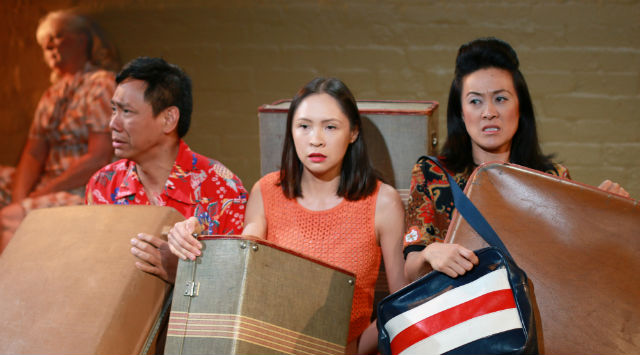
Jenny and Elias are visiting Gettysburg, Pennsylvania whilst trying to mend a rough patch in their relationship. They stay at a bed and breakfast, run by an elderly lady named Mertis, who is very nice, but who is also more than a tad mysterious. Her eyes, like her house, are secretive and cavernous, and in Annie Baker’s John, we always feel as though things are not quite what they seem. We see the young couple attempt to make things work, both trying hard not to let go, inside Mertis’ tchotchke-filled house, where past and present converge, unable to disentangle from one another.

Baker’s intriguing play is filled with characteristics of scary stories; lights that turn on and off by themselves, a pianola that plays unprompted, portraits and dolls imbued with a presence that can only be described as supernatural. There are lots of creepy goings on, but in the absence of an obvious genre style pay off, our minds are made to regard Mertis’ world with an unusual complexity, that quite matter-of-factly ventures into the metaphysical.

Director Craig Baldwin manufactures this eerie atmosphere with considerable diligence and detail, supported magnificently by set designer Jeremy Allen and lighting designer Veronique Bennett, who deliver exquisite imagery that has our imagination running wild. The house is in some ways the star of the show, and the work that has gone into making it come alive, is absolutely terrific.

Incredibly nuanced performances by the cast of four take charge of our attention for the entire three-and-a-half hour duration, keeping us guessing at every juncture, making us see things that may or may not be there. Efforts to render a spooky vibe can sometimes feel awkwardly lethargic, especially in Act One, but we are always engaged, always filled with curiosity, even when feeling impatient.

Belinda Giblin is electric as landlady, hugely impressive with the intelligence and rigour that she brings to her portrayal of the enigmatic Mertis. Her close friend Genevieve is played by an exhilarating Maggie Blinco, whose kooky vivacity adds much needed energy to the show. The troubled young couple is depicted with great chemistry by James Bell and Shuang Hu, who are convincing whether loving or fighting, but there is a restraint to their approach that can at times feel at odds with the humour of the piece.

There is much that can be interpreted as strange in Mertis’ home, but there is also a peculiarity to how the visitors struggle with their lives that can easily get unnoticed. The older women share a sense of ease that escapes Jenny and Elias, who we observe to be constantly at odds with the world, always responding to it with resistance and frustration. Mertis accepts things as they are, and nothing seems to unnerve her. She exists in harmony with a cosmos that many think is chaotic. The young ones on the other hand, appear to play by the rule book. They look like normal people doing normal things, but they are in contradiction with a bigger scheme of things, as exemplified by the house they temporarily occupy. The house just is, and it is us who have to learn to adhere to it.

www.outhousetheatre.org

Review: Trojan Barbie (New Theatre)

Venue: New Theatre (Newtown NSW), Sep 16 – 21, 2019
Playwright: Christine Evans
Director: Maddison Huber
Cast: Anthea Agoratsios, Sophie Avellino, Deng Deng, Sam Flack, Cathy Friend, Tristen Knox, Anjelica Murdaca, Taleece Paki, Lisa Robinson, Shannon Rossiter, Amy Sole, Kristelle Zibara

Theatre review
An homage to Euripides’ The Trojan Women, Christine Evans’ 2009 play Trojan Barbie places focus on legendary women of the Trojan War. Modern day tourist Lotte, who restores dolls in her normal life, is flung back to ancient times, where she is trapped in a women’s camp, witnessing the atrocities of war. Evans’ work is suitably tragic, but also surprisingly humorous in many of its early scenes. Familiar characters are rendered with a contemporary sensibility, allowing us to relate better to their stories, and to keep us amused.

Time travel aspects are not always presented effectively in the production, leaving us confused at several points, but director Maddison Huber ensures that each personality we encounter in her show, is distinct and memorable. Actor Lisa Robinson demonstrates strong comic abilities as Lotte, adept at delivering laughs even in the midst of battleground horrors. Kristelle Zibara is a convincing Hecuba, intense with the sorrow her maternal role is charged to convey. Sophie Avellino and Cathy Friend take on different kinds of madness, for Helen and Cassandra respectively, both performers bringing appropriate flamboyance to invigorate the stage. The show succeeds at dramatic moments of catastrophe, but when the action calls for a gentler touch, its lack of nuance can make for a less than satisfying experience.

A Chinese proverb says that women hold up half the sky. Even as men insist on occupying positions of power, we are always required to be on hand to pick up the pieces, whenever they bring degradation and destruction to the world. It is important that we look beyond how things currently operate, and commit to working towards a new system that does not simply replace men with women. These hierarchical modes of organising society have proven to be severely deficient, no matter who sits on top of the pile. If we want to ensure that nobody loses, it must mean that old ways of thinking about success, about winning, must be radically eliminated.

www.facebook.com/Scribe-Theatre

Review: High Performance Packaging Tape (Sydney Opera House)

Venue: Sydney Opera House (Sydney NSW), Sep 18 – 22, 2019
Collaborating Artists: Phil Downing, Mickie Quick, Lee Wilson, Mirabelle Wouters
Cast: Lee Wilson
Images by Daniel Boud

Theatre review
The man assembles a whole lot of household and industrial items, including plastic chairs, oversized balloons, rubber bands, cardboard boxes, and an endless supply of packaging tape. Using them like big boys toys, he performs a series of daredevil type stunts, usually with gravity as his opposition, almost like a circus act. Except Lee Wilson is dealing entirely with physics in High Performance Packaging Tape, leaving nothing to chance, and therefore unlike the circus, we are not fearful of things going wrong. No one is at risk of plunging to their deaths, and certainly no lions are hanging around waiting to maul him to death.

In the absence of danger, our attention is then free to shift towards intellectual aspects of this physical work. We wonder what it is that compels man to place obstacles before himself, as Wilson does incessantly in his show. Questions about gender, ethnicity and therefore social advantages, begin to arise. We wonder if privilege means that a person would tend to create challenges for the self, if challenges are not already present. In 2019, if we are no longer interested in what a white man has to say about the way Australian life is experienced, it appears that we leave him to his own devices, and he goes to prove his worth by exploring his existence in spaces that seem devoid of politics, in cultural frameworks he is able to determine for himself, that can disregard all the urgent discussions being had in the real world.

It is arguable if audiences can be as easily persuaded. Some might be able to invest in the statements being made about the body, as entirely apolitical objects, scientific and subject only to natural laws of matter and energy. The rest of us will struggle to extricate our corporeality from the implications of daily stresses, unable to relate to this ethereal vacuum, where suffering and injustice are so conveniently shut out.

Within this world of childlike play, where the creators make up their own rules, the production is faultless, and very sleek, with what it sets out to achieve. The humour is sophisticated, and the stunts are original. Wilson’s nonchalant composure is a cool juxtaposition against the dramatic intensity of the visual presentations. Auditory effects are remarkably inventive, involving digital manipulations of live sounds that heighten tensions in the auditorium. High Performance Packaging Tape is quite unlike anything one has seen before, an escape from realities that not all can bear.

www.branchnebula.com

Review: The Becoming (New Theatre)

Venue: New Theatre (Newtown NSW), Sep 15 – 20, 2019
Playwright: Katie Pollock
Director: Brett Heath
Cast: Alison Benstead, Jo Goddard, Ben Hanly, Patrick Holman, Sarah Maguire, Paul Wilson

Theatre review
Greta and Gregor are rich kids from the eastern suburbs of Sydney, both going through significant transformation, as a response to the world’s current state of tumult. Katie Pollock’s The Becoming can be seen as a coming-of-age tale, but is more likely to be taken as commentary on the sociopolitical mess we are experiencing today. We see Greta deciding to be a nicer person, whilst Gregor turns angry and militant; it is as though one environment has bred two extremists on either ends of a spectrum, both of which the play presents as ineffectual and regrettable. It is an amusing context that Pollock has located, inspired by Franz Kafka, and obviously pertinent with its thematic concerns. As a work of absurdist comedy however, its characters never really depart sufficiently from the mundane, with a sense of humour that is probably too subdued.

Directed by Brett Heath, the show is thankfully raucous in atmosphere, although the players never really attain a level of authenticity that would allow its ideas to resonate. Each role is approached with an enjoyable sense of theatricality, but we struggle to connect with anything meaningful even if the text does point to matters contemporary and troubling. Sarah Maguire’s indefatigable ebullience as Greta helps sustain our attention, and Patrick Holman is suitably offbeat as the misguided Gregor, particularly noteworthy for his performance of live drums that prove to be a rousing and sophisticated touch.

It is true that so much of what we observe to be happening in society, can be infuriating. Greta and Gregor may have found radical ways to express their dissatisfaction, but they achieve nothing, other than to escape that dreadful sense of helplessness when one is crippled with inaction. When the system is broken, those of us who are more intrepid, like the siblings in The Becoming, might be moved to try for solutions, but it is revealing that the two do not confer, choosing instead to operate independently even though they live under the same roof, and share the same blood. They are unable to listen to the other, each so certain of their own beliefs. Watching the collapse of this kinship, of humans failing to connect, it becomes unsurprising that disaster should unfold.

www.newtheatre.org.au

Review: The Irresistible (Sydney Opera House)

Venue: Sydney Opera House (Sydney NSW), Sep 11 – 15, 2019
Playwrights: Ariadne Daff, Zoe Pepper, Tim Watts
Director: Zoe Pepper
Cast: Ariadne Daff, Tim Watts
Images by Rémi Chauvin, Dan Grant

Theatre review
April wants to give her sister Bridget a break from motherhood, so little Cassie comes to stay. We soon discover that the child is not only a handful, she is in fact bizarre. The Irresistible too is often a strange exercise, with two actors playing a range of characters, behind translucent screens blurring our vision, and microphones altering their voices as if to say that it matters not, which actor is assuming which role.

The action is episodic, involving disparate narratives that our minds will insist on assembling a coherent picture out of, but the greatest pleasure in The Irresistible is to luxuriate in the extraordinarily imaginative approaches being applied to each theatrical moment. The magic is not in the stories themselves, but in how those stories are used to subvert our expectations, and therefore deal with what we consider to be normal in art and life. Director Zoe Pepper seems to imply that when we encounter the opposite of normal, an interrogation into who we truly are, comes to the fore. It is hard for humans to properly see ourselves, until a catalyst is introduced to turn us weird, and to force a deviation from the ordinary.

Performed by Ariadne Daff and Tim Watts, the simple text becomes springboard for experimentation, with their irrepressible desire to always manufacture something surprising, resulting in an experience that has us utterly mesmerised. The pair is outrageously inventive, both spirited in the kookiest way possible, and impossibly precise in their delivery of a technically demanding work. Sound by Phil Downing and music by Ash Gibson Greig are astonishing in their ambition and scope, daring to surpass other elements to become the most important and effective design aspects of the production. Jonathon Oxlade’s set and Richard Vabre’s lights manipulate our attention so that we cannot look away, keeping our sight intrigued and hopelessly engrossed for the entire duration.

The character Christian finds himself seduced by the performance of adult entertainer Neve, and responds by trying to dominate and consume her. At the theatre, we can never be sure how power dynamics can manifest themselves. Being capitalist, we enter with the subliminal notion that if someone is going to be the boss, the paying audience must surely be in charge. Art however, cannot let itself be subject only to market forces and the taste of the masses. It is responsible for moving discussions forward, to find advancements for our civilisation. For our society to progress, it seems artists are the only ones left willing to take the lead. We need the shock of the new, and The Irresistible is an excellent case in point.

www.sideponyproductions.com.au | www.thelastgreathunt.com

Review: Confessions Of A Custard Melon Pan (The Sydney Fringe)

Venue: 107 (Redfern NSW), Sep 12 – 14, 2019
Playwright: Arisa Yura
Director: Courtney Stewart
Cast: Arisa Yura

Theatre review
Arisa Yura is of the 1.5 generation, having moved from Japan in her early teens. She bears characteristics of her home country, but is also assimilated into Australian life. In her autobiographical work Confessions Of A Custard Melon Pan, we observe the contradictions, challenges and comedy of an existence straddling two very different cultures. Scenes are set alternately in both places, but Yura remains bi-cultural no matter the location, and is therefore always accompanied by a disquieting sense of displacement. Our incontrovertible corporeality implies that home is a staunchly singular notion, but many in the 21st century have roots growing in more than one terrain, which lead to the creation of complex identities requiring an almost constant negotiation with environments and communities, wherever one finds themself situated.

It is a one-woman bilingual play about not being able to just be. Yura demonstrates what it is like, caught between two worlds, but trying to construct one coherent entity. Her writing is charming and humorous, deft at communicating weighty ideas with a light touch. The blend of languages is cleverly rendered, and proves a surprising auditory pleasure. As performer she is focused, energetic and intuitive, with a simplicity in approach that never fails to drive home any point she wishes. Direction by Courtney Stewart introduces a delicious exuberance, keeping us amused and engaged. Sound design by Michael Toisuta makes accurate calibrations to mood from moment to moment, but several instances of scene transitions, when the performer is changing costumes off stage, require greater attention.

The custard melon pan is a confectionery half yellow, half white. Racial minorities in this country do not have the privilege of forgetting the colour of our skin. To live in a place where whiteness has imposed itself as the standard, those of us who are not, must constantly have colour on our minds, and deal with the burden of always being designated the other. When Yura returns to Japan, hoping to shed the labour that none would wish to acquire voluntarily, she discovers that colour goes beyond skin. She is again inadequate, even though her flesh and blood are meant to make colour inconsequential in her home land. We watch it dawn on our protagonist, that it is no longer she who has to find a way, but Australia that needs to make peace with its own future and origins.

www.arisayura.com