Review: The Readers (Belvoir St Theatre)

Venue: Belvoir St Theatre (Surry Hills NSW), May 5 – 19, 2018
Playwright: Scott Smart
Director: Elizabeth Nabben
Cast: Anni Finsterer, John McNeill, Scott Smart
Images by Clare Hawley

Theatre review
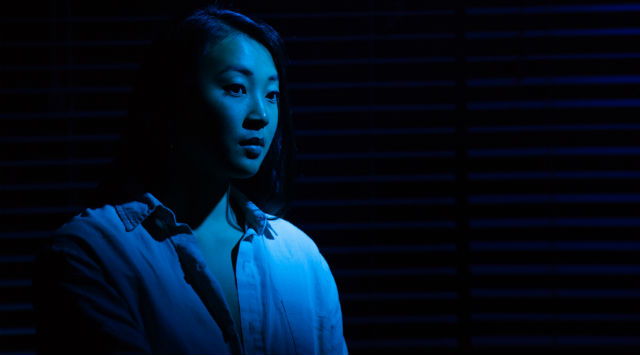
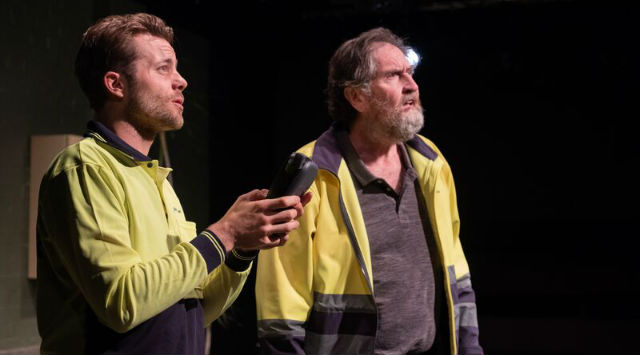
It is tempting to judge ourselves by things we read in the news. The extremities of society, whether the great successes or our dismal failures, give a powerful impression of the people we are, but routinely neglected are the smaller stories of millions of individuals, those that offer a more accurate picture of daily Australian life. Scott Smart’s The Readers puts focus on those who make up the regular working class, the ones who rarely make the papers.

Peter and Lachlan read electricity metre boxes for a living, going about their business with little fuss or drama. They are two white men who seem to suffer no disadvantage, but their lives are not without challenges. In our current state of accelerating capitalism, what were once perfectly respectable jobs, are gradually turned humiliating. The play shows the insidious nature of how money is allowed to compromise the dignity of our workers. Peter and Lachlan have rules to abide by, but not all of them are reasonable.

The production is elegantly directed by Elizabeth Nabben, who manifests a quiet charm around her characters and situations. It seems society has accepted that employers will, by some degree, infringe upon their staff, and The Readers embodies a quality of nonchalance that reflects that reality. Working for someone does not mean that one becomes a stakeholder, one simply becomes an instrument of functionality, and will have to accept a certain amount of dehumanisation within their prescribed responsibilities. It is the profit motive that takes precedence, rather than the welfare of our communities.

John McNeill and Scott Smart play the key roles, both subtle but strong with their humour, delivering excellent nuance for this gentle piece of theatre. They form an amusing duo, comedic but also poignant, without having to reach for creative choices that may be too obvious. The third wheel Annie, a flimsy character with arguably unconvincing traits, is performed by Anni Finsterer who plays up the silliness to great effect, for moments of extraordinary hamminess that prove surprisingly delightful.

In The Readers, we see that the only thing trickling down from top to bottom, is the anxiety of business ownership. Profits, on the other hand, remain exclusively within the upper crust. Managers do not hesitate to exert pressure on those who have to put in the hard yards, but only shareholders stand to gain monetary wise. Peter and Lachlan never complain. Like most of our work force, people accept their lot, accustom to the feeling of disempowerment. We are taught to work hard, to grin and bear it, in order that rewards may be delivered. That belief is not a lie, but it is clearly not the entire truth.

www.belvoir.com.au

Review: Greater Sunrise (Belvoir St Theatre)

Venue: Belvoir St Theatre (Surry Hills NSW), Apr 5 – 21, 2018
Playwright: Zoe Hogan
Director: Julia Patey
Cast: Laurence Coy, Jose Da Costa, Cassandra Sorrell, Alexander Stylianou
Images by Hon Boey

Theatre review
Australia’s history with Timor-Leste is chequered, to say the least. In Zoe Hogan’s Greater Sunrise, we see an account of the evil that we are capable of, when dealing with a neighbouring nation rich with oil, but poor in influence. Australian aid worker Joana discovers the ugly operations that her government undertakes in the country she is assigned to help, and tries to find a way for justice to prevail.

It is admirable that Hogan brings attention to the important but under-reported issues surrounding our relationship with Timor-Leste, but the play struggles to speak powerfully, with a plot structure that is perhaps too filmic in its approach to work on the stage. The erratic timeline and its excessively frequent scene changes, prevent us from becoming invested sufficiently in Joana’s story.

Cassandra Sorrell shows good conviction in the lead role, but performances in Greater Sunrise are rarely more than adequate. The production feels distant and vague, preventing us from finding any meaningful resonance that could correspond with its grand message. Lights by Benjamin Brockman and sound by Clare Hennessy, however, provide a level of polish that helps sustain our attention. The emotional cues provided by design elements give the narrative some tenacity when other aspects falter.

Greater Sunrise provides valuable elucidation about the ongoing project of colonisation in our region. It tells us that we need to find satisfactory methods of reparation for the way Indigenous communities have been unjustly exploited, and also to take responsibility for the immoral and unethical dimensions of our insatiable capitalistic drives. The planet provides immense wonder, but its allure seems determined to elicit human behaviour that is cruel and deplorable.

www.belvoir.com.au

Review: Sami In Paradise (Belvoir St Theatre)

Venue: Belvoir St Theatre (Surry Hills NSW), Apr 1 – 29, 2018
Playwright: Nikolai Erdman (adapted by Eamon Flack and the company)
Director: Eamon Flack
Cast: Paula Arundell, Fayssal Bazzi, Nancy Denis, Charlie Gerber, Victoria Haralabidou, Marta Kaczmarek, Mandela Mathia, Arky Michael, Yalin Ozucelik, Hazem Shammas, Vaishnavi Suryaprakash
Images by Clare Hawley

Theatre review
In a refugee camp, life is cheap. Its inhabitants are essentially stateless, treated like human waste; unwanted and despised by the world. When word goes out that Sami is contemplating suicide, a throng materialises, of groups suddenly taking interest in his existence, not to offer dissuasion or rescue, but to leverage his impending death for their own purposes. Nikolai Erdman’s deeply cynical The Suicide undergoes a wild adaptation by director Eamon Flack and the company of Sami In Paradise, updating the 90 year-old play so that it converges with concerns of the day. The ubiquitous but blasé digital activism being disseminated in developed nations, is juxtaposed against the dire plight of asylum seekers, to deliver a work that interrogates our social consciousness through some very acerbic humour.

A thoroughly entertaining production, Sami In Paradise engages cleverly with its audience, discussing the most serious of issues with a deceptively light touch. The many laughs that it provides requires that we pay attention to matters that many usually choose to turn a blind eye to; the only way to indulge in its comedy is to be engrossed in the dark tale that lies at the centre of all the jolly action. An effervescent carnival atmosphere is manufactured by Flack, who demonstrates extraordinary inventiveness in his use of space and talent. Jethro Woodward’s music plays an integral part in calibrating energy and mood for the piece, with musicians Mahan Ghobadi and Hamed Sadeghi proving invaluable to the show’s resounding success.

A motley crew of sprightly characters, inexhaustibly mischievous, take to the stage for an exceptionally well-rehearsed and creative theatrical experience. Their confident chemistry ensures that we enjoy every minute of their presentation; delightful and provocative in equal measure. Leading man Yalin Ozucelik’s glorious portrayal of the despondent and confused Sami, is a work of comic genius. Technically brilliant, but also undeniably soulful, his storytelling captivates and inspires, while keeping us endlessly amused. The cast’s ability to convey a sense of depth within each of its jokey manoeuvres, makes their show revelatory and meaningful.

Humans are capable of great atrocities, and it is important that art helps us understand the parts of ourselves that are reprehensible. It is easy to ignore the ugly ways in which we operate, and let comforting delusions lead us to believe that humanity is only benevolent. Art has to embody and reflect the truth, and the more that it is able to let us see who we actually are, the more it needs to be championed, even if the results are difficult. Sami acknowledges that we hold power over his destiny, and asks us point blank, if we wish to have him killed. Our answer should be simple, but all the evidence suggests that we are not capable of doing the right thing.

www.belvoir.com.au

Review: Single Asian Female (Belvoir St Theatre / La Boite Theatre Company)

Venue: Belvoir St Theatre (Surry Hills NSW), Feb 16 – Mar 23, 2018
Playwright: Michelle Law
Director: Claire Christian
Cast: Emily Burton, Lucy Heffernan, Patrick Jhanur, Alex Lee, Courtney Stewart, Hsiao-Ling Tang
Image by Dan Boud

Theatre review
Social status in Australia is ordered, always with the married white man at the top. Michelle Law’s Single Asian Female is therefore quite instinctively, a play about the experience of being deemed inadequate, in at least three different ways. The lead characters have to contend with the notion that their marital status, ethnicity and gender are problems, in a story about perfectly normal, or more accurately, complete people who can never quite be good enough. Pearl and her two daughters try to get on with life, but they face challenges every day for being unmarried, for being women, for being “ethnic”. Fortunately, the Wong ladies are talented, resourceful and resilient, so we see them coping well, or perhaps it is their sense of humour that keeps them afloat.

It may be a narrative that is concerned with adversity, but the show is joyful, and laugh-out-loud funny from start to end. The portrayal of family dynamics in Single Asian Female is lovingly crafted, to elicit warm and fuzzy feelings that we cannot help but luxuriate in. Director Claire Christian introduces passion and playfulness into every scene, with gloriously snappy exchanges that are as entertaining as they are convincing. Effective and lively use of space, on designer Moe Assaad’s colourful set, makes two-and-a-half hours go by in a flash.

Brought to vibrant life by a group of extraordinarily charming and confident actors, Single Asian Female features excellent performances and some blistering chemistry that is unequivocally enthralling. Hsiao-Ling Tang is very animated as Pearl, not particularly naturalistic in approach, but a consummate storyteller, remarkably powerful and authentic with all that she brings to the stage. The sisters are played by Alex Lee and Courtney Stewart, both exquisitely detailed and ingeniously creative, delivering some of the most riveting characters of Australian theatre in recent years. Supporting roles too are beautifully concocted. Emily Burton is effortlessly and persistently hilarious, Lucy Heffernan embodies obnoxious types worryingly well, and Patrick Jhanur invents an alluring new masculinity with beguiling quantities of sweetness. This formidable cast of six is likely the best company one could have on any given night.

Unlike Europe, we are but a stone’s throw away from Asia, yet our cultural and national identities are stubbornly thought of as Western. We conveniently disregard Aboriginal and Torres Strait Islander cultures, and similarly, people of colour with migrant histories are routinely relegated to a lower class. Rightful owners of this land are indisputable, but the way privilege is organised and distributed in this country clearly still favours, in very aggressive fashion, its colonisers. All the people in Single Asian Female are, regardless of colour, as Australian as one another, but the playing field on which we all have to exist, needs to even out.

www.belvoir.com.au | www.laboite.com.au

Review: Mother (Belvoir St Theatre / If Theatre)

Venue: Belvoir St Theatre (Surry Hills NSW), Jan 24 – Fe 11, 2018
Playwright: Daniel Keene
Director: Matt Scholten
Cast: Noni Hazlehurst
Image by Brett Boardman

Theatre review
Christie’s misfortune is deeper than any we have ever encountered. Having lost everything, she is on the streets with only memories of trauma, to while the days away, like a waking recurring nightmare. Daniel Keene’s Mother is about the hardest life a person can bear, a shocking Greek tragedy made real and salient for our times. It goes beyond an examination of mental health deterioration, to create a portrayal of the person underneath the illness, with all her humanity intact.

Keene is fascinated by the monster or, more accurately, the social pariah, but is interested in reaching a compassionate understanding of what we usually and conveniently regard as abhorrent. Mother insists that we connect with its subject. Countless moments of disarming poignancy, make us identify with this strange creature. It rejects our impulse to think of Christie as alien and disposable, insisting that we walk a mile in her shoes.

The role is magnificently performed by Noni Hazlehurst, who proves that perfection in art, is attainable and not just an abstract construct. She presents her one-woman show with flawless technical brilliance, leaving us in awe of the superhuman feat that is under way, whilst keeping us firmly locked into the narrative of Christie’s utter destitution. Hazlehurst being at the top of her game, allows us to see so clearly, what it is like for a woman languishing at the very bottom of the heap. The actor’s capacity for persuasion is extraordinary. The sense of authenticity that Hazlehurst is able to convey, feels boundless; there seems no delineation between the suffering of actor and character. She tells a tale of pain, and we are shaken by it, no matter where we think the anguish comes from.

It is an exceedingly elegant piece of direction by Matt Scholten, whose minimal approach is impressive in its confidence, but it is questionable if the staging adequately addresses Belvoir’s comparatively large auditorium. The production is a dynamic one that oscillates deftly between states declarative and poetic, with the quieter scenes tending to wane slightly in the big hall. Sound design by Darius Kerdijk is inventive and effectively evocative, and Tom Willis’ lights add an ephemeral beauty to the potent melancholy he establishes for the space. Costume designer Kat Chan ensures that Christie looks every bit the vagrant we pretend not to see in every Australian city.

A tremendous sadness permeates the play, and we are moved to consider our relationship with the homeless. Whether or not we wish to make personal connections, it is of fundamental importance that we are cognisant of our responsibilities regarding all the neighbours who surround us, no matter how they reside. Humanity is worth nothing, if we choose not to care for those in need. Christie, like any human being, is not blameless, but the moment we give up on trying to bring improvements to her life, is when we have to seriously interrogate our priorities as a first-world society.

www.belvoir.com.au

Review: My Urrwai (Belvoir St Theatre / Performing Lines)

Venue: Belvoir St Theatre (Surry Hills NSW), Jan 19 – Feb 4, 2018
Playwright: Ghenoa Gela
Director: Rachael Maza
Cast: Ghenoa Gela
Image by David Charles Collins

Theatre review
Ghenoa Gela is a Torres Strait Islander born in Rockhampton. Efforts to keep culture in her veins have always been deliberate and laborious; it is a constant battle for Indigenous Australians to resist colonisation and to retain their own identities. In My Urrwai, Gela shows us what it is like to be a woman of native heritage living in modern Australia, bringing particular focus to the unjust burden that black people have to bear, whilst existing on their own rightful lands, that white people had forcefully usurped.

Part of the tale involves a significant first visit to Gela’s extended family in the Torres Strait Islands, where she finds herself in moments of alienation, as well as extraordinary connection. My Urrwai is, among many things, a deep meditation about the need to belong, and with it, we examine the hugely important themes of displacement and repudiation as experienced by our First Nations peoples for 230 years and counting.

Formative and crucial fragments of Gela’s life are compiled intelligently, for an autobiography that feels impressively comprehensive in its scope. Even though My Urrwai does contain colourful idiosyncrasies, the earnest care with which it discusses issues of race is unmistakable, as it is probably inevitable that this one-woman show would be called upon to represent entire communities. The need for more productions featuring Torres Strait Islander voices, simply cannot be overstated.

As performer, Gela is an outstanding talent, combining years of training in stage disciplines, with an enviable presence, to produce the consummate storyteller. Her remarkably exacting and agile physicality, plus an uncanny ability to speak with great resonance, sonorous and philosophical, are the key ingredients in this wonderfully moving piece of theatre. Proving himself to be equally accomplished, is lighting designer Niklas Pajanti, whose work accurately prompts a wide range of emotional responses, from transcendent beauty to chilling terror. Director Rachael Maza’s sensitive manipulations of space, ensures that each scene is received crystal clear, whether in their inception, intent or purpose.

Unlike most plays we see on the Australian stage, My Urrwai is conscientious about acknowledging the multicultural aspect of our audiences. It understands that we do not all come from the same place, even if we do wish to identify as one. It is welcoming of all peoples, but it certainly does not subordinate those whose culture is on display. The ease with which it addresses Torres Strait Islander viewers, and its ability to establish a theatrical language that rejects white experience as the centre of all our orbits, is admirable. The process of decolonisation in how we do and think about art in Australia is a massively difficult one, but Ghenoa Gela and My Urrwai are jubilant rays of hope, undeniable in their brilliance.

www.performinglines.org.au | www.ilbijerri.com.au | www.belvoir.com.au

Review: My Name Is Jimi (Belvoir St Theatre / Queensland Theatre)

Venue: Belvoir St Theatre (Surry Hills NSW), Jan 5 – 21, 2018
Playwrights: Jimi Bani, Jason Klarwein
Director: Jason Klarwein
Cast: Dmitri Ahwang-Bani, Agnes Bani, Conwell Bani, Jimi Bani, Petharie Bani, Richard Bani
Image by Daniel Boud

Theatre review
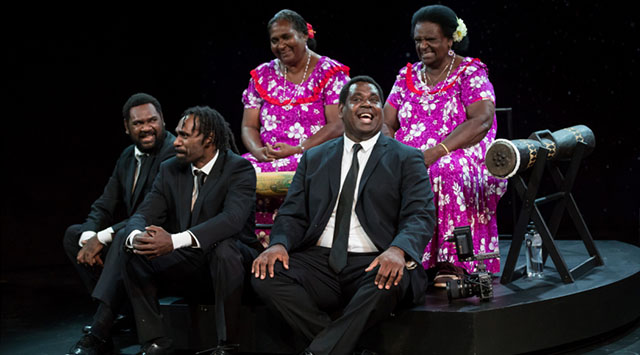
Jimi Bani hails from Mabuiag Island, in the near Western part of Torres Strait. His show My Name Is Jimi, is about culture and tradition, and the resolve to keep the uniqueness of his Wagadagam tribe alive and thriving in the modern age. True to form, the production features performers from his own family, across four generations, illustrating the essence and the importance of what is being relayed.

Small communities are always at risk of losing their identity. The young is seduced by external forces, through cultures of technology and consumption determined to establish a conformity, as required and dictated by Western capitalism. We see Jimi’s son Dimitri devouring the smartphone like any other youth, gradually losing touch with the real kinship that surrounds him.

Ambitiously directed by Jason Klarwein, the work is complex and detailed with its depictions. We learn not only what it is, that Jimi is keen to preserve, but also why and how these traditions have come to be of such value. Folklore and dance feature prominently, to inform and to entertain, but perhaps most importantly, as a demonstration of ancestral pride. There is exquisite humour in the piece, alongside its inherent warmth and poignancy.

Jimi Bani’s naturally commanding presence wins us over from the get-go, allowing us to empathise with his story effortlessly, even though his circumstances are admittedly far removed from many of our daily realities. Dimitri shares his father’s humour, delivering memorable moments of comedy. Agnes and Petharie are the senior women providing music, in ethereal, glamorous and dignified fashion. Conwell and Richard are Jimi’s brothers, appropriately sharing the weight of the show, as nimble sidekicks, particularly effective with their live camera work for filmic projections called upon to represent legends of the land. Especially noteworthy is Justin Harrison’s work as sound and projection designer, beautifully transcendent and crucial to the success of My Name Is Jimi.

Family can mean different things to people, but there is no denying the emotional hold it can have over each of us. Watching Jimi and his loved ones cultivate their extraordinary closeness, is reassuring, but also challenging to those who seek a radical independence in today’s climate of rationalism. It is now normal in many societies, to find definition for the self as an entity distinct from practices of the past, especially when one identifies weaknesses and problems associated with those customs. Jimi’s emphasis on language however, is noble and inspiring. Words contain so much, and they allow us to connect with histories when we choose to. Times will change, but forgetting the past, will only hamper any effort to progress. As we seek to become better, a link with earlier experiences is invaluable. Talking with those who had come before necessitates a bridge, and understanding cultures, especially one’s own, is often more rewarding than we can imagine.

www.queenslandtheatre.com.au | www.belvoir.com.au

Review: Barbara And The Camp Dogs (Belvoir St Theatre)

Venue: Belvoir St Theatre (Surry Hills NSW), Dec 2 – 23, 2017
Playwrights: Alana Valentine, Ursula Yovich
Director: Leticia Cáceres
Cast: Troy Brady, Elaine Crombie, Jessica Dunn, Michelle Vincent, Debbie Yap, Ursula Yovich
Image by Brett Boardman

Theatre review
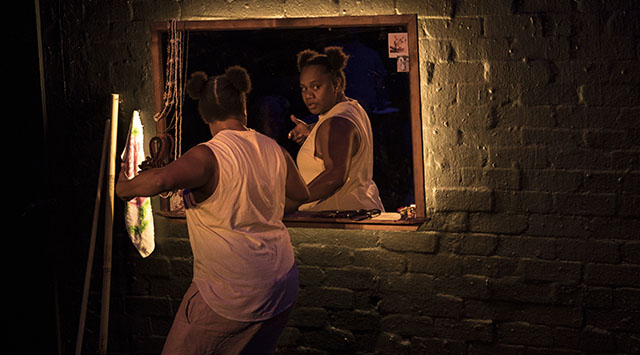
Barbara has a lot of fun in the city, singing at bars and events, being independent and vivacious. She is a mischievous character, and together with her cousin René, they paint the town red on the regular, determined to devour all that life has to offer, and to escape the troubling roots of their outback origins. Barbara And The Camp Dogs by Alana Valentine and Ursula Yovich, falls into categories of the musical and the epic journey, but it is a consistently surprising ride that defies all manner of expectations.

Barbara does well in life, but as an Aboriginal woman, the scars that she carries are deep, agonising and easier left ignored. When she finds herself having to return home to fulfil her filial obligations, all that she tries to deny, come flooding back to taunt her. The play expresses the nature of that immense suffering, with extraordinary acuity. Barbara and René sing, because so much of Indigenous experience is beyond our usual capacities of speech. In Barbara And The Camp Dogs, we are able to connect with the injustice and pain that have become entrenched in Black Australia. It divulges with power and wit, through its songs and storytelling, the darkest, most hidden of many Indigenous women’s lives.

It is impossible to overstate Jessica Dunn’s achievements as musical director. Barbara’s secret inner world turns intimately palpable, via influences of rock and soul, for a mode of communication sublime in its startling veracity. The songs move us as though a spiritual entity has taken hold. We are guided from scene to scene, with emotional intensity, precise and lush at every juncture.

Director Leticia Cáceres imbues the show with a warm glow, enchanting and irresistibly alluring. Everything about Barbara And The Camp Dogs is designed to have us fall in love with its characters and their narratives, and we endear to it all, readily and completely. There are occasional instances of abruptness in the transition of scenes, that can be slightly disorienting, but the raw aesthetic of the production is a forgiving one. Moreover, any blemishes would be easily shielded by the show’s incredibly charismatic stars.

The sensational voices and effervescent personalities of Ursula Yovich and Elaine Crombie win us over effortlessly, from the very beginning. The harmony forged between the two is a delight to our ears and to our hearts; what they present is wonderfully tender and exceptionally real. Yovich in particular, moves us in the most profound but unexpected ways. Telling us Barbara’s story of intolerable suffering, is not for a moment of catharsis, but a lasting gift of inspiration. We observe and learn, and promise to do better, to do more.

Barbara is not a social justice warrior. She is not a conscious activist, but she has to fight every day of her life, to defend herself against structural forces determined to keep her down. Australia’s shameful history of genocide, originating from the illegitimate claim of terra nullius in 1788, has reverberations that remain cruel and potent in the twenty-first century. A semblance of equality is not sufficient to heal these dreadfully severe wounds. Meaningful reparations will cost, but they must be made.

www.belvoir.com.au

Review: Atlantis (Belvoir St Theatre)

Venue: Belvoir St Theatre (Surry Hills NSW), Oct 28 – Nov 26, 2017
Playwright: Lally Katz
Director: Rosemary Myers
Cast: Paula Arundell, Lucia Mastrantone, Amber McMahon, Hazem Shammas, Matthew Whittet
Images by Daniel Boud

Theatre review
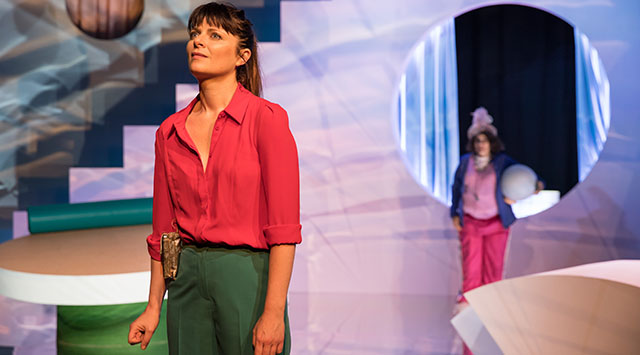
Lally Katz’s Atlantis is an autobiographical fantasy. It sprouts from the personal and authentic, then leads to something entirely imaginary. Lally, the protagonist, is consumed by anxiety, when at 35, she finds herself single and childless. We follow her on an odyssey that takes her from Sydney, to the USA’s east coast; an eventful, wacky journey that comprises a string of amusing characters and incidents. Lally goes through many discoveries, fuelled by a desperate search for love, or at least a husband and a baby.

It is not a quest that all will find persuasive. The deliberately silly scenes in Atlantis are certainly a lot of whimsical fun, but the central disquiet that motivates all the action seems too trivial, perhaps even narcissistic, to allow us to invest in a meaningful way. Through the plot, Lally comes in contact with more worthy concepts, of climate change, of poverty and of mortality, but they affect her only momentarily. We can all see that her problems diminish in significance as time passes, but nonetheless, Lally persists. She must find a man to fall pregnant with, or she simply cannot go on.

Amber McMahon plays a juvenile, although very likeable, version of the playwright. As though in a pantomime, McMahon’s exaggerated effervescence proves to be captivating, as she keeps us attentive through the highs and lows of Lally’s stories. The production is unquestionably humorous, directed by Rosemary Myers with a relentless sprightliness that offers entertainment and laughter, even when the narrative turns tiresome. Four other actors are called upon to perform a big roster of small roles, and they are all remarkable. The infinite versatility of the ensemble astounds us, with what they are able to achieve through sheer inventiveness. Also noteworthy are Damien Cooper’s lights and Jonathan Oxlade’s set, creating exciting images full of colour and movement, increasingly mesmerising as the show turns hopelessly hallucinatory.

Like in all our lives, the promise of a utopia propels the action in Atlantis. We need to believe in something, like that pot of gold at the end of a rainbow, in order that we can set ourselves in motion, so that we can fill time with meaning. Lally Katz does so much in the play, through all its scenes of mischievous adventure, but we see her being neglectful of each moment, keeping her mind focused instead on a puerile objective. When there is joy surrounding us, we must take notice and take pleasure in it. Better days will come, but understanding that they have a propensity to surprise us, and learning to see the signs that wish to evolve us, is how we can experience the magical unpredictability of this existence.

www.belvoir.com.au

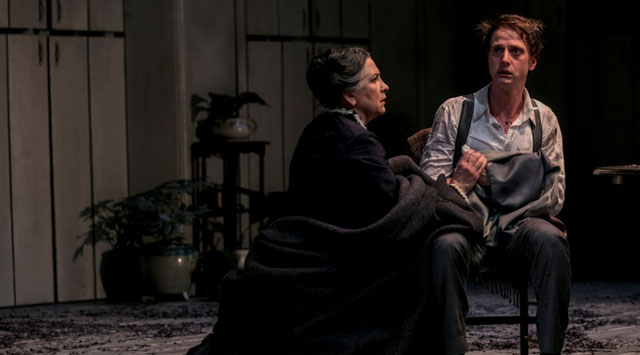
Review: Ghosts (Belvoir St Theatre)

Venue: Belvoir St Theatre (Surry Hills NSW), Sep 16 – Oct 22, 2017
Playwright: Henrik Ibsen (adapted by Eamon Flack)
Director: Eamon Flack
Cast: Tom Conroy, Taylor Ferguson, Robert Menzies, Colin Moody, Pamela Rabe
Image by Brett Boardman

Theatre review
It is late 19th century, and the widowed Mrs Alving is building an orphanage so that her dead husband’s money can be released from her conscience. She is still unable to find peace, even though her poisonous marriage is now over, after having suffered in silence for decades. Ibsen’s Ghosts is about the incontrovertible links between past and present. It looks at how we are controlled by beliefs, events and decisions of days gone by, and the unconscious ways in which we keep ourselves and one another bound to societal rules and conventions.

Mrs Alving understands that a better life is possible, yet she persists with misery. Director Eamon Flack prompts us to question the nature of our protagonist’s volition, whilst simultaneously placing emphasis on external forces that insist on her compliance. From all our personal experiences, we know the tension that lies inevitably between others and the will of the self. The concept of a self-determined existence is an attractive one, even though none of us can lay claim to have fashioned an entirely independent state of being.

Ghosts is an inherently challenging work, and with the passage of time, its narrative has turned predictably archaic, leaving only its central philosophies to speak with pertinence. Tradition and religion no longer hold the same power, so the Alving family’s story is in many ways only a relic, but Flack’s ability to turn the essence of Ibsen’s writing into a resonating force for his show, is certainly admirable.

Pamela Rabe’s performance as Mrs Alving has an understated charm, that shifts the play’s old melodramatic quality to something that is altogether more elegant and naturalistic. It is quite extraordinary, the way Rabe sublimates obsolete details into her very convincing storytelling. All the actors are worth their salt, successful in bringing invigoration and surprising nuance, to some very dry material. Equally remarkable are Nick Schlieper’s lights, especially noteworthy in the final act, when imagery turns breathlessly sublime, and we see baroque paintings come to life.

Artists need knowledge of the past, in order that they may forge new ground, but like characters in Ghosts, their work is constantly under threat of being undermined by the reverence we so often attribute to the historical. The continual resurrection of dead white males like Ibsen can be considered necessary, but it can also be thought symptomatic of problems that the Australian artistic landscape faces. Our art means little if it hinges so strongly on traditions of olden Europe. The Alving patriarch might be dead and buried, but those he had left behind are doomed to perpetuate his agony. We want them to renounce those burdens and henceforth, prosper with the current of their own autonomy, but it seems easier said that done.

www.belvoir.com.au