Review: Undertaking (Sydney Fringe Festival)

Venue: HPG Festival Hub (Erskineville NSW), Sep 6 – 30, 2017
Playwrights: Duncan Maurice, Sharon Zeeman
Director: Duncan Maurice
Cast: Rizcel Gagawanan, Jasper Garner Gore, Moreblessing Maturure, Benjamin Wang, Sharon Zeeman

Theatre review
In a very large disused office, an audience gathers to solve the mystery of 11 murders. There are clues littered everywhere, and we roam around using mobile phones as torches, with suspicious characters in our midst who may or may not be part of the show that we have come to see. Over the course of an hour, drama unfolds, with the cast revealing itself, in their highly unorthodox presentation of a contrastingly conventional serial killer story.

Duncan Maurice and Sharon Zeeman’s Undertaking works with the enveloping of space around bodies, which is the essential nature of the theatrical art form. Strangers congregate, awaiting time and space to transform in the hands of collaborating artists, who have constructed a plan, to orchestrate a process of communication above the mundane. In Maurice and Zeeman’s vision, passivity is the ruin of both art and life. To be a participant of their staging, our spectatorship extends beyond the mind. A kinetic response is required of us, but how much we are willing to give, always remains a personal choice.

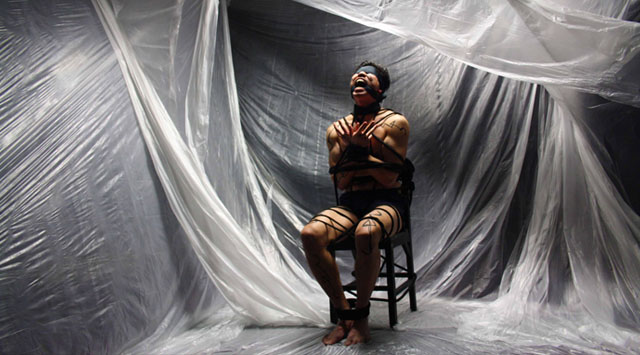
The journey fluctuates between moments of bustling activity, and creepy stillness. Some of us are compelled to make things happen, while others are content to wait for the next bout of drama. The wandering group consists of personalities who engage ardently in the investigative process, as well as those who observe quietly; we choose our own adventure. The show is most effective when actors are in close proximity, but the space is large and we are too often left to our own devices. Musical director David Herrero creates an omnipresent soundscape that assists in keeping us involved, especially potent when tensions escalate in the closing minutes. Actor Benjamin Wang is memorable for his terrifying depiction of a man on the brink of death.

Undertaking is a spirited work that takes seriously, its artistic responsibility to inspire its viewer. It is democratic and political, and even if the immediate narrative in the “whodunnit” genre can seem perfunctory, the experience is unforgettable. Whenever the making of art falls into repetitive predictability, we must call for a new challenge. Immersive theatre is just the way to tackle the tedious obedience, that has today become so pervasive.
www.mongrelmouth.com

Review: Moth (Millstone Productions)

Venue: ATYP (Walsh Bay NSW), Sep 6 – 16, 2017
Playwright: Declan Greene
Director: Rachel Chant
Cast: Jeremi Campese, Ruby O’Kelly
Image by Rupert Reid

Theatre review
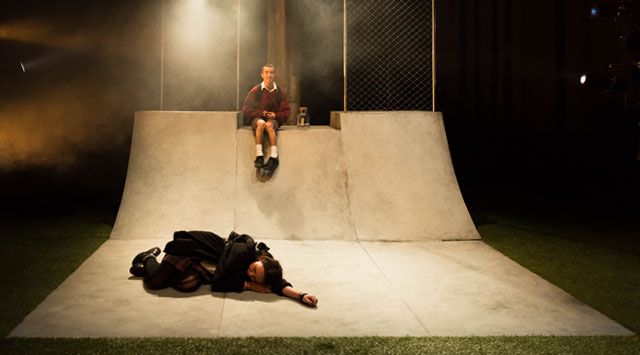
Sebastian has been coughing up blood. He is being bullied at school, and we observe that at home, things are not faring much better. Computer games and a close friend Claryssa, however, keep his spirits up. Declan Greene’s two-hander Moth, features a pair of teenage outsiders trying to figure things out in a hostile environment, with little more than each other for support. The work begins with familiar scenes of schoolyard mischief, but becomes increasingly surreal, along with the escalation of Sebastian’s mental illness.

The play gives expression to dark sides of today’s youth with an impressive honesty, but leaves us to manage an understanding of how this has come to be, and how we are able to find improvements and solutions for the ones we are wholly responsible for. Greene’s sharp focus on the phenomena of youth disenfranchisement within our communities, is edgy and unquestionably disturbing, but also tremendously intriguing, and in parts very entertaining indeed. Moth‘s reluctance to explain itself makes us work harder, and hence, fall deeper into the theatrical quandary that it presents.

Director Rachel Chant does spectacularly in having us experience both the mesmeric and repulsive qualities of Claryssa and Sebastian’s story. The show is urgently energetic, and even though it struggles to retain coherence when the plot turns resolutely obtuse, our attention is always pulled back into its tumultuously evolving narrative, by Chant’s extraordinary flair for manufacturing poignancy. Remarkably well designed, the production’s visuals and sounds are a real pleasure. Todd Fuller’s animated projections and Alexander Berlage’s lights add rich and exciting dimensions to the staging, while Chrysoulla Markoulli’s music and Tom Hogan’s sound design impact upon our consciousness with circumspect precision.

Actors Jeremi Campese and Ruby O’Kelly are flawless in the piece. Campese’s potent charisma proves irresistible, and instrumental in how we regard Sebastian’s very upsetting downward spiral. He is a captivating presence, with the uncanny ability to take us through fluctuating spells of drama and comedy seamlessly, sometimes simultaneously. O’Kelly is meticulous in her exacting depiction of Claryssa, with intelligently construed gestures and utterances, offering us a beautifully nuanced study of the troubled teen. These kids worry us. We understand their dependence, and we can see in their eyes, the most accurate image of the world that we become.

www.millstoneproductions.com

Review: What I’ll Never Say (Sydney Fringe Festival)

Venue: Erskineville Town Hall (Erskineville NSW), Sep 6 – 9, 2017
Playwright: Stuart Englund
Director: Dan Graham
Cast: Stuart Englund

Theatre review
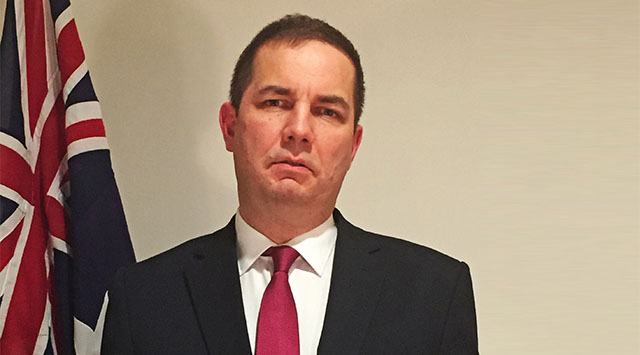
We often think of politicians as liars. We wish for them to be persons of extraordinary integrity, but believe them to be quite the opposite. Stuart Englund’s What I’ll Never Say is a monologue featuring a Member of Parliament talking, unsurprisingly, about himself. The piece is not particularly revelatory, containing nothing controversial, but its depiction of a man trying to shed a persona, in order that we may get to a sense of truth, is refreshing. Plot and pace are calibrated well for the piece, and we find ourselves able to remain attentive even when the anecdotes lose lustre.

Performed by Englund himself, who is not an actor by any stretch of the imagination, we struggle to glean every detail of the narrative. His presence is relentlessly droll, but a sincerity allows broad strokes to be painted, that give us adequate information and impressions of the personality being portrayed. Englund reads the entire show from sheets of paper on a rostrum, so even though we hear every word clearly, meanings are not always communicated with palpability. If a piece is written for the stage, an appropriate skill set is required to have it come to life, and on this occasion, the right person has not been elected for the job.

The things we read on the news are often stranger than fiction. Our political figures are larger than life, and the tales spun around these personalities can seem nothing short of fantastical. What I’ll Never Say is restrained, almost subdued by comparison, but it feels truthful in what it has to say about our leaders. It is in our culture as Australians to be anti-authority, and in its efforts to humanise the protagonist, we are encouraged to see the ordinariness of those who hold office. It is the intention of the work that individuals will be inspired to embrace politics, and have an increased awareness of insidious power structures that surround us. There can never be enough good people working in the public service, if only to undo the damage caused by the unscrupulous.

www.facebook.com/WhatIllNeverSay

Review: DNA (Last One Standing Theatre Company)

Venue: Erskineville Town Hall (Erskineville NSW), Sep 5 – 9, 2017
Playwright: Dennis Kelly
Director: Jeremy Lindsay Taylor
Cast: Holly Fraser, James Fraser, Alfie Gledhill, Jesse Hyde, Jess-Belle Keogh, Alex Malone, Josh McElroy, Bardiya McKinnon, Xanthe Paige, Millie Samuels, Emm Wiseman

Theatre review
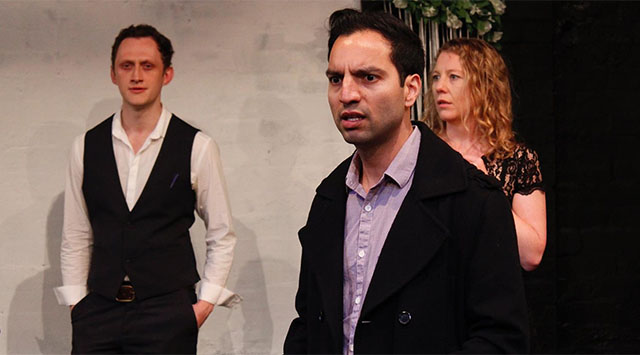
It is a terrible existence that the teenagers in DNA endure, but none are truly aware of the repugnance that is thrust upon them. Injustice and suffering is completely normalised. Life simply is often unbearable; they see it all around, people finding ways to put up with a world that is never good enough. Dennis Kelly’s play talks about the cycle of poverty and disadvantage, and an idea akin to fate that makes people settle for very little, in places like England where much has been taken from the lower classes.

One of the group has died in an accident, and the rest scurry and scheme to evade blame. They make no effort to retrieve the body, and are certainly unwilling to provide authorities with any assistance. Kelly puts on show a sickening reality, that when viewed from a position of our bourgeois objectivity, is painfully reprehensible. It confronts aggressively, our sense of social responsibility as developed nations who should know better, but who are culpable in the woeful damage caused by the persistent continuance of inequities, reinforced by the ever-increasing gap between the haves and the have-nots.

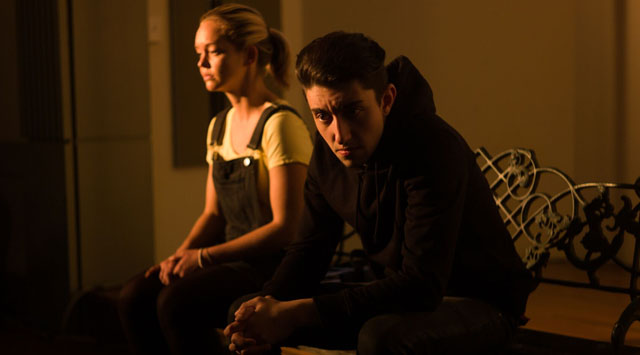
The production appeals strongly to our capacity for curiosity. Director Jeremy Lindsay Taylor keeps us questioning the motives and behaviour of his characters, by enacting an inner logic for DNA that always feels alien, in spite of its dramatic cogency. We understand the story, but we cannot believe how things have got to this point. It is a marvellous cast of eleven young stars who draw us in, with excellent conviction and discipline, having us convinced of the bizarre cruelty that occurs in our midst. Their work is revelatory, powerful in their unflinching dedication to the text’s inherent darkness.

It is not an entirely pessimistic exercise. We witness an urge to break these patterns of despondency in Leah (poignantly performed by Millie Samuels), who resists conventions of ignorance and resignation. While others continue with narratives of captivity, her impulse is to escape. It may be the only sensible thing to do, but it is also the exception, and a serious conundrum that requires our rumination.

www.lastonestandingtheatreco.com

Review: The Gulf (Lume Productions)

Venue: 57 Denison St (Camperdown NSW), Aug 23 – Sep 5, 2017
Playwright: Audrey Cefaly
Director: Mia Lethbridge
Cast: Brenna Harding, Diana Popovska
Image by Lucy Deverall

Theatre review
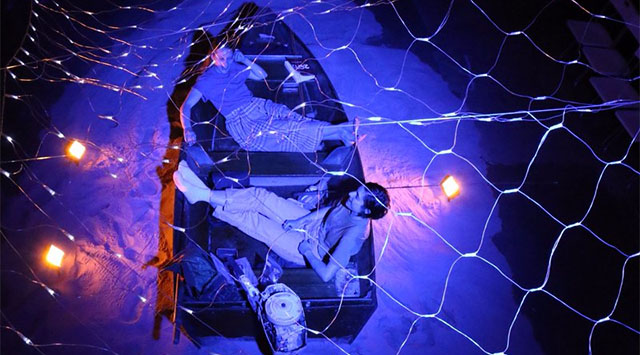
All Kendra wants to do is to go fishing, and what Betty likes best is to read, but they spend the entire day together on a boat, determined to intensify the bond between, hoping that the enactment of a romantic relationship could make their worlds feel somehow whole. Honesty and romance are not natural bedfellows, and in Audrey Cefaly’s very vulnerable The Gulf, it is revealed that to have two become one, is its own literal impossibility.

The lovers have true admiration for each other, but a strong attraction demands that they engage in a process of transformation, of the self and of the other, that renders that connection perpetually unstable. We cannot leave alone, the objects of our affection, and are compelled to interfere with, or perhaps destroy, all that we love. The act of identification, to realise the allure of someone, seems a gravitational force, that causes one to be subservient to an appetite for intrusion, and when that impulse is mutual, the tumult must only be vast.

Director Mia Lethbridge manifests a quiet but powerfully nuanced staging of the sensitive text. Its characters are not allowed to be privy to their own lapses, as in real life, those in love, can only see the good of their intentions. In the safety of each other’s company, Betty and Kendra are keen to demonstrate the sincerity of their maneuvers, but what Lethbridge allows us to see, are dimensions of inadvertent egotism and futility. Under the constant movement of Liam O’Keefe’s mesmerising lights, the women vacillate in our estimation, but it is ultimately ourselves that are always being judged.

The actors are committed to having the theatrical action contained and introspective. It is a risk to withdraw energy from their audience, but both are charismatic women, with meticulous approaches that project an uncompromising seductive power. Brenna Harding is emotionally and psychologically articulate as Betty. Her desires are clear, and her story is unambiguous and accessible. The broody Kendra is played by Diana Popovska, whose appeal is less immediate, but who becomes an increasingly intriguing personality over the duration. It is a highly accomplished presentation from the pair, and even though libidinous aspects of the relationship are not always successfully manufactured, The Gulf is a rich and rewarding piece in their hands.

Affairs of the heart, are not best understood by the mind. When we investigate deep enough, what was once sweet and delightful, quickly turns cynical. Audrey Cefaly’s play is both light and dark; it finds an understanding of human fallibility through a meditation on romance. Some of us can reconcile the two, while others will choose to see things as they are, and be resistant of such passions. However one regards this kind of love, it exists, and it will be, forever more.

www.facebook.com/LUMEprods

Review: Idiot Juice (Jackrabbit Theatre)

Venue: The Factory Theatre (Marrickville NSW), Aug 29 – Sep 2, 2017
Playwright: Charlie Falkner
Cast: Charlie Falkner, Alex Malone, James Sweeny
Image by Luke McMahon

Theatre review
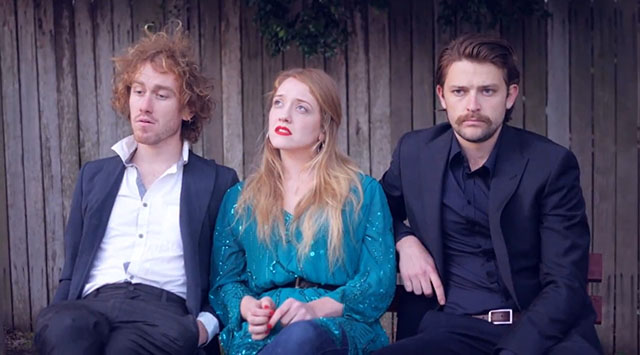
Charlie Falkner’s creation provides a simple structure for Idiot Juice, with three siblings hawking “medium juice” at a funeral, claiming that it provides visions of the dead for an hour, with each dose consumed. Within this context, performers improvise jokes in accordance with its predetermined plot trajectory. With death positioned at the centre of the action, we find ourselves on fertile ground for dark comedy, and opportunities are certainly present for poignant existential reflection, but the trio keeps things resolutely light.

Each comedian brings to the stage a distinct style of humour, with James Sweeny’s brassy approach proving invaluable in holding our attention captive. Alex Malone’s whimsy prevents the show from turning predictable, and Falkner’s self-effacing impulses are key to his charm. It is a cohesive group, and when the chemistry works, their show vibrates with a sense of unmistakable excitement, but an inability to maintain a consistently tight rhythm at several points, exposes unfortunate deficiencies in dexterity and confidence.

To be able to laugh at death, requires that we interrogate and excavate the deepest of our humanity. It forces us to examine how we apportion value, to identify the things that matter in life, or more accurately, to question those that reveal only frivolity. Idiot Juice is about gullibility, and how we are easily fooled into adopting ideals that are nothing more than myth or romance. As the saying goes, only death and taxes are certain in life, so everything else must only be a manifestation of the subjective imagination, and what we become, has a lot to do with choices.

www.jackrabbittheatre.com

Review: American Beauty Shop (Some Company)

Venue: Kings Cross Theatre (Kings Cross NSW), Aug 25 – Sep 16, 2017
Playwright: Dana Lynn Formby
Director: Anna McGrath
Cast: Charmaine Bingwa, Caitlin Burley, Amanda Stephens Lee, Jill McKay, Janine Watson
Image by Clare Hawley

Theatre review
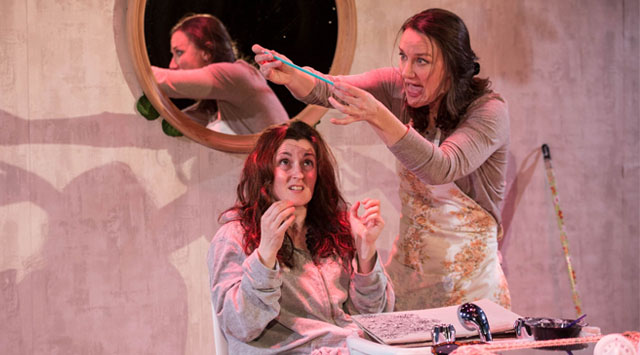
The times might be a-changin’, but the American Dream goes on strong. Sue is a hairdresser who runs a small business in the town of Cortez in Colorado, and although she lives hand to mouth, her dreams of escaping poverty never fade. Dana Lynn Formby’s American Beauty Shop is about an underclass of the USA, that believes in hard work as deliverance. They may or may not understand the systematic oppression that they suffer under, but they focus only on labour and enterprise, without any attention placed on political action. Sue accepts her place in society, and plays by the rules, thinking that a commitment to drudgery is her only way out.

Amanda Stephens Lee is an affable presence as Sue. We understand her struggles, and wish the best for her, but let down by lacklustre direction, the women’s stories in American Beauty Shop fail to move us. The production feels under-rehearsed, and although most of the cast is able to demonstrate a good grasp of their individual roles, we are kept waiting for sparks that never fly. The stakes are high for the characters, but dramatic tension is sorely missing from this stage. Conflict and altercations are rarely convincing, as though we sense that all will be good in the end. It is a false sense of security, and the desperation of the Cortez poor, remains an abstract, and distant, concept.

The system is broken, but it was always designed to fail the vast majority. It is an illusion that all who have wealth are deserving of it, implying that those without, are wholly responsible for their own misfortune. The women in American Beauty Shop have ambition and the appropriate fortitude to push for better days, but the cards are stacked firmly against them. They know only to participate in a game that gives them miserably poor odds, and as we watch their fates unfold, it is the lack of fairness in our increasingly capitalist worlds that must leave an impression.

www.facebook.com/somecompanyproductions

Review: Rossum’s Universal Robots (What Fresh Hell Theatre)

Venue: PACT Centre for Emerging Artists (Erskineville NSW), Aug 30 – Sep 2, 2017
Playwright: Karel Čapek
Director: Ariella Stoian
Cast: Peter David Allison, Abigail Honey, Francisco Lopez, Misha Mehigan, Michael Mulvenna, Blake O’Brien, Ciaran O’Riordan, Alex Radovan, Meg Shooter, Emily Trueman,

Theatre review
The play is almost a hundred years old, but the action is set in a distant future. Karel Čapek’s Rossum’s Universal Robots was a work of science fiction from 1920, credited to have introduced the word “robot”to the English language. It is that old chestnut about us versus technology, a narrative that relies on our often irrational fear about the human race being destroyed by artificial intelligence. Innovative a century ago, Čapek’s writing is now dreadfully naive, with outmoded arguments that fail to present as legitimate concerns.

The production is earnest, but more than a little rough around the edges. Its drama never manages to engage, and we never know if its comedy is intentional. Performance styles are incongruent, with each actor doing the best to their individual ability, resulting in a confused composite that amounts to a fair bit of tedium.

In a world that continues to struggle with overpopulation, anxiety about human babies no longer being born in Rossum’s Universal Robots is laughable. It does however, draw attention to our narcissism, and our arrogant attitude and belief that we rule this earth. We think that we own everything, that we are a sort of master race that has the unassailable right to occupation and sovereignty. Čapek imagined catastrophes of his future, but he never foresaw the simple idea, that it is not technology that will eventually bring us to our knees, but nature itself, who will prove to be bigger than us, while we languish in feign surprise, of its might and authority.

www.facebook.com/WhatFreshHellTheatre

Review: An Alternative Fact (Woolf Ensemble)

Venue: 107 Projects (Redfern NSW), Aug 29, 2017
Playwrights: Sam Anderson, David Margulies, Lucy Prebble, John Patrick Shanley, Frederik Stroppel, Liam Williams, John J Wooten
Directors: Meg Alexandra, Christine Greenough, Georgina Holt, Valentin Lang, Lauren Lloyd-Williams, Izzy Stevens
Cast: Sam Anderson, Megan Bennets, Isabel Dickson, Karli Evans, Thomas Filer, Christine Greenough, Haydan Hawkins, Lara Lightfoot, Amanda Marsden, Jamie Meyer-Williams, Claire Oehme, Jessica Saras, Johann Silva
Image by Clare Hawley

Theatre review
Seven short pieces, including one-act plays and select scenes from longer works, are presented in a series named An Alternative Fact. Featuring white lies, half lies, and complete falsifications, the production is a simple one, barely disguising its singular intention of providing a showcase for actors. The stories are not always well told, but we can certainly see all the work that is put into acting. David Mamet once wrote audaciously, that theatre requires only actors and no directors, but in An Alternative Fact, it is clear that for an audience to be involved in ideas, we need to be provided something that is over-and-above the witnessing of actors in labour over their craft.

Much of the production is raw, feeling almost impromptu in its approach, but there is no shortage of conviction on this stage. The players try to convince us, of their skill and talent, and of the material they have taken responsibility for. Truth is the nature of this beast, not just with its thematic concern, but as an exercise that draws attention so closely to the art of acting, we watch to see if each of the cast is able to be impervious, with that integral quality of honesty in their portrayals.

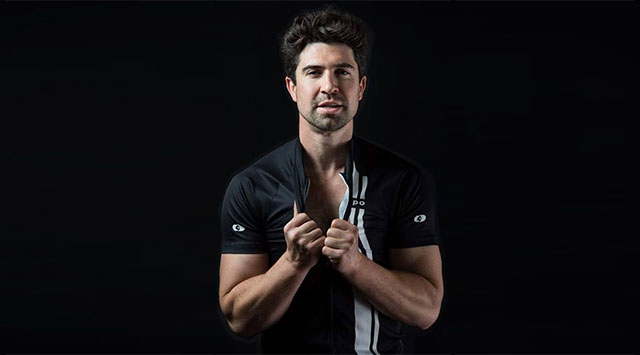
As Tristan in Lucy Prebble’s The Effect, Thomas Filer is a rigorous, persuasive presence. Simultaneously theatrical and natural, it is a captivating performance that allows us to perceive the levels of reality that could be manufactured for an audience. Most memorable of the night however, is Sam Anderson in an extract of his own one man show, Bi-Cycle. Polished yet intuitive, and thoroughly nuanced, it is the only segment that has us invest in its narrative. The piece is playful but earnest, finely calibrated to utilise Anderson’s charisma, to win us over.

It is all make believe, but theatre means little without authenticity. There is no guaranteed avenue to achieving that all-important resonance with an audience on every venture, but time will aid that process. Art is about experimentation, repetition and refinement. Artists need to hone their craft, and those who work on the stage, will have to go through the experience of a spectacular failure in full public view, every once in a while. Those who can bear it, will return for more, and those unable to endure that lack of security, will move on to pursuits that offer greater certainty, in fields less artistic.

www.facebook.com/woolfensemble

Review: The Father (Sydney Theatre Company)

Venue: Wharf 1 Sydney Theatre Company (Walsh Bay NSW), Aug 19 – Oct 21, 2017
Playwright: Florian Zeller (translated by Christopher Hampton)
Director: Damien Ryan
Cast: Faustina Agolley, John Bell, Marco Chiappi, Glenn Hazeldine, Anita Hegh, Natasha Herbert
Image by Philip Erbacher

Theatre review
André is getting on in years. He remains in good physical condition, but his mind is failing. The protagonist’s disintegrating memory in Florian Zeller’s The Father brings us through a narrative that vacillates in its reliability. We are constantly disoriented, like its subject, confused by the incoherence of people, place and time. Without any dependable means to decipher and interact with the world, André struggles to maintain a cogent sense of self; if the external cannot be appropriately explained, so too will the internal begin to lose meaning.

Zeller’s depiction of that mental decline, in its theatrical form, offers a valuable opportunity for the condition to be better understood. What could only be an abstract concept, that hitherto relied only on our emphatic imagination, becomes a much more powerful appreciation of an unfortunate state of being. Damien Ryan’s direction makes us feel as though we experience it firsthand. The 90-minute play however, has little new to say besides. After early scenes of quite thrilling revelations, things get old quickly. The show dissolves into predictability and repetitiveness, and when we arrive at what should be an emotional zenith, a surprising placidity is encountered instead.

The roles are performed well, each one lucid and believable. John Bell’s star quality keeps us firmly engaged with André’s plight. It is a robust portrayal, with an emphasis on the character’s dignity at a time of hardship, although a greater sense of vulnerability would make for more poignant drama. Daughter Anne, is played with an admirable realism by Anita Hegh, but the writing seems to restrict the actor to a slightly monotonous interpretation of her role. In the absence of a congruous timeline, characters are prevented from developing very dynamically. They appear in fragments, and the players are accordingly concise.

The production is simple and elegant, with Alicia Clements’ set design placing us confidently, in an upper class existence, where carers and nursing homes are matters of remorse rather than cost. André and Anne have the financial means to ease the pain of fading health, so we are protected from real catastrophe in The Father. Age and death however, will come to all, and as we watch a good man deteriorate, it should only be with resignation and acquiescence that we regard the closing scene, yet we resist, instinctively rejecting the truth of our mortality.

www.sydneytheatre.com.au