Review: Sweet Charity (Luckiest Productions / Neil Gooding Productions)

rsz_sc_0005_bps4219Venue: Hayes Theatre Co (Potts Point NSW), Feb 7 – Mar 9, 2014
Book: Neil Simon
Music: Cy Coleman
Lyrics: Dorothy Fields
Director: Dean Bryant
Choreography: Andrew Hallsworth
Musical Direction: Andrew Worboys
Actors: Verity Hunt-Ballard, Martin Crewes, Debora Krizak, Lisa Sontag

Theatre review
Bob Fosse directed and choreographed the iconic Sweet Charity, on stage and on film, in the late 1960s. The dance sequences are some of the most striking moving images ever seen, so one of the main challenges in staging the work today would be the treatment given to the re-creation of those scenes.

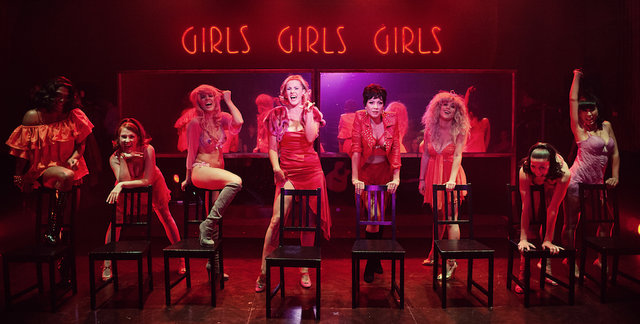
The current production at Hayes Theatre Co, helmed by director Dean Bryant and choreographer Andrew Hallsworth straddles between faithfulness and innovation. There is an acknowledgment that times and audiences have changed, but also an awareness that the immortal is a hard act to follow. Bryant’s adaptation uses the theatre’s spacial limitations to his advantage, and turns the work into an intimate and emotionally rich experience. There is a sense of things being scaled down, but for the most part, he achieves a good intensity on stage that results from the distillation of something conceptually grander. Hallsworth’s thankless task of re-interpreting Fosse’s choreography is surprisingly effective, even if the numbers “Hey Big Spender” and “Rich Man’s Frug” do leave us pining desperately for the film.

Visual elements are especially noteworthy. Ross Graham’s lighting is varied, dynamic and sensually appealing, providing the minimal set an aura of tragic beauty. It also gives logic to time and place, making the innumerable scene transitions happen flawlessly. Tim Chappel’s costumes and Ben Moir’s wigs are thoughtful and impactful without being overwhelming. They tell the story of the characters even before they begin to speak.

Martin Crewes plays a trio of Charity’s men, and delights with every role. The energy he brings to the stage is staggering, and he possesses a headstrong determination that is seductive and commanding. Crewes impresses with his powerful and creative song interpretations, and is responsible for both the funniest and saddest moments of the show in his role of Oscar. Debora Krizak shines as Nickie, one of the more jaded dance hall hostesses, and is easily the raunchiest and most colourful of characters. Krizak’s ability to portray earthiness and pathos is a real highlight. Verity Hunt-Ballard is the star of the show, with a vocal talent that makes Charity’s songs more meaningful than ever. The comic elements of the role are difficult (it’s not the funniest of scripts), but Hunt-Ballard is deeply moving at every tragic turn.

Sweet Charity can be thought of as pre-feminist. It constantly defines its women in terms of their relationships with men, and depicts their work in the adult industry as unquestionably pessimistic. All efforts are made for them to appear vivacious and intelligent, but their desires are left unexamined and unevolved. Unlike Fosse’s film, this production does not leave you with thoughts of glitz, glamour and glossy dance routines. Instead, it makes you ponder the big questions in our lives… and the meaning of love.
www.hayestheatre.com.au


www.facebook.com/luckiestproductions


www.goodingproductions.com

Review: Thank You For Being A Friend (Matthew Management / Neil Gooding Productions)

goldengirlsVenue: Seymour Centre (Chippendale NSW), Feb 13 – 28, 2014
Playwrights: Thomas Duncan-Watt, Jonathan Worsley
Directors: Neil Gooding, Luke Joslin
Performers: Julia Billington, Chrystal de Grussa, Donna Lee, Darren Mapes, Nigel Turner-Carroll

Theatre review
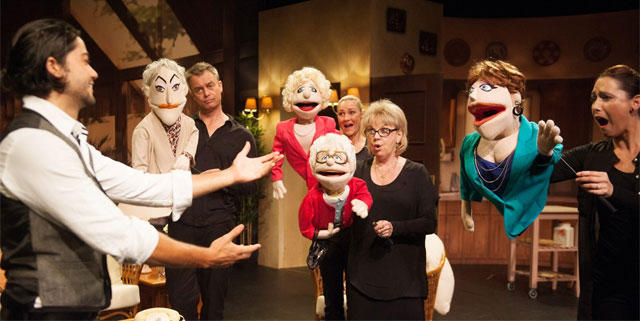
The Golden Girls was a big TV hit series in the 1980s, and has left an indelible mark on audiences everywhere. Many of us remember catchphrases, character traits, relationship dynamics, and plot structures. Indeed it is nostalgia that gives this revival in puppetry form its appeal. There are minor references to contemporary culture (like a “cell phone”, Fifty Shades Of Grey and Kim Kardashian), but effort was put into a show and script that is absolutely faithful to the original. The set is a delightful re-creation. We even get ad breaks that feature commercials from the era, of defunct fashion labels and forgotten brands.

All four puppeteers have a thorough understanding of the roles they assume. The mannerisms and voices they replicate are funny and thoroughly delightful. Donna Lee’s depiction of Sophia is endearing and, like on the TV show, delivers the biggest punchlines. Darren Mapes facial expressions are so reminiscent of Beatrice Arthur’s Dorothy, one probably looks at him more than his puppet. Julia Billington never fails to get a laugh whenever she brings up St. Olaf as Rose, and Chrystal de Grussa’s Blanche is a hilariously overblown version of Blanche Devereaux, whose “man-eater” antics remain uproariously ridiculous. Also noteworthy is Nigel Turner-Carroll, the fifth member of the cast who tackles a host of male support characters with aplomb and great humour.

The production is part of the 2014 Sydney Gay & Lesbian Mardi Gras program, not only because of Blanche’s gay son’s appearance, but also because of our memories of the original series’ efforts at discussing issues such as coming out, same-sex marriage, AIDS and discrimination against people with HIV. This loving tribute has rekindled a strangely deep relationship between audience and those golden girls. These ladies are fictional, but they are also dear friends.

www.thankyouforbeingafriend.com.au

Review: Falsettos (Darlinghurst Theatre Company)

falsettos1Venue: Eternity Playhouse (Darlinghurst NSW), Feb 7 – Mar 16, 2014
Book by William Finn, James Lapine
Music and lyrics: William Finn
Director: Stephen Colyer
Co-musical directors: Nigel Ubrihien, Chris King
Actors: Stephen Anderson, Margi de Ferranti, Ben Hall, Tamlyn Henderson, Elise McCann, Katrina Retallick, Isaac Shaw
Image by Helen White

Theatre review
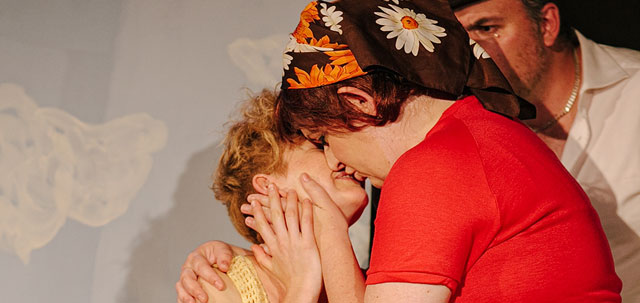
Falsettos is a musical that has everything. More than that, Darlinghurst Theatre’s latest production achieves excellence on many different levels, and provides a theatrical experience that exceeds many shows in Sydney of much grander scales (with far heftier price tags). This is a modest and intimate interpretation of an off-Broadway musical that first took form in 1981, but it surprises with the emotional punch it delivers, and the incredibly impressive standard of choreography, direction and performance.

When an actor is allowed to showcase the clichéd triple-threat in demanding roles, results can be breathtaking, and in the case of lead man Tamlyn Henderson, it is definitely so. Henderson’s performance is skilful and complex. He draws laughter and tears, all the while being Mr Showbiz, all booming singing voice and nifty footwork, but simultaneously completely believable and tender in his characterisation. Henderson is in a word, fantastic.

Katrina Retallick brings an extraordinary warmth to her Trina, and performs the single most memorable number of the night, based entirely on a step aerobics routine. Young actor Isaac Shaw steals hearts in the role of the irresistibly cute Jason, displaying talent and ability that matches up confidently to his adult counterparts.

In spite of his ugly wig and spectacles, Stephen Anderson’s natural charisma is clearly evident. His comic ability is well utilised in the show, and his singing voice is delightfully versatile and reliably resonant. Ben Hall provides the story’s eye candy, and certainly lives up to that challenge. Thankfully, Hall imbues his role with a healthy sense of humour, and is a strong enough singer to hold his own (but does suffer a little from the lack of microphones). It must be noted that Nigel Ubrihien’s solo piano accompaniment is outstanding, and does what a full orchestra sometimes fails to do. The feel and accuracy he contributes to the sonic landscape of the production is absolutely crucial and perfectly executed.

Visual design elements are effective but understated. Ingenuity is shown in the use of seven coffin-like structures that are incorporated elegantly into stage design and choreography, but could probably benefit from a little sprucing up. Our eyes focus on characters, while set, props, costumes and lighting take a back seat in this musical.

Director Stephen Colyer’s extensive background in dance shines through brilliantly. His use of movement and the physical form is intricate, deeply considered, and beautiful. The lines between choreography and direction are entirely blurred. Characters never dance for the sake of dancing alone. Every move is for character development and storytelling. Colyer obviously knows all there is to know about entertainment and show pacing, but he is also careful to handle the material with sensitivity and spirituality, which in turn produces a good level of depth that accompanies the sentimentalities that pervade the writing. The show he has created is artistically inventive and technically accomplished. It is also highly entertaining, thought provoking and full of humanity. This is the musical format thoroughly evolved.

www.darlinghursttheatre.com

Review: Pinball (Duck Duck Goose Theatre Company)

pinball1Venue: TAP Gallery (Darlinghurst NSW), Feb 11 – 28, 2014
Playwright: Alison Lyssa
Director: Sarah Vickery
Actors: Ali Aitken, John Michael Burdon, Leo Domingan, Emma Louise, Faran Martin, Karoline O’Sullivan

Theatre review
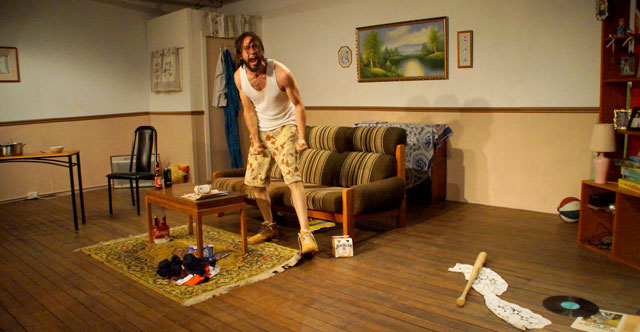
Pinball first appeared in 1980/81, providing an early voice for the plight of lesbian mothers, who had faced oppressive heteronormative forces in their fight for rights to custody of their children. Alison Lyssa’s words are powerful and devastating. With the passage of time, her feminist point of view as expressed in the play may resonate differently from original intentions, but her depiction of misogyny and homophobia in Western and Christian societal structures remains accurate, scathing and raw.

Sarah Vickery’s direction, like the pinball, brings colour, movement, bells and whistles to the work, effectively preventing the play from lingering too much in dark and dour territory. There is however an unevenness and disunity in acting styles, which results in confusion with storylines, and performers detracting from each other’s work. Karoline O’Sullivan plays melodrama well and excels with a sense of fragility and earnestness, but without the appropriate support from the rest of the production, her performance seems off-kilter. John Michael Burdon works extremely hard in all of his five roles, and is delightful in scenes that require his assertive flamboyance, but less effective when restraint is needed.

Pinball machines are frustrating. They deny your will and go where they wish, despite all your attempts at imposing control over their journeys. This is also true of revolutionary politics and art. Feminism and queer politics seek to destabilise and correct the failings of our status quo, and theatre has the responsibility to challenge and advance conventions when things become too cosy and predictable. Sometimes it’s just not about you liking it.

www.facebook.com/ddgtheatre

Review: We’re Bastards (Two Peas)

bastards1Venue: Old 505 Theatre (Surry Hills NSW), Feb 6 – 23, 2014
Playwright: Oleg Pupovac
Director: Glen Hamilton
Actors: Tara Clark, Oleg Pupovac
Image by Anna Chase

Theatre review
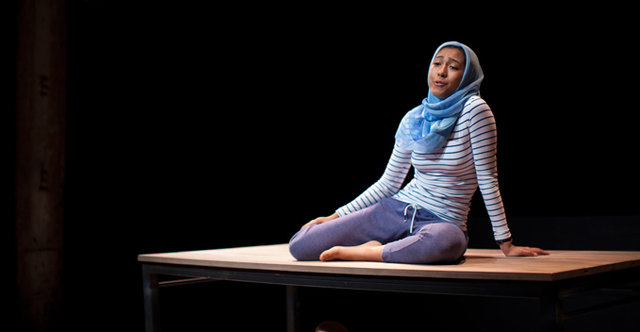
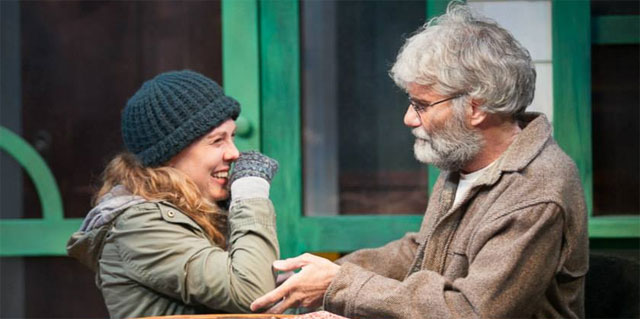
We’re Bastards is a play that doesn’t go anywhere, about people who don’t go anywhere. Everything seems congested, but within the stagnation, an abundance of characterisation is explored in its main characters. Darling and Joe are siblings living in the disenfranchised lower classes of the United States of America. Their concerns are a world away from our middle class Australian theatre audiences, but they are a pair of oddities that instantly spark our interest. It is a bit of a freak show that unfolds, but care is taken to attempt an explanation for the damage they display.

Oleg Pupovac’s script might be too simple for some tastes, but his strength as an actor shines through within the straightforward context. Pupovac achieves a level of realism with his speech and movement that gives the production a feel of authenticity. His chemistry with Tara Clark, who plays his sister, is a highlight of the show. There is a level of intimacy between the actors that comes across, and adds complexity and mystery to their relationship.

Glen Hamilton’s direction is colourful and energetic, but his style is gentle, which sometimes comes into conflict with the script that resides in a space simultaneously cold and brutal. We’re Bastards is a brave work that takes on a time and place that is ignored but intriguing. It is about the third world that is sprouting in our own backyards in this age of increasingly severe class divisions. We all have a stake in this bastardry/illegitimacy, but it is too easy to turn a blind eye, and it is the job of art to impose these stories of injustices upon us.

www.venue505.com/theatre

Review: Bite Me (ATYP)

rsz_bite_me_5_gxmphotographyVenue: ATYP Under The Wharf (Walsh Bay NSW), Feb 5 – 22, 2014
Director: Anthony Skuse
Playwrights: Jory Anast, Jake Brain, Sophie Hardcastle, Tasnim Hossain, Julian Larnach, Zac Linford, Felicity Pickering, Emily Sheehan, Kyle Walmsley, Keir Wilkins
Actors: Airlie Dodds, Darcie Irwin-Simpson, Joel Jackson, Angelica Madeni, Sam Marques, Paul Musemeci, Julia Rorke, Emily Sheehan, Kate Williams

Theatre review
Each year ATYP (Australian Theatre for Young People) brings together 20 young writers aged between 18 and 26 to participate in their National Studio. As part of the week, the writers are given a common theme and each creates a seven minute monologue for a 17 year old actor. Bite Me presents 10 of those scripts, in an unusual format that brings them together, not as a coherent whole, but a visceral entity that stands alone as a singular work of theatre.

The common theme in all the writing is food, but Anthony Skuse’s direction does not rely on that convenience to tie things together into one obvious unit. Instead, he focuses our attention on the actors’ work and design aspects of the production, to create an experience that is dramatic, thrilling, and avant garde. Skuse is acutely aware of the audience’s senses and all the potentialities an empty space holds for addressing them. His respect for actors and all their capacities is evident, and we are given the best sides of all his performers. Along with movement coach Adèle Jeffreys, Bite Me showcases a kind of image driven theatre that wonderfully imagines bodies in spaces, and pushes the boundaries of creativity within a realm of minimalism.

The cast is a young one, and while their standards of performance vary, all are allowed to present their strengths, and an excellent sense of evenness is achieved in terms of stage time. Julia Rorke, in Kyle Walmsley’s Food Baby, is easily the funniest in the ensemble. Her comic timing is natural and gleeful, and her determination in connecting with the audience is irresistible. Paul Musumeci’s performance of Keir Wilkins’ George is beautifully restrained. Like a caged lion, Musumeci exhibits a powerful magnetism, one resulting from a very controlled expression of a certain mysterious intensity that resides in the actor’s being. Jory Anast’s Pip Nat Georgie is performed by Airlie Dodds who delivers, without the aid of makeup and costumes, a memorable depiction of an archetypal young Australian masculine character. Dodds’ feminine appearance provides the perfect juxtaposition for her character, and allows us to see the actor’s interesting work with great clarity.

Set, lighting and sound design are thoughtful and exquisite. Narratives are scarce in Bite Me, but its atmospherics are dynamic and beautiful. This is a great achievement, given the minimalist approach taken by all the technical components. There have been many other showings of short plays that have entertained or titillated more, but this is a production that fascinates and impresses. It is thoroughly original.

www.atyp.com.au

Review: Proof (Ensemble Theatre)

proofVenue: Ensemble Theatre (Kirribilli NSW), Jan 31 – Mar 8, 2014
Playwright: David Auburn
Director: Sandra Bates
Actors: Matilda Ridgway, Catherine McGraffin, Adriano Cappelletta, Michael Ross

Theatre review
There seems a fine line between genius and madness. Both are by nature alienating, and people who present these qualities frequently feel misunderstood or isolated. In our age of overdiagnosis and hypervigilance, mental conditions seem to be everywhere, presenting to society innumerable challenges relating to the way we manage them in daily lives. As we continue to obsessively pathologise every less than common behaviour including the display of extraordinary talents, so do our tendencies to impose conformity throughout our communities. Proof is a story about a woman’s gift in mathematical ability, and the pressures she faces from living a less than conventional life.

Sandra Bates’ direction relays the story clearly, and pays close attention to dynamics between characters. We have a good sense of who these people are, and the world in which they live is portrayed vividly. Tragic elements of the play are fleshed out particularly well, with themes of death, illness, betrayal and jealousy providing tension and gravitas. The production is however, less effective in its lighter moments, where some of the comedy can be stiff and muted. Bates’s work might not be consistently strong through every scene, but where the drama does work, things get fabulously explosive.

The four actor ensemble is tight and even. These are generous performers who have opened up to their audience and to each other. The frisson between characters is a highlight of the show, and their interchanges are thoroughly enjoyable. Michael Ross plays Robert with ardour and depth. He delves into a realism that appeals to our empathy, but also performs the character’s madness with a fiery gusto that keeps us engrossed. Lead actor Matilda Ridgway is committed and present. She has a warmth that allows us to identify readily with Catherine’s ordeal, but her emotional range requires further expansion in order to hit all the right notes required by the emotionally complex script.

David Auburn’s writing delivers a story that is intriguing and passionate. It is also deceptively simple, and only with protracted excavation can all its subtleties be brought to light in the theatre. In this new production by Ensemble Theatre, we are treated to a fascinating story, told with an authenticity and a gentleness that will resonate with anyone who has ever wondered about the insanity and ingenuity that resides in every person.

www.ensemble.com.au

Review: Short+Sweet Dance 2014 (Short+Sweet)

shortsweetdance1Venue: New Theatre (Newtown NSW), Jan 21 – Feb 2, 2014
Festival Directors: Joshua Lowe & Adam Wheeler
Photography by Pia

Theatre review
Short+Sweet Dance is a platform for emerging and professional choreographers from a wide range of genres to develop and showcase their work. It is also an opportunity for the Aystralian dance community to share and exchange ideas. This review is based on the Gala performance, which presented best pieces from this year’s festival, where more than 45 works from all over Australia featured over two weeks. It is noteworthy that a vast majority of performers are very young, but their abilities range widely. One of the strengths of this collection of works is the way in which each dancer’s capacity is taken into account, and no one is required to stretch too far beyond their faculties. The program is also memorable for its diversity, with artists from different backgrounds working across a good range of genres.

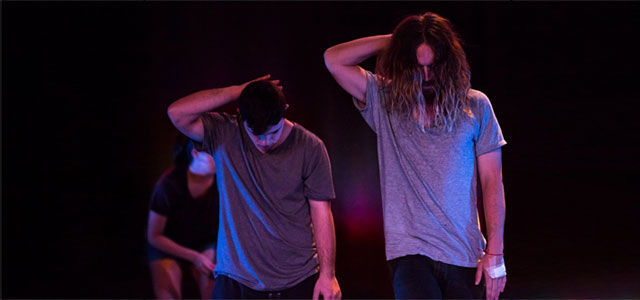
We commence with Familiar Strangers by Joseph Simons, who bases his abstraction on celebrity culture, and expresses a point of view that is characteristic of queer young men. Kirsty Fromholtz’s And Then Patterns (pictured above) features four dancers, each with a unique way of moving, is tender and probably the most emotionally engaging piece in the show.

Burlesque styles are explored in Natalie Pelarek’s Sink Or Swim, and Eva Crainean’s Girl Getting Bitter, both with a strong female presence, dealing with themes of gender difference. Sink Or Swim in particular, handles the subject matter very well, with extremely effective use of humour and sees Renelle Loretta Jones’ outrageous comic chops stealing the show.

Other stand outs include Jay Bailey’s Jaybird, which features a completely live soundtrack by the incredibly impressive beatboxer L.C.Beats. Also from the world of hip hop is Amber McCartney, whose interpretation of “popping and locking” in Hard-Boiled Wonderland, which utilises precise physical articulation brings to the program a sense of wonder and intrigue. No Fungus, No Tree by Sean Marcs and Anna Healey is an unusual work that features two very focussed and captivating performers. Their segment using Yazoo’s 1982 recording “Only You” is beautifully minimal and highlights the fantastic chemistry between the two. Nyunga by Thomas E.S. Kelly delivers an indigenous perspective and stars dancing sisters, Taree and Caleena Sansbury, who are truly delightful and graceful in their quiet confidence.

Our young dancers need to be congratulated for the training they put into their vocations. The amount of dedication in their art is evident in their skill and on their flesh. Their exploration into human physicality and visual mediums provides us with new and enlightening ways of looking at our own bodies and relationships with this vast universe in which we dwell. List of prize winners below.

Outstanding Choreography (joint winners):

  • Sean Marcs and Anna Healey for creating and performing No Fungus, No Tree – exploring the world of the symbiotic; and
  • Brianna Kell and Alexandra Andrews for creating and performing Salt – an inspired investigation

The People’s Choice (audience voted):

  • Swing Dancin’ – Natasha Crane’s infectious and quirky mix of styes performed by 25 artists

Award for Audacious Work:

  • Eva Crainean for Girl Getting Bitter – a comical, sexy and vengeful piece commenting on serious social issues and the femme fatale stereotype.

Outstanding Female Dancer (shared):

  • Amber McCartney for Hard-Boiled Wonderland – a movement study inspired by the work of Japanese novelist Haruki Murakami; and
  • Rosslyn Wythes for /Lu:p-/   – inspired by entrances, exits and the cyclical process where, within each loop, different information is revealed.

Outstanding Male Dancer: 

  • Harrison Hall for his solo work Melekh – “casting a shadow of light from within the darkness”.

www.shortandsweet.org

Review: Legend! (Decorum / Sydney Independent Theatre Company)

legend1Venue: Old Fitzroy Theatre (Woolloomooloo NSW), Jan 28 – Feb 15, 2014
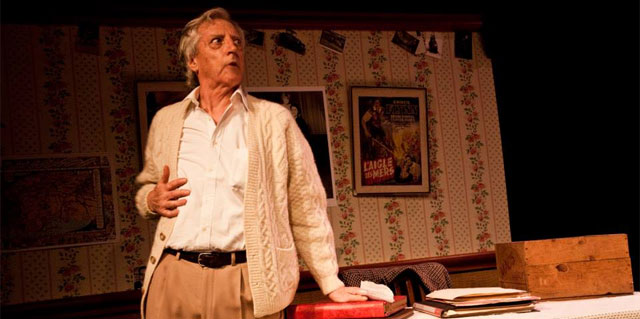
Playwright: Pat Sheil
Director: Lex Marinos
Actor: John Derum
Image by Katy Green Loughrey

Theatre review
‘Slips’ Cordon is in his home, reminiscing. We don’t know why, or who it is he speaks to, but there is certainly no shortage of tall tales to share. Pat Sheil toys with our “European history” in his script, re-writing events involving our iconic war heroes, legendary sporting personalities, celebrated performers, and various significant political figures of times past. These revisions are amusing, and depending on your level of affinity with the “source material”, possibly even hilarious.

Cordon is played by the effortlessly charming John Derum, who carves out a character that is immediately endearing. This is an actor who revels in spinning yarns, and his enjoyment of the limelight is infectious. We are drawn in and are glad to be his captive audience. Derum is excellent at punchlines. Indeed, the show does at times, feel like a stand up comedy routine, where a comedian simply tells jokes, without much concern for context or character development. We do not learn very much about Cordon, but he does make us laugh.

This is a clever script that could work well in the form of a novella, but Derum’s interpretation adds a dimension of time and place that is strangely (and ironically) authentic, even though we are free to imagine where and when the action before our eyes actually takes place. Legend! is only mildly iconoclastic. In fact there is an air of reverence for these legends that hangs heavily over the production. Rest assured that our sacred cows are left unscathed.

www.sitco.net.au

Review: Hotel Sorrento (The Genesian Theatre)

rsz_sorrento3Venue: The Genesian Theatre (Sydney NSW), Jan 18 – Feb 22, 2014
Playwright: Hannie Rayson
Director: Shane Bates
Actors: Sarah Purdue, Melanie Robinson, Gemma Munro, Barry Moray, Martin Bell, Oliver Beard, Lyn Turnbull Rose, Rob White
Image by Mark Banks

Theatre review
One of the key functions of art (if art has any function at all), is to express and represent concepts of identity. In the case of the Australian identity, the discussion is always a fascinating, and complex one. We are intrinsically invested in the issue, and the diversity of perspectives makes for effortlessly dynamic discourse. Hotel Sorrento was written in 1990 and talks a lot about who we are, who we like to think we are, what others think of us, and why we care. It presents a view of Australia as a nation trying to find its feet, almost like an awkward teenager in the later stages of puberty, unsure of itself but determined to establish something substantial and defined.

This production features a committed cast, including Oliver Beard who plays Troy, an awkward teenager just beginning to understand the mechanisms at play in his family that give meaning to his very being. Sarah Purdue is the strongest actor on this stage, creating a Hilary that is tender and moving despite her parochialism. Purdue’s knack for naturalism provides the perfect tone for the production and she successfully shows us the depths of her character even when the details are not all spelt out in the script. Lyn Turbull Rose is delightful and infectious in a scene talking about yearning and passion as Marge, and Martin Bell injects much needed humour in a show that tends to be overly serious at times.

Shane Bates’ direction focuses on storytelling, and the clarity of his plot is a pleasure. The show however, seems to be a bit oversimplified, and the characters seem a little analogous. We are left with a desire for something more colourful, with slightly more complication and inconvenience. Nevertheless, it is exciting to see a great script remembered and revived with such fitting respect and genuine affection.

www.genesiantheatre.com.au