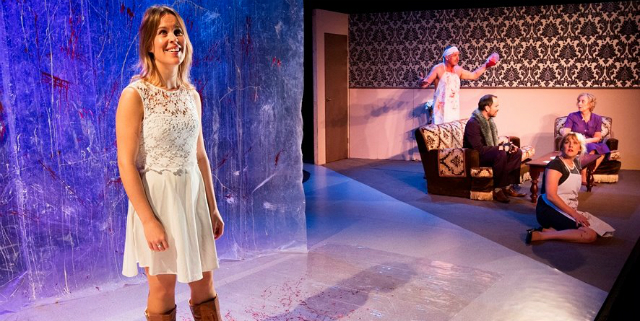
Review: Why Torture Is Wrong, And The People Who Love Them (New Theatre)

newtheatreVenue: New Theatre (Newtown NSW), Jun 3 – 28, 2014
Playwright: Christopher Durang
Director: Melita Rowston
Actors: Peter Astridge, Romy Bartz, Ryan Gibson, Terry Karabelas, Alice Livingstone, Ainslie McGlynn, Annie Schofield
Photograph © Bob Seary

Theatre review
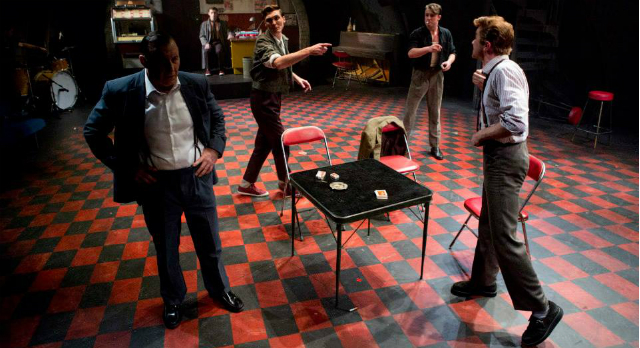
With a title as provocative and powerful as this, the play’s central concept hangs over everything that unfolds. We evaluate every situation, trying to decide what our personal definitions of “torture” might be, in relation to the statements that the writer makes. It is not a passive experience, sitting in the darkness of this theatre. The script seeks to involve and implicate us in its world. We look at its characters and wonder how we fit in, or indeed how the stories fit into our lives.

The production however, struggles to connect with us. The players are in their own world, always at a distance, and while there is a consistent semblance of poignancy and performances are all polished and precise, there is an uncomfortable inaccessibility that makes engagement difficult. Melita Rowston’s direction is wonderfully heightened and outlandish, but its strict structure seems to restrict her actors from playing with audience reactions and from using our presence as extensively as a comedy of this nature should. Nevertheless, Rowston’s work is suitably subversive in vision, and the courage at which she tackles the play’s difficult subjects is noteworthy.

Set design by Sasha Perri and Clarisse Ambroselli is imaginative and efficient. The action takes place in almost ten different places, and great lengths are taken to make every setting convincing and evocative. The play goes through many scene changes, and each transition is managed with elegance. From a production values perspective, the show scores very well.

Standouts in the cast include Peter Astridge, who plays Leonard, an extreme right winger of the nutty and violent variety. Astridge’s confident absurdity is refreshing and seductive. The caricatured roles are not written with much range or variance, but Astridge manages to find nuances to create a sense of dimension and unpredictability. Romy Bartz as Hildegarde plays up to the wildness in Christopher Durang’s comedy and delivers several big laughs. There are no weak performances in the show, and all roles are cast well. The script seems to require its players to portray the duality of character and actor, and although some effort is put into creating a sense of “metatheatricality”, a more conventional approach is usually chosen. Immersed within their roles, they miss opportunities for a more post-modern style of commentary on the situations being depicted.

A play that examines our moral compasses with torture and terror, should never leave us cool, or cosy. Its elements of controversy and iconoclasm should take precedence, and their disruptive nature should spawn discomfort, or disquiet. The play shows itself thinking things through; it is concerned with the use of intelligence, and it wishes to be challenging. The edge of the envelope can be pushed further.

www.newtheatre.org.au

Review: Beauty! Glamour! Fame! (The Cafe Debris Company / Merrill Pye Productions)

brentthorpe

Venue: The Imperial Hotel (Erskineville NSW), Thursdays Jun 5 – Jul 3, 2014
Playwright: Brent Thorpe
Director: Brent Thorpe
Cast: Brent Thorpe, Zan Cross
Image by Brett Boardman

Theatre review
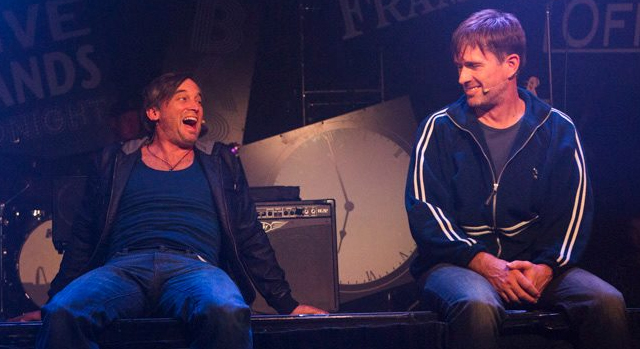
Saying that Brenda Trollope is larger than life is an understatement. She is rambunctious to the extreme and fervently demented, with a penchant for sharing too much, and at too much detail. She is a creation of Brent Thorpe, who is a performer with a keen sense of subversive humour, and an even keener urge to entertain.

In Beauty! Glamour! Fame!, Trollope addresses her audience directly, divulging tales of debauchery, and enacting outrageous highlights from her colourful existence. References to Australian culture of the last forty years abound. There is no question that the lady has been around the block more than once or twice. Thorpe’s performance is energetic and frenzied, owing more to vaudeville than to Stanislavski. His approach focuses on timing and presence, without letting the idea of emotional truth get in the way of a good tall tale. There is one scene, however, where Thorpe speaks on a “talkback radio” program as a secondary character Deirdre Flick, and an authenticity in his convictions shines through. In the space of several minutes, he encapsulates all that is disturbing about Australian media and politics today. Deirdre needs her own show.

Zac Cross plays various male characters, providing sturdy support as the reliable sidekick. Thorpe’s nerves can at times be apparent, but Cross seems to take everything in his stride. They are an odd coupling, but nothing in the show is averse to strangeness. It is an eccentric work about an eccentric mind. Trollope is not interested in the deep and meaningful, but she enjoys herself. She does not invest in poignancy, but pulls out all the stops for laughter. There may not be very much love or compassion here, but Trollope’s valour is certainly a thing to behold.

www.theimperialhotel.com.au

Review: Brothers Wreck (Belvoir St Theatre)

belvoir

Venue: Belvoir St Theatre (Surry Hills NSW), May 24 – Jun 22, 2014
Playwright: Jada Alberts
Director: Leah Purcell
Actors: Cramer Cain, Lisa Flanagan, Rarriwuy Hick, Hunter Page-Lochard, Bjorn Stewart
Image by Brett Boardman

Theatre review
Jada Alberts’ play is about family, poverty and depression. It is also a coming-of-age story about masculinity in Australia’s Northern Territory. Alberts’ characters are lively and refreshing, with a vernacular that is rarely heard on our stages, yet it accurately reflects the way many of us speak in daily lives. The play has a charming realism. It makes the familiar seem fascinating, and regular people become interesting.

Lisa Flanagan plays Petra, a vibrant woman of substance. Flanagan’s presence is immediate and robust, and she plays her role with great precision and versatility. Her sharply confident comic timing introduces an excellent levity, and her tears leave a lasting impression. The clear highlight of the show however, is Hunter Page-Lochard’s performance as lead character Ruben. Ruben is an underprivileged young man receiving psychotherapy treatment after becoming embroiled in a traumatic event. Unable to acknowledge and verbalise his emotions, Ruben’s grief manifests in destructive behaviour, resulting in disharmony at home and discord with local authorities. Page-Lochard inhabits his character to astonishing authenticity. His use of voice, movement and facial expressions present a level of believability that is deeply impressive, and powerfully captivating . There is also a sense of drama and tension in his work that demonstrate a natural propensity for the actor to entertain and connect. Page-Lochard is interested in portraying something truthful, but is also mindful of showmanship. To find that fabulous combination in a young indigenous actor is incredibly exciting.

Direction by Leah Purcell places emphasis on the quality of performances. There is an obvious purity and sincerity in the actors’ work, and the ensemble chemistry provides a beautiful closeness to the family being depicted on stage. Purcell, like Alberts, sensitively crafts an effective realism, but the play lacks a certain theatricality to elevate it from our everyday mundanity. The script requires greater tension and suspense, and both director and playwright could experiment with more imaginative devices to engage us more creatively. A great deal of depth is established in the play’s characters and relationships, but a more adventurous approach to telling their stories would give them more dimension and dynamism.

It is important that stories like Brothers Wreck are told. We need to learn about the underclasses and they must always be given a platform to represent their perspectives, and to develop their artistry. Young men like Ruben are damaged not by nature, but by our sociopolitical dysfunctions. It is a most pressing priority for our nation, that their voices be found, and be emboldened.

www.belvoir.com.au

5 Questions with Yannick Lawry

yannicklawryWhat is your favourite swear word?
I don’t swear a huge amount but I’m a fan of using ‘dickhead’ as a term of endearment.

What are you wearing?
An old, familiar purple hoodie and a pair of stonewashed jeans. Today is a comfort day!

What is love?
Total equality in terms of support and responsibility.

What was the last show you saw, and how many stars do you give it?
Belvoir’s adaptation of The Government Inspector. It was the most passionate, involved and committed set of performances I’d ever seen in Sydney. 5 stars.

Is your new show going to be any good?
You know what? I reckon it’s going to be a blast.


Yannick Lawry is appearing in Brad Checked In, with Citizen Content.
Show dates: 3 – 21 Jun, 2014
Show venue: The Old Fitzroy Hotel

Review: Mojo (Sydney Theatre Company)

mojoVenue: Wharf 1 Sydney Theatre Company (Walsh Bay NSW), May 17 – Jul 5, 2014
Playwright: Jez Butterworth
Director: Iain Sinclair
Cast: Tony Martin, Lindsay Farris, Eamon Farren, Ben O’Toole, Josh McConville
Images by Brett Boardman

Theatre review (originally published at auditoriummag.com)
When boys grow up and begin to find their feet in the adult world as men of stature, the acquisition of masculinity often becomes critically important. The characters in Jez Butterworth’s Mojo seem to spend all their waking moments satisfying that overwhelming and insatiable need to be seen and treated as men of worth, and in the London underground gangland of the late 1950s, this involves unthinkable violence, and outrageous criminality. Butterworth’s daring and extravagantly brutal 1995 script illustrates a world of sex, drugs and rock and roll, where sons are raped, fathers are murdered, and honour is maleficently displaced.

Butterworth’s work starts up in high gear. He gets to the mayhem quickly without setting up thorough introductions for its story. There is a disorientation that occurs in the beginning, and the viewer is required to be alert, in order to decipher manic events while keeping up with the fantastically rich dialogue. Iain Sinclair’s direction in the initial scenes emphasises speed and energy, which can be a challenge for the plot, but a hyper-reality is firmly established for the play’s time and space. We are transported to a past that fits our imagination in part, but also controversial. The play’s rampant drug taking and extreme profanity is a far cry from the innocence of Grease, and the sophistication of Orson Welles’ Touch Of Evil. Sinclair’s work owes more to David Lynch’s 1986 masterpiece Blue Velvet in its handling of ultraviolence and surreal personalities. An air of menace sets in quickly and the pressure it exerts is unrelenting. The production has a magnetic quality in spite of its obscure otherness. It plays like a riddle, glutted with suspense and eccentricity, and we are seduced at every step, desperate to peek around every impending corner.

Indeed, the production succeeds as a piece of narrative-driven entertainment. It is engrossing, amusing and thrilling, with a good amount of shock value thrown in for a sense of gangster authenticity that also gives the show a cool edge. Its themes are not immediately evident, but they resonate afterward. The show does not ask questions directly, but it certainly encourages us to question what had been seen. Sinclair might be comfortable with dramatics that strike like a sledgehammer, but his ability to probe our conscience about bigger issues is as accomplished as it is subtle.

Also displaying excellence is Sinclair’s design team. Visual aspects, including lighting, costumes and sets are adventurously creative and intelligent. Nicholas Rayment’s lights are exhaustively explored, fulfilling functional and aesthetic requirements equally brilliantly. There are moments of beauty that look to be inspired by film noir, and also memorable incidences of dread that are as sinister as a dank lane way in any cosmopolitan city at 3am. Pip Runciman’s set design ingeniously creates spaces out of the usually nondescript Wharf Theatre stage. Levels and doorways are introduced to great effect, and the representation of a nightclub that is attractive in front, and dilapidated behind, is efficiently managed.

Percussionist Alon Ilsar’s work is perhaps the most inventive. He provides accompaniment for most of the scenes, underscoring action by amplifying mood and manufacturing tension. Ilsar’s background sounds are noticeable but not intrusive. When it does come to the fore, it is in the style of experimental jazz, which adds considerable sophistication to the production.

Chemistry in the cast is strong, and mesmerising. The actors are perfectly in tune, and together, they present a microcosm that we find believable in spite of its irrationality, and irresistible even though it is deeply repulsive. Josh McConville is comically frantic as the amphetamine fuelled Potts. His consistent buoyancy gives the play a propelling energy, and prevents the darker sections from becoming too melancholic. There is an enjoyable vibrancy to his performance that keeps an important sense of youth and juvenility in the story. Together with Ben O’Toole’s slightly more innocent Sweet, they portray a couple of young men keen to prove themselves, and to make a mark in their sordid world. Lindsay Farris is enigmatic as Baby, a deranged personality who is central to the play’s interest in maturity and manhood. Farris takes the opportunity to depict his unorthodox character with a liberal measure of offbeat artistic choices, and carves out a fascinating performance that is simultaneously alluring and poignant.

The young men in Mojo are in a state of confusion. We see them exercise the impulse to impress, to emulate, and to succeed, but their role models are severely impaired. Masculinity is highly valued, and in many of our lives, it is through acquiring masculinity that men achieve social acceptance and establish status. The definition of masculinity is then a matter of great concern. Greed, violence, destruction, deception, betrayal and criminality are all inextricably linked with notions of success and fulfillment in Mojo. It is a bleak picture painted of the past, but it seems that the proposition made here is that evolution is illusory, and that boys will be boys.

www.sydneytheatre.com.au

In Rehearsal: The Boat People

Rehearsal images above from The Boat People, by The Hayloft Project and Rock Surfers Theatre.
At The Bondi Pavilion, from May 29 – Jun 21, 2014.
More info at http://www.rocksurfers.org/

Review: Truth, Beauty And A Picture Of You (Neil Gooding Productions)

hayestheatrecoVenue: Hayes Theatre Co (Potts Point NSW), May 9 – Jun 1, 2014
Book: Alex Broun, Tim Freedman
Music: Tim Freedman
Lyrics: Tim Freedman
Director: Neil Gooding
Musical Director: Andrew Worboys
Cast: Ian Stenlake, Scott Irwin, Erica Lovell, Toby Francis, Ross Chisari

Theatre review
Opera and the stage musical are theatre genres with their own defined song structures. Music is written in a specific way so that the genre works. Tim Freedman’s songs were written not for the stage, but for the world of pop and rock. This “juke box” musical is formed with highlights of his recording career with The Whitlams, and it is debatable how well the selection stands up against compositions tailored for the genre, but there is no question that this premier production of Truth, Beauty And A Picture Of You is effective on many levels.

Freedman and Alex Broun have built around the songs, a story replete with nostalgia and sentimentality, ensuring an emotional experience that audiences expect of the format. Characters and lines are thoughtfully crafted, with scenes between songs sometimes leaving a greater impression than the musical numbers themselves. Neil Gooding’s direction utilises space limitations of the Hayes Theatre to his advantage, evoking wistfully, the grunge of the 1990s and of Newtown, where the action is set, but it should be said that visual design could benefit from being a little more adventurous. The incorporation of live musicians within the space is charming. Gooding allows them to be within sight, but they are never intrusive. Above all, Gooding is a sensitive storyteller. The plot unfolds beautifully, with surprise, laughter and pathos always in the mix. His cast is a strong one, and the conviction of their performances is impressively engrossing.

Ian Stenlake, in the role of Anton, unleashes remarkable charisma. He is not a heroic protagonist, but his confident presence captivates us, and makes us care for all that he goes through. Stenlake’s ability to portray frivolity and an Australian casualness is wonderfully endearing, and his comic timing is a highlight of the show. Scott Irwin plays Charlie, buoyant and optimistic in 1994, but wearied and dejected in 2014. His unbelievable transformation between both eras bears an authenticity that is astonishing. Irwin’s work is subtle but powerful. His depiction of the character’s darker moments are devastating, and it is this gravity that gives the production its soul.

Younger members of the cast might be slightly less accomplished, but their talents are evident. Their vocal abilities in particular are outstanding, and they bring new life to many of the songs. It is unfortunate that the only obvious technical weakness of the production has to do with the way voices are mixed, as the band tends to drown out some of the singing in the bigger numbers. Erica Lovell as Beatrice is delightful and spirited. She is the strongest actor in the young bunch, and turns a somewhat inconsequential character into a memorable one.

Truth, Beauty And A Picture Of You is a moving show about love in its many guises. It tugs at our heartstrings and touches deeply. Like every great musical, it is affecting and entertaining, and it presents an opportunity to showcase some of our greatest talents, in whom we find great joy and sublime inspiration.

www.hayestheatre.com.au | www.goodingproductions.com

Review: Stones In Her Mouth (Mau)

stonesinhermouthVenue: Carriageworks (Eveleigh NSW), May 28 – 31, 2014
Choreography: Lemi Ponifasio
Director: Lemi Ponifasio

Theatre review
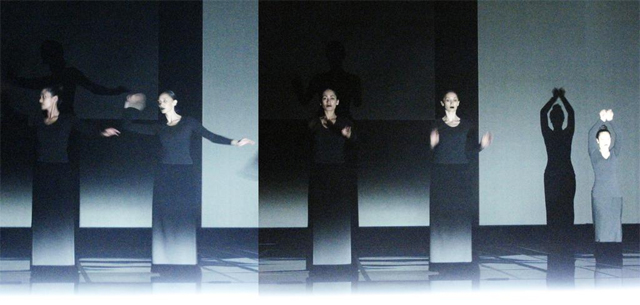
There are many juxtapositions in Lemi Ponifasio’s Stones In Her Mouth. The company’s ten performers are all women, interpreting a male director’s vision. The setting is ultra-modern, but much of the content feels firmly rooted in tradition. The women sing songs that seem to be from a folk practice, but their recorded accompaniment is evocative of a futuristic space age soundscape. Imagery is expressed almost entirely in black and white. The deep contrasts are in a constant state of negotiation, searching for harmony and moments of lucidity. The show is often about struggle, but the quality of performance is never in strife. The Mau company is flawless, and the proficiency at which their art is practiced, is staggering.

It is not an exaggeration to say that watching these women in action is awe-inspiring. There is a sense of shamanistic ecstasy to this work. Their voices and physicality are thoroughly honed, to a degree that would be astonishing for any audience. The cohesion and consonance in the ensemble, along with the level of focus they achieve as individuals, play almost like a miracle, unfathomable yet irrefutably real. Their connection with us is a spiritual one, because their language is ritualistic, and their states of trance move us and envelope us so that we too feel a part of the divine.

Stones In Her Mouth is also political. The show begins with the cast in darkness. We hear them but we cannot see them. A bright white light shines instead at us, transfixed in our seats, so that we become the object of fetish, and they in turn dictate the terms at which they are to be viewed. The work makes few explicit statements, but it is impossible to doubt the social significance of gender, ethnicity and colonial imperialism, implicative in each gesture and utterance. Our position as viewer shifts between the arraigned, the aggressor, and ally. The women portray complexity, but they are invariably powerful and dignified.

Ponifasio’s creation is breathtaking and transcendental. His art moves us by virtue of its very presence, and it is in the unique shaping of that presence with his masterful manipulation of time and space, that Ponifasio presents his exceptional artistry.

www.carriageworks.com.au | www.mau.co.nz

Review: Cain And Abel (Belvoir St Theatre / The Rabble)

rabbleVenue: Belvoir St Theatre (Surry Hills NSW), May 15 – Jun 8, 2014
Creators: Kate Davis, Emma Valente
Director: Emma Valente
Actors: Dana Miltins, Mary Helen Sassman
Image by Brett Boardman

Theatre review
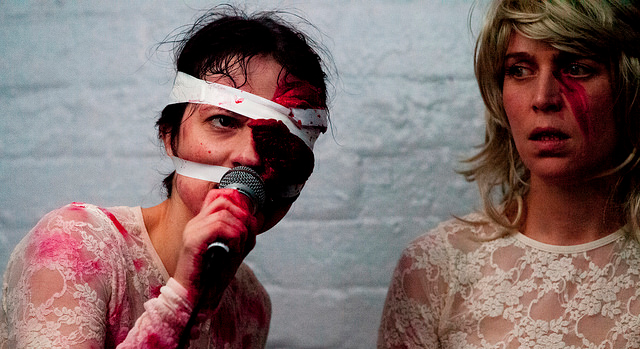
In certain religious texts, Cain and Abel were the first children born of Eve, and Abel was the first human to die. The brothers’ story is one that has undergone much speculation and scrutiny, with Cain’s motives for murder being the key point of contention. In Kate Davis and Emma Valente’s subversive vision, the first children are daughters, so it is a woman who inflicts the first act of violence. They do not investigate the reasons for the infamous slaying, but explore instead, by substituting male for female, meanings and expressions of gender and its social perceptions in relation to human traits and behaviour.

This is a theatrical work that is heavily influenced by fine art. Dialogue is sparse and reliance on words to create and communicate meaning is minimal. Davis and Valente are concerned with arresting the senses and talking viscerally, resulting in a fascinating show that is almost hypnotic in its appeal. Shades of Japanese Noh theatre can be observed in the mesmerising leading ladies, Dana Miltins and Mary Helen Sassman, who work with a grave stillness that has more to do with spirituality and metaphysicality than storytelling. In this Cain And Abel, we are required to read not only with our eyes and ears, but also to engage with its energies and instincts. As an Australian work, it is distinctively original, even within the realm of experimental theatre.

Miltins performs an understated but terrifying aggression. Her Cain is not a femme fatale, as women do not exist as temptresses on this stage. In multiple scenes depicting various imagined manifestations of the fabled carnage, we are forced to witness her sister’s slaughter repeatedly, and to contemplate wildly, our own ideas about the artist’s themes, and beyond. Indeed, the abstraction of the piece resonates strongly, and in the absence of simple narratives, our personal thoughts are taken on adventurous odysseys.

Visual and sound design are not facilitators for something greater, they are integral to the theatrical experience, and executed to perfection. A main feature is an enclosed set made of clear acrylic, that allows for brutality to be contained (along with assorted offending liquids). The creation of distance provides a membrane of psychological protection, so that our minds gain enough detachment and security to indulge in meditations over the blood-letting before us.

Davis and Valente’s work is brave, iconoclastic and important. Religion is deeply rooted in many, and its unchecked authority affects every society. This disruption of the Cain and Abel story is emancipatory, because it encourages an intellectual response that is evolved and compassionate. It asks questions that matter, and it is incumbent upon us to consider them with a pure conscience.

www.belvoir.com.au | www.therabble.com.au