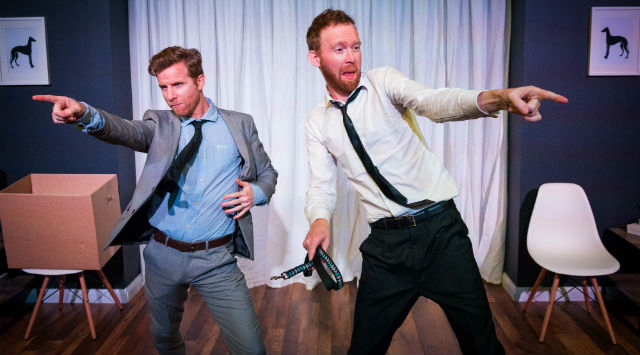
Review: Orphans (Seeker Productions)

seekerproductionsVenue: Old Fitzroy Theatre (Woolloomooloo NSW), Apr 19 – 30, 2016
Playwright: Dennis Kelly
Director: Richard Hilliar
Cast: Liam Nunan, Jacki Mison, Christopher Morris

Theatre review
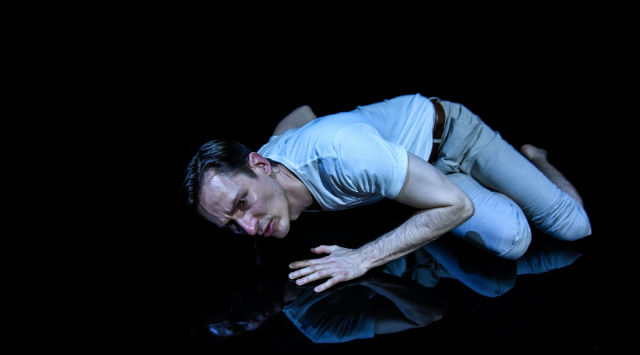
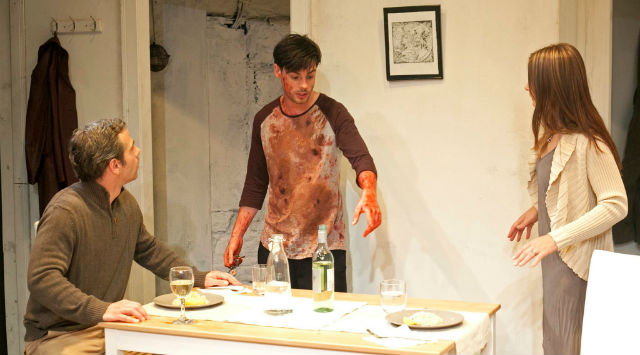
In Dennis Kelly’s Orphans, we look at violence and its origins. Liam is a young man who encounters unspeakable brutality. His world is one of turbulence and confusion, the nature of which was established years ago as an orphaned child, that he unfortunately sustains through to the present day. Helen is his caring sister who although similarly traumatised, is determined to create normalcy in their lives. Their story is a moving one, but presented with additional dimensions of a thriller and some very black comedy. The conflict between Helen’s order and Liam’s chaos presents tensions that serve the play well, with a skilfully designed escalation of stakes that draws us in deeper and deeper into its drama.

The very compelling characters in Orphans are played by three excellent actors who showcase their remarkable talents in a work that presents some colourful extremities to show off their thespian muscles. Director Richard Hilliar opens up every opportunity for the players to shine, and the thoroughness at which each personality is explored and portrayed, is the show’s strongest feature. Liam Nunan’s depiction of his role (also named) Liam’s trauma is unrelenting yet textured. The level of focus and emotional power he puts on display is a marvellous sight that provides a sense of edginess appropriate for the confronting nature of the material. Equally intense is Jacki Mison who gives Helen an intriguing sense of complexity that is almost hypnotic in its appeal. The more she reveals, the more we wish to discover, and the authenticity she is able to introduce along with the character’s strangeness keeps us engrossed in Helen’s quandary. Christopher Morris has a more subtle approach but is no less dynamic as Helen’s husband Danny, whose surprising transformations through the plot are crafted with great instinct and precision. The outlandish narrative is offered balance by the actor’s quiet but confident presence, allowing us breathing space within its profusion of aggressive energy.

There is also good work to be found in Liam O’Keefe’s lighting design and Tegan Nicholls’ efforts on sound. Atmosphere is generally modulated well for transitions between scenes, although visual cues do not provide enough certainty about the married couple’s socio-economic status, which becomes increasingly relevant. Similarly ambiguous are the play’s comic qualities. The darkness of its themes notwithstanding, clearer indication of humour would garner better responses to the production, and provide a greater variance in tonal shifts over its duration.

Trauma in childhood is perhaps inevitable. At varying degrees, each of us would have felt violated or betrayed in our time as small, vulnerable creatures navigating the environment, but how we develop from that tainted moment, is a real concern that Orphans investigates. We think about the process of growing up, and question the practicability of becoming happily stable adults. Some of us discover the fallacy of “happy ever after” early on but many others cling to the belief that ideals exist and a life of perfection is within reach. The truth is that things do get better, but whether we believe that there can ever be an end to personal struggle, would depend exclusively on each individual’s outlook.
www.facebook.com/…

Review: A Man Walks Into A Bar (Off The Avenue Productions)

offtheavenueVenue: Blood Moon Theatre (Potts Point NSW), Apr 21 – May 7, 2016
Playwright: David Geary
Director: Andrew Beban
Cast: Nina Marsh, Sam Newton, Chris Yaacoubian
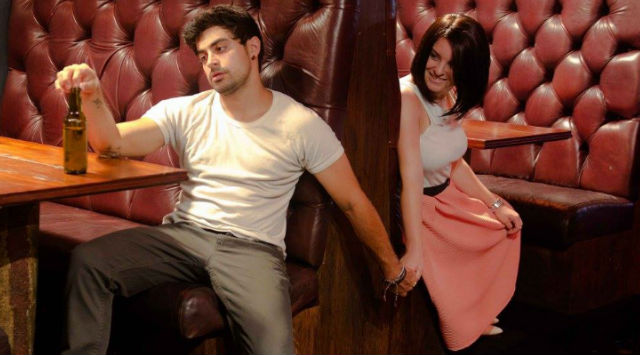
Image by Angie Carmen Photography

Theatre review
Much can happen in the space of an hour, and when two people are telling quick quips about the time a man walked into a bar, 60 minutes can be filled with more than a few anecdotes. David Geary’s play is interested in people who go to bars, and the things that can happen in them. We observe life from one of its more mundane locations, trying to catch a reflection of what we look like in our day to day existences. Not every morsel is comedic, but they are all thoughtful fragments that we can relate to.

Nina Marsh and Chris Yaacoubian are individually strong performers who find good chemistry in a show to be remembered for its effervescence. Both have an enthusiastic approach to their material, keen to share jokes with an audience that they keep engrossed. Marsh impresses with a powerful singing voice that she features in several musical numbers, accompanied by Sam Newton whose guitar underscores beautifully the entire production. Yaacoubian is a solid and charming presence that gives the production a delightful sense of confidence. The show requires greater nuance, and more defined character variations in order that poignancy may be achieved, but it is a good effort that expresses interesting ideas.

A lot of what theatre wishes to do, is to find an understanding of the human condition, and to communicate at a level of universality. Art does not have to cater to the masses, but it should attempt to connect. The greatest component of live performance is its captive audience. It presents an opportunity to share experiences, which implies a requirement to first locate what it is that we hold in common. We many not all enjoy alcohol, and we may not all frequent watering holes, but it is human to crave the companionship offered by social spaces. When a stage is involved, we let the players take control, and they take on the responsibilities of friendship, if only for a short time. A Man Walks Into A Bar is effective when it strikes up intimate conversations that feel as though we are looking into someone’s soul, but less delightful when it trails off, getting caught up in its own moments of drunken stupor.

www.offtheavenue.com.au

Review: Disgraced (Sydney Theatre Company)

Venue: Wharf 1 Sydney Theatre Company (Walsh Bay NSW), Apr 16 – Jun 4, 2016
Playwright: Ayad Akhtar
Director: Sarah Goodes
Cast: Paula Arundell, Glenn Hazeldine, Sachin Joab, Shiv Palekar, Sophie Ross
Images by Prudence Upton

Theatre review
We can all agree that everything is not quite coming up roses in the world today, with terrorists blowing up cities everywhere, and people waging war against one another, all in the name of race and religion. There is no denying that at the root of these catastrophes is hate. Hate that comes in a manner of guises and a range of justifications, but ultimately it all boils down to the simple truth that people are prejudiced and destructive. This is difficult to hear, because life is impossible without believing that humanity is good, so we embrace hope with a kind of blind naivety and evade the truth in order that we may get out of bed and be happy.

Ayad Akhtar demolishes those delusions with Disgraced, in which racist hate is served up plain as day. The characters are intelligent, successful and glamorous, tailor-made so that they are irresistible to bourgeois theatregoers, but their ugly sides emerge, increasingly aggressive over time, and we find ourselves in a state of violation, caused by this transgressive mix of seduction and repulsion. It is at the point where we become intimate with protagonist Amir and the people around him that we see their racism. We are unable to dismiss them because we had already submitted trust, having decided that they are good people, so our minds are in conflict, made to juggle the puzzle pieces that refuse to form an easy picture. In that process of confusion, we reach for a new depth of understanding about our nature and how hate resides in our beings, and how it manifests. In the face of Akhtar’s explicit honesty, we are presented a challenge of interpretation. We recognise the reality of the situation, but we have no convenient way of dealing with the information. The big mess of life is truer than the circumscribed narratives we use to arrange our thoughts, and in this play, that chaos is allowed to rear its ugly head, without a false sense of resolution to contain our anxieties. Bad things happen because there are people with hate in their hearts. Getting to know them is important, but not having anywhere to go thereafter is the conundrum.

It is a stunning and explosive script that drops bombs at regular intervals to unnerve, to disarm and most of all, to confront. It is a response to the undeniable horrors around us that involves no sugar-coating, and no rose-tinted glasses. It is a brutal piece of writing, made only more powerful by its ability to tell us the worst while it secures our unwavering attention. Sarah Goodes’ direction delivers that brutality with a blunt but measured force. Her ability to communicate details no matter how subtle, makes this staging an enriching and enlightening experience. She draws attention to nuances that are missed in our daily interaction with the subject matter, dismantling our habit of two-minute sound bites and 140 character tweets, in exchange for a more thorough study on the state of our world.

Amir is among the most important characters to have appeared in recent theatre history. His experience is ubiquitous but virtually never brought to light. There is shame, fear and danger associated with his story, so our impulses tell us to keep it buried, for we are afraid of the controversies he represents, and we worry about the people he offends. Performing the role is Sachin Joab, exhilarating, authentic and alluring in his depiction of the Pakistani-American caught in a moment of crisis. Joab brings extraordinary illumination to the tremendous complexity of his part, presenting a great deal of insight into a psychology that we all need to know. His work is emotional and vulnerable, but the actor is also able to convey an unmistakeable menace that is central to the play’s effectiveness. Joab overwhelms us with his talent and conviction, and leaves an indelible impression with his remarkable grace. Also exquisite is Elizabeth Gadsby’s set design, providing a backdrop of sophistication and class to a tale about social status and division. The configuration of spaces caters cleverly to all seats in the auditorium, offering excellent perspective and a beautiful vista from every angle.

This is a show full of tension, with its drama derived from issues of the day that are usually too unseemly to discuss in frankness. The action happens in an exclusive New York apartment, but we all have a stake in the subject matter. Peace will benefit everyone, but in its pursuance, we all seem to be losers. In the middle of a war, we are never sure if anything that we say or do will contribute to making things better, but regardless of context, art must always reveal the truth. We cannot mend what is broken without knowing its problems and although a bitter pill is hard to swallow, there is no escaping it. In Disgraced, characters have to drop their pretences and acknowledge the cold, hard fact that their world is in turmoil, but whether they can bring about improvements, or revert to their previous delusions, is not a question anybody has a definitive answer for.

www.sydneytheatre.com.au

Review: Lake Disappointment (Carriageworks)

carriageworksVenue: Carriageworks (Eveleigh NSW), Apr 20 – 23, 2016
Playwrights: Luke Mullins, Lachlan Philpott
Director: Janice Muller
Cast: Luke Mullins
Image by James Brown

Theatre review
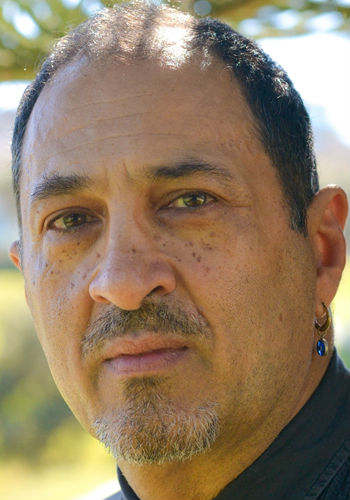
Many of us hold menial jobs. Things need to get done by people (even in this age of high technology) that require little more than a person’s presence and some physical exertion. Lake Disappointment is a unique story about a man who spends his life being the body double of a film star. His mental capacities are barely involved in the daily operations of his full-time and isolating occupation, so his mind’s energy goes into constant dialogue with himself. With little opportunity for social interaction, he is in a state of perpetual reflection, but with little stimulation or nourishment, his intellect is stunted and his life stagnates. Written by Luke Mullins and Lachlan Philpott, the script is a wonderful look into a weird existence. Through the portrayal of an unusual creature, it offers insightful contemplations about the human condition, and all its egotistical propensities for ambition, jealousy and delusion.

It is a funny piece of writing, with nuanced but easily identifiable humour. We laugh at the character’s vanity and his aspirations, because we recognise those qualities. The desires and emotions in the play are deeply familiar in spite of their obscure context. Direction by Janice Muller establishes a gentle approach to the jokes, but atmosphere is imbued with an intensity from the very start. An unmistakeable swelling of tension progresses slowly through the show, but its scenes are not always dynamic. Mullins plays the role with an abundance of charisma, but the very controlled tone of delivery he chooses for his character eventually becomes repetitive. It is a disciplined performance with a lot of palpable gravitas that needs a healthy dose of oppositional lightness to deliver an even more engaging experience.

Designers for the staging do a marvellous job of creating a work of theatre that is sleek, sensual and surprising. Lights by Matt Cox, along with Michael Hankin’s set design make fabulous use of space, not only to guide our emotional responses, but also to manufacture visual symbols that help develop the story to a richer depth. Sound is managed by James Brown who accesses our impulses through an acute sensitivity, providing revelations beyond the dimension of words and matter.

Life is demanding. We have to be strong and courageous to weather its storms, but no matter how good we become at dealing with life, our individual insignificance in the scheme of things is ultimately undeniable. People want so much, and we try so hard for things that may eventually mean little. The body double in Lake Disappointment talks about himself incessantly but does not question his desires. He works hard at life but does not reflect on any of his actions or thoughts. It is a life unexamined, where the subject conspires with his circumstances to keep himself entrapped, like a hamster on its wheel, running without rhyme or reason, unable to stop, unable to reach any destination.

www.carriageworks.com.au

5 Questions with Nicholas Papademetriou and Clemence Williams

Nicholas Papademetriou

Nicholas Papademetriou

Clemence Williams: If Firs was ever granted long service leave, where would he go and how long would he last before wanting desperately to return to the family?
Nicholas Papademetriou: He’d definitely go to Paris just to know what it was like after all the stories he’d heard from the master’s trips there. He’d stay in a grand hotel like the Crillon and make sure the service was as good as he would have given. He’d miss the family from day one, but he’d probably not come back as his age would probably see him die peacefully after a delicious breakfast in bed in his hotel suite.

Shoot/Shag/Marry three characters in the play.
Firs would shoot Yasha, shag Gaev (just for payback) and marry Varya. Me – I’d shoot Lyubov, shag Lophakin and if I had to marry (cause I don’t believe in it) probably Pischkin cause he’d be drunk and out most of the time.

What’s your dream role?
I’ve already played one – Perry in Mike Leigh’s Greek Tragedy – and there are a few dream roles left, but George in Virginia Woolf and Shylock.

If you could join any past/present music group, what would it be and why? Where would you tour?
I’d want to be the fourth back singer in The Supremes, cause I know all the words to their songs. I love that big hair and outfits of the 60’s. I’d want to play Vegas, the Copacabana in New York and a live concert in the Colosseum.

If you could change three things about the current political climate, what would they be?
I’d make Tanya Plibersek Prime Minister, I’d cut all politicians wages by half and I’d instigate a public panel (consisting of ordinary citizens) who would hold the deciding vote in any decisions, bills, actions, etc that were being passed on both federal and state levels.

Clemence Williams

Clemence Williams

Nicholas Papademetriou: If you could make a film that would commence where the play ends, which characters would you follow and what would the film be about?
Clemence Williams: For me, one of the most challenging characters to create an arch for is Anya. Of all the Orchard Dwellers, I think she holds the most potential for change and yet she is incarcerated by the generation before her. It’s for this reason that I think she’d make a wonderful subject of a film or perhaps a mini series: documenting her education, love affairs (above and beyond Trofimov, no doubt) and escape from a family that has done nothing but hold her back.

Which Shakespeare would you like to direct the most?
Without a doubt, Hamlet. While it straddles cross generational themes, for me it will always be the Quarter Life Crisis play. And so I would like to tackle it early in my career while his dilemmas still seem within reach.

Which three people either fictional or non would you combine to make the person that you might come back as in a future life?
That’s a tough one. Probably somewhere between Eugene Ionesco, Jennifer Lawrence and my grandmother. I would want the absurd outlook on life and art of Ionesco, Lawrence’s humour, flair and excellent hair and my grandmother’s grace, humility and integrity.

Do you think one can get through life without lying in any way, shape or form? This includes anything that comes under the banner of little white lies.
Ultimately, one should try. I think there’s a line between complete frankness and tactfulness that one has to walk, but if everyone decided to drop the bullshit then we might get more done in a day.

If you could adapt any film, composition of music (any genre) or book into a theatre piece, which would you choose?
I have so many answers to this that it’s impossible to pin one down… but I was recently quite struck by the beauty and the sadness of Jeanette Winterson’s Why Be Happy When You Can Be Normal. I think it would be a fascinating slice of a lifetime to stage.

Nicholas Papademetriou and Clemence Williams are working on David Mamet’s adaptation of The Cherry Orchard by Chekhov.
Dates: 26 April – 28 May, 2016
Venue: New Theatre

5 Questions with Chantelle Jamieson and Mansoor Noor

Chantelle Jamieson

Chantelle Jamieson

Mansoor Noor: What role would you love to play that you haven’t yet?
Chantelle Jamieson: I’d love to play Beatrice in Much Ado About Nothing. Who wouldn’t love to be that witty.

What is a show you would never do again?
Unfortunately, Derek Walcott’s Caribbean version of The Odyssey. We did it at drama school and I think everyone involved would happily forget it. I was playing Athena and the only memory of the role I have is of putting more and more glitter on every night to try and distract from what was happening on stage.

What is something that you know now that you wish you knew when you were first starting out as an actor?
No matter how much glitter you wear, you can’t fix a bad performance.

What have you enjoyed the most about working on Belleville?
I know it’s sucky but, Claudia, our director. It’s been amazing to work with such a passionate gifted young female director. It takes so much out of you holding a team together over the journey of a show, but her indomitable attitude is infectious. Also the cast are pretty great. You’re welcome, Mansoor.

Any tips on speaking French?
When you see an ‘r’ in a word, forget about rolling it, think about clearing your throat. Comprenez vous? That means “do you understand?”… I had to use Google translate for that.

Mansoor Noor

Chantelle Jamieson: If a film was made about your life who would you want to play you and who would really get the part?
Mansoor Noor: Daniel Day Lewis or Meryl Streep. So transformational. Let’s face it though, it would probably be Dev Patel. Or Joel Edgerton, #diversity

What is the most valuable experience you’ve gained from working on Belleville?
Probably having to learn lines in another dialect. I already speak a second language so I didn’t think it would be this challenging but the slightest mispronunciation can change everything. My mother actually lived in Paris for 6 years. She didn’t help me at all.

You’re also a photographer, which do you get most enjoyment out of?
Being on stage is certainly one of the most thrilling things you can experience. I think as artists we sometimes forget that not everyone gets to have the feeling of walking around on stage pretending to be other people in front of complete strangers. But I also love shooting actors’ head shots. Is this your way of asking me to shoot you some new head shots Chantelle?

Favourite thing to say in French?
It’s actually one of the words you get to say in the play. Incredible or rather, in-croy-a-ble!
I’ve started using it in my everyday vernacular.
“How is your dating life Mansoor?”
“Oh! Incroyable… bad.”

What’s the first memory you have of performance?
My debut performance was in a production of Billy Goat Gruff And The Baby Troll in Grade 6. And I think it’s safe to say I stole the show with my unintentionally Middle Eastern sounding Billy Goat.

Chantelle Jamieson and Mansoor Noor can be seen in Belleville by Amy Herzog.
Dates: 13 April – 12 May, 2016
Venue: Old Fitz Theatre

5 Questions with Julian Kuo and Alex Malone

Julian Kuo

Julian Kuo

Alex Malone: What’s your favourite song in Spring Awakening?
Julian Kuo: It would have to be ‘Touch Me’, it has everything!

Who would play you in a biopic about your life?
Joseph Gordon-Levitt.

You’re understudying quite a few roles in Spring Awakening. What do you find is the most difficult thing about understudying?
This Is the first time I’ve ever been a cover. You need to know every little difference in choreography and in harmony, on top of obviously knowing those roles’ dialogue, blocking and lyrics. In other words, I guess the hardest part is just learning it all and making sure you’re ready to go on if you’re called on!

How many instruments do you play and how long have you been a super wizard music man?
I love that description, I’m going to put it at the top of my CV from now on. I play piano and I used to play clarinet a LONG time ago. My real instrument has always been my voice though. I began studying music while I was in the opera as a boy soprano and I never really stopped. So I guess I could say I’ve been that super wizard music man since 13-ish!

If you could play any role in a musical or play what would it be?
It’s too difficult to pick one so I’m going to say two; Burrs in Andrew Lippa’s The Wild Party and Jamie in Jason Robert Brown’s The Last Five Years.

Alex Malone

Alex Malone

Julian Kuo: What are the similarities between you and Illse? Is there something that you feel really connects the two of you?
Alex Malone: We are pretty much the same person (minus the really awful stuff that happens to her). She and I are both pretty hippy and we both have a habit of speaking our minds. We actually had a costume fitting the other day and Mitchell decided I’d just wear the dress I wore to the theatre after hours of trying stuff on.

What’s the worst/most embarrassing thing that has ever happened to you on stage?
I’m a sucker for a corpse and I find a lot of inappropriate stuff funny, so probably laughing in a death scene would be the worst thing I’ve done on stage. Not my proudest performance.

If you were a girl living in Germany during the 1890’s do you think you’d fall into line or would you be the rebel? Why?
I was a bit of a nerd in school and I hate getting in trouble, so I probably would have just kept my head down and finished my sewing. The ‘no sex before marriage’ thing would have sucked though.

I know you studied in Perth over at WAAPA, how are you enjoying the east coast?
I really love it. I grew up in Perth as well so it will always home, but Sydney has been really awesome so far, plus most of WAAPA is here anyway so half the time it feels like I’m still in school.

After a long night in the theatre, what’s your favourite midnight snack?
A dirty kebab on the way home. Extra cheese.

Julian Kuo and Alex Malone can be seen in Spring Awakening the Musical.
Dates: 27 April – 14 May, 2016
Venue: ATYP

Review: Hay Fever (Sydney Theatre Company)

Venue: Sydney Opera House (Sydney NSW), Apr 11 – May 21, 2016
Playwright: Noël Coward
Director: Imara Savage
Cast: Briallen Clarke, Tom Conroy, Alan Dukes, Harriet Dyer, Genevieve Lemon, Tony Llewellyn-Jones, Josh McConville, Heather Mitchell, Helen Thomson
Images by Lisa Tomasetti

Theatre review
Judith Bliss and her family share an exquisite sense of humour, as well as dubious moral standards. They live out their self-obsession like a flamboyant form of high art, entangling unsuspecting acquaintances into their shenanigans, blurring the lines between fantasy and reality. Noël Coward’s Hay Fever is the pinnacle of British wit, transcending time and space with a style of frivolity that does not seem to age. Whether silly or edgy, the play’s air of sophistication never falters. Intelligent but not intellectual, it gives us feather light humour without ever being patronising. A sheer delight for fans of theatre, and rambunctious fun for those on stage.

Director Imara Savage finds room for creativity, and exercises her artistic freedom while retaining all the best of Coward’s essence. Savage’s rendition seems faithful to the writer’s milieu, even though its sensibilities are thoroughly modern, revealing an instinctive ability to locate the timeless and perhaps universal elements of the play. These are not characters with profound messages to convey but they offer opportunities for imaginative and extravagant use of the theatrical platform, and Savage certainly rises to that challenge. Her show is visually exciting, with an infectiously exuberant spirit that overflows the stage and demands our attention. Set and costume design by Alicia Clements is sublime. The Bliss home is rendered with a bohemian rustic beauty, and costumes although effortless, are rich with glamour and sex appeal.

A host of larger than life personalities is created with wild abandon by a remarkable ensemble, led by Heather Mitchell who appears to have amassed inexhaustible tricks up her sleeve for the depiction of a prima donna, and her Judith is spectacularly resplendent in grandiosity and excess. Performances in the production are exaggerated, but also nuanced and thoughtful. Grand gestures and overstatements are appropriately supported by its dramatic “show within a show” context. Tom Conroy and Harriet Dyer play Judith’s children, both powerfully inventive in their approach, using the entirety of their beings to embody the outlandish Bliss siblings. Conroy and Dyer are charming, funny and captivating actors whose creations are as engaging as they are eccentric.

In Hay Fever, there are the Blisses, and then there is everybody else. The world seems to be split into vibrant and dull, colourful and ordinary. It is a story about the joie de vivre that we should all be mindful of holding dear, no matter what age we find ourselves in life’s journey. Playfulness is a trait that many are afraid of. In the process of growing up and in the pursuit of individual ambitions, we often find ourselves feeling defeated by the ravages of time, and we begin to lose our natural lustre as optimism becomes hard to preserve. Judith and her loved ones live like there is no tomorrow. Fearless and audacious, they forge ahead, devouring all that life has to offer.

www.sydneytheatre.com.au

Review: The Best Brothers (The Old 505 Theatre)

old505Venue: Old 505 Theatre @ 5 Eliza St (Newtown NSW), Apr 13 – 30, 2016
Playwright: Daniel MacIvor
Director: Gareth Boylan
Cast: Sean Lynch, Johann Walraven

Theatre review (of a preview performance)
Like many other brothers, Hamilton and Kyle Best are not an affectionate pair. There is something about the closeness of siblings that can often prevent them from expressing tenderness for each other; a kind of certainty and confidence resides in their bond that renders physical and verbal assurances of love unnecessary. Of course, there is also the issue of maleness, of always assuming a hard exterior in the daily practice of gender, that ensures minimal sentimentality between men. Canadian playwright Daniel MacIvor’s The Best Brothers is a quirky look at family dynamics and a witty depiction of contemporary masculinity. Its comedy is subtle and unconventional, but deeply charming.

Gareth Boylan’s quiet, almost stoic approach as director provides a stylish framework for our enjoyment of the Bests. There is a story to be followed, but the play’s real concern is its characters and relationships, and Boylan’s unique aesthetic is a delightful aperture through which we explore the brothers, their mother and her dog. It is a smartly designed production, with just enough lighting and sound embellishment adding interest, in order that our senses may engage meaningfully. Set design is sleek and effective, although greater care should probably go into the masking of wings to minimise distraction from backstage activity.

Playing Kyle is Sean Lynch, dynamic and affable, with a charismatic presence bringing authenticity to the show’s artfully minimalist aura. The performer has strong instincts that allow him to connect well with viewers, and is often very entertaining with minute flourishes revealing an inventive mind. Equally enthusiastic is Johann Walraven as Hamilton, memorable for demonstrating a strong conviction but is perhaps less suited to the material at hand. There is good chemistry to be found between the two, and although their show is a well-rehearsed one, more nuance could be developed for greater emotional response. At the centre of The Best Brothers is a process of mourning, but sorrow seems to be missing from the men’s antics and high jinks. They spend all their energy taking care of things on the surface, so that no time is left for grief, allowing us only glimpses of truth behind their shiny exteriors. The Bests never wallow. Eruptions are left to subside on their own, while they keep calm and carry on.

www.venue505.com/theatre

Review: Good People (Ensemble Theatre)

ensembleVenue: Ensemble Theatre (Kirribilli NSW), Apr 7 – May 21, 2016
Playwright: David Lindsay-Abaire
Director: Mark Kilmurry
Cast: Gael Ballantyne, Drew Livingston, Tara Morice, Zindzi Okenyo, Jane Phegan, Christopher Stollery
Image by Clare Hawley

Theatre review
When a baby is born, we want to think that the world is their oyster, and where they are today will have little bearing on where they may end up many years after. In David Lindsay-Abaire’s Good People, we meet two people with roots in the same rough part of town, but whose lives have taken drastically different turns over time. One is enjoying the fruits of a meteoric rise up the socio-economic ladder, while the other finds herself stagnated in poverty. It is a thoughtful play about opportunity and privilege, with the most basic of narratives, but its sharp-witted dialogue is expertly crafted not only to stimulate our minds but also to deliver some very big and clever laughs.

Tara Morice leads a formidable cast in a production that will be remembered for its outstanding quality of acting. Morice’s humour is acerbic but subtle, much like her character Margaret’s resentment. Bitterness is not her predominant feature, but it emerges periodically to overtake her easy exterior and everyone is caught off guard. The actor never makes a big deal of her punchlines, but the dryness of her delivery is somehow no inhibition to the power of her comedy. Morice is absolutely hilarious on stage, yet is able to communicate all of Margaret’s complexities with thorough clarity. Hers is not a life that every bourgeois theatregoer is familiar with, but her performance illustrates each detail and essence so that we achieve a level of understanding that feels exhaustive and genuine. Christopher Stollery’s skills are on par, and the combination of the two is pure theatrical gold. Stollery’s captivating performance brings an electrifying playfulness keeping us engrossed and alert, while portraying his character Mike with an unyielding sincerity that prevents him from turning caricature. In the role of Kate is Zindzi Okenyo who presents surprising nuance for a woman determined not to reveal much. The actor’s flair for comedy is showcased beautifully, and her warm presence brings a valuable dignity to her part in the story.

Direction by Mark Kilmurry is faithful to the spirit of the work, and provides an honest voice to the underclass being represented in Good People. Our protagonist is neither deified nor demonized, so we are able to recognise her humanity and empathise with the injustices she experiences. There is a wise restraint evident throughout the production, demonstrating Kilmurry’s emphasis on truth over the temptation to play for laughs, resulting in a show that perfectly balances its entertainment value with its sociological ideas. Working hard does not guarantee your dreams coming true, and making the right choices does not mean glory at the end of each journey. Life is not fair, and fortune will not fall evenly on every individual. Nature will take its course, but humans can take charge of our own fates. The play is about people helping each other, a simple and fundamental virtue that we should all possess, but like many virtues, we seem to leave it an abstract concept while we practise something quite contrary.

www.ensemble.com.au