Review: Mauritius (New Theatre / Sure Foot Productions)

Venue: New Theatre (Newtown NSW), Jul 12 – 29, 2017
Playwright: Theresa Rebeck
Director: Richard Cornally
Cast: Brett Heath, Kitty Hopwood, Peter-William Jamieson, Emma Louise, Andy Simpson
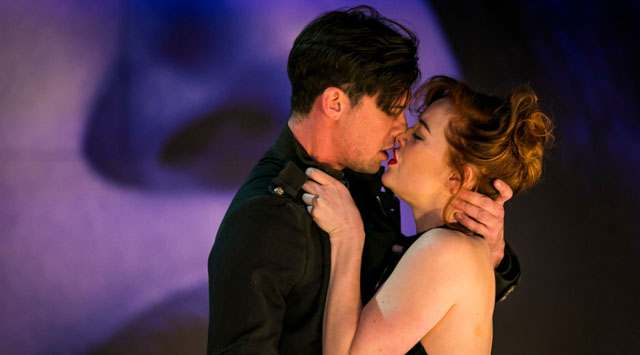
Image by Sundstrom Images

Theatre review
Jackie finds herself in possession of some highly collectable postage stamps after her mother’s death, and goes about trying to sell them for an enormous sum of money. The process is fraught with danger and dispute, as shady figures and family members get in her way. Theresa Rebeck’s Mauritius talks about greed, and the ugly behaviour that accompanies our thirst for personal gain. It is not a work with philosophical depth, but its effective take of a classic structure, provides ample opportunity for a gripping and entertaining thriller.

The production is well-rehearsed, with actors demonstrating excellent conviction. There is good energy on the stage, but a strange and awkward lack of humour tarnishes the show. Chemistry between players is present, although their focus on drama is often misplaced, during sections of the play that seem to offer favourable circumstances for comedy. Lighting and sound could help lift atmosphere, but both are severely neglected.

Kitty Hopwood is a very intense Jackie, always looking as if she is consumed by fear. Her steadfast approach reveals a part of the character that is anxious about her situation, but her scenes have a tendency to feel monotonous as a result of that unwavering artistic choice. More motivated by laughter is Peter-William Jamieson, who thankfully brings some joviality to the role of Dennis. A memorable performance is given by Brett Heath, who plays the villain of the piece Sterling, with a sense of creativity and playfulness that delivers theatricality, to this otherwise overly stiff and serious presentation.

www.surefootproductions.com

Review: Australian Graffiti (Sydney Theatre Company)

Venue: Wharf 2 Sydney Theatre Company (Walsh Bay NSW), Jul 7 – Aug 12, 2017
Playwright: Disapol Savetsila
Director: Paige Rattray
Cast: Gabrielle Chan, Airlie Dodds, Peter Kowitz, Kenneth Moraleda, Mason Phoumirath, Srisacd Sacdpraseuth, Monica Sayers
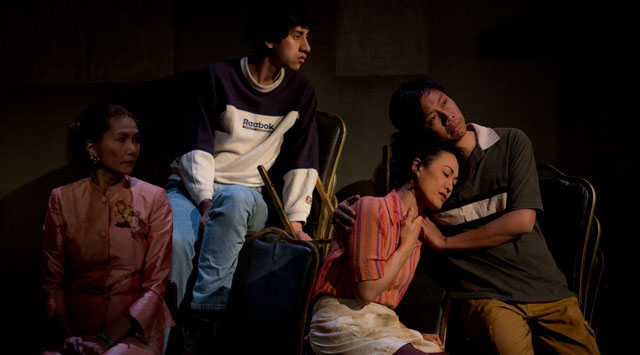
Image by Lisa Tomasetti

Theatre review
Asian restaurants are a familiar sight in Australian towns everywhere, but what we know is restricted only to their dining rooms and service areas. In Australian Graffiti, Disapol Savetsila presents a fantastical, but bleak, look at what happens behind the kitchen door of these inscrutable spaces.

It is a story about Thai-Australians, both immigrants and native-born. Ben is a teenager, born in Sydney but who has since moved to an unnamed country town with his mother Baa, proprietor of the local Thai restaurant. Boi, Loong and Nam are employees stuck in the kitchen, with only work as salvation, completely cut off from mainstream society. When graffiti appears on one of the local churches, bearing Thai characters, the town takes the opportunity to carry out their racism, boycotting and harassing the group of five outsiders.

Savetsila’s seamless interweaving between surrealism and realism, creates his own universe of storytelling, where fact and fiction, tangibility and metaphysical, coexist to reveal truths of Australian life from the perspective of cultural minorities. Australian Graffiti is a play for the marginalised, speaking to and for communities with a voice rarely represented in our artistic landscape. It is a sign of the times, a valuable work that heralds the arrival of a new generation of creators that can only materialise with a certain level of social maturation.

The production is sensitively rendered by director Paige Rattray, whose gentle melancholy allows the play’s poignancy to sing through, with a deep and painful authenticity. Australian Graffiti is often darkly humorous, and Rattray’s depiction of its personalities is suitably nuanced, revealing both the good and the faults of the people we meet, even the ones who experience persecution.

Tenderly and imaginatively lit by Sian James-Holland, with music by Max Lyandvert and sound by Michael Toisuta that take us through subtle fluctuations of emotional states, the design creatives do an excellent job of turning a vast auditorium into a surprisingly suitable stage for Savetsila’s intimate writing.

Mason Phoumirath is impressive as Ben, passionate and convincing with what he presents as lead actor. His relation to place and people feels remarkably genuine, even though the circumstances are highly unusual. There is a psychological accuracy in his portrayal that gains our empathy, and the stories we hear become believable as a result. Gabrielle Chan and Kenneth Moraleda bring vulnerability and sentimentality to the show, with intensely moving expressions of the migrant experience, bringing attention to the play’s humanitarian concerns.

Underneath so many of our world’s surfaces, resides a threat of violence. Australia’s colonisation, our history of it and the continuing project of it, is rarely spoken of with sufficient honesty, and like any human defect that is left unattended, disease inevitably transpires. Ben’s family is of Thai origin, and their enemies are European. The lack of an Indigenous presence in their battle, is symptomatic of our inability to recognise what is fundamentally true of the land that we share, and whenever we are unable to acknowledge the root of our problems, they can only persist.

www.sydneytheatre.com.au

Review: Before Lysistrata (Kings Cross Theatre / Montague Basement)

Venue: Kings Cross Theatre (Kings Cross NSW), Jul 10 – 22, 2017
Playwright: Ellana Costa
Director: Saro Lusty-Cavallari
Cast: Ellana Costa, Alex Francis, Michaela Savina
Image by Zaina Ahmed

Theatre review
We know Lysistrata as the one who convinces the women of Greece to deprive themselves of sex, in order that their men would cease fighting each other in the Peloponnesian War. In Before Lysistrata, playwright Ellana Costa imagines a scenario that leads up to that audacious act. Lysistra and Lampito are the first ladies of Athens and Sparta, each representing a different side of politics.

It is the left and right wings of society, again at loggerheads. Whether 400 BC or 2017 AD it seems, we are determined to make enemies of one another, unable to be at peace with the idea of disagreement. The men go to war, determined to quash the other side, so that the world only needs contain one uniform ideology. With the death of sons that inevitably result, the ladyfolk band together, and hatch a plan to end the atrocities.

At points where the lines of good and evil are blurred, when us and them are disrupted, the show becomes refreshing. Its message can however, feel simplistic, as do its characters and dialogue. Wit and drama can be found in Costa’s well-meant text, but performances are unfledged, and the production never really builds enough tension that would allow sparks to fly. Few artistic risks are taken that will offer elements of surprise or intrigue. Its political interest holds court, central and singular.

Where there is solidarity, great things can be achieved. For each generation that experiences increasing social fragmentation, the idea of organised processes of action becomes correspondingly alien. That we can be unified, must not only be an abstraction, but how we get there, is more bewildering than ever before.

www.montaguebasement.com

Review: Neville’s Island (Ensemble Theatre)

Venue: Ensemble Theatre (Kirribilli NSW), Jun 29 – Aug 12, 2017
Playwright: Tim Firth
Director: Mark Kilmurry
Cast: Andrew Hansen, David Lynch, Craig Reucassel, Chris Taylor
Image by Prudence Upton

Theatre review
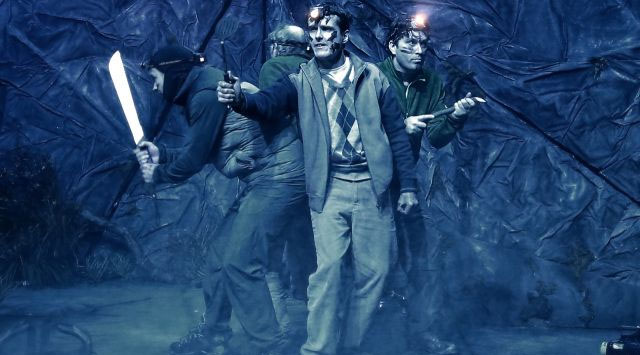
Four men are stranded on an island, after a corporate team building exercise takes a wrong turn. Neville is the senior of the group, who tries to keep things in order, while the other three middle aged men unravel, descending into various states of hysteria as the hours pass by.

Tim Firth’s 1992 comedy has at its centre, issues surrounding modern masculinity and the anxieties it triggers, but that important social concern only becomes a serious point of discussion, very late into the piece. For at least three quarters of the duration, its characters fumble around, struggling with having to deal with their sudden exposure to the wild. Their antics could mean hilarity to some, but depending on the sense of humour one possesses, the play could also be unbearably corny, tenaciously so, for many.

The actors are well rehearsed, each one demonstrating excellent conviction, but the writing offers little in terms of nuance that could allow any of them to truly impress. Quite remarkably, the cast succeeds at making individual characters believable, even though the play’s attempts at depth are precarious at best.

The stage is consistently lively, and when chemistry does take effect, their show can offer quite compelling entertainment. Neville’s Island is determined to amuse. Even if one is not tempted to laugh out loud, there is something satisfying in its earnest and enthusiastic tomfoolery, like every well-meaning dad joke that one would hate to miss.

www.ensemble.com.au

Review: Little Borders (Old 505 Theatre)

Venue: Old 505 Theatre (Newtown NSW), Jul 4 – 15, 2017
Playwright: Phillip Kavanagh
Director: Dominic Mercer
Cast: Lucy Goleby, Brandon McClelland
Image by Kate Williams

Theatre review
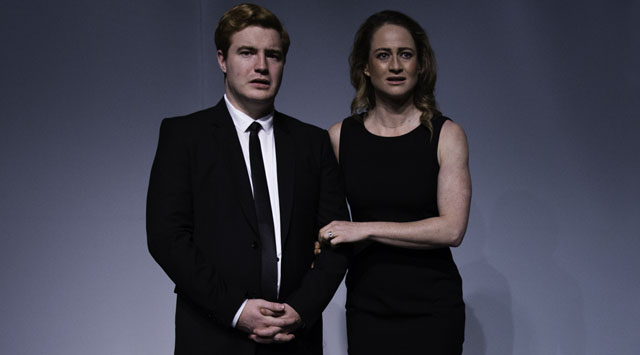
Elle and Steve are moving houses, because they have convinced themselves that their Middle Eastern neighbour is a terrorist. Little Borders by Phillip Kavanagh, is about the paranoid, fearful and narcissistic people that many of us have become, in a confused world that has us believe that things will go wrong in an instant, and that other people are to blame.

The young couple is bestowed every social and economic privilege that could give them the best opportunity at a comfortable existence, yet they are full of volatility and hostility, obsessed with the idea that their lives are going to fall apart at any given moment. Their self-destructive behaviour is depicted with biting astuteness by Kavanagh, who reveals the insidious nature of hate in our contemporary communities.

The production is suitably dark, if slightly too predictable in its despair. The important messages of Little Borders are given remarkable elucidation by director Dominic Mercer, and we leave shaken by our disastrous reflection, but the show has a tendency to feel too safe and slightly unambitious in its interpretations of Kavanagh’s bold writing. We sense that the words provide room for a greater theatricality, although its minimalism is nonetheless effective, and beautifully executed. Set design by Charlie Edward Davis and Jeremy Allen, is understated but charming, and undeniably memorable.

Actors Lucy Goleby and Brandon McClelland prove themselves to be highly accomplished in the piece. Goleby’s intensity, although quiet and contained, is a captivating study of Elle, a woman gripped by insecurity and irrational anxiety. She keeps us inquisitive, and terrified, by her authentic manifestation of a person that we sometimes find ourselves being. McClelland is a charismatic presence, with immaculate hair and perfect teeth providing disguise for a character that has no redeeming features. His juxtaposition of clean cut suburban wellness against the pure evil of Steve’s words and actions, is chilling, and perversely entertaining.

It is a frightening look at the psyche of our worst neighbours. The play resonates with an alarming accuracy, even though the events that unfold are very dramatic and extreme. It is truthful in what it says about modern life; the interminable feeling of inadequacy, and the need to infringe upon the lives of others, as we proceed to suppress everything that we have no understanding of. We are not told however, how it is that Elle and Steve have become such monsters; Kavanagh’s deliberate omission is provocative. We should really know those reasons for ourselves. These are our middle class lives, and we know these people. All the evidence that would explain their madness must already be in plain sight, if we choose to examine it.

www.old505theatre.com

Review: Cloud Nine (Sydney Theatre Company)

Venue: Wharf 1 Sydney Theatre Company (Walsh Bay NSW), Jul 1 – Aug 12, 2017
Playwright: Caryl Churchill
Director: Kip Williams
Cast: Matthew Backer, Kate Box, Harry Greenwood, Anita Hegh, Josh McConville, Heather Mitchell, Anthony Taufa
Images by Daniel Boud

Theatre review
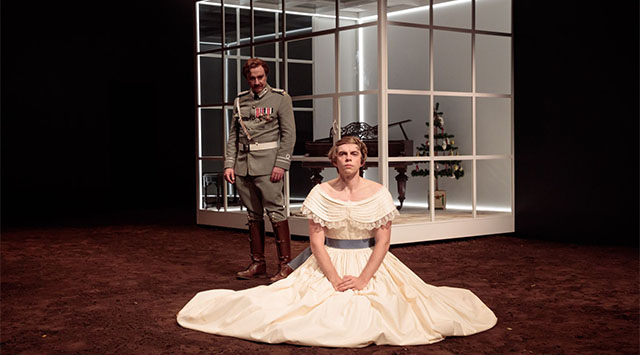
Betty takes a long time to grow up. In fact, it is centuries before she becomes her own woman. In Act I, she lives in Victorian era Africa, having moved from Britain with her husband, a “colonial administrator”. In Act II, we find that not only has she advanced in age, time itself has moved abruptly to the current day.

Caryl Churchill’s Cloud Nine is about the way gender, with all its associated contrivances and constraints, is imposed upon individuals in Western societies, ruthlessly reinforced time and time again, in service of a white patriarchal project that seems to have no beginning and no end. It is a scheme that benefits few, and as we see in the play, no one is left unscathed by its oppressive nature.

The absurdities inherent in the practice of gender and whiteness, are shrewdly re-purposed for all of Cloud Nine‘s outrageous comedy, as well as its very scintillating drama. Churchill’s creation might be near on 40 years old, but its uncompromising boldness remains deeply affecting. Ensuring that the work’s confrontational qualities are retained, is director Kip Williams who pairs a flamboyant theatricality with a keen eye for detail, to deliver a show that is as entertaining as it is challenging, and quite surprisingly, profoundly moving.

Actor Heather Mitchell is phenomenal in the production. Playing Betty in Act II, and Betty’s young son in Act I, she works her magic to elicit our compassion, demanding that we respond with the best of our humanity, even when her characters are going through the most precarious of story lines. Whether playing a woman her own age, or a boy of nine, we believe all that she offers, and allow her to take our emotions on an intense but rewarding ride.

Also very memorable is Josh McConville, effortlessly but uproariously funny, again in dual roles of adult and child. As Betty’s husband Clive, he amuses us without giving access to any empathy for his despicable character, and as little Cathy, we fall for the wonderful innocence and irresistible cuteness he introduces, never mind that he looks nothing like a 5 year-old girl. The show is remarkably well-performed. Each member of the ensemble feels a star, and we connect with every personality being presented.

A pristine glass box sits upstage, tightly shut, desperately trying to enclose and protect itself. Representing a Western civilisation that insists on maintaining its incongruity with nature, Elizabeth Gadsby’s set design is a simple concept that speaks volumes. Times can change, and our societies have made progress, but that instrument of containment stays resolutely in place. As our efforts to erode structures of injustice and inhumanity continue, and as we observe transformations occur slowly, we can reach for ourselves, the experience of personal emancipation, so sweet, so wonderful, even if it is actually, no more than a state of mind.

www.sydneytheatre.com.au

Review: The Rover (Belvoir St Theatre)

Venue: Belvoir St Theatre (Surry Hills NSW), Jul 1 – Aug 6, 2017
Playwright: Aphra Behn
Director: Eamon Flack
Cast: Gareth Davies, Andre de Vanny, Taylor Ferguson, Leon Ford, Nathan Lovejoy, Elizabeth Nabben, Toby Schmitz, Nikki Shiels, Kiruna Stamell, Megan Wilding
Image by Anna Kucera

Theatre review
It is mid 17th century, and a bunch of rowdy English tourists descend upon Naples to partake in the masqueraded festivities of Carnival time. Aphra Behn’s depiction of wild revelry may be restricted by mores of the Restoration era, but its spiritedness is nonetheless unmistakable. In its atmosphere of debauchery, the characters talk of love and marriage, preoccupied with the sport of spouse hunting.

The play is conventional, but as the production’s prologue asserts, we cannot ignore Behn’s position as England’s first woman playwright, or the feminine perspective that her work brings to the stage. Although women are again, and literally, divided into virgins and whores in The Rover, they each act with agency, and their desires are provided due significance. Whether nuns or courtesans, we always know what it is that they want for themselves, and we watch them going about procuring what are essentially self-determined lives.

Director Eamon Flack delivers a thoroughly enjoyable work of high octane comedy, playfully inventive in approach, and unabashedly raucous with its expressions. Details can become confused, as the show’s humour takes first priority, but narratives are of slight importance in a show of this nature. It dazzles and it delights, with Mel Page’s brilliant work as set and costume designer scoring high; the imagery presented by The Rover is deliciously colourful and consistently alluring. Lights by Matt Scott are jaunty and energetic, with the inclusion of a “follow spot” enhancing the vaudeville quality of performances.

It is a remarkable cast, unrelenting with their extraordinary exuberance and skill. Flack showcases each of the player’s idiosyncratic sense of humour, while maintaining a cohesion to the comedy style of his creation. Megan Wilding is a standout in dual roles, seductive as the saucy temptress Lucetta, and delightfully foulmouthed as the maid Moretta, but always irresistibly funny and disarmingly magnetic, no matter the personality we encounter. As the charming cad Willmore, Toby Schmitz is a refreshing presence, theatrical but with a striking spontaneity that introduces a hint of danger, to the inevitable predictability of the story.

American comedian Beth Stelling says, “nothing makes a dick go softer than a funny woman.” The fallacious idea of women being less effective in comedy, still persists, but in The Rover, five comical women and five humorous men demonstrate that the funny bone recognises only talent, unconstrained by notions of gender. From Shakespeare to Gogol, and from Chaplin to Gervais, male geniuses have staked their dominance in the field. Spaces in art, like in commerce and politics, continue to be usurped by the masculine, but feminine retaliation is underway, as it has for generations, in this seemingly unending operation. After all, a woman’s work is never done.

www.belvoir.com.au

5 Questions with Blake Erickson and Nicholas Starte

Blake Erickson

Nicholas Starte: The process of stepping into the role of such an iconic member of Australia’s history must be confronting. Has that affected your process compared to previous characters you’ve played?
Blake Erickson: I’ve played historical figures before and I find the process easier than creating a character from scratch, to be honest. Their life history is laid out before you, first-hand accounts of who they are and how they responded to events exist so you have a kind of blueprint for a character before you even begin. That said, this isn’t a historical re-enactment. This is a dramatic story based on real events. Cook is a colossal figure in British history, but in Australia and elsewhere his legacy is often linked with the tragedy of European invasion and imperialism. Between those extremes existed a human being and that’s what I’m interested in.

Why do you think this relatively unknown part of Cook’s history is important to Australian audiences today?
Absolutely. Australia has a lot of soul searching to do, the process of reconciling our history is ongoing. Cook didn’t discover Australia, New Zealand, the islands of the South Pacific or anywhere else inhabited by people. He was the point of first contact between the British and indigenous peoples across the world. What’s significant about Between Worlds is it allows this first-contact story to be heard from the side of indigenous Hawaiians. I think it’s really important that Australians don’t think of British explorers as “us” and indigenous people as “them”. I hope this show makes Australians pause and consider the side of history they’ve perhaps automatically aligned themselves with.

As an actor, what is your favourite part of developing new works?
It’s pretty darn cool when you’re the first person to perform new material, or better yet have material written especially for you. But more than that you get to help own the production in a way that you can’t when you receive the final script and get directed and choreographed into it. It’s the difference between wearing something tailor made and buying something off the rack.

Having been involved in a number of workshops of this piece, how has it developed from your first experience, to now?
I’ve worked on the development of many, many, many new Australian musicals. This is probably my tenth workshop of a new musical, this is my third on Between Worlds alone and I knew from the very beginning that Between Worlds was special. The marriage of musical styles between European music theatre and traditional Polynesian harmonies was utterly captivating from the get-go. The show is also a study in the frailty of people, and how a relentless desire to secure a legacy can prove lethal. I’m thrilled that with each workshop it just has gone from strength to strength and I’m so excited for people to see the show. Something I do not say about every show. Ahem.

How can you relate to this portrayal of Cook?
I’ve spent a lot of time in the Pacific region. I’ve travelled through French Polynesia, New Caledonia, Fiji, Hawaii, Wallis et Futuna, and spent a bit of time in Papua New Guinea as a kid. It’s a part of the world that is extremely close to my heart. Cook loved the Pacific, he literally idolised Polynesian culture in a way no European had ever done before. He’s also a man who feels that he has unfinished business, and I think any actor if they’re honest would tell you that no matter what you may have done it’s all about what’s coming up over the horizon. I’m just fortunate that what lies ahead is this beautiful show. Now, Nic, some questions for you…

Nicholas Starte

Blake Erickson: In a workshop how much influence does a performer have over the development of a new show?
Nicholas Starte: I think, like it or not, just having a work spoken out loud by actors for the first time brings out a whole new dimension. Fortunately for us, Nick, Gareth and Jason have given us a rare opportunity; a workshop space that feels extremely safe, where ideas are encouraged. I love this way of working and I think actors can be an author’s greatest resource, because it’s a chance to hear their characters fought for individually and not just looked at as a whole.

What’s been your favourite part of the process of workshopping a new Australian work like Between Worlds?
I love discussion. And anyone who has been in one of these workshops with me will know, this is easily my favourite part of the process. Talking about themes, coming up with ideas, problem solving, it’s just the best! I just have to reign in my excitement from time to time.

What do you see as the relevance of a musical about the death of captain cook to contemporary Australian audiences?
It really comes from the fact that this is not just a story about Captain Cook, at least, not the Cook we know from primary school. This story is about cultural conflict, seeing other cultures through the gaze of our own and the need for empathy, something that, frankly, is lacking today. We may be more exposed to other cultures and ways of life than ever before, but if anything, we’ve grown more ignorant of them. This play is a chance to see both sides of the story and also hear the part of Cook’s story we never heard as kids.

Just how difficult is the Hawaiian language component of the role?
Look, I’m not gonna lie, it’s a struggle, not just because it’s a foreign language, but it’s a dialect that has very little material for reference. While the language is still alive, the way it is spoken and the way many Hawaiians speak English has become very diluted. We’ve been taking accent inspiration from Polynesian and Maori accents and used the rules of the language itself to dictate the way we speak, but mate… those single syllable diphthongs are doing my head in!

How familiar were you with the historical events that form the basis for our play?
I was in the position I think most Australian audiences will be on first seeing this show. No bloody idea mate.

Blake Erickson and Nicholas Starte are appearing in the rehearsed workshop performances of Between Worlds the musical.
Dates: 15 – 16 July, 2017
Venue: ATYP

5 Questions with Ellana Costa and Michaela Savina

Ellana Costa

Michaela Savina: Who do you believe is the most effective ancient Greek villain?
Ellana Costa: My favourite villains are the Sirens from the story of Jason And The Argonauts. I love that their power can be felt from a distance. I love the idea that these women play into the stereotype of the beautiful, mysterious woman that all men want, only so they can lure these men to their deaths. I also love the image of Jason, so desperate to see and hear the Siren song, that he ties himself to his ship. Talk about a glutton for punishment.

How do you find it performing your own writing?
I think every writer should be forced to perform that own writing at least once. It changes the way you see the writing process. I’ve always enjoyed working in a collaborative way and I’ve noticed a lot of changes I’ve decided to make from the script, to my character particularly, have come out of a realisation that the way I think doesn’t always translate well to the page. The exciting thing, however, about performing a character I’ve created, is that I really feel like I know Lampito. I feel like I understand her and why she is making the choices she’s making.

What’s your favourite thing about Lampito?
I think Lampito is incredibly strong, but I think what I love most about her is the way she shows her strength. She lives in a society where she is often looked down on because she is a women, but when she sees something she thinks is wrong, she say something. Even though she knows it will result in pain for her. She has a real moral backbone that I think is beautiful.

How would you define strength?
I define strength as resilience. To be strong doesn’t mean never falling, or never being upset, or never feeling like you can’t do it. For me, strength is feeling those things, acknowledging them, and then taking the steps you can to get back up. You can’t be strong without vulnerability, and when you are vulnerable you’re able to show your strength.

Who do you call to serve on your utopian action squad?
Well, it would be a combination of fictional and real world bad ass ladies. Let’s start with the obvious one: Wonder Woman. She is a n Amazonian goddess and will obviously be leading our party. I would then request Beyonce for soundtrack, general inspiration and fierce moves. I would also ask Black Widow from Avengers (for DC/Marvel mashup) and then I think I’d end with Geena Davis. That woman is an Olympian archer and super hilarious. Couldn’t image a better crew.

Michaela Savina

Ellana Costa: If you could be any one (or anything) from an ancient Greek myth, who would you be and why?
Michaela Savina: I think I would have to go for Circe because she’s got all of this badass magical power. Also in Odyssey she turned all the men in to pigs which is a move I really endorse.

Who is your feminist role model and why?
It’s like picking a favourite child this question, I think I’m going to go with Joan Didion as basically half my actions in life are just trying to make myself more like her.

What is the most interesting element of Lysistrata’s story for you?
In our adaption I think we’ve really drawn out the idea of sacrifice and what exactly that looks and feels like on a human level. I think understanding that sometimes the same sacrifice can land very differently for people is quite interesting.

What is your favourite thing about playing Lysistrata?
I really love playing her personality quirks, even though she has all this expertise and intelligence her emotional intelligence and social skills are quite lacking and that’s always fun to play. She really does mean well but she just slightly misses the mark.

Dead or alive, who is present at Lysistrata’s symposium on 21st century politics?
Ruth Bader Ginsberg, Arundati Roy, Yassmin Abdel-Magied, Georgia O’Keefe and Patti Smith, I’m kind of thinking about the post symposium drinks, my god that’d be some fascinating conversation.

Ellana Costa and Michaela Savina can be seen in Before Lysistrata by Ellana Costa.
Dates: 10 – 22 July, 2017
Venue: Kings Cross Theatre

5 Questions with Tom Christophersen and James Dalton

Tom Christophersen

James Dalton: What are the three most common mistakes people make when their house is haunted?
Tom Christophersen: I’m really glad you asked this. This is important stuff. When people encounter paranormal activity they usually do one of the following three, very dumb, things…

1) Deny everything, or worse, blame the strange chewing noises in the attic on the family cat. It’s never the cat. If paranormal reality television is anything to go by, ignoring creepy stuff is just going to bring about your quick and violent demise as the spirits/demons/energy in your house raise the stakes in order to prove its presence to you.

2) Burn the ouija board. Never burn the effin’ ouija board. It’s a portal. Spirits cannot return to the dimension they have been summoned from if you trash the portal. Think demonic ‘Sliders’. Put the board somewhere safe and priest-up. Get the heck blessed out of it and then have it removed and stored far, far away from your mortal soul.

3) Refuse to move. If your walls are bleeding ectoplasm, your children are possessed and your family pets are under spiritual attack, it’s probably best to leave. Immediately. Don’t even pack. Moving house can be financially demanding – but your life is more important than your credit history.

I’m about to die, how can I become a ghost?
Make sure you are really, really sad. Or better yet, furious as hell. It seems that people who die experiencing an extreme negative emotion are more like to imprint their energy onto a place/building/object. Similarly, murder victims often appear as ghosts, echoing clues or messages about their demise to the living. If you have unfinished business on earth, you’re likely to stick around.

You say your dad encountered spirits when you were a child. What lasting effect has this had on you?
At the time I thought it was completely normal. My parents divorced when I was about ten. I have distinct memories of Dad coming over to rental properties we (my mum, my sister and I) were thinking of putting in offers for to ‘check them out’ for ‘anything suss’ – ghosts. It was only when I was a teenager that I started to ask more questions about my dad’s experiences. For the record my father is the very picture of Agnostic-straight-white-Australian-masculinity which added to the mystery of these stories and encounters which became almost unspoken family lore as I grew up in Adelaide. It set up an idea in my head that the fantastic and the domestic could cohabit the same place.

What is queer about ghosts?
The American-based ‘Spiritual Science Research Foundation’ claims that 85% of gay men are possessed by female spirits (reverse that for lesbians). I’m not too sure that math checks out for me personally but it’s a pretty insane answer, right? Honestly though, I think there are ideas of otherness and outsiders that can be related to thinking around queer culture and ghosts. Both these things have been relegated to exist in the specific peripheries in our culture and so hold a certain taboo power. I guess both have the ability to scare people. They are both explainable but not with the scientific tools available to us at the present time. They both make complete sense in my mind.

Who would be a GILF?
So I’m going to assume that they are going to appear in their prime, right? If yes, then James Dean (total queen), River Phoenix… and Elvis because god dammit those eyes.

James Dalton

Tom Christophersen: Why is telling ghost stories in the theatre important?
James Dalton: Theatre is a ghost story. Our stages are haunted and we all huddle together in the dark like toffs at a Victorian séance, waiting to clap the dead away for the night.

Your work is often surreal. Why is surrealism important to you and how does Business Unfinished carry this notion of the fantastic?
Naturalism and realism say “this is how the world ought to be”, but surrealism croaks “this is how the world is”. Talk to children, talk to people up late and anxious, talk to someone in shock, talk to someone manic with joy: they all do, feel and see things that are bent from the norm. It’s unhealthy and worse to hide and deny such things, only telling people how there is a limited way we ought to be.

Business Unfinished is surreal in that you have brought these powerful images from the fringes of your waking life, introduced them to experiences from the fringes of other people’s lives, and share them in a mode that is both endearing and horrifying.

What five items would you insist be included in your personal ghost busting kit?
Audio recorder. Night-vision camera. My great-grandmother’s rosaries. Salt. Thriller on cassette.

What is your favourite scene from a foreign horror film and why?
The final video footage sequence at the end of J-horror classic Noroi: The Curse. It features people standing still in a way that feels wrong, and this is by far the most terrifying thing anyone can ever see.

Where do we go after we die?
We become the song that everyone remembers us dancing to.

James Dalton directs Business Unfinished, written and performed by Tom Christophersen. The show is a part of Bondi Feast 2017.
Dates: 27 – 29 July, 2017
Venue: Bondi Pavilion