Review: A View From The Bridge (Old Fitz Theatre)

Venue: Old Fitzroy Theatre (Woolloomooloo NSW), Oct 18 – Nov 25, 2017
Playwright: Arthur Miller
Director: Iain Sinclair
Cast: Ivan Donato, Giles Gartrell-Mills, David Lynch, David Soncin, Zoe Terakes, Janine Watson, Lincoln Younes

Theatre review
It is always good to see the bad guy fall. In Arthur Miller’s A View From The Bridge, Eddie is the patriarch who gets torn down fantastically by his own moral infractions. The dramatic tension is derived however, not from the pleasure of witnessing his ruin, but from the delusions that he suffers, in his inability to see the damage he causes, as he goes about doing what he incorrectly perceives to be good and right.

The work is an indictment of the archaic and unjust systems of social control we continue to endure, but its poignancy lies in the portrayal of fragility and discontentment in those who are thought to benefit most from those infringements. A View From The Bridge is about toxic masculinity, and the destruction that men bring upon themselves by perpetuating traditional notions of gender. Instead of fulfilling their promise of order and prosperity, Eddie discovers that the power he so stubbornly clings to, reveals itself to be of service to none of the people or ideals he holds dear.

The greatest success of this tremendously gripping production, is director Iain Sinclair’s rendering of Eddie as a tragic but unsympathetic character, made to be held accountable for his actions. We see his immense vulnerabilities but are dissuaded from making concessions on his behalf. Miller’s text is romantic in its depictions of the working man, but this is a production that emphasises, appropriately, his culpability and faults.

Actor Ivan Donato is spectacular in the role, simultaneously savage and sensitive, allowing us to view Eddie from the psychological personal and more importantly, as the indefensible villain of the piece, even if Miller’s narrative has a precarious tendency to position him as victim of circumstances. It is important that although we understand the character intimately, we are prevented from ever letting him off the hook. Donato provides all that we require to judge as harshly as he deserves.

The 1950s American melodrama of the piece, is deliciously executed by all the cast, each one intense and exacting in their contributions. It is an incontrovertibly powerful show, magnificently operatic with its exhibition of emotions, forged through meticulous and nuanced deliberation. As individual performers, all are captivating, and as an ensemble, their collective chemistry is quite explosive.

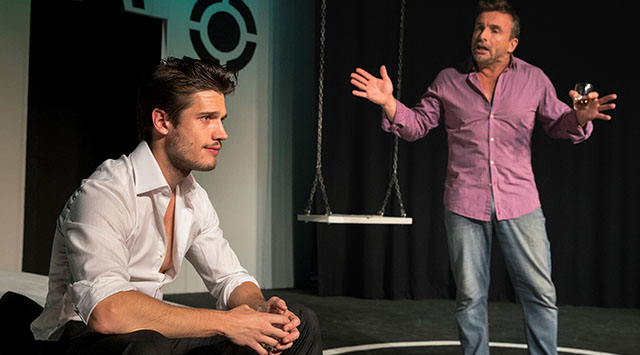
Sinclair’s inventive use of space, across two planes, cross-shaped in its “theatre in the round” format, keeps us thrilled and engaged. Defenceless against the huge personalities and their extravagant exchanges, in these very close quarters, we get involved, in the most meaningful way, studying closely as each scene unfolds, shifting our moral compasses as the plot moves us purposefully through violations and conundrums. There is incredible sophistication in the director’s approach; our hearts and minds are told a story with astonishing expertise. Also remarkable is Clemence Williams’ work on sound design, with its ebbs and flows manipulating at will, every transformation of atmosphere, whether lavish or minute.

Eddie makes repeated demands about being given respect and honour, but does not offer the same to others. His narcissism expects that he alone wears the pants in the house, and everything else falls into place accordingly, as a matter of course. Even when his preposterous behaviour lands him in hot water, he thinks that the world has wronged him. We can tell the misogynists and homophobes that their actions and attitudes need fixing, but like Eddie, most will not acknowledge the evil that they produce. Waiting for broken systems to mend themselves is futile. In a way, A View From The Bridge suggests that radical force is inevitable in real progress, but violence must never be considered the only means to an end, even if it is excellent entertainment, witnessing brutal torture of our enemies.

www.redlineproductions.com.au

Review: The Big Meal (The Depot Theatre)

Venue: The Depot Theatre (Marrickville NSW), Oct 18 – Nov 4, 2017
Playwright: Dan LeFranc
Director: Julie Baz
Cast: Cormac Costello, Emily Dreyer, Angus Evans, Suzann James, David Jeffrey, Tasha O’Brien, Brendan Paul, Kaitlyn Thor
Image by Katy Green Loughey

Theatre review
Things happen very quickly in Dan LeFranc’s The Big Meal. Nicole and Sam meet at a restaurant, and their lives flash before our eyes, from courtship and marriage, through to childbirth, sickness and death. The play is not about the peculiarities of any of the characters we meet. In some ways, it is about the insignificance of the individual existences we believe ourselves to inhabit. Taking the “circle of life” approach, LeFranc attempts to chart the journey of a human being, from beginning to inevitable end.

It is the idea of a “typical” person that The Big Meal is concerned with, but it cannot go unnoticed, that it is strictly an American middle class heterosexual paradigm that it is interested in depicting. In the play, the people do little but give birth, raise children, and repeat. It is not the intention of the work to include a wider scope of what these characters are capable of, or indeed the other responsibilities that they doubtless will have. We see only one facet of their worlds.

The Big Meal means to speak universally, but the experiences therein are, to many, exclusionary. Nonetheless, it is a dynamic piece of writing that will facilitate very vibrant stage activity, and director Julie Baz makes sure that her show is an exuberant one. Scenes unfold before us, fast and furious, in a race to the end. We think about mortality, as though a delicious meal that must only be finite. It is noteworthy that Mehran Mortezaei’s lights take us efficiently through each of the play’s dramatic leaps across time, with minimal hassle in the transitions between.

Performances are generally strong, by a crew of actors clearly delighted by the wide range of personalities that each is called upon to undertake. Their transformations are a joy to watch. Cormac Costello and Suzann James are particularly memorable in the final moments, with a tenderness and an emotional authenticity that has us captivated, and touched. Also impressive is Brendan Paul, who plays innumerable boys and men over the course of 100 minutes, proving himself to be an engaging, disciplined and passionate presence.

Talking about death is important. The acceptance and awareness that our lives come to an end, extends our consciousness beyond the self. It frees us to be better people, kinder and more generous in all our dealings. To understand that we are all transient in the bigger scheme of things, could wake us to our duties as custodians of the planet, or at least remind us of the inconsequential nature of all the things we may struggle with, in our day to day. One should be moved to think about legacy, and find inspiration to leave behind something wonderful, or simply to depart having caused no harm.

www.thedepottheatre.com

Review: The Kitchen Sink (Ensemble Theatre)

Venue: Ensemble Theatre (Kirribilli NSW), Oct 14 – Nov 18, 2017
Playwright: Tom Wells
Director: Shane Bosher
Cast: Ben Hall, Huw Higginson, Duncan Ragg, Contessa Treffone, Hannah Waterman
Image by Prudence Upton

Theatre review
The story happens in a working class household, north of England. Kath and Martin are regular people with regular concerns; they worry about job security, and try their best to provide for their children. Sophie and Billy are on the precipice of adulthood, but yet to find their own wings.

There is no big drama in Tom Wells’ The Kitchen Sink, only an intimate authenticity to its depiction of family life that most will find deeply charming. The characters connect in a simple but profoundly honest way, and whether or not our circumstances are similar, it is in Wells’ acute observations of those ties that bind, that the play allows us to empathise.

A remarkable warmth pervades the stage, and it moves the audience. For the production’s duration, we are all embroiled in the daily lives of these ordinary people, who have very quickly, and magically, become our kin. Director Shane Bosher manufactures a space that puts us at immediate ease, ready to get involved in every domestic exchange that occurs. Simultaneously sensitive and robust, Bosher’s approach not only makes The Kitchen Sink an affecting experience, it is also memorably and delightfully funny.

Thoroughly rehearsed and finely considered, a cast of five quite extraordinary performers, present a work of impressive art and entertainment. As Kath, Hannah Waterman’s passion, charisma and infallible sincerity, anchors the show in a place that always feels genuine and benevolent. She exemplifies all that is good about the maternal instinct, and we in turn, become generous ourselves, in how we receive the show.

Duncan Ragg and Contessa Treffone play a young couple, close but not yet committed. Both are intricate in approach, with ingenious inventions that enrich the personalities they create so convincingly. Ben Hall and Huw Higginson are father and son, each actor extremely likeable, and we find ourselves persuaded by all that they bring to the stage.

The Kitchen Sink begins and ends at home. Whatever our individual lives may become, those of us who have a home to return to, must count ourselves lucky. Stars will rise and fall for every existence, but to have unwavering love and security from those we count family, is invaluable. We rightly put great attention on things like money and careers, but there is no fault greater than neglecting the sacred.

www.ensemble.com.au

Review: Miracle City (Sydney Opera House)

Venue: Sydney Opera House (Sydney NSW), Oct 12 – 29, 2017
Books & Lyrics: Nick Enright
Music & Concept: Max Lambert
Director: Darren Yap
Cast: Missy Higgins, Josie Lane, Lara Mulcahy, Gus Murray, Liam Nunan, Anthony Phelan, Kelly Rode, Jessica Vickers
Image by Branco Gaica

Theatre review
The Truswells are American televangelists who make commerce out of religion, by commodifying faith and targeting herds of desperate souls. They put on a weekly TV show, promising inspiration, redemption and salvation, in exchange for cash from their loyal viewers. Behind the scenes however, the family is going broke, as they try unsuccessfully to fulfil ambitions of expanding their operations.

Miracle City depicts an absurd slice of life, but the production is rarely funny. The plot trudges along, offering no surprises and only few instances of amusement. In the absence of humour, we search instead for poignancy, which disappointingly and quite bewilderingly, never arrives. It is fortunate then, that the show features excellent singing and a pleasing score of Christian gospel music.

The cast works hard, with leading lady Kellie Rode bringing a valuable sense of vibrancy and polish to the show. Gus Murray cuts an imposing figure as Reverend Truswell, but it is a portrayal that seems insufficiently sinister in this tale of crushed dreams and broken morals. A trio of choristers provide some stunning powerhouse vocals that lift the mood, thankfully, at very regular intervals. Missy Higgins, Josie Lane and Lara Mulcahy play subsidiary characters, but their voices are the highlight of a musical that is otherwise strangely passionless.

We pay businesses to satisfy our needs, but we want them to be transparent in our dealings. Religion can give a lot to individuals, but the magic that they perform, often relies on obfuscation and mystery. We need to be in touch with the sacred, but we do not wish for access to the venerable be contingent on trade. Those who peddle in the divine, are therefore deceptive and hypocritical, whether on trash TV or in our more hallowed institutions.

www.thetheatredivision.com

5 Questions with Paul Blenheim and Jennifer Vuletic

Paul Blenheim

Jennifer Vuletic: Had you read Merciless Gods or much else of Christos Tsiolkas’ work prior to becoming involved in the stage production of Merciless Gods? 
Paul Blenheim: Yes, I’m a big fan of Christos Tsiolkas and Tina Arena. When Stephen asked me to develop Merciless Gods, I was like, ‘where do i sign?’ and he was like, ‘just here on the dotted line like every other contract, you idiot’. And I was like, ‘ok, calm down sister’ and then we had some chardonnay and celebrated with $7 worth of chips and some meats. 

Did you bring to bear any of your own experiences of growing up as an ethnic queer kid in Melbourne to the rehearsal process?
No. I am part Italian but I grew up on the central coast and i may have been forced to do a bucket bong in a sand dune in the 90s but I’ve never chopped limbs off or been made to jerk-off a fat pimp on ecstasy so I’ve had to go and be imaginative. 

How does Merciless Gods sit within the context of other Little Ones Theatre productions that you’ve performed in? 
It’s similar to other Little Ones productions in that I take my clothes off and kiss men that are four times the size of me but, other than that, I’d say this is new territory in terms of content and style. It’s still an event. It still throws a plate of asparagus at the wall of heteronormativity in similar fashion to that plate throw in American Beauty. It’s still beautiful in design but it has a quietness or stillness to it that gives room for the text to grip your heart, rip it out, give it a lick like it’s a well-cooked piece of kangaroo from the (insert whatever pub in Sydney needs a boost) and then put it back in and revive it. It’s my favourite. My drama teacher once told me that I was the Annette Bening of the Central Coast. Ok, she didn’t. 

Little Ones Theatre have been described by The Age’s Cameron Woodhead as ‘a leading light on Melbourne’s indie scene’. How do you think Sydney audiences will respond to the company’s work, and this production in particular? 
Look, I’m happy for the company to take the credit for that one even though Cameron told me he was talking specifically about me in the Little Ones production of Nine back in 2002. No, Little Ones have been putting on some spectacular shows in Melbourne but I think Merciless Gods is the perfect show for them to bring to Sydney. It has Jennifer Vuletic in it. Whenever someone says Jennifer Vuletic and Christos Tsiolkas in the same sentence, you get on the Griffin website and pre-book your tickets to the Berlin Helpmanns. 

You’ve also worked with the likes of Hayloft Project, Sisters Grimm, Elbow Room and Dirty Pretty Theatre – is it an exciting time to be working in independent theatre?
It’s always exciting. I mean, it’d be more exciting if I was married to someone who owned a brewery or an airline. But this year has been the best year in a while for theatre in Melbourne and every time i fly back to Sydney on Ansett there is another incredible theatre company starting up that has to close the bar by the second interval (is Gladys invited to opening?) or new writers smashing it out of the ballpark. And the standard of acting in both cities never fails to blow me away. I can’t wait to bring this baby home via the West Connex. I’m so excited i could pee myself. Does Alan Joyce read this? Is Tanya Plibersek coming? Who the fuck is on the guest list? OMG have we invited Clover? I’ll trade you all of St Kilda for Clover Moore. 

Jennifer Vuletic

Paul Blenheim: What’s your favourite story in Merciless Gods and why?  
Jennifer Vuletic: Pauly, YOU’RE my favourite story in Merciless Gods – I find you endlessly hypnotic, quixotic, charming, enigmatic and compelling. In fact, why aren’t we doing the whole show about you, Annette? Nude of course, cos that’s how you roll. In fact, that’s how several of us roll in this show, nude or semi-nude. The entire show is revelatory – a peeling away of onion-skin layers, revealing not so much the onion, but the experience of what it is to be pungently, rawly, diced, sliced and julienned by the brutal sous chef that is life… OK, I think I’ve exhausted the vegetable metaphor, so to the question again… favourite story, to be in? “Hair Of The Dog”, as it’s so deliciously horrific to wrestle to the death with you and  the divine Brigid Gallacher like some kind of demented panther. To watch? Merciless Gods – civilised sociopaths being awfully beautifully awful to each other – a crazed car accident.  

You’ve done it all and your resume is ridiculous. Big musical theatre stage or small intimate drama stage? Discuss.
Dahhhhhhhling the frocks! the chory! the roar of the greasepaint, the smell of the… well, you get the drift. I love musicals, because everyone works so fkn hard for joy. To bring joy, sheer joy. But small intimate drama? Nothing to touch it for electricity, for the smell of fear, for nakedness (see above) of both flesh and soul.

How the hell did Nicolazzo convince you to come back to share the stage with the likes of me? (Or what drew you to the material/the company?)
He promised me vast sums of cash, tickets to the Palme D’or and an instant smash hit. Well, one out of three ain’t bad… I met Nicolazzo and fell immediately in love. He’s the best thing to hit Australian theatre in decades. Maybe ever. So we bonded over that quintessential Italian experience Brunettis, and I’ve been grovelling at his feet on the rehearsal floor ever since. And then there’s that Christos guy – he’s a beautiful, big-hearted bruin of a writer-person and I have loved watching the mutual regard and generosity and sheer artistry spiralling up out of the Dan Giovannoni/Christos Tsiolkas collaboration. The material is EVERYTHING. What actor wouldn’t leap at the chance to inhale this heady stuff? To play a grieving Italian mother, a vicious alcoholic German writer and a dying man? And then there’s this divine cast – Brigid Gallacher, Sapidah Kian, Charles Purcell, Peter Paltos and you, my love. Who’s that sixth cast member, I keep forgetting her name….. Add to that the genius of Katie Sfetkidis, Eugyeene Teh and Daniel Nixon and, well, I was a goner. They had me at “Hello, and would you consider wearing yellow socks?”

Proving that you’re capable of anything because you’re actually from heaven, you’re in the process of becoming an International Relations superstar. Following on from my suggestion that you play Norma Desmond as soon as possible, I’d like to know whether you would you prefer to play her or Ban Ki Moon? As in, Broadway or the UN? It’s crunch time.  
You are one funny bastard, Blenheim. You’ve got me there… Norma or Ban Ki Moon (now of course superseded by Antonio Guterres, but I kinda wish Helen Clark had been successful cos I would’ve LOVED to have played her:  “I’m riddy for my closeup Muster De Mulle”)… oh, I don’t know! The more I interrogate the vagaries and vicissitudes of International Relations, the slings and arrows of outrageous sanctions, and the notion that the leader of the free world is a giant infant with garden mulch for hair, I don’t know which way things are gonna go… hang on, hang on, that’s it – I play Norma AS Ban Ki Moon! Brilliant. Solved.

To be on stage with you is the best. I get genuinely terrified because it feels like I’m looking into the eyes of a completely different person but I feel like I don’t need to do anything except listen… hang on, sorry, this isn’t a question, it’s just me being in love with you. Um. Do you have any ideas of two-hander plays that you and I could do next year maybe? You know, just two emerging artists putting on a show? Dinner and a show, preferably. If you don’t have an answer for that, what was the best piece of advice you were ever given in the theatre? 
You’ll really say anything for a free dinner, won’t cha? OK, I confess – I am a different person. When I’m with you. Something comes over me. It could be hives. Pollen allergy. Gluten intolerance. But, yes, I do feel myself transmogrifying in your presence. I welcome the chance to emerge with you Pauly. From something warm, silken and preferably knitted. Two-handers? why stop there, let’s do four-handers! Six-handers! Throw in a couple of feet! Best piece of advice? Never act with animals (too late) children (too late) or Paul Blenheim (too soon?) Truly, I adore you.

Paul Blenheim and Jennifer Vuletic star in Christos Tsiolkas’ Merciless Gods by Little Ones Theatre, part of the Griffin Independent season.
Dates: 1 – 25 November, 2017
Venue: SBW Stables Theatre
images by Sarah Walker

Review: No End Of Blame (Sport For Jove Theatre)

Venue: Seymour Centre (Chippendale NSW), Oct 12 – 28, 2017
Playwright: Howard Barker
Director: Damien Ryan
Cast: Akos Armont, Angela Bauer, Danielle King, Sam O’Sullivan, Monroe Reimers, Lizzie Schebesta, Amy Usherwood, Bryce Youngman
Image by Kate Williams

Theatre review
In No End Of Blame, Howard Barker creates a hero out of political cartoonist Bela Veracek, who begins his life in Hungary at the end of the 19th century, and ends up in England decades later, after a stint in Lenin’s Russia. It is a man’s search for truth, through decades of war and social unrest, and an artist going against every grain to make sense of the world.

First published in 1981, the piece is stylistically representative of English male playwrights of the time, angsty and very wordy. Thatcher had become Prime Minister, and the righteous had much to fight for; Barker is certainly argumentative in No End Of Blame. Damien Ryan’s production updates the work from the punk era to something altogether more earnest and refined.

Projected on a large, white backdrop, are drawings by Nicholas Harding, David Pope and Cathy Wilcox, who bring an extraordinary dimension of artistry, constantly pulling our attention back to the actual medium being celebrated. Also remarkable is Alistair Wallace’s sound design, utilising a meticulous selection of music that takes us to places far away and sublime.

There is a lot of excellent acting to be enjoyed. Akos Armont is the charismatic and passionate lead, dependably convincing even though Bela’s emotions seem always to be operatic in scale. Supporting roles are all vibrantly rendered, with Danielle King especially memorable in a range of small parts, and highly effective as newspaper editor Stringer, delivering a tremendous sense of poignancy at show’s end.

As commentators of our world, cartoonists have the noble responsibility of pointing their finger at all that is wrong. This usually means that it is the powerful that come under the pencil’s attack, and it is necessary for us all to be cognisant of how those powers will try to quash their naysayers. Bela’s story came before the internet age, but even though we no longer have the same reliance on the print industry to provide a battle ground for democracy, those same dynamics exist today in how we use our phones and computers. The bad guys are able to control our freedoms, in some ways easier than before, and our resistance must remain vigilant and tenacious.

www.sportforjove.com.au

Review: Monopoly (Hot Room Theatre Group)

Venue: Petersham Bowling Club (Petersham NSW), Oct 13 – 14, 2017 with performances at other venues thereafter
Playwright: Steven Hopley
Director: Steven Hopley
Cast: Jasper Garner Gore, Benjamin Kuryo, Diego AR Melo, Alison Lee Rubie, Emilia Stubbs Grigoriou

Theatre review
It makes sense to write a play about Sydney people playing Monopoly. We are obsessed with property prices, and cannot stop talking about it. Living in a metropolis requires that each of us has a certain level of aspiration, even just to survive this dog-eat-dog world. The characters in Steven Hopley’s Monopoly are competitive, though to varying degrees. Aside from one white cishet male, born with a silver spoon in the mouth, the other board game participants have limitations, in their race to the top.

At its best, the piece discusses the idea of privilege and by the same token, systematic disadvantage, as we understand them to exist in Australia today. Arguments are made about the kinds of people who benefit most from the way our society is structured, while others are regularly left behind. It is noteworthy that issues of poverty and sexism are given some focus, while other aspects of our inequity, such as sexuality and race, are left conspicuously neglected.

An exuberant ensemble drives the piece, with each actor demonstrating a good grasp of the material. There are portions that become convoluted, when they become deeply involved in a game that the audience can only ever have a peripheral appreciation for, but Hopley’s direction is always careful to provide a sense of urgency to sustain our attention. It is a well-rehearsed show, entertaining, if slightly hesitant in its efforts to provoke thought.

The Monopoly game requires that competitors amass houses, or face decimation. It is not quite the same in real life. The need to own property is rarely questioned, an archetypal Australian dream that is ubiquitous yet only vaguely justified. The characters in Monopoly are a true reflection of the Sydneysider. We all want to possess a piece of this land, when all we should ever be content with, is having the right to live here.

www.facebook.com/…

Review: Buyer And Cellar (Ensemble Theatre)

Venue: Ensemble Theatre (Kirribilli NSW), Oct 6 – Nov 12, 2017
Playwright: Jonathan Tolins
Director: Susanna Dowling
Cast: Ben Gerrard
Image by Prudence Upton

Theatre review
In her book My Passion For Design, Barbra Streisand reveals a private shopping mall in the basement of her property in Malibu, California. Playwright Jonathan Tolins imagines what it must be like to find yourself the sole employee of that strange place, in his 2013 one-man play Buyer And Cellar.

Unsurprisingly, the work overflows with camp and frivolity, but Tolins anchors the fun with a genuine interest in human nature, building his narrative around our fascination with the rich and famous, and taking a look into the limitlessness of ambition, and our insatiable need for affirmation.

In Buyer And Cellar, we are presented a version of Streisand, semi-fictional, who thinks herself never beautiful enough, successful enough, or admired enough. Alex, the aforementioned shop boy, is the everyday person, positioned in close proximity, to make us examine the different lives, and to consider our own values as they relate to the meanings of accomplishment, happiness and love.

The play is witty, very creatively conceived. It will appeal to much more than fans of Streisand, but a passing familiarity with the entertainment icon, and with American pop culture, is required. A specific kind of gay sensibility, of the family-friendly flavour (more “Just Jack” than John Waters), determines the comedy style, and actor Ben Gerrard is sensational in the show.

For 90 minutes, he is bewitching, so precise and energetic, that we all find ourselves hopelessly immersed in the story, whether or not we give two hoots about Streisand and her ridiculous closets. There is a tendency for Gerrard to outshine the actual material being shown, but it is for certain that we emerge thoroughly, and fabulously, entertained. His partnership with director Susanna Dowling, is clearly a match made in heaven.

Appropriately, design is marvellous in this production of Buyer And Cellar. Alexander Berlage’s lights and Marty Jamieson’s sounds are particularly effective, as we find ourselves transported to a Hollywood dreamland. Both artists are adventurous and meticulous in what they bring to the stage. Charles Davis’ set is simple, in the most elegant way, but probably slightly understated for the Streisand brand.

It is not fair that some people should have so much, while the rest of us are deprived of ever experiencing that level of wealth, but if we believe that everything comes at a cost, it might be some consolation thinking about the things that have to be given up in order to arrive at that state of abundance. There is no such thing as a free lunch, and although Streisand has traded in huge talent and hard work, we also see the emotional deficiencies she suffers, that form the propulsive force resulting in her eminent glory. The woman we see in Buyer And Cellar is dissatisfied and often unhappy, but as the playwright keeps reminding us, this is a work of pure fantasy.

www.ensemble.com.au

5 Questions with Brielle Flynn and Frankie

Brielle Flynn

Frankie: Why do you act?
Brielle Flynn: I ask myself all the time haha….I act because it was the first and only thing I felt alive doing and that felt right- like “yeh, this is what I want to do.” I love having the opportunity to delve into the life of a character and explore the complexity of humans. If it speaks to an audience, whether it’s personal or about an issue affecting us socially, I think theatre can really have the power to create discussion and thought. So not only do you get to play dress ups, you can cause a stir or realisation in someone else- that’s pretty cool.

Exactly how many heightened characters are you playing and… how?
Well, I’m playing 5 characters! I think the best thing for me through this process was finding a physical idea of them, and letting that affect the rest. I went with what traits I thought they might possess, the way they look at the context/people around them, and played around with vocal range. I don’t know where the Scottish ninja came from, but hey! Mainly, I just have fun within each one.

Which of your characters do you enjoy the most and why?
I actually really enjoy playing the rabbit- I think she has a very intimidating energy but at the same time is so unsure of what she is saying. She sort of talks her way through hidden insecurity. 101 gets an honourable mention too- she’s wacky and I have lots of fun playing with that role.

What does the theme of the play mean to you?
To me, it explores the blur between reality and imaginary- that as actors we try to push for realism, but puts a question on how much this can affect your mental health, and how it’s dealt with by those around you.

When you are not acting, you are… ?
Working in retail, writing, and more often than not, daydreaming.

Frankie

Brielle Flynn: Tell us about Frankie?
Frankie: I’m going to go literal here. After a series of terrible events, I needed a fresh start, and so I had my name legally changed to Frankie.

What was the process for the idea of this play?
I began to write draft one of Hypnagogism using nothing but a blank Word document and a psychology textbook. Twenty pages in, I went to a psychiatric hospital. While I was in there, they wouldn’t let me near a computer. I had to rely on messy scribblings in a journal. For me, idea formation is violent and uncontrollable. Ideas assault me- one after the other- it happens fast. The ideas replay over and over until they’ve safely landed on a page. The moment I write one down, another one pops up and they’re all connected in complex ways. I look at them, up there, in my prefrontal cortex (which at this point has stealthily extended itself way out past my forehead), and watch the threads link each idea together in a specific order, an order I must memorise. My fingers are not fast enough. My working memory hits limiter. I chunk each thought as quickly as I can. More space. More room. More ideas are coming. My shorthand gets shorter and my notes become more abstract but they’re there- they’re all there and when I look down at my notes I see my ideas once more, up there, in my invisible brain. It’s exhausting. It’s exhilarating. By the time I was discharged from the hospital, I had a collection of memory jogs. I pieced them together like a three-dimensional puzzle, and then, manically, I typed up the rest of draft one in four days. This was in 2015. I spent a couple of years obsessively learning how to write good. Then I fixed everything up, got it down to 90 pages, and Hypnagogism became an actual, real play.

Why did you want to write it?
My original plan did not involve a play. After I was psychologically injured at drama school, I realised that what happened to me was common, and so I set out to fix the problem. It was Dr Mark Seton, co-author of the Australian Actors Wellbeing Study, who suggested that I write a play. So I did.

How does it feel seeing it come to life?
Sometimes in the rehearsal room it was like watching a memory, which is tough, because trauma symptoms. Luckily the cast, lighting designer, and my co-director have brought more to it than I ever could. Seeing the finished product, I’m bewildered. It’s something else.

Who are your inspirations?
I identify quite a bit with the guy who did Tokyo Story, Yasujiro Ozu. I kinda just do my own thing. But there’s a catch: convergent evolution of ideas. It’s impossible to be original. I seem to be a weird mix of Tom Stoppard, Samuel Beckett, and Sarah Kane (so I’ve been told). It’s also impossible not to be influenced by things you’ve been exposed to. This particular play seems to draw inspiration from Alice In Wonderland, The Wizard Of Oz, and old school South Park. It was more that I wrote a bunch of things, then noticed what influenced the things that I wrote. Douglas Adams probably influences my writing a great deal too. I’d say though, and this has nothing to do with writing, that Jane Goodall inspires me the most.

Brielle Fiynn is appearing in Frankie’s Hypnagogism.
Dates: 4 – 14 October, 2017
Venue: The Factory Theatre

Review: Birdland (New Theatre)

Venue: New Theatre (Newtown NSW), Oct 3 – Nov 4, 2017
Playwright: Simon Stephens
Director: Anthony Skuse
Cast: Jack Angwin, Graeme McRae, Charmaine Bingwa, Leilani Loau, Louise Harding, Airlie Dodds, Matthew Cheetham
Image by Chris Lundie

Theatre review
Paul is a rock star who plays to crowds of 100,000 people. That scale of extraordinary fame and fortune, is an existence beyond the comprehension of us mere mortals. In Simon Stephens’ Birdland, we see a kind of dehumanised individual struggling to find a sense of normalcy in a world where everything is permissible and accessible, and where everything is eventually reduced to meaninglessness.

The play lifts the lid on the lustrous personalities who entertain us. We fall in love with these strangers, and envy their lifestyle, thinking that theirs is the ultimate freedom, to have every request and desire met. It is fascinating to imagine what it must be like, to not be able to want, after having consumed everything. The human compulsion to pursue that which remains unsated, is crucial in how we are able to operate from day to day. The depressed cannot get out of bed, because nothing is worthwhile. The superstar experiences something similar, when all appetite is quelled even before they appear.

Paul becomes increasingly anaesthetised, resulting in a frantic escalation of indulgence and excess. Graeme McRae is strong in the lead role, offering an interpretation that is detailed and intelligent. It is extremely demanding work, and while our compassion for Paul is carefully sustained for the entire two hours, McRae’s stamina seems to wane in the later stages. The production is quiet and sensitive, with director Anthony Skuse’s remarkable ability to provide a sense of fragility keeping us engaged, but the bareness of the stage, although visually appealing, can at times feel overly taxing on the actors, who have nothing but themselves to make each moment spark.

It is less daunting for the rest of the cast, who play a series of supporting characters orbiting Paul. Charmaine Bingwa is outstanding in Birdland. As an African escort, she is dangerously alluring, and as an English policewoman, she is deliciously unkind, but it is in the scene where she plays Paul’s father that Bingwa is most memorable. We are suddenly overwhelmed with emotion, when we see the only thing of genuine value to Paul, falling to pieces along with every other aspect of his being. It is a beautifully performed show, with each actor captivating in their passionate commitment to the craft.

It is healthy to want better for ourselves, and dreaming big is a way for us to find impetus to live with excitement and joy. A state of contentment however, must never be absent. The tension between needing more, and feeling satisfied, might seem a contradiction, but it is in finding a way to negotiate their co-existence that we can perhaps achieve emotional and psychological stability. Nobody rejects Paul, so it can only be up to him to say no.

www.newtheatre.org.au