Review: Antony And Cleopatra (Bell Shakespeare)

Venue: Sydney Opera House (Sydney NSW), Mar 3 – Apr 7, 2018
Playwright: William Shakespeare
Director: Peter Evans
Cast: Johnny Carr, Ray Chong Nee, Joseph Del Re, Lucy Goleby, Catherine McClements, Ursula Mills, Zindzi Okenyo, Gareth Reeves, Steve Rodgers, Jo Turner, Janine Watson
Image by Heidrun Löhr

Theatre review
In Shakespeare’s version of the historical drama, we see Antony of Rome trying to sort out the world’s problems, while his lover Cleopatra of Egypt attends to matters of the heart. A story of two of the world’s legendary leaders is twisted askew in Antony And Cleopatra, and we observe how much the idea of a female ruler was disturbing to the English mind. Under Shakespeare’s depiction, the woman’s decisions are made around the feelings she carries for her beau, but the man is allowed to get on with business as usual, burdened by much more than a love affair.

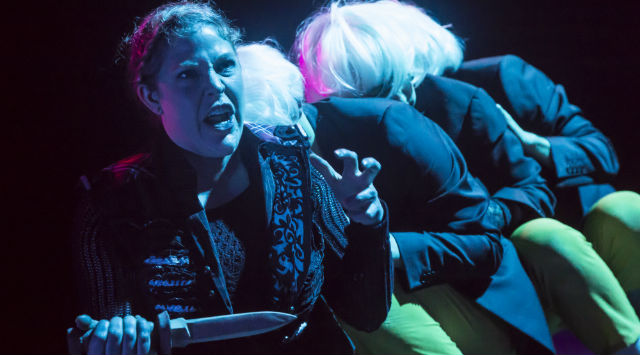
The production is beautifully presented. Anna Cordingley’s simple solution for set design conveys stately glamour with little fuss or ostentation, and her costumes achieve a remarkable level of sophistication, crucial in making the royal characters convincing. Lights by Benjamin Cisterne are similarly attractive, especially impressive when displaying bold choices, although many instances of unintended glare from a reflective backdrop, are more than a little distracting. Director Peter Evans does well in manufacturing a visually captivating piece of theatre; his work with abstract physical movement is particularly effective, but the classic tragedy struggles to find any genuine sense of poignancy on this stage.

Cleopatra is played by Catherine McClements, who brings good humour to the piece, cleverly subverting much of Shakespeare’s inanely “feminised” dialogue. The actor is a powerful presence, and we submit to her queenly preeminence with little effort. Johnny Carr is an intense Antony, charming in his conviction, but a strange interpretation of the role’s final moments, sets the scene for an anticlimactic conclusion to the play. An absence of chemistry between the two leads, further diminishes the potential for greater piquancy in this ancient romance. Moments of drama can however, be found in scenes that feature supporting actor Lucy Goleby, who introduces both vigour and nuance to her depictions, of Pompey and Scarrus, adding excitement and significant tension to the show. Also memorable is the luminescent Zindzi Okenyo, sensuous and strong as Egypt’s maid of honour Charmian.

The women are languid in Antony And Cleopatra. Seductive and emotional, and despite visible attempts to elevate status and meanings around them, Cleopatra’s romantic fixation keeps the story firmly in a sphere of gender inequality. We wish for relationships to help us be better people, who will do better things, but what we see happen between these protagonists is quite the opposite. Love is a destructive and retrogressive force, causing people to lose their minds and weaken their fortitude. Just four years before the play’s first staging, Elizabeth I of England ended her reign, remaining to her last breath, The Virgin Queen, if not for anything true about what men can do to a woman, then certainly for what men can write about women.

www.bellshakespeare.com.au

Review: Being Dead (Don Quixote) (MKA Theatre / Unofficial Kerith Fan Club)

Venue: Kings Cross Theatre (Kings Cross NSW), Mar 6 – 10, 2018
Creation and performance: Kerith Manderson-Galvin

Theatre review
In Being Dead, Kerith Manderson-Galvin is constantly “corpsing”, or “breaking”, unable to commit to the theatrical device known as a character. This is all a ruse of course, in this avant-garde variant of the Don Quixote story. A work of art is to be created, a show is anticipated to be staged, and the accompanying ambitions are, as always, unimaginably grand. Artists needs to be brave; we expect performers to be polished up, ready and flawlessly poised, but that does not mean a negation of their humanly vulnerabilities.

Manderson-Galvin’s presentation embraces qualities normally prohibited. Hesitant, apologetic, confused and very nervous, the actor reveals all that conventional wisdom deems unsuitable for theatrical consumption. These states of being, although negative, are unquestionably authentic, and within the text’s radical employment, they become saliently relevant to its story of wild aspiration. To dream big, one’s weaknesses cannot be ignored. In throwing one’s all into a project, imperfections too require attention.

The character we see, never really knows when their show begins. They are fearful and indecisive, in a perpetual state of procrastination, but for the audience, it is clear that the performance is underway the moment we see the genius Manderson-Galvin pacing on stage, portraying the fear that grips anyone who wishes to accomplish something extraordinary. It is a strange discipline that is being flaunted, an odd coupling of overt awkwardness and concealed deliberateness. It is false bravado turned inside out, for an experience wonderfully unusual and perversely delightful.

Equally enjoyable are its several sequences of sheer beauty, unpredictable and comforting, gestures of kindness perhaps, to release us of its otherwise stubborn edginess. Lights by Jason Crick and sound by Jules Pascoe, keep the production contained and coherent, pleasant elements that we cling to, like a security blanket, amid Being Dead‘s resolve to challenge and disturb.

Unbeknownst to themself, our protagonist succeeds in their search for something magical. Preoccupied with anxiety, they fail to detect all the good that is being created. Fear is a monster, an adversary to be combated with great fortitude and ferocity. Strength will deliver victories, but stillness is necessary, if the rewards are to be appreciated.

www.mka.org.auwww.unofficialkerithfanclub.com

5 Questions with Patrick Howard and Victoria Zerbst

Patrick Howard

Victoria Zerbst: Patrick, you have traversed many stages and productions in various wonderful roles, what has your theatre journey been like for the last few years and what brings you back musical theatre?
Patrick Howard: The past few post-drama-school years of working freelance in theatre have been really challenging and rewarding. I’ve found myself naked, covered in blood, crying on top of four tonnes of soil before quick-changing into a devil costume. I’ve found myself playing a weird detached version of myself, doing stand-up comedy about death. But mostly I’ve worked behind the scenes in production/stage management and as a director and sound designer. The last book musical I did was six years ago, discounting Marat/Sade a few years back, and it’s been wonderful and very different to be doing a musical again. As a musician (which I was before I was a thespian) and an actor, there’s something so incredible about reaching a place of heightened emotion as your character, where your only choice is to sing; words alone won’t cut it. Of course, Sondheim does this so well and seamlessly, it never jars at all. I missed that thrill, and I missed making music with a giant bunch of passionate actors, it’s so thrilling to be doing it again after all this time.

Frank would be such an interesting character to play! How do you develop a character who does such terrible things but remains likeable and charming throughout the show?
It’s a tricky one. I often find myself very frequently playing men that are quite performatively masculine, aggressive and do terrible things. I take a lot of perverse pleasure in this, being a bit of a bleeding-heart queer boy in real life – I feel like this gives me a unique take on what can be, at times, pretty architypical roles. The difference with Frank is that, as the central protagonist of the story, the audience needs to root for him even though he does some really awful things – he’s not a cut-and-dry bad guy. With any character, playing the truth of what’s in the text should do almost all of the work, you’ve got to trust the writer as god of the world you’re inhabiting, and in Merrily, Sondheim and Furth have cleverly arranged Frank’s story in reverse, with the audience watching him transform from a tragic, miserable wreck of a man into his former, youthful, optimistic self. Your empathy for Frank grows through this, you can see the mistakes he’s made, and more than if it were played chronologically, I think it makes you really consider what choices lead us to our various ends.

What has it been like working with Little Triangle and all the amazing members of the cast and crew?
A bloody dream. The team are so wonderful and it’s got to be the most professionally-run indie company I’ve ever worked for. Our producer, Rose, is so organised and her love of her work is so evident. Our director, Alex, is an absolute dreamboat, and is incredibly insightful and intelligent. Conrad, our MD, is a wizard and has to be one of the most optimistic and encouraging people I’ve ever met. Our répétiteurs Antonio and Alex are remarkable, and the rest of the cast… I mean you just have to come and see them. Each is more talented, generous, gorgeous, encouraging and intelligent than the last. There’s an incredible synergy in the room, and I’m not ashamed to say that after the first few rehearsals I’d walk the bus home with happy tears welling in my eyes, because they all brought so much joy into my little artfag heart. We sing a lot about being ‘Old Friends’ in the show for people who’ve only known each other for a few months, but it truly feels like we all go way back.

Do you reckon prospective audience members should listen to a few tunes before coming to the show? Which ones would you recommend?
Oooh, I suppose it depends if you’re someone who likes to know everything about what they’re about to see, or if you like to be completely surprised. Not many people know this show very well, it was famously a tremendous flop when it opened on Broadway in 1981, and despite being re-written a bunch and being a truly brilliant show, it doesn’t get seen often outside of, oddly, high school productions (as can be seen in the recent movie Lady Bird). But if you wanted a little taste of the show before going to see it, I’d recommend tapping your toes along to ‘Now You Know’, which is the absolute banger that closes Act 1, or the titular ‘Merrily We Roll Along’ which opens the show. For something with a little more heart, ‘Growing Up’, ‘Not A Day Goes By’, or ‘Good Thing Going’ are what you’re after.

Why do you think this musical is still important? What do you want the audience to get out of it?
I think often a lot of theatre tends to focus on romantic relationships as central to plot, and that’s particularly the case in most musical theatre. Merrily does have quite a bit of romantic drama in it, certainly, but this is one of only a few shows that really focuses in on a complex, messy, beautiful friendship, namely between Frank, Charley and Mary. These three are the best of friends there are (and ultimately, they aren’t, which is just so, so heartbreaking), and I think it’s wonderful to celebrate friendship and have it portrayed quite honestly on stage. Playing scenes where Frank and Charley, two married, heterosexual men, openly tell each other in quite emotional terms that they love each other, is such a special thing as well – for all their faults, the way they express their friendship is really beautiful. I think watching the story unfold backwards makes it important, too. It gives an audience the relief of guessing ‘what happens’ and lets them concentrate on what’s happening, with the dramatic irony of knowing what comes next. You can find little moments in the action to think, ‘See, here’s where it starts to go wrong. Why can’t you see it happening Frank?’ and maybe that gives you pause to think more carefully about the choices you’re making in your own life.

Victoria Zerbst

Patrick Howard: What about theatre in Sydney is exciting you most at the moment?
Victoria Zerbst: I’m so excited by theatre in Sydney at the moment and there are so so many shows on my to see list. I think that’s because a lot of shows coming up align heaps with my interests – sick female-centred stories, independent musicals, works by new and emerging Aussies writers and lots of theatre for young people.

How has your background in comedy helped you prepare the role of Mary Flynn?
I think coming from a comedy background has helped me find new and interesting ways to deliver lines and bring out humour in dialogue. Mary is already a very wry and hilarious character with sick one-liners so experimenting with timing and delivery of the lines has been such a blast.

But I also think writing and performing comedy for the past few years has really helped me find my voice as a performer. Writing my own stuff has been very empowering because I’ve learnt what makes me laugh, what makes me different as a performer, and how I can uniquely shape a role from my own point of view.

That has really helped me find an honest and real way for me to tell Mary’s story that comes from my blood. Hopefully this will connect with audiences and bring the character to life.

Mary is quite an intelligent, complex character, but spends years pining for Frank, even when there’s little-to-no chance of fulfilment. What is it like to play a role like that in 2018?
This is such a cool question and something I think about a lot! Mary is a smart, thoughtful character but one of her primary arcs in the show is her dealing with an unrequited romantic situation. She is often left disempowered by her relationship with Frank and I often wonder if it appears that she is primarily defined by this relationship.

But I really think there is a lot more to her thank that. I try to reframe her romantic pursuit of Frank from her own point of view – she’s a total dreamer, she’s endlessly hopeful and loyal and she really cares about the people in her life. I think this speaks to her complexity as a character and her intertwined strength and vulnerability.

Strong female characters don’t have to be flawless, completely empowered women. I think her enduring love for Frank is totally relatable and, while I often wish she would just snap out of it and see her own worth, I think this internal conflict is something with which a lot of people can relate.

What’s been most thrilling about the process so far, and what’s been most challenging?
Thrilling: Definitely running all the songs in rehearsals. I love the music so much and hearing them sung so well by this amazing cast I swear everyday I’m so moved and then I’m dancing and then I’m crying.

Challenging: Oh man some of Sondheim’s melodies!! So often I sit by the piano frozen by this man’s genius and then I curse his name for those subtle little changes in musical phrases that literally keep me up at night.

Sondheim is a god of 20th Century theatre, and his music and lyrics alone are reason enough for people to come and see the show. What are some other reasons to come, and what do you hope audiences take away?
The thing I love most about this musical is that is has such a big heart. It’s definitely one of those ‘makes you laugh, makes you cry’ shows. I think audiences will totally fall in love with these characters and feel for them on their journeys as the show takes them back through time.

Because the show spans so many years of these characters lives, there are so many amazing emotional arcs and moments of growth and change. I hope in watching this show audiences are moved to think about the choices we make in life, how we define success, how people change over time, how our dreams are found and forgotten, and about how friendships are made and lost over time. There are so many juicy moments in the show about friendship and forgiveness, love and connection and I think that will speak to everyone who comes and sees the show.

Patrick Howard and Victoria Zerbst are appearing in Merrily We Roll Along, by Stephen Sondheim.
Dates: 7 – 24 March, 2018
Venue: The Depot Theatre

Review: Cage (The Old 505 Theatre)

Venue: Old 505 Theatre (Newtown NSW), Feb 27 – Mar 3, 2018
Playwright: Jordan Shea
Director: Shae Riches
Cast: Josh Anderson, Badaidilaga Maftuh-Flynn, Patrick Diggins

Theatre review
Three young men from Australia are banged up abroad, imprisoned in Bangkok for a night of debauchery gone awry. In trouble because they had neglected to understand and respect local customs, Jordan Shea’s Cage takes these characters through the wringer, to depict the kind of obnoxious ignorance, contempt and imperialistic attitudes so prevalent in the way we conduct ourselves, in relation to our Asian neighbours.

Our colonial story is a persisting one. From the time of early European immigration, a wanton disregard of established cultures has operated as a pervasive force seeking to redefine and repurpose Australia and the region. In Cage, we see ourselves go to Thailand as tourists, thinking that the sole purpose of an entire country’s existence is to serve our need for mindless amusement. The punishment issued by Shea’s writing, for that continual and outrageous dereliction, is scathing and quite satisfying.

Directed by Shae Riches, the show is an effectively provocative one that brings illumination, to a problem that we already know to be true. Some scenes prove to be much more riveting than others, but as a whole, the production is unquestionably rewarding. Set design by Antoinette Barbouttis is cleverly conceived, restrained, and highly efficient in its ability to shape our imagination. Lights by Liam O’Keefe are dynamic and appropriately dramatic, while Alexander Lee-Rekers’ adventurous ideas with sound help extend the play’s dimensions beyond its prison walls.

Performances are strong, particularly impressive is Badaidilaga Maftuh-Flynn as Cuong, who creates astonishing authenticity for some very outlandish scenarios. The naive Ryan is played by Patrick Diggins, whose concentration translates into persuasiveness, and we almost begin to sympathise with his character’s predicament. Bryce the ghastly bogan, a hideous personality that is sadly all too familiar, is brought to life by Josh Anderson, especially affecting in the play’s more emotional sequences.

Parts of our national identity are incredibly generous, but there is no denying the reprehensible sides to our nature. The examination of ourselves in the context of a foreign prison, exposes some of our worst qualities, allowing us to see the devil inside. Whether abroad or at home, our capacity for damage is unrelenting. If power can only recognise power, it only follows that retribution is the only language that can hope to induce hindrance.

www.old505theatre.com

Review: Kill Climate Deniers (Griffin Theatre Company)

Venue: SBW Stables Theatre (Kings Cross NSW), Feb 23 – Apr 7, 2018
Playwright: David Finnigan
Director: Lee Lewis
Cast: Eden Falk, Sheridan Harbridge, Emily Havea, Rebecca Massey, Lucia Mastrantone
Images by Brett Boardman

Theatre review
In the current state of evolution with information technology, it can often seem that everyone has extremist tendencies. As social media becomes an increasingly rudimentary part of modern existence, we are compelled to contribute to its constant stream of content creation, by discovering voices that we never before possessed. We manufacture opinions and outrage, in order to participate in the new society, to feel that sense of belonging every human requires.

As a result, we are more fractured than ever. Everything turns into contestable binaries, and every person must take a position on all matters. Ambivalence or disinterest has no place in this iteration of Western civilisation. In David Finnigan’s Kill Climate Deniers, the idea of an extremist shifts from anomaly to commonplace, and all its characters hold strong adversarial views about the strangely contentious issue of climate change. As its title suggests, “terrorist activity” fuels the narrative of Finnigan’s play, but it is only good intentions that we find guiding its ruminations.

In an anarchic fantasy, where our real-life passions are transformed into radical action, it is not the decimation of the other side that Finnigan wishes to accomplish, but an understanding of opposing perspectives that he hopes for. By imagining a worst case scenario, in which everyone loses, doors are open for a discussion that aims to unite us. We are accustom to looking at all the differences between left and right, but Finnigan is interested in finding similarities.

It is however, a stylistically progressive piece of writing, with an aggressive sense of the haphazard driving its plot, in firm repudiation of traditional storytelling structures. Director Lee Lewis brings a wildness to proceedings that captivate with a caustic energy. Trent Suidgeest’s lights and Steve Toulmin’s sounds bring organised chaos to the stage, for a show that is unpredictable and messy, occasionally frustrating, but ultimately persuasive with its spirit and conviction.

Actors are charismatic, each one proving themselves to be seasoned and skillful, consummate entertainers we can rely on. Sheridan Harbridge and Rebecca Massey are irresistibly appealing with the broad comedy that emanates effortlessly from every fibre of their being. Emily Havea and Lucia Mastrantone deliver stronger acerbity to the politics at play, both impressive with the authentic gravity they introduce into the important issues being dissected. Eden Falk is perfectly cast as narrator/author, tenaciously believable and endearing, offering us a marvellously coherent interpretation of the text’s complex nuances.

The point of Kill Climate Deniers is neither controversial nor unexpected, but the experience it provides is unforgettably exhilarating. It is theatre that grabs you and throws you around, impressive in its inexhaustible capacity to keep us fascinated. At the end though, it is an extremely tall order for any work about climate change to be satisfying. Art can help us move towards resolution (if we allow ourselves to be completely optimistic), but there is perhaps no way any artist can give us a solution to those problems. What the play wants to say, is anticlimactic, but it remains true, that change requires action, and we are poised at a crossroads where our choices will determine our very survival.

www.griffintheatre.com.au

5 Questions with Lou Pollard and Tim Hansen

Lou Pollard

Tim Hansen: What was your first Shakespearean role on stage?
Lou Pollard: Portia in The Merchant Of Venice when I was a teenager questioning my entire life. My mum’s family were very religious and I spent years going to Sunday school at my grandparent’s church. So I have a lot of hymns and prayers in my head that don’t mean much to me! This play was the first time I actually understood the biblical concept of God teaching man to show mercy to fellow human beings. “Though justice be thy plea, consider this, That, in the course of justice, none of us should see salvation: we do pray for mercy; And that same prayer doth teach us all to render the deeds of mercy.”

Who is your favourite Shakespearean villain?
I do love Lady Macbeth, but is she a villain, or just a woman with the strength to stand by what she believes, and do what the men around her do not have the courage to carry out? She reminds me of British PM Margaret Thatcher, a woman with a hard heart and strong convictions surrounded by powerful men. Or maybe she was just a complete cow with no empathy whatsoever. Humans are
very complicated beings, Shakespeare understood this so well. “Come, you spirits / That tend on mortal thoughts, unsex me here, / And fill me from the crown to the toe top-full / Of direst cruelty. Make thick my blood. / Stop up th’ access and passage to remorse

How are you preparing for the show?
I’m feeling very white bread, so I’m listening to rap tracks. My youngest daughter loves Nicki Minaj so I’ve had her on repeat at home. I’ve also been reading monologues and sonnets, and I read Bill Bryson’s book Shakespeare: The World As Stage which is a fascinating look at the history of the time and where Shakespeare was living when he wrote most of his work.

What monologue are you prepping, and why did you choose it?
I’ve picked my favourite sonnet because I want to play with the rhythm of it. I’ve been a big Eminem fan for a long time and I’m thrilled I’ve got the opportunity to maybe bring my humour and
sense of play to a ‘serious’ work. Some acting friends who are well-versed in Shakespeare feel that the sonnet I’ve chosen is a bit of a downer, but I think it ends on a really positive note. I first learnt the sonnet 25 years ago and as I age it becomes more of a truth in my life than ever before.

Why do you think Shakespeare still resonates with audiences after all these years?
Shakespeare was so smart and funny and understood that relationships are tricky. His writing conveys that he understood the complexity of humans and the tangled, messy lives we lead. His
sense of humour was so sharp and his observations of the frailties of human life were so acute, that we still understand when he says, “to be or not to be, that is the question: Whether ’tis nobler in the mind to suffer. The slings and arrows of outrageous fortune. Or to take arms against a sea of troubles. And by opposing end them. To die, to sleep– No more–and by a sleep to say we end. The heartache, and the thousand natural shocks that flesh is heir to.” That’s why I love working with the Leftovers. Their clever shows provoke an audience to question how we as a society deal with gender roles, crime, racism & intolerance; the same issues that Shakespeare was writing about.

Tim Hansen

Lou Pollard: When did you fall in love with Shakespeare?
Tim Hansen: I was first meaningfully exposed to Shakespeare in high school and it wasn’t exactly love at first sight. Like a lot of high school students I could not understand why we had to trawl through this archaic language and try to understand it and write essays on it and pick apart conceits and sonnets and metaphors. It wasn’t until I was in year 9 and my school participated in the Shakespeare competition (is that still a thing? I went to school last century) that I really began to “get” Shakespeare. I grew up in a country town and there were really limited opportunities to get up on stage and perform, so when my English teacher said there was a competition that involved being on stage and performing I was totally in – I would have been happy reciting the ingredients on a box of clothes detergent as long as there was an audience. My group performed Act 3 Scene V from Romeo And Juliet, where Capulet rages at Juliet because she won’t marry Paris. I was Capulet. I remember walking around and around my backyard with my script in hand reciting the lines to myself in order to learn them, and I remember loving it because the language had this rhythm to it that just kind of synced with my steps and sunk into my brain like a hot ball bearing into butter. To this day I can still remember my opening lines. So studying it in English sucked all the fun out of it, but once I got up on stage to perform it, I got it. Now, I read Shakespeare for my own personal pleasure. It’s calming and beautiful. I love it.

Why did you want to work with the Leftovers Collective?
I’m a weird performer. I have a theatre degree but have kind of patchy actor training. My main vocation is actually music composition, and music is where I spend most of my creative
headspace. Music is my job, whilst theatre is my passion, and though I love my job I miss getting up on stage. Plus although I love conventional director/actor/script/audience set ups, I’m very attracted to experimental collaborative processes where no one’s really sure what’s going to happen. And then, suddenly, there’s a collective that takes you as you are, that doesn’t ask for you to strictly mould yourself around the requirements of one person’s vision but instead says “what are all the things you can do? Let’s find a way to make theatre together”. That kind of thing is totally my cup of tea.

What’s your favourite Shakespearean insult?
For sheer overall relentlessness you can’t go past the interactions between Kate and Petruchio in The Taming Of The Shrew – I think it was a production of that play by Bell Shakespeare way back in like 2000/2001 I saw that was the first time I laughed out loud from beginning to end at a Shakespearean play. But I think my favourite would have to be from Troilus And Cressida: “Thou hast no more brain than I have in my elbows”. Brutal.

Are you a trained dancer? Will you be dressed in dance gear for the show?
Um I am most certainly not a trained dancer. I move like a rusty clothes line blowing in a gale. So yes I will absolutely be dressed like a tragic reject from Wham!

Where would you most like to perform this show?
I have this vision of us all getting together in some deserted car park and having an 80’s style dance-off with boom boxes and breakdancing like at the beginning of Michael Jackson’s Bad video clip. Except please don’t ask me to breakdance. I’ll just break.

Lou Pollard and Tim Hansen are appearing in Shakespeakre Dance Party, with The Leftovers Collective.
Dates: 11 March, 2018
Venue: Hustle & Flow Bar, Redfern

Review: Lethal Indifference (Sydney Theatre Company)

Venue: Wharf 1 Sydney Theatre Company (Walsh Bay NSW), Feb 17 – Mar 10, 2018
Playwright: Anna Barnes
Director: Jessica Arthur
Cast: Emily Barclay
Image by Prudence Upton

Theatre review
Reema is an Indian bride, brought to Melbourne to be starved, bashed and raped by her new husband Ajay. We know this, because a white woman is onstage telling us the harrowing story. The intention in Anna Barnes’ Lethal Indifference is good, of course, as it shines a light on domestic violence, one of Australia’s biggest problems. The one-woman show however, affords no space to any of its Indian characters, only an unnamed protagonist who works as a media representative of an anti-violence organisation, struggling to cope with the weight of her vocation.

To place a white person at the centre of Reema’s story is deeply problematic. The removal of already underrepresented ethnic minorities from our theatres is reprehensible, especially when their stories are at the core of what is being discussed. If it were a woman of colour who takes to the stage, this issue might well be dissipated. It is noteworthy that in fact, there is no reason at all that requires our storyteller to be white, if we wish to examine the production from this perspective.

Also, Lethal Indifference unwittingly presents domestic violence as an “ethnic” problem, with its heavy reliance on Reema and Ajay, where we know for a fact that domestic violence occurs indiscriminately in all types of households. To single out a racial minority to facilitate this discussion, instead of having the unnamed woman “tidy up her own backyard” so to speak, using instead, stories of white families, is objectionable.

The heavily pregnant Emily Barclay stars, with suitable charm, leaving us feeling as bad for her character as we do the true victims of domestic violence. Barclay’s portrayal of second-hand “vicarious” trauma almost succeeds in stealing the thunder from Rameen, the invisible character who has clearly paid the much greater price for Lethal Indifference‘s melodrama.

It is a polished piece of theatre, with Mel Page’s ominous set design drawing us into the dark world that is being evoked, providing stark gravity to the space that is being explored. Director Jessica Arthur creates sufficient variation within the long monologue, to sustain our attention and interest. The production’s seeming ignorance about its own racial problem, is astonishing, considering the surface sophistication that it so proudly exhibits.

When we talk about women’s problems, we need also be sensitive to other forms of subjugation and persecution that people suffer in our communities. It is not a matter of white women’s problems being less worthy of analysis than those borne by women of colour, but in the process of discussing any prejudice and injustice from a context of Australian whiteness, we must fight for the voices of ethnic minorities to be duly represented. The disappearance of Reema from this production, one that boasts an all-white stable of cast and creatives, reveals so much about our failures in Australian art and society.

www.sydneytheatre.com.au

Review: Strangers In Between (Seymour Centre)

Venue: Seymour Centre (Chippendale NSW), Feb 14 – Mar 2, 2018
Playwright: Tommy Murphy
Director: Daniel Lammin
Cast: Simon Burke, Wil King, Guy Simon
Image by Sarah Walker

Theatre review
Not everyone is lucky enough to have families who offer affection and support. For many LGBTQI people, the system of kinship is often a manufactured one, relying on families that we have chosen for ourselves rather than the ones we were born into. The prejudices that continue to divide us, are very alive in Tommy Murphy’s Strangers In Between, a story that takes place in the early years of this new century. Shane has left the country town of Goulburn, for the bright lights, and acceptance, of the broadminded city folk in Sydney. The teenager runs from the systematic bigotry of home, in search of a community he hopes would be welcoming. Queer children will always be birthed by straight parents, so the threat of domestic conflict will perhaps never completely diminish, therefore Murphy’s tale of belonging can be thought of as a timeless one.

Actor Wil King is dramatic, but convincing, in the role of Shane. Delivering both theatricality and nuance, King is as compelling as he is sensitive, for a depiction of innocence that is unexpectedly moving. His intensity can occasionally prove overbearing, but there is no denying the trenchant perspectives he brings to the stage. The middle-aged gay man Peter, is played by the delightful Simon Burke, who creates a camp and compassionate personality many will find endearingly familiar. It is a delicate performance that combines a cool exterior with a warm heart, to accurately portray a Darlinghurst “scene queen” type. Also very accomplished is Guy Simon, who impresses in his dual roles of Will and Ben, characters as different as night and day, but both equally authentic with all that they convey. Director Daniel Lammin does exceptional work in bringing the play to life. His minimal approach ensures that the bonds that form between the men, are depicted with clarity and profundity, so that the audience is transported to a space of reflection and appreciation for the communities that we are part of.

The LGBTQI rights movement has delivered significant change to perceptions and acceptance, but the more freedoms we attain, the less likely we seem to want to attach ourselves to ideas of community. The Darlinghurst in Strangers In Between, from just thirteen years ago, has now lost its vibrancy. What was once a tight-knit locale, is now dispersed and aloof. The queer city slickers today are powerful and entitled, protected by advancements in attitudes and legislation. We no longer hold on to each other for dear life. In the past, young ones like Shane were able to fall into the nurturing arms of Oxford Street, but what happens today and hereafter, looks to be ever less optimistic.

www.dontbedown.net | www.fortyfivedownstairs.com

5 Questions with Josh Anderson and Badaidilaga Maftuh-Flynn

Josh Anderson

Badaidilaga Maftuh-Flynn: If you could have any job other than acting, what would it be?
Josh Anderson: A bear biologist. I think bears are incredible creatures and I’d love to study and help protect bears in the wild.

If your brother was like Bryce and ended up in a Thai prison, what would be your reaction?
If my brother was stuck in a situation like Bryce, I’d do everything in my power to have a merciful sentence passed down. Capital punishment is an atrocity – but as we’ve seen in the past, there isn’t a hell of a lot we can do once a sovereign nation’s mind is made up.

If you could choose to live in any city/place in the world, where would you live?
Stockholm. What’s not to love?

If you ran into Donald Trump in an elevator, what would you do/say?
I’d take the stairs.

What do you feel is the most challenging part of being an actor in the Australian industry?
I think there are many challenging things for actors in the Australian industry, but one that springs to mind is the limited space available for independent theatre makers. There are incredible companies out there that just don’t have the rehearsal space, performance venues or financial support to be able to produce quality theatre on a regular basis. I have personally benefitted from working in the independent sector and have learnt a great deal from the artists that keep our industry interesting and alive. Support independent theatre!

Badaidilaga Maftuh-Flynn

Josh Anderson: What’s the thing that lead you to acting?
Badaidilaga Maftuh-Flynn: I was always on and off with acting as a child and originally wanted to be a scientist… it wasn’t until I was 16 that I auditioned for a program called The Bridge Project with THEATREINQ, a local theatre company in my home town of Townsville, that I fell in love with the craft. Run by artistic director Terri Brabon and actor Brendan O’Connor they showed me what it was to build a career, company and most importantly a family in this industry. They both are my biggest inspirations.

What’s something about you that surprises people?
I have lived all over Australia and spent the majority of my childhood moving and living in cars, caravans, houses, tents you name it. I have attended 9 schools including a Steiner school, was home schooled and have lived in upwards of 90 houses.

If you had one superpower, what would it be and what would you do with it?
Time travel for sure! I am a big doctor who fan… I would never change, only observe – I am a traveller at heart.

What’s the closest brush with the law you’ve had?
I remember one time I was living in Darwin, a housing commission complex in Litchfield court – very rough place. Street kids, lots of drugs and crime so police where a regular occurrence. I got into a fight with one of the other local kids who was bullying me and I ended up throwing a lemon at him and knocking him off his bike as he tried to get away. The police came and gave us both a stern warning and said if it happens again they would come back and drag us away by our hair… we were around 8.

Would you rather a face made of tongues or arms made of eyes (tongues and eyes are functional)?
Arms made of eyes! There is no way I would want to walk around with exposed tongues all over my face… Imagine if someone coughed on you – plus your range of sight would be incredible

Josh Anderson and Badaidilaga Maftuh-Flynn are appearing in Cage, by Jordan Shea, part of the Freshworks season at Old 505 Theatre.
Dates: 27 February – 3 March, 2018
Venue: Old 505 Theatre

5 Questions with Tony Barea and Casey Richards

Tony Barea

Casey Richards: What excites you most about being a part of this production?
Tony Barea: The opportunity to demonstrate how I have grown as an actor over the last three years since joining The Actors Pulse is very exciting. To be able to stand in front of an audience and tell a story through the eyes of such a rich character – one that has been played by the likes of Al Pacino – is a challenge that I feel I’m more than up for, and only adds to the excitement. And some nerves too!

What has brought you to the theatre?
A love of storytelling which until recent years was confined to my other passion, writing. It was in fact a case of writer’s block which led me to explore other avenues of creativity and manifested with actor classes and a newfound love for the theatre.

Favourite line in the play?
My favourite line would have to be “You stupid fucking c…..t” No line in the play demonstrates more clearly the world that these characters live in. The vulgarity and the depths to which they will sink to in order to make a sale, and the reaction when things don’t go to plan. So much is revealed about Roma’s world from this line and the ensuing monologue. I’m really looking forward to bringing my own flavour to it.

Fun fact about you?
I ran petrol stations for 10 years prior to taking up acting. Who would have thought?

What excites you about the staging of this play?
The staging of the first act in the bar next door, the gender swap of some of the characters, the fact that it is the first time on the stage for some of us, all add to the excitement of staging this play. And of course not to mention that we are all fellow students at The Actors Pulse

Casey Richards

Tony Barea: What do you like most about playing your character?
Casey Richards: It would have to be the challenge of receiving all my moments. With a smaller speaking role I have to make sure that my behaviour is on point and that I am constantly in the moment both giving and receiving.

What do you approach first when you pick up a script?
What is my character’s purpose? Why does he even exist? It’s an exciting journey of discovery. One which then involves sharing those discoveries.

If you could work with any actor in the world who would it be?
Robin Williams or Heath Ledger. Both had amazing talent that they were able to share with the world. Whilst I won’t be able to work with either, growing up with them as an influence on me is a source of deep inspiration, which I hope to one day emulate.

What made you want to do acting?
Originally it was just for fun. I love watching behind-the-scenes cuts from movies and it just struck me that it looked like a heap of fun. I have since discovered that the art of storytelling and connecting to people is what I enjoy most.

Does the character that you play bare any similarities to you?
It does. Initially it was a little difficult as my character is much older than me, but as I have dug deeper I have continued to find parts of myself that are in alignment with the character. I feel that I will continue to discover more with each rehearsal leading up to the performances and I’m looking forward to that.

Tony Barea and Casey Richards can be seen in Glengarry Glen Ross, by David Mamet.
Dates: 23 February – 3 March, 2018
Venue: The Actors Pulse