Review: The Readers (Belvoir St Theatre)

Venue: Belvoir St Theatre (Surry Hills NSW), May 5 – 19, 2018
Playwright: Scott Smart
Director: Elizabeth Nabben
Cast: Anni Finsterer, John McNeill, Scott Smart
Images by Clare Hawley

Theatre review
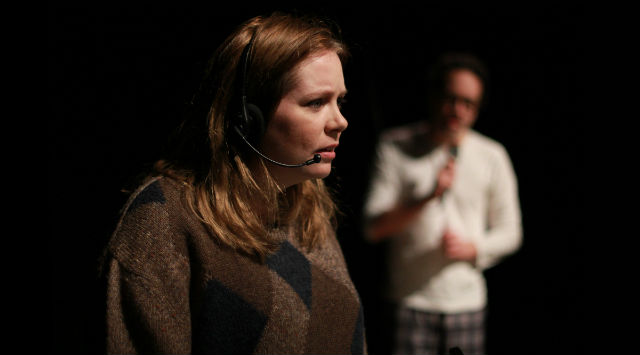
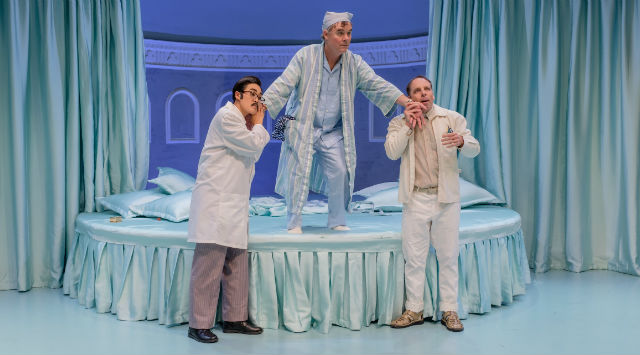
It is tempting to judge ourselves by things we read in the news. The extremities of society, whether the great successes or our dismal failures, give a powerful impression of the people we are, but routinely neglected are the smaller stories of millions of individuals, those that offer a more accurate picture of daily Australian life. Scott Smart’s The Readers puts focus on those who make up the regular working class, the ones who rarely make the papers.

Peter and Lachlan read electricity metre boxes for a living, going about their business with little fuss or drama. They are two white men who seem to suffer no disadvantage, but their lives are not without challenges. In our current state of accelerating capitalism, what were once perfectly respectable jobs, are gradually turned humiliating. The play shows the insidious nature of how money is allowed to compromise the dignity of our workers. Peter and Lachlan have rules to abide by, but not all of them are reasonable.

The production is elegantly directed by Elizabeth Nabben, who manifests a quiet charm around her characters and situations. It seems society has accepted that employers will, by some degree, infringe upon their staff, and The Readers embodies a quality of nonchalance that reflects that reality. Working for someone does not mean that one becomes a stakeholder, one simply becomes an instrument of functionality, and will have to accept a certain amount of dehumanisation within their prescribed responsibilities. It is the profit motive that takes precedence, rather than the welfare of our communities.

John McNeill and Scott Smart play the key roles, both subtle but strong with their humour, delivering excellent nuance for this gentle piece of theatre. They form an amusing duo, comedic but also poignant, without having to reach for creative choices that may be too obvious. The third wheel Annie, a flimsy character with arguably unconvincing traits, is performed by Anni Finsterer who plays up the silliness to great effect, for moments of extraordinary hamminess that prove surprisingly delightful.

In The Readers, we see that the only thing trickling down from top to bottom, is the anxiety of business ownership. Profits, on the other hand, remain exclusively within the upper crust. Managers do not hesitate to exert pressure on those who have to put in the hard yards, but only shareholders stand to gain monetary wise. Peter and Lachlan never complain. Like most of our work force, people accept their lot, accustom to the feeling of disempowerment. We are taught to work hard, to grin and bear it, in order that rewards may be delivered. That belief is not a lie, but it is clearly not the entire truth.

www.belvoir.com.au

Review: Revolt. She Said. Revolt Again. (House Of Sand)

Venue: The Old 505 Theatre (Newtown NSW), May 2 – 19, 2018
Playwright: Alice Birch
Director: Charles Sanders
Cast: Violette Ayad, Anna Cheney, Enya Daly, Richard Hilliar, Moreblessing Maturure, Eliza Sanders
Images by Jasmin Simmons

Theatre review
The play begins as though a manual providing instruction on becoming a radical feminist, offering steps of revolutionary action to attain some kind of ideal state of being. For those who understand their subjugation, the idea of taking down the powerful is always appealing, but the truth remains, that vacuums are nonviable and breaking something down requires the installation of something new. Alice Birch’s Revolt. She Said. Revolt Again. is a thrilling ride for anyone with a taste for rebellion. Its militant spirit is seductive, with powerful declarations that will excite those similarly inclined. The piece evolves unexpectedly, introducing in later portions, complexities that confront its own passionate proclamations of earlier scenes. Birch wants us mobilised, but in a smart way. Activism cannot thrive only on impulse. Long term strategies must accompany courses of action, or we risk ending up at a place worse than before.

The show speaks resonantly, with director Charles Sanders’ intellect a fortifying authority that establishes clarity for all its arguments. The politics in Revolt. She Said. Revolt Again. are made compelling by Sanders’ palpable enthusiasm for the subject matter, and their insistence that we hear its messages, translates into excellent drama. Design style is fairly simple for the production, with Joanne Joy’s visual projections particularly effective in helping to assert some of the highly provocative concepts.

All six performers for the piece are impressive, each one given ample opportunity to put on display their individual talents, as well as a unifying and admirable conviction pertaining to the material at hand. Eliza Sanders imbues her lines with authenticity and precision, delivering a delightful acerbity with every utterance, and equally memorable for her disciplined physical expressions. The imposing figure of Moreblessing Maturure is accompanied with a tender vulnerability, especially convincing in a maternal role, conveying unassailable qualities of our humanity with beautiful restraint and confidence. The lone thorn among the roses is Richard Hilliar, whose comedy hits all the right notes, whether understated, madcap or frighteningly bombastic. Violette Ayad and Enya Daly bring emotion when we least expect it, creating additional dimensions to an already rich work, and Anna Cheney’s ability to oscillate between realism and the flamboyantly bizarre, has us fascinated and entertained.

Anarchy may not be the answer we need, but the power of resistance must never be underestimated. Revolt. She Said. Revolt Again. is full of inspiration, for those of us who recognise the concerns that it raises. Revolutions must start somewhere, and the personal can be the site on which we begin positioning the battleground. Warriors have the capacity for long, hard slogs, and they understand that to suffer the pains of combat, far surpasses the unbearable torment of injustice. Fights are best undertaken when there is light at the end of tunnel. In the business of social activism, soldiers will get beaten down every day, but a resilient optimism is the key conspirator, to the ability to know right from wrong.

www.houseofsand.org

Review: Yours The Face (Blood Moon Theatre / LZA Theatre)

Venue: Blood Moon Theatre (Potts Point NSW), May 1 – 12, 2018
Playwright: Fleur Kilpatrick
Director: Liz Arday
Cast: Daniela Haddad
Image by Liz Arday

Theatre review
Emmy is a female fashion model, and Peter is a male photographer. They meet on a job in London, both excited to be visiting from abroad, and both finding themselves attracted to one another. We watch nervously, waiting for disaster to strike, predicting the inevitable in this tale of power imbalance, but Fleur Kilpatrick’s Yours The Face refuses to fit into the mould. It is a relief to see Emmy resist being infantilised, that her sexuality and sense of self are presented as valid, even if the structures that she operates within are problematic.

The work challenges us to think about institutionalised sexism, whilst it presents individuals who seem blameless and who look to be acting with agency. It questions our participation in industries that thrive on inequity, making us think about the meaning of responsibility, in situations when acting in accordance with what is considered legal and permissible, are arguably ethically inadequate.

Daniela Haddad plays both roles, and proves herself sufficiently prepared, but the actor’s inexperience is evident in the demanding work. Positioned in front of a screen, with projections accompanying her entire performance, Haddad’s face is often obscured by the imagery, and we find ourselves routinely distracted by competing visual elements. Director Liz Arday’s concepts are strong, and they make for a show that is ultimately thought-provoking and rewarding, but the production is certainly demanding of its audience’s ability to concentrate.

When we are not actively taking down and taking over old systems, our involvement only serves to sustain them. There will be benefits that come with playing by the rules, but hidden costs have to be examined, and measured against what we deem to be genuinely decent. What Emmy and Peter do, are conventional and accepted, in fact they stand to become rich and famous if the stars align, but in Yours The Face, we observe that all is not well. Disease festers and exacerbates, when we choose only to pay attention to all that glitters.

www.lza-theatre.xyz | www.bloodmoontheatre.com

Review: Youth And Destination (Manifesto Theatre Company)

Venue: Kings Cross Theatre (Kings Cross NSW), Apr 27 – May 12, 2018
Playwright: James Raggatt
Director: James Raggatt
Cast: Jack Angwin, Georgia Blizzard, Gloria Bose, Julia Christensen, Maree Cole, Skyler Ellis, Alex Malone, Bardiya McKinnon, Nikita Waldron, Ross Walker
Images by Emily Havea

Theatre review
There is no conventional narrative in James Raggatt’s Youth And Destination, only a series of short sequences that offer insight into his young mind. The brevity of scenes allows the playwright to touch on a broad range of topics over the course of an hour, but the format prevents sufficient depth from being reached, aside from occasional dialogue that might inspire a sense of intrigue that encourages us to see beyond the mundane.

There is much to admire in the young; they are often inquisitive, passionate and fearless. Wisdom, although never restricted to the mature, can however be elusive. On this occasion, thoughts expressed are honest and very earnest, but the lack of life experience is evident, and Raggatt’s attempts at circumspection will not be able to satisfy every member of audience. Some nonetheless, will see themselves accurately reflected, in this work by young people, for young people.

An exceedingly pleasant group of actors prove themselves accomplished, with no fiction to perform but instead, putting on stage a convincing semblance of the self. In the absence of more complex story lines, their task is to make compelling, snippets of modernity, whether banal or extraordinary. Star of the show is not an actor, but lighting designer Martin Kinnane, whose aesthetic inventiveness and technical excellence, bring to the production a necessary polish, along with rigorous calibrations of mood, from scene to scene.

The young can tell us so much about the world, but pinning down the meaning of life, is not usually their strongest suit. Youth And Destination is a sensitive work, slightly overcautious with how it wishes to be perceived. Whether young or old, we all have to grapple with how others look upon us; we are so fundamentally social. It is incumbent on the artist however, to be courageous, and to always be revealing of their own truth, especially that which is unique and idiosyncratic in quality. Few can claim to speak for communities, but when we return to the individual in an exhaustive and meticulous way, what we say about the personal can become unimaginably significant.

www.kingsxtheatre.com.au

Review: Carmen, Live Or Dead (Oriel Entertainment Group)

Venue: Hayes Theatre Co (Potts Point NSW), Apr 28 – May 13, 2018
Music & Lyrics: iOTA
Book: Craig Harwood
Director: Shaun Rennie
Cast: Natalie Gamsu, Stefanie Jones, Andrew Kroenert
Images by David Hooley

Theatre review
It is true that Frida Kahlo had had an affair with Soviet politician Leon Trotsky, but it is entirely fictional that a lovechild was born as a result of that brief relationship. Nonetheless, Craig Harwood’s vividly imagined Carmen, Live Or Dead almost has us believing in its fantasy, that Kahlo’s offspring does exist, and that Carmen Frida Leon Davidovich had once lived in Australia.

It is an appealing fabrication; the idea that Kahlo’s magnificence lives on beyond her legendary paintings, and Harwood does create a persona that is as colourful and spirited as any fan could wish for, even if the writer’s plot structure has a tendency to be unnecessarily convoluted. Prominent in the presentation, are eight original songs by iOTA, all of them charming, often very quirky in style, and thankfully not too derivative of the Broadway genre.

Visually sumptuous, the production features a whimsical set, exquisitely decorated and painted by designer Dann Barber, evoking quintessential Mexican beauty, alongside enchanting imagery that pays tribute to the art of Kahlo. Benjamin Brockman’s lights are sensual and alluring, providing a sensation of transcendence that convincingly elevates the theatrical experience, whilst retaining its delicious and unique aura of street-smart griminess.

Director Shaun Rennie manufactures a series of captivating moods, allowing every scene to intrigue, with moments of visceral engagement that leave an impression. Performer Natalie Gamsu is a warm presence who shines in each song, but the character being portrayed does not always feel authentic; her true emotions are elusive and the connections we make can feel tentative. Stefanie Jones and Andrew Kroenert provide musical accompaniment, as well as actorly support, both accomplished with their contributions, for a show memorable for the surprising effectiveness of its restrained approach to instrumentation.

Carmen announces her impending death early in the show, inviting us to partake in flashback summations of her life and times, that constitute this piece of musical theatre. We are also inspired to consider our own deaths, and how our individual stories will eventually be told. Footprints will fade, but nothing matters more than how much good we are able to leave behind.

www.carmenliveordead.com

Review: The Lieutenant Of Inishmore (New Theatre)

Venue: New Theatre (Newtown NSW), Apr 24 – May 26, 2018
Playwright: Martin McDonagh
Director: Deborah Mulhall
Cast: Lloyd Allison-Young, Michael Becker, Alice Birbara, Steve Corner, Angus Evans, Patrick Holman, James McCrudden, Nicholas Sinclair
Images by Bob Seary

Theatre review
It is 1993, and the threat of devastating violence in Northern Ireland is a daily reality. Groups are formed, and re-formed, in accordance with shifting political ideals that deliver little more than bloodshed and suffering. Martin McDonagh’s The Lieutenant Of Inishmore first appeared in 2001, only a few years after the abatement of conflict, when the memories of terror were still fresh, and the play’s comedy is therefore, predictably dark.

Also completely absurd and deeply ironic, a narrative is built around Padraic, a homicidal maniac who kills in the name of nationalism, and the very unlikely soft spot he has for Wee Thomas, the pet cat at home. Blisteringly funny, the sardonic The Lieutenant Of Inishmore deals with real life trauma, by channelling the senselessness of recent history through heightened humour, into a digestible form. Every time we laugh at a joke, we are required to reflect on the wounds to which it refers, and in that process find a way to reach an understanding, of things too difficult to find psychological and emotional resolution for.

Director Deborah Mulhall sets the tone perfectly, for an outrageous ride of a show. The bold comedy is as enjoyable as it is thought-provoking, and our communal laughter works to create a sense of unity around the play’s discussions of terrorism and war. A delightful cast keeps us amused from the very start, when the formidable duo of Patrick Holman and James McCrudden open the production with an energetic confidence and delightful eccentricity. Chemistry between the two is nuanced and tenacious, and thoroughly enjoyable to the bitter end. Lloyd Allison-Young is a very compelling leading man, incisive in his portrayal of Padraic. Inventive and charismatic, with an enviable knack for comic timing, he lands every punchline with finesse and flair.

The story is ridiculous, but we leave the theatre thinking its wild fiction is no stranger than the truth. As we grapple with the idea of children in foreign lands being bombed, and of our neighbours being arrested for charges of terrorism, we often experience disorientation and confusion, as though the world had been turned upside down. We try to install order into things to form a semblance of logic, because information must be arranged to cohere somehow, for the alternative of ignorance and apathy is unforgivable. So much of how we are is bizarre, and bizarrely inhumane, but even when we are unable to locate the reasons for our atrocities, to prevent them from occurring must always be fundamental to who we are.

www.newtheatre.org.au

Review: Still Point Turning: The Catherine McGregor Story (Sydney Theatre Company)

Venue: Wharf 1 Sydney Theatre Company (Walsh Bay NSW), Apr 21 – May 26, 2018
Playwright: Priscilla Jackman
Director: Priscilla Jackman
Cast: Nicholas Brown, Andrew Guy, Chantelle Jamieson, Ashley Lyons, Heather Mitchell, Georgina Symes
Images by Philip Erbacher

Theatre review
For those of us who are transgender, the experience of life is always a little bit extraordinary. Radically othered, by virtue of the fiercely homogenising quality of gender, there is a part of us that cannot help but perceive things from the periphery, whether we feel ourselves to be accepted or marginalised. Catherine McGregor is a media star, in many ways Australia’s answer to Caitlyn Jenner, both sixty-something, both extremely privileged and established in their professional fields, and both coming out as trans in spectacular fashion in the 2010s. They are not trailblazers by any means, for we have existed since the dawn of humankind (assuming gender had existed from the very beginning), but their stories coincide with a particular time in Western history, when being trans is suddenly a thing to celebrate.

This new interest in our identities contains unquestionably, a hint of the freak show; we often find ourselves a curiosity that everybody else feels as though they finally have license to poke and prod at. It can be argued however, that we are the ones who have demanded attention be paid to our difference, in this, for many, lifelong battle for approval and recognition. In Priscilla Jackman’s Still Point Turning, a delicious balance is struck, in which the object of our gaze is simultaneously accommodating and commanding. The audience is intrusive, but at the protagonist’s insistence. She proclaims to not want the responsibilities of being a poster-girl for the movement, but presents herself with blunt candidness and a fearless embrace of the prying spotlight. The work is “based on interviews with Catherine McGregor”, and she is very forthright with her disclosures.

It is a political and benevolent act, but also narcissistic (as she admits), and that seemingly dissonant combination provides a potent vitality for playwright and director Jackman, whose creation here proves to be a remarkably rich piece of theatre. The show satisfies our need for the sordid and gossipy, allowing us into the profoundly personal struggles of a public figure, whilst offering some of the most informative and thought-provoking content of any biographical account. For a play about a personality whose interests are in sport and the military, Still Point Turning is perhaps surprisingly entertaining, relentlessly so, but its true value is in its frank and unembellished, and thus rare, depiction of a transgender experience.

We may not have arrived at a point where a story of this nature does not bear the burden of having to make that desperate plea for understanding, and we find McGregor’s suffering often occupying front and centre of the stage (alongside her charming sense of humour) but it is noteworthy that the show does go quite a distance beyond an exploitative depiction of trans tragedy. Societal progress can be observed in its ability to discuss its issues inquisitively and genuinely, offering perspectives that are less emotional and more sincerely exploratory. For audiences of all persuasions, the play’s statements and contemplations about how each of us negotiates gender (and other identity markers or constraints) is a rewarding opportunity for deep reflections about our places in social life; who we think we are, how we wish to be perceived, and the things we do to create a persona that each can be personally content with.

The production is passionate and polished, with clever lighting by Nick Schlieper creating comfortable shifts between time and space, whilst helping contain an unnecessarily large performance area. Music and sound by Steve Francis are conventional but highly effective in their calibrations of atmosphere. Designer Michael Scott-Mitchell’s costumes are simple but very smart, with the lead’s pristine white Carla Zampatti suit a breathtaking, memorable design feature.

Actor Heather Mitchell delivers a brilliant performance in the starring role; intelligent and insightful with her dramaturgy, impressively precise, bold in presence, and gloriously funny. Eminently convincing and disarmingly charismatic, we cannot take our eyes off of her. Her Catherine is fascinating and delightful, and we almost wish for the show not to end, if only to retain her company. A supporting ensemble of five effervescent players add to the fun, each one independently compelling and endearing, but wonderfully cohesive as a team, thick as thieves and marvellously engaging.

Even though Catherine McGregor has accomplished a great deal in her illustrious life as journalist, cricket commentator and military officer, the woman presented in these 100 minutes of Still Point Turning is defined principally by her transness. Whether or not this is an accurate depiction of McGregor’s own truth, it is an intriguing proposition that one’s fundamental sense of identity can be so firmly attached to ideas of gender. It is perhaps a consequence of unyielding persecution, of oppression and cruel humiliation, that what should only be an incidental element of a person’s being, is turned into a subsuming component.

McGregor puts blame on no one, talking only about transphobia as a personal demon, but the undeniable truth remains, that when we harm ourselves, it is always a result of conditioning by the outside. It is easy to think of McGregor as a person who has it all, and as such, we require that she expresses only humility and gratitude. However, the prejudice that all trans people continue to be subject to, range from insidious to barbaric. It is pervasive, even in progressive regions, and there is no doubt that we must always take the opportunity, to step up to defend the rights of our transfolk. To be visibly trans is crucial to our progress, and Cate’s indomitable capacity for attention, is to be admired and more importantly, emulated.

www.sydneytheatre.com.au

Review: The Effect (Old Fitz Theatre)

Venue: Old Fitzroy Theatre (Woolloomooloo NSW), Apr 18 – May 19, 2018
Playwright: Lucy Prebble
Director: Andrew Henry
Cast: Emilie Cocquerel, Firass Dirani, Emma Jackson, Johnny Nasser
Image by John Marmaras

Theatre review
Connie and Tristan are participants in a medical trial involving antidepressants. Temporarily shut off from the world, they live inside a science facility with only each other for company, and very quickly develop a strong romantic connection. Lucy Prebble’s The Effect is interested in the chemical aspects of what we understand to be human nature, and the moral implications of drugs we design to alter our experience of life. It poses questions about what we consider to constitute authenticity in being human, and looks at the ways in which we place value on things we term natural and synthetic.

The play is ridden with anxiety, fuelled by the pervasive scepticism we have of pharmacology and the money around it, but a puerile disquiet is undeniably present, that relies on reductive ideas presupposing the natural to always be unquestionably better. The Effect features scene after scene of tense drama, which director Andrew Henry is certainly not averse to amplifying at every opportunity for maximum theatricality. Alexander Berlage’s lights are accordingly bold and intrepid, effective in delivering some memorably stark imagery. The show is often gripping, with an intensity that sustains our attention, but its arguments are not always persuasive. It arouses intrigue, without providing sufficient rationale for us to feel satisfied with the statements it attempts to make.

Actor Johnny Nasser brings valuable subtlety to the role of Toby, alternating between good and bad guy, for a sense of complexity that resonates with truth, in this discussion of mental health and modern medicine. Other players have a significantly more grandiose approach, that can restrict us from reaching a greater understanding of the text’s nuances. Their extravagant gestures make for an energetic performance, but our access to the psychology of characters is consequently limited. The Effect contains philosophy that matters to us all, although a more detailed conveyance of meanings would be necessary for the production to affect us deeper.

As we watch ourselves being challenged by medicine, unable to submit easily to the science, we see an obstinate belief in a state of purity, and are prompted to interrogate the validity of our trust in naive ideals associated with all things “natural”. It is also similarly evident that when individuals are called upon to put their lives in the hands of others, trust is an issue that can never be made completely unassailable. Underlying these thoughts are fears that reflect our need for self-preservation. We can doubtless see the insignificance of the human race in the widest scheme of things, but our indomitable hunger for control seems essential to how we think and act, even when we know the futility of our efforts.

www.redlineproductions.com.au

Review: Get Her Outta Here (107)


Venue: 107 (Redfern NSW), Apr 19 – 21, 2018
Creator: Isabella Broccolini
Cast: Isabella Broccolini
Images by Phil Erbacher

Theatre review
Isabella Broccolini is the lady in red, swathed in an uncompromising colour representative of all things fiery. We see a picture of obstinacy, a woman of dogged determination making single-minded statements about selfhood, and of identity in general. Her red suitcase never leaves her side, like a snail with her home attached, adding to the image of tenacity, but symbolising discontentment, in a performance piece that seems to talk a lot about the unexpected duality of perseverance and relocation.

Get Her Outta Here is wonderfully engrossing, fuelled by the inexorable presence of its creator. Broccolini’s physicality is confident and powerful, with an idiosyncratic style to its movement that has us captivated. Her body is untethered to the homogenising nature of dance training, but offers a clarity and strength to what it wishes to convey, as though disciplined in accordance with her own ideals.

The work is abstract, beautifully so, and audiences will interpret it how they wish. When art refuses to be obvious, it runs the risk of leaving us apathetic, but Broccolini’s enigmatic (and often very funny) approach is deeply alluring. We find ourselves opening up to her, allowing her obscure expressions to provoke and inspire. Music by Grace Huie Robbins moves the show through its various phases with excellent effect, creating shifts in dimensions that help enrich our imagination. Lights however, are under-explored and regretfully monotonous, for a production that is otherwise an aesthetic delight.

Broccolini’s speech is coy, but glimpses of honesty are revealed in her storytelling, to help our minds assemble a sense of truth for the red lady. Under the quirky and jokey, almost camp, deflecting exterior, lies a distinct rage, drenched in blood, perhaps too gory to expose unadorned. Get Her Outta Here is a woman’s fight with territory, even as she resists every place that she finds herself. Outsiders wish to be anywhere but here, and for us, the cliché is especially true, that it is the journey, and not the destination, that fulfils. Our project of reclaiming and redefining space, is not yet able to afford any room for complacency. For the time being at least, the red lady’s adventures with her red suitcase shall not cease.

www.107.org.au | www.isabellabroccolini.com

Review: Sex & Death (Blood Moon Theatre)

Venue: Blood Moon Theatre (Potts Point NSW), Apr 10 – 28, 2018

Something In The Basement
Playwright: Don Nigro
Director: Garreth Cruickshank
Cast: David Luke, Annette van Roden

It’s Time
Playwright: Garreth Cruickshank
Director: Garreth Cruickshank
Cast: Russell Cronin, Jack Douglas, Kitty Hopwood, Annette van Roden

Theatre review
Two short plays, both concerned with marriage, form a double bill entitled Sex & Death. The first, Something In The Basement by Don Nigro is ostensibly about the mystery of sex, and the second, It’s Time by Garreth Cruickshank, deals with family violence. They both point to some fundamental ideas about the traditional unity of two persons, perhaps questioning the validity of that ancient institution for our current times.

Something In The Basement is a comedic exploration of sex, using the basement of a couple’s home as allegory, for the strange workings of compatibility and the libido. Humour is obscure for the piece, and its performers never quite manage to make it a sufficiently funny show. The meanings, as represented by their relationship with each other and with their house, too are rarely satisfactorily conveyed, left abstract with scant resonance. The production’s naturalistic approach seems an inappropriate choice, exposing only the mundanity of married life, and little else besides.

It’s Time dwells on the harrowing experiences of a housewife from the 1950s, who receives regular beatings from her husband. We meet her later in life, but it is her recollections of her darkest days that she wishes to share. Mrs O’Brien tells all, as flashbacks are introduced, with regrettable inelegance as actors walk in and out of view for sequences that last mere seconds. Annette van Roden plays the role with great sensitivity and maturity, exhibiting exceptional strength as a woman put through the wringer, and who emerges victorious. We wish to see how she escapes abuse and grows stronger in the aftermath, but the play ends abruptly, allowing only her suffering to define this version of Mrs O’Brien.

The people in Sex & Death fail at marriage, but we see them work hard at salvaging things to fulfil their commitments. Marriage is full of promise. We are told that it is essential to a good life, although arguments are never more than tenuous. Tethering the self to another, through measures religious and legal, is a bizarre habit that continues to prove hard to break. We aim to understand ourselves through science, logic and facts, but it often appears that irrationality plays the biggest part in being human. There is no rhyme or reason for so much of what we do, and hence we are prone to repeat our foibles time and again. Marriage will never live up to the grandness of its pitch, but we will nonetheless keep buying in. It is romance, idealism and delusion, but we are only human.

www.bloodmoontheatre.com