Review: The Laden Table (Bakehouse Theatre Company)

Venue: Kings Cross Theatre (Kings Cross NSW), Mar 10 – 25, 2017
Playwrights: Nur Alam, Raya Gadir, Chris Hill, Marian Kernahan, Ruth Kliman, Yvonne Perczuk
Director: Suzanne Millar
Cast: Alex Chalwell, Doron Chester, Suz Mawer, Sarah Meacham, Mansoor Noor, Jessica Paterson, Abi Rayment, Monroe Reimers, Gigi Sawires, Geoff Sirmai, Donald Sword, Justina Ward
Image by Natasha Narula

Theatre review
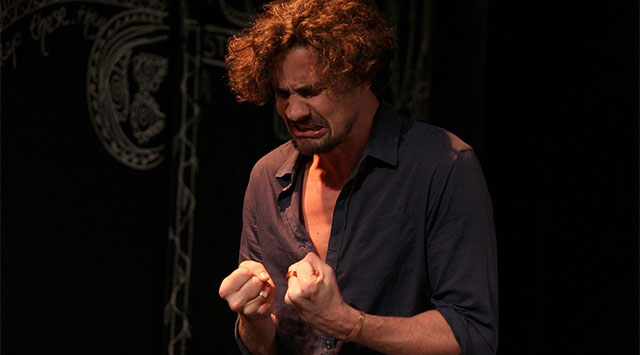
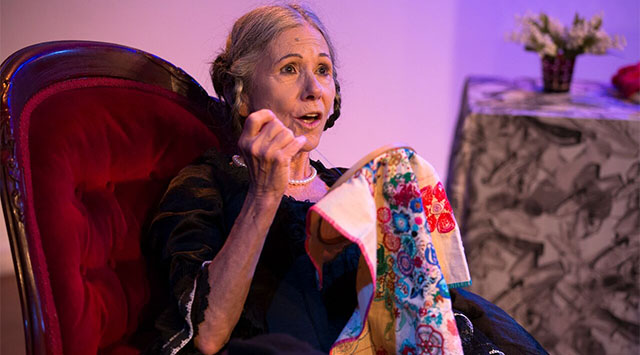
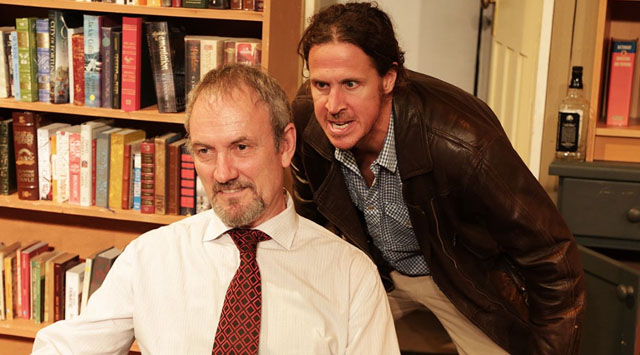
A resplendent, but homely, dining table awaits, with twelve empty chairs anticipating two families and their stories about cultural displacement and historical discord. The Laden Table features Jewish and Muslim Australians, and the baggage they continue to carry after centuries of religious hostility. Their lives are in Sydney, but they exist beyond the here and now. What had happened in the past and what is yet to come, are crucial to how they act and think today.

It is a magnificent piece of writing, that interrogates, with unyielding severity, the nature of prejudice and more specifically, the way good people make enemies of each other through their religious affiliations. The Laden Table offers insight into how the layperson of the Jewish and Muslim faiths conceives of their own oppression, and how that manifests into hateful beliefs and behaviour. Structurally intricate, but with a vivid and coherent plot line, the play addresses issues of great profundity in a manner that is both elucidative and deeply affecting. It teaches some of the biggest lessons any individual could wish to learn.

The production is arresting in its poignancy, and thoroughly captivating. Director Suzanne Millar does a marvellous job of creating a work full of texture and nuance, with regular shifts in dramatic tone that secure our attention for the show’s entirety. Lighting designer Benjamin Brockman provides instinctual logic to every one of The Laden Table‘s startling scene changes, and amplifies emotional impact throughout its narrative, whether subtle or sensational. Will Newnham’s sound design adds to the carefully calibrated atmosphere, moving us between unpredictable spaces, and leaving a remarkable impression with a special moment that fuses prayers of both faiths in surprising harmony.

Stakes are high in the story, and the ensemble overwhelms us with an authentic gravitas. War is happening elsewhere but in these two Australian households, we feel the reverberations of the Israeli-Palestinian conflict, and the sense of mortal danger faced by millions is more than a bleep on the nightly news. Gigi Sawires and Geoff Sirmai are the elders, both flamboyantly engaging and unconventionally colourful with what they bring to the table. Jessica Paterson and Monroe Reimers introduce convincing depth to their characters’suffering, and Suz Mawer is a powerful presence as a modern Muslim woman, constantly having to negotiate past and future, spirituality and logic. The vulnerable complexity that Mawer portrays so well, is embodiment of what the play represents; and to expect easy answers is impracticable.

Religion does a lot of good, but the harm it causes cannot be denied. Atheists will say that the eradication of religion will solve many of the world’s problems, but that utopia will never come, even within the next few lifetimes. The way our faith is ingrained, has a tenacious permanency that endures over generations. It shapes many minds and guides many deeds, but it is never beyond reproach or provocation. God will always be there, but how we relate to them changes, and how we want them reflected in our lives, is up to us.

www.bakehousetheatrecompany.com.au

Review: A Period Piece (Glitterbomb / The Old 505 Theatre)

Venue: Old 505 Theatre (Newtown NSW), Mar 14 – 25, 2017
Playwright: Gretel Vella
Director: Carissa Licciardello
Cast: Mikaela Atallah, Hannah Cheers, Julia Christensen, Clare Hennessy, Mat Lee, Julia Robertson, James Wright
Image by Omnes Photography

Theatre review (of a preview performance)
In Gretel Vella’s A Period Piece, menstruation takes centre stage in each of its madcap episodes. Mischievous and irreverent, its collection of short skits takes a look at the absurd taboo that surrounds the subject, and its significance as a mechanism of misogyny in our daily lives. The work presents entertaining observations, and an important perspective on how society is taught to be afraid and ashamed of women’s bodies, and how that irrational aversion informs the way we have constructed sexism through the ages.

The production, directed by Carissa Licciardello, is delightfully high-spirited, with an energetic cast that zips gleefully from one comedic scene to another. A band of three musicians add even more vibrancy to the atmosphere, playing silly songs that keep us in a giddy mood, while driving home further, the show’s message of female empowerment. Set design by Nick Fry is a simple idea, but fastidiously executed to help illustrate the antiquated values we carry, with unforgivable obstinacy, in order that systems of patriarchy may be upheld.

There is a rawness to A Period Piece that is unapologetic, and very enjoyable. It is an untidy affair, but inviting and joyful, although a more philosophical approach could provide greater depth (and a more lasting impression) to its concerns. When Aristophanes dreamt up the story of Lysistrata and foregrounded the fact that a woman’s womb, and her sexuality, controls all our existence, we should have begun to see that her holding up half the sky is an understatement.

www.dasglitterbomb.com

Review: The Bleeding Tree (Wharf 1 Theatre)

Venue: Wharf 1 Sydney Theatre Company (Walsh Bay NSW), Mar 9 – Apr 8, 2017
Playwright: Angus Cerini
Director: Lee Lewis
Cast: Paula Arundell, Airlie Dodds, Shari Sebbens
Image by Brett Boardman

Theatre review
A man has been killed by his wife and two daughters, shot deliberately in cold blood and left to die. It is rural Australia, so there is no hiding the disappearance of a person, or the circumstances surrounding the savage incident. Angus Cerini’s The Bleeding Tree confronts the rules of society, exposing the inadequacies of how we live as communities and how we forsake the weak. The dead man had been violently abusive, but the women in his home were never offered sufficient help to escape his brutality. As neighbours begin to discover their actions, we are surprised to see their acceptance of the episode.

Cerini’s writing is dangerous, deep and devastatingly beautiful. It operates at the precipice of morality, for a play that uses the audience’s imagination and reasoning, to deliver remarkable thrills, on levels that are emotional as well as intellectual. It is a story that rarely gets told. Family violence is commonplace, and is slowly being removed from secrecy, but we are are still learning how to talk about it. The Bleeding Tree is a new kind of parable that admonishes the guilty so that repugnant behaviour is seen unequivocally as such. The death of the patriarch does not occur in grey areas, and we are challenged to look at the remains of the monster and consider what is right and wrong, in a reality that does not allow time to be reversed. We do not exist in coulda, shoulda, woulda, and in The Bleeding Tree, we cannot have our cake and eat it too, if justice is to be served.

It is an extraordinarily sophisticated production, directed by Lee Lewis whose take on the Australian Gothic is as refreshing as it is visceral. Exquisitely designed to transport us to its nightmarish parabolic outback, the theatrical space is consummately considered. Renée Mulder’s set, Verity Hampson’s lights and Steve Toulmin’s music, all conspire to bring us into their psychological wilderness, where good and bad have swapped places, and we must shift our beliefs accordingly. The trio of actors deliver an astonishing performance, with a cohesion in energy, style and objective, giving polish and confidence to a production that delivers gripping drama and convincing proclamations. Paula Arundell is exceptional as Mother, with a complexity in her presence that conveys both vulnerability and strength, helping us understand the precariousness, along with the inevitability of what happens. It is a quiet approach, but the power that we connect with is fabulously palpable.

Women are often trapped in systems that fail us, and we are taught to tolerate the denial of what should only be just and fair. The women in The Bleeding Tree were caught within a familial patriarchy, as well as a greater social one, that required of them their prolonged and painful subservience. When it eventually became clear that sitting around and waiting for situations to improve was a fruitless exercise, they found the only way out was to take radical action. Every day everywhere, people are kept down by power structures that benefit from their oppression, but when those at the bottom realise the truth of their condition, their compliance will be seen in a new light, and change can begin to take place.

www.griffintheatre.com.auwww.sydneytheatre.com.au

Review: Calamity Jane (One Eyed Man Productions)

Venue: Hayes Theatre Co (Potts Point NSW), Mar 8 – Apr 1, 2017
Book: Ronald Hanmer, Phil Park (from the play by Charles K. Freeman, and film by James O’Hanlon)
Lyrics: Paul Francis Webster
Music: Sammy Fain
Director: Richard Carroll
Choreographer: Cameron Mitchell
Cast: Laura Bunting, Virginia Gay, Anthony Gooley, Sheridan Harbridge, Rob Johnson, Matthew Pearce, Tony Taylor, Nigel Ubrihien
Image by John McRae

Theatre review
It is the story of a frontierswoman from American history, a tomboy type with a big heart and very tall tales. A neglected musical from mid-20th century, Calamity Jane is probably best remembered as a film starring Doris Day in 1953. No surprises then, that the writing is squeaky clean, conforming completely to the ideology of the McCarthy era, when the USA convulsed at its height of moral panic.

Director Richard Carroll’s version aims to subvert the obvious camouflages at work in the original, especially in terms of its delusory representations of gender and sexuality. Archaic notions of how a woman should dress, and how her libido should manifest, are confronted head on, in this uproarious and very likeable comedy about a woman in charge. This iteration of Calamity Jane does not obliterate the existence of patriarchal oppression, but it foregrounds our heroine’s resistance, culminating in the spectacular exposure of her homosexual impulses in the number A Woman’s Touch. Originally conceived to inflict upon her, the sacrosanctity of housework, Calamity takes the opportunity here to find redress and expression instead, for the lustful desires she feels for another woman.

Virginia Gay is irresistible in the title role, charismatic, supremely confident, and hilarious. Her singing alternates between musical theatre, country and jazz, bringing a surprising quality of rejuvenation to the show tunes. Although not all performers are equally suited to their parts, it is overall an effective cast, with Sheridan Harbridge and Tony Taylor particularly delightful, and very gleeful, as residents of the Golden Garter. The majority of instrumental accompaniment is provided by lone pianist, and musical director Nigel Ubrihien, who brings tremendous atmosphere and excellent character to the staging.

The production succeeds in its efforts at sending itself up, and in the process, confronts the subjugation of femininity in traditional forms of storytelling. There is a sense however, of the show losing steam, as it progresses into a more sentimental second act. Its actors remain strong and convicted, but the audience needs greater convincing to adapt to the significant change of mood, and its subtle shift in meanings. We stay loyal to the riotous nature of Act 1 because it strikes a chord. It is a time for wild women and unruly behaviour, and now is when we fall in love with Calamity Jane.

www.hayestheatre.com.au

Review: Are We Awake (Old Fitz Theatre)

Venue: Old Fitzroy Theatre (Woolloomooloo NSW), Feb 28 – Mar 11, 2017
Playwright: Charles O’Grady
Director: Sean Hawkins
Cast: Aleks Mikić, Daniel Monks

Theatre review
We think that an ideal romance is made of two perfect halves, where no one entity is more reliant on the relationship than the other. In Charles O’Grady’s Are We Awake, Hypnos lives with an increasingly severe disability, and while his lover Endymion has no problems taking on the role of carer, things come to a head when he is offered a job in a different city. The story is concerned with the nature of the unions that we forge, exploring what it means to be in love, when a person is unable to be self-sufficient. There is great sensitivity in O’Grady’s writing, with remarkable depth in his imagining of characters for this sentimental, and very angsty, two-hander.

Sean Hawkins does excellent work directing the piece, giving beautiful variation to texture and tension for this otherwise straightforward single-setting play. He overcomes the challenge of the writing’s big, rambling speeches by keeping delivery of dialogue pacy, but offers balance with charming sequences of momentary silences. In the role of Hypnos is Daniel Monks, impressive in his precise articulation of a very wide range of emotion, for a sensational performance that feels wholly convincing. Equally engaging is Aleks Mikić, whose creation moves us with an admirable psychological accuracy in his depiction of Endymion’s internal struggles. The couple’s fabulous chemistry is the strongest feature of the show, and we are hopelessly captivated.

Few of us will find happily ever after with that one true love, but we all defy the fairy tales of childhood, every day of our lives. Even with the tremendous challenges that Hypnos has to bear, he can only look ahead and keep moving. We are taught that marriage is the most necessary of loves, but the truth is that good people will always have someone to lean on, no matter how we categorise our human connections. Some of us may need more help than others, but all our hearts have the capacity to be as big as our companions require. Even though it will not look the way we had dreamed it, love exists and it is all around.

www.oldfitztheatre.com

Review: Chimerica (Sydney Theatre Company)

Venue: Roslyn Packer Theatre at Walsh Bay (Sydney NSW), Feb 28 – Apr 1, 2017
Playwright: Lucy Kirkwood
Director: Kip Williams
Cast: Matthew Backer, Gabrielle Chan, Jason Chong, Tony Cogin, Geraldine Hakewill, Brent Hill, Rebecca Massey, Monica Sayers, Mark Leonard Winter, Anthony Brandon Wong, Charles Wu, Jenny Wu
Images by Brett Boardman

Theatre review
Massacres, no matter how catastrophic, can get forgotten. Unlike the 9/11 attacks that we memorialise everyday, fuelled partially by economic imperatives of the USA, incidents such as the 1989 Tiananmen Square protests have faded away with time, and in this particular case, with rigorous effort on the part of Chinese officials.

The arresting image of a man standing in front of battle tanks however, still packs a punch, and 27 years after the event, it remains in circulation as one of the most influential and famous photographs ever taken. The enigma of Tank Man leaves many questions unanswered. It is an irrefutable document of an historical moment, but nothing of that moment (or the moments leading up to, and thereafter) has ever been explained.

Playwright Lucy Kirkwood’s imagination goes wild in Chimerica. It is 2012, and we meet a fictive photographer, Joe, who had famously captured the shocking moment at Tiananmen Square. He is now on a tenacious search for Tank Man, determined to uncover the truth, and through his escapades, we explore China as it stands today, or at least, are offered a Western conception of China’s current state of affairs. It is predictably precarious, for an American writer to offer critical assessment of the Chinese experience, but Kirkwood brings balance to her piece by portraying American institutions with a comparable level of disparagement; they are as bad as each other, perhaps.

The narrative of Chimerica is thoroughly enjoyable, a thriller that manages to grip right from the start, and that delivers a formidable jaw-dropper at its end. In this production however, details and personalities in the fairly complex story can become confusing. Direction by Kip Williams establishes a tautness in pace and atmosphere that makes for enthralling viewing, aided by Nick Schlieper’s very clever and diligent lighting design, but uneven acting for the main roles prevents the show from reaching its greatest potential.

Mark Leonard Winter is convincing as Joe the photographic journalist, but the emotional dimensions to his depictions often feel too vague and distant. The other lead character Zhang Lin is played by Jason Chong, who delivers several captivating scenes of poignancy, but the actor struggles to overcome the role’s quality of mystery, and he too is unable to help the audience connect at a more satisfying depth. Scene-stealer Charles Wu sparkles the brightest in two smaller parts. As Benny, he is refreshing, lively and charming, and as young Zhang, Wu is authentic and engaging. Also notable are the twenty performers who make up the ensemble, all impressive with their physical discipline, all in command of their excellent, and crucial, collective presence.

The song Long De Chuan Ren (Descendants of the Dragon) is a recurring sonic motif, introduced by sound designer The Sweats with wonderful inventiveness and cultural sensitivity, to orchestrate a representation of Chinese culture and its people, throughout the play. The song likens China to a dragon, a creature to be feared and revered, and it is true that iron fists have always ruled the nation, throughout different centuries, dynasties and governments, but the country is no stranger to revolutions. Whether or not we think of our governing mechanisms as democratic, systems of oppression will always attempt to ambush and exploit how we live, and it is up to the masses to find a way to resist, and to overturn the forces that wish to breach each and every one of our human rights.

www.sydneytheatre.com.au

Review: The Duke (Hoipolloi Theatre Ltd)

Venue: The Riverbank Palais (Adelaide SA), Mar 6 – 8, 2017
Playwright: Shôn Dale-Jones
Director: Shôn Dale-Jones
Cast: Shôn Dale-Jones

Theatre review
The Duke is entirely a one-man show, with Shôn Dale-Jones sitting at a desk, accompanied by two microphones providing variation to his voice (one with reverb, one dry), and a laptop on which he operates sound cues. Theatre is almost always a collaborative art form, but here, there are only the artist and his audience. It is a doggedly minimal approach for staging a play; all we have is a piece of writing, and the writer presenting it to us, without ever leaving his seat. A leftist aesthetic perhaps, which is probably the only appropriate style for a play that has the refugee crisis as its main propulsive force.

The play is about the tension between opposing sides of our conscience, clear and guilty. It explores the parallels between selling out as an artist, and our greed as nations vehemently protecting borders; all the twisted things we do for money. A further dimension of sentimentality is brought into the show, with a narrative concerning the author’s widowed mother and the replacement of a broken heirloom at all costs. Dale-Jones’ humour is poetic, sometimes charmingly wistful, and his ability to move us seamlessly from one reality to another, with only his words as a theatrical device, is quite magical. He proves to be a marvellously imaginative writer, with an engaging, although sometimes slightly caustic, presence on stage.

The Duke demonstrates that it is easy for us to know right from wrong, but in spite of our natural instincts to do good, we are often led down the garden path by fear and money. Instead of creating heated and condescending arguments that ask for greater compassion to those seeking asylum, Dale-Jones simply speaks to us with respect, understanding that our humanity is intact. It is political theatre, seeking to effect change, not only because half the box office takings go to the Save the Children’s Child Refugee Crisis, but it reminds us gently, of the things we should hold important in our lives. The show’s separate stories talk to us on different levels, and helps us consider the various spheres of our Western existence; the professional, the personal and the social, how we can find harmony in each, and how it requires us to dare to do good.

www.hoipolloi.org.uk

Review: Saul (Glyndebourne Festival Opera)

glyndebourneVenue: Festival Theatre (Adelaide SA), Mar 3 – 9, 2017
Music: George Frideric Handel
Libretto: Charles Jennens
Director: Barrie Kosky
Cast: Mary Bevan, Kanen Breen, Taryn Fiebig, Stuart Jackson, Christopher Lowrey, Christopher Purves, Adrian Strooper

Theatre review
Stories of narcissism are more relevant than ever. In our age of omnipresent cameras and selfie-fueled social media, we are made to look at our personal selves more intensely than ever before, with no belief system powerful enough to convince us of any detrimental effects that would come from this unnaturally high level of self-obsession. We are all kings and queens, in our own minds at least, always placing the preponderant I at the centre of our universes, rarely able to conceive of anything greater, beyond the immediate and the ego.

Saul loses his mind, when he thinks his kingship threatened by David, a younger, better version of himself, who had become the nation’s darling after slaying the giant Philistine Goliath. Seeing his subjects, and his children, becoming thus enamoured, is completely devastating to Saul, who proceeds to unravel, in a series of self-destructive manoeuvres that take him to his dramatic ruin. It is a highly moralistic tale, one that upholds a particular notion of purity, and that abominates vanity, but Saul‘s preachiness takes on new resonance in our advanced evolutionary state of self-interest, made even more pertinent by Barrie Kosky’s characteristically heretical direction.

The show (an English production) is lavish, lush and at times, scandalously lascivious. The approach can be seen as ironic; exposing a gay affair between David and the prince Jonathan, or having Saul suck on a witch’s nipple, then smothering himself in the bad woman’s milk. Costume and set designer Katrin Lea Tag, along with lighting doyen Joachim Klein provide thrilling imagery so decadent (we gasp when the curtains rise), that one is prevented from interpreting any of Handel’s religious instruction too literally. Instead, we luxuriate in the extravagance of it all, and let the morals be subjugated by the far more engaging, and sonorous beauty of the production’s remarkable artistry.

The enthralling Christopher Purves is a commanding Saul, his voice and charisma in constant competition for our affections. Mary Bevan and Taryn Fiebig are both impressive sopranos, who bring surprising authenticity and tension to their characterisations. Most memorable is perhaps the company of fifty from the State Opera Chorus, who overcome acoustic limitations of the auditorium, for a collective presence full of power and remarkable conviction.

There are sections in the show that are purposefully minimal in approach, but those require a standard of performance that is not always delivered by the cast. Although we alternate between engrossment and disinterestedness over its duration, Kosky’s Saul is unforgettable. The fierce sense of adventure in every one of its bold, inventive and playful expressions, demonstrates the brilliance that can come out of creative genius when met with corresponding resources. We have the talent and money here, but how we can make them converge remains an Australian predicament, on an operatic scale.

www.glyndebourne.com

Review: Richard III (Schaubühne Berlin)

schaubuhneVenue: Her Majesty’s Theatre (Adelaide SA), Mar 3 – 9, 2017
Playwright: William Shakespeare (adaptation in German, by Marius von Mayenburg)
Director: Thomas Ostermeier
Cast: Thomas Bading, Robert Beyer, Lars Eidinger, Christoph Gawenda, Moritz Gottwald, Jenny König, Laurenz Laufenberg, Eva Meckbach, Bernardo Arias Porras, Sebastian Schwarz, Thomas Witte
Image by Arno Declair

Theatre review
In Thomas Ostermeier’s Richard III, the spirit of anarchy reigns supreme. One can easily think of Richard as a nihilistic figure, a rebel without a cause perhaps, in a constant state of discontentment. Enslaved by his atypical physicality, he has an insatiable need to antagonise and annihilate, but to what end, we can only speculate. It makes perfect sense then, that Ostermeier’s production feels like punk, and his Richard, a rock god that is all flamboyant angst and tantalising danger. The show is spectacular, thrillingly visceral, and profoundly inventive, challenging our senses to discern new from old, making us wonder what it means to have seen it all before, and why it is that we must always have theatre that exists on the cutting edge.

The production is designed to perfection, giving every action on stage an irresistible sense of drama, keeping us captivated without a hint of anything ever being too flashy or distracting, even though it operates stridently on an extraordinary level of sensory extravagance. Jan Pappelbaum’s set is versatile and purposive without requiring a single moment of laborious conversion. Understated contraptions facilitate an endless sense of movement, all achieved with the greatest of elegance and efficiency. Visually sumptuous, and incredibly cool, lights by Erich Schneider, along with Sébastien Dupouey’s video projections, provide the space with a dystopian air of foreboding, while imbuing a seductive glamour impossible to resist.

Leading man Lars Eidinger confronts us with a Richard that can only be described as blisteringly au courant, and dripping with sex. It is tempting to dismiss a star’s magnetism as somehow natural and an enigma, but Eidinger redefines the concept of an actor inhabiting a role, with this interpretation of Shakespeare’s notorious freak of nature. It is a phenomenal level of comfort and familiarity that is on display, with actor and character completely melding with each other. We feel his rigorous mastery but can only see a singular existence on the stage, with no whiff of contrivance, no sign of a man putting on an act. Eidinger is fantastically theatrical, but it never crosses our mind that he should only be pretending.

When the show comes to its inevitable tragic, and very gloomy end, we are forced into a shift in tone that must take place, in order that Richard’s unparalleled exuberance may be stripped away forever. Musicians Nils Ostendorf and Thomas Witte’s brilliant noises that had injected us with an almost orgiastic, bloody passion, are finally tamed, along with our mournful protagonist who must now cower to his fate. As he dies, we are left to lament the end of something unequivocally sensational. The last minutes may seem bitter in comparison, but there is probably no other authentic way that can conclude the story of our rambunctious king. Fortunately, as the poem goes, it is “not how did he die, but how did he live,” and even though there may be regret at his last breath, this Richard III leaves us only with unimaginable delight and breathtaking inspiration.

www.schaubuehne.de

Review: Political Children (ATYP)

innerwestyouthVenue: ATYP (Walsh Bay NSW), Mar 1 – 3, 2017
Playwright: Felicity Nicol
Director: Felicity Nicol
Cast: Sebastian Cutcherwirth, Emma Hooton, Elodie Jake, Lola Rose van Overdam, Theo Tunks
Image by Michael Snow

Theatre review
Felicity Nicol’s Political Children emerges from the Safe Schools debacle, that saw a national program designed to protect LGBTQI children, turn into a battle ground, on which members of government and the media were able to focus their hateful rhetoric for political gain. A pretense of public debate allowed prejudice and misinformation free rein, culminating in a state of hysteria that saw ignorance and idiocy triumph.

An opportunity to educate new generations on the true nature of human sexuality and gender expressions, was quickly shut down by forces of bigotry. Fearful of enlightenment and the consequential benefits to society, the disdainful have severely hindered what was to be the end of our worst prejudices. Not only are there people who want to live in lies, it seems that they are the ones who have the power to preserve a particular modus operandi that relies of the systematic subjugation, vilification and abuse of parts of our community.

It is a piece of verbatim theatre, of sorts. Composed of material from Australia’s vast media landscape, what we hear in Political Children are things people have said, previously documented on different platforms, now collated and presented on this stage. Nicol as both writer and director, is exacting and forceful. There is nothing ambiguous in what the play wishes to express.

Lights by Benjamin Brockman and music by Nate Edmondson are employed with a deft touch to guide us boldly through every unequivocal statement; technical design for the production is heavily relied upon not just to cue emotional responses, but also to help us with all the character and plot details we need to know. It is a very young cast of actors, teenagers full of gumption, ready to discover the wondrous magic of the art form, along with a deep exploration into the complex social aspects of sexual and gender diversity.

When it comes to pleasures of the flesh, there is nothing to fear but fear itself, yet our consciousness is filled with taboos and prohibitions, oppression and suppression, and a whole lot of guilt, in relation to the experience and conception of sex. Our practice of gender too, is informed by wholly arbitrary and harmful rules that wish to limit each person’s potential, all of which seek to control, and to persecute. Nobody stands to benefit from the persistence of this utter and cruel stupidity, not even its most fervent advocates.

www.atyp.com.au