Review: The Gloveman (Blood Moon Theatre)

Venue: Blood Moon Theatre (Potts Point NSW), Oct 4 – 14, 2017
Playwright: C.J. Naylor
Director: Michael Block
Cast: Chris Argirousis, Brinley Meyer, Chris Miller, Matt Blake, Janine Penfold, Ben Dewstow
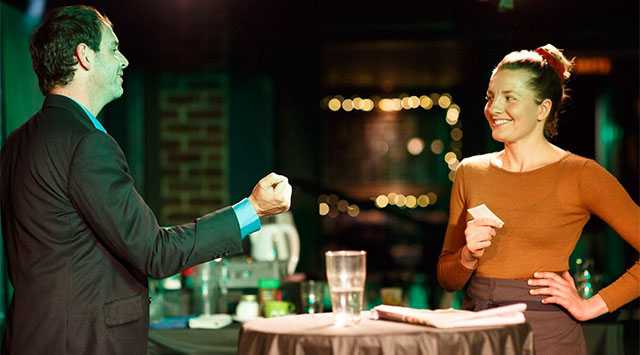
Image by Hayden Brotchie

Theatre review
Edith has an unfulfilling life, working in a small town pub in Leeds, England. Restricted by a minor disability, she had all but resigned herself to a life of discontentment, until a pivotal encounter with Hugh, a shady figure in the local football circuit. C.J. Naylor’s story involves corruption and ambition, but for all its enthusiasm, The Gloveman serves up little drama. The stakes never seem to feel high enough, and the various divergent narratives contributed by each of its characters, add up to a plot that is consequently haphazard. Naylor’s approach to dialogue however, is often delightful, with colourful and lively exchanges that some will find amusing.

It is an energetic show, featuring an exaggerated tone to acting styles that can be charming at times, and comical at others. The decision to use Australian accents instead of a very specific Northern England one is understandable, but the effect is disorienting. The role of Edith is played by Brinley Meyer, whose warm and confident presence keeps us endeared. Personalities in The Gloveman are portrayed with little complexity, but director Michael Block provides a sense of familiarity akin to everyday television presentations that helps us relate. Supporting actor Janine Penfold is particularly memorable, for her interpretation of journalist Gabe as a woman of substance and grit.

When Edith goes missing, presumed abducted by baddies, the menfolk she takes care of at home, preoccupy themselves with arguments about who amongst them is the best goalkeeper in town. It is not uncommon that the woman imagines herself indispensable, persisting with her servitude convinced that the greater good justifies her personal suffering. Meanwhile, all the glory and dirty money that circulates within her community, bypasses Edith, as her elbow grease continues to be called upon to support their sporting economy.

www.bloodmoontheatre.com

5 Questions with Charmaine Bingwa and Graeme McRae

Charmaine Bingwa

Graeme McRae: Who’s your favourite character of the play and why?
Charmaine Bingwa: Alistair, the protagonist Paul’s father; though I’m being slightly biased as I play him. There is a simplicity to him that is so compelling. I love him as he is so representative of the generational disconnection that all too familiar in families. He also serves to remind no matter how hard we try to avoid being like our parents, elements of it are usually inescapable.

What is it like working with our director Anthony Skuse?
Firstly he is an amazing human being. He works very intuitively, has a sense of openness, yet implores exactitude and specificity as God in the detail. He is so widely read too, he’s pretty darn phenomenal.

You had a completely different career before pursuing acting. What caused this change?
I used to work in banking believe it or not! Living in Sydney, I had to balance my creative dreams with the expensive reality of this city. Slowly but surely I was guided towards acting, it almost felt like I could no longer hold my creativity in. I don’t regret it though, I learned loads and made heaps of friends! Plus, I am one of the few actors who is also a numbers girl!

If Skuse gave you a point in the show to come on and play a song on your electric guitar and sing, what would it be? I’ll do harmonies from the wings if you need.
“Paranoid Android” by Radiohead. It’s gloriously anthemic! I feel like Paul and Johnny would play Radiohead-esque music. I love how eclectic the song is, it feels like Alt Rock’s “Bohemian Rhapsody” and I think the lyrics “When I am King, you will be first against the wall” strikes at the heart of the play. Gratuitous solos and definitely room for your BV’s, Graeme!

Have you ever had an experience with a personality like Paul? If so, what happened? If not, make it up.
Unfortunately, yes. My ex was a narcissist and it was the pits. They can’t see beyond themselves, lack empathy and just take and take and take. My least favourite type of humans. But you can’t take it personally as their destructive personalities are usually just mirrors to their own internal brokenness.

Graeme McRae

Charmaine Bingwa: This is the third Simon Stephens play you have worked on, what do you love about him as a writer?
Graeme McRae: It is! I love the way his plays open up as you work on them. A scene can seem pretty basic on first read because of the conversational quality of his writing but once pulled apart becomes profound. As a writer Stephens doesn’t spoon feed you, he makes you work. He asks you to find the clues in the text as to what is happening in the scene. I think this occurs because the writing is succinct, nothing is over written, the character never goes on & on about how they’re feeling. You’ll only get a fragment in what might seem a throw away line. As you can see, I’m not as succinct.

What is it like working with our director Anthony Skuse?
Skuse will always be a pleasure to work with. He has the ability to make the rehearsal room feel like home. His knowledge of art, in its many forms, is inspiring and can at times make you feel a little ignorant but is only used to allow you to see the work through a different lens. Ultimately you end up looking at a lot of art and watching a lot of art films. He’s the first to admit he doesn’t know what’s happening in a scene and so any thought or idea had in the room is allowed to be expressed and played with making the piece a true collaboration.

Birdland has many musical musings; what is your favourite song and why? And do you use music in relation to your acting craft?
I’ve been stuck on Hozier for a good while. He’s got a song called “It Will Come Back” that I think is lyrically spot on for the subject matter. I don’t think I consciously delve into other music when working on a project but it does happen. I remember working on Three Sisters last year and found myself listening to a lot of Tchaikovsky and for this it seems The Doors and Radiohead have been on constant loop in my car.

In many ways Birdland is a dissertation on money, fame and in the impact on people and society at large. What are your thoughts on that and how is it relevant today?
Ooooooo, good one. Feels like an essay question. I think the play does a great job at looking at both sides of the transaction. What happens when you start to believe in your own fame? Why do we as consumers want to own a part of a person’s life? Essentially money is just a number and fame is just a word and you need to be careful about how much you buy into any of it. Told you, far from succinct.

You play Paul, the ultimate rock god. Tell us the ways you are a rock god in your own life.
Ha! Thinking about how to answer this just makes me feel mediocre. The closest I get is busting out to Smooth 95.3 in my car. I know, I’m the coooooolest.

Charmaine Bingwa and Graeme McRae can be seen in Birdland by Simon Stephens.
Dates: 3 Oct – 4 Nov, 2017
Venue: New Theatre

5 Questions with Grace Lauer and Tobias Manderson-Galvin

Grace Lauer

Tobias Manderson-Galvin: You’ve come all the way from Dresden, Germany (via L.A) to be in Puntila/Matti and I wonder as it is the structure of a classic joke: did anything funny happen to you on the way to the theatre? PS it doesn’t have to be funny haha.
Grace Lauer: I had a crazy experience/crazy apparition while driving. 10.30pm so it’s dark. I’m on a part of the autobahn that has no speed limit so I am going quite fast, there is nothing around, no infrastructure, nothing, just road and all of a sudden lit by my headlights I see these white legs in massive heels flash up on the side of the road really close to me like right there .. and then they are gone just as quickly. Or I passed. I’m not sure. I was so perplexed.. and creeped out somehow. A prostitute? The ghost of a prostitute, the legs of a ghost of a prostitute, my imagination? I drove even faster hoping it, they wouldn’t follow me, the ghost legs of the autobahn prostitute, yes that they wouldn’t follow me or it wouldn’t follow me, my imagination – yes that my imagination wouldn’t follow me, leaving it in the dust or better on the tarmac of the autobahn near the spot of the legs of the prostitute the autobahn legs. When I spoke to my brother he offered up the information that street prostitution is very illegal in Germany so neither she nor her legs should have been there really. I didn’t succeed. My imagination is right here with me.

Driving… you play Matti the chauffeur, in Puntila/Matti, so you, I didn’t know this but so you have a licence to drive?
Only a German one. I’ve only driven in Australia a couple of times, I don’t think I’m allowed to. Somehow I got pulled over one of these times and I was so nervous, and I gave him – the policeman – the German licence and he wanted to do the test- the alcohol test. I was giggling uncontrollably and he said ‘Have you been drinking m’am’; and I was really really nervous so I wasn’t blowing properly and then I said, ‘I think I ate an orange yesterday maybe it fermented in my stomach’. And then my mother – who was in Australia, she was in the passenger seat – said “it’s my daughter’s first breathalyser can we take a photo please,” I failed three more times to do the breathalyser test and my mother wouldn’t stop taking photos so the policeman let us go.

The ghost on the street is that the only ghost you’ve ever seen?
One other time. I was running a race in year four. And I got teamed up with a guy. And the guy- so the girl were running the race. And the guys were side lined supporting you as cheer squad. So I got teamed up with this guy I was MASSIVELY in love with. And I remember running and being in front but Deborah K. was running next to me and she was much taller and had longer legs than me and so like I recall running and then the gym teacher was like ‘come on guys support your girl’ and this guy was cheering so loud and I was like ‘I NEED TO WIN THIS’ and then it wasn’t like a prayer or something but in my head I was like ‘please please run faster’ and I just shot off and won this race by like metres and metres and so that was my first encounter with a ghost. Or even the ghost.

Did you win your sweetheart’s affection?
Not until years later and we went out for quite a while. We ‘dated’. I never told the boy about the ghost though and it didn’t last. The crazy thing and I was talking about this to some filmmakers in a sauna in LA. At least they said they were filmmakers. And also it seemed like everyone has their own radio station or podcast in L.A. So anyway they seemed to subscribe to this proto-Freudian, cult-like concept that everyone has an experience between the ages of like 5 to 8 years old that defines your whole life. For me it was winning that race.

But you became an actor not a runner. So how is this your defining moment?
It was a moment of realisation- no believing, let’s say, that there is this potential for a greater benevolent force. So I’m not sure I’m totally 100 percent comfortable with Matti killing Puntila at the end. We can give spoilers here right?

Tobias Manderson-Galvin

Grace Lauer: Have you ever seen ghosts?
You know we’re in Puntila/Matti, not Ghosts at Belvoir right?

I’m asking the questions. So have you?
Once I saw a dragon. I was visited by the Patron Saint of Telemarketing. I’ve communed with angels. I can travel my soul into other people’s bodies and control them like puppets. I can manifest balls of pure energy and all four elements. I can know anyone’s deepest desires by hearing only their cough. There is a spirit panther that follows me sometimes. But no I’ve never seen a ghost.

Speaking of Freud, have you ever seen a psychologist?
A psychiatrist/therapist actually; I went for 12 weeks. Each week she (the doctor) would say ‘I’m really sorry my office is being used by a colleague so we need to use this other room today I normally use for children. So we’d meet in this room full of stuffed toys. She said get comfortable so I arranged all the toys on the couch with me; with a fluffy anaconda around my neck as a scarf. She’d ask questions and sometimes the toys would answer. At the end of the twelve weeks I said to her: ‘So what’s wrong with me doc?’ She said nothing but I was very entertaining and she felt guilty that she’d been the one getting paid for the time. I never returned.

We had 14 walk outs on the second preview; does that bother you?
Once I did a show with an audience of 5. I didn’t like the attitude of three of them so I kicked them out. The show is not for everyone. Tolerance has its limits. I bumped into the three on the street later that night and they said ‘you’re the worst comedian we’ve ever seen’. I said ‘You didn’t see me.’ Turned out one of the two people that I left in the audience was a reviewer. Five stars.

There’s a fair bit of play between yourself and the audience that you didn’t tell me about in rehearsal. Does that happen when you go to other people’s shows?
Only if it feels appropriate. I once threw a show at punk hardcore luminary Henry Rollins’ spoken word concert (at Rollins himself), and he seemed pretty chill with it, but then beat me up in the carpark afterwards while his manager shouted ‘take a photo and post it on the internet, punk, no-one will ever believe you’. So I pick my battles now. But still- F*** you, Rollins.

Grace Lauer and Tobias Manderson-Galvin are performing in Puntila/Matti, part of Sydney Fringe 2017.
Dates: 25 Sep – 14 Oct, 2017
Venue: Kings Cross Theatre

5 Questions with Laura Djanegara and Danen Young

Laura Djanegara

Danen Young: This production has a cast of 17, how have you found working with such a large group of
actors?

Laura Djanegara: Everyone involved in this production is really fun and easy to work with. Although on
stage, I only really work with a few actors in terms of engaging with them in performance. The few
moments where we’ve had all cast involved, the only thing I needed to work on was being 100% sure where
I needed to be and where I was going to avoid running into people. It took a little while to get to know the performers on this production due to the size of the cast but entering tech week we are all bonding more as an ensemble.

Many scholars regard The Winter’s Tale as one of Shakespeare’s “problem plays”. What have been some of the biggest challenges so far in bringing this story to life?
With quite a lot of Shakespeare productions, and indeed with this one, there are a few cuts to the script to ensure a good running time of the performance. One of the tricky things this leads to is getting the full character arc because you lose moments or dialogue that may have assisted. I think this play has managed to work around that. It means having a really clear understanding of turning points in the script is essential. Knowing what you are doing and why and where you change your mind etc. This should be the case with any show but especially with Shakespeare or heightened language. Understanding the thought process of your character and getting the speed of thought is important.

Your character is Camillo, traditionally a male character. What would you say to those who argue
against the changing of a character’s gender?

In 2017 and among theatre practitioners I can’t really imagine anyone arguing against gender fluidity in
performance. Especially in a Shakespeare, whose performance history is littered with gender changing,
having initially had all characters played by men. If I were to encounter anyone who would oppose I would
be happy to discuss it. I would ask ‘Did you lose the meaning of the play through having that character
portrayed by someone of an opposite gender?’. If anyone still argued against it I would encourage them to
have a more open mind.

Shakespeare’s works are 400 years old. Why do you think he is still so oft performed, and why do
people place such a high value on the importance of his work?

Shakespeare’s writing is just beautiful. 400 years on, he still manages to write in a way that is
accessible even though the circumstances might be so far removed from what we now experience. I think he
is performed because there is still so much we can learn from his writing. It is also crucial to understand, appreciate and respect the history. Shakespeare, for me and I’m sure many others, stands out because of his masterful use of the English language.

What’s your go to easy snack for rehearsals?
I am not much of a snacker to be honest. I’d probably have to say coffee if I had to pick. Can’t function
without my good friend caffeine.
Danen Young

Laura Djanegara: Can you explain the basic plot of The Winter’s Tale without using the letter e (except when in a characters name i.e perdita)
Danen Young: Good pals King Leontes and King Polixenes bond in Sicilia. 9 months pass. A baby is within
virtuous Hermione, Leontes’ Lady. Leontes flips out, angry, and says the baby is Polixenes’. Suspicious of an affair, Leontes throws out the child, and puts Hermione in jail. Leontes grows in confusion and hurt, and bad stuff occurs. 192 months pass. Perdita (Leontes’ banish’d baby) is now grown, living a lowly life with Shepherd and his son Clown in Polixenes’ Kingdom. Perdita wants to marry Florizel, Polixene’s son. A party is had, drinks had, goods sold, songs sung and young luv burns bright. But! Polixenes is not privy to this fact that Perdita is actually King Leontes’ banish’d baby, and so forbids said marrying. Polixenes flips out, and things start falling into… You must go to show to know what flows on from this.

Your character is a troubadour of sorts with a slight case of kleptomania. How do you relate?
Well I love songs for their story telling capabilities. Music and poetry are wonderful vehicles for ideas
and expression, and even more fun when the character is cheeky. As for the kleptomania, mainly I steal
things accidentally. Usually lighters.

Why do you think it is important for audiences to see this play? What universal themes still ring true?
I feel like The Winter’s Tale is not as well known as some of his other plays. It’s an eclectic mix of action, thriller, drama and comedy, with a bunch of very fun and interesting characters. In a way its a sort of coming-of-age story, with Time passing o’er 16 years, and we get to see the long term effect of making heavy decisions on a whim based off an emotional impulse.

This is your second production with Secret House, what are your favourite things about working with this production company?
Secret House are incredible. I only came in late to Cymbeline last year with these guys, but it was clear from the moment I stepped in to the rehearsal room that they were focused on putting on the very best show they could. Jane and James really love bringing theatre to the people in Sydney, and that’s infectious. Also, their sets are incredible!

In Shakespeare’s times all female roles were played by men, if you could play any female character from any of his plays who would you pick and why?
Female role. That’s tough. There are so many strong female roles. I would have say a tie between
Helena or Hermia from A Midsummer Night’s Dream. I’m a huge fan of the Lovers’ scenes from that play, and the girls always stand out for me with their passion and fire, but also how they love and get hurt. For me they would just be a joy to play.

Laura Djanegara and Danen Young can be seen in The Winter’s Tale by William Shakespeare.
Dates: 27 Sep – 7 Oct, 2017
Venue: The Depot Theatre