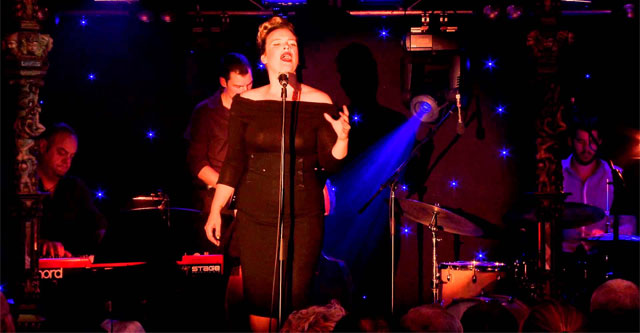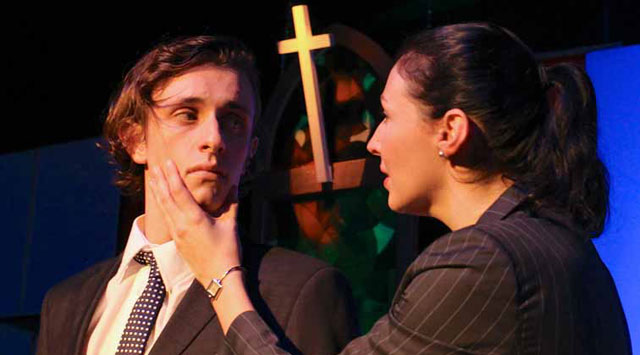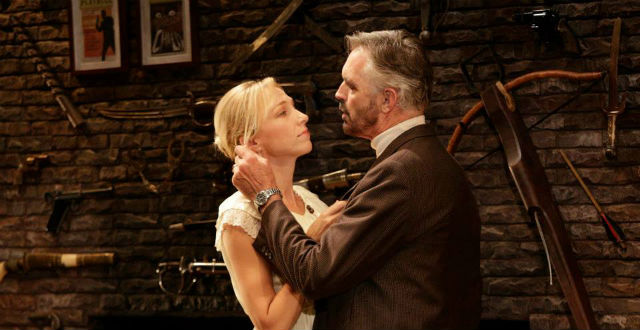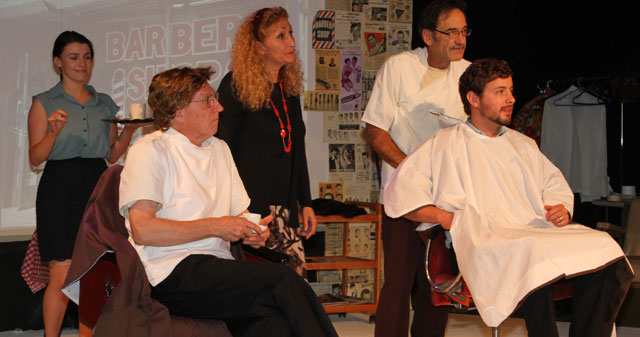
Review: Suddenly Last Summer (Sydney Theatre Company)

Venue: Sydney Opera House (Sydney NSW), Feb 9 – Mar 21, 2015
Playwright: Tennessee Williams
Director: Kip Williams
Cast: Paula Arundell, Melita Jurisic, Brandon McClelland, Robyn Nevin, Eryn Jean Norvill, Susan Prior, Mark Leonard Winter
Images by Brett Boardman

Theatre review (originally published at Auditorium Magazine)
The very nature of trauma is dramatic. It disrupts the heart and mind, and leaves in its wake, disorientation and damage. To repair and to move on, fragmented pieces must first be assembled so that a sense of narrative and coherence can be found. The business of theatre involves storytelling, but it also involves a representation and expression of the human condition. At its best, art communicates something that is deep, but also universal. We want to be able to connect on some meaningful level, whether obtuse or simple. Like psychotherapy and other healing processes, theatre can often be difficult and confusing, but what matters is that artists and audiences emerge with something of value, and perhaps something new.

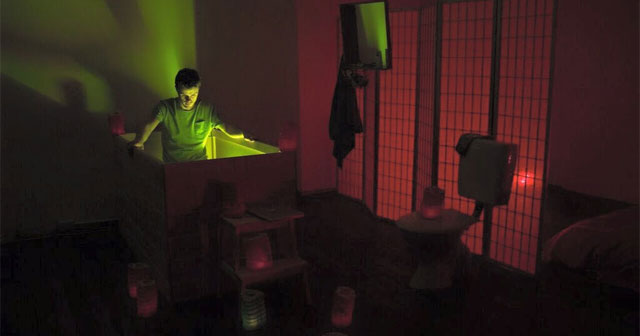
More than half a century has past since Tennesse Williams’ Suddenly Last Summer first appeared off Broadway, but its ideas remain seductive, and his words have proven themselves to be eternally sublime. Scripts in the theatrical canon are timeless because they are of themselves exceptional, or are able to initiate something extraordinary. Williams’ brilliant work appearing on any stage today will spark debates on the degree to which a new interpretation should stray from the predictable. There will always be purists who prefer faithful renditions that acknowledge the perfection of what is already established on paper, and then others would applaud daring departures that take the text to unexpected realms. Kip Williams’ production places three video cameras on stage with his cast. The revolving stage contains a plain cyclorama that doubles as a screen, so that multiple perspectives of the same stage moment can be offered. The show opens with just the back of the screen in view, and the first scene is projected onto that backdrop so that we can only see a movie sized projection of the performance. The stage then turns to reveal its other side where the actors and set are situated. The projection now continues on the front of the backdrop as the action takes place right before it. The camera operators do not hide from our sight, and although all its design harks back to 1937, our experience is a thoroughly modern one.

The actors portray characters with a sense of nostalgic accuracy, but there is no conventional theatrical experience to indulge in. Our eyes are constantly being pulled away from one image to another, and yet another. We are never allowed to focus too long on any dramatic moment. The work distracts us from itself, and we become frustrated and anxious, like the disturbed people we are studying. The concept of the stage is redefined by the use of video in Suddenly Last Summer. Surely, what we see in the theatre constitutes the performing space, but if our eyes are being manipulated by technology so that we are exposed to something strange, then space takes on different form and notion. If all we can see in the 544-seater is a needle piercing into the leading lady’s arm, then something magical has happened on that stage. Similarly, if a man runs off stage but appears to continue running up the fly tower on screen, then the confines of the proscenium can be seen to have vanished. It is certainly experimental work, and with everything that is unusual, we react first with bewilderment, and if our mental capacities are able to process beyond the immediate, then perhaps the work has achieved interesting intellectual effects. When the director’s work is good, it is because he is immensely inventive, but when bad, it is for the same reason.

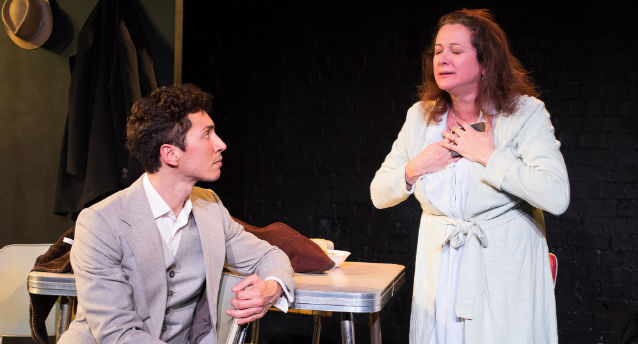
Less ambiguous is the quality of performance from Eryn Jean Norvill, phenomenal in the role of Catharine. Through madness and fear, the most extravagant drama can materialise, and Norvill is stunningly uninhibited with the level of emotional and visceral intensity she achieves. Williams’ poetry is delivered through her voice as though singing the most sumptuous, yet tragic, of arias. Whether observing her in the flesh or through the lens, her star quality is undeniable, and it is clear that without her heartbreaking portrayal of a woman in agony, the production would not be remembered for much more than its formalistic inventions. Also captivating is Robyn Nevin, whose regal presence is a perfect match for the severe and menacing matriarch, Mrs Venable. The veteran actor’s portrayal is authentic and hugely engaging, which probably explains the camera’s frequent focus on her, even at moments when she is not taking centre stage. Nevin’s “reaction shots” are beautifully done, but a tricky element that can sometimes diminish the effect of what is actually unfolding in the plot.

Suddenly Last Summer has an astonishing story to tell, with exciting themes that would interest any audience, but the playwright’s efforts come dangerously close to being subsumed by the methods in which his story is told. The unorthodox staging eclipses the text itself. There is so much to discuss and think about when the curtains fall, but what takes precedence is the director’s orchestration of proceedings, which seem to be much more concerned with structure, rather than content. Of course, we should not prioritise the writer’s voice over the director’s simply because the play is well-known, but human impulse wants to revel in narratives, and any deprivation of that enjoyment will come up against resistance. Luckily, when the shock of the new fades away, we discover that it is the immortal soul of a classic tale that endures, and suddenly, last night’s turmoil is distilled and the essence left behind is the memory of Mr Tennessee Williams’ unparalleled legacy.

www.sydneytheatre.com.au

Review: Playing Rock Hudson (Old Fitz Theatre / Left Bauer Productions)

FEATURE5[1]Venue: Old Fitzroy Theatre (Woolloomooloo NSW), Feb 3 – 15, 2015
Playwright: Cameron Lukey
Directors: Jason Langley, Cameron Lukey
Cast: Paul Dowson, Kim Knuckey, Tyran Parke, Peter Talmacs, Mark Taylor, Grace Victoria, Benjamin Winckle

Theatre review
The act of “coming out” by public figures remains a contentious issue. Rock Hudson was a prominent American actor from the 1950s, who had kept his homosexuality a dark secret up to his AIDS-related death in 1985. Playing Rock Hudson offers a look into the star’s final years and his lover Marc Christian’s lawsuit against Hudson’s estate after his passing. Cameron Lukey’s script is detailed and ardent, with shades of tabloid style revelations accompanying passionately political interpretations of events and personalities. It satisfies our need to catch a glimpse of the gay man that had been hidden from view and promotes discussion about the way LGBT history is tainted by deceit, and how it can be amended.

Direction of the work by Lukey and Jason Langley, feels like a nostalgic homage to films of Hollywood’s Golden Age. Scenes are reminiscent of romantic and courtroom classics, achieved by thoughtful costuming (by Georgia Hopkins) and specific acting styles, but the show’s rhythm and energy are consequently slightly lethargic by today’s standards. Sequences are not sufficiently differentiated to prevent a sense of repetition, which also results in a plot momentum that is less than dynamic.

Performances are consistently strong, with a support cast that is especially noteworthy. Grace Victoria is a compelling Elizabeth Taylor, leaving a lasting impression by bringing complexity and humour to a legendary character that most are familiar with. Benjamin Winckle plays multiple smaller roles, but each is distinct, colourful and memorable. Leading men Paul Dowson and Mark Taylor are committed and alluring. Dowson plays Rock Hudson with an astonishing likeness and quiet confidence, and the mysterious love interest Marc Christian is played by Taylor with intriguing ambiguity and charm.

The importance of role models for oppressed minorities cannot be overstated. Those who choose to live in the closet will always have their own reasons, but their actions are an obstruction to efforts for the eradication of discrimination everywhere. Even though he continued denying his sexual orientation from the public, it is believed that Hudson’s announcement of his illness 3 months before death, had had a critically positive impact on funding in the USA for AIDS research. People in positions of power and influence owe a debt to the communities who reward them with privilege and prestige. When acting in self-serving hypocrisy, the debt they owe us all is immeasurable.

www.leftbauerproductions.com

Review: Cock (Old Fitz Theatre / Red Line Productions)

redline2Venue: Old Fitzroy Theatre (Woolloomooloo NSW), Feb 3 – Mar 6, 2015
Playwright: Mike Bartlett
Director: Shane Bosher
Cast: Brian Meegan, Matt Minto, Matilda Ridgway, Michael Whalley
Image by Tim Levy

Theatre review
John is caught between a man and a woman. These relationships cannot co-exist, because the three people believe that the nature of love is monogamous, and more than that, love requires resolute sexual identities. Mike Bartlett’s Cock is essentially a play for the post-gay era. It makes us look at the boundaries and definitions that have come to rule our lives, and to consider their arbitrariness despite their unadulterated and pervasive presence. John has to decide if he is gay or straight, and as the pressure escalates, we become increasingly aware of the absurdity of his circumstance. There are few things in the LGBT world more controversial and dangerous than saying that sexuality and gender are choices that can be made by conscious adults. Cock makes reference to the need for manufactured concepts that serve political purposes, which may not be legitimately applicable to all individuals that they try to protect, and would disintegrate when its purpose is served. Of course, we can understand that no one would choose to be gay in a world that discriminates and persecutes those who deviate from heteronormativity, but if society has progressed far enough, then maybe making a conscious choice to become the “other” is no longer a threatening proposition (if the “other” can still exist in that progressive civilisation). What is discussed in Cock suggests the redundancy of sexuality labels in how we live, even how we love.

Shane Bosher’s direction strips the production of all sets and props. The actors do not make any costume changes, so all they have are words and ideas, bodies and space. The theatre-in-the-round configuration encourages constant movement, and coupled with scenes of incessant fight and struggle, the atmosphere is often electric. Bartlett’s writing is energetic and bold, with humour and drama bulging at the seams, but it is clear that Bosher’s affinity with the play’s graver portions is stronger. Tension on this stage is omnipresent, but jokes are hit and miss. The leading men give exciting performances but lack the versatility to flow persuasively between the light and dark of the writing.

Michael Whalley is John, the young man stuck in a state of confusion. Whalley embodies the frustration and weakness of his character with great clarity, and the play’s difficult themes find a surprising resonance through his performance, but John needs to be more affable in order for the dramatics to have greater efficacy. John’s male lover is played by Matt Minto, who is delightfully flamboyant, but repetitively so. The character is a stubborn one, and we eventually grow tired of his unchanging voice and mannerisms. Conversely, the female lover shows a great range of intellectual and emotional states, and those transformations make Matilda Ridgway’s performance a gripping one. She finds authenticity in a script that is more conceptual than real, and creates the only character we are able to empathise with, even though we are baffled by her devotion to John, the non-hero. Brian Meegan is a last minute replacement for the male lover’s father, so it is entirely understandable that he is yet to have all his lines down, but he does a superb job in later scenes to consolidate the play’s plot and philosophy.

LGBT communities in the West have invested decades to create cultures and identities, in order that oppression may be resisted and subverted. Once those objectives are fulfilled, however, a new stage of evolution will commence. In Australia, that time has not yet come, so John will continue to be forced into conceding an invariable sexual preference, whether it rings true to his personal experiences, or not.

www.oldfitztheatre.com

Review: Gaybies (Darlinghurst Theatre Company)

darlotheatre2Venue: Eternity Playhouse (Darlinghurst NSW), Feb 6 – Mar 8, 2015
Playwright: Dean Bryant
Director: Dean Bryant
Cast: Cooper George Amai, Sheridan Harbridge, Rhys Keir, Steve Le Marquand, Zindzi Okenyo, Olivia Rose, Georgia Scott
Image by Helen White

Theatre review
Plays about LGBT experiences often fail the test of time. They reflect certain moments in political causes, and social progress renders most stories passé after their periods of relevance are over. Mart Crowley’s The Boys In The Band (1968) and Jean Poiret’s La Cage Aux Folles (1973) now seem dated and contrived, but there is no denying their historical significance and the respective parts they have played in the human rights movement for gay men in the west. Dean Bryant’s Gaybies comes out of current debates about marriage rights of same-sex couples, and their detractors’ apprehension about parenting by LGBT families, should laws be changed to permit these unions.

Bryant’s script takes the form of verbatim theatre, composed of interviews he has conducted with children of same-sex parents, as well as a few lesbian and gay adults in the process of conception. The work is a timely response to community concerns, and a colourful look at contemporary family lives in Australia, providing a perspective that challenges notions of conventionality and presumptions of what makes a favourable set of circumstances for children to thrive. It is the kind of text that would either be daring and controversial, or merely preaching to the choir, depending on the audience it plays to, but Bryant’s own direction injects inventive variety and surprising humour to ensure a delightfully engaging experience for all but the very bigoted.

The brilliant cast brings a palpable tenderness to the production, with all seven performers taking on three roles each, demonstrating versatility and a good amount of heart and soul. Zindzi Okenyo has a gentle but magnetic presence, ensuring that we stay on her side from start to end. Her style is understated and honest, with an infectious enthusiasm that gives weight to her stories. Also very affable is Rhys Keir, who creates big distinctions between each of his characters, allowing them to be individually memorable. Keir’s impulses feel authentically spontaneous, and the vibrant energy he brings to the stage is refreshing and full of charm. Crowd favourite Sheridan Harbridge delivers a polished yet moving performance, with a visibly solid connection between the actor and her material. Harbridge’s comic and vocal abilities serve her well in the show, and we cannot help but fall under her spell repeatedly.

Owen Phillips’ set design is a straightforward but effective idea, executed with elegance. His facsimile of a community hall relies on our personal associations with a space characterised by ordinariness, and like the show’s very concept, visual aspects are kept pleasantly simple. Even though the absence of a traditional narrative structure means that we lose opportunities for greater emotional indulgences, what Dean Bryant and his cast provide are important testimonials and a valuable documentation that would function as a sign of the times, and without doubt, a step towards the momentous and inevitable legalisation of marriage for all.

www.darlinghursttheatre.com

Review: The Credeaux Canvas (Lambert House Enterprises)

lamberthouseVenue: Seymour Centre (Chippendale NSW), Jan 29 – Feb 14, 2015
Playwright: Keith Bunin
Director: Ross McGregor
Cast: Emilie Cocquerel, Carmen Duncan, Felix Johnson, James Wright

Theatre review
In Keith Bunin’s The Credeaux Canvas, the commodification of art and youthful ambition are explored through the intertwined lives of three young Americans in 2001 New York City. This is a story of broken dreams and deceit, as well as the often underplayed hardships of growing up. On the surface, Bunin’s characters have everything in the world going for them, each with talent, intelligence and social access, but they make choices that are doomed from the start, and all have to pay the price for their mistakes. The play delves into relationships and events, but leaves us to question the ways humans err, and to investigate what it is that likens us to the moth that gets burned by a flame.

This is a handsome production, beautifully and thoughtfully designed to evoke an accurate sense of time, space, and drama. Emma Vine’s set of a dilapidated apartment is executed with sophistication and flair, and lighting by Liam O’Keefe adds variety and nuance to scenes with careful subtlety. A highlight of the show is music by Christopher Gordon, who takes charge of scene transitions with great imagination and impressive elegance.

Ross McGregor directs the show with a passionate sensibility. He tries to keep scenes active and lively, but is restricted by individual abilities of his cast. Leading lady Emilie Coquerel is polished and energetic, but her character never feels believable enough, although it must be said that her transformations are depicted with good clarity. The key role of Winston is played by James Wright, who brings a natural naiveté to the painter’s wide-eyed entrance into adulthood. Both Coquerel and Wright can be overly self-conscious, most notably in a nude scene where the actors engage uncomfortably in a long conversation, revealing not much more than their bodies.

Felix Johnson is a dynamic performer who shows great commitment in his supporting part of Jamie, with an endearing emotional volatility that allows us to identify and engage with his narrative. Veteran actor Carmen Duncan appears in just one scene, but blinds the audience with her formidable talent and skill. She plays art collector Tess with sensational presence and brilliant humour, captivating the crowd in a way that only extensive experience and that enviable star quality can.

Death is mentioned several times in The Credeaux Canvas, and indeed, life is short, and although we only have one chance at it, mistakes are made so that they can be rectified, and through regret, we can grow. There is a darkness to the play’s conclusion with its characters finding themselves at a juncture where they can either continue on roads of destruction, or make a change for the better. It is a significant point in time for them, but their story gives us the knowledge that every moment is an opportunity to move, from the dark to the light.

www.facebook.com/credeauxcanvas

Review: Beyond Therapy (Understudy Theatre)

understudytheatreVenue: King Street Theatre (Newtown NSW), Jan 28 – Feb 14, 2015
Playwright: Christopher Durang
Director: Johann Walraven
Cast: Tel Benjamin, David Hooley, Andrew Johnston, Rebecca Scott, Nadia Townsend, Jasper Whincop

Theatre review
Christopher Durang’s sensational Beyond Therapy was first staged in 1981, at a time when psychotherapy and counselling were just arriving into the consciousness of the mainstream. Unlike the tendency today to class every colourful mode of behaviour and thought pattern as dysfunction of one sort or another, the play emerges from a period which paid attention to the peculiarities of human expression to locate machinations that might be able to provide explanations to our ever-present existential angst. The inevitable interrogation of normalcy, and the dismantlement of conventional expectations takes pride of place in Durang’s meditation on life for the thirtysomethings, but Johann Walraven’s direction of the piece does not always adhere to that sense of chaotic ideology. Walraven’s exploration of the play comes from a realistic perspective, trying to find coherence in what is essentially absurd and wild at heart. His need to find understanding is entirely reasonable, but the approach causes a muting of what could have been a comedy that guffaws at a much higher octane. The show is about being crazy, and although Walraven does not forget that fact, his interest in grounding the action in a place of logic sometimes gets in the way.

Performances by the cast of six are committed and focused, but an air of restraint permeates the atmosphere. The material requires no straitjacket, and when the actors find moments of abandonment, the production clicks right into position. Nadia Townsend plays Dr Wallace with a kind of Saturday Night Live sensibility, playing for laughs rather than earnest authenticity and her approach works well. There is no need for actors to provide explanation for Durang’s words because they are loud and clear on their own. They should, however, bring an energy to the stage that embodies a manic universe that the text is keen to reveal, so that its raucous comedy can be unleashed. Chemistry in the work is honest and resolutely present, especially in a sequence that sees Rebecca Scott’s character Prudence taunting the patrons at a restaurant. The ensemble loses its self consciousness and takes on an exciting unhinged humour, delivering some of the biggest laughs of the show.

Themes in Beyond Therapy are timeless and universal. It talks about growing up and marriage, within a context that investigates the meanings of sanity and social acceptability. Great art attempts to excavate the layers of fictions that we place between our daily lives and a sense of truth that seems to lie in an irrefutable core somewhere. We go about our business moving from one day to the next with the niggling suspicion that most of what we do is farcical, and entirely laughable if not desperately pointless. Yet, most of us would rather play the role of the sane, persisting with the anxieties and uncertainty of a life done in appropriateness. We believe that the alternative is out there, but we are afraid of what it might present, especially when madness begins to look no more closer to truth than our private falsities.

www.kingstreettheatre.com.au

Review: PUNCTURE (Legs On The Wall / Form Dance Projects / Vox – Sydney Philharmonia Choirs)

Venue: Riverside Theatre (Parramatta NSW), Jan 21 – 25, 2015
Director: Patrick Nolan
Choreographer: Kathryn Puie
Composer: Stefan Gregory
Images by Prudence Upton

Theatre review
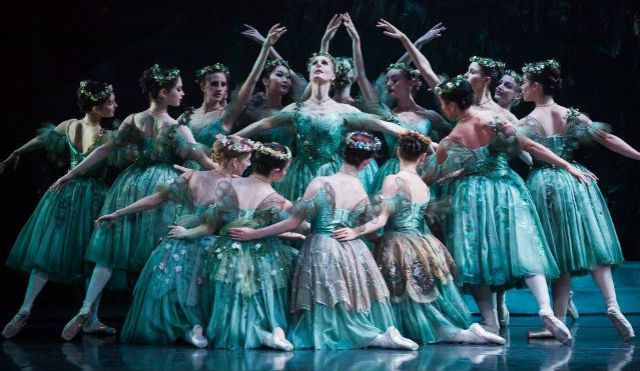
Dancers are at the forefront in the exploration of theatrical space. Without the burden of words and narratives, they open up senses to what the physical presence of things and bodies can do on a stage, and how we communicate between persons, to create meaning where little or none had existed before. Puncture features a great number of people, some are dancers, and the others singers, introduced as though emerging from the audience, and we are encouraged to identify with them, and to read their performance as though what they present have come from us, even if we feel secure in our seats with temporary passivity. The mix of characters features a beautifully diverse range of ages and ethnicities that reflect the breadth of human experience, and of Australian life. The vocalists in particular, are almost a visual copy of the viewing crowd, and efforts at incorporating them into the dance, provide some of the more emotional moments of the piece.

Patrick Nolan and Kathryn Puie have created in Puncture, something that is a little less self-conscious, and a little more accessible than what we have come to expect of modern dance. They investigate the notion of inclusiveness to address the art of performance, as well as the consumption side of show business. It is a noble ambition to blur the lines of where the show starts and where it ends, but redefining audienceship is a difficult exercise. While not always successful, the ideology of breaking barriers provides strong impetus that shapes the show into something that feels adventurous and earnest. We are at our most engaged when the cast tackles the unconventional. The incorporation of rigging (executed behind the scenes by Jon Blake and Felix Kerdijk) to lift bodies 4 metres away from the ground, the soprano on an aerial hoop, and the tender interchanges between choristers and dancers; we are kept fascinated and entertained.

The 22-strong choir is led by Music Director Elizabeth Scott and Composer Stefan Gregory, with accompaniment on piano by Luke Byrne and on percussion by Bree Van Reyk. The marriage between what we hear and see is wonderfully cohesive, with the music at its most successful when it ventures into the avant garde. Even at its most daring, all the sounds are elegantly resolved, except when words like “hello” and “love” are used, disrupting the abstract beauty that wishes to be experienced in personal ways. It is noteworthy that there are many intriguing personalities in the choir, who could have been featured more heavily in the work’s choreography. Trained dancers tend to lose their individualities in the very discipline they invest in, and the juxtaposition provided on this occasion with non-dancers on the same stage is a main feature. Getting the singers to do more with their bodies is probably challenging, but it is precisely the idea of redefinition that would be elevated further, and the meanings that one draws from Puncture can therefore be more powerful.

Many in the show are dedicated and accomplished dancers, but this is not a piece about athleticism or superhuman faculties. It is an expression of how we live, feel and breathe as individuals and as collectives. Its themes are not always clear, but it articulates its concerns with sensitivity and focus. These artists intend to show us something important in their inimitable ways, and if we think that everything important can be put into words, then they have proven us wrong.

www.legsonthewall.com.au / www.form.org.au / www.sydneyphilharmonia.com

Review: After Dinner (Sydney Theatre Company)

Venue: Wharf 1 Sydney Theatre Company (Walsh Bay NSW), Jan 15 – Mar 7, 2015
Playwright: Andrew Bovell
Director: Imara Savage
Cast: Glenn Hazeldine, Anita Hegh, Rebecca Massey, Josh McConville, Helen Thomson
Images by Brett Boardman

Theatre review
As our societies become increasingly concerned with political correctness, theatre seems to have to reach back through the annals of time to locate comedies that appeal to wide audiences, and ones that do not disrupt any of our delicate sensibilities. Contemporary subject matter is replaced with nostalgia, and we can laugh at days gone by in the safety of imagining that things have improved since. Andrew Bovell’s 1988 play After Dinner is a harmless piece about loneliness and sex. It does not resonate with great poignancy, but it does strike a chord with accurate depictions of human emotion and behaviour.

The production’s core feature is its extraordinary cast. All five actors are brilliant comics and they take the opportunity to showcase their very best under the generous direction of Imara Savage, who cleverly places focus on performance above all else. The script and its humour have aged significantly, but Savage’s team apply a modern interpretation that gives an unexpected edge to what could have been a desperately clichéd farce.

Helen Thomson plays Monika with magnificent aplomb. There is a fearless abandon to her approach that gives the show an air of wildness and decadence, encouraging the crowd to indulge in the text’s many mischievous, and occasionally blue, jokes. Thomson’s extravagant sense of humour is infectious and irresistible, and the almost ridiculous bigness of her performance is given solid support by a gentle empathy she invests into her character’s underlying sadness. The role of Stephen is played by Josh McConville, who manages to miraculously marry sleaze with sweet, creating a persona that is as repulsive as he is charming. The actor’s physicality is perfectly exploited (with the help of stunning work on wigs by David Jennings) to create an appearance and a movement vocabulary that is nothing short of hilarious, and very evocative indeed, of a kind of unfortunate barfly from the era.

Design elements of the production are effective but less than ambitious. The look and sound of the work is surprisingly tame for a decade that is associated with poor taste and general gaudiness, but fortunately, all the action that takes place on stage is anything but beige. Beneath the energetic and incessant provision of laughter, is a view into modern lives, and the challenges we experience with issues of intimacy. Instead of after dinner tribute bands, we talk today, about hook up apps and sexting, but continue to be confounded by the search for love and some of its illusions of fulfillment. With the unfathomable advances in information technology, communications have taken over every aspect of every second, yet loneliness is more present than ever before.

www.sydneytheatre.com.au

Review: The Winslow Boy (The Genesian Theatre)

genesianVenue: The Genesian Theatre (Sydney NSW), Jan 17 – Feb 14, 2015
Playwright: Terence Rattigan
Director: Nanette Frew
Cast: Matthew Balkus, Meg Mooney, Lois Marsh, David Stewart-Hunter, Sonya Kerr, Lachlan McNab, David Prickett, Tom Massey, Jane Thorpe, Mehran Mortezaei, Roger Gimblett

Theatre review
Terence Rattigan’s 1946 work The Winslow Boy centres around the theme, “let right be done”, and its distinction from the concept of attaining justice. Not a great deal is made of this intellectual dissection in Nanette Frew’s direction, but in place of philosophical depth is quaint nostalgia and lighthearted entertainment. The interpretation is anti-naturalistic, with more than a hint of stylistic emulation of English theatre and life in the 1910s, resulting in a production that is staid and distant to begin with, but slowly warms up to something that is ultimately quite delightful.

There are good performances in the piece, including Sonya Kerr who plays Catherine Winslow, a suffragette finding her way through a changing world for women. Kerr is vibrant and playful, bringing a fun liveliness to the space. Her enthusiasm is not always matched by colleagues, but her persistence pays off and she creates the most engaging character of the show. In the role of Sir Robert Morton is Roger Gimblett whose chemistry with Kerr is a highlight. Gimblett is a dynamic actor who delivers effective drama, but would benefit with greater familiarity with his lines. The master of the house Arthur Winslow is performed with elegant gravity by David Stewart-Hunter who is a convincing patriarch, if a little oversubtle in approach.

Many audiences love a period piece, and Genesian’s The Winslow Boy satisfies on some levels. Cosmetically, it is well put together (especially Sandra Bass’ hats and Sharon Case’s wigs), but much of the execution feels surface, with characterisations and storytelling requiring further development. The production gives its creators much to be pleased about, but bars can always be raised higher in artistic expression, even when tackling a century old tale.

www.genesiantheatre.com.au

Review: Short+Sweet Theatre 2015 Top 80 Week 2 (Short+Sweet)

shortsweetVenue: New Theatre (Newtown NSW), Jan 14 – 18, 2015
Festival Director: Pete Malicki
Image by Sylvi Soe

Theatre review
Week two of 2015 Short+Sweet Theatre features a wealth of talent. There is exciting writing, clever direction, inspired acting, and sharp costuming to be found peppered through the night. Although no single work is able to be outstanding in every creative capacity, memorable moments are many, and the event continues to be an important one for Sydney artists and audiences alike.

Robert Renshaw’s Chat To Death teeters on the precipice of pornography, but the dangerous eroticism he explores is thrilling and beautiful, although quite explicit. The context he builds is not perfectly resolved, but his use of language more than satisfies. In Ryan Pemberton’s Business Meeting, a macabre and very quirky take on what happens in corporate boardrooms is beautifully directed by Pemberton whose sense of humour is odd, unique and very appealing. Direction is also a highlight in Rachel Welch’s So Says The Sea. James Hartley finds nuance in a deceptively simple script, and portrays surprising depth in just ten minutes. His cast is a strong one, especially Petrie Porter and Aleks Mikic who both impress with committed and meaningful interpretations of what could have been quite plain characters.

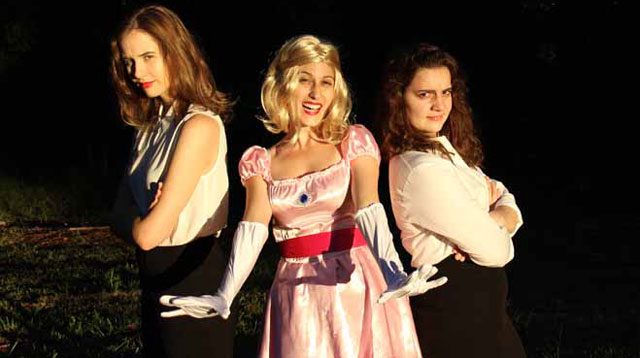
Other fabulous performances include Matthew Friedman, whose own piece The Least Impossible Thing That Happened This Evening opens the programme with vibrant energy and genuine enthusiasm. Equally buoyant is Jo Ford’s Chance You Can Dance, whose outrageously camp actors Hilary Park and Drew Holmes deliver irresistible laugh out loud sequences with their charming references to familiar cultural archetypes. Gavin Vance’s Screamers! The Wizard Of Aussie! Aussie! Aussie! (pictured above) stars the unforgettable Joseph Chetty who plays an Australian version of Dorothy Gale, blending drag comedy with a bawdy cabaret approach to present a scathing critique of the Abbott government, culminating in a live rendition of ‘Somewhere Over The Rainbow’ that is thoroughly and utterly electrifying. Dorothy’s call for a better national leader is a convincing one, and for a quick minute, she makes us believe in the pot of gold that lies at the end.

www.shortandsweet.org