Review: Mosquitoes (Sydney Theatre Company)

Venue: Sydney Opera House (Sydney NSW), Apr 8 – May 18, 2019
Playwright: Lucy Kirkwood
Director: Jessica Arthur
Cast: Annie Byron, Jason Chong, Mandy McElhinney, Jacqueline McKenzie, Angela Nica Sullen, Louis Seguier, Nikita Waldron, Charles Wu
Images by Daniel Boud

Theatre review
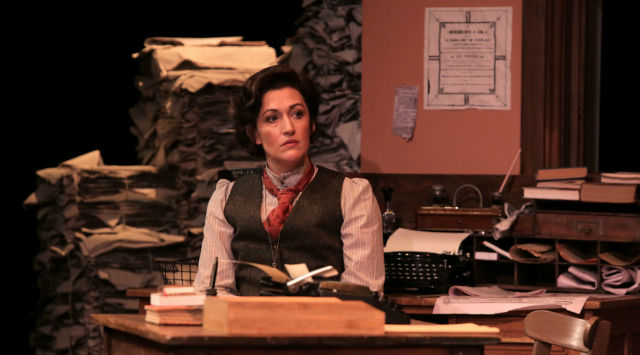
The two sisters could not be more different. Alice is a high-achieving scientist, and Jenny is an anti-vaxxer; it would seem that all the brains had gone to one sibling, leaving the other quite the imbecile by comparison. Lucy Kirkwood’s Mosquitoes sets up a dynamic that tempts us to think in binary terms, but guides us away from forming false equivalences in our estimation of its characters. Although we see good and bad, smart and stupid, the play is able to convince us that people are people, that to determine some life as more valuable than others, would always be tenuous and quite indecent.

After one very big mistake, Jenny’s messy life appears to be going resolutely downhill. The reverberations of her self-destruction are felt by Alice, whose own existence begins to unravel, perhaps as a result of her sister’s chaotic proximity. Playwright Kirkwood sets the family drama against a backdrop of science and nature, with Alice’s career in physics providing context for us to ruminate on both the separateness and inseparable-ness of things. We isolate things to understand them, but forget their indissolubility in the bigger scheme. Our minds are able to conceive of distinct particles, but none exists in absolute detachment. Families are made of individuals, who are at once autonomous and conjoined.

Mosquitoes‘ small domestic scenes are not an easy fit on this vast stage, and although production designer Elizabeth Gadsby and lighting designer Nick Shlieper do not always succeed at containing and concentrating our vision, there is an alluring quality in the elegance that they do achieve. Some very big acting by Annie Byron, Louis Seguier and Charles Wu in supporting roles, are risky choices that prove helpful, and satisfying, in getting us involved. Director Jessica Arthur brings excellent amplification to personal emotions for the characters we meet, but her show is insufficiently provocative, able to communicate effectively only on surface levels. We want more insight into our contemporary times, and more philosophy in general, from a piece of writing that seems to promise so much intellectual rigour.

Jenny is played by Mandy McElhinney, whose humour is a striking feature, full of confidence and impressive verve. Jacqueline McKenzie’s Alice is appropriately high-strung, with an admirable intensity, although slightly one-note in her approach. Their work is assisted by James Brown’s music and sound design, who does marvellous work when tensions are rising, but is occasionally deflating, when in contradiction with the comedy being presented by the cast.

When we find Alice at the end of her tether, rationality turns her ironically monstrous, almost fascistic in attitude, as she tries to put order back into life. At that moment, the shiny appeal of her intelligence and sophistication, reveals something inhumane, and we begin to perceive Jenny’s prior weaknesses with disarming empathy. It is a magical instance of equalisation that transpires, if only in our irresistible urge to place judgement. At these times of extraordinary factiousness, there is perhaps no greater need than the urgency to look for similarities in between. In our efforts to make things better, we identify problems, and relegate them to imagined groups of others, and forget the ultimately inextricable culpability of the self. It is easy to think of the cosmos as one, but to prevent it from falling to pieces, in this day and age, looks to be impossible.

www.sydneytheatre.com.au

Review: How To Rule The World (Sydney Theatre Company)

Venue: Sydney Opera House (Sydney NSW), Feb 11 – Mar 30, 2019
Playwright: Nakkiah Lui
Director: Paige Rattray
Cast: Gareth Davies, Vanessa Downing, Michelle Lim Davidson, Nakkiah Lui, Hamish Michael, Rhys Muldoon, Anthony Taufa
Images by Prudence Upton

Theatre review
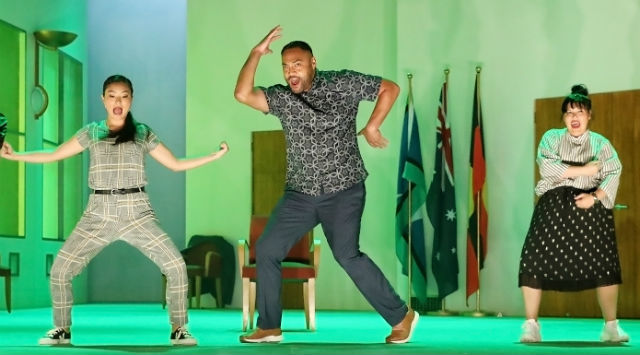
In Nakkiah Lui’s How To Rule The World, the government is trying to pass the Sovereign Territory Bill, a thinly-disguised piece of legislation that further advances the white supremacy cause that is already too much a part of our social fabric. Canberra insiders Vic, Zaza and Chris, are people of colour, all absolutely fed up with the state of affairs. They join forces to install a political puppet, by hiring a white male actor as a shoo-in for the senate, who will subsequently hold the balance of power required to kill off the offending bill.

It is a passionate work, piercingly funny, with an ambitious scope that even at over two-and-a-half hours, can at times feel hurried with its plot. As a result, we may not always understand with great detail, why the people do the things they do, but we nonetheless have an excellent time watching them being unequivocally hilarious. Directed by Paige Rattray, the show is exuberant, but laden with irony, and thoroughly modern in its dissection of power distribution in Australia, making no bones about the white patriarchy that corrupts our country from the inside out.

Lui herself plays Vic, a character central to the play’s advocating of a national treaty that will recognise and institute Indigenous rights, for the past and future. It is a performance memorable for its vulnerable authenticity, effortless at delivering a poignancy that stays with us, long after the laughter has subsided. Michelle Lim Davidson and Anthony Taufa are Zaza and Chris respectively, both endearing and vibrant personalities who ensure that we are always rooting for the right people. The three make a cohesive team, independently effective, but powerful as a singular entity.

The stooge is played by Hamish Michael, who breathes exciting life into an otherwise rudimentary character. His Tommy Ryan is a painfully accurate portrayal of the suits we see everyday on TV; vacuous, desperate and bizarrely comedic. The Prime Minister is a suitably deplorable man, as interpreted by Rhys Muldoon, who shines especially when his true colours are revealed in the latter half, as the going gets tough for the man on top. Gareth Davies appears in a very large assortment of roles, each of them wonderfully imagined and executed with stunning perfection, to earn the biggest laughs of the night. Also in multiple parts is Vanessa Downing, who although creates less of an impact, proves herself a dependable and unwavering source of support for the show’s louder types.

Set design is functional, and appropriately dreary in Marg Horwell’s depiction of our halls of parliament. The decision to do without set changes is a contentious one, considering the play’s frequent location changes, but to keep the action economically contained, encourages its scenes to flow quickly for the audience to remain exhilarated. Lights by Emma Valente are cleverly and efficiently rendered to shift time and space, with little noticeable fuss. Valente’s video projections include an instance of encircling sharks in the PM’s office that is particularly delightful. Paul Mac and Steve Francis provide sound and music, further perking up the proceedings, consistently reliable in their addition to the production’s humour.

We like thinking that the Western societies in which we dwell are democratic, but we also accept that there are people who want to rule the world, and we habitually acquiesce to those desires. At all our election days, each of us casts a vote, feeling as though we are an indispensable part of the most integral of processes, then we walk away letting the powerful carry on with business as usual. They climb their way up, as though determined to leave us behind. When we notice that the interests of those who have made it to the upper echelons are no longer in accordance with our concerns, we become exasperated. Injustices are felt only at the bottom, yet we wait for those on top to lead the change.

www.sydneytheatre.com.au

Review: Mary Stuart (Sydney Theatre Company)

Venue: Roslyn Packer Theatre at Walsh Bay (Sydney NSW), Feb 5 – Mar 2, 2019
Playwright: Kate Mulvany (after Friedrich Schiller)
Director: Lee Lewis
Cast: Fayssal Bazzi, Caroline Brazier, Simon Burke, Peter Carroll, Tony Cogin, Andrew McFarlane, Rahel Romahn, Helen Thomson, Matthew Whittet, Darcey Wilson
Images by Brett Boardman

Theatre review
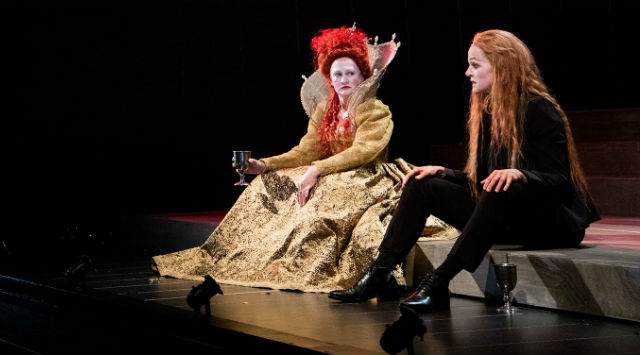
Queen Elizabeth I of England must finally decide whether to sign the death warrant of her cousin Mary, Queen of Scots, after 19 years’ imprisonment. In Kate Mulvany’s adaptation of Friedrich Schiller’s 1800 play Mary Stuart, we look at the final days of this historical feud, paying attention to political machinations, as well as the fascinating psychological processes that the two women would have had to go through, in what is clearly the most difficult and traumatising of human experiences. A highly intelligent work, Mulvany transposes the ancient story into a contemporary tale foregrounding themes that matter today, with renewed focus on the feminist implications of this conflict between powerful women.

Surprisingly funny, featuring witty dialogue that transcends the ages to connect with our everyday ears, Mulvany transforms the royals into flesh and blood individuals that we can easily relate to. With none of the pretension often associated with period pieces about European queens and kings, we are free to examine all the sublimated dynamics between Elizabeth and Mary, to come to our own conclusions about power structures, whether or not one chooses to share the playwright’s feminist lens. Mary Stuart is also effective in delivering drama, powerful in the way it conveys the palpable emotions of a woman compelled to put a loved one to death, and another who faces her own demise.

The vast auditorium is put to good use by Elizabeth Gadsby who situates the action in a suitably grand setting, palatial but austere. Lights by Paul Jackson are especially effective in the graver sections, to facilitate the sensation of mounting pressure as we move toward the inevitable. Music and sound can sometimes be too subdued, especially in the earlier more comedic scenes, but when things turn serious, Max Lyandvert is certainly on hand to heap on the tension. Costumes are a highlight, perhaps predictably, with Elizabeth’s opulent gowns really making an impact. Mel Page’s work on all the women’s looks are unequivocally remarkable.

Director Lee Lewis exercises a stylistic restraint over her stately presentation, determined not to let pomp and ceremony distract from its central concerns. Visuals can sometimes feel sparse and incommensurate with our imagination of both the queens’ worlds, but Lewis’ strength in elucidating rationale behind all manner of human behaviour, is sublime. Actor Helen Thomson is electrifying as Elizabeth, appropriately majestic and piercingly humorous, insisting that entertainment value accompanies all the intellectual stimulation that the play so doggedly provides. Thomson continually reveals layers to the queen throughout the two-hour duration, consistently unpredictable with her depictions, including moments of poignancy that are quite unexpected. Her rendering of Elizabeth as a real and authentic person, is an astounding achievement. Mary is played by Caroline Brazier, whose very deliberate portrayal of grace under pressure is as beguiling as it is intriguing. Her penultimate scene of exposure is truly arresting, as she performs an outpouring of intense and contradictory emotions that gives us a glimpse of the woman under the crown.

Women compete because our power is scarce. We are pit against one another, and we participate in these battles, rarely challenging these absurdly unjust systems and the beliefs that they perpetuate. American Professor Emerita of Sociology and Women’s Studies, Gail Dines suggests that empowerment is a false hope, for to place ourselves within patriarchal hierarchies necessitates the exploitation of many women. Liberation on the other hand, evokes a collectivism that prohibits oppression of any kind. The two queens in Mary Stuart were able to wield power of all kinds, but it is clear that their lives were never their own. Enslaved by their fathers, their states and their religions, we watch them at war, inside a living hell not of their own making, and wonder how much of our own lives are just the same.

www.sydneytheatre.com.au

Review: A Cheery Soul (Sydney Theatre Company)

Venue: Sydney Opera House (Sydney NSW), Nov 5 – Dec 15, 2018
Playwright: Patrick White
Director: Kip Williams
Cast: Emma Harvie, Anita Hegh, Jay James-Moody, Brandon McClelland, Tara Morice, Sarah Peirse, Monica Sayers, Shari Sebbens, Nikki Shiels, Bruce Spence, Anthony Taufa
Images by Daniel Boud

Theatre review
Miss Docker is an inconvenient older lady. Living in the suburbs, her presence is a constant source of irritation to all and sundry, even though she goes out of her trying way to be a useful member of community. Possessing neither great discernible talent, nor satisfactory social skills, her good intentions prove inadequate, and having gone past an ascribed use-by date, exclusion is her daily reality.

Critical of the Australian middle classes, Patrick White’s A Cheery Soul takes aim at our parochial values, and that strange sense of fear resulting from our insecure colonial identity, one that corrupts the way we are with one another. Additionally, the play is a study of how women are devalued, through its depictions of a character who has failed to fulfil her destiny of wife and mother, in a society determined to disallow her from deviating from its narrow definitions of womanhood.

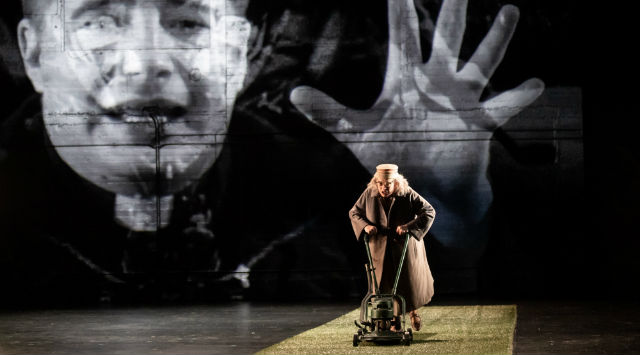
White’s signature incorporation of poetry and abstraction have a tendency to dilute the drama in his narratives, and although director Kip Williams does well to introduce a generous and robust scale of theatricality that is quite dazzling, the show oscillates regularly between entertaining and challenging, for an experience that feels, ultimately, not much more than moderately rewarding. Nevertheless, it is noteworthy that live video is an inventive and memorable device here, with Williams and set designer Elizabeth Gadsby demonstrating an admirable meeting of the minds for a very effective use of the medium.

Actor Sarah Peirse brings a charming and familiar eccentricity to Docker that conveys a valuable realism for the piece, but it is arguable if the protagonist is on this occasion, sufficiently appealing for us to be firmly engaged with the plot. Reverend Wakeman is played by Brandon McClelland, whose flamboyant approach offers wonderful moments of intensity that add texture to a persistently sad story. Ensemble work is strong in the production, with sequences featuring the cast performing as a haunting chorus especially beautiful.

When scared little people make up the majority, it is the imaginative and the adventurous who are ostracised. Still in our psyche, an outpost of the old British Empire, we remain consumed by anxiety, always thinking ourselves deficient, desperate to be as good as everyone else in faraway fantasised Europe. We behave as though neglected and orphaned, consequently responding by always choosing to embrace the ordinary, in a constant state of keeping up with the Joneses, and irrational in our fear of all things different and unexpected. There is little value in living by replicating, even though it gives an impression of social cohesion, conformity holds us back from progress and deprives us of compassion. In A Cheery Soul we see that to love thy neighbour can be easy, if only we learned to step of our own way.

www.sydneytheatre.com.au

Review: Accidental Death Of An Anarchist (Sydney Theatre Company)

Venue: Sydney Opera House (Sydney NSW), Sep 10 – Oct 27, 2018
Playwright: Dario Fo (adapted by Francis Greenslade & Sarah Giles)
Director: Sarah Giles
Cast: Caroline Brazier, Julie Forsyth, Bessie Holland, Annie Maynard, Amber McMahon, Susie Youssef
Images by Daniel Boud

Theatre review
It is all over the news that an anarchist had fallen to his death from a Milan police station. The official word claims it a suicide, but there are suspicions of foul play. For Accidental Death Of An Anarchist, Dario Fo took inspiration from an actual incident of 1969, and inserted a Maniac into his 1970 imagination of events following the controversy, essentially accusing authorities of murder and corruption. It was a spectacularly clumsy cover up that required questioning, and Fo’s play has proven itself a timeless piece of writing that can always be relied on to help civilians weather any political storm. It reminds us that we are pawns in the game of the powerful, and that we have to endeavour to see beyond the wool that is constantly being pulled over our eyes.

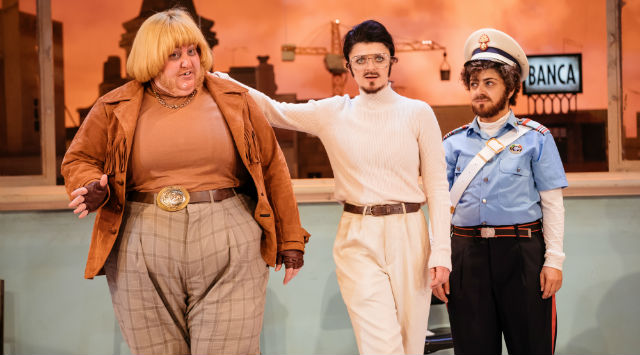
This new adaptation by Francis Greenslade and Sarah Giles is a refresh, but a faithful one that retains the extravagantly farcical spirit of its original. Dialogue is given a stylistic update, but time, place and characters are left unmarred. Giles’ direction of the work is raucous, vigorously so, for a very broad comedy that might take some getting used to, but laughs are certainly to be had.

An all-female cast is charged with the joyful task of lampooning men in power, with Amber McMahon occupying the central role, exhibiting extraordinary verve and inventiveness as the irrepressible Maniac. Julie Forsyth is genuinely hilarious as Inspector Bertozzo, distilling masculinity to its ugliest components, for a cutting study in physicality and speech that conspires flawlessly with her remarkable theatrical timing. Also delivering uproarious hijinks is Bessie Holland, whose Inspector Pisani is a breathtaking invention of caricature at its finest, astute and acerbic in her observations of repugnant boys club behaviour.

The media landscape feeds us endless morsels of information that fight for our attention and outrage. An unexplained death today, is replaced by a racial slur tomorrow; even with the best intentions, we are unable to decipher the truth, much less find the wherewithal to contest the wrongs of the world. Those in power understand this, so they disseminate frivolous scandals that seem so important in the moment, and absorb all our time and bandwidth, until there is no way we can hold them to account.

www.sydneytheatre.com.au

Review: The Harp In The South (Sydney Theatre Company)

Venue: Roslyn Packer Theatre at Walsh Bay (Sydney NSW), Aug 16 – Oct 6, 2018
Playwright: Kate Mulvany (from novels by Ruth Park)
Director: Kip Williams
Cast: Joel Bishop, Luke Carroll, Tony Cogin, Jack Finsterer, Benedict Hardie, Emma Harvie, Anita Hegh, Ben O’Toole, Lucia Mastrantone, Heather Mitchell, Tara Morice, Rose Riley, Rahel Romahn, Jack Ruwald, Guy Simon, Bruce Spence, Helen Thomson, Contessa Treffone, George Zhao
Images by Daniel Boud

Theatre review
When Margaret Kilker met Hugh Darcy in 1920, life in rural Trafalgar was idyllic but inert. The couple, both Irish-Australian, young and hopeful, soon headed to Sydney for a brighter future, setting up home in Surry Hills, where they found community, and formed the foundations of a legacy never intended or even imagined.

The Harp In The South is a six-and-a-half hour epic, in two parts, by Kate Mulvany, based on two of Ruth Park’s novels from the 1940’s and another from 1985. Composed mainly of migrant perspectives as experienced by three generations of Irish women, the play offers contemporary audiences a version of our city’s recent history that feels counter-cultural, one that is derived not from contrivances of the establishment, but from stories told by the poor and disadvantaged. All the wonderful things we associate with this city, are built upon the fortitude of those who bear injustice and genuine hardship. Instead of hearing once again about the great white forefathers who take every credit, The Harp In The South restores the voices of forgotten individuals, and places them in the mythical centre of Sydney’s eminence.

Mulvany’s adaptation is exhilarating and witty, replete with irresistible drama, and brimming with inspiration. A palpable soulfulness informs her every manoeuvre, revealing a deep love of the subject and the material, that proves to be completely and profoundly affecting. Although concerned with a cultural specificity, Mulvany’s play contains a sensibility of inclusiveness, that understands the diverse realities of those to whom this story is relevant. The Kilker-Darcy household leads the action, but their truth can only resonate within a context of multiculturalism, and the accompanying portrayals of Indigenous, Chinese, Greek and Italian characters provide not only a degree of ethnological accuracy, they also make an important statement about the way we have, for a long time, sought to share space in harmony.

Director Kip Williams’ vision is exquisite, for a production extraordinary in what it achieves, not only in aesthetic terms, but even more valuable is its promise to galvanise society, through highly persuasive, and sentimental, depictions of our common past, involving all the complexities in our endeavours to be good families, friends and neighbours. Even though the events that unfold are from a different era, every scene rings true, with a familiarity that emanates from its absolute honesty. The Harp In The South is tremendously soulful, and it speaks to all who have an intimate connection with Surry Hills and its surrounds.

Flawlessly designed, the show looks and sounds magnificent. David Fleischer’s sets, Nick Schlieper’s lights and Renée Mulder’s costumes, form an impeccable collaboration delivering theatrical grandeur, with a pervasive and melancholic nostalgia best described as beautiful. Music by The Sweats and sound design by Nate Edmondson, combine new with old, real with abstract, seamlessly cajoling us from one dimension to another, making us laugh and cry at will. The songs we choose to sing, are the truest indication of who we are, and the many melodic renditions of The Harp In The South are like spiritual disclosures, engineered to touch us in the heart and in the mind.

A large cast of actors, play a very large number of characters, each one fabulously evocative, no matter how brief their appearance. Contessa Treffone, marvellous as both Josie and Dolour, is onstage for a substantial portion of this durational challenge, persistently impressive with her spirited and delightful comedy, and triumphant with the integral vulnerability she brings to the show. Margaret and Hugh are brought to life by Anita Hegh and Jack Finsterer, both reliably poignant, but also cuttingly humorous when appropriate. Heather Mitchell too is splendid, and thoroughly amusing, as the matriarch Eny Kilker.

Unforgettably funny, are Benedict Hardie and Rahel Romahn in all their innumerable guises, although Helen Thomson is a clear favourite, unequivocally outstanding with an incomparable volume of laughs, particularly wonderful as the bawdy brothel madam Delie Stock. Lesbian nuns Theopilus and Beatrix are a thrilling pair, performed playfully yet tenderly, by Lucia Mastrantone and Tara Morice, endearing as a sisterly set, and independently formidable in an astonishingly varied range of personalities.

We can proclaim to know ourselves, but art can often surprise with new epiphanies. There is no end to how humanity can understand itself, and it is imperative that we are committed to finding ever greater truths, if we should continue to believe in better tomorrows. We may not be direct descendants of the people in The Harp In The South, but they show us so exhaustively, who we are, as Sydneysiders, as Australians. The shoulders we stand on were not always solid, but all our strength today must be attributed to that past.

www.sydneytheatre.com.au

Review: The Long Forgotten Dream (Sydney Theatre Company)

Venue: Sydney Opera House (Sydney NSW), Jul 23 – Aug 25, 2018
Playwright: H Lawrence Sumner
Director: Neil Armfield
Cast: Jada Alberts, Wayne Blair, Nicholas Brown, Brodi Cubillo, Melissa Jaffer, Ningali Lawford-Wolf, Wesley Patten, Justin Smith, Ian Wilkes
Images by Heidrun Löhr

Theatre review
King Tulla’s remains are being flown back to Australia, after having been detained in England for three generations. His grandson Jeremiah is required to preside over the welcome home ceremony, but the prospect of having to deal with buried trauma and lost family histories, sees him unravelling, as he comes to grips with all that his emotions have struggled to face. There are few stories as profound and important for us today, as H Lawrence Sumner’s The Long Forgotten Dream. It explores the crippling effect of colonialism, on our Indigenous peoples, as well as the paradoxical urgency of their need to recover, to foster a brighter future. Sumner is marvellously revelatory of the Aboriginal experience, splendid in his clarity of language and of thought, for a piece of writing extraordinary for the power it dispenses, and for the wisdom that it contains.

Director Neil Armfield brings palpable life to this tale of lost souls and transposed dimensions. We are moved by the production’s remarkable tenderness, evident in every delicate aspect that it presents on stage. Live music by William Barton is ethereal but incredibly precise, with a spiritual quality that has us responding in accordance with each of its enigmatic inclinations. Jacob Nash’s set design keeps us enthralled, speaking to us as though on a visceral or perhaps instinctive level, in varieties of shapes and proportions, carrying us from space to space. Mark Howett’s sensual lighting style is relied upon to add warmth to the family drama, and gravity to our national concerns. Technical elements of The Long Forgotten Dream are inventive in their conception, and sumptuously executed.

It is an exquisite cast that takes the stage, with leading man Wayne Blair delivering phenomenal intensity and poignancy, to anchor the show in an unyielding point of pertinence. He couples vulnerability with dignity, ensuring that we are moved by Jeremiah’s circumstances and more vitally, by all the wider injustices implied in the depiction of his suffering. It must also be noted that Blair’s whimsical approach to humour is deeply endearing, and a crucial factor in allowing us to identify with a personality that can seem a world away from most of our daily realities. Also very charming is Ningali Lawford-Wolf, who plays Jeremiah’s sister Lizzie, a sassy, bold presence dependable for introducing a vibrant luminosity with every entrance. Jada Alberts is suitably subtle and thoroughly convincing as Jeremiah’s daughter Simone, and Melissa Jaffer is captivating in a somewhat surprising way, when she conveys so effortlessly, the romantic secrets of a 102-year-old woman.

The refusal to listen, may be our biggest pitfall. We can make repetitive and incessant claims of good intentions, but our inability to actually prioritise the needs and demands of Indigenous communities, will only serve to sustain these unacceptable state of affairs. When we think about Aboriginal and Torres Strait Islander ancestral remains and sacred objects being controlled by colonising forces and their institutions, it becomes obvious the degree to which Australia denies the sovereignty of its First Nations. The inequity and, in some cases, inhumanity, they have had to tolerate, can only begin to find atonement when we are able to place their welfare at the very forefront of the national agenda, on equal footing with, if not ahead of, our selfish and exclusionary obsessions.

www.sydneytheatre.com.au

Review: Saint Joan (Sydney Theatre Company)

Venue: Roslyn Packer Theatre at Walsh Bay (Sydney NSW), Jun 5 – 30, 2018
Playwright: George Bernard Shaw (additional text by Emme Hoy, Imara Savage)
Director: Imara Savage
Cast: Gareth Davies, John Gaden, Brandon McClelland, Sean O’Shea, Socratis Otto, Sarah Snook, Anthony Taufa, David Whitney, William Zappa
Images by Brett Boardman

Theatre review
Joan of Arc never even made it to her twenties. Executed at the age of nineteen, her story represents the worst of our misogyny, and in director Imara Savage’s version of George Bernard Shaw’s play, that absurd fear of powerful women is given elucidation, as we see state and religion go to great lengths to exterminate Joan, so that the threat that she poses to the patriarchy is banished. In Saint Joan, instead of the usual veneration and idolatry, a war hero is swiftly and mercilessly taken down, for the sole reason of her gender.

Men can have daring ambition and resolute faith, but in a girl, those qualities are turned into the charge of heresy. Shaw’s original vision proclaimed “no villains in the piece,” but Saint Joan is, on this occasion, thoroughly subverted, to expose the inhumanity of forces we hold in reverence, of those so much power is lavished upon. Church and government do not get off scot-free in this rendition of Joan’s legend. Their guilt in the historical episode, is brazenly exposed. Our father figures are rightfully condemned, made to own up to the brutal murder of an heroic warrior.

Full of passion, the work is powerful and gritty, made spectacularly riveting by the presence of its leading lady. Sarah Snook is an unequivocal sensation in the role, equally intense whether depicting vulnerability or majesty, marvellously incisive with the delivery of each line. She conveys meaning and emotion with admirable depth and a disarming authenticity, having us pining for her every artistic bestowment. Her interactions with the cast are replete with chemistry, and the men (all other players here are the culpable masculine) bring generous support, often brilliantly engaging in their own right.

David Fleischer’s set design is a restrained, highly sophisticated evocation of our traditional institutions, with a heavy curtain that encapsulates all that is required to express a simultaneous sense of awe and oppression. Lights by Nick Schlieper and sound by Max Lyandvert, take us through atmospheric and spatial transitions with admirable precision, manipulating our instinctual responses with great dexterity, so that our attention is focused always and only, on the exact resonating point.

Evil has a knack for hiding in plain sight. What was once a story about men being dutiful, is today revealed to be a site for the unravelling of abhorrent systems that thrive on ruthless subjugation. Where we were once entangled in the ambiguity of Joan’s assertions and behaviour, we can now depart from the doctrines that had given justification for the unforgivable persecution of a girl who had done nothing wrong. Corrupting forces will remain, but our ability to act virtuously with courage, truth and justice, is forever in ascension.

www.sydneytheatre.com.au

Review: Blackie Blackie Brown: The Traditional Owner Of Death (Sydney Theatre Company)

Venue: Wharf 2 Sydney Theatre Company (Walsh Bay NSW), May 12 – Jun 30, 2018
Playwright: Nakkiah Lui
Director: Declan Greene
Cast: Ash Flanders, Megan Wilding
Images by Daniel Boud

Theatre review
Dr Jacqueline Brown is a mild-mannered archaeologist, who spends her days looking for evidence of the Australian past. Aboriginal histories are often kept buried, so it only makes sense that she should take matters into her own hands, in order that the primal urges to connect with her cultural heritage could find gratification. Learning that some of one’s family had been subject to genocide however, will have quite extreme effects on any person’s psyche. Nakkiah Lui’s Blackie Blackie Brown: The Traditional Owner Of Death charts the rise of a new superhero. A parody of blaxpolitation and Hollywood superhero films, the play depicts the underdog’s ascent and revenge, in a wildly fantastical setting typical of those genres.

Inspired by 70s blaxploitation tropes, antagonists in Blackie Blackie Brown are characterised as the white establishment, but more radical is its requirement that we see regular white folk, those we are conditioned to think of as “ordinary Australians”, as the enemy. In our heroine’s audacious mission to kill 400 white people, each individual’s sins and transgressions fade into irrelevance, and we have to confront instead, the legacy of illegitimate occupation, and the ongoing usurping of space and privilege, by the ruthless project of white supremacy, to which this nation has fallen prey over the last two-and-a-half centuries.

The message is a hard one to swallow, for the predominantly white audiences who will find themselves directly and personally castigated, but as with all good works of comedy, it is the humour that provides magical mollification, as though its sense of absurdity provides relief from the harsh truth. The laughter that Blackie Blackie Brown delivers, is relentless and uproarious. Lui’s very astringent jokes are cutting, sometimes controversially so, offering its players plentiful opportunity to raise temperatures in the auditorium.

Megan Wilding is a mesmerising leading lady, effortlessly alternating between the earnest vulnerability of Dr Brown and her alter ego Blackie Blackie Brown’s extravagant vivacity. The character’s barbarous adventures could easily have us turning against her, but Wilding is impossible to dislike. Full of charm, and with a striking presence, we devour all that she brings, whether madcap, or profoundly authentic. In accompaniment is the high camp stylings of Ash Flanders, equally endearing in a range of screwball guises, each one hilarious and wonderfully inventive.

The pair is well-rehearsed, for an intricate production that involves extensive use of visual projections (animated by Oh Yeah Wow, designed by Verity Hampson), allowing the show to leap across spaces, geographical and metaphysical, with great efficiency. Filmic influences, particularly in relation to the cartoonish violence being portrayed, are cleverly incorporated in this live meets video amalgamation, by director Declan Greene, whose vision seems boundless in its daring and grandness. Also marvellous is the work on sound by Nate Edmondson and Steve Toulmin, who keep adrenaline pumping for the duration of the piece, having us under control with an exquisite blend of sounds that seems to have direct authority over our viscera. Technical aspects although not entirely flawless, are complex and precise, and there is no denying the scale of ambition necessary for this show to come together; the stage management team is worthy of commendation.

There are few places where minorities can speak freely about their own oppression. The nature of the beast determines that those under the thumb, are well-behaved and polite in the presence of their oppressor, or risk having to suffer even greater abuse. Art has the ability to let all voices be heard. A society that believes in art, will allow a space for a kind of honesty that other spheres are unable to withstand. Art encourages communication in ways that are truthful, and compensate where regular language proves deficient. To kill 400 innocent white people is a ridiculous proposition that anyone would disregard, but to be able to understand the idea beyond the literal, would bring us deep into a discussion that Australians need to have.

www.sydneytheatre.com.au

5 Questions with Priscilla Jackman and Charles O’Grady

Priscilla Jackman

Charles O’Grady: What’s the most significant or surprising thing you’ve learned about trans people and gender identity through the process of making this show?
Priscilla Jackman: I’ve learnt so much on this journey but probably the most obvious thing has been correcting my previous misconception about the homogeneity of the trans community. In my
ignorance as a cisgender white woman, I assumed that trans people share common ground, common values, options etc. Of course, just like all facets of society there is enormous range and diversities within the trans community. Getting to know Catherine McGregor has been such an extraordinary revelation, because her experience and her journey has made me think, quite deeply about humanity and the commonality of our experience, as much as those aspects of her life which are so different to my own.

I find that every time I do a show like this – this one in particular! – I come away having learned or re-evaluated something about myself. Is there anything you’ve discovered over the course of this production that’s changed how you understand your own identity?
I guess a chief understanding and development for me has been an affirmation of the extraordinary collaborative process that making theatre is all about. Often as a director in the past, I have felt solely responsible for overseeing every aspect of a project, feeling I should have all the answers to everything. The most wonderful and humbling experience of working on this show has been to realise that in terms of my identity as a director, actually, the creative solutions have often been born through a deep and rich collaboration with all my team. Recognising the power of this collaboration and the creative strength and collective experience in the room has led to some of the most important creative break-through moments during rehearsals.

You and I have talked a lot about how beautiful and resonant Cate’s voice is. If you could have her read one book or play aloud to you, what would it be?
Apart from cricket, Catherine’s chief obsession is language – her love and faculty for language and storytelling is precisely what captivated and inspired me in the first place. She loves Shakespeare, the Greeks, can rattle off any number of famous military and political speeches verbatim, in a heartbeat. I love to hear her recount famous speeches – Robert Kennedy is a favourite. I love her love of poetry. But perhaps my favourite is her rendition of St Crispin’s Day speech from Henry V. So to answer your question, I would love her to read Henry V to
me.

What element of this show are you most proud of?
There is so much to be grateful for, being involved in bringing this production to life. For me, one of the greatest gifts has been to work with the team. I have never felt as supported and connected to my design team and have absolutely loved and adored working with Michael Scott Mitchell and Nick Schlieper. I have learnt so much from them both. Working with Heather Mitchell has also been one of the most inspiring experiences of my professional life – all members of our team have given so much heart and soul to the work, it has been extraordinary. The day Cate arrived at our rehearsal room, unexpectedly and played cricket with the cast, was one of the proudest days of the rehearsal process – because in that moment everything made sense – the journey that
we have been on together, the importance of telling this extraordinary story, the grace and generosity of both Cate and the cast and the team. I think we all walked away from that day feeling very affirmed that this is indeed, a very special project and special opportunity.

How has making this show differed to other shows you’ve directed in the past?
There are many differences and many similarities. Differences lie in the experience of the team I have around me – including working with you Charles – my first ever Assistant Director! I have created new work in the past using adaptation processes, but this is the first play I have written using a verbatim methodology.

Charles O’Grady

Cate talks frequently about her idol and ‘talisman’, Indian cricketer Rahul Dravid. Do you have a ‘Dravid’ in your professional or personal life, and if so, who?
I feel like I have several Dravids – most of whom would hate to be mentioned by name here! – in the sense that there are a lot of people in my life who have directly or indirectly kept me going, pulled me back from the edge in darker periods, reminded me there are reasons to keep surviving, or just been there when I needed calm and clarity. They all know who they are and they’re all rolling their eyes because, as Dravid says to Cate, “it was nothing” for them to show me kindness and support. I think often we don’t know who the “still points” in our chaos and turmoil are going to be until we find them and we’re clinging on for dear life. In terms of celebrity talismans I’ve carried with me in my life as a gender diverse person, Laura Jane Grace (lead singer of Against Me!) was a big one, as her album Transgender Dysphoria Blues was what gave me the courage to come out to my family. One time she tweeted me saying we were “BFFs”. It was amazing.

What about the text or the concept most excited you when we first discussed it?
There were two things that most got my blood running when reading the script and chatting to you about it. The first thing was that, despite our very different lives and worlds, I found a surprising number of similarities in my story and Cate’s story – something I wouldn’t have necessarily expected from someone who transitioned later in life, and who is involved in sports and the military! There’s so many moments in the script – some big, some minute – that felt to me like a hand reaching out and touching mine, like someone saying “I was there too, you’re not alone”. The second and possibly greater thing was that I saw a nuanced and complex portrayal of a trans person whose opinions I often disagree with. I love that I’ve been forced to re-examine some of my own pre-conceptions, that this is a play that constantly demands more from me, that gets me fired up and passionate. As a younger queer person, I can sometimes fall into the trap of forgetting there are multiple views within my community. Engaging with the words of someone who sees certain things differently to me, who also expresses her views so eloquently, has been as much an intellectual challenge as an emotional one.

Cate talks about cricket being a space for her where “everything just dissolves” and she feels congruent in her identity. Do you have any passions that have the same effect on you?
For me it’s always been dancing. I did ballet from age five to eighteen – I was never very technically proficient but I knew a lot about dance and loved every moment of it. For me, ballet, and dance generally, became a space free of gender – odd, as I was in classes exclusively with girls and we were constantly feminised. But the physical act of dancing was always about being a body moving in a space, and not being a gender – it was about making shapes and evoking stories, and I didn’t need to be a girl OR a boy to do that. Now, though, I find that I get the same euphoria of congruence when I sing.

What’s your favourite iconic ‘cricket sledge’?
Now that I’ve quite literally read the book on the noble Art of Sledging, I’d have to say my fave sledge is by Stephen Harold Gascoigne, better know as ‘Yabba’, who said to a fumbling batsman: “Bowl the bastard a grand piano and see if he can play that instead!”

Sum up this play in five words or less.
Chaos. Congruence. Cry-inducing. Cursing. Cate.

Priscilla Jackman is director, and Charles O’Grady is Assistant Director for Still Point Turning: The Catherine McGregor Story.
Dates: 21 April – 26 May, 2018
Venue: Wharf 1 Theatre