Review: Black Cockatoo (Ensemble Theatre)

Venue: Ensemble Theatre (Kirribilli NSW), Jan 4 – Feb 8, 2020 | Riverside Theatres (Parramatta NSW), Feb 18 – 22, 2020
Playwright: Geoffrey Atherden
Director: Wesley Enoch
Cast: Joseph Althouse, Luke Carroll, Chenoa Deemal, Aaron McGrath, Colin Smith, Dubs Yunupingu
Images by Prudence Upton

Theatre review
When Johnny ‘Unaarrimin’ Mullagh went to England in 1868 as part of Australia’s ‘First XI’, he probably never expected to become our first international cricket star. A century and a half later, his descendants probably never expected that the legend would today be so easily forgotten. Black Cockatoo by Geoffrey Atherden reintroduces the historical figure as a true Indigenous trailblazer, an Aboriginal example of black excellence that the white patriarchy of our sporting arenas seems so determined to wipe away from memory. The play has a tendency to feel overly wholesome, as though sanitised for public consumption, but its importance as cultural emblem cannot be understated.

Directed by Wesley Enoch, the show is a sincere and tender proclamation, paying tribute to Indigenous identities past and present. The complexity of black experiences as colonised peoples, is meaningfully, albeit politely, portrayed in Black Cockatoo. We see our protagonist in a state of conflict, able to recognise his privilege as star on the field, but never ignorant of injustices that befall himself and those he considers his community.

Set design by Richard Roberts establishes elegance for the production’s overall visual aesthetic, but requires greater versatility to help us imagine dramatic shifts in time and place. Lights by Trent Suidgeest and music by Steve Francis are sensitively rendered, both proving effective in conveying poignancy for the piece.

Actor Aaron McGrath is full of charm as Mullagh, dignified and beautifully nuanced in his depiction of a true blue hero. Black Cockatoo‘s narrative does not offer very much that is emotional or surprising, but McGrath makes us fall for the central character effortlessly. In the role of Lady Bardwell is the noteworthy Chenoa Deemal, who brings to the stage an august presence. Also impressive is Colin Smith as coach of the team, remarkably convincing as an ethically dubious Charles Lawrence.

Our Indigenous continue to have to navigate the absurdity of being seen as exotic on their own land. The ‘First XI’ went to England to play cricket, but often found themselves perceived as a circus act, a curiosity that robbed them of their humanity, a persisting strategy that provides legitimacy to mistreatment at the hands of colonisers. We need to hear the voices of minorities, because an understanding of their autonomy is fundamental to the betterment of all our lives. We no longer want our stories told by others. We want the right to talk about ourselves, whether or not the others are willing to listen.

www.ensemble.com.au

5 Questions with Nisrine Amine and Antony Makhlouf

Nisrine Amine

Antony Makhlouf: You play Josephine in Lady Tabouli, how would you describe her?
Nisrine Amine: She’s a handful. Lol. She is a strong woman, with a hard set of beliefs. Quite stubborn. But with a deep faith and loyalty to family. She is almost like the burghul (wheat) in a bowl of tabouli – a little hard on the teeth yet necessary for the salad to come together. She’s quite different to characters I’ve played in the past; not immediately likeable but you definitely grow to understand her as the play goes on. And that’s the main thing with characters on stage – not that we like them but that we can understand them.

Who is Lady Tabouli?
In the first iteration of the play (at Griffin Theatre as part of Batch Festival), Lady Tabouli was very clearly Danny’s alter ego; she was a vibrant and free sense of self that he was so desperately wanting, but struggling, to become. In this new version of the play, I think she is more elusive than that – she is up to individual interpretation and maybe sits somewhere between convention and progression? Shackles and freedom? She is the clash of culture and individuality; group identity and personal truth. Maybe I’ll have a better answer for you once she comes to life in January.

What are your thoughts on the “other” Lebanese salad, fattoush?
Oooo, I am a big fan. I like a good ‘crunch’ in my food. And we all know a good fattoush has some serious bread crunch game happening. So I think I might take a bowl of that over tabouli. Oh no, I have blasphemed. Alas.

Who’s your favourite character in the play?
I dunno but (director) Dino’s is ‘the heat’. (You’ll know when you watch).

So you’re directing James Elazzi’s Son of Byblos for Belvoir 25A next year. What are you looking forward to the most about this experience?
All of it! It’s going to be surreal moving ‘behind the scenes’ for one of James’ works (all of my connections with his work up to now has been as ‘actor’). There’s definitely going to be (self-imposed) pressure to continue Dino’s great directing work on a piece of Elazzi writing, but I’m up for the challenge. The main thing I’m looking forward to, in all honesty, is working with my actors. I am soooo eager to get into that rehearsal room and start building character and relationships. And to help lead the actors to beautiful and truthful moments.

Antony Makhlouf

Nisrine Amine: How similar are you and your character of Danny?
Antony Makhlouf: The similarities of Danny and I is that we’re both Australian-Lebanese men who need to balance two separate cultures. Despite the tug-of-war effect this can have at times, I love sitting within two cultures for it provides me with an insight into two worlds. This has broadened my outlook and enriched my understanding of people. I like to think I’ve created a hybrid culture of my own. Whereas with Danny, his circumstance does not afford him the space to do the same. Instead he needs to be ruthless in his pursuit of self-determination. This is where our similarities end.

What’s your favourite part about the rehearsal process?
I love those moments when you crack the scene open and the words on the page, that you’ve been reading for a while, come to a new and bigger meaning.

What mark are you hoping this play will make on the Sydney theatre scene?
Foremost, I hope Lady Tabouli draws in the people that it depicts. Don’t get me wrong, the play is open to all audiences, however there are members of the community that will see themselves on the stage and benefit from that experience. In Lady Tabouli’s preliminary version at Griffin Theatre’s Batch Festival, a large chunk of our audiences were just that, and the response was real and overwhelming. There is something very special and powerful about this work. It transcends the theatre and offers a release I believe certain marginalised communities are craving to experience. Thus, and with all respect, I am more interested in talking and affecting those people, above anything else.

What’s the key to the perfect bowl of tabouli?
You should probably ask my mum that one. But, I do love tabouli that is a day old – the flavours really settle in by then. Refrigerate overnight and then eat it with warm Lebanese bread.

Where to from here?
After Lady Tabouli, I finish filming season four of Get Arty. I also want to get cracking on creating a new collection of art prints. And I hope to continue to develop and grow as a performer, so a short course overseas somewhere is on the cards.

Nisrine Amine and Antony Makhlouf can be seen in Lady Tabouli by James Elazzi.
Dates: 9 – 18 Jan, 2020
Venue: Riverside

Review: The Iliad Out Loud (Sport For Jove Theatre)

Venue: Belvoir St Theatre (Surry Hills NSW), Jan 23 – 27, 2019
Playwright: William Zappa
Director: William Zappa
Cast: Blazey Best, Heather Mitchell, Socratis Otto, William Zappa
Images by Lisa Tomasetti, Jamie Williams

Theatre review
Homer’s ancient poem is adapted and abridged in William Zappa’s The Iliad Out Loud, first for radio, and now for the stage. This iteration of the epic stretches across three parts, each three hours long, presented by four actors and two musicians, in the form of a staged reading. It takes after what is believed to have happened in 8th century BC, when the original was performed, to be heard and not read. Zappa’s text can easily be repackaged as a novel, and often we wonder if that would have been a better format, especially during the very many drawn out battling sequences, which require only visualisation and no analysis on our part.

This condensation of events would likely be more rewarding for those who are already fans of the story. A thrilling ride for some can prove an ordeal for others, as the production routinely rushes past character development to cover significant occurrences. Without sufficient background understanding of personalities, we struggle to resonate with their trials and tribulations in all the warfare, that Zappa so exhaustively conveys.

Michael Askill and Hamed Sadehi are musicians and stars of the show, a two-man band that makes a real art form of their accompaniment. In the absence of more conventional theatrical imagery, Askill and Sadehi pull out all the stops to stoke our imagination, adding infinite colour to the pages of words being dispensed. Lighting by Matt Cox too, is inspired, with a series of elegant transformations to illumination, helping guide us through states of emotion.

Zappa is an outstanding reader, full of dynamism on his stage, holding our attention with extraordinary ease, effortless in sharing his immense enthusiasm for a seminal work of his heritage. It is a confident cast that travels with us on this journey, impressive in their detailed familiarity with every twist and turn of the 9 hours.

The warring men blame their behaviour alternately, on one woman Helen, or on the gods Zeus and his ilk. Their inability to face their own culpability in all the conflict, feels an accurate reflection of every war in every era. It may not be true that women are never in favour of such brutality, but it is certain that none of these atrocities can ever be perpetrated without men. All the war heroes in Iliad can be thought of as good guys, and our continual inclination to excuse them of the horrors that they choose to enact, reveals, at least in part, why we remain in a perpetual cycle of bloodshed.

www.sportforjove.com.au

Review: Man With The Iron Neck (Legs On The Wall)

Venue: Sydney Opera House (Sydney NSW), Jan 23 – 26, 2019 | Dunstan Playhouse (Adelaide Festival Centre, South Australia), Mar 8 – 11, 2019
Playwright: Ursula Yovich
Directors: Josh Bond, Gavin Robbins
Cast: Caleena Sansbury, Kyle Shilling, Tibian Wyles, Ursula Yovich
Images by Victor Frankowski

Theatre review
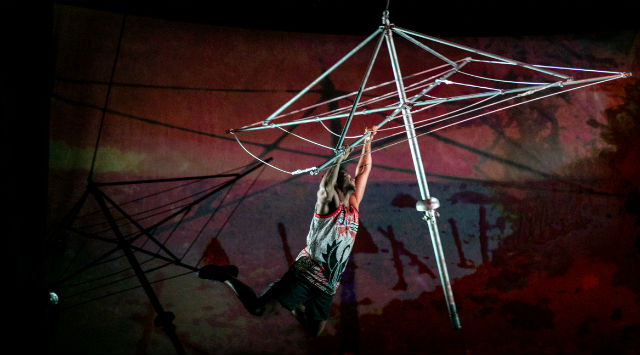
Named after Aloys Peters, a 1930s German stunt performer “who hangs himself and lives to tell the tale,” Ursula Yovich’s play Man With The Iron Neck addresses the issue of suicide among our Indigenous youth. Bear is an aspiring and talented footballer, about to go places, but there are demons that haunt and that threaten to hold him back from all his hopes and dreams. Having grown up with the pain of his father’s abandonment, Bear’s interminable suffering although not immediately evident, reveals itself to be palpable and immutably deep. Yovich’s writing is gentle but deliberate, a moving exploration into a contemporary problem borne out of inter-generational trauma.

Masculinity too, is a resonant theme in Man With The Iron Neck, as we examine a young man’s development in a household without male role models. Bear is required to adhere to traditional notions of his gender, but what is available for emulation, is tainted with tragedy. A substantial amount of physical theatre is introduced by directors Josh Bond and Gavin Robbins, to illustrate Bear’s narrative of late teen maleness, notably involving aerial acrobatics that prove mesmerising. Gratifying work on sound design by Michael Toisuta and Jed Silver, is crucial in the production’s ability to transport us between realms surreal and realist. Performer Kyle Shilling is an engaging presence in the lead role, with an admirable athletic confidence that assists with the show’s dynamism.

Bear’s story is evidence that serious effort into undoing undesirable effects of colonialism, has to take place in tandem with processes of private healing. It is the confluence of both social and personal strategies that is required for our young, especially those of Aboriginal and Torres Strait Islander backgrounds, to be able to move toward brighter futures. We have to learn to talk about our lives as groups and as individuals, to ensure that no one is left behind. It is abundantly clear that our Indigenous youth are routinely neglected; there are reports that seven Aboriginal child suicides have taken place in less than four weeks of January, 2019. As a wider Australian community, we remain unwilling to contribute to solutions, choosing to indulge in delusions that the problem is isolated and removed from our non-black daily realities. We all bear the duty of care for these lives, and our failure is not only shameful, it is reprehensible.

www.legsonthewall.com.au

Review: The Weekend (Moogahlin Performing Arts)

Venue: Carriageworks (Eveleigh NSW), Jan 18 – 23, 2019
Playwright: Henrietta Baird
Director: Liza-Mare Syron
Cast: Shakira Clanton
Images by Jamie James

Theatre review
Lara is trying to do the right thing, by working hard in Cairns, trusting that her partner is taking care of their children back home in Sydney. When one of her sons phones up to notify her of their father’s disappearance, Lara takes the first plane home to save the day. The real drama happens after her kids are fed, when she is compelled to go looking for Simon, even though it is not the first time that he makes an unexplained exit from his responsibilities.

Henrietta Baird’s The Weekend is a one-woman action-packed comedy, that sees our heroine brave the enigmatic public housing towers of Redfern, to encounter the lower classes of her Indigenous community, and the harrowing socio-economic challenges that they face. Baird’s writing is full of thrills, brimming with keenly observed humour, and a modern attitude that boldly pushes Australian playwriting into exciting new realms.

Actor Shakira Clanton takes on all ten characters in the play, each one vibrant and richly manifested. Her mischievous approach is deeply delightful, as she turns us into putty in her hands, taking us through every peak and trough of this amazing journey. It is an unforgettable experience, to see and hear hidden facets of our beloved city, to vicariously revel in Lara’s extraordinary weekend of discoveries. Clanton’s is a performance replete with artistic detail, endlessly intricate and dynamic, thoroughly enjoyable.

Directed by Liza-Mare Syron, the show is often edge-of-your-seat exhilarating, and pure unadulterated fun. Supported by a marvellous team of creatives, including lighting designer Karen Norris, and composers Nick Wales and Rhyan Clapham (Dobby), it is a smart production that provides just enough embellishment, so that we can luxuriate in The Weekend‘s colourful dialogue and personalities, to enjoy the best storytelling that the theatrical arts can facilitate.

Much of The Weekend is about the problems that we inherit. When our behaviour is disappointing, or when we simply find ourselves to be lacking in some way, and we try to reason with these dysfunctions, it is necessary that we go back in time, in order that we can locate explanations for deficiencies. For Lara, Australia’s history of colonisation informs a substantial portion of her misadventures, and on a personal level, archaic notions of womanhood too, are crucial to how she had been able to tolerate mistreatment. When we arrive at an understanding of our baggage, tangible and intangible, is when the hard work has to truly begin.

www.moogahlin.org

Review: The Chat (Carriageworks)

Venue: Carriageworks (Eveleigh NSW), Jan 16 – 20, 2019
Creators: J R Brennan, David Woods
Cast: Arthur Bolkas, J R Brennan, Shane Brennan, Ashley Dyer, Nicholas Maltzahn, Ray Morgan, John Tjepkema, Simon Warner, Les Wiggins, David Woods
Images by Prudence Upton

Theatre review
We are informed that some of those performing in The Chat are ex-offenders from the Melbourne area. The work is a collaboration with artists, including creators J R Brennan and David Woods, reenacting performance workshops centred around a role play scenario, in which an ex-offender plays the part of a parole officer. When the show reaches its concluding episode, the audience finds itself in the position of a parole board, and we have to decide if the role player had revealed enough redeeming qualities in order to be set free.

That responsibility bestowed upon us, although fictitious, carries an undeniably enormous weight, making us think about the nature of justice and rehabilitation in our societies, a topic that most of us have the privilege of circumventing. Being in close quarters with characters whose very lives depend on how our rules concerning incarceration are exercised, turns abstract ideas into a palpably distressing process, as we try to make decisions that bear the most serious of consequences on individuals who we have come to know.

Although much of The Chat is, predictably, not performed with a great deal of skill, an invaluable sense of authenticity is introduced by people who have lived through first-hand, these issues we have to wrestle with. Their presence prevents us from engaging the usual intellectual distancing, that makes answering these questions, inappropriately convenient. The production is given polish by Jenny Hector and Steve Hendy’s lighting design, and by Brennan’s sound design, for a presentation that ultimately leaves an impression that is simultaneously simple and sophisticated.

These difficult circumstances, of punishment and banishment, underlie so much of how we operate, yet matters of law and order are rarely interrogated meaningfully by the general populace. We leave them to experts and tradition, trusting that others know better, when in fact, there probably are no concerns more democratic. Those in need of pardon, work hardest for our compassion, but when we have to determine how compassion is being dispensed, people often forget the universality of our fallibility.

www.carriageworks.com.au

Review: Counting & Cracking (Belvoir St Theatre)

Venue: Sydney Town Hall (Sydney NSW), Jan 11 – Feb 2, 2019 | Ridley Centre (Adelaide Showgrounds, South Australia) Mar 2 – 9, 2019
Playwright: S. Shakthidharan
Director: Eamon Flack
Cast: Prakash Belawadi, Nicholas Brown, Jay Emmanuel, Rarriwuy Hick, Antonythasan Jesuthasan, Nadie Kammallaweera, Ahi Karunaharan, Monica Kumar, Gandhi MacIntyre, Shiv Palekar, Monroe Reimers, Hazem Shammas, Nipuni Sharada, Vaishnavi Suryaprakash, Rajan Velu, Sukania Venugopal
Images by Brett Boardman

Theatre review ⭐️⭐️⭐️⭐️⭐️
It was 1983 when Radha first came to Australia, escaping persecution in Sri Lanka during the racial riots of Black July. With her husband killed in the midst of unrest, Radha was left with no choice but to flee alone and pregnant, arriving in Sydney to put down new roots in a foreign land. S. Shakthidharan’s Counting & Cracking is a very big play, ambitious and benevolent, rhapsodic in its attempts to uncover the whole truth about a woman, observed as a maternal figure from the playwright’s vantage point. Shakthidharan’s work is warm and witty, generous in its seismic attempts to explain everything, taking us through half a century of untold stories to reach an understanding about the people we are today.

It is often a gripping production, directed by Eamon Flack who renders marvellously the play’s more domestic and romantic scenes. Relationships are beautifully cultivated, between powerful characters, with a convincing sentimentality that encourages the audience to invest deeply, our attention and our emotions, right from the very beginning. Political dimensions are communicated less lucidly, but we are able to gather sufficient information for the narrative drive to maintain interest.

Designer Dale Ferguson’s transformation of Sydney Town Hall’s colonial interior, into a festively radiant Sri Lankan space of congregation and celebration, is a sight to behold. Majestic and monumental, it embraces our bodies and psyches, holding us firmly inside its milieu, to have us luxuriate in all its extravagant expressions. Contrastingly, acoustics are a sore point for the production, with sound engineering unable to overcome the echoey vastness of the old building, thus resulting in occasional dissipation of dialogue. There are however auditory delights to be had, in the form of Stefan Gregory’s score, performed live by a trio of musicians (Kranthi Kiran Mudigonda, Janakan Raj and Venkhatesh Sritharan) whose expert accompaniment provides us with unparalleled sensuality and soulfulness.

Actors Nadie Kammallaweera and Vaishnavi Suryaprakash share the lead role, both captivating and extremely likeable, allowing us to fall under Radha’s spell for the show’s entire duration. Their combined dynamism gives Counting & Cracking complexity and authenticity, and we find ourselves moved by a tale that is at once unique, yet spiritually universal. Sukania Venugopal is memorable as Aacha, the vivacious matriarch who brings colour and effervescence to the stage with every exhilarating entrance. Radha’s son Siddhartha provides the cultural anchor for this Australian story, performed by a very compelling Shiv Palekar, whose luminous confidence proves to be as impressive as it is alluring.

It is always demanded of migrants that we prove our worth. Counting & Cracking is in some ways an exercise in showing the establishment that we contribute at least as much as the others; it makes a statement about our Australianness, arguing against incessant lies about immigration being nothing but a burden on this society. More valuable is the play’s reclamation of identity, in its insistence that the portrayal of Australian lives must include histories and origins that are routinely excluded and denied. As humans, we must always strive for unity, but cohesion must bear the unequivocal acceptance of difference, hard as it may be.

www.belvoir.com.au | www.co-curious.com

Review: Since Ali Died (Griffin Theatre Company)

Venue: SBW Stables Theatre (Kings Cross NSW), Jan 8 – 19, 2019
Playwright: Omar Musa
Director: Anthea Williams
Cast: Omar Musa (with guest vocalist Sarah Corry)
Images by Robert Catto
Theatre review
Omar Musa imagines himself travelling down a river with Muhammad Ali, both men outsiders, connected by experiences of ostracism. Musa’s Since Ali Died provides insight into how people of colour survive the dogged exclusions of white society. Through poetry, prose and hip hop phraseology, Musa’s extraordinary writing provides access to intense and complex emotions, that relate to a sense of displacement, in an Australia struggling to think of itself as anything other than an illegitimate monolith. It is a work about home, but on how it can disown you, presented in a theatrical context that sees a remarkable talent confront an audience comprising adversaries and allies, all of us relevant and implicated.

As performer, Musa is charisma personified. We are won over effortlessly, by a stage presence naturally confident yet vulnerable, one that showcases an honesty that many will find utterly disarming. Masculinity is portrayed in a delicate light, with director Anthea Williams carefully preventing any sense of alienation that could arise from the motivating fury of Musa’s expressions. It is an exercise in compassion that results, an occasion that welcomes all, one that encourages us to think about the parts we play, as individuals and as collectives, in Musa’s personal stories.

Melancholic and incredibly moving, Since Ali Died is a timely meditation on contemporary Australian life, an undeniable summation of all our unique challenges, whether spiritual, social or political. Black and brown people endure discrimination by white structures that lay fake claim to this land, just as Muslims are relegated impudently, to a status of religious inferiority. Omar Musa’s very body and soul, right before our eyes, is evidence of those injustices that insidiously constitute our harmful way of life. He is thriving, but he suffers. In his music, simultaneously celebratory and indignant, we are able to understand the strength that is required of people like Musa. It is dark but uplifting, refusing to give in to destruction. His energy is ample and indomitable, and although painful to see it expended on coping mechanism, there is plenty left for orchestrating a change.

www.griffintheatre.com.au | www.riversideparramatta.com.au

Review: My Urrwai (Belvoir St Theatre / Performing Lines)

Venue: Belvoir St Theatre (Surry Hills NSW), Jan 19 – Feb 4, 2018
Playwright: Ghenoa Gela
Director: Rachael Maza
Cast: Ghenoa Gela
Image by David Charles Collins

Theatre review
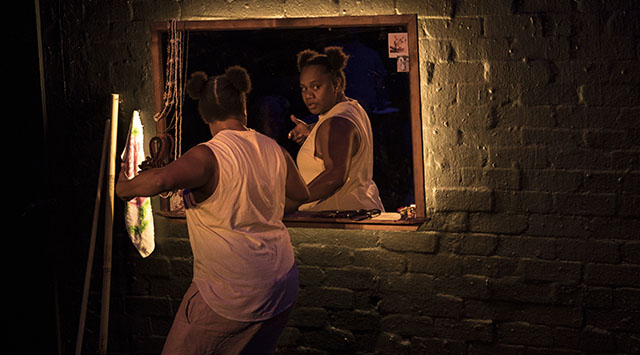
Ghenoa Gela is a Torres Strait Islander born in Rockhampton. Efforts to keep culture in her veins have always been deliberate and laborious; it is a constant battle for Indigenous Australians to resist colonisation and to retain their own identities. In My Urrwai, Gela shows us what it is like to be a woman of native heritage living in modern Australia, bringing particular focus to the unjust burden that black people have to bear, whilst existing on their own rightful lands, that white people had forcefully usurped.

Part of the tale involves a significant first visit to Gela’s extended family in the Torres Strait Islands, where she finds herself in moments of alienation, as well as extraordinary connection. My Urrwai is, among many things, a deep meditation about the need to belong, and with it, we examine the hugely important themes of displacement and repudiation as experienced by our First Nations peoples for 230 years and counting.

Formative and crucial fragments of Gela’s life are compiled intelligently, for an autobiography that feels impressively comprehensive in its scope. Even though My Urrwai does contain colourful idiosyncrasies, the earnest care with which it discusses issues of race is unmistakable, as it is probably inevitable that this one-woman show would be called upon to represent entire communities. The need for more productions featuring Torres Strait Islander voices, simply cannot be overstated.

As performer, Gela is an outstanding talent, combining years of training in stage disciplines, with an enviable presence, to produce the consummate storyteller. Her remarkably exacting and agile physicality, plus an uncanny ability to speak with great resonance, sonorous and philosophical, are the key ingredients in this wonderfully moving piece of theatre. Proving himself to be equally accomplished, is lighting designer Niklas Pajanti, whose work accurately prompts a wide range of emotional responses, from transcendent beauty to chilling terror. Director Rachael Maza’s sensitive manipulations of space, ensures that each scene is received crystal clear, whether in their inception, intent or purpose.

Unlike most plays we see on the Australian stage, My Urrwai is conscientious about acknowledging the multicultural aspect of our audiences. It understands that we do not all come from the same place, even if we do wish to identify as one. It is welcoming of all peoples, but it certainly does not subordinate those whose culture is on display. The ease with which it addresses Torres Strait Islander viewers, and its ability to establish a theatrical language that rejects white experience as the centre of all our orbits, is admirable. The process of decolonisation in how we do and think about art in Australia is a massively difficult one, but Ghenoa Gela and My Urrwai are jubilant rays of hope, undeniable in their brilliance.

www.performinglines.org.au | www.ilbijerri.com.au | www.belvoir.com.au

Review: My Name Is Jimi (Belvoir St Theatre / Queensland Theatre)

Venue: Belvoir St Theatre (Surry Hills NSW), Jan 5 – 21, 2018
Playwrights: Jimi Bani, Jason Klarwein
Director: Jason Klarwein
Cast: Dmitri Ahwang-Bani, Agnes Bani, Conwell Bani, Jimi Bani, Petharie Bani, Richard Bani
Image by Daniel Boud

Theatre review
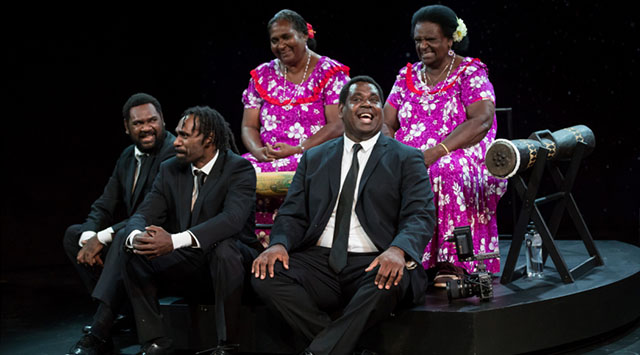
Jimi Bani hails from Mabuiag Island, in the near Western part of Torres Strait. His show My Name Is Jimi, is about culture and tradition, and the resolve to keep the uniqueness of his Wagadagam tribe alive and thriving in the modern age. True to form, the production features performers from his own family, across four generations, illustrating the essence and the importance of what is being relayed.

Small communities are always at risk of losing their identity. The young is seduced by external forces, through cultures of technology and consumption determined to establish a conformity, as required and dictated by Western capitalism. We see Jimi’s son Dimitri devouring the smartphone like any other youth, gradually losing touch with the real kinship that surrounds him.

Ambitiously directed by Jason Klarwein, the work is complex and detailed with its depictions. We learn not only what it is, that Jimi is keen to preserve, but also why and how these traditions have come to be of such value. Folklore and dance feature prominently, to inform and to entertain, but perhaps most importantly, as a demonstration of ancestral pride. There is exquisite humour in the piece, alongside its inherent warmth and poignancy.

Jimi Bani’s naturally commanding presence wins us over from the get-go, allowing us to empathise with his story effortlessly, even though his circumstances are admittedly far removed from many of our daily realities. Dimitri shares his father’s humour, delivering memorable moments of comedy. Agnes and Petharie are the senior women providing music, in ethereal, glamorous and dignified fashion. Conwell and Richard are Jimi’s brothers, appropriately sharing the weight of the show, as nimble sidekicks, particularly effective with their live camera work for filmic projections called upon to represent legends of the land. Especially noteworthy is Justin Harrison’s work as sound and projection designer, beautifully transcendent and crucial to the success of My Name Is Jimi.

Family can mean different things to people, but there is no denying the emotional hold it can have over each of us. Watching Jimi and his loved ones cultivate their extraordinary closeness, is reassuring, but also challenging to those who seek a radical independence in today’s climate of rationalism. It is now normal in many societies, to find definition for the self as an entity distinct from practices of the past, especially when one identifies weaknesses and problems associated with those customs. Jimi’s emphasis on language however, is noble and inspiring. Words contain so much, and they allow us to connect with histories when we choose to. Times will change, but forgetting the past, will only hamper any effort to progress. As we seek to become better, a link with earlier experiences is invaluable. Talking with those who had come before necessitates a bridge, and understanding cultures, especially one’s own, is often more rewarding than we can imagine.

www.queenslandtheatre.com.au | www.belvoir.com.au