Review: Jennifer Forever (Two Peas)

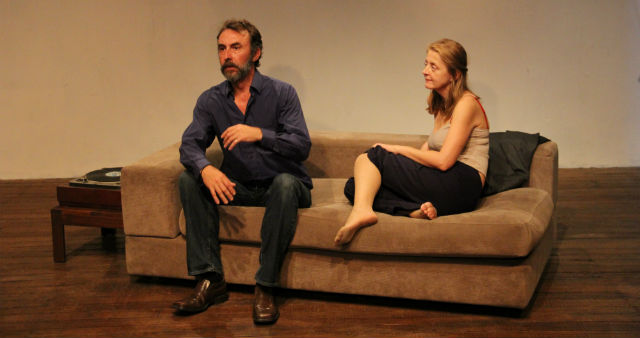
twopeas1Venue: Old 505 Theatre (Surry Hills NSW), Sep 17 – 28, 2014
Playwright: Tara Clark
Director: Tara Clark
Cast: Dominic McDonald, Gemma Scoble

Theatre review
Note: This review reveals a key plot twist.

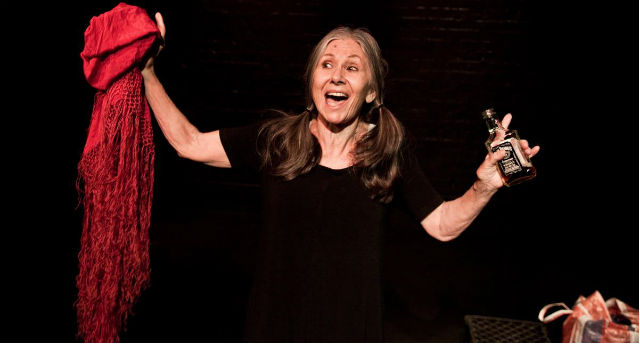
The play begins with ambiguity, danger and tension. Our minds and emotions struggle with meanings and morals, trying to form a narrative while jostling for head space with our own senses of right and wrong, theatrical representations and social acceptability. The work is about sexual predators, sex work and the way sex is used to construct perspectives of the world and the way we live in it. These ideas are best enjoyed in an air of uncertainty, instability and disquiet. When Tara Clark’s Jennifer Forever is provocative, it has a fierce and unsettling energy, but when it dissolves into a more assertive political position, its arguments lose their edge to become more conventional.

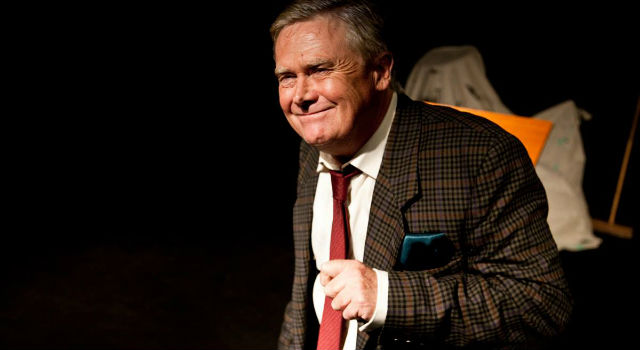
The strength of Clark’s writing lies in its passionate dialogue and the textured characters it presents. Fiery and thought-provoking confrontations between Man and Girl are used to great dramatic effect by Clark’s own direction. Playing Girl is Gemma Scoble who attacks her counterpart with a sadistic glee. She performs Girl’s two age brackets convincingly but can sometimes be too surface in her approach. She is persuasive as a figure of power and aggression but moments of vulnerability are not as compelling. Dominic McDonald’s performance as Man is impressive in its complexity. He makes the role despicable, intriguing and palpable, with an ability to find qualities that are universal to the human experience. McDonald has a sensitivity that allows us to connect with the daunting character that he portrays, and the several stages of transformation he performs is gripping entertainment.

For several scenes, Man addresses the audience directly in a series of lectures, but it is not just this element that makes the play feel excessively didactic. Clark has a clear message she wishes to relay, and her voice is unapologetic and direct. The story quickly subsides and we witness intense quarrels about the main themes of the text. The characters give way to the big ideas that take centre stage, but what remains becomes too simple and obvious in comparison. Jennifer Forever‘s timely look at paedophelia is honest and refreshing. It reflects our contemporary concerns and even though its theatrical effectiveness waivers, it addresses our need for discussion on the topics. We are at the precipice of a disintegrating taboo and achieving a greater understanding that will protect and heal is crucial.

www.thetwopeas.com

Review: The King And I (Opera Australia / Sydney Opera House)

thekingandiVenue: Sydney Opera House (Sydney NSW), from Sep 7 – Nov 1, 2014
Music: Richard Rodgers
Book and Lyrics: Oscar Hammerstein II (based on Anna And The King Of Siam by Margaret Landon)
Director: Christopher Renshaw
Cast: Lisa McCune, Teddy Tahu Rhodes, Shu-Cheen Yu, Jenny Liu, Adrian Li Donni, Marty Rhone, John Adam
Image by Brian Geach

Theatre review
There is no denying the contentiousness of casting a performer who is not of Asian heritage to play the role of the King of Siam. It is a very rare occasion that a main stage production in Australia features a specifically Asian character in its lead, and to deprive Asian actors of the opportunity to headline a show of this grand scale is unfortunate. On the other hand, we are a culture that believes in meritocracy, where the best candidate for the job should win the part. Instead of background, we look at ability, and in the case of Teddy Tahu Rhodes who is King, in the Sydney season of The King And I, he proves himself a force to be reckoned with. Handsome, imposing and astonishingly talented, Rhodes is in many ways, perfect for the role. His humour is confident and sharp, and his rich baritone voice is immensely satisfying. Rhodes has charisma in abundance, which is key to his successful portrayal of royalty and chauvinism.

Anna is played by the endearing Lisa McCune, who is surprisingly animated in her depiction of the English language teacher from Wales. Her voice is not the most powerful in the cast, but her interpretation of classics like Getting To Know You and Shall We Dance is thoroughly accomplished, and her enthusiasm for the role is more than evident. McCune’s Anna is a delicate figure, but her energy is consistently buoyant, and her performance is compelling and enjoyable. The production features outstanding supporting players, including soprano Jenny Liu as Tuptim who provides the most ethereal and emotional singing in the production. Liu’s ability to convey passion and angst is a great asset to the show, and she embodies the tragedy of the plot effectively. The role of Lady Thiang is performed by Shu-Cheen Yu who delights with a stunning theatricality derived from traditional Chinese forms. Her use of physical and facial expressions is a rare treat on Australian stages, which simply must not be missed.

Designers never share top billing with cast members, but this is a production with a visual glory that will be remembered for years to come. Brian Thomson’s scenic design is luxurious and exquisite, with Nigel Levings’ lighting providing further variation to scenes. We never stray far from the King’s palace, but the stage looks and feels different in every scene, and nearly every change is awe inspiring. The glamour and vibrancy of Roger Kirk’s costumes are second to none, with every ensemble conveying beauty and romance. Choreography of the legendary segment The Small House of Uncle Thomas by Susan Kikuchi (based on Jerome Robbins’ original work) is sublime. Watching the famed sequence emerge from the familiar film into reality, in such fine form is a dream come true. Christopher Renshaw serves as director of the production, bringing with him great amounts of flair and elegance, especially in bigger scenes with groups of children and servants. There are always nuances to discover and flourishes to admire in the background. Renshaw handles the writing’s awkward (and dated) racial dynamics well. Jokes are made out of the clashing and discord between races, but caricatures are toned down significantly so that characters escape obvious degradation.

In spite of the productions efforts however, we cannot escape the core message of The King And I, which pits two cultures against each other and concludes at a point where the Siamese King experiences a dramatic transformation, while the Caucasian Anna remains the same person. The underlying message is clear; one side requires improvement and the other can stay unchanged. Furthermore, the Asian character’s evolution needs to be in line with the Westerner’s standards of taste and acceptability in order for the show to find resolution. It is understandable that the esteemed nature of Rodgers and Hammerstein’s work is resistant to radical alteration, and the fact that the story is based on famous memoirs places psychological constraints on artistic licenses, but creativity in the arts should know no bounds, especially when it takes on the responsibility to improve ideologies and advance civilisations.

www.thekingandimusical.com.au

Review: Europe (Slip Of The Tongue)

slipofthetongueVenue: Seymour Centre (Chippendale NSW), Sep 10 – 27, 2014
Playwright: Michael Gow
Director: James Beach
Cast: Pippa Grandison, Andrew Henry
Image by Kurt Sneddon

Theatre review
Making sense of humanity requires that we look at history. History gives us meaning and inspiration, it tells us how we should progress. The same follows for the concept of nationhood. The conceit of nations is a discussion about identity in relation to histories. Australia is thought of by many as a derivation of sorts. Its European settlement and ancestry has shaped its public image into one that is invariably referential. It constantly negates its first cultures and its recent migrations, to place emphasis on its ties with the European continent. We are spurned, forgotten and disparaged, yet we are desperate, supplicant and nostalgic. We define ourselves in European terms, and our score cards are created in their image. We wait for acceptance and approval like abandoned babies suffering from developmental retardation. We live in the shadows of parents who no longer remember our birth.

Douglas sacrifices every dollar on flights to Europe. He seeks to rekindle a week long romance with Barbara who had visited Australia briefly. Douglas believes that his life would be perfect if he wins her over. Barbara is perplexed that a flippant moment from the past has returned to haunt her. Douglas is surprised by her reaction and says repeatedly that he would leave, but misses every train. Michael Gow’s script is a comical love story, and a meditation on Australian whiteness. It examines tenuous connections with a motherland, and the existential angst of the castaway. James Beach’s direction is thoughtful and gentle. The duplicitous nature of the narrative is conveyed successfully, and the minimalism of his staging creates a tenderness that reflects Douglas’ internal complexion. There is a languidness that detracts from humour in the early scenes, but the resulting show is an elegant one that speaks intelligently, with an openness that welcomes interpretation.

Pippa Grandison is suitably continental in her approach. She succeeds in portraying the foreignness of Barbara, and her conscious efforts at creating a sense of exotic otherness is well considered and entertaining. Barbara is a stage actor, and Grandison could benefit from playing up her theatricality further, especially in the early segments where more energy could be put into the comedy of the characters’ encounters. Aussie country boy Douglas is played by Andrew Henry who uses just enough stereotyped conventionality to depict cultural relevance, but more appealing is the authentic naiveté he brings to the role. Henry’s work is confidently simple, which ensures that small gestures speak volumes, and dialogue is allowed to resonate. It must also be noted that his performance of intoxication at the play’s conclusion is completely delightful.

Romance provides spice to life. We long for attention and adoration to be reciprocated, so that some kind of affirmation can be established, but that attainment is only temporarily satisfactory, for romance is a need that can never be sated. As long as we keep thinking of ourselves as a chip off the old block, or as the apple that has fallen a little too far from the tree, we will forever be an inferior echo that fails to be its own self determining entity. There is much to love about our own place on earth. We need to acknowledge our histories but we need to make the best of the here and now, wherever we may be.

www.slipofthetongue.com.au

Review: Other Desert Cities (Ensemble Theatre)

ensembletheatreVenue: Ensemble Theatre (Kirribilli NSW), Sep 4 – Oct 18, 2014.
Playwright: Jon Robin Baitz
Director: Mark Kilmurry
Cast: Lisa Gormley, Deborah Kennedy, Diana McLean, Stephen Multari, Ken Shorter

Theatre review
It is Christmas time and we visit the home of an older Californian couple, both prominent figures from the right wing of politics. Polly and Lyman Wyeth are not always politically correct, but their self awareness gives them an air of relaxed charm. Their children Brook and Trip have arrived for the festivities, but we soon discover that all is not well. Brook is set to publish a tell-all memoir and takes the opportunity to reveal the book to her family. Jon Robin Baitz’s Other Desert Cities, is a tale about the damage our closest ones inflict upon us, family secrets, and the stories we dream up in place of missing pieces. We keep the truth from one another because we think that people need to be protected, and also because of shame. We can choose our friends, and run away from them when intimate revelations become problematic, but family ties are hard to break, so we keep the peace, by perpetuating lies.

Baitz’s script is classically structured. It is amusing, gripping and surprising, with the potential to be incredibly moving. Its themes of family disintegration, mental illness, regret and guilt are all loaded with sentimentality, and when handled well, could be heartbreaking. Mark Kilmurry’s direction brings out the dramatic conflicts of the story with some success, but tension does not build up sufficiently. It is an energetic show, with good amounts of shouting and crying, but the plot does not always engage. The cast seems to be discordant, each finding separate emphases, and their chemistry does not quite convince.

Lisa Gormley invests heavily into her character’s depression and her torment is clear to see. Her early scenes before confrontations begin, feel forced and inauthentic, but her work in the second act is the show’s saving grace. Ken Shorter’s naturalism is a joy to watch. His presence is genuine and strong, but he brings a warmth to the role that does not always serve the narrative well.

Ailsa Paterson’s set design confines the Wyeths in the 1970s. Their home is dated, and we see that they have not moved on for over twenty years. We live the consequences of our decisions, good or bad. There is no assurance that doing the right thing would lead to brighter days, but the Wyeths’ story gives hope that resolutions can be found if you try hard enough.

www.ensemble.com.au

Review: Children Of The Sun (Sydney Theatre Company)

Venue: Sydney Opera House (Sydney NSW), Sep 8 – Oct 25, 2014
Playwright: Maxim Gorky (adapted by Andrew Upton)
Director: Kip Williams
Cast: Valerie Bader, James Bell, Justine Clarke, Yure Covich, Jay Laga’aia, Jacqueline McKenzie, Hamish Michael, Julia Ohannessian, Chris Ryan, Helen Thomson, Contessa Treffone, Toby Truslove
Images by Brett Boardman

Theatre review (originally published at Auditorium Magazine)
In Andrew Upton’s adaptation of Maxim Gorky’s Children Of The Sun, 12 characters of distinct and diverse personalities intermingle in the privileged Protasov household, each with their own sets of concerns and each holding world views that struggle to find cohesion and alliance. Written in 1905, but set 50 years earlier, Gorky’s play looks to the past in order that we may speak of the now. Created at a time of great political and social unrest, a fictional history was used to illustrate the disquiet of the day. The work is about the anxieties and uncertainties inherent in the process of revolution, and the troubling consequences of fragmentation in communities. In our age of technological modernity, we relate instinctively to its theme of individualistic narcissism, and the increasingly fracturing nature of our local and world affairs allows us to empathise with the writer’s angst and trepidation in the face of social upheaval.

The disharmony of relationships is strikingly enhanced in Upton’s version. Its farcical comedy is relentlessly witty and often surprisingly clever, but always subservient to the greater tension of unrest that gradually unfolds. The language we hear is modern, almost colloquially Australian, which not only makes for sharper punchlines, but also allows us to readily identify personality archetypes and status structures. The disconnect between the household’s apolitical characters and the political movement that intensifies on the outside is fascinating to observe. Upton’s dialogue portrays the insularity of daily life, with the characters unknowingly providing reverberations for a larger context. It is classic social commentary that seems immortal, because its necessity never seems to diminish.

Kip Williams’ marvelous direction of the piece works with all the nuances and philosophies of the script to deliver an irresistible production that is both entertaining and thought-provoking. Every character is intriguing and authentic, and Williams injects in each a dimension of dignity, refusing to make convenient fools of anyone. Herein lies the poignancy of work. The range of personalities is diverse, and even though we are unable to identify with everyone, we recognise the humanity in all of them. The vulnerability that they display is familiar, which means that the danger they encounter rings true for us.

Williams achieves a deliciously precarious balance between comedy and drama, effectively vacillating between frivolity and severity throughout the production. It is an intensely engaging show that manipulates our responses almost at will. There is an unpredictability to its plot that takes us off the beaten track and rejects our expectations, but it always enthralls our senses. Its rhythm is perfectly orchestrated in collaboration with our fluctuating emotions, and we become utterly lost in all its trials and tribulations.

Giving the narrative an impressive clarity is its extremely colourful and dynamic cast, many of whom exhibit extraordinary theatrical abilities that look very much like genius. Helen Thomson gives an unforgettable performance as Melaniya, a blundering seductress whose desperation is matched only by her beauty. Thomson’s work is precise and studied, but her instinctive timing creates a deceptive sense of spontaneity. Hilarious, playful, and larger than life, her every entrance is commanding and powerful. Thomson finds comedy in unexpected places, making us laugh while leaving us stupefied at the magnitude of her talents. Even more flamboyant is Hamish Michael, who is delightfully hammy as the painter Dimitri. His humour is unfettered and extravagant, always keen to highlight the vacuous pretensions of his role. Michael relishes the opportunity to play jester, with a wildness to his performance that is certainly amusing, and absolutely suited to the grand scale of the venue.

Pavel is the childlike patriarch, whose devotion to science renders him feckless in all other areas. Toby Truslove embodies the character’s eccentricity perfectly. The actor is slightly betrayed by his youthful appearance but his use of voice and physicality is very well-considered. Truslove’s ability to aggrandise what is basically an introspective personality helps establish Pavel as the charming man who finds himself the object of two women’s affections. Pavel’s sister Liza is his opposite. She is a creature of intuition and emotion, whose ill health is a symbolic manifestation of all the worries she carries for the world. Actor Jacqueline McKenzie is sensitive, elegant and tremendously affecting in the role. She demonstrates excellent range and an acute intellect that carves out the most intricate character on this stage.

Production design is restrained but highly evocative. David Fleischer’s big revolving stage holds several minimal structures that demarcate spaces, but all are in full view for the duration. The aesthetic is modern, but its sentiment is traditional. Significant plot devices like rain and fire are introduced gently, without causing a distraction from the story. Costumes and props are beautifully coordinated, with a sense of historical accuracy. Time and space is manufactured efficiently with minimal fuss, but every moment looks harmonious and beautiful.

This production of Children Of The Sun gives theatre lovers everything their hearts desire. It entertains, educates and thrills us, and it gives us so much to admire in the talent and skills that it showcases, but it does not provide answers to its own pressing questions. It is a quietly controversial work that makes statements about community, equity and political action. It makes us recognise the importance of social advancement, but seeks not to be divisive. It leaves with us a plea for progress and perhaps a yearning for a new revolution, but it relies on our own benevolence and intelligence to find a way.

www.sydneytheatre.com.au

Review: The Shuffle Show (The Chippendale Hotel)

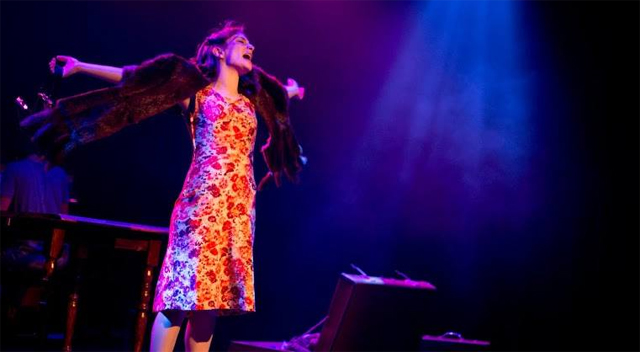
elenagabrielleVenue: The Chippendale Hotel (Chippendale NSW), Sep 10 – 13, 2014
Playwright: Grant Busé, Elena Gabrielle
Director: Grant Busé, Elena Gabrielle
Cast: Grant Busé, Elena Gabrielle
Image by 3 Fates Media

Theatre review
The Shuffle Show is a cabaret performance in which Grant Busé and Elena Gabrielle play devoted employees of an Apple store. There are many opportunities for sending up these curiously culty creatures of retail, and the duo makes full use of their every quirk to formulate a show that pays homage to the mega brand, and to deliver ceaseless laughter and amusement. “1000 songs in 1 hour” is their tagline, which seems implausible at first, but just five minutes into their stage time and we become convinced that Busé and Gabrielle’s talent and flair can comfortably achieve more than what our mere mortal minds can conceive.

Both performers are effectively multi-skilled, having written and directed the piece themselves to showcase their “triple threat” abilities. Gabrielle sings extraordinary operatic notes, then teases with a burlesque style number, and does a surprising “wigga” impression with a medley of rap classics. The variety of the show’s format allows Gabrielle to explore a delightful breadth of competencies, and witnessing her mischievous exhilaration in embracing different styles is truly joyous. Busé provides accompaniment on his acoustic guitar for virtually the entire duration, and is equally accomplished a singer and comedian. He does not display as great a range as his counterpart, but is consistently funny and tenaciously present. The strength in chemistry and timing between the two is the third star of the show, and their concluding extended dance segment is as unexpected and ridiculous as it is deliriously entertaining.

Through the journey of a thousand songs, we come to realise not just the pervasiveness of pop culture, but also the thoroughness at which our worlds are penetrated by technology and consumption. Steve Jobs is elevated from genius to saint, and we are powerless in the face of immense corporate voracity. The age of the iProduct continues to proliferate and resistance seems increasingly futile, but artistic talent is the one thing left that Goliath has to fear.

www.elenagabrielle.com | www.grantbuse.com

Review: Noise Complaint (The Imperial Hotel)

sarahgaul1Venue: The Imperial Hotel (Erskineville NSW), Sep 9 – 14, 2014
Playwright: Sarah Gaul
Director: Sarah Gaul
Cast: Sarah Gaul

Theatre review
Sarah Gaul writes clever songs, and sings with charming bravado. She talks about things she knows, and reveals the concerns of young adults in Australia. Her themes tend to be more whimsical than sobering, but it is on occasions when she touches briefly on more intimate and sadder disclosures that she shines.

Her original material is strong, more memorable songs include Bad, A.V.O., Streetlights and Homesick. The irony Gaul introduces into her song writing does not always translate with enough edge, but the melancholic quality to her world view is endearing. She does renditions of popular tunes by Leonard Cohen and Iggy Azalea, which showcases her impressive keyboard skills and accomplished use of voice. Her connection with the audience however, requires further development. She seems to shy away from eye contact, choosing to be watched instead of finding a way to engage more closely within the relaxed and cozy setting.

It is encouraging to see a young woman taking on the reins to create a career for herself. Like every independent and courageous artist working against the tides of an increasingly capitalistic economy, Gaul should be admired for making her own dreams come true. Time is on her side, and it is with enthusiasm that one looks forward to new songs and new manifestations from a talent full of ambition and promise.

www.sydneyfringe.com.au

Review: Out Of Gas On Lovers Leap (The Kings Collective)

thekingscollectiveVenue: TAP Gallery (Darlinghurst NSW), Sep 9 – 14, 2014
Writer: Mark St. Germain
Director: Grace Victoria
Cast: David Harrison, Cecelia Peters
Image by Kate Williams Photography

Theatre review
USA in the 1980s was a time of great prosperity, when greed was good and the pursuit of riches seemed the only valid way of life. The pragmatism of money encouraged the dismantling of family units, and children grew up in the care of hired help, while parents explored possibilities in thriving economies. Mark St. Germain’s Out Of Gas On Lovers Leap is a lamentation that looks at two high school sweethearts, Myst and Grouper. Both characters are created with excellent depth and their backgrounds thoroughly elucidated. The script is dark and dangerous, with the aimless and misguided teenage couple discussing confronting subjects like abortion and suicide, and indulging in sex, drugs and rock ‘n’ roll before our eyes.

The play is about the gravity in these young lives, but Grace Victoria’s direction allows too much frivolity. The production is entertaining, and extremely high energy, but the dark nuances of the text is often lost. We hear the disturbing details of the dialogue but they do not resonate with a sense of urgency and tension. The cast is vibrant and enthusiastic, but they are not given enough instruction and the deeper social connotations of the story are sacrificed for a lot of clamour and amusement.

Cecelia Peters plays Myst, the talented daughter of a pop music celebrity. Peters’ fervour for comedy keeps the show buoyant, and she pushes effectively to create a sense of excitement. Her emotions are intensely portrayed, but not always appropriately so. The role of her boyfriend Grouper is performed by David Harrison, who is equally effervescent. There is a focus to his work that gives it a sense of polish, and he forms a complementary team with Peters, even if sexual chemistry between the two is a little lacking.

Entertainment is an important factor in assessing a theatrical work’s efficacy, and in the case of Out Of Gas On Lovers Leap, its cast does well at keeping us engaged. Not everything on stage needs to have poignancy and profundity but Mark St. Germain’s script requires a treatment that is more sensitive. The message is a serious one, and it needs to be presented with greater severity. The production concludes well, with Peters and Harrison showing wonderful commitment in the final scene, although a change in tone does occur suddenly. It is now thirty years after that fateful night at Lovers Leap, and Generation X is in its middle age, bringing up its own children. The circle of life may be perpetual, but questions relating to the heredity of emotional and psychological damage become increasingly relevant.

www.thekingscollective.com.au

Review: The Chosen (Moira Blumenthal Productions / Encounters@Shalom)

thechosenVenue: Shalom College (Kensington NSW), Aug 27 – Sep 14, 2014
Writer: Aaron Posner, Chaim Potok (from the novel by Chaim Potok)
Director: Moira Blumenthal
Cast: Anthony Darvall, Barry French, Gabriel McCarthy, Daniel Mitchell, Maeliosa Stafford
Image by Geoff Sirmai

Theatre review
The Chosen is the stage adaptation of a well-known 1967 novel of the same name. It features the friendship between two religious teenage boys in Brooklyn, New York. Reuven is a Modern Orthodox Jew and Danny is a Hasidic Jew, and the play showcases their differences wonderfully. Set against World War II and the subsequent revelation of the Holocaust in Europe, this coming of age story is a sentimental, and at times powerful, look at faith, family and friendship.

The script is eventful, with colourful characters and spirited dialogue. Moira Blumenthal’s direction creates distinct personalities that tell their tales with delightful clarity. There is a palpability that feels almost biographical, and along with it, an appealing gravity that keeps us engaged. A particular strength of Blumenthal’s is the seamlessness at which scene transitions are managed. Her use of space and actor positioning is full of flair in the negotiation of the script’s many short sections.

Performances are accomplished, although older members of the cast are quite noticeably stronger. The two young men are comparatively (and understandably) green, but both Gabriel McCarthy and Anthony Darvall show excellent commitment and focus. Daniel Mitchell as Reb Saunders, the spiritual leader of a Hasidic group is especially captivating. The role is a severe one, and Mitchell brings to it a pronounced sense of drama that makes for exhilarant viewing. The actor’s outstanding presence encompasses experience and confidence that lights up the stage.

Stage design is basic, but its elevation helps improve perspectives in a challenging venue. More ambitious is Alistair Wallace’s sound design, which helps manufacture a sense of time and place with creative use of music and effects.

There is a big emphasis on the father-son relationship in The Chosen, but both boys’ mothers are conspicuously missing. We do eventually discover that Reuven’s mother is deceased, but the juxtaposition of a heavily religious context with an all male narrative raises questions about the place of women in these families, and their respective cultural spheres. The story was created in the 1960s, but a production of the play today should take into consideration its skewed gender attitudes, and perhaps its relevance in view of this glaring omission. Nevertheless, this is a staging that speaks to our eternal search for the deeper meanings in life, and our never ending struggle to find political and spiritual peace. Chaim Potok’s text talks about the co-existence of two contradictory truths, an abstract concept that becomes convincing in this depiction of a pure and inspiring friendship.

www.encounters.edu.au

Review: Unholy Ghosts (White Box Theatre / Griffin Theatre Company)

griffintheatreVenue: SBW Stables Theatre (Kings Cross NSW), Aug 27 – Sep 20, 2014
Playwright: Campion Decent
Director: Kim Hardwick
Cast: Robert Alexander, James Lugton, Anna Volska
Image by Danielle Lyonne

Theatre review (originally published at Auditorium Magazine)
We often go to the theatre for a dose of fantasy. It can be escapism that we seek, or a quest for inspiration, and it becomes easy to conceive of fantasy as a thing severed from daily lives where in fact, nothing can make good sense unless it bases itself in reality. Campion Decent’s Unholy Ghosts is mostly autobiographical. It deals with family and death, probably the most real of all concepts to undertake, and also the most difficult of things to articulate. Through art and the guise of theatrical fantasy, Decent enacts a way to analyse, heal and mourn the inevitable but deepest losses one can experience.

Family ties are uniquely challenging. Some of us are gifted more pleasant circumstances than others, but we all understand the unyielding nature of those bonds. Regardless of time and distance, only a very few can truly claim to have made clean cuts from their closest blood relations. We all know what family can make us feel, and it is that intensity of love (and hate) that makes Unholy Ghosts immutable and its effects inescapable. Decent’s writing is humorous but gentle, with a sublime melancholy that appeals to the tenderest of our sentiments. Its thorough honesty is quite confronting. We cannot resist empathising, which means that we cannot help but reflect upon the ones we hold dear, and the invisible, but persistently lingering notion of death that threatens and surrounds us.

The characters are named in the programme simply as Son, Mother and Father, and the script provides what seems to be factual information about their lives and defining events through the years, including the tragic passing of the unseen Daughter. It is a compilation of Decent’s recollections, as well as invented scenarios that help with gaining insight, or at least to find some kind of understanding, so that pain can be tamed and the living can move on. The play’s structure is hugely enjoyable. The confusion between fact and fiction, laughter and tears, victims and wrongdoers, creates a complexity that is undeniably resonant in its familiarity.

Direction is provided by Kim Hardwick, who does an excellent job of locating comedy and pathos in every moment, and allowing them to co-exist in an unusual harmony. Liberal amounts of dark humour pervades the stage, but there is also a surprising compassion that always makes its presence felt. We see resentment, anger and bitterness in the family members, but their conflicts only exist for a love that requires resolution. The intimacy of the space gives the audience easy access to the people on stage, and their terrific chemistry keeps us spellbound. Hardwick has achieved the remarkable feat of crafting a show where we fall for all of its characters at first sight. Unholy Ghosts is unashamedly sentimental, but it is also thoughtful. There are very strong emotions that surface towards the conclusion, but they are not of the wallowing type. The play keeps a level head, always maintaining a level of self-examination, which makes the sadness much more profound.

James Lugton plays the Son, a version of the playwright himself. Lugton’s emotional fortitude is a great asset to the production, for he lets us see the depth of suffering a person endures without a need for predictable and obvious gesturing. The strength he portrays is so genuine and pronounced, that it conveys the sorrow that he cannot reveal. The more he strives to keep a positive outlook, the more we hurt. It is a confident performance that deceives us with its relaxed nonchalance. It looks the opposite of melodrama, but its results are more affecting. There are moments however, where the actor seems to lose focus and he trips over lines several times, causing one to wonder if certain sections are less rehearsed. Also periodically distracted is Robert Alexander who plays Father, but like Lugton, his lapses are negligible. Alexander’s work is colourful, and the miserly man he depicts is charmingly comical and unexpectedly likable. The accuracy at which he performs the role of the “regular older man”, is brilliantly reminiscent of the literal and figurative fathers of our lives, complete with annoying quirks and disappointing imperfections. There are actors who win us over even before their first scene finishes, and Alexander is a shining example. His charisma is magical, and partnered with a clear affection for the stage, his creation is one that endears and impresses.

Mother is a creature of flamboyance and mischief, who had bought her son the Bette Midler book, A View From A Broad for his sixteenth birthday. The divine Anna Volska is electrifying. Her work ranges from outlandish and grotesque, to delicate and introspective. It is a tremendous role, and the actor fulfills every brief and requirement. Volska delivers many instances of sheer hilarity, but the delicious poignancy she invokes at every appearance is unforgettable.

Visual design is minimal and unobtrusive. No great flair is showcased, but nothing feels lacking. Sound design assists well with mood changes but several keyboard interludes are slightly too conspicuous and outmoded. In the final scene, lighting makes a drastic transformation to accompany the uplifting end. The choice to shift tone so extravagantly is questionable. It is clear that optimism and the celebration of life is a key message, but stating the case so literally may not be necessary. Also unnecessary is the compulsion to release the audience in such upbeat fashion.

The play’s happy ending however, is solid and convincing. Whether exuberant or subdued, we understand the spiritual and psychological journey that Campion Decent has taken, and we appreciate the position of enlightenment he presents. Life ends and relationships end, and it is their brief temporality that gives them value. We only wish for something to last forever when we know that its end approaches. It is tempting to declare that nothing is eternal, but the fact is that art can outlive us, and great writing endures for generations. How splendid the thought that ghosts can prevail, if the artist’s life is well lived.

www.whiteboxtheatre.com.auwww.griffintheatre.com.au