Review: Dining [Uns]-Table‏ (PACT Centre For Emerging Artists)

pact1Venue: PACT Theatre (Erskineville NSW), June 17 – 20, 2015
Choreographer: Cloé Fournier
Director: Cloé Fournier
Cast: Cloé Fournier
Image by Katy Green Loughrey

Theatre review
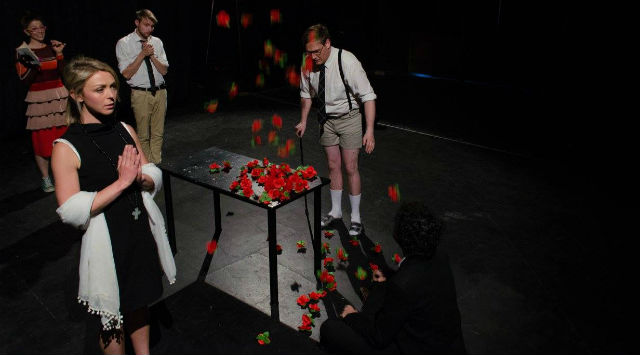
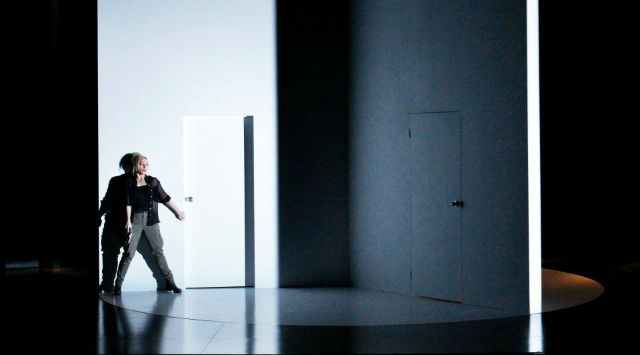
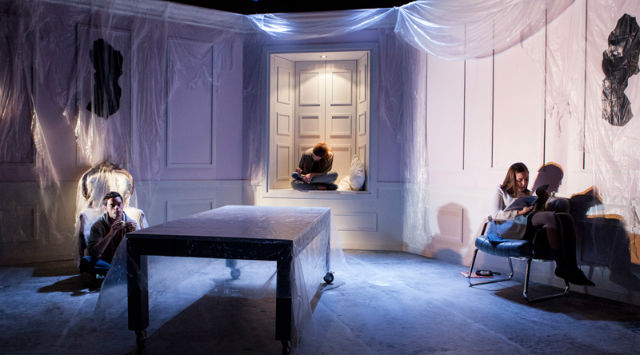
Events from childhood have the potential to shape a person’s entire life, no matter how innocuous they might seem at the time. Little souls have a kind of sensitivity that adults forget, and things that we do and say can have a lasting effect beyond any of our intentions. Cloé Fournier’s Dining [Uns]-Table is an exorcistic ‏work that draws inspiration from memories of a Christmas party with family members many years ago. Fournier works from a base of dance and physical theatre, but she establishes a definite sense of narrative, to provide her audience with reference points that allow us to connect with the surprising range of emotions that are being expressed. The style of art on stage is experimental and its language is thrillingly original, but all its moments are communicative and we read the unconventional presentation from an instinctive and familiar space of interior intimacy. Fournier’s exploration of her personal memory, is in conversation with our own remembrances, and the commonalities we are able to locate, are divine.

If essential ingredients for theatre are inventiveness and a spirit for adventure, Dining [Uns]-Table scores top marks. Furthermore, it is performed with exceptional gusto and flair, by a dancer whose talents are diverse and irrepressible. Fournier’s physicality is flawlessly employed by her own choreography, which is in turn, always thoughtful and refreshing. Her presence is that of a seasoned actor, with the ability to convey story and sentiments clearly and succinctly, always keeping us enthralled. The artist has a precise approach that leaves no stone unturned, and the show feels exhaustive both in terms of what it wishes to depict, and how it does so. The experience is fascinating and all-consuming, and by the end, we are completely satisfied and leave the space thoroughly impressed.

When we approach a work of art, we hope to see a reflection; not an exact facsimile of selves, but a representation of the human condition that we can relate to. This requires both creator and viewer to take a step forward, and to find a point of contact that will spark imagination and hopefully discover something meaningful. In Cloé Fournier’s work, we get in touch with elements that are fundamental to the construction of our identities, shared or personal. The depth that she leads us to, comes not as a result of the divulgement of details from her own experiences, but from the way she seeks to move us in the space that we temporarily encounter. There is so much power in the meeting of strangers at the theatre, and Dining [Uns]-Table agitates an eruption that brings new definition to how things are made and received on Australian stages.

www.pact.net.au

Review: This Is Not Mills And Boon (Glorious Theatre Thing Co / Old 505 Theatre)

glorioustheatreVenue: Old 505 Theatre (Surry Hills NSW), Jun 23 – 28, 2015
Playwright: Erica J Brennan
Director: Richard Hilliar
Cast: Emma Chelsey, Cat Martin, Diego AR Melo, Dominic McDonald
Image by Liam O’Keefe

Theatre review
Sex is a difficult thing to talk about. It is deeply personal, and social etiquette dictates that we keep it hidden under wraps. What is proffered to be general and common knowledge are invariably narrow definitions of healthy sexual functioning and practice. Maturity is therefore almost always an awkward process that involves young people grappling with unexpected deviations from those preconceived notions of norms, and the turmoil that it precipitates can be quite agonising.

Erica J Brennan’s This Is Not Mills And Boon is about Abigail, a young woman trying to understand her sexual self, through the discovery of sexual diversity in erotic literature. The plot is devised with a creative vision, using well-considered anti-chronological timelines and the meaningful juxtaposition of fantasy with reality, but for what is clearly the most risqué of themes at its centre, Brennan’s approach is uncomfortably polite. The raunchy context requires a certain quality of bluntness, or perhaps a coarser sensibility, in order that its jokes may cut deeper, and its many libidinous situations resonate with greater danger and tension.

Director Richard Hilliar introduces a good amount of theatricality to the staging, with strong support by designers (Ash Bell’s costumes are especially noteworthy) to create a show that is effervescent and fast-paced, but it seems to shy away from the opportunity for an exploration into sex and its boundaries that goes beyond the surface. Occupying centre stage is Abigail’s tedious impassivity, which grows more and more pronounced with time, and its presence is allowed to take over the story without it ever being interesting enough. Emma Chelsey plays the lead with a convincing naiveté and an appearance that easily portrays both girl and woman, but her performance is too plain. Without a sense of complexity that intrigues or titillates, the exercise is one that ultimately feels puerile and overly cautious.

Brennan and her protagonist’s journey from girl to goddess might not be the most compelling tale, but it provides a universal parallel for those of us who have experimented and have found our individualistic inclinations in what could be life’s greatest joy. The revelations that come with the formation of confident sexualities are invariably profound, and it is that kind of poignancy that all work about sexual awakenings have to live up to.

www.venue505.com/theatre | gloriousthingtheatreco.wordpress.com

Review: Legends! (Gordon Frost / Theatre Royal)

781198-f461dc9e-0993-11e5-8dc7-b0c4f7af3b6c[1]Venue: Theatre Royal (Sydney NSW), Jun 18 – Jul 5, 2015
Playwright: James Kirkwood
Director: Christopher Renshaw
Cast: Maxwell Caulfield, David Denis, Leah Howard, Phillip Lowe, Hayley Mills, Juliet Mills

Theatre review
James Kirkwood’s 1987 comedy Legends! is about screen sirens wrestling with the fact that time can be unkind, and that parts of us are considered over-the-hill before we are ready to acknowledge their demise. The script is only 28 years old, but it feels more dated than the characters it portrays. Many of the jokes are tired, and its inclusion of African-Americans only as servants and strippers is clearly inappropriate for today’s milieu. All the personalities are simplistic, and although we recognise them on the level of stereotypes, they are not affecting beyond anything archaic and predictable.

Direction of the work by Christopher Renshaw does not seek to invent a new sense of humour in order to update the tone and feel of the text, but his show is nevertheless, tightly paced and energetic. The plot is relayed with clarity and enthusiasm, but its lack of wit is unable to be disguised. It must be noted though, that Justin Nardella’s achievements as designer on the production is remarkable, with set and costumes in particular, conveying a striking glamour that is quite captivating.

Performances by the show’s stars, Hayley and Juliet Mills, are polished and engaging. Their interpretation of dueling has-beens at the centre of the play is not wicked enough for the show to be much more than amusing, but we are impressed by the thoroughness of their professionalism in what is evidently a very well-rehearsed performance. The Mills sisters have gestures and voices that demonstrate their admirable stage expertise, and even though the story being told is not filled with passion, the duo’s dedication and enjoyment of their art are lovely to behold. Also exuberant are supporting actors Leah Howard and David Denis, who contribute significant luster to a very conventional production. Their impulsive and lively approach provides buoyancy to an otherwise contrived style of presentation.

Legends! is an old-fashioned comedy, which is not to say that it will not find an audience. It holds appeal for certain cultural segments, but is perhaps not a popular choice for the rest of us. What is it that makes people laugh is never a certainty, and the rules are never stable. Time and space, along with humour, are constantly in flux, and what was once hilarious can now be tedious. Sylvia and Leatrice might no longer be relevant to today’s movie-going public, but their voice should still persist, even just to tide with the sands of time in anticipation of trends and tastes to return.

www.legendstour.com.au

Review: Like Me (Mongrel Mouth)

Venue: Merchants House (Sydney NSW), Jun 18 – Jul 11, 2015
Playwrights: Angela Blake, Charles Upton, Duncan Maurice, Moreblessing Maturure, Sharon Zeeman
Director: Duncan Maurice
Cast: Angela Blake, Adam Connelly, Ali Crew, Eli King, Moreblessing Maturure, Latisha Owens, Charles Upton, Ben Scales, Sharon Zeeman
Images by Chris Evans

Theatre review
Social media is probably the truest sign of our times, which means that our awareness of its manifold implications is not yet fully formed. We are overwhelmed by its swift evolutions and embroiled in its persistent intrusions, riding its waves of euphoria without a thorough understanding of what it all means, and more pressingly, its impact upon modern and future lives. Like Me delves into the technological manifestations of our narcissism to explore the worst aspects of our self-obsession, in a surreal language that articulates fluently our emotions and incoherent thoughts about this new slice and era of human history. The show is scathing and critical of selfie culture, finding ways to question its pervasive consumption, and exploring its dangers and famous fatalities. Without ever naming names, it discusses platforms and personalities that fuel the compulsive need for popularity, egomania and greed, thereby creating an updated artistic expression to the way we juxtapose the now classic relationship between capitalism and love.

Duncan Maurice’s direction is interested in the grotesque and morbid, yet a sickening cuteness is omnipresent. His work brings to the fore, a conflation of our deceptive and hypocritical style of contemporary communications, à la Jekyll and Hyde, that presents a very public face that betrays the truth behind our computerised selves. 9 characters, sensationally dressed by Alex PF Jackson to look like Teletubbies at a Comme des Garçons fashion show, frantically and maniacally scamper around us, feeding an absurd need for affirmation, slaves to a non-existing, imagined higher calling that demands their energy and allegiance.

Beautifully and innovatively created by set designers Gemma O’Nions and Louie Diamontaye, and lighting designer Christopher Page, the place is a mad house with players that are intimidating and intrusive, but we do not leave. It is pleasurable and seductive, and we comply. The cast is extraordinarily cohesive with its style, dialect and presence. They are one organism that pulses the same, even though individual personalities are brilliantly cultivated. Latisha Owens is frighteningly bold as Poppy, an ultra vivacious self-styled sex bomb of the internet whose torturous desperation dictates the tone of proceedings. Moreblessing Maturure portrays an adorable innocent Sarah-Jay , pure of spirit but nonetheless entangled and sadly corrupted. The performers are all wide eyed and entranced, intoxicated by tech, but their souls tell a different story, which we hear quite subconsciously in the thrilling soundscapes and music of David Herrero.

Scenes in Like Me can at times be repetitive, and its cataclysmic aura can become predictable, but its resonances catch you by surprise, and they hit home. The work offers a solution to the problems it rants about, but it feels futile. The pessimism we encounter, not only in the show, is overwhelming, but it is truthful. There is no easy answer to our predicament, but what the production does achieve is to put in perspective what our instincts know to be wrong in our culture today. It is complicated and complex, and this is no watered down interpretation of issues. How we progress beyond this point in time is anybody’s guess, but for now, there is no better snapshot on offer, of our online beings, warts and hashtags and all.

www.mongrelmouth.com

Review: Triassic Parq (Squabbalogic Independent Music Theatre)

Triassic Parq Company 3   Pic Michael Francis.jpgVenue: Seymour Centre (Sydney NSW), Jun 17 – Jul 4, 2015
Book & Lyrics: Marshall Pailet, Bryce Norbitz, Steve Wargo
Music: Marshall Pailet
Director: Jay James-Moody
Cast: Mark Chamberlain, Keira Daley, Blake Erickson, Crystal Hegedis, Rob Johnson, Adèle Parkinson, Monique Sallé
Image by Michael Francis

Theatre review
There are two sides to every fight. In Triassiq Parq, we finally learn the truth about the dinosaurs in Spielberg’s Jurassic Park and why they had run amok killing every human in sight, all those 22 years ago. It turns out nature had imposed its own ideas about gender and reproduction on the living exhibits, and along with the subsequent collapse of religion in the neo-Triassic community, all hell breaks loose. Clearly, absurd doesn’t even begin to describe it, but the madness of the contexts proves to work even better in the musical format than in a blockbuster adventure-thriller movie. Sure, there are no frightful moments of computer generated cartoonery here, but the level of hilarity being spawned would rival any attempt at filmic entertainment.

The production is a relentlessly comical one. Even though it takes itself seriously enough to display an impressive standard of professionalism, director Jay James-Moody unearths a great deal of inventiveness to ensure that the show is funny at every step of the way, and with a wicked but sophisticated sense of humour, he prevents the show from ever turning too unsavoury in light of the text’s extravagant silliness. Minor sacrifices are made in terms of the relationships between characters that could have been portrayed with more emotional depth, but it is a small price to pay for the genuine and incessant laughter it is able to manufacture.

Neil Shotter’s brilliant set design achieves an unexpected variety of spacial configurations that help make scene transitions dynamic and cohesive. It is not a lavish construction, but what it delivers is incredibly imaginative and very effective. Also contributing to the show’s success is its 4-piece band, headed by musical director Mark Chamberlain, as well as the work of sound designer Jessica James-Moody. The confidence and liveliness of what they present, along with its ability to coalesce all physical and visual elements on stage into an effervescent whole, is remarkable.

Performances from all members of cast is strong. They are entirely committed and unified in vision, and what they may lack in terms of star quality, they more than make up for with tenacity and skill. Blake Erickson is memorable as the Pastor (and also as Morgan Freeman), with a powerfully versatile voice, and a delightfully camp sensibility that stretches from wincing to wild, perfectly suited to the tone of the show. In the role of the curiously transgender T-Rex 2 is Adèle Parkinson, who attacks with a kind of outrageous abandonment that keeps us captivated at every turn. Parkinson’s singing connects as much as her comedy does, and we find ourselves enamoured with all that she brings to the stage. Leading man Rob Johnson plays the Velociraptor of Innocence, the dinosaur who declares it a beautiful day to be a woman, before disaster strikes. The vibrant and energetic Johnson is a precise, if slightly wooden, performer whose disciplines as a triple-threat serve him well in the part. His presence needs to grow larger for centre stage, but it is a warm one that makes him an easily liked personality.

There are few things as irritating as a musical that tries to convey deep and meaningful messages, and fails. Triassiq Parq is no such thing. It uses the musical format to bring joy and wonder to an eager crowd desperate to be divorced from reality, who for 90 minutes escapes into a world of childlike stupor in search of something extraordinary and light. Triassiq Parq is clever, mischievous, and dexterously executed. It is everything one could need at trying times.

www.squabbalogic.com.au

Review: The Great Speckled Bird (PACT Centre For Emerging Artists)

pactVenue: PACT Theatre (Erskineville NSW), June 17 – 20, 2015
Playwright: Ryan McGoldrick
Director: Ryan McGoldrick
Cast: Ryan McGoldrick, Claire Stjepanovic, Steve Wilson-Alexander
Image by Sanja Simic

Theatre review
The show opens with three blank panels on the backdrop, and with Ryan McGoldrick talking about the desire to write. In The Great Speckled Bird, we are never quite sure if McGoldrick has anything to say, apart from exploring and putting into articulation, the creative process itself. Perhaps commencing from the conditions of a writer’s block, and then finding liberation as the key to releasing artistic expression (as opposed to the sort forcibly derived from hard toil), what McGoldrick creates is something ephemeral, nonsensical, and thoroughly whimsical. It is also beautiful, with minimal visual embellishment but the artist has a knack for communication that holds our attention with a gentle persuasion. He introduces a spirit of innocence and wonderment that we recognise instinctively, and should we choose to embrace it, represents a re-acquaintance with something that one would hope is universal and pure.

Musicians Claire Stjepanovic and Steve Wilson-Alexander share McGoldrick’s quality of playfulness, and their presence adds a dynamism that helps the work take flight. What they achieve is entertaining and joyful, and the story they tell, while fanciful, inspires personal thoughts about the origin of life, which is clearly a deep meditation no matter how one chooses to approach it. The collaborative efforts here are seamless and full of idiosyncratic character. Stjepanovic and Wilson-Alexander’s music is delightful, and splendidly performed.

Quirky and experimental theatre is the antithesis, and indeed, the antidote for big, serious productions that can often become too caught up in conventions and commercial expectations. Art should be aware of its audience, but it must not imagine a uniformity in its reception. It needs to address a diversity that reflects the social context that it comes out of, and not seek to perform only to one kind of people. There is a confidence in The Great Speckled Bird that believes in the ubiquity of viewers who are not of the mainstream, and it chooses not to speak down to anybody, even if we are only over-sized children caught up in the creators’ fantasy.

www.pact.net.au

Review: Spring Awakening (Kore Productions)

koreproductionsVenue: The Factory Theatre (Marrickville NSW), Jun 15 – 17, 2015
Book & Lyrics: Steven Sater (based on the original play by Frank Wedekind)
Music: Duncan Shiek
Directors: Alexander Andrews, Sam Haft
Cast: Thomas G Burt, Jamie Collette, Abbie Gallagher, Hannah Garbo, Nathaniel Hole, Julianne Horne, Charlotte Kerr, Logan McArthur, Jonathan Nash-Daly, Damien Noyce, Jordan Stam, Mitch Thornton, Kaleigh Wilkie-Smith

Theatre review
Spring Awakening is concerned with how teenagers learn about sex, and how they deal with burgeoning adulthood. The musical is critical of how adults fail to provide adequate or appropriate guidance, and this low-budget production by young enthusiasts, provides an uncanny parallel between that central theme and the state of theatre in Sydney for emerging talents. We have a rich history of show business in this town, that boasts some of the world’s greatest practitioners, but they are missing from this staging. There seems an unfortunate chasm between generations, and on this occasion, a full scale production, although well-meaning, has been created from a wealth of promising but inexperienced individuals, who have naively chosen to tackle a beast much more formidable than they were ever able to foresee.

Sound issues are not chief of its problems, but its frankly shocking deficiencies from beginning to end have rendered the plot incomprehensible, and represents a complete disregard for any semblance of balance to harmonies being attempted by performers. Consolidating all the string sections in the arrangement onto a single violin is probably a matter of financial inevitability, but the results are often painfully lacking.

Efforts at creative spacial use by directors and choreographer help with energy and scene transitions, but execution requires a great deal of finessing. The story’s most crucial event takes place at a position on stage that only the very first rows can glimpse, further demonstrating the need for more experienced management on the project. The cast is a green one, with some discernible ability, but there is no cohesion in their conception of what is being presented. Key characters are sung by unremarkable voices, and the level of acting overall is regretful. One exception is Charlotte Kerr who shines in her solo as Ilse, with a beautiful and controlled voice that brings a moment of sobering polish to the show.

All of the very best have failed spectacularly in the public eye. Creative souls must not sit back and wait for the perfect opportunity before allowing themselves to put their passion into action. Many have perished without leaving a mark for fear of failure. The artistic process is very rarely without episodes of disappointment, but one cannot expect a masterpiece to materialise without first braving the wilderness.

www.koreproductions.com.au

Review: Re: Memory (Suitcase Civilians / Old 505 Theatre)

old505Venue: Old 505 Theatre (Surry Hills NSW), Jun 16 – 21, 2015
Devised by: Jade Allen, Sepy Baghaei, Scott Parker
Director: Sepy Baghaei
Image by Liam O’Keefe

Theatre review
It is impossible to overstate the importance of memory and the extent to which it shapes our lives. Our beliefs, thoughts, behaviour and relationships rely on the flawless functioning of memory, and human experience rests upon its stability in order that everything can retain its meaning. Sepy Baghaei’s work attempts to excavate our capacity to remember, not to test its accuracy, but to provide a sense of the link between today and yesterday, by looking at how the way we are today is informed by and undivorceable from the past.

Attendees of her event are blindfolded for most of the hour. Our gaze is turned inward, and we are required to respond to voices and sounds by following prompts and answering questions. The show can be seen as two halves. One deals with how we relate to the physical world, and the other is entirely internal, where we examine personal emotions and psychology. The “facilitators” are confident and warm, so we allow ourselves to be vulnerable, and at the moment we surrender control, the experience becomes fascinating and deeply interesting.

What Baghaei creates is thoroughly adventurous and quite wonderful, but finding greater depth is a challenge. This piece of theatre relies on attendees to become its only cast members, and with only a short opportunity of interaction (instead of months of rehearsal), we can only reveal and see so much. It feels like skimming a surface, where the most affecting and profound are surely hidden. Leaving Re: Memory feels very satisfying, almost gleefully so, but the experience should continue. It is a show that should keep playing long after we have exited its stage, but it is easier to fall back into the daily grind and leave behind those early stages of introspection. Nevertheless, there is no knowing yet, if the mind does keep working its magic independent of our intentions, after Baghaei’s gentle interrogations.

www.venue505.com/theatre | www.facebook.com/suitcase.civilians

Review: Being Norwegian (Brevity Theatre)

brevityVenue: Old Fitzroy Theatre (Woolloomooloo NSW), Jun 9 – 21, 2015
Playwright: David Greig
Director: Alexander Butt
Cast: Katy Curtain, David Woodland
Image by Pollyanna Nowicki

Theatre review
Relationships are “challenging”, to say the least. Lisa and Sean are in Sean’s apartment, after having met in a pub not long before. Both are hopeful for something exciting, and greater than everyday life to happen. The strangers quickly reveal parts of their hidden selves to try to make the night a meaningful one, but they clash. Lisa is assertive, and Sean is disarmed. The awkwardness of creating new relationships is familiar to us all. We crave deep connections, but finding it can be difficult for most. David Greig’s Being Norwegian is a half-hour sojourn investigating that peculiar dynamic when two meet for the first time, both in search of the same but struggling to find commonality.

The natural discomfort of strange encounters is expressed well, under Alexander Butt’s direction. The eagerness for affirmation and the urgent need to gratify primal urges, libidinal and otherwise, are presented with accuracy and good humour. Butt finds pleasure in the cheekiness of the writing, and works at creating laughs through a varied range of methods, which prevents the show from the threat of becoming a one trick pony.

The characters are colourful and amusing, but they require greater complexity and texture for us to find identification, in order that their narratives and jokes may cut deeper. Katy Curtain and David Woodland are polished performers with strong presences that captivate with ease. Their comedic chemistry is confident, although the sexual energy they manufacture can feel hesitant. The work is often exaggerative in tone, but the players manage to portray a surprising authenticity in a way that only dedicated show folk can. Curtain and Woodland are at home on the stage, and we are delighted to be in their company.

www.oldfitztheatre.com | brevitytheatre.com.au

Review: Misterman (Siren Theatre Co / Red Line Productions)

sirenVenue: Old Fitzroy Theatre (Woolloomooloo NSW), Jun 9 – 27, 2015
Playwright: Enda Walsh
Director: Kate Gaul
Cast: Thomas Campbell
Image by Diana Popovska

Theatre review
Enda Walsh’s Misterman addresses the very contemporary concern of fundamentalist religiosity and its place within secular societies. The tension between the private and the public seems to be approaching its breaking point with our obsessive attention on terrorist activity around the globe. The principle of individuals keeping religious beliefs to themselves has always been precarious, and now we see every day, the violent trespass of those beliefs upon the lives of others. Thomas lives in a small Irish town, and like Travis in Martin Scorsese’s Taxi Driver, he becomes increasingly frustrated by the sins he perceives to be thriving around him. Further parallels can be drawn with other “outsiders” like Norman Bates and Carrie, and accordingly, Misterman appeals to our sentimental feelings for the underdog, as well as that undeniable dread arising from seeing the oppressed struggling at the end of their tether.

Beautifully imagined and directed by Kate Gaul, the intimacy of the venue is utilised to enhance the confrontational quality of the text. Her show is a bold one, with an abundance of creative devices invented to provide intrigue, interest and dimension to the monologue format. Subtleties of Walsh’s writing can sometimes be drowned out, but the intensity of what is being presented proves to be arresting, and we engage with the work thoroughly for its entirety. The holistic incorporation of design faculties demonstrates a sophistication that reflects a deep understanding of the nature and capacities of theatre. Set by Gaul, lights by Harley T A Kemp, music and sound by Nate Edmondson contribute much more than atmosphere. The way we understand the protagonist’s environment and his psychology happens through the accomplishments of this formidable design crew, and their exhaustive exploration of space and fantasy.

Thomas Campbell gives the performance of a lifetime in Misterman. His affinity with the material at hand, and the vast amount of depth he has discovered in the text and within himself, have conjured up a tremendous character, rich with life and poignancy. Campbell pushes hard and what he attains is glorious. The focus, energy, sensitivity and intuition he displays, is a rare gift to audiences that we must accept with a gratitude as sincere as what he puts on stage.

The play is about the way we break, and because we are all, to some extent, broken people, the work is accessible in spite of Thomas’ oddness and idiosyncrasies. The isolation and cruelty he experiences is exceptional but also familiar, and through his story, we can perhaps learn about understanding and compassion, which are necessary but often lacking. We don’t need much to survive, but the basic things don’t come easy.

www.oldfitztheatre.com | www.sirentheatreco.com