Review: Osama The Hero (Tooth And Sinew Theatre)

toothandsinewVenue: Kings Cross Theatre (Kings Cross NSW), Jan 21 – Feb 4, 2017
Playwright: Dennis Kelly
Director: Richard Hilliar
Cast: Tel Benjamin, Lynden Jones, Poppy Lynch, Joshua McElroy, Nicole Wineberg
Image by Ross Waldron

Theatre review
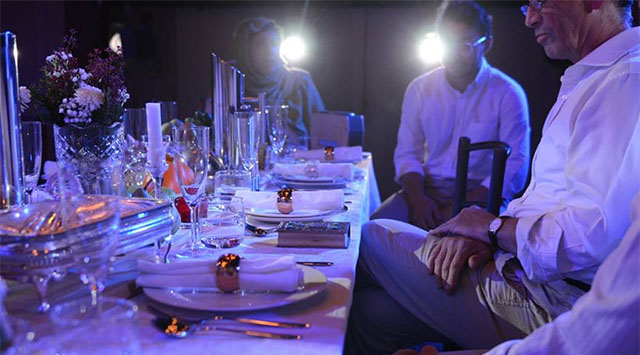
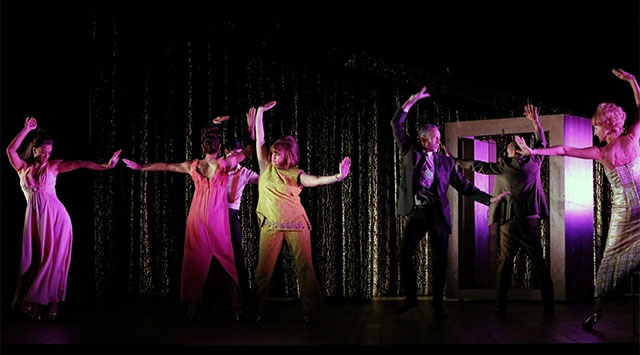
Just slightly beneath the skin of every human existence lies the barely contained need for violence, but like every propensity that we try to suppress, it finds expression in unexpected ways. Dennis Kelly’s Osama The Hero discusses our thirst for blood, looking at where that appetite comes from, and how it manifests. We find ourselves in an English housing estate, observing a group of neighbours inflicting cruel harm on one of their own.

It is a tale about scapegoating, and the habitual transference of our evil desires onto easy targets. In the case of Kelly’s play, young Gary, and his innocence, become the object of the group’s brutality, and in the process of his persecution, revelations are made about our oft-unexplained and neglected violent selves.

Director Richard Hilliar goes to great pains for every one of the play’s savage moments to occur with great power. The transgressions are hideous, and they are presented as such. A cultural gap exists between us and the working classes of England located at the centre of the drama, and it is arguable if the production’s interest in that specificity of experience has been made to translate effectively. As we are kept dazzled by the uniqueness of a cultural other, we often lose sight of the universality that can allow the work to resonate more intimately.

The ensemble of five is unquestionably energetic and committed, but the challenge posed by Kelly’s language and its accompanying encumbrance of dialects, can be a cause for distraction. Our attention alternates between hearing meanings, and observing the unsatisfying labour put into achieving what is ultimately a cosmetic accuracy. At their best however, the actors provide masochistic delight in an atmosphere of terrifying menace, the kind of which one would hope to encounter only at the theatre. Nicole Wineberg is particularly memorable in a scene involving her character Louise’s obsession over a video showing a man being killed. She brings the show to an intense peak, with the palpable depiction of a woman lost in evil and dread.

Bad people are almost always other people. If Osama The Hero succeeds, we should see ourselves in its characters, and gain a better understanding of the way we operate, as individuals and collectives, in these post-9/11 times of terror and fear. There is perhaps no solution to our unyielding need to make enemies out of fellow human beings, but knowing how that process works is essential if our evolution is to be progressive. When Osama bin Laden was executed, we never really expected the world to suddenly become a better place, but it certainly quenched the thirst of our carnivorous vengeance, if only for a moment.

www.toothandsinew.com

Review: Odd Man Out (Ensemble Theatre)

ensembleVenue: Ensemble Theatre (Kirribilli NSW), Jan 19 – March 18, 2017
Playwright: David Williamson
Director: Mark Kilmurry
Cast: Gael Ballantyne, Justin Stewart Cotta, Rachel Gordon, Lisa Gormley, Matt Minto, Bill Young
Image by Clare Hawley

Theatre review
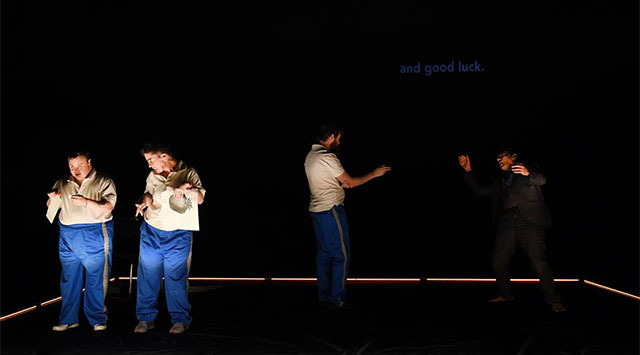
Alice and Ryan meet on a bus, and are quickly drawn to each other. They have little in common, except for a shared desperation to become coupled up. Alice is sensitive about her biological clock running out of time, and Ryan is fearful of loneliness. They work hard to create a union, and in Odd Man Out, it seems tough grind is the key to success.

Marriage happens hastily for the pair. Ryan has never said “I love you” back to Alice, and proves himself embarrassing and humiliating in every social situation, but Alice decides to marry him anyway. No surprises then, that the husband turns out a disappointment. It is true, in David Williamson’s world of intractable heteronormativity, that women get into relationships to change men, while men hope for women in their lives to never grow.

We never really believe the Alice character. Maybe it is her severe lack of judgement that betrays the credibility of the narrative, or maybe, we are simply very tired of stupid girls in our stories. Turns out the “odd man out” here, could actually be a rather strange woman. Actor Lisa Gormley’s extraordinarily animated style may not have made things any better, but her conviction in spite of the playwright’s flawed imagination, is impressive. Her work is entertaining, and her aforementioned exuberance, does provide effective distraction from the play’s implausibilities.

Played by Justin Stewart Cotta, Ryan is a much more detailed and authentic personality who helps provide necessary grounding to Odd Man Out. Cotta turns in a spectacular performance, intelligent and thorough in his approach, for an interpretation that is immensely engaging and amusing, while retaining a solid amount of insightful nuance. Whether wildly rhapsodic or sensitive and quiet, Cotta provides the production with excellent layers of depth and clarity, giving the show a meaningful sense of purpose.

Mark Kilmurry’s direction of the piece is spirited and taut. The show has a vigorous energy aided by inventive use of a small chorus of actors, introduced into scenes of otherwise structurally simple dialogue. Sound design by Alistair Wallace is similarly effective in manufacturing a sense of motion and progression, for an urgency that helps us stay captivated.

The play ends abruptly, and awkwardly, with a fairy-tale conclusion that reveals a human need for hope, however misplaced it may be. Odd Man Out is fundamentally romantic, even if it is rarely sweet or poetic. Against all odds, we will dream up a way to make love happen, and that, is the essence of a life well lived.

www.ensemble.com.au

Review: The Testament Of Mary (Sydney Theatre Company)

stcVenue: Wharf 1 Sydney Theatre Company (Walsh Bay NSW), Jan 13 – Feb 25, 2017
Playwright: Colm Tóibín
Director: Imara Savage
Cast: Alison Whyte
Image by Lisa Tomasetti

Theatre review
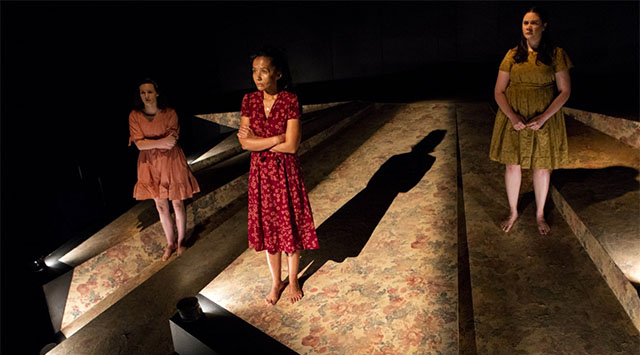
The stage is cordoned off by red velvet rope. Exquisite marble tiles form the floor and walls of an exhibition space, or perhaps a place of worship, and an awe-inspiring statue of the Virgin Mary is positioned atop a small flight of steps. Elizabeth Gadsby’s design establishes a vision familiar to many; the flawless icon, silent with endless depths of compassion and love.

Colm Tóibín’s The Testament Of Mary begins with the effigy disintegrating. Porcelain dissolves into flesh, opulence into earthiness. Mary emerges a real woman, speaking to us directly of her memories of Jesus’ last days on earth. The agony of a mother having lost her son is palpable in the theatre, but it is Mary’s vehemence to talk that captures our attention. A woman’s perspective is often slighted, even if it belongs to the one who had given Him life.

The play’s most satisfying moments involve hints of sacrilege, but it holds few surprises for those who have only a cursory knowledge of, or interest in, the story of Christ. Australians are 61% Christian, so the relevance of Tóibín’s piece, which comes with little exposition of background, is not necessarily a definitive one. Individuals with greater personal investment into this theology would, without question, benefit more from its alternate interpretation of events, and there certainly are many whose fundamental beliefs will be challenged here.

It is a subdued production, with actor Alison Whyte demonstrating consummate professionalism in her approach; honest, reflective and present. Opportunities for a more baroque style of performance are eschewed to portray something simpler and altogether more realistic. Theatricality comes courtesy of lighting designer Emma Valentine’s knack for precise punctuation and accentuation, but the show feels overly polite, emotionally curtailed, and subsequently evasive, as we attempt to find connection with its intentions and meanings.

Faith only exists where there is doubt. Questioning the veracity of our religious convictions can seem dangerous, but is ultimately the only way to affirm truths that we hold dear. There are perhaps no more absorbing ways to enter into a discussion that to talk about religion, so we expect a play of this nature to be controversial, scandalous, even explosive, but when it falls short, the disappointment is hard to mask.

www.sydneytheatre.com.au

Review: #Lads (Kings Cross Theatre)

kxtVenue: Kings Cross Theatre (Kings Cross NSW), Jan 13 – 14, 2017
Director: Danny Ball
Cast: Callan Colley, Ryan Morgan, Ben Schumann, Ross Walker

Theatre review
Presented early in its developmental stages, #Lads is unpolished and unresolved, but like any work of art fuelled by conviction, it is ready to be interacted with. Longstanding ideas about masculinity and youth are framed within contemporary, and trendy, concepts of entitlement and privilege, for a slightly updated look at the perennial problem of manhood, as seen through social distinctions of money, race, gender and sexuality.

The show sets up contexts that are perhaps too familiar, but the questions it inspires are nonetheless potent. We are always worried about the young, because their mistakes are always spectacularly glaring. The team is thankfully very conscious of its generation’s failures, and spends the entirety of the presentation expressing all that is undesired. There is no hint however, at what a better life would look like. The rebel without a cause, it seems, is here to stay.

A more refreshing perspective that #Lads touches on, is the dysfunction friendship that exists between the four boys. We want to know what keeps them together, and what they require of each other, to satisfy their individual twenty-first century narcissisms. We are interested to know how each of their impairments differ, and the extent to which they are isolated within their fragile facade of unity.

As Australians become increasingly wealthy, the problems and difficulties of bring up our children take on new dimensions. As our lives become more liberated and autonomous, our middle-classes are able to decide to procreate only when we become confident in our ability to provide, but offspring that have never witnessed poverty and other forms of struggle, cannot be expected to understand easily, the nature of hardship, and its accompanying qualities of humility and compassion. The millennials, like everyone else, will come into their own, and as always, time is the only one who holds the key to that revelation.

www.kingsxtheatre.com

Review: Nosferatutu… Or Bleeding At The Ballet (Griffin Theatre Company)

griffinVenue: SBW Stables Theatre (Kings Cross NSW), Jan 7 – 21, 2017
Playwrights: Tommy Bradson
Director: Sheridan Harbridge
Cast: Tommy Bradson, Sheridan Harbridge, Brandyn Kaczmarczyk
Musicians: Steven Kreamer, Sally Schinckel-Brown, Olga Solar
Image by Lucy Parakhina

Theatre review
We find ourselves at a ballet performance, but a vampire hijacks the proceedings. What he offers is something entirely different from the Swan Lake that had been intended, but is no less beautiful and captivating. Tommy Bradson’s Nosferatutu… Or Bleeding At The Ballet is a tale of jealousy and unrealised ambition. It is about the manifestation of envy as a destructive force, alongside a subversive creativity that can result from the darkness of life as a struggling artist.

On stage, Bradson is an enchanting performer, a Frankenstein monster assembled from our memories of Rowan Atkinson and Marc Almond at their respective best. He wields a kind of magic that is bizarre and confusing, but mostly, it is transportative, taking us effortlessly away to, well, anywhere else but here. Bradson is no ballerina, but every gesture is seductive and powerful. His eyes are mesmerising, full of intense but unresolved emotion, and his voice, a stunning cacophony made of wild imagination and an unbridled passion for high drama.

Direction by Sheridan Harbridge is spirited and adventurous, charming in its embrace of a kind of theatrical madness that the protagonist inspires. The incorporation of live music, headed by Steven Kreamer, is highly effective, with a surprising sophistication in what it allows the production to convey. Also noteworthy are Alex Berlage’s lights and Ashisha Cunningham’s set, both impressive in their interpretation of space for this quirky but bold experiment of non-narrative storytelling.

When Nosferatutu attacks and murders his nemesis, the blood that splatters is a celebration of the avant-garde, and an expression of the innovation that all art requires. It is a messy affair, but anarchy is never convenient, and disruption is always necessary for greater meanings to be unearthed.

www.griffintheatre.com.au

Review: Prize Fighter (La Boite Theatre Company / Belvoir St Theatre)

laboiteVenue: Belvoir St Theatre (Surry Hills NSW), Jan 6 – 22, 2017
Playwright: Future D. Fidel
Director: Todd MacDonald
Cast: Margi Brown-Ash, Thuso Lekwape, Gideon Mzembe, Pacharo Mzembe, Zindzi Okenyo, Kenneth Ransom
Image by Brett Boardman

Theatre review
We meet Isa as he tries to make a new life in Australia. After experiencing years of trauma in Congo, he now focuses aggression onto the fighting ring, and as he boxes his way through flashbacks of unimaginably tough times, we witness his tragic biography unfold onstage.

Prize Fighter involves a young man making sense of the world, in order that healing and a brighter future become possible. It is also about a migrant reaching out to his adopted land, asking for understanding and acceptance. Future D. Fidel’s writing is concise and simple. The play knows what it wishes to say and says it clearly, but its inability to delve deeper into our protagonist’s psychological and emotional complexities, results in a story that has a tendency to feel generic.

Direction by Todd MacDonald gives the show exciting vigour, with an athletic cast providing a beautiful sense of visual animation. Lighting design by David Walters is creative, surprising and very polished, but the production often feels distant, or perhaps elusive. Its dim dreamlike quality seems to prevent us from connecting firmly with the characters, and we struggle to connect with an intensity that would befit Isa’s plight.

We hear about humanitarian crises, on the news every day. Reports are made by people in positions of privilege, for the consumption of people with privilege. These stories affect us all, but the stakes are infinitely higher for those seeking refuge, yet their voices are rarely heard in our cacophonous landscape of upper-class broadcast culture. Prize Fighter is a rare opportunity for a first-person account, an important contribution to unceasing discussions on who are allowed to occupy this land. If the world is one, our boundaries can only be false, but humans have always been at war, and even though utopia is only imagined, life means little if we are unable to conceive of something better.

www.laboite.com.auwww.belvoir.com.au

Review: Ladies In Black (Sydney Lyric Theatre / Queensland Theatre)

ladiesinblackVenue: Sydney Lyric Theatre (Sydney NSW), Jan 3 – 22, 2017
Book: Carolyn Burns
Music & Lyrics: Tim Finn (based on Madeleine St John’s novel, “The Women In Black”)
Director: Simon Phillips
Cast: Kate Cole, Carita Farrer, Bobby Fox, Natalie Gamsu, Madeleine Jones, Kathryn McIntyre, Sarah Morrison, Ellen Simpson, Greg Stone, Trisha Noble
Image by Lisa Tomasetti

Theatre review
There is no question that the world needs more stories about women and our solidarity. Examples of how we tear each other down are aplenty, but the ways we offer love and support need to be better envisioned in art and in life, so that we may begin to subvert systems of patriarchy that rely on our disunity to thrive.

Ladies In Black features a group of “shop girls” at a Sydney department store in the 50’s, each of them consummate professionals, all of whom get on remarkably well. There however, is little else to enjoy about the musical. Thoroughly lacklustre, unable to deliver the exuberance and glamour it wishes for its characters to portray. Its humour is underwhelming, with narratives that fail to resonate, and even though Tim Finn’s songwriting could be admired for its slightly unconventional take on the musical theatre format, much of it is uninspiring and forgettable.

For a show that makes fashion one of its central interests, the production is designed with little imagination or innovation. Choreography never offers anything more than the bog-standard, and the cast rarely looks to be challenged or excited by what they have to present. Occasional appearances by Natalie Gamsu, Greg Stone and Bobby Fox as “continental migrants” introduce moments of exhilaration, but they are few and far between.

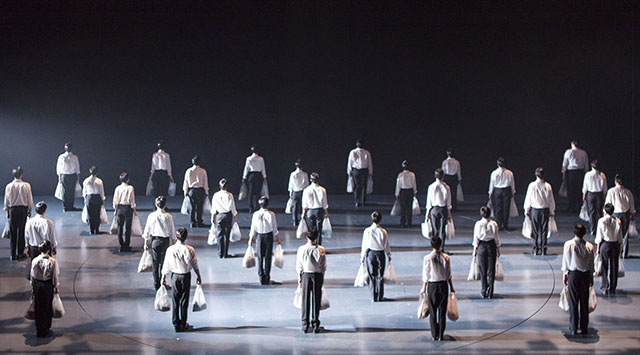
Young Lisa confronts parochial Australia in Ladies In Black. She is at a crossroads, encountering choices that stoke her passions, versus others that feel easy and normal. We observe a blandness that can take hold, and ways of living that can pale our existences into insignificance. The women go to work everyday, and in their camaraderie, attempt to find deeper meanings to their existences, but the struggle to prevent their black clothed power from fading into a repugnant beige is ever-present, and often defeated.

wwww.queenslandtheatre.com.au

Review: Babes In The Woods – Australian Purity Defil’d (Don’t Look Away Theatre Company)

dontlookawayVenue: Old Fitzroy Theatre (Woolloomooloo NSW), Dec 13, 2016 – Jan 21, 2017
Playwright: Phil Rouse
Music: Phillipe Klaus
Director: Phil Rouse
Cast: Annie Byron, Gabriel Fancourt, Sean Hawkins, Alex Malone, Eliza Reilly, Ildiko Susany
Image by Ross Waldron

Theatre review
It is Christmas time, and in Australia, we go absolutely bonkers. Phil Rouse’s pantomime take on Babes In The Woods is a wild, wacky jaunt that marks the end of 2016, celebratory in tone but fiercely castigating of our ever-frustrating sociopolitical climate. If the show is a summation of the way we were, these 12 months are, once again, nothing to be proud of.

Rouse’s production however, is a triumph. Exuberant, inventive, poignant, and very funny, his creation is both frivolous and meaningful, targeting issues that concern us all, but always in the right shade of humour, no matter how dark the subject. The big and brash style of presentation allows the worst of our behaviour to be put on display, all in the name of comedy, but its need to keep things frothy can seem to diminish the severity and gravity of what is being discussed. Nevertheless, it is an admirable effort that does not forget the downtrodden, as we indulge in the unrestrained merriment and mirth characteristic of our silly season.

Phillipe Klaus’ spirited work as composer and musical director keeps the show structured and cohesive. Not all performers are impressive with their singing, but Eliza Reilly is delightfully memorable as the powerfully voiced Angel of White Privilege, allowing white children Australia-wide to act recklessly, and delivering more than a few laughs to her captive audience. Sean Hawkins is hilarious and shameless as Jack the himbo lumberjack, flexing muscles, both comedic and anatomic, to get us going. It is a remarkable cast, infectiously enthusiastic and impressive with their uninhibited creativity and imagination.

The final musical number in Babes In The Woods lampoons the lip service we often pay to the less fortunate. It makes fun of the $50 we might give to charity each month for absolution from the first-world evils that we commit. Theatre is a powerful medium, but it can also be ineffectual. Our art should always aim to do more, but if catharsis is the best we can manage on the night, there needs to be an accompanying sense of enlightenment that would take us to brighter days. A happy new year is incumbent upon how much we are able to learn from yesterday, so that tomorrow can be made better.

www.facebook.com/dontlookawaytc

Review: The Taming Of The Shrew (Montague Basement)

montaguebasementVenue: PACT Centre for Emerging Artists (Erskineville NSW), Nov 29 – Dec 10, 2016
Playwright: William Shakespeare
Director: Caitlin West
Cast: Travis Ash, Tel Benjamin, Robert Boddington, Sam Brewer, Hannah Cox, Jane Watt
Image by Zaina Ahmed

Theatre review
Shakespeare’s The Taming Of The Shrew is about society’s need to subjugate women. The play takes issue with Katherine, characterising her as headstrong and troublesome, a young woman to be brought under control. The plot is kept basically the same under Caitlin West’s direction, but comedy is turned into tragedy in her version of events.

The production is a heavily edited, compressed revision of the, now objectionable tale. A more detailed approach to Katherine’s and her beau, Petruchio’s perspective backgrounds would allow us to feel more involved in the story, but the main concern here is the argument between West and Shakespeare, between where we are today and how we had been yesterday. The ideas are simple but powerful, and although the methodology would benefit from finding more nuance in its expressions, the resultant show is nonetheless, an exciting one.

There is good conviction from the actors who take the stage. The rapidity of their performance keeps things enjoyable, but by the same token, we are prevented from getting to know any of the characters very well. Robert Boddington and Hannah Cox are combustive as the lead couple, both passionate for the work, and able to achieve a valuable volatile connection that gives the show its dangerous, astringent quality.

We can leave the past behind, but have to acknowledge its influence on how we think and behave. In order to move forward, we must look back and address history. This cyclical concept of time requires that the scars we carry are being attended to, in order that progress may be found. Much of Shakespeare’s legacy involves the ugliness of humanity. Each generation of theatre makers that comes along will have amongst them, those who fall for the Bard’s words, and who must bear the burden of his failures.

www.montaguebasement.com

Review: Bare (The Depot Theatre)

supplyevolutionVenue: The Depot Theatre (Marrickville NSW), Nov 30 – Dec 17, 2016
Book: Jon Hartmere, Damon Intrabartolo
Lyrics: Jon Hartmere
Music: Damon Intrabartolo
Director/Choreographer: Hannah Barn
Cast: Aaron Robuck, Sophie Perkins, Alex Jeans, Natalie Abbott, Timothy Langan, Teale Howie, Alexandra Lewtas, Caroline Oayda, Matt Laird, Stephanie McKenna, Ibrahim Matar, Tara Hanrahan, Annette Vitetta, Penny Larkins, Gavin Leahy

Theatre review
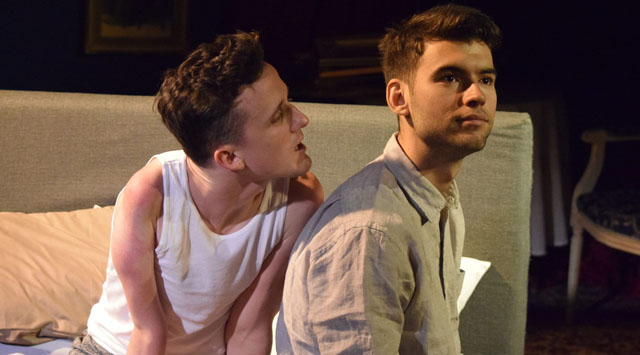
The musical is set in a Catholic high school. Peter and Jason are secret lovers struggling to come to terms with their gay relationship and the identity markers that will inevitably become a matter of controversy given the social context. It is an age-old story, but one that bears repeating. Our religious institutions remain unkind to those who do not conform to their narrow definition of acceptable sexual behaviour, and Bare‘s response is still important, even if its story offers little that would be refreshing for the twenty-first century.

Hannah Barn’s direction of the piece pays strong attention to the show’s emotive qualities. Every melodramatic flourish is amplified to passionately drive its point, and to captivate. The more humorous portions of the musical seem to be neglected, which results in a production that can feel slightly unvarying and predictable, but there is plenty of dynamism to be found in the music. Musical director Matthew Reid does wonders with his 8-piece band, providing injections of energy whenever required, and calibrating atmosphere with remarkable sensitivity throughout, but sound design, especially in the first half, needs to be refined.

It is a very committed cast of performers that take to the stage. Alex Jeans and Aaron Robuck play their leading parts with integrity, and even though their interpretations of characters can feel somewhat one-dimensional, both young men tell their stories with impressive enthusiasm. Along with Jeans and Robuck, accomplished singing by Natalie Abbott and Penny Larkins give the production a surprising polish that reflects a good level of professionalism and admirable devotion to the time-honoured craft of musical theatre.

Bare is yet another work that documents the struggle of gay men in a society that refuses to accept them as equals. We have heard it all before, but we must not stop telling these tales of oppression as long as the cruelty persists. For some of us, progressive political movements have brought us better lives, but for many others, the chains of injustice are a daily reality. We might like to think of ourselves as first world civilisations, but if we have children living in fear and in some tragic cases, taking their lives, our complacency has to take responsibility.

www.thedepottheatre.com