Review: Brothers Karamazov (Arrive. Devise. Repeat)

Venue: PACT Centre for Emerging Artists (Erskineville NSW), Dec 6 – 16, 2017
Playwright: Richard Crane (based on Fyodor Dostoyevsky’s novel)
Director: Viktor Kalka
Cast: Alice Birbara, Ryan Devlin, Patrick Howard, and Lucia May
Image by Clare Hawley

Theatre review
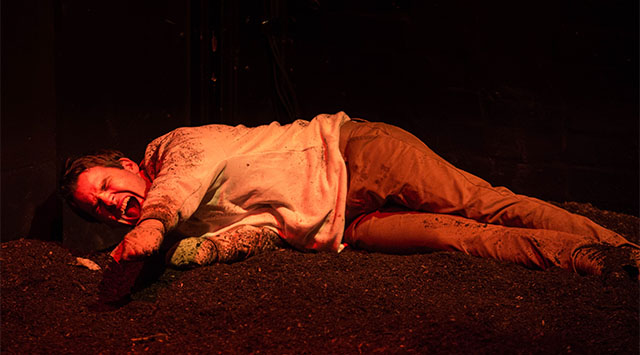
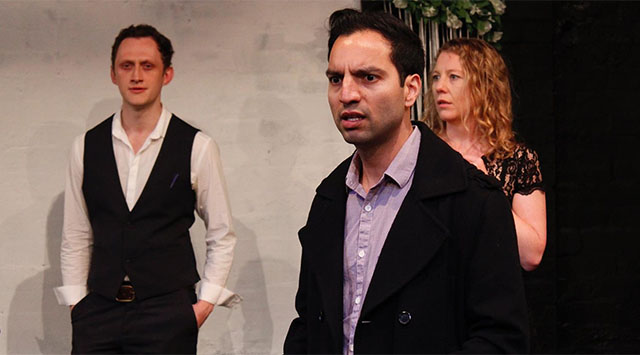
There are only so many conclusions a person can come to, when contemplating the existence of God. In Richard Crane’s adaptation of Dostoyevsky’s Brothers Karamazov, an enormous novel is condensed, leaving only its big philosophical ideas feebly accompanied, by futile episodes of theatre that can only seem reductive in their attempts to make a point.

The depiction of religious struggle in Brothers Karamazov is timeworn, although clearly persistent in its relevance to millions, who continue to structure their lives around all things mystical and illusory. It is an attractive production, with ambitious work across all design faculties from Liam O’Keefe’s lavish lighting to Victor Kalka’s evocative set. Often beautiful and alluringly moody, our senses are kept attentive, even when our minds withdraw from engagement.

Four actors play a range of characters, with unfortunately confusing results. Unable to sufficiently identify the personalities we encounter, the show takes an inordinately long time to establish coherence. Nonetheless, it is a compelling cast, each one full of energetic conviction. Patrick Howard is particularly memorable, with an arresting presence, determined to entertain.

A world in which everything is permissible, is doubtlessly frightening. Self-preservation requires that we invest, in the name of safety and order, in social contracts that we think to be noble, but whether state or religion, the institutions we exalt, never fail to overreach with the powers they are accorded. The same instruments we need for protection, are used invariable to oppress. To keep them constantly monitored is paramount and to have them regularly dismantled and refreshed, is arduous but critical.

www.arrivedeviserepeat.com

Review: Shifting > Shapes / Fem Menace (PACT)


Venue: PACT Centre for Emerging Artists (Erskineville NSW), Nov 22 – 25, 2017

Shifting > Shapes
Choreographer and composer: Thomas E.S. Kelly
Collaborator and performer: Taree Sansbury

Fem Menace
Creator and performer: Cheryn Frost
Co-creators and performers: Cath McNamara, Tahlee Kianda Leeson

Theatre review
Presented as part of PACT’s “Afterglow” season, two works Shifting > Shapes and Fem Menace, feature young women dancing to the beat of their own drums. We watch them finding physical languages that could reveal their identities, that help express feelings and thoughts, to make their mark maybe, to be seen and heard, in a world that is determined to subdue creativity and art.

Shifting > Shapes explores humanity through the idea of shape-shifting, in which a person adopts the consciousness of animals, and begins to think and move like them. When performer Taree Sansbury becomes a goanna (or Dirawong) and a rainbow serpent, she sinks close to the ground. The relationship between body and earth looks never to be more intimate, than when Sansbury takes on the physical specificity of a different species. In the moments that she reverts to human, we observe the discord between being and space, as though we are the only ones alien to our own planet.

Fem Menace is concerned with the anxieties about being contemporary women, in this latest wave of feminism. A key point of its discussion is sexuality, as an essentially social undertaking, private but always in relation with the world outside of the self. In the honest representation of woman as sexual being, the conundrum of objectification seems to be omnipresent. Cheryn Frost, Cath McNamara and Tahlee Kianda Leeson present an uncompromising wildness that dares us to regard their presence as anything other than as intended.

Both pieces are conceived and executed with a sense of purity; faithful and authentic in their transition from inspiration to stage. For Shifting > Shapes, the unapologetically minimalist approach of choreographer and composer Thomas E.S. Kelly, maintains a razor sharp focus on its theme, whilst asserting his Aboriginality as legitimate and authoritative. The women in Fem Menace are experimental, putting their minds and bodies through exhaustive interrogation. The results of which are deeply fascinating, and often very beautiful. There is perhaps no way to look at ourselves with absolute objectivity, but it is in our art, that we can best know each other.

www.pact.net.au

5 Questions with Cheryn Frost and Thomas E.S. Kelly

Cheryn Frost

Thomas E.S. Kelly: What is your show about?
Cheryn Frost: Fem Menace is about how there is a monster inside me. It’s also about women; the fun we have, the fears we face, our lived and shared experiences. 

What made you want to explore this topic?
We wanted to make a work that is about being women, the world in which we live and the monsters we’re constantly facing and fighting. Considering the huge discussion at the moment with how women are being mistreated by monsters in the industry, it reinforces the importance of continuing that dialogue and getting our voices heard by wider audience.

Why now?
Why not?

What can the audience expect watching your work?
You can expect a warped fragmented party, with a slap of reality, a drop knee of what ifs, a shot of confidence and purge of monsters.

Who has helped bring your project to life?
Catherine McNamara & Tahlee Leeson! They are the other two spicy ladies that make up Fish Hook. The three of us met whilst studying at the University of Wollongong and realised that we all wanted to make dynamic kick-ass theatre. Fish Hook was born and here we are finally making our first show that actual people will see!

Thomas E.S. Kelly

Cheryn Frost: What is your show about?
Thomas E.S. Kelly: Shifting > Shapes is about shape shifting. Humans to animals to landforms and back again. Looking at it through an Indigenous and non-Indigenous lens, seeing it culturally and how it sits in today’s society. 

What has been the biggest challenge making the work?
The biggest challenge for this work is simply just time. Making sure that I’ve dedicated enough time to all the elements so that the show works on all levels.

What do you hope your audience will think about when they leave your show?
I always hope that when the audience leaves one of my shows that they find out something about the Aboriginal culture that they didn’t know before and then find a place for that knowledge in today’s society.

Who and or what inspires you?
I draw inspiration from my lineages of the past and future. The lineage of my ancestors, my family, my dance lineage.

You can have dinner with 5 people (living or dead) who do you choose and why?
Nan and Pop on my mothers side because they passed away when I was younger and I have so many questions for them. And a family member from each one of my heritages that is the knowledge keepers to simply listen and learn. 1 Aboriginal 1 Ni-Vanuatu 1 Irish.

Catch Cheryn Frost and Thomas E.S. Kelly in Fem Menace / Shifting > Shapes, part of the Afterglow season at PACT.
Dates: 22 – 25 November, 2017
Venue: PACT

Review: Home (Tantrum Youth Arts)

Venue: PACT Centre for Emerging Artists (Erskineville NSW), Oct 4 – 7, 2017
Director: Janie Gibson
Cast: Sara Barlow, Thomas Lonsdale, Roger Ly, Alexandra Mangano, Meghan Mills, Meg O’Hara, Taylor Reece, Stephanie Rochet, Rosie Scanlan, Clare Todorovitch, Phoebe Turnbull
Image by Eryn Leggatt

Theatre review
The point of departure is a meditation on home, a concept that we associate with all things secure, warm and familiar, but the 11 artists delve deep within, to unearth instead, many unexpected and troubling aspects of living in Australia today.

The piece begins predictably, perhaps too innocently, about the planet and its natural environment, with seen-it-all-before physical configurations, typical of theatre featuring ensembles of young people. After some warming up, director Janie Gibson takes us to the deep end, where pretence gives way to raw honesty, and the real drama happens.

Home‘s collation of words by various entities (with dramaturgy by Lucy Shepherd), is a remarkable achievement, showcasing a valuable range of perspectives that form a truthful and timely representation of where we are today, as a society and a collective consciousness.

Alexandra Rose talks poetically about the idea of body as home, Phoebe Turnbull speaks boldly for new feminists everywhere, Roger Ly articulates with great humour, the historical experience of our many marginalised ethnic minorities, and Meg O’Hara is blinding with her infectious passion as a queer activist. There is a lot of power in Home, derived from very serious and exquisite thought.

Art scintillates when brave and authentic, and there is much to be excited about here. Also very noteworthy is the live music accompaniment by Huw Jones, whose electronica underscores the entire show with intelligence, and beautiful sensitivity. Quality of acting in the group is inconsistent, but Stephanie Rochet-Cuevas’ brilliance as performer is unequivocal, presenting a “star is born” moment on the Sydney stage, having recently arrived from Chile, via Newcastle. She is formidable, a force to be reckoned with, and a personality one sincerely hopes to see grace our theatres again soon, and often.

Home is where we should be able to find comfort. It is also where we are safest and most able to confront the darkest of our beings. In bringing their audience their most authentic vulnerabilities, the artists compel us to connect, with the work and with each other. Enclosed and tethered, we think about the spaces we share, and the inevitability of our dependence on each other, and the care, that increasingly, we forget to take.

www.tantrum.org.au

Review: Cleansed (Montague Basement)

Venue: PACT Centre for Emerging Artists (Erskineville NSW), Sep 20 – 23, 2017
Playwright: Sarah Kane
Director: Saro Lusty-Cavallari
Cast: Sam Brewer, Lucy Burke, Alex Chalwell, Kurt Pimblett, Jem Rowe, Michaela Savina, Annie Stafford
Image by Clare Hawley

Theatre review
Tinker is a figure of authority at a hospital, and the sadist antagonist in Sarah Kane’s Cleansed. She is all-powerful, able to wield any form of torture she pleases. The patients are trapped, unjustly and unexplained, subject to a range of inhumane violations, in scenes of terror that constitute the savagery of Kane’s play. Also prominent are instances of nudity and sexual activity, that accompany pervasive themes of gender and sexuality, all presented as the main agents of instigation, for the brutality that we see. Everyone in Cleansed is being punished for their sex, and we wonder if the hospital functions as an allegory for the wider world.

Director Saro Lusty-Cavallari’s gore is heightened and viscerally affecting. His show recalls films from horror and exploitation genres, but the effect of shock here, is thought-provoking and never meaningless. Long scene changes prevent our anxiety from ever reaching a boiling point. Our minds are given space to work for clarity, during these moments of emotional release, but an opportunity for a more thrilling experience that could result from the manufacture of a truly suffocating atmosphere, is sacrificed. Live video projections are incorporated for an adventurous commentary on current states of technological voyeurism, and are used along with bold approaches to light and sound, to enhance dramatic qualities of the production.

The provocative material is brought to life by an impressive cast of actors with great conviction and nerve. The very scary Tinker needs a bigger, more foreboding presence, but Annie Stafford’s restraint allows our imagination to explore freely into the psyche that is at work here. Jem Rowe is outstanding as Robin; the fear and desperation he portrays seems thoroughly authentic, and the spectacle he creates around his role is brilliantly captivating. Sam Brewer and Alex Chalwell play gay lovers, memorable for the poignancy of their relationship and the remarkable intensity at which they tell that story.

There is no underestimating how much we control each other with sex. The essentially social nature of our genders and sexualities, have opened us up to evaluation and persecution from all corners. The fear of being labelled deviants, and the understanding of that consequence, are indicative of attempts to keep us adhering to an intolerable straight and narrow. Even Tinker is herself consumed by her self-diagnosed perversion, and proceeds to exercise her hypocrisy in the most destructive ways possible. Consenting adults are frightening. They can threaten the very fabric of a society that lives by rules that are arbitrary, cruel and profoundly wrong.

www.montaguebasement.com

5 Questions with Kurt Pimblett and Annie Stafford

Kurt Pimblett

Annie Stafford: In Cleansed, your character is a ghost for the majority of the show, do you have a favourite ghost story or have you ever had a run-in with a ghost?
Kurt Pimblett: Yeah, me and my cousins and sister saw a lot of ghosts growing up. One of them was the ghost of our dog who’d been run over the year before, which was nice. I think my favourite ghost story though is that Paul Jennings one where a boy falls down a well and there’s a ghost down there who steals all your clothes and escapes and then you become the naked ghost trapped in the well. I feel like that’s the kind of weird ghost thing Graham would do.

When you first read the stage directions “dance of love”, what dance moves came into your head?
Two things, simultaneously. One of them was this incredibly beautiful and emotive sequence that was immediately recognisable as a dance of love – no-one would ever put any other name to it. The other was the bit from High School Musical where those two kids do a weird interpretive dance to audition for the winter musical and get told they should have therapy. I hope that what we’ve ended up with is a happy medium between the two.

Now this is a classic question, in the Hollywood film version of this play, who would you want to play Graham and why?
Harry Styles. No explanation necessary.

What did you find the hardest when approaching this text? Because let’s be honest, its pretty damn out there.
With Cleansed, Sarah Kane has been quite kind with the dialogue and emotional journeys of most characters. Everything that’s happening makes sense, the logic isn’t hard to access, and it feels natural to embody and put into action. Cleansed is a huge practical challenge though, and a lot of thought has gone into realising her incredible stage directions. A lot of them seem a bit impossible, but what I found most confronting in rehearsal was the things that aren’t impossible. The things that you can totally just go and do, but wouldn’t, or shouldn’t, if you weren’t in this play. Another thing I found difficult was rationalising Graham’s relationship with Grace, in conjunction with Graham’s relationship with Tinker. I very much approached the text thinking that Graham was always right and was totally a good guy (which is a useful perspective to keep in mind as an actor), so I was pretty shaken when it started to dawn on me that sometimes his choices aren’t the most upstanding.

You’re stuck on a desert island with only one other cast member from Cleansed, who would you want it to be? And why?
Okay. I would want it to be someone whose sense of humour gelled well with mine, so that it doesn’t get boring, but also so that when I start making off-colour panic-jokes they don’t get weirded out. Are we trying to escape the island? Because then I would also want someone who’d be determined and upbeat enough to help me make a billion different palm tree boat prototypes. Also probably someone with a nice grounding in facts because on a desert island my skills probably wouldn’t extend far beyond writing poems about the ocean and I’d need someone to tell me what’s okay to eat and where snakes live so I can avoid them. There’s also a high chance that I’d get so restless and desperate for entertainment that I’d stop listening to them about which berries are poisonous and start to provoke the snakes just for something to do, so it would be great if the person could talk me down from doing things like that. Look, this is a tall order, so Cleansed cast, if any of you feel like you can adequately fill this role, hit me up.

Annie Stafford

Kurt Pimblett: Tinker has a lot of power but (arguably) questionable morals. What kind of life advice would she give? If she wrote a self-help book what would it be called?
Annie Stafford: I sincerely hope no one ever asks Tinker for advice let alone reads her self help book. How the heck did she get that book deal?! That aside, I think her incredibly deep and sage life advice would be “Get shit done. Shut shit down”. To be completely honest, that’s been my own motto for the past 2 years. But in a very absurdist way it applies to Tinker. She’s pretty proactive, getting things done. And if she’s not about something or it isn’t worth her time, she shuts it down. It’s title? “I’m not responsible.”

Shoot, shag, marry: Cleansed. Go. And try not to shag or kill anyone you’ve already shagged and killed.
Oh well that narrows it down, you’ve literally left me with 3 characters. I think I’d…Tinker would marry Woman. But they’d have to travel to make that happen, cheers Australian Government for that one. Who would have thought you’d be living the dream in a Sarah Kane play. Political moment over. Shag Carl just to add insult to injury, and oh so much injury poor ol’ Carl. And I guess kill Robin. That’s actually quite hard when you take out of it everyone I’ve already killed and shagged. I mean Tinker has already killed and shagged, don’t want to get too method over here.

It is a tricky text – is there anything that you read and thought would be difficult but turned out not to be? Anything that went the opposite?
I actually thought the sex scene between the Woman and Tinker would be really hard, maybe not simply to choreograph, which it wasn’t, but my ability to do it. To be naked in a rehearsal room in such close proximity to someone else, without the tricks of the trade you get in screen. But the process of it was so smooth, and after a while it just makes sense. After sitting in the play for so long and sitting with Tinker and her journey, that moment is so necessary and normal and just feels right-thus I felt so ready to do it when it came to that time. And the opposite? Figuring out Tinker. She’s a tough cookie. So close to performances and I’m still working her out. Which I like actually, she keeps surprising me.

What’s your favourite Sarah Kane’s Cleansed stage direction?
But there are so many excellent ones!!! Can I do a top 3? Well, I’m going to anyway.
1. “Carl tries to pick up his hands – he can’t, he has no hands.”
I’ve decided against giving 3, I want there to be some element of surprise for the audience. But I’ve definitely given you an absolute gem. Sarah Kane is actually hilarious.

Lastly, in a direct theft from the dude from Inside The Actors Studio, if heaven exists, what would you like to hear God say when you arrive at the pearly gates? Answer as both yourself and Tinker.
Before I say, I want these answers to be read in the voice of Morgan Freeman. For some very unknown reason, that’s what my idea of God sounds like. As Annie I would like to hear “Hey mate, good work, here’s a beer”. It would preferable be a VB, taste of the old country. As Tinker, I think she will hear “You don’t even go here!” but I reckon she’d like to hear “You did what you had to do for love”.

Kurt Pimblett and Annie Stafford are appearing in Sarah Kane’s Cleansed, part of the Sydney Fringe Festival 2017.
Dates: 19 – 23 September, 2017
Venue: PACT
Review: Rossum’s Universal Robots (What Fresh Hell Theatre)

Venue: PACT Centre for Emerging Artists (Erskineville NSW), Aug 30 – Sep 2, 2017
Playwright: Karel Čapek
Director: Ariella Stoian
Cast: Peter David Allison, Abigail Honey, Francisco Lopez, Misha Mehigan, Michael Mulvenna, Blake O’Brien, Ciaran O’Riordan, Alex Radovan, Meg Shooter, Emily Trueman,

Theatre review
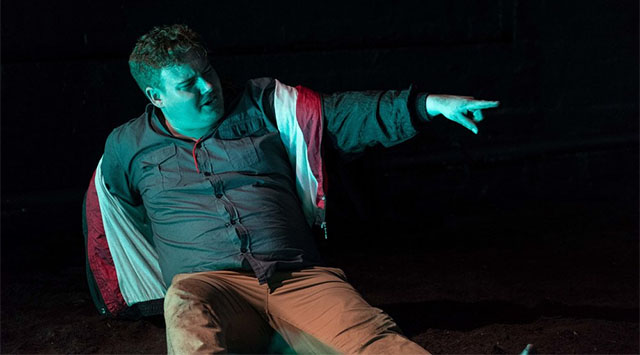
The play is almost a hundred years old, but the action is set in a distant future. Karel Čapek’s Rossum’s Universal Robots was a work of science fiction from 1920, credited to have introduced the word “robot”to the English language. It is that old chestnut about us versus technology, a narrative that relies on our often irrational fear about the human race being destroyed by artificial intelligence. Innovative a century ago, Čapek’s writing is now dreadfully naive, with outmoded arguments that fail to present as legitimate concerns.

The production is earnest, but more than a little rough around the edges. Its drama never manages to engage, and we never know if its comedy is intentional. Performance styles are incongruent, with each actor doing the best to their individual ability, resulting in a confused composite that amounts to a fair bit of tedium.

In a world that continues to struggle with overpopulation, anxiety about human babies no longer being born in Rossum’s Universal Robots is laughable. It does however, draw attention to our narcissism, and our arrogant attitude and belief that we rule this earth. We think that we own everything, that we are a sort of master race that has the unassailable right to occupation and sovereignty. Čapek imagined catastrophes of his future, but he never foresaw the simple idea, that it is not technology that will eventually bring us to our knees, but nature itself, who will prove to be bigger than us, while we languish in feign surprise, of its might and authority.

www.facebook.com/WhatFreshHellTheatre

Review: The Taming Of The Shrew (Montague Basement)

montaguebasementVenue: PACT Centre for Emerging Artists (Erskineville NSW), Nov 29 – Dec 10, 2016
Playwright: William Shakespeare
Director: Caitlin West
Cast: Travis Ash, Tel Benjamin, Robert Boddington, Sam Brewer, Hannah Cox, Jane Watt
Image by Zaina Ahmed

Theatre review
Shakespeare’s The Taming Of The Shrew is about society’s need to subjugate women. The play takes issue with Katherine, characterising her as headstrong and troublesome, a young woman to be brought under control. The plot is kept basically the same under Caitlin West’s direction, but comedy is turned into tragedy in her version of events.

The production is a heavily edited, compressed revision of the, now objectionable tale. A more detailed approach to Katherine’s and her beau, Petruchio’s perspective backgrounds would allow us to feel more involved in the story, but the main concern here is the argument between West and Shakespeare, between where we are today and how we had been yesterday. The ideas are simple but powerful, and although the methodology would benefit from finding more nuance in its expressions, the resultant show is nonetheless, an exciting one.

There is good conviction from the actors who take the stage. The rapidity of their performance keeps things enjoyable, but by the same token, we are prevented from getting to know any of the characters very well. Robert Boddington and Hannah Cox are combustive as the lead couple, both passionate for the work, and able to achieve a valuable volatile connection that gives the show its dangerous, astringent quality.

We can leave the past behind, but have to acknowledge its influence on how we think and behave. In order to move forward, we must look back and address history. This cyclical concept of time requires that the scars we carry are being attended to, in order that progress may be found. Much of Shakespeare’s legacy involves the ugliness of humanity. Each generation of theatre makers that comes along will have amongst them, those who fall for the Bard’s words, and who must bear the burden of his failures.

www.montaguebasement.com

Review: Macbeth (Montague Basement)

montaguebasementVenue: PACT Centre for Emerging Artists (Erskineville NSW), Nov 29 – Dec 10, 2016
Playwright: William Shakespeare
Director: Saro Lusty-Cavallari
Cast: Travis Ash, Robert Boddington, Hannah Cox, Alex Francis, Barret Griffin, Lulu Howes, Jem Rowe
Image by Zaina Ahmed

Theatre review
It is a story of greed and betrayal, arising from unbridled ambition, but it is also a parable of retribution and punishment. The transgressions in Macbeth reveal dark and buried parts of our psyche, although neglected in much of daily life, we all know to exist beneath our amiable surfaces. Our conscience keeps things in check, but some of us use divine inspiration as permission to carry out less than pleasant deeds. Shakespeare’s characters know that the supernatural forces they conspire with are evil, but in our realities, they are never quite so undisguised.

Saro Lusty-Cavallari’s rendition of the play is a straightforward telling of the story. A few artistic licenses are taken in his effective conflation of characters, but the plot is left soundly, almost radically, unaltered. Good work on music selection by Lusty-Cavallari brings drama to the production, but the frequent use of stage blood has a tendency to look puerile. Flashes of strong acting by Hannah Cox as Lady Macbeth and Jem Rowe as Malcolm, introduce moments of elevation to a cast that is generally underwhelming. Robert Boddington as Macbeth is insufficiently expressive, in body and in voice, neither to entertain nor to provide psychological insight into one of Western theatre’s most infamous characters.

Countless other productions of Macbeth have come before, many of which have been huge successes. Artists have the right to take on any classic, should they think themselves capable, but they must remain conscious of their audience’s relationship with the text in question. It is highly likely that any performance of a work like Macbeth would be compared to memorable versions that have come prior. Young artists can choose between cutting their teeth with challenging material in the public domain, or settle for something more attainable. Impatience usually results in clumsiness, but it is also a valuable quality necessary for us to soar at great heights.

www.montaguebasement.com

Review: iDNA (PACT Centre for Emerging Artists)

pactVenue: PACT Centre for Emerging Artists (Erskineville NSW), Nov 16 – 26, 2016
Created & performed by: Bonnie Cowan, Emily Dash, Alison Eaton, Alex Ford, Cheryn Frost, Jorjia Gillis, Cath McNamara, Keila Terencio, Anna Thomsen, Sam Wang, Natalie Wilson
Directors: Fred Copperwaite, Katrina Douglas

Theatre review
Whether cyclical, linear or however else we wish to conceive of time, being human will always require that we look at the past in order to achieve an understanding of the phenomenon that ensnares us today. The investigation into who we are, will always be deemed necessary. Being human is a constant process of philosophical reflection, and art is one of its best manifestations.

iDNA is a series of meditations on identity, as inspired by the very contemporary interest in DNA. The science of DNA promises to reveal things about us that we yearn to know. It might be thought of as a kind of religious text that we access, a form of knowledge that seems to exist outside of our bodies, that informs on our very corporeality. Science and religion is how we talk about ourselves, by reaching out, if only for a moment, to discover what it is that feels like truth.

There are eleven performers in the piece, each with a distinct personality, each given space to articulate something personal about identity. The resultant work struggles to find cohesion, but its fractured nature communicates an important notion of diversity, that although our instincts wish for us to see the self in everybody else, we must come to an acceptance that each creature who walks the planet is an individual, and our survival depends upon an understanding, that much as we wish, difference will never be obliterated from our essence. We have to live together somehow, flora and fauna, water and earth. The science shows us unequivocally, that we exist means that we are all connected, but how we prevent destruction inside and outside of our species, is the key to a good life, natural as that annihilation may seem.

www.pact.net.au