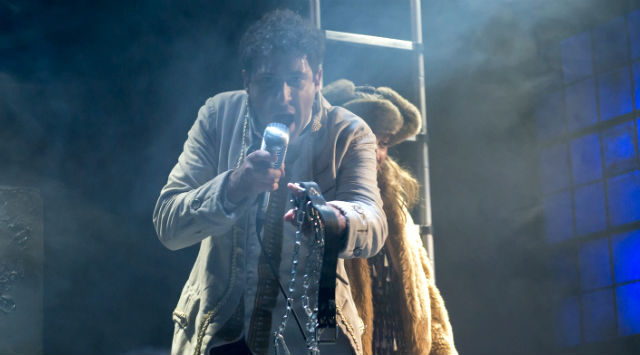
5 Questions with Melissa Bonne and Robin Goldsworthy

Melissa Bonne

Melissa Bonne

Robin Goldsworthy: Cast your mind back…you’ve picked up Look Back In Anger for the very first time. You read it cover to cover and gently set it down beside your play reading chair. Walk us through your immediate gut reaction.
Melissa Bonne: Well, I actually read this play for the first time while I was studying acting at The Actor’s Pulse, but I was 17 so I don’t know if I was smart enough or open enough to truly take the story in. When I read it for the first time, since the first time, I actually just sat there (in my play reading chair), staring at the last page for a while, not only unsure of what to make of how the play ended, but also unsure of why it made me feel so uncomfortable. At the time I didn’t exactly know how to articulate why I was feeling that way but I knew that because of that, I had read something very special and that this play was probably going to be very important for me in some, if not many ways. It also didn’t feel like I had just read a play. It felt more like I was right there in that tiny room with these four people. I think that’s a pretty rare gift for anyone — artist or audience — that when it comes to a play or film or story, it feels almost too real to be something you are watching but more something that you are a part of, and I think maybe that is one of the things that is great about this play…it is so confronting and ruthless in everything that it is saying, that it’s almost impossible for audiences not to get pulled in and become so personally involved in the experiences of the characters.

What an amazingly complex character Alison is! A true gift for any actress to sink her teeth into. So my question is: If Alison were a sandwich, what type of sandwich would she be?
Hmm. Well, she would have to be the best bread made from the finest ingredients by maybe a French Chef or something. And I’d say her crusts would have to be gently sliced off. Her bread parts would also have to be right out of the oven so that she was still warm when served. Inside there would have to be something with bite, but tender, like a spicy piece of organic chicken. She would need a bit of razzle dazzle, so maybe something like a slice of avocado with a drizzle of olive oil and some broccoli sprouts. And she wouldn’t be complete without something sweet, so perhaps a thin slice of beetroot. When served, Alison would need to be gently sliced into triangles, as a triangle is her favourite shape.

Have you, yourself ever looked back in anger with regards to any moment in life thus far?
Oh dear. Well in regards to my own life, I’ve mainly looked back in anger at the not so great things that I myself have done or the great things that I had the opportunity to do but didn’t do… times in my life where I could have been kinder to people or paid more attention – like during a card game or something, where I would be in my own world and end up losing every time. One of the things that comes to mind that I would be angry looking back at, is growing up as a teenager and thinking I knew what was best for me. So silly. Should’ve listened to mum more. Grrr.

What is the best/worst thing about working with the prodigious acting talent of Robin Goldsworthy?
Haha, well it’s been delightful so far. I think you were perfectly cast and I am so glad because you’re a very authentic person to work with and you always make me laugh – which is so very important! Overall I feel very blessed to have you, Andrew and Chantelle to work with because you all make it very easy for me to believe you in every moment and believe you are the characters you are playing. So the best thing would totally be that you are completely believable as Cliff, but the worst thing would be that you have such a great, charming accent… which is, just so you know, quite the distraction. Oh and your jackets… I’m a big fan of how you dress to rehearsals. Very cool you are.

If John Osborne wrote Look Back In Anger today, how do you think the play would shift thematically?
If you think about what the themes possibly mean in the context of this story, I don’t think they would have to shift all that much to be relevant today or in other words, for audiences to relate to, especially when you simplify it all. For example, you have Alison and Jimmy — from two completely different backgrounds — who fall in love, only to find that their backgrounds are a constant obstacle in their relationship with each other and their lives together. I feel like there is always this human need for connection through understanding and you can see it in so many stories and it is such a dominant force in this play. When people come from different upbringings and backgrounds, it sometimes seems to cause conflict and that conflict eventually separates people from one another. That’s what happens throughout this play. But there is this truth that everyone can relate to on some level, and that is, through understanding all bridges are formed, but that understanding is only really possible when people are heard. I think that finding your voice and having your voice be heard is such an important part of this play and ultimately, every voice being just as relevant as the next, is a message that we are left with. Although Osborne may use a more modern way of delivering this story, I think using the same themes would be just as a gift now for people as they were in 1956.

Robin Goldsworthy

Robin Goldsworthy

Melissa Bonne: What would you like people to take away from this play, or in other words, what about this play would you like to stay with our audiences after they have seen it?
Robin Goldsworthy: Mainly how relevant this play still is. 2016 has been a pretty ugly year so far and there’s so much fire in the heart of this play that slots perfectly into our modern context. There’s a lot of anger and passion around the world at the moment, and this play’s got that in spades.

If you were alive and living in London in 1956 and still you — a wonderful person and actor — what do you think it would be like to play Cliff in the original production of Look Back In Anger?
Oh I think it would have been tremendous fun! There had never been a play like this on the London stage before… The institutions and ideas that are raged against in Look Back make it such an exciting and dangerous play. To do that for the first time, who wouldn’t love that?

Cliff’s upbringing and background is a bit of a mystery in this play. What story would you give him that could possibly change everything that we think about this man and his journey in the play?
Well we talked about Cliff’s sexuality in rehearsals for a while. There’s such a closeness and tenderness between him and Alison that’s totally non threatening to Jimmy (husband to young Alison) so yeah, we discussed the possibility of Cliff being gay. Would it change much? Not sure. In another production it would have been really fun finding out.

What has this play and/or Cliff taught you about yourself?
That Welsh is an incredibly hard accent to tame. At the moment I sound like Mrs Doubtfire’s gone to India. We’ll get there, hopefully.

What is the one question you would ask John Osborne?
I’d ask him if he were a sandwich, what kind of sandwich would he be? 😉

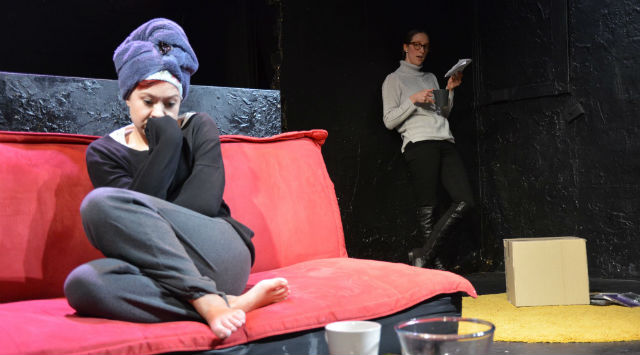
Melissa Bonne and Robin Goldsworthy can both be seen in Look Back In Anger by John Osborne.
Dates: 16 August – 10 September, 2016
Venue: Old Fitz Theatre
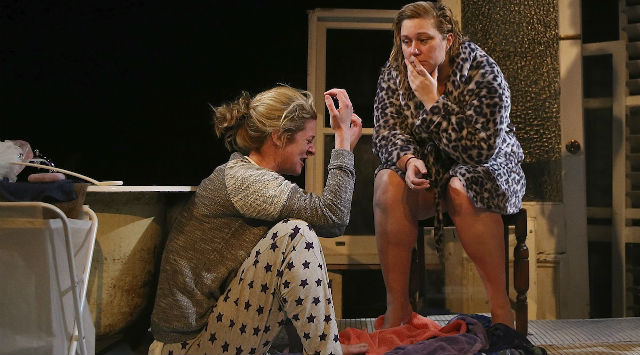
Review: Low Level Panic (Thread Entertainment)

threadentertainmentVenue: Old Fitzroy Theatre (Woolloomooloo NSW), Jul 12 – Aug 12, 2016

Playwright: Clare McIntyre
Director: Justin Martin
Cast: Geraldine Hakewill, Amy Ingram, Kate Skinner
Image by Julia Robertson

Theatre review
Three young women share a home, and in their interactions within the intimate setting of a shared bathroom, we come to understand their desires and insecurities, along with the obstacles they encounter in daily life that shape their respective sense of self. Jo, Mary and Celia are different in many ways, but they are all subject to the male gaze. Their heterosexuality locks them further into complicated entanglements with the opposite sex, and allows Claire McIntyre’s Low Level Panic to unpack issues of politics and misogyny for a look into the modern woman’s relationship with the world, and more particularly, with sex, and with her own body. The statements made in the play are nothing new; it is after all, close to three decades old, having first appeared in the late 80’s, but the experiences it portrays still feel accurate and its revelations remain raw.

Director Justin Martin’s production is innovative and exuberant, with bold staging devices that assist in making the play’s concepts more lucid and powerful. The introduction of social media as an instrument of oppression brings the story up to date, offering a frame of reference that we relate to readily. A team of seven men are positioned around the stage dressed like stagehands, but are in fact part of the show, always watching, and always insisting that their masculine presence not be dismissed. They purport to be invisible but are actually a menacing force that fuels the subtext of the women’s conversations. Martin’s theatrical embellishments are a pleasure; sensitive, intelligent and often witty, but being much more pronounced in the first half, later sequences feel suddenly stark, almost too plain to meet our heightened expectations.

Performances are passionately vivid. The marvellous Amy Ingram leaves a remarkable impression with her impeccable timing and disarming authenticity as Jo, a character with endearing vivacity who nonetheless suffers from the unfortunate, but all too common, obsession with her self-determined physical inadequacies. The actor brings a valuable dignity to a discussion that tends to present her role as a victim of circumstance, and her brilliant sense of humour is the spoonful of sugar that makes the caustic medicine go down. Geraldine Hakewill and Kate Skinner provide excellent support with contrasting portrayals of femininity that gives the text’s argument a complexity, by challenging our preconceptions of gender representation.

In Low Level Panic, we are witness not only to the fact of sexual objectification, but also the reinforcement of that prejudice against women, by the three housemates onto themselves. The Stockholm syndrome as applied to the reprehensible male gaze is a truth rarely spoken. Segregation and subjugation based on gender is one of the most entrenched foundations of patriarchy, even the enslaved is unable to recognise her own debasement. Bringing us to this realisation is where the play becomes radical, but how it leaves off is of great importance. In our individual and collective feminisms, the problem of the male gaze is addressed in divergent ways. None reigns supreme, but it is our very action of living feminist lives that is meaningful.

www.facebook.com/threadentertainment

5 Questions with Lucy Clements and Brandon McClelland

Lucy Clements

Lucy Clements

Brandon McClelland: As a writer, which piece of literature or drama do you most wish could have had your name in place of the author’s? Conversely, which are you most glad your name is absent from?
Lucy Clements: To have my name on: Hamilton, Wicked or My Fair Lady. I’m such a fan girl for the great musicals. I’d get writing on my own, but my ridiculous lack of music knowledge and taste makes me nervous to try… but hey, why make excuses, I should get writing! And absent from… I’ll go Mao’s Little Red Book. Pretty glad my name’s not on that.

If you could travel in time, but only in one direction and with no possibility of return, when would you travel to and why?
I’d definitely go forward, I think the unknown is so much more exciting than all the stuff we already know about from the past. But probably only one century max… as too much more and I’ll probably find myself in a global warming destroyed world and be consumed by man eating plants that have taken over the planet. And only if I could take you with me!

Fracture is a piece that has gone through extensive development, transformation and is a completely different iteration than its original Perth production. Since the first draft of Fracture to now, what has been the most significant change in your own life?
Meeting you of course! Because of our relationship I have moved out from my family home in Perth and am now living with you in the midst of the vibrant art scene of Sydney, I’m debuting my first work with you as my lead actor and co-producer… and I will soon be following to you to New York on your Broadway tour of STC’s The Present! If someone had told me that all of this was going to happen three years ago I never would have believed them.

Do you believe a playwright’s voice should be neutral (non-partisanal, apolitical, objective) or should they have a singular opinion that they back unreservedly? In relation to this, which of these do you think dominates the Australian theatrical landscape?
I don’t believe there is a “right” or “wrong”. There are many successful opinionated and neutral-voiced plays. My personal taste goes towards a voice that gives you both perspectives and lets you decide… so, a neutral voice. I recently read Night of January 16th by Ayn Rand. Although Rand is quite well known for her opinionated works, this particular play, set in a courtroom where the audience becomes the jury, plays on our own personal biases and how this can manipulate our judgment. The play does nothing to prove who is “good” or “bad”, but presents both sides of the story and challenges audiences to cast from this our own opinions. I loved this play. I find it much more challenging to have to find my own opinion with all the facts presented to me, rather than having one side of the story drummed into me as opinionated pieces can do. I believe Fracture has a neutral voice. It simply tells a story, and lets audiences decide what is good and what is truth within it. I think we’ve got both sides pretty covered in Australia, particularly with 44% of our programing being international scripts (which is also a very saddening statistic!).

You originally planned to be a nurse, so do you believe your earlier career aspirations have had an effect on who you are as a writer/artist?
Definitely! I’ve always been quite an empathetic person – hence my drive to become a nurse. I think all the characters I write are created from the same drive. In Fracture, my leading character (who you are playing) has abandoned his life partner without a goodbye or word of warning. But why do people make these choices? What’s going on inside them that from the outside can make them seem cowardly or cruel? Was it even in their control? What perspective can I tell this story from that could make audience’s understand, to question other people’s circumstances one more time before casting judgement? These are all the questions that Fracture interrogates – which are the questions that drive all of my plays.

Brandon McClelland

Brandon McClelland

Lucy Clements: Here’s a million bucks to put on a production in Sydney next year. What play, which venue, and do you have anyone in mind to direct and/or co-staring beside you?
Brandon McClelland: Well, a million dollars is a ridiculous amount of money. I’d most likely split it up and try to program a full season of independent shows from a range of different young writers and directors. Although if, like Highlander, there can be only one, then I would love to put that money towards a production of The Weir by Connor McPherson in a smaller theatre. I don’t know who’d direct it. Maybe I’d hold auditions just to turn the tables.

What’s the best and worst thing about dating your director?
Best thing is that we already have a shorthand in regards to communication and we can talk about the play pretty much round the clock. The worst thing is that there’s no excuses when it comes to doing my ‘homework’ as it were. You know everything about me. Example: I didn’t read the new addition to the scene because I was watching Mythbusters again.

What excites you most about realising Fracture?
It’s a show I’ve followed since its premiere in Perth. Being involved in the development and progression of the play over the past year it’s clear that it is a completely different beast and I think it’s an exciting project. The conversation it enables regarding mental health is particularly poignant and personally relevant. I’m fascinated to discover how audiences will react.

This is your second time taking on the dual role of producer and performer. What draws you to this combination?
I’m a sucker for punishment. I don’t know really. It’s a tough ask to take on both roles and I think you have to be a very special kind of mind to successfully operate and fulfil your duties equally. I don’t know how I’d do it without you. I really don’t.

You’re elected as Prime Minister of Australia. What’s your first call of action?
Treaty with the Indigenous, First Peoples with full recognition in the constitution. No hesitation.

Lucy Clements and Brandon McClelland are co-founders of New Ghosts Theatre Company, presenting Fracture in Sydney after a successful season in Perth last year.
Dates: 2 – 12 August, 2016
Venue: Old Fitz Theatre

Review: Henna Night (Mercury Theatre)

mercuryVenue: Old Fitzroy Theatre (Woolloomooloo NSW), Jul 5 – 9, 2016

Playwright: Amy Rosenthal
Director: Glen Hamilton
Cast: Jane Angharad, Romney Stanton

Theatre review
Two women are brought together by their love of one man. They are not particularly inspiring people, but theatre does not have the responsibility to only give us role models. Judith and Ros are in a confrontation, both projecting their resentments onto the other, eventually finding commonality in their romantic dissatisfaction that allows them to discover a bond, unexpected of themselves, but completely predictable for their audience. They languish in all the imperfections of their love lives, but never question the futility of their efforts. Amy Rosenthal’s Henna Night is a story about desperation that shows an unflattering picture of what we look like when feeble and fallible.

It is a mildly comical work, with an emphasis on naturalism that tends to subdue the funnier lines of the script. The clash of rivals is conveyed with insufficient theatricality, but the show has a coherence that communicates logically in the absence of great dramatic tension. Actors Jane Anghard and Romney Stanton are convincing in their portrayals, if a little lacking in dynamism. The production’s shifts in mood and atmosphere could be more amplified for better sensory variation to keep us engaged further with nuances of the piece. Director Glen Hamilton attempts to unearth the truth in these women’s experiences, and is successful in bringing an honesty to the stage, but he requires more spice to accompany this overly polite creation, laden with too much sugar.

It is arguable if nice girls always finish last, but in Henna Night, we yearn for Judith and Ros to throw punches and smash vases. We want to see them lash out, because our own angers and frustrations need a safe space to experience a moment of salvation. Thespians are given the license to behave badly in their worlds of make belief, so that we can benefit from that exorcism of our shared demons. The people in the play have a message for us, but they appear gently and disappear too quietly, leaving little more than a dent in our memory.

www.facebook.com/…

5 Questions with Geraldine Hakewill and Amy Ingram

Geraldine Hakewill

Geraldine Hakewill

Amy Ingram: This play explores the friendships and relationships of women and how they view each other and themselves. Do you recognise yourself in any of the women or the relationships they share?
Geraldine Hakewill: I recognise myself in all three women, and I’ve definitely experienced the sorts of relationships they share: the jealousy, the awkwardness, the passive-aggressive conversations, the solidarity, the depth of love and affection, the fragility, the dangerous unpredictability and the profound trust. I think most women will recognise it all too. That is the brilliance of this play and why it still works. I really get Mary’s over-analysis and anger at the world. I completely identify with Jo’s self-loathing coupled with positivity. And Celia is basically me, on crack. Not really. (But really).

Feminism seems to be making its way back into the forefront of social media, how do you think this play looks at feminism in today’s current political climate?
I think what is fascinating about us doing this play right now is that so little has changed since Claire McIntyre wrote it back in 1989. That’s very frightening. Beauty is still the strongest currency in this world, and women are still afraid when we walk down the street at night because we might get attacked, simply for being female. This isn’t OK. What has changed is that it feels like social media has been taken up as a tool to unite feminists around the world, be they male or female, and allow people to have a voice in order to educate and to argue and to discuss. I think that’s brilliant. As much as the anonymity of Twitter and Facebook allows for trolling and abuse, it also allows people who aren’t public figures and who never thought they could participate in a public discussion, to share their stories and create awareness. This production has been updated by Justin (Martin, our director) so that we are referencing this shift. We aren’t changing Claire’s words, but we are bring her text into this era of modern technology and we’re trying to explore how media and technology has changed feminism and the discussion around it- for better and for worse. It feels more immediate and relevant than almost any other play I’ve ever done.

Your character is very particular about her routine and products. If you could take one of those products and make it do anything in the world what would it do?
Well, what if my ocean fresh exfoliating shower gel could somehow make me invisible? I think that’d be pretty amazing. I’m such a secret snoop, and I’ve always loved the idea of being a spy. This would be really helpful. Even if it was just 45 minutes worth of invisibility. Plenty of time for spy-stuffs. And well worth the $5.99.

If you met Celia out at a bar what do you think she would be doing? What would you two get up to in the course of the night?
I think she’d be waiting for a Tinder date. She’d be looking pretty hot. She’d be nervous-sweating but she would have worn extra strong antiperspirant and so she’d still smell fresh. She’d be sitting alone at the bar. I’d be with a group of friends at a booth after a day of rehearsals. I use hippy deodorant so I would not be as fresh as her. Her date is two hours late but she’s stubborn. She waits. She’d look forlornly over to our group as we laughed too loudly at some private ‘actor’ joke that no one else will ever find funny. I’d go to buy a round of drinks and she’d comment on my jeans. They fit well. Thanks, I’d say. It’s really hard to find the perfect jean. She’d agree. By the end of the night we are singing Celine Dion karaoke together at 4am and promising to be best friends for life. We never see each other again. But, I’ll always be impressed that she knew all the words to “It’s All Coming Back To Me.”

If your life was a midday movie what would the title be?
“It’s All Coming Back to Me.” It’d just be a series of musical flashbacks and dream ballet sequences. You can be in it Amy, if you like. We can do a pas de deux.

Amy Ingram

Amy Ingram

What was so special about this role that made you want to come down from Brisbane to do it?
First off it was more about working with Kate as I had not seen her in ages and always thought it would be great to work with her. She seemed so excited about the project I was immediately intrigued. Then I read the script and laughed out load at so many points I knew that was a good sign. I am extremely interested in roles where women are the central focus and their character journey is more than a supporting role for some 40 year old dudes mid life crisis. The fact that this show also looks how we view ourselves in the world meant I was basically hooked! On a side not it is always exciting to work with new people, in new places and venues – I think it makes you a better artist.

The play was written and is set in the 80s in England. Do you think we’re managing to do a good job of setting it in 2016 in Australia? And how?
Unfortunately most of the conversations we have now about equality and how women are objectified to the point of violence are exactly the same. All that has changed is the context and medium or lens used. The rise of social media and the fact that more and more women are moving into higher positions of power (HURRAHHHH!) means that we are some cases seeing the extent to sexism in a much clearer light. So basically – Yes – I think we are doing a good job of it because the world is often doing a shit job of shutting sexism down. When I first read the script I was surprised at how old it was and I think you can’t help but put a contemporary context on it because we are living here and now and our lives and experiences fuel our choices on stage

What do you think the title, Low Level Panic refers to?
Welcome to the everyday world people. We are in a constant fret about our appearance , what people think about us, what we think of ourselves. This is not exclusive to women. But you add onto that the fear some women face everyday in their own homes. The simple choice of trying not to walk home when it is dark. Asking yourself if the dress you are wearing is going to invite negative attention, crossing the road when you run because because you don’t want to get heckled . And I know some people reading this will say I’m blowing it out of proportion and #notallmen. And that’s true. It’s absolutely true . But then why does what I mention still happen more frequently than you’d think and why do we still feel this way?

What’s your favourite thing about being Amy Ingram?
Now why would I give away that info for free? Come to the show and have a drink with me afterwards and find out for yourself…

You really don’t like wearing pants, but if you had to wear pants every day of your life, describe your ideal pair. They can be magical.
Pants that make me fly. Or time travel. Pants that can take me to some tropical island whenever I wish. Now those are pants I can get around. Also pants that whenever I reach into the pockets there are wads of money inside. I’d bloody never take them off.

Geraldine Hakewill and Amy Ingram can both be seen in Low Level Panic by Clare McIntyre.
Dates: 12 July – 12 August, 2016
Venue: Old Fitz Theatre

5 Questions with Danielle Baynes and Pip Dracakis

Danielle Baynes

Danielle Baynes

Pip Dracakis: What are the similarities between Lady and Danielle?
Danielle Baynes: I’m similar to who the Lady becomes at the end of the play. At the beginning I share her curious, romantic and cautious side. She’s very naïve though, I’m much more cynical. After a certain experience she has in the middle of the show we definitely become kindred spirits. She’s more talented than me but we’re both hilarious. We sort of look the same, except her face is much bigger.

What do you enjoy most about performing in live theater?
If it can only be one thing, then I’d say the audience. The shared experience, the instant feedback, the mixture of being completely in control and totally out of control at the same time. Nothing compares.

What is the most ridiculous thing a director has asked you to do in rehearsal?
Look I won’t name and shame, BUT Michael Dean once had a group of us running around a dodgy, empty car park late at night in Parramatta yelling “red alert”.

Who inspired you in the creation of the mysterious male character in Bicycle?
Oh Pip, the question you’ve been dying to ask all this time… I won’t go into detail about the personal inspiration, but I was inspired by an author named Bram, and a little bit inspired by Mads Mikkelson.

What’s your guilty pleasure?
At the moment it’s binge watching crime shows in bed until 3am. I also indulge in too much soft cheese. But Nigella Lawson said, “I don’t feel guilty about any pleasure. I think you should only feel guilty if you don’t feel pleasure”, and I try to take on that attitude as well.

Pip Dracakis

Pip Dracakis

Danielle Baynes: If you and I were musical instruments, what would we be?
Pip Dracakis: You would be a Steinway and I would be a Stradivarius.

You are a brilliant Actor Musician, what’s unique about this type of performer and how did you approach your role in Bicycle?
I see my role in Bicycle as a storyteller and try to serve the story and text in all my musical and physical choices. It’s great to be able to work on a show where you can think as an actor and communicate through music.

What’s the strangest thing someone has said to you after a performance (any performance)?
During one of our post-show Q&A’s for Merchant of Venice with Sport for Jove, we were asked how we all knew each other. The kid was in year 7. I think he was struggling with all the other questions about dealing with a racist play in the 21st century.

What was the process in creating the score for Bicycle?
I listened to a lot of different repertoire but most of my musical ideas were inspired by the text and born out of the organic rehearsal process. Lots of trial and error, seeing what enhanced the script and what moments were best left without any musical underscoring. In some scenes, the music is totally improvised and in others, there are prescribed excerpts by Bach or Bartok, for example.

And finally, if someone was to make a movie of your life, who would play me?
Fran Fine.

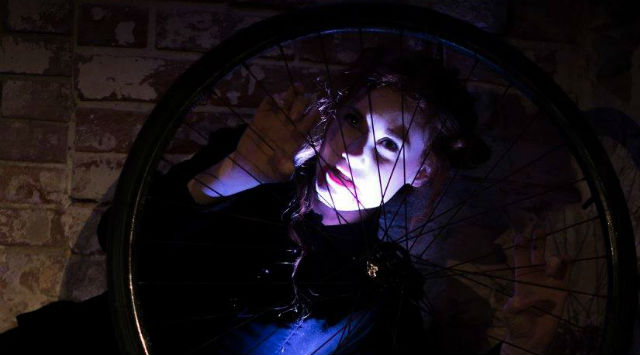
Danielle Baynes and Pip Dracakis can both be seen in Bicycle.
Dates: 21 June – 2 July, 2016
Venue: Old Fitz Theatre

Review: Bicycle (Lies, Lies And Propaganda)

liesliespropagandaVenue: Old Fitzroy Theatre (Woolloomooloo NSW), Jun 21 – Jul 2, 2016

Playwright: Danielle Baynes
Director: Michael Dean
Cast: Danielle Baynes, Pip Dracakis

Theatre review
It is one woman against the world in Danielle Baynes’ Bicycle. The odds are stacked against our 19th century protagonist as she discovers not only her life’s passion, but also the injustices that women face when trying to carve out a self-determined existence. Coming of age in Baynes’ play means realising the discrimination that is systematically entrenched in a world that had previously seemed innocent. An awakening of desires demands that her eyes are open to truths, and her story of tragic enlightenment is told in a way that disallows us from denying its persisting relevance. The nameless Lady’s feelings and experiences, her perspective of the world, and her hunger for what is right, all find connection with our 21st century sensibilities, and shock us into seeing the intimate parallels between what we had considered to be bygone history and what we continue to retain. It is a passionate piece of writing, insightful and brilliantly elucidating through a narrative that is at once personal and universal. At the core of its many colourful permutations of form, is its unmistakeable feminist advocacy that many will find irresistibly inspiring.

Baynes plays the Lady in the hour-long monologue, with Pip Dracakis providing an added female omnipresence with her person and violin. Space is restrictive, and the production relies squarely on the leading lady’s ability to keep our attention and imagination engaged, which she accomplishes remarkably well. Scenes are thoughtfully demarcated and given distinct flavour by director Michael Dean, but some sequences are more effective than others, resulting in a plot trajectory that can feel uneven in its resonance. Dracakis’ live music gives the show a dynamism that works seamlessly alongside Baynes’ actorly endeavours for a powerful statement about art, and the struggles in its creation.

Sex and art are linked in Bicycle, both are appetites ferocious in nature and indomitable. The Lady’s liberties are completely usurped by a patriarchy that is determined to diminish her wishes and talents. We live in a world where powerful people go to great lengths to maintain the status quo, for their position necessitates the subjugation of many. This seems to be part of human nature, never to change, but processes where disenfranchised groups work to destabilise and subvert oppressive forces are always ongoing. Not all will succeed, but the battle continues for the human spirit is at its most potent when the downtrodden are left with nothing else to lose. Her rights as a sexual being and an artist, are a threat to her father and his conspirators, who do all they can to disempower her, but we are glad to see her fight to the end, whether or not she comes out on top.

www.liesliesandpropaganda.com

5 Questions with Francesca Savige and Damien Strouthos

Francesca Savige

Francesca Savige

Damien Strouthos: Do you scrunch or fold your toilet paper?
Francesca Savige: I scrunch-fold. It’s a metaphor for my whole life.

What has been your worst moment on stage in a past show?
General dire moments of insecurity aside, I had one incident of corpsing on stage that was was so inappropriate and unprofessional that I’m too embarrassed to go into detail. I regularly laugh in rehearsals (Anthony Gooley is making me giggle a lot in rehearsals at the moment) but I usually pull myself together for performance. This unspeakable occasion was out of control.

Who do you think will win Origin 1 next week?
Whether you mean football, electricity or Darwin, I lose.

What excites you about our production of Inner Voices?
The play, the director, the cast, the design the venue. Pretty much everything. That’s not me pimping for publicity, it’s fact. But if I had to pick one thing, it’s the brain stimulus. I’m loving good theatre that’s prompting discussions lately. I’m still reeling from Sport for Jove’s Taming of the Shrew, and this play is giving me plenty of delicious food for thought.

Where do you find the humanity in our show where there are no plain ‘good’ or ‘bad’ characters?
John Bell was the first director of Inner Voices in 1977, and in his intro to the Currency Press script, he writes that “There is a compassion in the play – not for Ivan himself but for his situation”. I think that’s the humanity in the whole play- we can all relate to the destruction of innocence, to abandonment and isolation… At least those of us who have been lost in shopping centres and put on leash. (Yep. Me too, Damien)

Damien Strouthos

Damien Strouthos

Francesca Savige: Having been on tour quite a lot over the past few years with Henry V and Romeo And Juliet for Bell Shakespeare, do you have a best and worst tour memory?
Damien Strouthos: Best and worst memory are probably one. Henry V 2014, performance in Sale, Victoria. A viral corpsing moment that effectively stopped the show (standard) during the last scene thanks to a Mathew Backer line fluff. 7/10 actors uncontrollably convulsing with laughter isn’t the best way to end a 2.5 hour Shakespeare. Or maybe it is. I had my fist half way down my throat trying to stop whilst we were meant to be signing a 3 part harmony of “I vow to thee my country”. To this day, mention to any of the actors from that company the phrase ‘Sale, Henry V‘ and you’ll get a good yarn.

What are you most enjoying about rehearsals at the Old Fitz at the moment?
$3 beers and working with some people I really admire.

Have you previously encountered Louis Nowra on page, stage or in person? And if so, what was that experience like?
I’ve read a few of his plays, never performed in one. Which is odd as Inner Voices is arguably his most obscure. The experience on working on it so far has been totally challenging in a good way. I haven’t met him but he hangs out at the Fitz a lot so I hopefully will get the opportunity to ask him why he put a bloke in a bear suit in scene 7.

Can you draw on any personal experience for your current role as the Russian infant King who was kept imprisoned for 23 years, with minimal human contact and communication?
My mother lost me a in a shopping centre once when I was too young to describe who I belonged to. I was also one of those kids who wore a child leash (there’s not really a better name for that?) so yeah, I totally understand oppression and isolation.

To be honest, I tend not to use my life in my work too much unless I’m really not hitting something emotionally. Just being informed by the given circumstances and using the words on the page and trying to be truthful. Without knowing it, your life informs your work I think.

If you could speak only one word for 23 years, what would it be?
I’ll just pop that there.

Francesca Savige and Damien Strouthos are appearing in Inner Voices by Louis Nowra.
Dates: 15 June – 9 July, 2016
Venue: Old Fitz Theatre

Review: Inner Voices (Don’t Look Away Theatre Company)

dontlookawayVenue: Old Fitzroy Theatre (Woolloomooloo NSW), Jun 15 – Jul 9, 2016
Playwright: Louis Nowra
Director: Phil Rouse
Cast: Annie Byron, Julian Garner, Emily Goddard, Nicholas Papademetriou, Anthony Gooley, Francesa Savige, and Damien Strouthos
Image by Ross Waldron

Theatre review
Ivan VI lived 23 short years in Russia, but in Louis Nowra’s Inner Voices, his destiny is transformed dramatically to tell a story about how kings are made, and how countries are ruled. Originally published in 1977, Nowra’s words in the play remain fresh and humorous, and although its political edge seems to have worn with time, Inner Voices‘ punk sensibility is still evident today in its iconoclastic characterisations and anti-authoritarian outlook.

It is a very exuberant production that Phil Rouse has directed. Notwithstanding our unfamiliarity with its context, the unrelenting and spirited acerbity of his style keeps us engrossed. The thoroughness at which the text’s comedy is explored, is not only endlessly amusing, it also helps provide depth of meaning to an outlandish narrative. Thoughtfully designed, the production’s aesthetic values are textured and powerful. Anna Gardiner’s set and Katelyn Shaw’s sound design are especially remarkable in the degree to which they are able to consistently add surprising dimension to the play.

Inner Voices‘ cast of seven is an exceptionally dynamic bunch. Ivan is played by Damien Strouthos, whose uncanny ability to portray eccentricity is a perfect fit for the quirky role. The actor takes the opportunity to showcase excellent range in a part that goes through several significant transformations, and we see various facets to Strouthos’ talents, all equally accomplished. Anthony Gooley is absolutely memorable as Mirovich, with razor sharp wit and a flamboyant theatricality that knows no bounds. Enthralling and hilarious, Gooley is outstanding on this stage and we are kept amazed by the genius inventiveness he injects into every line of dialogue.

It is the eve of another federal election in Australia, and we think about the likely candidates who will rule us for another three years. Inner Voices reflects our prevailing cynicism, and exposes the falsities associated with the state of our politics and governments. We want truth and honesty from those who represent us, but we have become all too aware of the hypocrisies and cunning that are required for people to attain positions of power. If good people cannot win in a broken system, all we have are at best, compromised and substandard. Nowra’s play does not offer us any solutions, but it certainly is a reminder that we should want to do better.

www.facebook.com/dontlookawaytc

Review: Belleville (Mad March Hare Theatre Company)

madmarchhareVenue: Old Fitzroy Theatre (Woolloomooloo NSW), Apr 30 – May 12, 2016
Playwright: Amy Herzog
Director: Claudia Barrie
Cast: Josh Anderson, Taylor Ferguson, Chantelle Jamieson, Mansoor Noor

Theatre review
Whether or not one believes in “happily ever after”, there is little doubt in the truth that relationships are never completely smooth-sailing. When people are bonded together, what keeps them from breaking up are not always snowdrops and daffodils. Amy Herzog’s Belleville is about the poison that can fester in romantic unions, observed through a married American couple, Abby and Zack, disquieted and displaced in Paris. We see them trying to make things work, but the only thing they share is a chronic anxiety about being together, the causes of which the playwright keeps concealed until the end. In our efforts to explain the mystery of their circumstance, we access our own understandings of how things can go awry between two people who have grown so close, thereby reflecting an unfortunate universality of the experience.

It is a play full of intrigue and danger, brought to the stage by director Claudia Barrie who creates a disarming tension from the unrelenting but subtle details of the couple’s relationship collapse. Their unnamed dysfunction is made palpable by Barrie’s flair for manufacturing suspense, and our minds are kept racing in response to the mysterious plot. The production is confidently designed by a team who taps into the undercurrents and subtexts of the writing, to address the less deliberate parts of our consciousness. The characters struggle to say what they mean, but their feelings are manifest in the atmosphere that we share. Performances are committed and thoughtful, with all actors proving to be dynamic and entertaining, although some moments could be less tentative. Abby is played by Taylor Ferguson who does a marvellous job of expressing physically what her role is unable to put in words, and Josh Anderson’s volatility as Zack keeps us on tenterhooks, wondering if and when he is going to reach a point of nervous breakdown.

Paris is the city of love, and many dream of its enchanting and exotic perfection, without ever having stepped foot in it. Indeed, Paris represents a kind of quixotic approach to romance that is fundamental to its appeal. We want what we have never experienced, certain of the fulfilment it will deliver without knowing what it actually contains and entails. Abby and Zack arrive at their point of difficulty because of decisions made on a basis of weakness, conformity and resignation. They went after something they knew nothing of, and find themselves stranded in a space of destruction and hopelessness. If they get out of it alive, they can leave ignorance behind and head into the future with brighter minds, but if they remain trapped, the end can only be calamitous.

www.madmarchtheatreco.com