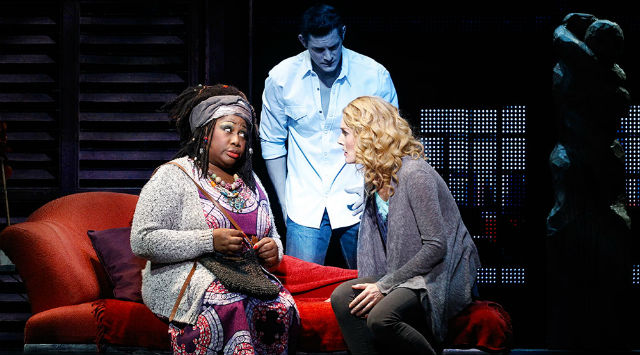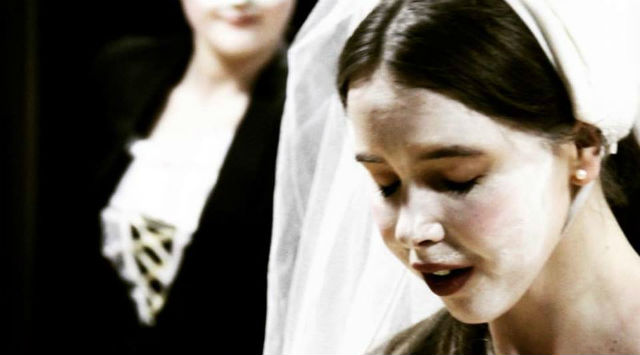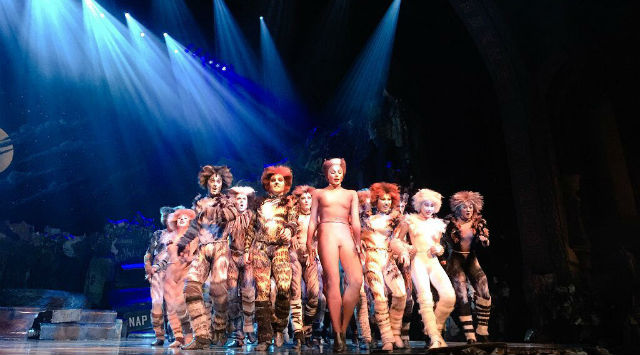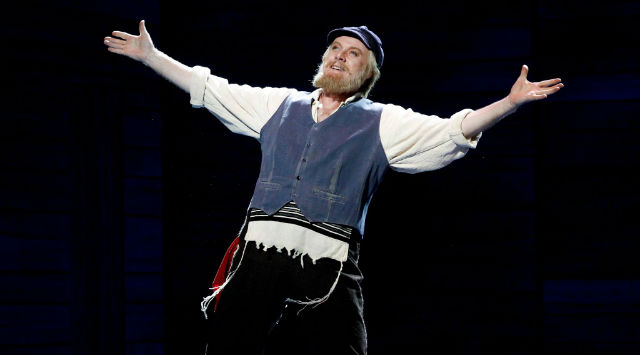
Review: Nine (Sydney University Musical Theatre Ensemble)

museVenue: Seymour Centre (Chippendale NSW), Oct 21 – 24, 2015
Book: Arthur Kopit (based on the Italian by Mario Fratti, after Federico Fellini’s )
Music & Lyrics: Maury Yeston
Director: Jonathan Rush
Cast: Mikhaila Chaplin, Anna Colless, Hannah Cox, Genevieve de Souza, Rielly Dickson, Doug Emery, Jacinta Gregory, Bridget Haberecht, Bronwyn Hicks, Jane Hughes, Gabi Kelland, Lisa-Marie Long, Jos Markerink, Rose McClelland, Olga Solar, Nicole Toum, Stephanie Troost, Sam Wood

Theatre review
Based on Federico Fellini’s 1963 semi-autobiographical film , this is a musical about a man’s passion for life, work and women. The central character in Nine is Guido Contini, the superstar director under pressure to create a new work. He escapes, procrastinates and reminisces, but we do not see the film being made. His artistic process is not a straightforward one, and we learn that genius manifests itself in unexpected ways.

The songs in Nine are melodic and extravagant, powerfully orchestrated by ten musicians under the supervision of Alexander Norden, who breathes life into Maury Yeston’s 42-year-old compositions. The show is directed with flair and energy by Jonathan Rush, and choreographed intelligently by Natasha Heyward. It is a production that successfully expresses the exuberance of Fellini’s Italy, with all elements finding cohesion in the decadence and wildness of that romanticised world.

There are accomplished performances in the show, most notably Hannah Cox’s turn as Liliane La Fleur, completely stealing the show in her sensational Folies Bergère number, with perfectly pitched humour, rambunctious sex appeal, and a stunning sense of joy. There are major problems with sound in the production, but stronger singers, including Anna Colless and Bronwyn Hicks do manage to overcome them with sheer vocal power. Less fortunate are the show’s leads Doug Emery and Bridget Haberecht, the Continis who find themselves consistently drowned out by musical accompaniment. Nevertheless, their committed and eloquent performances leave a strong impression, and help to deliver a fascinating narrative that is ultimately very satisfying.

This might be a minimal staging, but its imperfections are few. Nine stands the test of time, and this small revival demonstrates the potentialities and pleasures it contains. Inspiration is invaluable, and artists especially must be able to identify them. Fellini’s magnificence is emulated in Yeston’s musical, and this production is clearly touched by the muses, but we do not have to wait for the calling of divinity to be spurred on to create something special; as we see in Guido’s story, greatness is to be found in la dolce vita.

www.museatusyd.com

Review: Rent (Highway Run Productions)

highwayrunVenue: Hayes Theatre Co (Potts Point NSW), Oct 8 – Nov 1, 2015
Book, Music and Lyrics: Jonathan Larson
Director: Shaun Rennie
Musical Director: Andrew Worboys
Cast: Laura Bunting, Denise Devlin, Casey Donovan, Linden Furnell, Josh Gardiner, Loren Hunter, Stephen Madsen, Nana Matapule, Jack O’Riley, Matthew Pearce, Chris Scalzo, Monique Sallé, Kirsty Sturgess, Chloe Wilson
Image by Kurt Sneddon

Theatre review
Stories about the impoverished artist are always romantic. The bohemian life is one that fires all our imaginations, but only a few of us are able to experience. In spite of all the debauchery and vulnerabilities associated with that way of life, we admire the purity that they represent with their uncompromising choices. The characters in Jonathan Larson’s Rent are passionate and idealistic, and like characters in Puccini’s La Boheme, their poverty is seen to be something of a rebellion against an establishment that is corrupt and ugly.

There are tragic repercussions in the narratives of Rent, and it is not until those occur in the second act that emotions begin to run high. All the musical numbers are beautifully realised under the direction of Shaun Rennie, but characters and their stories are somewhat distant, perhaps due to the age of the piece. Rennie, along with his designers (set by Lauren Peters, lights by Ross Graham and costumes by Georgia Hopkins) bring an accuracy to the look and feel of the USA in the mid-90’s, and Musical Director Andrew Worboys does an excellent job of updating its sound, but for a substantial duration, the piece plays like a concert with brilliant performances that engage, but only on a superficial level. We wait for poignancy to take hold, and although it eventually does, its effects seem too little, and too late.

The cast is comprised of 14 powerful voices that give the musical a superb polish. Some are stronger actors than others, but the quality of singing is consistently impressive and thoroughly enjoyable. Mimi is played by Loren Hunter, who shines bright in the role with her creation of a personality that is complex, colourful and clear. There is a precision to her work that delivers just the right amount of pathos, keeping us connected through her sense of authenticity. Along with her warm vocal tones, Hunter’s portrayal of conflict and suffering is an irresistibly captivating one. Also memorable is Casey Donovan, feisty and dramatic as Joanne, the Ivy League-educated lawyer. Donovan stuns us with her extraordinarily soulful singing, giving the musical genre a rare edge, and surprises us with a convincing characterisation of an intriguing personality. Christopher Scalzo is a controversial Angel. Originally written as a trans woman, Scalzo’s interpretation reads more like a cisgender gay male. Well-known trans characters of the theatre are extremely rare, so this obliteration is unfortunate, but it is a commendable decision that Scalzo is not required to assume a false trans identity for the stage, and is instead allowed to give expression to the role in a manner that is perhaps more in line with his personal gender identity. It is also noteworthy that Scalzo’s gutsy approach to his songs adds a raw dimension to a show that can be too clean in its presentation of the New York underground. His concluding scene is sensitively rendered, providing one of the key elements to the most moving portion of the production.

Rent was created at a time when AIDS was the leading cause of death in young Americans. Although there is much more still to be achieved in the space of HIV/AIDS research and medical advancement, we have come a long way since those early days of death and darkness. Discrimination however, still persists and the message in Jonathan Larson’s work remains relevant. Wealth distribution is still the cause of our troubles, and the urgency to address the problems in Africa is undiminished. The production’s upbeat end is to be expected, and although it seems futile in these times of complacency to bemoan the fact that the struggle is yet to be over, the truth in Larson’s work resonates, and it is always the underprivileged that is neglected and we simply have to do better.

www.hayestheatre.com.au | www.highwayrunproductions.com

Review: Anything Goes (Opera Australia / Gordon Frost Organisation)

Venue: Sydney Opera House (Sydney NSW), from Sep 5 – Oct 11, 2015
Music and Lyrics: Cole Porter
Book: Guy Bolton & P.G. Wodehouse, Howard Lindsay & Russel Crouse, Timothy Crouse, John Weidman
Director: Dean Bryant
Cast: Gerry Connolly, Carmen Duncan, Bartholomew John, Wayne Scott Kermond, Debora Krizak, Claire Lyon, Todd McKenney, Caroline O’Connor, Alex Rathgeber
Images by Jeff Busby

Theatre review
Cole Porter’s songs are amongst the most familiar in the Western world, and Anything Goes boasts a whole raft of evergreen hits, all taking pride of place in the musical. Originally staged in 1934, the show has been revived many times, along with film versions in 1936 and 1956 and a television special in 1954. Porter’s music is unquestionably delightful and quite irresistible. The wit of his lyrics, and catchiness of his melodies were perfect for stage and screen during his active years from the 1920’s until his final TV score in 1958 for Aladdin. This latest rendering of Anything Goes is a nostalgic gem that brings back all that is wonderful of the era, and adapts it to contemporary tastes. Direction by Dean Bryant is snappy and bold, but the production is always mindful of the conservative American climate that it re-enacts and never allows itself to get vulgar, although moments of bawdy humour are plentiful and extremely well-received. Where there are forbidden fruits, the idea of “anything goes” can take hold anywhere, and Bryant’s less is more approach pays off. By being only slightly naughty, he makes us laugh from beginning to end, tapping into a sense of old-fashioned cheekiness that still works.

Anything Goes features an ensemble cast, with many small (and very lightweight) narratives held together by the conceit of a classic cruise liner setting. We do not usually expect definitive stars for this variety of show, but Caroline O’Connor’s presence clearly dominates. Her skill, energy and seasoned pizazz, together with supreme confidence and splendid comic timing, ensures that her talent is a cut above the rest and that her every appearance jolts the crowd into spasms of irrepressible excitement. Also fantastic are the young lovebirds, Claire Lyon and Alex Rathgeber, both with impeccable voices beautifully suited to the genre, and each with physical disciplines that let the depiction of their characters be believable, charming, and terribly romantic. Their rendition of De-Lovely is a show-stopper with demanding choreography by Andrew Hallsworth executed with tremendous flair and exquisite sentimentality, bringing to the show a sophistication that exceeds all expectations. Supporting players are effective comedians but less gratifying in their respective musical numbers, most of which appear in Act II, and causing an unfortunate dip in energy as the show attempts to reach its climatic conclusion.

Designers of the show must be lauded for a lavish production that looks outstanding in its refinement and elegance. Even though visual elements are probably derivative and significantly inspired by previous incarnations, costumes by Dale Ferguson are a treat to behold and a genuine highlight. Ferguson’s set, along with Matt Scott’s lights, are as dynamic and intelligent as they come. Every movement on stage occurs flawlessly, and our eyes shift effortlessly under the spell of their technical wizardry. Placement of the orchestra in the elevated centre stage is a genius touch that recalls big band formations of the past, and contributes to a wonderful acoustic dimension impressively balanced by Michael Waters on sound design.

The title might be Anything Goes, but nothing is left to chance. There is little logic in the stories and characters we see (and its occasional racial humour will undeniably offend some), but everything on the stage is measured to utmost precision. It is professional theatre at its strongest, and will provide benchmarks on many aspects of performing arts, in Australia and worldwide. Musicals are not the best at advancing a society’s politics and civilisation, and it rarely reveals rare truths of the human condition, but a work of this standard will inspire greatness in many forms. A night of sheer entertainment might not move mountains, but where we can find meaning, is the way it helps us see that mere mortals are the ones to make miracles happen.

www.anythinggoesmusical.com.au

Review: LKY (Metropolitan Productions)

lkymusicalVenue: Marina Bay Sands (Singapore), Jul 21 – Aug 16, 2015
Book: Tony Petito
Story: Meira Chand
Music: Dick Lee
Lyrics: Stephen Clark
Director: Steven Dexter
Cast: Sharon Au, Benjamin Chow, Radhi Khalid, Vester Ng, Adrian Pang, Dayal Gian Singh, Sebastian Tan

Theatre review
Propaganda involves the telling of lies, usually by governments, to influence a population toward its own conception of an endorsed attitude. Aside from the always contentious nature of that sense of an approved and absolute outcome, what constitutes the nature of lies, and truth, are always ambiguous. There is no doubt that the achievements of Singapore’s legendary founding father, Lee Kuan Yew remains a stunning accomplishment, but the stories surrounding the man, like those of every other personality of such enormous fame, are enigmatic, sometimes tenuously so, and constantly debated over. In LKY, attempts at interpreting historical events leading up to the independence of Singapore, are understandably moderate. In the face of ever-conflicting memories and dissenting opinions of a shared past, the musical is careful to depict the country’s biography with sufficient heterogeneity to provide an impression of diversity in order that the work does not translate with a conceited Disney-like quality of convenient idealism, but it does predictably, take the last word, ultimately adhering to dominant ideologies of “what must have been”.

It is clear at every stage of the plot that no surprises will have an opportunity to rear its ugly head, which results in storytelling that suffers from a lack of dramatic tension, although the component of sentimentality is certainly not in shortage. Music by Dick Lee is expertly created not only to deliver the compelling emotional power equivalent to that of any successful mainstream musical, it uses patriotic sensibilities to manufacture irresistibly rousing tunes that takes hold of its audience with a level of conviction impossible to deny. Steven Dexter’s sophisticated direction ensures a captivatingly energetic show, with thoughtful and dynamic use of space that fascinates our senses at all times (brilliantly visualised by designers, Gabriel Chan on lights, and sets by Takis), and with distinct and coherent characters who help the often complex narrative flow with swift and graceful efficiency.

The mammoth task of encapsulating Lee’s extraordinarily active life over a twenty year period is less elegantly developed. Although Tony Petito’s book is not overly reductive of the period, its many renderings of significant moments in Singapore’s 50’s and 60’s are fleeting and, without the luxury of time for deeper political dissection, those crucial milestones become confusing for an audiences that are unlikely to be aficionados of political history. Also disappointing is the show’s inability to humanise its subjects, with an air of mythology persisting in its representation of an impossibly earnest host of personalities.

Adrian Pang stars as Lee, in a performance full of polish, but with no room for edge. Pang’s work is confident and accomplished, and in spite of an ordinary singing voice, provides a gravity to his clearly simplified role, which prevents the production from turning too lightweight. Without allowing a more multi-dimensional character to form, our affiliation with the icon is kept distant. Revealing no flaws, we are prevented from relating to Lee with greater closeness, and may even begin to regard his story in the production with some level of suspicion. Lee’s wife Kwa Geok Choo is the only feminine presence in a cast of more than 20. It is deeply unfortunate that women are eradicated from this important tale of nation building, and even though Kwa is shown to be highly intelligent, her role symbolises scarce more than a supportive and painfully traditional woman behind the great leader. Performed by Sharon Au, the part is virtually inconsequential to the show’s narratives, but due to her brief appearances in many key sequences, it is a memorable one. As with the title role, Kwa is written with a woeful blandness that the actor evidently finds challenging for creating anything substantial. There is a marked absence of authenticity in the woman being portrayed, but the two leads demonstrate a comfortable chemistry that delivers an ultimately convincing wife and husband pairing.

Stronger in voice, and in charisma, is Benjamin Chow as Lim Chin Siong, Lee’s adversary in the piece, who has the advantage of being attributed both light and dark qualities, thereby allowing a more nuanced approach than others. Chow manifests a commanding physicality that confirms his character’s leadership qualities, and his construction of a passionate figure of politics has a magnificence that frequently overshadows the comparatively mild “goody two shoes” version of Lee on this particular occasion. It must be noted also, that Radhi Khalid as Tunku Abdul Rahman, and Dayal Gian Singh as S. Rajaratnam are important features in a too frequently monoethnic perspective of early Singapore.

Every nation’s identity requires its own heroes and myths. The arbitrariness of borders are made material through the weaving of histories and legends, so that meaning and values can be manufactured for the hope of unifying peoples. Tensions always exist in the pursuit of common ideologies, because truth is always multifarious. In art, all things are possible but truth is fundamental. In LKY, the truths that we see are valid, but they do not offer fresh perspectives and serve only to reinforce the status quo. Mozart is played worldwide every minute, and Shakespeare is re-staged every day. The repetition of stories is central to being human, for the need to shape our understanding of the world never ceases, but artists have the responsibility to contribute something beyond common knowledge, especially in the making of something that is more than familiar.

www.metroprod.com

Review: Space Cats (Brevity Theatre)

brevityVenue: Bondi Pavilion (Bondi NSW), Feb 25 – Mar 7, 2015
Book: Samantha Young
Lyrics: Samantha Young
Music: Matthew Predny, Emele Ugavule
Director: Samantha Young
Cast: Olivia Charalambous, Skyler Ellis​, Gautier Pavlovic-Hobba, Aaron Tsindos, Samantha Young

Theatre review
Laika the dog, left Russia in a spacecraft and finds himself on a planet where the Queen Cat reigns supreme. She is on a mission to rid her world of everything undesirable, and has slaughtered everyone, except for her minions, Bruno and Mars, and one final offender, Bin Cat, who sits in prison waiting to be executed. Clearly the Queen has no tolerance for any sort of behaviour that may contradict her own, and it is the themes of compassion and understanding that provide this mini-musical its impetus, along with temperate but well-meaning ideas about governance and social diversity.

Samantha Young’s work as writer and director is subversive, but her tone is relentlessly light and joyous. The show is a euphoric application of the musical genre, using its shallow and frivolous propensities to excellent comic effect. Original songs with lyrics by Young and music by Matthew Predny and Emele Ugavule are inventive, always with a cheeky attitude, but they are not uniformly strong. It is understood that this one night presentation is a preview of sorts, with a more refined “end product” to eventuate in the near future. There certainly is a great deal of potential and promise in this outrageously quirky germination of a production that seems to have many effective elements in place, awaiting further development and polish.

The cast of five is a compelling ensemble, with excellent chemistry and a cohesive humour that projects a confidence generously outweighing the prematurity of their material. Aaron Tsindos’s camp sensibility is a highlight at many points, delivering waves of laughter with a Kenneth “Carry On” Williams style of flamboyance in his role of Bruno. Playing Laika is Skyler Ellis who tunes his portrayal of earnestness from sincere to corny with intuitive accuracy, and whose singing voice impresses quite effortlessly. All performances are delightful, with a clever blend of energy and irony for a tongue-in-cheek, and sometimes raunchy, approach that many would find irresistibly amusing. Space Cats is about love, with passion emanating from every one of its facets, and although the production is missing finesse at many points on this particular occasion, we leave the auditorium convinced that love can actually conquer all.

www.brevitytheatre.com.au

Review: Heathers (Snowqueen Productions / Working Management)

hayesVenue: Hayes Theatre Co (Potts Point NSW), July 16 – Aug 9, 2015
Book, Music and Lyrics: Laurence O’Keefe, Kevin Murphy (based on the screenplay by Daniel Waters)
Director: Trevor Ashley
Choreographer: Cameron Mitchell
Cast: Jaz Flowers, Lucy Maunder, Stephen Madsen, Erin Clare, Libby Asciak, Vincent Hooper, Jakob Ambrose, Lauren McKenna, Mitchell Hicks, Michelle Barr, Rebecca Hetherington, Stephen McDowell
Image by Kurt Sneddon

Theatre review
The film Heathers is a cult favourite from 1988 that surprised viewers, with its dark approach to the teen movie genre that had been in vogue at the time. What appeared on the surface to look like standard fare about high school hierarchies and puppy love turned out to be fascinatingly morbid. Its exploration of teenage angst in a plot that discussed suicide and murder preempted today’s attention of school shootings and other massacres of the kind. Laurence O’Keefe and Kevin Murphy’s musical version is a much more frivolous interpretation of events in the movie, although it is noteworthy that stories and characters are largely kept intact. Most of the songs are well-written, but they range from comical to sentimental, with very few occasions for the macabre that the original film was successful at generating.

Accordingly, Trevor Ashley’s direction of the work is hugely comedic, with meticulous focus on amplifying every funny moment. His style is deafeningly camp, which is not unsuitable for the production, but that distinctively loud tone of presentation tends to play on a single level with little variation, and allows for scarce instances of complexity. The first act in particular, is relentlessly raucous. We cannot help being engaged, but the story feels empty. The writing does not seem to provide sufficient space for tension to build, and the central character Veronica is not given a realistic chance at making a strong enough connection with her audience for the narrative to work as well as it does in the film. Additionally, the leads do not have the same superstar charisma of Winona Ryder and Christian Slater to keep us spellbound, but Jaz Flowers and Stephen Madsens’ accomplished singing does a good job of moving the show along.

Act Two is a marked improvement, with more compelling plot twists and greater disparity between scenes. Supporting performers impress in their solos, including Lauren McKenna as Ms. Fleming, the flamboyant high school teacher whose intentions to help the students are more self-serving than altruistic. McKenna is inventive, confident and very effervescent in her cheeky depiction of the faux hippy woman. Vincent Hooper plays the Sweeneys (senior and junior) with outstanding energy and enthusiasm. The performer embraces the bawdy style of humour and creates hilarious exaggerations of the American jock, which delivers some of the biggest laughs of the night.

Heathers the musical is amusing at every point, with many entertaining sequences of choreography and effective comedy. It does however, miss the opportunity for creating greater tension and poignancy with its resonant subject matter. The teenagers in Heathers grow up too fast. Their loss of innocence requires deeper exploration, but as in real life, we brush aside their concerns too easily.

www.hayestheatre.com.au

Review: Avenue Q (Enmore Theatre)

avenueqVenue: Enmore Theatre (Newtown NSW), from Jul 2 – 18, 2015
Music and lyrics: Robert Lopez, Jeff Marx
Book: Jeff Whitty
Director: Jo Turner
Cast: Shauntelle Benjamin, Julia Dray, Kimberley Hodgson, Madeleine Jones, Owen Little, Matthew Predny, Nicholas Richard, Justin Smith, Riley Sutton, Rowena Vilar

Theatre review
On Avenue Q, everyone is struggling with the challenges of life, and all have quirks that lead them to feeling marginalised by society at some point, but they are a community that provides support to each other, no matter their differences. They embrace the diversity of their street, and never fail to put judgements aside, for a song and a dance, and more than a few laughs. It has been 12 years since the show’s original première off-Broadway, and the bona fide hit is now a well-oiled machine, tuned to perfection. The script is clever and engaging, with punchlines that never fail, and the songs are all witty and extraordinarily catchy.

Jo Turner’s direction for this Sydney run, is lively, mischievous, and surprisingly moving. He is conscious of the brand’s gently subversive nature, and speaks politically at appropriate moments, but it is his emphasis on the show’s joyful comedy and its sentimental poignancies that cuts through strongest. Every moment seems meaningful, and while not always deep, Turner consistently draws from us powerful emotional responses, both light and dark. The stage is kept active and busy, so that our senses are keenly enthralled, but our attention is focused on a tightly woven plot, relayed with crystal clarity, as is its range of characters.

A strong Australian cast is at the production’s helm, with Matthew Predny’s work as vocalist, puppeteer and actor leaving the greatest impression for his two roles, Princeton and Rod. Charming, effervescent and impossibly sweet, we devour everything that he offers up, and are amazed by all that he is capable of. Also compelling is Madeleine Jones as Kate Monster, whose big dreams remind us of forgotten idealism and who touches us with her tender youth and innocence. Jones’ portrayal is passionate, with thrilling vocals that gain control of our emotions with ease. It is a very warm presence that the team brings to the stage, making us all feel like everything’s A-OK, and we want to know how to get to Avenue Q… how to get to Avenue Q.

www.facebook.com/AvenueQSydney

Review: Bring It On (Supply Evolution)

bringitonVenue: NIDA Parade Theatres (Sydney NSW), June 27 – July 9, 2015
Music: Tom Kitt, Lin-Manuel Miranda
Lyrics: Amanda Green, Lin-Manuel Miranda
Libretto: Jeff Whitty
Director: Rod Herbert
Choreographers: Melissa McKenzie, Tracey Rasmussen
Cast: Isaac Bradley, Sophie Carol, Jaime Hadwen, Justin Hitchcock, Kat Hoyos, Timothy Langan, Alexandra Lewtas, Henry Moss, Ashley Power, Kirsty Sturgess, Temujin Tera, Jessica Van Wyk, Nicole Vella,

Theatre review
Cashing in on the success of the 2000 film, the Bring It On musical first premièred in the USA in 2011. The work retains characters and dramatics of the original, but unlike the film soundtrack, which featured a best-selling collection of memorable songs, compositions for the stage version are never quite as catchy. Its writing feels generic, almost paint-by-numbers, obviously created for the Broadway stage where it had played for less than half a year.

Direction for this Sydney production is similarly predictable. Rod Herbert puts effort into getting things right, with a desire to emulate a certain idea of conventional musical theatre, rather than focussing on real moments on stage that could develop personalities and relationships for us to become engaged with. There is a lot of hullabaloo, but very little magic, with performances that often look like play-acting that never go beyond the surface, and a humour that is rarely effective beyond the plainly cheesy context. On a brighter note, the show is well-rehearsed. Except for several instances of cheer stunts not achieving their target, the cast always seems energetic and in confident stride.

The role of Danielle is played by Kat Hoyos, whose presence is strongest in the very large cast, and who comes closest to a performance that contains some quality of authenticity. Her vocals do not live up to the demanding material, but she looks and feels the part, and we believe the personal narrative she conveys. Male members of the cast play smaller supporting roles, but Isaac Bradley, Temujin Tera and Henry Moss bring flashes of sparkle to the stage with their respective solos. Bradley and Tera impress with their rap sequences in the opening of Act Two, and Moss belts out convincing notes in his several show stoppers. Also a very big voice is leading lady Alex Lewtas, who sings her numbers well, but we never quite believe the Campbell she portrays. Her approach is too simplistic, with more than a hint of Disney, and the important elements of duplicity and sinisterness that accompany her saccharine sweetness fail to take hold.

Scenic design is too understated for a brash work like Bring It On, but Benjamin Brockman’s lights are a good effort at making up for its shortfalls. Brockman’s work is key to the depiction of time and scene transitions, and he provides surprise, emotion and an overall glossiness, to a staging that can easily turn hollow. It is to the production’s great credit that a live band is utilised for the performance, but sound design is inconsistent, and the show never quite affects us with sufficient power, on a sonic level.

No matter how formulaic a creation, tales of the underdog can always move an audience. We want the small guy with the big heart to come out on top, because it is easy to identify with the ones who struggle. This musical aims high but does not reach far enough. Ambition should not be discouraged, and there is no room in the arts for the tall poppy syndrome. The sky is the limit, and the only way for all, is up.

www.bringitonthemusical.com.au

Review: Triassic Parq (Squabbalogic Independent Music Theatre)

Triassic Parq Company 3   Pic Michael Francis.jpgVenue: Seymour Centre (Sydney NSW), Jun 17 – Jul 4, 2015
Book & Lyrics: Marshall Pailet, Bryce Norbitz, Steve Wargo
Music: Marshall Pailet
Director: Jay James-Moody
Cast: Mark Chamberlain, Keira Daley, Blake Erickson, Crystal Hegedis, Rob Johnson, Adèle Parkinson, Monique Sallé
Image by Michael Francis

Theatre review
There are two sides to every fight. In Triassiq Parq, we finally learn the truth about the dinosaurs in Spielberg’s Jurassic Park and why they had run amok killing every human in sight, all those 22 years ago. It turns out nature had imposed its own ideas about gender and reproduction on the living exhibits, and along with the subsequent collapse of religion in the neo-Triassic community, all hell breaks loose. Clearly, absurd doesn’t even begin to describe it, but the madness of the contexts proves to work even better in the musical format than in a blockbuster adventure-thriller movie. Sure, there are no frightful moments of computer generated cartoonery here, but the level of hilarity being spawned would rival any attempt at filmic entertainment.

The production is a relentlessly comical one. Even though it takes itself seriously enough to display an impressive standard of professionalism, director Jay James-Moody unearths a great deal of inventiveness to ensure that the show is funny at every step of the way, and with a wicked but sophisticated sense of humour, he prevents the show from ever turning too unsavoury in light of the text’s extravagant silliness. Minor sacrifices are made in terms of the relationships between characters that could have been portrayed with more emotional depth, but it is a small price to pay for the genuine and incessant laughter it is able to manufacture.

Neil Shotter’s brilliant set design achieves an unexpected variety of spacial configurations that help make scene transitions dynamic and cohesive. It is not a lavish construction, but what it delivers is incredibly imaginative and very effective. Also contributing to the show’s success is its 4-piece band, headed by musical director Mark Chamberlain, as well as the work of sound designer Jessica James-Moody. The confidence and liveliness of what they present, along with its ability to coalesce all physical and visual elements on stage into an effervescent whole, is remarkable.

Performances from all members of cast is strong. They are entirely committed and unified in vision, and what they may lack in terms of star quality, they more than make up for with tenacity and skill. Blake Erickson is memorable as the Pastor (and also as Morgan Freeman), with a powerfully versatile voice, and a delightfully camp sensibility that stretches from wincing to wild, perfectly suited to the tone of the show. In the role of the curiously transgender T-Rex 2 is Adèle Parkinson, who attacks with a kind of outrageous abandonment that keeps us captivated at every turn. Parkinson’s singing connects as much as her comedy does, and we find ourselves enamoured with all that she brings to the stage. Leading man Rob Johnson plays the Velociraptor of Innocence, the dinosaur who declares it a beautiful day to be a woman, before disaster strikes. The vibrant and energetic Johnson is a precise, if slightly wooden, performer whose disciplines as a triple-threat serve him well in the part. His presence needs to grow larger for centre stage, but it is a warm one that makes him an easily liked personality.

There are few things as irritating as a musical that tries to convey deep and meaningful messages, and fails. Triassiq Parq is no such thing. It uses the musical format to bring joy and wonder to an eager crowd desperate to be divorced from reality, who for 90 minutes escapes into a world of childlike stupor in search of something extraordinary and light. Triassiq Parq is clever, mischievous, and dexterously executed. It is everything one could need at trying times.

www.squabbalogic.com.au

Review: Spring Awakening (Kore Productions)

koreproductionsVenue: The Factory Theatre (Marrickville NSW), Jun 15 – 17, 2015
Book & Lyrics: Steven Sater (based on the original play by Frank Wedekind)
Music: Duncan Shiek
Directors: Alexander Andrews, Sam Haft
Cast: Thomas G Burt, Jamie Collette, Abbie Gallagher, Hannah Garbo, Nathaniel Hole, Julianne Horne, Charlotte Kerr, Logan McArthur, Jonathan Nash-Daly, Damien Noyce, Jordan Stam, Mitch Thornton, Kaleigh Wilkie-Smith

Theatre review
Spring Awakening is concerned with how teenagers learn about sex, and how they deal with burgeoning adulthood. The musical is critical of how adults fail to provide adequate or appropriate guidance, and this low-budget production by young enthusiasts, provides an uncanny parallel between that central theme and the state of theatre in Sydney for emerging talents. We have a rich history of show business in this town, that boasts some of the world’s greatest practitioners, but they are missing from this staging. There seems an unfortunate chasm between generations, and on this occasion, a full scale production, although well-meaning, has been created from a wealth of promising but inexperienced individuals, who have naively chosen to tackle a beast much more formidable than they were ever able to foresee.

Sound issues are not chief of its problems, but its frankly shocking deficiencies from beginning to end have rendered the plot incomprehensible, and represents a complete disregard for any semblance of balance to harmonies being attempted by performers. Consolidating all the string sections in the arrangement onto a single violin is probably a matter of financial inevitability, but the results are often painfully lacking.

Efforts at creative spacial use by directors and choreographer help with energy and scene transitions, but execution requires a great deal of finessing. The story’s most crucial event takes place at a position on stage that only the very first rows can glimpse, further demonstrating the need for more experienced management on the project. The cast is a green one, with some discernible ability, but there is no cohesion in their conception of what is being presented. Key characters are sung by unremarkable voices, and the level of acting overall is regretful. One exception is Charlotte Kerr who shines in her solo as Ilse, with a beautiful and controlled voice that brings a moment of sobering polish to the show.

All of the very best have failed spectacularly in the public eye. Creative souls must not sit back and wait for the perfect opportunity before allowing themselves to put their passion into action. Many have perished without leaving a mark for fear of failure. The artistic process is very rarely without episodes of disappointment, but one cannot expect a masterpiece to materialise without first braving the wilderness.

www.koreproductions.com.au