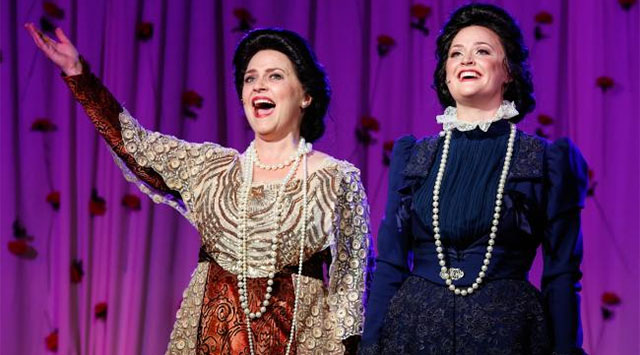
Review: Melba (Hayes Theatre)

Venue: Hayes Theatre Co (Potts Point NSW), Aug 11 – Sep 9, 2017
Book & Lyrics: Nicholas Christo
Music: Johannes Luebbers
Director: Wayne Harrison
Cast: Annie Aitken, Michael Beckley, Caitlin Berry, Andrew Cutcliffe, Blake Erickson, Genevieve Lemon, Emma Matthews, Adam Rennie, Samuel Skuthorp
Image by Clare Hawley

Theatre review
Nellie Melba was the first Australian musician to have achieved international stardom, a legendary figure whose story provides inspiration not only to artists who dream of making it big, but also for women everywhere who know how it is to be told to tame their ambitions. She became wife and mother early in life, as was de rigueur in late nineteenth century, and in the musical Melba, we see her struggle to acquire the independence necessary for professional success. A fabulous selection of classical arias are inserted into a new work of musical theatre, with book and lyrics by Nicholas Christo, and music by Johannes Luebbers.

The original material is delightful, with scandalous details in Melba’s story providing an unexpected sense of titillation to proceedings. Director Wayne Harrison keeps us invested in the show’s characters and narratives, for a production that captivates at every point. Design elements however, are generally underwhelming, with set and costumes requiring greater imagination and boldness, for a more accurate approximation of our fantasies, of the diva and her circles.

Performers Annie Aitken and Emma Matthews share the eponymous role, each bringing to the stage, their phenomenal talents and abilities. It is a strong concept, to have disparate disciplines, opera and musical theatre, represented in this quite unique format for Melba, but it is not always a seamless blend in its efforts to accommodate two physical manifestations of the same personality. Nonetheless, the magnificent quality of singing in the show is sufficient to remedy most of its shortcomings. Also noteworthy is Andrew Cutcliffe who successfully turns us against the forsaken husband Charlie. His creation of a persuasive villain for the piece, is efficacious, and impressive.

In its efforts to keep the memory of our heroine, dignified and noble, Melba can often feel compromising in how it portrays her humanity. The picture it delivers is unbelievably pristine, and the drama is subsequently more gently rendered than is perhaps desired. We need people to look up to, especially trailblazers who show us that the impossible can be done, but it is important that we understand that flaws and foibles are what we have in common, especially when the magic they possess can seem so unattainable to mere mortals.

www.hayestheatre.com.au

Review: Velvet (Roslyn Packer Theatre)

Venue: Roslyn Packer Theatre at Walsh Bay (Sydney NSW), Jul 26 – Aug 20, 2017
Director and creator: Craig Ilott
Musical director: Joe Accaria
Choreographer: Lucas Newland
Cast: Joe Accaria, Kaylah Attard, Emma Goh, Marcia Hines, Mirko Köckenberger, Rechelle Mansour, Tom Oliver, Craig Reid, Stephen Williams

Theatre review
The show begins when a young man appears on stage with luggage. Dressed as a Jehovah’s Witness, or maybe a Mormon, the wide-eyed innocent finds himself in a new city, and we imagine that he encounters disco for the first time. This would mean that the action takes place in the late 1970s, when Donna Summer and the Bee Gees ruled the charts, and in New York, the notorious night club Studio 54 was the epicentre of society and culture. Craig Ilott’s Velvet is essentially a variety show, an homage to the era of the hustle, the afro and cocaine. All is light and frothy, with the protagonist’s journey offering a vague sense of narrative, that holds everything together.

At the centre is a slew of hits, unforgettable songs that defined a generation, marvellously reassembled and executed by musical director Joe Accaria, who ensures that their sparkly appeal is always accompanied by a deep appreciation for the soul and funk roots of these dance-floor stompers. Living legend Marcia Hines plays the diva with effortless grace, trusting that her exceptional voice to take us away from daily humdrum to her realm of sequinned ethereality. Leading man Tom Oliver works harder to prove himself, in archetypal musical theatre style, energetic and earnest in his efforts to reach out to everyone in attendance. Acrobats and circus performers provide excellent spectacle and thrills, each of them accomplished and beautiful. The production relies heavily on two very versatile talents Kaylah Attard and Rechelle Mansour, to maintain its effervescence but later sections require more surprises, perhaps in the form of bigger costumes or additional dancers, to sustain our enthusiasm.

Colours of the rainbow flag make more than a few appearances. We cannot be sure if our boy comes out as gay, but he certainly does come out of his shell in the process. Disco may be about debauchery and hedonism, but we remember it also, for the liberation it inspires and represents, even today. At its best, disco is uplifting while it keeps us feeling dirty. It makes us think of sex as salvation, and creates a space where heaven and hell can meet to reveal so much that is dichotomous about being human.

www.velvettheshow.com

Review: Under The Covers (Hayes Theatre)

Venue: Hayes Theatre Co (Potts Point NSW), Jul 19 – 23, 2017
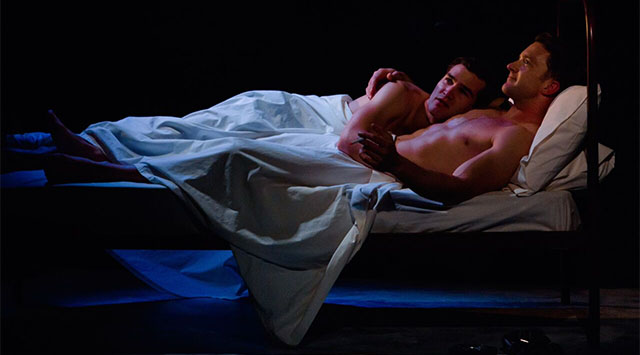
Playwright: Matthew Mitcham
Director: Nigel Turner-Carroll
Cast: Matthew Mitcham, Rhys Morgan, Matthew Ogle

Theatre review
It has been 9 years since Matthew Mitcham won a gold medal at the Olympics for his diving. At 20 years old, he was on top of the world, having the time of his life, bathed in glory. Normalcy afterwards, has been understandably challenging. Under The Covers is a cabaret presentation in which Mitcham searches for something satisfying, in his current status as a retired athlete. It is an experience we rarely encounter, a young man having to come to terms with the idea that his best days are probably over. He names his state of anxiety, “midlife crisis”, which is outlandish for a person in his twenties, but Mitcham helps us understand his emotional struggles in this earnest, if slightly clumsy, string of autobiographical disclosures.

Linking episodic thoughts and recollections, mostly presented through a monologue style, are songs that Mitcham sings, sometimes with his ukulele as accompaniment, and sometimes with a pianist and a drag performer for added interest. It is a raw performance, relying on honesty and sincerity to capture our attention. Even though he seems less seasoned than most musical theatre artists who take centre stage, there is an undeniable charm in Mitcham’s childlike innocence (he compares himself to Peter Pan), and gifted with a warm timbre that he uses remarkably well for his penchant for pop, the hour long show is ultimately an entertaining sojourn, if oddly unaffecting.

There are clear parallels between sport and art, most obvious of which is the endeavour for triumph. To strive, is to have the capacity to fail. In Under The Covers, Matthew Mitcham is humbled, brought to his knees almost, having to admit that that defining moment of heroism, has to be left behind, if the rest of his days is going to be meaningful. On this stage, we watch him shine, and witness instances of floundering, but the champion’s spirit remains intact and resolute, showing us how he cannot help but put up the best fight, no matter the circumstances.

www.underthecoverslive.com

Review: Only Heaven Knows (Luckiest Productions)

Venue: Hayes Theatre Co (Potts Point NSW), May 26 – Jul 1, 2017
Music, Book, Lyrics: Alex Harding
Director: Shaun Rennie
Cast: Mathew Backer, Blazey Best, Tim Draxl, Ben Hall, Hayden Tee
Image by Robert Catto

Theatre review
Tim and Cliff’s love story begins in 1944, probably the most dangerous of times for gay men, with many impounded in European concentration camps, and the rest of the world correspondingly paranoid and cruel in their treatment of homosexuality. Alex Harding’s Only Heaven Knows remembers queer life in mid-20th Century Sydney, and the resilient community that persisted to thrive, with a dignified integrity, in the face of unrelenting and brutal persecution.

It is the subplots that captivate. Minor characters who chronicle struggles of a traumatic past, retain their pertinence, proving themselves more resonant than a central romance that seems unremarkable by comparison. The work is flamboyantly sentimental, but is only occasional moving. We are engaged instead by its textual complexity, seduced by an opportunity to analyse its sociopolitical connotations and to examine the degrees of relevance its narratives continue to hold over our existence today.

Production design attempts to address the frequent changes of settings, but scene transitions can often lack elegance. Performers take awkwardly long walks before finding the stage. Entrances and exits notwithstanding, the show is sensitively brought together by director Shaun Rennie, with a warm sincerity that elevates a slightly dated play from 1988, to something that is strikingly urgent. The ghost of Lea Sonia, a drag queen character, has the freedom to travel through time, to make references about marriage equality, and Grindr, so that history is resurrected for good reason.

There are marked divergences in terms of singing ability, but the cast is surprisingly cohesive. In the world of musical theatre, scene-stealing show-offs are almost encouraged, so it is a rare treat to be able to adore every performer equally. Matthew Backer is impressive with the thoroughness of nuance he introduces to all his roles, and is truly unforgettable in a scene that brutally portrays the experience of electroconvulsive therapy inflicted upon “sexual deviants” of the time. Blazey Best and Hayden Tee are excellent with their comedy, both actors sharp and confident, while adhering to the subtle tones of the production. The lovebirds, played by Tim Draxl and Ben Hall, are tender and effortlessly convincing, making the most out of fairly colourless material.

It is important that young ones know our queer histories, and it is important that love stories are made for people who identify differently from the mainstream. In 1944, queer folk had few past lessons to draw upon, and nothing in the future that they could look forward to. Only Heaven Knows allows us to grow with the knowledge that people had been through worse, but things keep getting better. It also serves as reminder the depth of depravity that societies are capable of, and that a sense of moral vigilance must never be taken lightly. The game of endless persecution may shift its focus away from one community to another, but those who had suffered must not be complacent in their newfound emancipation, but continue with a resistance against senseless violence and oppression.

www.hayestheatre.com.au

Review: Mr Burns (Belvoir St Theatre)

Venue: Belvoir St Theatre (Surry Hills NSW), May 19 – Jun 25, 2017
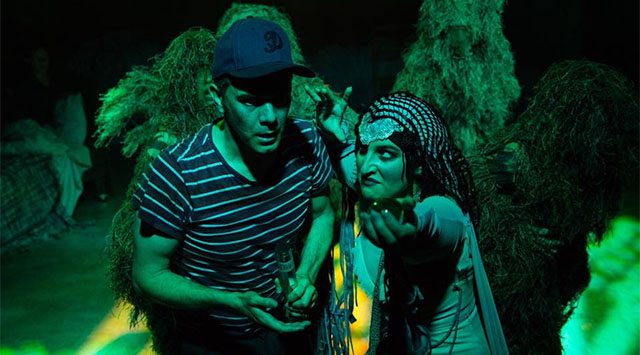
Playwright: Anne Washburn
Music: Michael Friedman
Lyrics: Anne Washburn
Director: Imara Savage
Cast: Paula Arundell, Mitchell Butel, Esther Hannaford, Jude Henshall, Brent Hill, Ezra Juanta, Jacqy Phillips
Image by Brett Boardman

Theatre review
There are three distinct acts in Mr Burns: A Post-Electric Play. First, we discover that the world has gone to hell in a handbasket; it is the apocalypse, and we have run out of electricity. A small group of survivors huddle together, trying to keep themselves sane by retelling episodes of The Simpsons. They each contribute fragments, but memory, like all human ability, proves to be considerably less than infallible.

Over the next decades, this compulsion to hark back to when things were better, grows in magnitude. The act of storytelling becomes grander, so do the increasingly fabricated remembrances of how things had been, back in the day. Eventually, we see that The Simpsons is turned into a kind of origin story that no longer accurately recreates the real thing.

Anne Washburn’s play is wildly imagined, but not always successful in its ability to aid our suspension of disbelief, as is necessary for all styles of science fiction. At each step of the narrative, we are bothered by questions left unanswered, that create an expanding sense of implausibility to the narrative. It is appropriate then, that the show turns progressively extravagant, until in Act Three, where we are presented with something that looks no different from standard Broadway musical fare.

The production begins dour, perhaps understandably so, but its long and enduring dullness marks a disappointing start for a crowd that has clearly amassed for that very particular Simpsons sense of humour. Satisfaction eventually arrives with Act Two, as the tone turns quirky and playful, and stimulating philosophy is introduced to its existentialist explorations.

The first musical number appears, quite unexpectedly, weaving American pop references into a kind of campy postmodern mash-up, to excellent effect. We see the characters desperately trying to hold on to all things bright and shiny from the past, much like the conservatives in our real life, unable to come to terms with their new circumstances. Entertainment continues to be dispensed henceforth, but we discover that the show had reached its peaked too soon. It all comes to a somewhat underwhelming conclusion.

It is a proficiently designed production. Mr Burns’ black sequinned catsuit by Jonathon Oxlade is very fabulous indeed, an unforgettable vision for the theatrical annals. Oxlade’s sets are appropriate to each sequence, but the show offers only a few surprises with its imagery, presumably restrained by its context of resource depletion.

Mitchell Butel leads an endearing cast of enthusiastic and colourful performers. As Mr Burns, Butel’s gangly limbs attempt to steal the show with their incredible animated dexterity, but the actor’s comedic capacities are impressive, and a real asset to this tenaciously serious creation.

It really is no joke, that we refuse to adequately address our energy crisis. Those with a stake in industries that are bringing devastation to the environment, like the villainous Mr Burns, continue to be allowed to plunder and destroy. We have to keep optimistic in order to be of any effect as opposition to their corruption, but the prevailing state of confused democracy seems to be getting us nowhere. Knowing right from wrong, is no longer sufficient in mobilising power and generating action, in our current climate of fake news, alternative facts, and insatiable greed. If history teaches us anything, it is revolution that will shift paradigm, but there is no hint even of burgeoning insurgency, in this age of despondent complacency.

www.belvoir.com.au

Review: Big Fish (RPG Productions)

Venue: Hayes Theatre Co (Potts Point NSW), Apr 18 – May 14, 2017
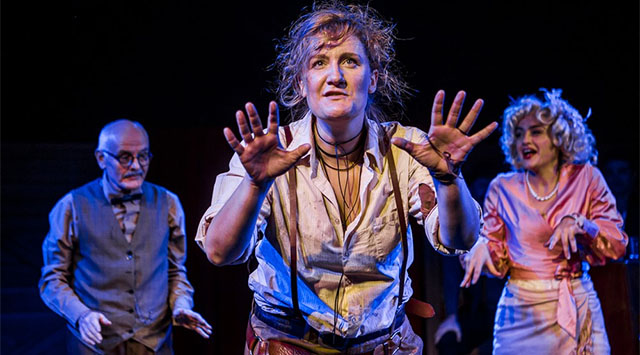
Book: John August (based on the novel by Daniel Wallace and the screenplay by John August)
Music & Lyrics: Andrew Lippa
Director: Tyran Parke
Choreographer: Cameron Mitchell
Cast: Kirby Burgess, Seth Drury, Joel Granger, Brendan Godwin, Zoe Ioannou, Brenden Lovett, Phillip Lowe, Alessandra Merlo, Adam Rennie, Katrina Retallick, Brittanie Shipway, Aaron Tsindos, Zachary Webster
Image by Kate Williams

Theatre review
Edward Bloom spins yarns that only he can believe. He deals with reality using outrageous embellishment, but these tall tales have alienated his son Will, who struggles to connect with the man behind the illusions. Big Fish is about life and death, love and family, all the emotional stuff that make musicals work. A formula exists because it is effective, and here, we see all the obvious manipulations that get us to a predictable sentimental peak, yet we cannot help getting ourselves entangled in all of the Bloom family’s drama.

Dubbed the “12 Chairs Version”, this rendition may be streamlined, but director Tyran Parke brings a richness to the staging, with simple but exciting visuals that live up, surprisingly, to the story’s imaginative landscapes. The cast is buoyant and bubbly, determined to entertain. Leading man Phillip Lowe is fabulously charming, but problems with a throat infection seriously impair his ability to deliver the show’s many very grand showtunes. Instead, on hand to offer vocal magic is Adam Rennie in the role of Will, who is nothing less than sensational when the songs get chipper and stirring.

Women characters in Big Fish are often pathetically conceived, but the players do their best to bring life to their parts. Katrina Retallick takes the role of an embarrassingly docile mother, and turns her into a memorable figure; warm, generous and full of spirit. Her delivery of the heartbreaking “I Don’t Need A Roof” is a highlight, with Retallick’s performing talent proving to be the most captivating feature of the production. Also delightful is Brenden Lovett, simultaneously grotesque and adorable as circus ringmaster Calloway. The most over-the-top of Edward’s fantasies is also one of the most moving, when given the Lovett treatment.

We all know that our lives are finite, but we rarely think about how our deaths affect the way we live. We go about our daily business as though there is always tomorrow to worry about, but the unassailable truth is that death will come too soon. Edward was offered, as a child, a glimpse of his final moments, and what he saw was joyful. If we can all believe that what we eventually leave behind is going to be good, then our experience of today, must surely be replete with contentment.

www.bigfishaustralia.com.au

Review: Calamity Jane (One Eyed Man Productions)

Venue: Hayes Theatre Co (Potts Point NSW), Mar 8 – Apr 1, 2017
Book: Ronald Hanmer, Phil Park (from the play by Charles K. Freeman, and film by James O’Hanlon)
Lyrics: Paul Francis Webster
Music: Sammy Fain
Director: Richard Carroll
Choreographer: Cameron Mitchell
Cast: Laura Bunting, Virginia Gay, Anthony Gooley, Sheridan Harbridge, Rob Johnson, Matthew Pearce, Tony Taylor, Nigel Ubrihien
Image by John McRae

Theatre review
It is the story of a frontierswoman from American history, a tomboy type with a big heart and very tall tales. A neglected musical from mid-20th century, Calamity Jane is probably best remembered as a film starring Doris Day in 1953. No surprises then, that the writing is squeaky clean, conforming completely to the ideology of the McCarthy era, when the USA convulsed at its height of moral panic.

Director Richard Carroll’s version aims to subvert the obvious camouflages at work in the original, especially in terms of its delusory representations of gender and sexuality. Archaic notions of how a woman should dress, and how her libido should manifest, are confronted head on, in this uproarious and very likeable comedy about a woman in charge. This iteration of Calamity Jane does not obliterate the existence of patriarchal oppression, but it foregrounds our heroine’s resistance, culminating in the spectacular exposure of her homosexual impulses in the number A Woman’s Touch. Originally conceived to inflict upon her, the sacrosanctity of housework, Calamity takes the opportunity here to find redress and expression instead, for the lustful desires she feels for another woman.

Virginia Gay is irresistible in the title role, charismatic, supremely confident, and hilarious. Her singing alternates between musical theatre, country and jazz, bringing a surprising quality of rejuvenation to the show tunes. Although not all performers are equally suited to their parts, it is overall an effective cast, with Sheridan Harbridge and Tony Taylor particularly delightful, and very gleeful, as residents of the Golden Garter. The majority of instrumental accompaniment is provided by lone pianist, and musical director Nigel Ubrihien, who brings tremendous atmosphere and excellent character to the staging.

The production succeeds in its efforts at sending itself up, and in the process, confronts the subjugation of femininity in traditional forms of storytelling. There is a sense however, of the show losing steam, as it progresses into a more sentimental second act. Its actors remain strong and convicted, but the audience needs greater convincing to adapt to the significant change of mood, and its subtle shift in meanings. We stay loyal to the riotous nature of Act 1 because it strikes a chord. It is a time for wild women and unruly behaviour, and now is when we fall in love with Calamity Jane.

www.hayestheatre.com.au

Review: Ladies In Black (Sydney Lyric Theatre / Queensland Theatre)

ladiesinblackVenue: Sydney Lyric Theatre (Sydney NSW), Jan 3 – 22, 2017
Book: Carolyn Burns
Music & Lyrics: Tim Finn (based on Madeleine St John’s novel, “The Women In Black”)
Director: Simon Phillips
Cast: Kate Cole, Carita Farrer, Bobby Fox, Natalie Gamsu, Madeleine Jones, Kathryn McIntyre, Sarah Morrison, Ellen Simpson, Greg Stone, Trisha Noble
Image by Lisa Tomasetti

Theatre review
There is no question that the world needs more stories about women and our solidarity. Examples of how we tear each other down are aplenty, but the ways we offer love and support need to be better envisioned in art and in life, so that we may begin to subvert systems of patriarchy that rely on our disunity to thrive.

Ladies In Black features a group of “shop girls” at a Sydney department store in the 50’s, each of them consummate professionals, all of whom get on remarkably well. There however, is little else to enjoy about the musical. Thoroughly lacklustre, unable to deliver the exuberance and glamour it wishes for its characters to portray. Its humour is underwhelming, with narratives that fail to resonate, and even though Tim Finn’s songwriting could be admired for its slightly unconventional take on the musical theatre format, much of it is uninspiring and forgettable.

For a show that makes fashion one of its central interests, the production is designed with little imagination or innovation. Choreography never offers anything more than the bog-standard, and the cast rarely looks to be challenged or excited by what they have to present. Occasional appearances by Natalie Gamsu, Greg Stone and Bobby Fox as “continental migrants” introduce moments of exhilaration, but they are few and far between.

Young Lisa confronts parochial Australia in Ladies In Black. She is at a crossroads, encountering choices that stoke her passions, versus others that feel easy and normal. We observe a blandness that can take hold, and ways of living that can pale our existences into insignificance. The women go to work everyday, and in their camaraderie, attempt to find deeper meanings to their existences, but the struggle to prevent their black clothed power from fading into a repugnant beige is ever-present, and often defeated.

wwww.queenslandtheatre.com.au

Review: Bare (The Depot Theatre)

supplyevolutionVenue: The Depot Theatre (Marrickville NSW), Nov 30 – Dec 17, 2016
Book: Jon Hartmere, Damon Intrabartolo
Lyrics: Jon Hartmere
Music: Damon Intrabartolo
Director/Choreographer: Hannah Barn
Cast: Aaron Robuck, Sophie Perkins, Alex Jeans, Natalie Abbott, Timothy Langan, Teale Howie, Alexandra Lewtas, Caroline Oayda, Matt Laird, Stephanie McKenna, Ibrahim Matar, Tara Hanrahan, Annette Vitetta, Penny Larkins, Gavin Leahy

Theatre review
The musical is set in a Catholic high school. Peter and Jason are secret lovers struggling to come to terms with their gay relationship and the identity markers that will inevitably become a matter of controversy given the social context. It is an age-old story, but one that bears repeating. Our religious institutions remain unkind to those who do not conform to their narrow definition of acceptable sexual behaviour, and Bare‘s response is still important, even if its story offers little that would be refreshing for the twenty-first century.

Hannah Barn’s direction of the piece pays strong attention to the show’s emotive qualities. Every melodramatic flourish is amplified to passionately drive its point, and to captivate. The more humorous portions of the musical seem to be neglected, which results in a production that can feel slightly unvarying and predictable, but there is plenty of dynamism to be found in the music. Musical director Matthew Reid does wonders with his 8-piece band, providing injections of energy whenever required, and calibrating atmosphere with remarkable sensitivity throughout, but sound design, especially in the first half, needs to be refined.

It is a very committed cast of performers that take to the stage. Alex Jeans and Aaron Robuck play their leading parts with integrity, and even though their interpretations of characters can feel somewhat one-dimensional, both young men tell their stories with impressive enthusiasm. Along with Jeans and Robuck, accomplished singing by Natalie Abbott and Penny Larkins give the production a surprising polish that reflects a good level of professionalism and admirable devotion to the time-honoured craft of musical theatre.

Bare is yet another work that documents the struggle of gay men in a society that refuses to accept them as equals. We have heard it all before, but we must not stop telling these tales of oppression as long as the cruelty persists. For some of us, progressive political movements have brought us better lives, but for many others, the chains of injustice are a daily reality. We might like to think of ourselves as first world civilisations, but if we have children living in fear and in some tragic cases, taking their lives, our complacency has to take responsibility.

www.thedepottheatre.com

Review: Mack & Mabel (Working Management)

workingmanagementVenue: Hayes Theatre Co (Potts Point NSW), Nov 18 – Dec 18, 2016
Book: Michael Stewart (based on an idea by Leonard Speigelgass)
Music: Jerry Herman
Director: Trevor Ashley
Choreographer: Cameron Mitchell
Cast: Angelique Cassimatis, Shay Debney, Adam Di Martino, Sally Hare, Scott Irwin, Caroline Kaspar, Shaun Rennie, Kuki Tipoki, Stephen Valeri, Jessica Voivenel, Zachary Webster, Mikayla Williams, Deone Zanotto
Image by Lightbox Photography

Theatre review
Set against a backdrop of early Hollywood, Mack & Mabel is about a love that never happened, a romantic tale that is more “coulda woulda shoulda” than happily ever after. Created in 1974, the musical is in essence a damsel in distress story, where the girl is not strong enough to get what she wants, and in this case, the guy never quite gets his act together to rescue her. The songs are fun and perky, but mostly unmemorable. Every imaginable cliché of the genre is enlisted for a show that works hard to entertain, and although it is never able to surprise, the experience it delivers is nonetheless an enjoyable one.

Directed by Trevor Ashley, with choreography by Cameron Mitchell, the show is highly animated, and relentless with its pizzazz. Every song is staged with great detail and deliberation, but while there is no shortage of energy and action, its comedy is not always effective, and its pathos is insufficiently potent. It is a diverse cast with varying levels of competencies, but their conviction keeps us attentive to every sequence being presented. Leading lady Angelique Cassimatis charms us with indefatigable flamboyance, and her male counterpart Scott Irwin provides grounding with a melancholic sincerity. Deone Zanotto is outstanding as Lottie, a secondary character called upon to bring all the bells and whistles needed to spice things up. Zanotto’s physical discipline and vocal agility are a joy to witness. Also noteworthy is Neil McLean’s sound design achieving excellent dynamism and clarity with how we hear music, lyrics and dialogue in the production.

There is little in Mack & Mabel that we can relate to, but it is a good excuse for some exhilarating song and dance. There is a frustration in seeing Mabel’s life presented as a failure due to her fruitless dedication to Mack. What might have been a kind of beautiful resignation and saccharine sentimentality in the past, is now just far-fetched, and tedious, whether or not one reads the musical from a consciously feminist perspective. The drama relies on our submission to its dated sensibilities about romance, and thankfully, many of us have progressed far beyond that.

www.hayestheatre.com.au