Review: The Bleeding Tree (Wharf 1 Theatre)

Venue: Wharf 1 Sydney Theatre Company (Walsh Bay NSW), Mar 9 – Apr 8, 2017
Playwright: Angus Cerini
Director: Lee Lewis
Cast: Paula Arundell, Airlie Dodds, Shari Sebbens
Image by Brett Boardman

Theatre review
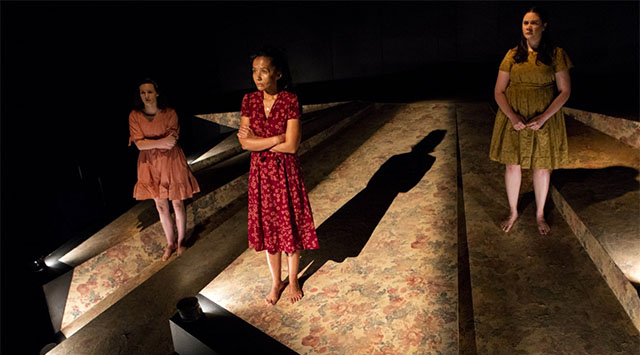
A man has been killed by his wife and two daughters, shot deliberately in cold blood and left to die. It is rural Australia, so there is no hiding the disappearance of a person, or the circumstances surrounding the savage incident. Angus Cerini’s The Bleeding Tree confronts the rules of society, exposing the inadequacies of how we live as communities and how we forsake the weak. The dead man had been violently abusive, but the women in his home were never offered sufficient help to escape his brutality. As neighbours begin to discover their actions, we are surprised to see their acceptance of the episode.

Cerini’s writing is dangerous, deep and devastatingly beautiful. It operates at the precipice of morality, for a play that uses the audience’s imagination and reasoning, to deliver remarkable thrills, on levels that are emotional as well as intellectual. It is a story that rarely gets told. Family violence is commonplace, and is slowly being removed from secrecy, but we are are still learning how to talk about it. The Bleeding Tree is a new kind of parable that admonishes the guilty so that repugnant behaviour is seen unequivocally as such. The death of the patriarch does not occur in grey areas, and we are challenged to look at the remains of the monster and consider what is right and wrong, in a reality that does not allow time to be reversed. We do not exist in coulda, shoulda, woulda, and in The Bleeding Tree, we cannot have our cake and eat it too, if justice is to be served.

It is an extraordinarily sophisticated production, directed by Lee Lewis whose take on the Australian Gothic is as refreshing as it is visceral. Exquisitely designed to transport us to its nightmarish parabolic outback, the theatrical space is consummately considered. Renée Mulder’s set, Verity Hampson’s lights and Steve Toulmin’s music, all conspire to bring us into their psychological wilderness, where good and bad have swapped places, and we must shift our beliefs accordingly. The trio of actors deliver an astonishing performance, with a cohesion in energy, style and objective, giving polish and confidence to a production that delivers gripping drama and convincing proclamations. Paula Arundell is exceptional as Mother, with a complexity in her presence that conveys both vulnerability and strength, helping us understand the precariousness, along with the inevitability of what happens. It is a quiet approach, but the power that we connect with is fabulously palpable.

Women are often trapped in systems that fail us, and we are taught to tolerate the denial of what should only be just and fair. The women in The Bleeding Tree were caught within a familial patriarchy, as well as a greater social one, that required of them their prolonged and painful subservience. When it eventually became clear that sitting around and waiting for situations to improve was a fruitless exercise, they found the only way out was to take radical action. Every day everywhere, people are kept down by power structures that benefit from their oppression, but when those at the bottom realise the truth of their condition, their compliance will be seen in a new light, and change can begin to take place.

www.griffintheatre.com.auwww.sydneytheatre.com.au

5 Questions with Declan Greene

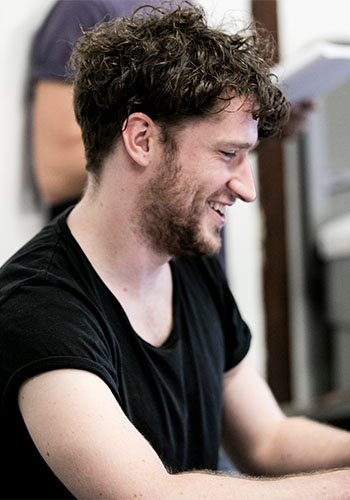
Declan Greene

I’ve admired Declan Greene’s writing for a while now. A distinctive sense of irreverence and adventure means that his shows are always unsettling, unpredictable and brilliantly controversial. Greene’s modernly queer perspective of our world generates a kind of outsider art that speaks to anyone who feels a little bit excluded, and I would suggest that that is all of us. For this special edition of 5 Questions, I attempt to find out how he ticks.

Suzy Wrong: I’d like to ask your age to put some context around your experience of growing up within a particular point of gay activism history, but don’t answer if you don’t wish to, ‘cos I sure as hell ain’t telling anyone my age.
I’m 32, and I grew up in rural Victoria with a lot of deep set homophobia at school, which I really internalised. Like, I was very visible screaming queen, so was called a fag a lot – and then I turned mean and vicious and started calling other kids fags – anyone who was smaller or weaker than me… So… Yeah. After high school I still really wrestled with identifying as ‘gay’ for a long time – even after I started sleeping with men – because I still thought gay culture was lame and embarrassing, all just Priscilla and Queer As Folk and fake tanner etc. Meeting Ash Flanders when I was twenty sort of changed my life, because he really showed me that being gay was this very customisable sort of thing – I could love punk and DIY and drag queens and super camp divas all at the same time, and actually there was a subset of queer culture that cherished all that dirty, faggy shit. That’s where my political identity was sort of formed.

Do you often use the terms “gay” and “queer” (or others) to describe yourself? Do they point to different parts of you, and how you relate to the world?
I have definitely used the term ‘queer’ to describe myself, but I’m becoming increasingly uncomfortable with it. I guess to me ‘queer’ is sort of like ‘punk’ – it’s not a fixed category, it’s a type of resistance. It exists in a state of constant flux, in opposition to whatever bad stuff is happening in the mainstream at the time. What’s queer now isn’t what was queer five years ago. And at the moment I feel like to be queer means to demolish binary thinking, and to embody fluidity, intersection, and inbetween-ness as a form of resistance. All of which I really believe in, politically speaking, but it doesn’t describe me socially… I sleep with men exclusively, and my gender is cis male… so maybe in 2017 I’m too binary to be queer? I don’t know. I guess I could say that I’m politically queer and socially gay – but I also probably wouldn’t say that, because the amount of energy consumed in that sort of elaborate navel-gazing self-identification makes me really anxious sometimes, in an era of Trump and Le Pen and Pauline Hanson!

Do you think all that insight and self-understanding is central to the purpose of your practise? What would you say the nature of your art is?
I tend to interrogate my position in relation to my subject matter quite a lot, because I’m often drawn to stories that centre on some kind of social oppression, but I exist in a space of relative privilege – as a white cis guy with a decent quality of life… so I always want to make sure that my interest in this material isn’t patronising or paternalistic or blah-blah-blah. It’s funny: I was brought up Catholic and sometimes I think that influences my work more than I’m conscious of… like, this deep sense of guilt about the stuff I’ve been lucky about. My only big struggles have been with my sexuality and money/class, so maybe my practice is about atoning for that on some level…? I don’t know, it’s complex too, because the artists and thinkers I admire are people like Jean Genet and John Waters and Joan Rivers and Camille Paglia and Nina Simone: genuine iconoclasts, who never gave a fuck what people thought of them, who never felt guilty or apologetic or beholden to the opinions of others. So that’s the push and pull in my art always: like, trying to muster up the bravery to say what I really think or feel, while trying to minimise harm to people who might be more vulnerable than me.

How do you imagine your audience? What do they look like in your ahead? Do you write for a particular type of person?
I try not to imagine the audience as one big organism, because it’s obviously full of many varied people, all coming at the work from an incredible diversity of perspectives and lived experiences. With something like The Homosexuals, Or Faggots, which is located in a very specific part of the LGBTIQA+, there’s always the temptation to take shortcuts and assume that the audience will have a common understanding of the political terrain you’re addressing – but I always try to imagine the audience is coming to these issues totally fresh, and write a fair bit of context into the play.

Are you consciously political or subversive in your process? I suppose I’m asking, if it all needs to make a point? Is it a burden?
The politics in my shows are definitely conscious, but it’s not really a burden to include them because in a lot of ways they’re actually my starting point. There has to be some sort of formal challenge, plus a line of political enquiry I’ve got a burning desire to follow – something big and furious enough that it that can sustain me over the year or more it takes to conceive and write and redraft a new play. With The Homosexuals, Or Faggots I’d had this idea in the back of my mind for a long time that I’d like to try writing a farce, but I didn’t really know why yet – there was no impetus to begin. Then I read a weird semi-mocking article about a Caitlyn Jenner Halloween costume on a big gay news website – like Gaily Grind or something – which threw up a bunch of questions for me about privilege, freedom of speech, political correctness, allyship, and the responsibilities white gay cis men have to the wider LGBTIQA+ community. And the two notions just sort of clicked together: a farce set in the world of queer identity politics.

The Sydney season of Declan Greene’s The Homosexuals, Or Faggots, is presented by Griffin Theatre Co.
Dates: 17 March – 29 April, 2017
Venue: SBW Stables Theatre

Review: A Strategic Plan (Griffin Theatre Company)

griffinVenue: SBW Stables Theatre (Kings Cross NSW), Jan 27 – Mar 11, 2017
Playwright: Ross Mueller
Director: Chris Mead
Cast: Briallen Clark, Matt Day, Justin Smith, Emele Ugavule
Image by Brett Boardman

Theatre review
Andrew works at a nonprofit organisation that brings new music to the young. On the surface are noble intentions, but bureaucracy and ulterior motives threaten its existence every day. Andrew finds himself in a sink or swim position, trying to protect his job, along with his sanity. Ross Mueller’s A Strategic Plan is an angry play for our angry times, a diatribe that pits integrity against exploitation, art against money, with little nuance in between.

Its characters are familiar well-worn stereotypes, some with a heart of gold, and others simply despicable. We never warm up to any of them or to their stories, but the actors who play these roles are certainly dedicated. There is a lot of screaming and shouting, presumably to stop our attention straying away from the predictable and lacklustre plot. Justin Smith and Matt Day play their parts with a lot of conviction, and not much else, as the writing provides little that would allow their personalities any complexity. There is a good level of professionalism in all production aspects, that keeps us sticking around until the end, but the resulting aftertaste is regrettably bland.

There is much to hate in how our corporations operate, and in government bodies that disappoint us repeatedly. It is admirable that A Strategic Plan looks into these failings, but it has a hard time getting us to share in its anger. Malfeasance and injustice occur often, and we have become increasingly disillusioned. We should expect more of community, but the state of the world overwhelms us with all its deficiencies, and to resist a descent into bitter apathy is a challenge we have to face.

www.griffintheatre.com.au

5 Questions with Briallen Clarke and Emele Ugavule

Briallen Clarke

Briallen Clarke

Emele Ugavule: Australia has seen four Prime Ministers in five years, resulting in our biggest arts funding institution, the Australian Council, being ripped apart & diminished to a shadow of its former self. Forcing a number of respected performing arts hubs to shut down. What do you think the role of Australian arts practitioners are in times of political trauma?
Briallen Clarke: What I love about being an artist is that work we create can be anything we want it to be. It can escape from reality, it can be a chronicle of the times, it can be accessible, it can be challenging, it can feed our culture, it can be a catalyst for change, it can be beautiful, it can reflect nature, it can soothe the soul. The role of an arts practitioners is to strive to make work that does one, several or all of these things. What is difficult in times like these, is how we can find ways continue to do this. Whether we create art to make a statement, as a form of therapy or as an emotional release, we must continue to do it. Artists by nature in this country are dogged in their resourcefulness and creativity. Never has it been more important to be keep going because if we stop making art, they win. Our role is to keep making art no matter what.

How important is relativity in a play? Do you think that the script & its delivery must attempt to resonate with its audience’s contemporary experiences or that no matter what, people will always find a way to relate to a story in their own way?
I do believe that plays resonate with people no matter what the subject matter or central issues are that are explored. Even if all it does is stimulate discussions about how outdated the views presented are, or how unrelatable it is to a contemporary audience, it is still serving to encourage audiences to reflect on their own lives and belief systems, which is valid. Of course there isa certain potency that comes with seeing a play which directly reflects events or themes as as they are being experienced, it is engaging and thrilling. However, I don’t believe that a play loses purpose or importance as the world changes, the function it serves and the impact it has just evolves.

Why and how is A Strategic Plan relevant?
I think that is for the audience to discover and decide.

Your comedic style is very unique and magnetic. What/who have you drawn inspiration from to create Linda?
Aren’t you kind?? Linda is definitely an amalgamation of a few people I have encountered in my life. She exists in a world that is so different from my own so I did a lot of looking out to initially create this character. The more I have come to know her though, there are aspects of her personality that I can relate to for sure. The world of this play gives license to making things slightly more heightened too so it has been interesting to decide on which parts of her personality to dial up, and at what points in the story.

Can you share a moment from your process whilst working on A Strategic Plan that you loved?
Something that I have loved and that has been such joy is how much we have laughed, like really hard belly laughing. Company fits of unable to breathe, bent over, tears streaming down face type of laughter. Any actor will tell you though that this kind of laughter exists in equal parts joy and torture so it has been an aspect of the process I have both loved and struggled with (see I’m even laughing now at the thought of it!).
Emele Ugavule

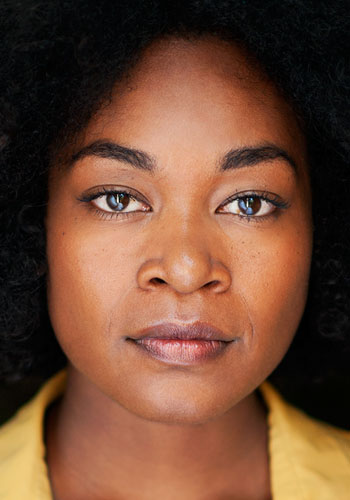
Emele Ugavule

Briallen Clarke: What do you think is the best thing about being an actor?
Emele Ugavule: Oooooo. Tough. Nice. To be honest this job is incredibly rewarding in many ways, but the one thing that I think I find the most rewarding is that it allows me the privilege of being a storyteller. I come from a culture where storytelling is how we pass on our legacy, our history, our traditions. Being an actor allows me to do the same but as a vessel for other people’s stories instead of my own – so it teaches me to look at people whose lives I would otherwise never encounter, with compassion and to tell their stories with empathy yet objectivity.

You love to travel. Which destination is next on your list?
The Pacific! Particularly, Melanesia. Specifically – Vanuatu!! I need to invest more in where I’m from and I’m very passionate about Pacific visibility and stories – and Melanesia is the key to Pacific identity. I’m half Tokelauan (Polynesia) and Fijian (Melanesia) and almost all the stories of the Pacific that we see today in mainstream media (including Moana) focus on Polynesia. Melanesia is a cultural mine. It was the first part of the Pacific to be settled and yet remains one of the last cultural & linguistic mysteries to the world so I’m incredibly drawn to it.

You’re a gifted musician and lover of music. Has that been useful in your creation of Jill for A Strategic Plan?
Oh you’re so kind! I mean totally. My life is pretty much musicians these days. All my mates are musicians, my partner is a musician. So it’s a world I’m very much invested in and have spent the last few years learning to create a strong dialogue within. Music has always played a huge role in my life – it’s actually the reason I got into acting, long story bla bla, so it’s been lovely to be able to engage with my friends in conversation surrounding their world to authentically tell their story through my world.

What artists have you had the pleasure of working with that you have found particularly inspiring?
Ohhhhhhhhhhhhhhhhhhhh man! Brag town. All my mates to be honest! Ngaiire, Wallace, New Venusians, Broken Mountain to name a few. Sydney has such an incredible hub of musicians & vocalists that it doesn’t get enough credit for!! All the people I’ve worked with have either been my mates first or have become my mates as a result of us working together and they all inspire me in different ways whether it’s Ngaiire’s incomparable stage presence & vocal agility, Wallace’s flawless dance moves & lyrical flow, the 7 piece band magnetic sound & dance inducing vibes of the New Venusians, or Broken Mountain’s nostalgically poignant yet sharp drops – all of them work so very hard at their craft and care so very much about the people they work with and I find that kind of work ethic inspiring.

Any artists at the top of your wish list to work with?
Oh. Uh. I’ve never really thought about this. I just love working with musicians and have been lucky enough to be asked to work on projects with artists who I find incredibly cool and interesting. I think 2016 really presented a new shift in sound and visual aesthetic for the pop music world as a response to the political climate in America, which brought artists such as Solange, Beyonce, Alicia Keys, Common & Frank Ocean to the fore front of the GP’s consciousness. I tend to fall ‘out of love’ with artists just as quickly as I ‘fell in love’ – because should I ever meet them I don’t want to have this ‘You’re out of my league’ complex, we’re all humans and just because your career makes you more visible than me, it doesn’t make you any better than me – so there’s a lot of artists whose work I love and respect that challenges me and my work intellectually and emotionally but no one that I’m drawn to in a way that makes me think ‘I want to work with that person!’. I’ll just keep doing my own thing and if someone wants to work with me, that’s cool. If not, that’s cool too.

Briallen Clarke and Emele Ugavule can be seen in A Strategic Plan by Ross Mueller.
Dates: 27 Jan – 11 Mar, 2017
Venue: SBW Stables Theatre
Review: Nosferatutu… Or Bleeding At The Ballet (Griffin Theatre Company)

griffinVenue: SBW Stables Theatre (Kings Cross NSW), Jan 7 – 21, 2017
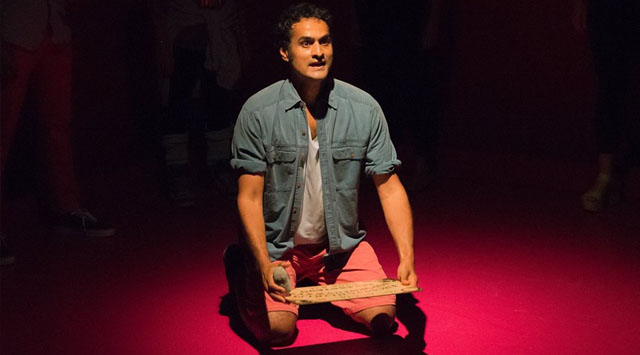
Playwrights: Tommy Bradson
Director: Sheridan Harbridge
Cast: Tommy Bradson, Sheridan Harbridge, Brandyn Kaczmarczyk
Musicians: Steven Kreamer, Sally Schinckel-Brown, Olga Solar
Image by Lucy Parakhina

Theatre review
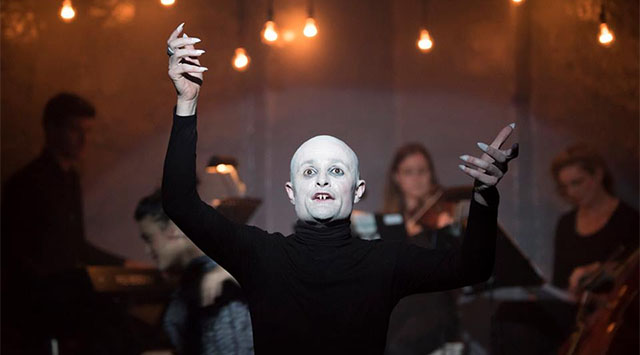
We find ourselves at a ballet performance, but a vampire hijacks the proceedings. What he offers is something entirely different from the Swan Lake that had been intended, but is no less beautiful and captivating. Tommy Bradson’s Nosferatutu… Or Bleeding At The Ballet is a tale of jealousy and unrealised ambition. It is about the manifestation of envy as a destructive force, alongside a subversive creativity that can result from the darkness of life as a struggling artist.

On stage, Bradson is an enchanting performer, a Frankenstein monster assembled from our memories of Rowan Atkinson and Marc Almond at their respective best. He wields a kind of magic that is bizarre and confusing, but mostly, it is transportative, taking us effortlessly away to, well, anywhere else but here. Bradson is no ballerina, but every gesture is seductive and powerful. His eyes are mesmerising, full of intense but unresolved emotion, and his voice, a stunning cacophony made of wild imagination and an unbridled passion for high drama.

Direction by Sheridan Harbridge is spirited and adventurous, charming in its embrace of a kind of theatrical madness that the protagonist inspires. The incorporation of live music, headed by Steven Kreamer, is highly effective, with a surprising sophistication in what it allows the production to convey. Also noteworthy are Alex Berlage’s lights and Ashisha Cunningham’s set, both impressive in their interpretation of space for this quirky but bold experiment of non-narrative storytelling.

When Nosferatutu attacks and murders his nemesis, the blood that splatters is a celebration of the avant-garde, and an expression of the innovation that all art requires. It is a messy affair, but anarchy is never convenient, and disruption is always necessary for greater meanings to be unearthed.

www.griffintheatre.com.au

Review: Lighten Up (Griffin Theatre Company)

griffinVenue: SBW Stables Theatre (Kings Cross NSW), Dec 2 – 17, 2016
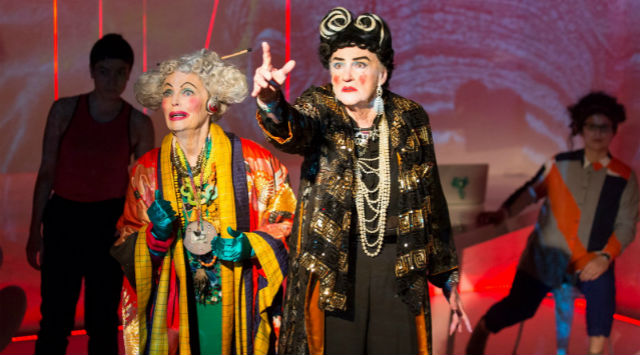
Playwrights: Nicholas Brown, Sam McCool
Director: Shane Anthony
Cast: Katie Beckett, Nicholas Brown, Vivienne Garrett, Julie Goss, Sam McCool, Bishanyia Vincent
Image by AH Imagery

Theatre review
John thinks that he is white, but people keep telling him that he looks Indian. In his efforts to make his appearance fit his sense of self-identity, he scrubs his skin with pumice stone, and owns a collection of contact lenses in green and blue. To make things even more problematic, John is an actor, whose looks are his meal ticket, but also a constant source of judgement and frustration to be endured virtually every day. Nicholas Brown and Sam McCool’s Lighten Up is about racism, that complex and fraught topic of discussion Australians love to fight over. We never seem to be able to agree on what it means to be racist, and every individual’s unwillingness to own up to their prejudices means that we are rarely able to get to the truths of the matter. Often, the best we can do is agree to disagree, which unfortunately fixes none of our problems.

Brown and McCool’s play however, is brutally honest in its social commentary. There are no surprises in its depiction of our culture of colonialism, but what it says about ethnic minorities helping to perpetuate our own subjugation is fascinating. The issues it raises are clearly concerning, but the show is a funny one, often uproariously so. The playwrights’ acerbic wit gives Lighten Up an edginess that is as startling as it is entertaining, and even though several of its plot devices are slightly dubious, the show’s power is undeniable. Its politics may not be everybody’s cup of tea, but its refreshing approach makes for exciting theatre that will amuse any audience type.

As director and dramaturg, Shane Anthony brings excellent illumination to the play’s important nuances. His show is bright and bubbly, but always determined to make its point. In its tenacious effort to drive home its message, the staging can sometimes feel less than elegant, with awkward transitions in terms of mood and character dynamics, but its overall effect is very rewarding indeed.

The cast is wonderfully accomplished, and tremendously likeable, with writer Brown taking on the lead role and inhabiting perfectly the essence of John and his story, proving himself to be a precise and dynamic performer who communicates with surprising depth and impressive charm. Similarly compelling is supporting player Julie Goss, memorable for an alluring exuberance that fluctuates playfully, and provocatively, between sincerity and sarcasm. Bishanyia Vincent is an outrageous presence whose every entrance is greeted with sparkling laughter. Her ability to find comedy in every line is a major contribution to the show’s deceptive but pertinent congeniality.

The worst people in Lighten Up are the ones who hate themselves the most. We often explain racism to be a hatred of others, but in the play, it is clear that that compulsion arises first for the self. When we are unable to accept perceived flaws or weaknesses in ourselves, we often turn that disdain outwards, scapegoating convenient targets to manufacture a kind of psychological and emotional balance. When the world tells us that we are not enough, it is easy to use that same barometer to chastise others. Compassion is our hope to better communities, but it needs to begin with a greater internal kindness. Love can only be true, if the one who gives it knows it well.

www.griffintheatre.com.au

Review: The Turquoise Elephant (Griffin Theatre Company)

griffinVenue: SBW Stables Theatre (Kings Cross NSW), Oct 14 – Nov 26, 2016
Playwright: Stephen Carleton
Director: Gale Edwards
Cast: Catherine Davies, Maggie Dence, Julian Garner, Belinda Giblin, iOTA (pre-recorded), Olivia Rose
Image by Brett Boardman

Theatre review
The Turquoise Elephant takes place some time in the not so distant future. Temperatures in Sydney have gone up to 48 degrees, and people are still squabbling about how to, and whether to, fix climate change. The right and left wings of politics have gone completely extreme with their demands, allowing nothing to be achieved, and all the common person can do is either to take to the streets in inconsequential protest, or wallow in non-action.

Stephen Carleton’s writing is pessimistic, but also very funny. Madcap characters and outrageous dialogue make the play drip with irony, as it shows us ugly amplified visions of how we are today, as we fail at addressing environmental problems that are already prevalent. The plot is a simple one, by nature of its characters’ stagnation and inability to do anything useful, The Turquoise Elephant does not develop very far story-wise. Director Gale Edwards does spectacular work with her show’s comedy, highly effective in its flamboyant commedia dell’arte influenced approach, but scenes begin to feel repetitious toward the bitter end. The gravity of the play’s core message does not take hold with great vigour, although that could well be a result of the undeniable apathy that we are being accused of.

Actor Belinda Giblin is remarkably vivid in her portrayal of Olympia, the disaster tourist who takes perverse pleasure in witnessing the annihilation of our planet. Giblin is tenaciously larger than life, enthralling even when her character is asleep, making us laugh whether the material is broad or obscure. The cast is hugely charismatic, and uniformly enjoyable. Also remarkable is the production’s visual elements. Emma Vine’s wonderfully wild costumes inject a vibrant, deliciously sinister edge, while Brian Thomson’s set and Verity Hampson’s lights effectively depict decadent wealth with fantastic imagination and marvellous ingenuity.

Our climate calamity is news to no one. If the play says anything useful at all, it is that our habitual social divisiveness can be as destructive as the weather we fight about. As communities become increasingly accepting of class conflicts that come with drastically unequal wealth distribution and fanatical political polarities, we will be less and less likely to know how to solve problems. A lack of social cohesion may not be as dramatic an idea as glaciers melting or islands disappearing under water, but the danger it poses is no less serious.

www.griffintheatre.com.au

Review: Gloria (Griffin Theatre Company)

griffinVenue: SBW Stables Theatre (Kings Cross NSW), Aug 26 – Oct 8, 2016
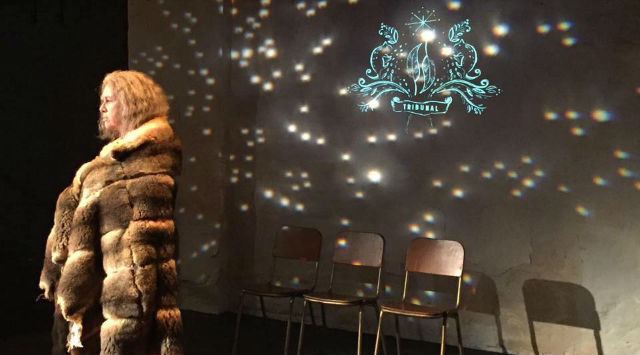
Playwright: Benedict Andrews
Director: Lee Lewis
Cast: Kristy Best, Chloe Bayliss, Marta Dusseldorp, Louis Fontaine, Huw Higginson, Meyne Wyatt, Pierce Wilcox
Image by Brett Boardman

Theatre review
Gloria is a mother and a wife, but to everyone around her and to herself, she is first and foremost, a star of the stage. Having spent her life playing many legendary tragic heroines, Gloria knows more about the fictional women of Western theatre than she does the actor who portrays them. Benedict Andrew’s script is stylised and abstract, an imaginative creation that parallels Gloria’s struggle for coherence. The leading lady’s existence is one of disorientation and tumult, and Andrew’s writing relishes in that chaos for a work striking in its originality and remarkable boldness.

Equally audacious is director Lee Lewis’ resolve to reach the truth in the enigmatic world of Gloria, where obfuscation and secrets are given their due, while a foundation of instinctive authenticity is established with absolute imperviousness. Every artistic and mysterious flourish, no matter how flamboyant (including Steve Toulmin’s extraordinary music), is anchored in startling emotional precision and intensity, conveyed through a captivating combination of deep understanding and steely determination.

The actors provide an unforgettable experience, visceral and immediate, persistently surprising and colourful, with a baroque sensibility that elevates the theatrical form to a rare level of infectious excitement. Marta Dusseldorp is devastating as Gloria. In a state of constant distress and confusion, Dusseldorp’s embodiment of Gloria is tenacious, powerful and very, very dark.

The play is intentionally coy about Gloria’s problems, therefore even though emotions are almost always at a fever pitch, its moments of melodrama are few. The audience is then free to find an interpretation of her narrative, so we rely on our own faculties to impose upon Gloria, a reading of her story that will only ever be partially accurate. The actor wishes to step onto the stage with nothing of herself, and everything of the person she represents. An emptiness resides in her, and because the soul is constantly morphing for another, it forgets itself.

www.griffintheatre.com.au

Review: Tribunal (Powerhouse Youth Theatre / Griffin Theatre Company)

pytVenue: SBW Stables Theatre (Kings Cross NSW), Aug 12 – 20, 2016
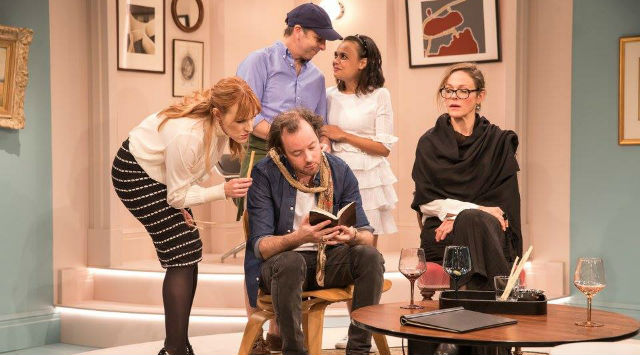
Concept: Karen Therese
Collaborators/text/performers: Sarah Coconis, Paul Dwyer, Iman Etri, Katie Green, Rhonda Grovenor Dixon, Bilal Hafda, Mahdi Mohammadi, Karen Therese, Jawad Yaqoubi
Image by Gracie Partridge

Theatre review
Any story can be told at the theatre, whether exaggerated or realistic, but to create something convincing is often a struggle for practitioners. In Tribunal, key personalities play themselves, leaving no room for us to doubt their authenticity. The presentation is a discussion of colonialism in Australia, with a particular focus on our habitual mistreatment through the years, of groups that are systematically subjugated and persecuted by a rapacious government, and its complicit populace. The production places side by side, an Aboriginal elder and an Iranian refugee, not only to convey the injustices inflicted upon them, but also to emphasise the delusionary insistence by White Australia of the land’s Westernness and its racist exclusion of all that it considers “other”.

Our weathered sensibilities may no longer be able to react with shock at the show’s revelations, but its verbatim, anecdotal format is unquestionably powerful, due especially to the sheer presence of those who have suffered under our cruelty. The act of putting on display their pain and damage, creates a palpable state of emergency and crisis that we simply cannot extricate ourselves from. In the guise of a tribunal hearing, the production turns its passive audience into the awakened body politic; we are all implicated in these harrowing recounts, no matter how long ago or how far away these events had taken place. Powerless individuals who shirk responsibility are, for the moment at least, given passionate idealism, and the audience begins to think about its part, as citizens involved in the machinations contributing to the humanitarian catastrophes that must be addressed.

We may not all run off into the night with radical courses of action inspired by Tribunal, but it sows the seeds required for a nation to evolve stronger morals and to inculcate better humanitarian values into its every decision, especially the tough ones. Bringing people from abstract consciousness, into a real life sharing of space, is theatrical magic that can do wonders to how we experience society. It is easy being inhumane to those who only live in imagination, but when confronted face to face, we can only be guided by compassion and love, which are after all, the most valued of all our qualities as the earth’s beings.

www.pyt.com.auwww.griffintheatre.com.au

Review: The Literati (Bell Shakespeare / Griffin Theatre Company)

griffinVenue: SBW Stables Theatre (Kings Cross NSW), May 27 – Jul 16, 2016
Playwright: Justin Fleming (after Molière)
Director: Lee Lewis
Cast: Caroline Brazier, Gareth Davies, Jamie Oxenbould, Kate Mulvany, Miranda Tapsell
Image by Daniel Boud

Theatre review
There are two halves to the family in Justin Fleming’s The Literati. Philomena and her elder daughter Amanda have aspirations for a sophisticated existence, both enamoured with books and language, while Christopher and younger daughter Juliet are of a simpler ilk, down-to-earth like true blue Aussies never to be caught dead with tickets on themselves. The play is about pretension, and the meaning of knowledge. We explore what it is to be good people, in a world where values are easily misplaced and ideas about virtue are unstable and skewed. Its message is uncomplicated, with a plot that proves to be entirely predictable, but The Literati is gorgeously written, with inexhaustible wit permeating every rhyming couplet in this thoughtful adaptation of Les Femmes Savantes by Molière. The jokes come fast and furious, along with inspired ruminations about diverse subjects including romance, intellectualism, purity and class.

Characters in The Literati are archetypal, but convenient moralistic jabs at “the bad guys” are thankfully few. The play wrestles with the problematic duo of Philomena and Amanda, shallow on one hand, but admirably ambitious on the other. Their desires are noble, but their mode of pursuance is misguided. The play sets up an old-fashioned dichotomy of pure and impure, but allows itself to negotiate between the two, so that we achieve a more textured understanding of good and bad within the story. Director Lee Lewis makes the appropriate decision of placing effect before depth, for a work that has nothing unusual to say but has very impressive ways of expressing its beliefs. The comedy is often flamboyant, but Fleming’s exquisite words are always in the spotlight, full of evocative power and mischievous vigour. The production is buoyant from start to finish, and although occasionally repetitious with its methods of eliciting laughter, we are kept engrossed in its electrifying showmanship.

Playing Christopher and Clinton is the one endearing Jamie Oxenbould, convincing and dynamic in his diverse roles. A memorable sequence features the actor alone on a revolving stage performing with meticulous clarity, and an exuberant sense of absurdity, both his characters in passionate dialogue with each other, completely absorbent of our attention, astonishment and adoration. Gareth Davies and Kate Mulvany offer up very broad humour with outlandish interpretations of their caricatures, finding every opportunity to perform their unrestrained comedy to a very appreciative and delighted crowd.

People in The Literati fight over the redundancy of words and culture, when notions of style are not validated by substance. The moral of Molière’s story is neither controversial nor surprising, but we are captivated by the production’s theatricality and the resonance of its language. In some ways, the show defeats its own argument, for what keeps us enthralled is not its idealistic core, but the talent that emanates from it. We fall in love with its gestures and articulations, but pay little heed to its very point of contention. We can look at art without the need for a presumed frame of reference or an indication of something behind, something deeper. Art is not a means to an end, but a sacred entity meaningful on its own terms. “If you want to know all about Andy Warhol, just look at the surface of my paintings and films and me, and there I am. There’s nothing behind it.”

www.bellshakespeare.com.auwww.griffintheatre.com.au