Review: Good Works (Darlinghurst Theatre Company)

darlotheatreVenue: Eternity Playhouse (Darlinghurst NSW), Oct 31 – Nov 29, 2015
Playwright: Nick Enright
Director: Iain Sinclair
Cast: Taylor Ferguson, Lucy Goleby, Anthony Gooley, Stephen Multari, Jamie Oxenbould, Toni Scanlan
Image by Helen White

Theatre review
In Nick Enright’s Good Works, we are often confused about time and characters. It is a deliberate ploy to have us focus on what people are doing to each other, regardless of when things had taken place or who those people might be. It probes us to consider if contexts matter when we are unkind. It talks about how we treat children, and how behaviour is perpetuated beyond the illusion of growing up. The play’s plot structure is perhaps its most interesting feature. The story and its themes are not unusual or spectacular, but through its highly inventive way of communication, we are required to relate to its ideas on a level of intimacy. If we do not have certainty about characters, we can only understand events by applying them conceptually, to our selves.

Director Iain Sinclair’s construction of space through Hugh O’Connor’s complex multi-tiered platforms is theatrical magic. The constant profusion of movement, visual depth and dimension is an aesthetic joy, and also an effective mechanism for providing demarcation for minute scene transitions. Sinclair’s knack for creating dramatic tension and his ability to extract meaning from them, ensures that the play unfolds with a gravity necessary for its poignant messages to hit home.

It is a strong cast that presents this challenging work. Each player is required to embody a range of ages and personalities, and although not every scene is equally powerful, there is no questioning the authenticity and thoughtfulness of their approach to individual parts. Lucy Goleby leaves an impression with studied stillness on a stage buzzing with energetic activity. Her eyes are, on more than one occasion, our sole focus as they convey quiet but intense emotion. Taylor Ferguson brings remarkable exuberance and strength to a character who faces multiple setbacks. The resilience and fallibility of humanity that she demonstrates is touching, and beautiful.

There is not much point to life if we do not try to do good, but Good Works shows us the conflict and complications that occur in communities when flawed individuals try to do their best within their inevitable limitations. We examine how it is that we can come to conclude which decisions are best, without resorting to convenient solutions that religions are keen to provide, and we question if there is possibility for behaviour to be anything else than emulation. Whether Enright’s play is pessimistic or otherwise, would depend heavily on one’s own outlook on life.

www.darlinghursttheatre.com

Review: Duck Hunting (Contemporarian Theatre Company)

contemporarianVenue: King Street Theatre (Newtown NSW), Nov 4 – 29, 2015
Playwright: Aleksandr Vampilov
Directors: Shai Alexander and Toby B. Styling
Cast: Michelle De Rosa, Nicholas Drummond, Paul Gerrard, Louise Harding, Christian Heath, Jessica Saras, Carlos Sivalingham, Anthony Sottile, Joshua Wiseman
Image by Toby B. Styling

Theatre review
Craig’s only passion is duck hunting, but he spends every second of his life avoiding it, preoccupied with all the petty mundanity of a bourgeois existence. He seems full of hatred for his job, his new home, the women around him, and most of all, himself. We see him snorting cocaine and downing copious amounts of alcohol, fantasising about better times, to which he never commits. The eccentric 1976 script by Aleksandr Vampilov is about a small man’s state of crisis. There is hardly anything likeable about Craig, but we do recognise the issues that he grapples with. The play is transposed to a modern day Australian context fairly effectively, but the sheer length of the work at three-and-a-half hours is a challenge. A heavy edit would most certainly make things more dynamic.

Shai Alexander and Toby B. Styling’s highly stylised direction delivers a lot of hits, but also more than a few misses. Their experimental anti-naturalistic mode of presentation is refreshing, with an ability to add surprising dimensions to the text, but the staging needs greater finesse to ensure that its surreality does not fall into pointless gesturing and mere pretence. The tone of performance required for the piece is specific and highly unconventional, using an idiosyncratic physical language that the cast is not always sufficiently au fait with. Michelle De Rosa and Paul Gerrard stand out for their confident embrace of the production’s offbeat nature to create characters that seem strange on the surface, while providing firm logic to their respective narratives. Craig is played by Christian Heath who brings energy and presence, along with an unshakeable conviction to hold our attention. In spite of his character’s faults, the actor’s own vulnerability and his determination to portray fragility in the protagonist’s story, help us gain an unusual, albeit objectionable, perspective of the world.

Duck Hunting is an ordinary tale that the everyman can understand. More interesting is the way it attempts to explore the potentials of the theatrical medium, and how the stage conveys meaning. It is not always successful with its endeavours, but its sense of adventure and pursuit of originality should not be disregarded. We never discover if Craig has any talent at all, but we know that he does not make it to the hunting ponds. For the artist, talent will always be subjective, but as long as self-belief and commitment exist, art will be created, and that alone, is achievement.

www.contemporarian.com.au

Review: A Girl With Sun In Her Eyes (Red Line Productions)

redlineVenue: Old Fitzroy Theatre (Woolloomooloo NSW), Oct 27 – Nov 14, 2015
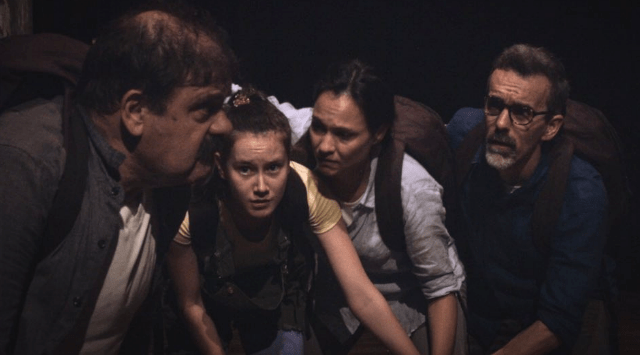
Playwright: Joshua Rollins
Director: Andrew Henry
Cast: Martin Crewes, Kai Paynter, Gabrielle Rogers, Jeremy Waters, Kate Williams, Ezekiel Simat
Image by Vanessa Wright

Theatre review
Life is not a bed of roses. It is a hard fact to come to terms with, but we live with evil around us, and people make decisions everyday that cause harm to others. In Joshua Rollins’ A Girl With Sun In Her Eyes, we see law enforcers at work, and as they confront the darkest sides of human nature, what they reveal are some of the worst that we are capable of. The filmic script jumps between short scenes to concoct a sense of intrigue and to manufacture a plot that can be placed squarely in the suspense genre. Characters are not created with great complexity, but their narratives are strong. There are sequences that aim to shock, and even though they border on the exploitative, their effects are unquestionably powerful.

Director Andrew Henry focuses on bringing intensity to individual performances, but chemistry between actors is lacking. Leading man is the magnetic Jeremy Waters who puts on a very high energy show, but counterparts do not often meet on his level. The staging and interpretation of scenes are straightforward, with little theatricality involved. The choice for a naturalistic approach is logical, but it seems to prevent the exploration of its quite brutal themes to extend beyond the surface. The production’s literal spacial configurations also create issues with scene transitions requiring an excessive number of blackouts that inevitably cause dramatic tension to dissipate repeatedly. Sound and lights help with a sense of continuity, but the piece struggles to find a coherent and sophisticated theatrical realisation of the episodic writing.

A Girl With Sun In Her Eyes is deeply pessimistic, but its ugliness is recognisable. It exposes the duplicity that we all share, of the possibilities for good and bad that reside in all our decisions. We may not wish to acknowledge personal intentions as ever being purposely harmful, but there is no doubt that people around us act with less than honourable motives, and one can never be too careful about becoming entangled. Innocence is a beautiful thing, especially when out of reach.

www.oldfitztheatre.com

Review: Hamlet (Bell Shakespeare)

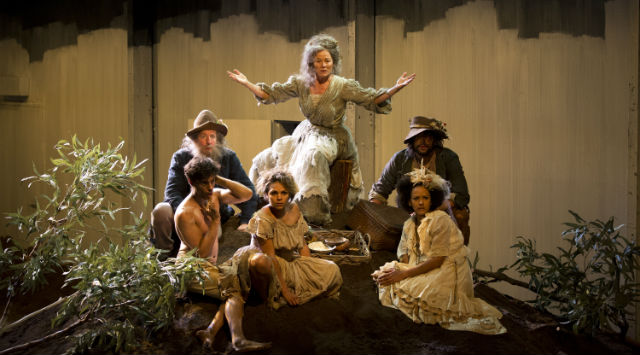
Venue: Sydney Opera House (Sydney NSW), Oct 27 – Dec 6, 2015
Playwright: William Shakespeare
Director: Damien Ryan
Cast: Philip Dodd, Ivan Donato, Robin Goldsworthy, Josh McConville, Julia Ohannessian, Sean O’Shea, Matilda Ridgway, Catherine Terracini, Michael Wahr, Doris Younane
Images by Daniel Boud

Theatre review
Director Damien Ryan’s rendition of Hamlet takes place in mid-20th century Denmark, with surveillance technology, airport last call announcements, and broadcasts of royal weddings. The prince is deeply upset by the death of his father, and by his mother’s very quick remarriage, but within this modern context, his very well known nervous breakdown seems to also involve the pressures of nobility as we understand them today. Our memory of Diana, Princess of Wales persevere, and the way she had been spoken off as having gone out of control, serves as a parallel to this Hamlet.

Ryan’s ideas are refreshing and plentiful. They can be meaningful, or merely ornamental, but his work is invariably engaging. In our age of collective attention deficit disorder, the production’s ability to retain our interest for over 3 hours is remarkable. Every scene is energetic, whether poignant, comedic, or transitory, Ryan finds a way to deliver entertainment and a quality of intrigue regardless of the text’s intentions. This is excellent directing, that has given rise to a show that can captivate even the most cursory of Shakespeare’s fans. Visual design contributes significantly to its pleasures. Alicia Clements’ versatile set produces dimensions on the stage with minimal fuss, and lighting designer Matt Cox’s nightmarish atmosphere administers a mesmerising effect that takes charge of our gaze.

In its efforts at bringing a newness to Hamlet, it might be argued that some dramatic tensions are unfortunately lost from the plot. The significant subdual of King Claudius’ villainy, along with the decision to play Queen Gertrude as an innocent, might be politically correct moves, but they take away from the power struggles that provide a certain spiciness to the admittedly clichéd foundations, especially in its first half. Nevertheless, the sophisticated and measured performances of the entire cast are enjoyable, and thankfully, easy to follow.

Josh McConville’s interpretation of the title role is a dynamically ranging one that exhibits a daring freedom eager to explore and experiment. McConville is powerful with all that he presents, playing comedy and tragedy equally well, but the distinction between both can appear too drastic. We understand the subject of madness involved, but it is debatable whether consistency of character can be improved in his expression of Hamlet’s state of mind. Ophelia is played by Matilda Ridgway, who shakes off the personality’s obligatory tweeness over the course of the play and puts on an impressive display of sorrow and rage in her concluding moments, for some of the most passionate and compelling scenes of the production. Philip Dodd is memorable and disarmingly funny in his parts as Polonius and Gravedigger. The actor’s confident and nuanced comic timing is a necessary element that helps with the show’s buoyancy, effectively preventing any monotony from setting in.

Revenge speaks to our base desires. A hallmark of advanced societies is the rejection of capital punishment, yet stories about vengeance resonate with no trouble at all. In Hamlet, revenge is a cancer that destroys from within. Its effects are contrary to the emotions that guide it. When enacted, the only ones who win are those from the outside, uninvolved in the eye for eye narrative. It is a profound lesson, one that is deeply, and appropriately for this text, Christian. To forgive and forget is an ideal that is unthinkable for many, but probably the only alternative to our prince’s tragic demise.

www.bellshakespeare.com.au

Review: Project #Oüahn (Baühs)

bauhsVenue: 46 Foveaux Street (Surry Hills NSW), Oct 21 – 26, 2015
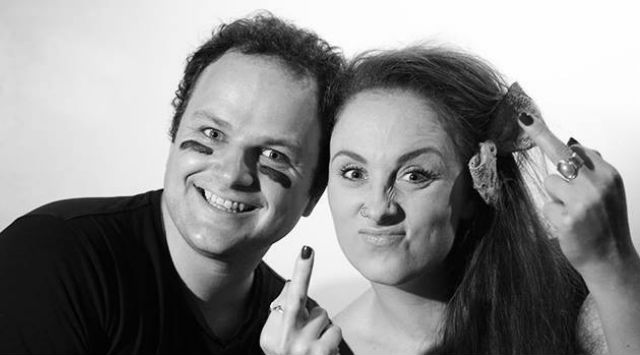
Playwrights: Gabriella Imrich, Christina Marks, Eliza Scott
Director: Christina Marks
Cast: Gabriella Imrich, Eliza Scott
Image by Diana Popovska

Theatre review
On stage are two young women, best described as anxious and frustrated. They speak in symbols, and their art is abstract. What they do is rarely explicitly named, perhaps to avoid things becoming undermined by convenient labels that can never completely address their thoughts. Instead, what we have is a series of physical and verbal enunciations that provide unmistakeable visceral sensations and clear indications about the way we experience our bodies, the construction of identities, and the political forces that dominate and disenfranchise. Project #Oüahn is a subversive work about subversion. The work aims to challenge, and because of our inevitable participation in prevalent ideologies, we do find ourselves in uncomfortable spaces in its 60-minute duration. It is hard to tell if the piece communicates universally, but its intention is not to create an “us and them” dynamic with its microcosm. There are moments of division, but its interest is ultimately about self-determination and self-empowerment. Its message is one of independence, but also of love, even if much of its language is militant and tough.

We do not find a conventional narrative structure, but the two actors Gabriella Imrich and Eliza Scott begin by setting up a visual reference to the madonna-whore complex. Their surfaces appear to be different as day and night, but as they wage war and undertake torment on each other, we soon discover that they are two of the same. It is a representation of the internal dialogues that we have and the socially complicit nature of how we monitor and police our own thoughts and behaviour. There is a precision to the performers’ motivations, that makes sense of the work’s abstractions in spite of their deliberate ambiguity. Chemistry between Imrich and Scott is flawless, and the production forges ahead with a confidence that is assertive and powerfully convincing. Christina Marks’ direction balances mystery and revelation, for a show that intrigues at every point, but is satisfying throughout. Sound design by Enola Gay is to be noted for adding a sophisticated yet dramatic dimension to proceedings.

The final section of the production is as memorable as any theatrical moment can hope to be. A mesmerising sequence that expresses divine beauty and tranquil strength, embodying an affirmation of life, lived with wisdom and courage. The art that we make is never worth more than when it is progressive. Project #Oüahn is a selfless exploration into the meaning of freedom that will touch anyone whom it is able to connect with, but freedom, like all that is worthwhile, will only discharge its magical prowess for those who know to receive it.

www.bauhsbauhsbauhs.com

Review: Nine (Sydney University Musical Theatre Ensemble)

museVenue: Seymour Centre (Chippendale NSW), Oct 21 – 24, 2015
Book: Arthur Kopit (based on the Italian by Mario Fratti, after Federico Fellini’s )
Music & Lyrics: Maury Yeston
Director: Jonathan Rush
Cast: Mikhaila Chaplin, Anna Colless, Hannah Cox, Genevieve de Souza, Rielly Dickson, Doug Emery, Jacinta Gregory, Bridget Haberecht, Bronwyn Hicks, Jane Hughes, Gabi Kelland, Lisa-Marie Long, Jos Markerink, Rose McClelland, Olga Solar, Nicole Toum, Stephanie Troost, Sam Wood

Theatre review
Based on Federico Fellini’s 1963 semi-autobiographical film , this is a musical about a man’s passion for life, work and women. The central character in Nine is Guido Contini, the superstar director under pressure to create a new work. He escapes, procrastinates and reminisces, but we do not see the film being made. His artistic process is not a straightforward one, and we learn that genius manifests itself in unexpected ways.

The songs in Nine are melodic and extravagant, powerfully orchestrated by ten musicians under the supervision of Alexander Norden, who breathes life into Maury Yeston’s 42-year-old compositions. The show is directed with flair and energy by Jonathan Rush, and choreographed intelligently by Natasha Heyward. It is a production that successfully expresses the exuberance of Fellini’s Italy, with all elements finding cohesion in the decadence and wildness of that romanticised world.

There are accomplished performances in the show, most notably Hannah Cox’s turn as Liliane La Fleur, completely stealing the show in her sensational Folies Bergère number, with perfectly pitched humour, rambunctious sex appeal, and a stunning sense of joy. There are major problems with sound in the production, but stronger singers, including Anna Colless and Bronwyn Hicks do manage to overcome them with sheer vocal power. Less fortunate are the show’s leads Doug Emery and Bridget Haberecht, the Continis who find themselves consistently drowned out by musical accompaniment. Nevertheless, their committed and eloquent performances leave a strong impression, and help to deliver a fascinating narrative that is ultimately very satisfying.

This might be a minimal staging, but its imperfections are few. Nine stands the test of time, and this small revival demonstrates the potentialities and pleasures it contains. Inspiration is invaluable, and artists especially must be able to identify them. Fellini’s magnificence is emulated in Yeston’s musical, and this production is clearly touched by the muses, but we do not have to wait for the calling of divinity to be spurred on to create something special; as we see in Guido’s story, greatness is to be found in la dolce vita.

www.museatusyd.com

Review: Dead Centre | Sea Wall (Red Stitch Actors Theatre)

redstitchVenue: Old Fitzroy Theatre (Woolloomooloo NSW), Oct 20 – Nov 14, 2015
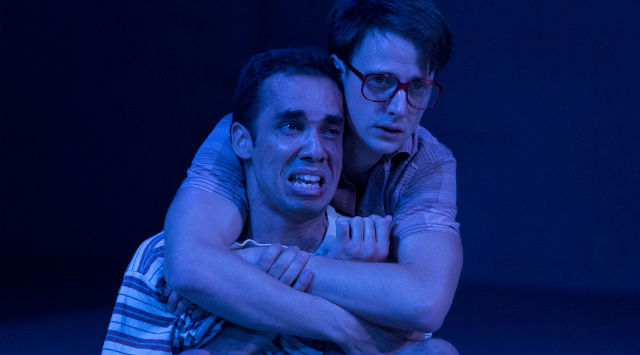
Playwrights: Tom Holloway, Simon Stephens
Director: Julian Meyrick
Cast: Rosie Lockhart, Ben Prendergast
Image by Jodie Hutchinson

Theatre review
The more we hurt, the more difficult it is to find expression for our internal struggles. We compartmentalise pain, and with time, become more adept at denying their existence, but their effects do not fade. Tom Holloway’s Dead Centre and Simon Stephens’ Sea Wall are two half hour monologues that deal with sorrow and depression. We encounter the protagonists in traumatic states, and see them fumbling through life trying to find a way out of their anguish. Holloway’s piece is vividly descriptive, with evocative fragments that softly, but actively, fire up our imagination. Stephens’ work is equally poetic, but takes a completely different tone. Focussing on the grieving process, he uses the difficulties in articulating painful experiences as a basis for the text, and creates a quiet work that escalates suddenly at the end to deliver a powerful revelation.

The two pieces are presented one after another, but visual elements suggest an entwinement between both stories. Design of the production is understated, but elegant and sensual. Matthew Adey’s lights and Katie Cavanagh’s video projections, along with Ian Moorhead’s sound design, establish an understated but concentrated atmosphere in which the actors offer their very delicate tales. Direction by Julian Meyrick gives a beautiful cohesiveness to the two halves, with a sensitive approach that highlights the similarities between each character’s experiences. We witness the fragility in our humanity, and realise the importance of accepting and understanding the weaker moments of our personal lives.

Rosie Lockhart plays Helen in Dead Centre, fleeing England for Uluru, in search of an answer to her indescribable troubles. The actor’s engaging presence grips us from the start, but it is her ability to communicate a wealth of emotion with a seemingly minimal mode of performance that truly impresses. Helen never tells us what her problems are, but Lockhart leaves us in no doubt about the depth of her torment. Also remarkable are the flashes of humour that emerge, brief but effective, and key to installing a solid connection between actor and audience. Alex in Sea Wall is played by Ben Prendergast, whose portrayal of loss and bewilderment resonates with an intimate familiarity. The evasiveness and fear of sentimentality that he exhibits is a perceptive interpretation of how we deal (or do not deal) with immense emotions, but concluding moments see outbursts of intensity that appear too suddenly, and we question the accuracy of those dramatics.

Catharsis frequently occurs through the artistic process, but not usually at the same degree for all involved. Artists can indulge boundlessly in their excavations of private feelings, but the inspiration brought to their audience must not be ignored. In Dead Centre | Sea Wall, emotions run high, but they tend to stay safely on stage. The poignancies that it imparts are muted, but they are also real. We do not get embroiled too closely with Helen or Alex, but we study them intently and learn about the nature of suffering. The stories are theirs, but the way they help us explain and comprehend life, becomes universal.

www.redstitch.net

Review: Blood Bank (Ensemble Theatre)

ensembleVenue: Ensemble Theatre (Kirribilli NSW), Oct 16 – Nov 22, 2015
Playwright: Christopher Harley
Director: Anthony Skuse
Cast: Meredith Penman, Gabrielle Scawthorn, Tom Stokes
Image by Clare Hawley

Theatre review
At a hospital, death is everywhere, but characters in Christopher Harley’s Blood Bank experience life while the palpable presence of time hangs over each of their heads. The script is tender and sensitive, with humour always close at hand in its explorations into our darkest moments of illness. It is an imperfect script, with dubious relationship dynamics and a plot structure that requires further refinement, but each scene is charming, and beautifully rhythmic. Its themes keep the play firmly in a space that is thoughtful and profound. We can all relate to the narratives that unfold; whether light or heavy, its ideas appeal to our deepest feelings relating to the biggest of concerns, love and death.

Blood Bank is a consistently engaging work, buoyed by strong performances. Gabrielle Scawthorn is powerful at both ends of the emotional spectrum. She is an effective comic who identifies every opportunity for laughter, keen to bring a joyous energy to the stage, and does not hesitate to plunge into her character Abbey’s guilt and grief, with a resonant authenticity that can be quite touching. Her counterpart Tom Stokes takes a more subtle approach, but is no less convincing in his portrayal of psychological truths. The part is a sorrowful one, and it is to the actor’s credit that there is little self-indulgence to be found. Instead, Stokes’ honest interpretation creates moments of poignancy, and establishes a brilliant chemistry in the cast that is often the highlight of the production. Director Anthony Skuse magnifies all the nuances of the script so that our experience of the show is a rich and vibrant one. He holds our attention by tapping into our intimate fears, and makes believable what could have been tenuous at best.

There are things that we sweep under the carpet, so that life can move on. It is true that no matter how much philosophising we put it through, death must be, but it is also the awareness that all things come to an end, that gives us the desire to cherish them. Art about mortality therefore serves an important function. In shining a light on the end, we become acutely mindful of the now. Blood Bank talks about the choices we make, when we have little time left. It also reminds us, that time is always scarce, whether we are living or dying. To quote Kurt Vonnegut, “Of all the words of mice and men, the saddest are, ‘It might have been.'”

www.ensemble.com.au

Review: Three Sisters (The Genesian Theatre)

genesianVenue: The Genesian Theatre (Sydney NSW), Oct 16 – Sep 14, 2015
Playwright: Anton Chekhov (translated by Brian Friel)
Director: Timothy Bennett
Cast: Priscilla Bonham-Carter, Martin Bell, Nick Carter, Ted Crosby, Rob Drew, Susan Farrell, Kathryn Hutchins, Lana Kershaw, Elizabeth MacGregor, Tom Marwick, Tom Massey, James Moir, Dominique Nesbitt, Martin Searles, Darien Williams

Theatre review
In Chekhov’s Three Sisters, time moves past its characters to show us the stasis and passivity of their pessimistic lives. The play runs for almost three hours, but few things change for the Prozorovas over the course of its 5-year plot. There is always a sense that things are better elsewhere, but the women never venture very far away. Whether it is circumstance that keeps them bound to their family home, or their lack of resolve that prevents them from finding greener pastures, is ambiguous. Brian Friel’s 1981 translation is a vibrant one, with a subtle humour accompanying the despondency of its scenarios, but Chekhov’s incessant lamenting is certainly left unscathed.

This staging, directed by Timothy Bennett, attempts to be a faithful rendering of the piece. Design aspects are effectively executed, with attention spent on ensuring a period depiction that appears accurate. Correspondingly, performances seem to resist any modernisation. The cast’s preference for a stylistically nostalgic tone is charming, but can also feel stilted and staid. Finding enough depth to express the complexities of Chekhov’s writing is challenging, and on this occasion, the actors’ emphasis on establishing accuracy in affectation and manner, come in sacrifice of character studies that portray psychological and behavioural authenticity. The production provides an impressionistic account of events and personalities, but we desire something more substantial beyond its pleasant surface.

At the play’s end, the sisters once again talk about the future. It is a mixture of hope and hopelessness, and as we ponder their story from a distance of over a century, we wonder if their longing for better days has come to pass. It is important that we understand the shackles that keep the women bound in the play, and the dysfunctions in societies that stand in the way of progress. What prevents the Three Sisters from finding happiness is open to interpretation, and like the introspection required for our own lives to improve, an exercise that will prove to be rewarding.

www.genesiantheatre.com.au

Review: My Zinc Bed (Ensemble Theatre)

ensembleVenue: Ensemble Theatre (Kirribilli NSW), Oct 10 – Nov 22, 2015
Playwright: David Hare
Director: Mark Kilmurry
Cast: Danielle Carter, Sam O’Sullivan, Sean Taylor
Image by Clare Hawley

Theatre review
Addiction might be termed a modern phenomenon. In recent years, conditions of all kinds ranging from alcohol and drug use, to sexual and stealing behaviours, have become forms of addiction, almost achieving medical or pathological legitimacy in the general discourse of Western life. David Hare’s My Zinc Bed examines the meanings behind this contemporary way of looking at human volition and responsibility, and the quality of human weakness versus expectations regarding the individual’s contribution or dependence on society. The script is extremely contemplative, punctuated by stimulating and controversial ideas that can be challenging, although the tone of the work is notably gentle and compassionate. We are encouraged to examine the human condition from a refreshing perspective and to evaluate our assumptions about addictions of different kinds, but always being mindful about the vulnerabilities that we share.

Mark Kilmurry’s direction is interested in all the philosophical content of the text, and succeeds in making his play a relentlessly thoughtful one, while maintaining a dramatic tension that keeps us engaged throughout. Characters in the play are not particularly likeable, but their experiences are readily identifiable, and Kilmurry ensures that their exchanges never fail to fascinate. Visual elements are effectively minimal, but subtle design flourishes are executed with remarkable elegance. Tobhiyah Stone Feller’s set and Nicholas Higgins lights provide the illusion of emptiness, but provide immense scope for sentimental fluctuations. What appears to be cold and hard on the surface, is actually quite subconsciously moving with each transition of scenes.

There are breathtaking performances to be found in the production. All three actors demonstrate a thorough understanding of text and characters, and their interactions are consistently powerful. Every line is delivered with the sizzle of subtext and mystery, and we are seduced into worlds of imagination and reflection. The rhapsodic Sean Taylor is as magnetic as he is convincing. We are lured into studying his every minute gesture, believing them to be of great significance, and his commanding voice is simply irresistible. The actor’s presence is an overwhelming one, and it is fortuitous that his abilities at storytelling are no less impressive. Danielle Carter’s part requires her to display extraordinary inner complexity and also to portray the somewhat customary femme fatale with a forceful allure, both of which she performs with tremendous impact. The central Paul Peplow is played by Sam O’Sullivan, who brings earnestness, passion and emotional intensity to a personality that is more than familiar to many of our lives. His work feels genuine, and the believability of his creation is crucial to the show’s success.

Being social means that we rely on each other. Every person is both strong and weak, and there is a constant negotiation that happens in how much we are willing to forgive, how we apportion blame, and how far we can extend kindness. Paradigms of illness and disease demand of us generosity, but like anything social, they stand to be exploited in ways that will not always find universal agreement. Addiction is real, but also false. Like any label of identification, it provides an indication of circumstances, that must always be prepared to be questioned.

www.ensemble.com.au