Review: Cyprus Avenue (Empress Theatre)

Venue: Old Fitzroy Theatre (Woolloomooloo NSW), May 15 – Jun 8, 2019
Playwright: David Ireland
Director: Anna Houston
Cast: Lloyd Allison-Young, Roy Barker, Branden Christine, Jude Gibson, Amanda McGregor
Images by Yure Covich

Theatre review
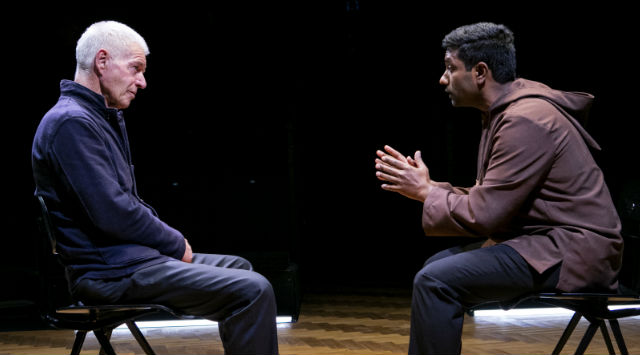
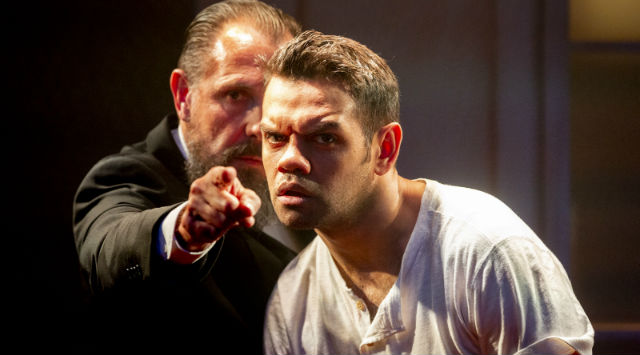
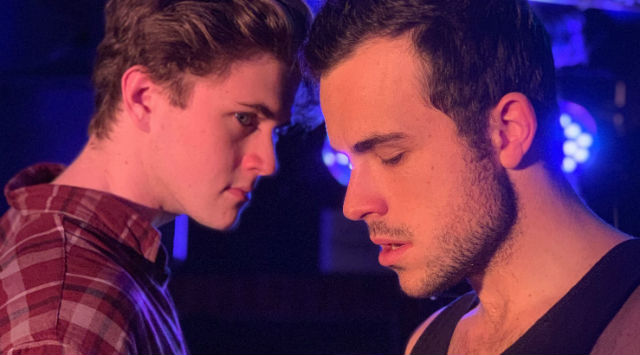
Even though Eric does not run around in a white conical hood, and he takes every opportunity to make grand declarations that he is not a racist, there is no question that our protagonist is the worst kind of bigot. David Ireland’s Cyprus Avenue is a confronting, if slightly exploitative, play about a sad old man trapped in the traumatic days of The Troubles. Habitually putting everyone in identity categories, his hate for “the others” seems to know no bounds; even his five-week old granddaughter is not spared. Playwright Ireland makes a powerful statement about prejudice, with his flamboyantly brash approach offering a style of theatre that is full of dramatic tension, as well as ample opportunity for intellectual stimulation.

Direction by Anna Houston appropriately emphasises the quirky quality of Cyprus Avenue‘s comedy, bringing valuable balance to its otherwise brutal nature. Difficult concepts are left undiluted, so that the audience cannot help but examine its challenging provocations. Leading man Roy Barker embodies beautifully, contradictory dimensions of Eric. He is deplorable, but also charming; tender yet full of evil. Unfortunately, the actor’s constant stumbling over lines puts a damper on proceedings, with the disruptions of speech rhythms causing considerable distraction. Other cast members are much more polished with what they present, each remarkable in their respective roles, all of them compelling with what they bring to the stage.

There is profoundly objectionable behaviour in Cyprus Avenue that we must attempt to analyse. The show’s controversial situations make it an imperative that we find ways to process, not only the violence that happens in Eric’s fictitious world, but also the equally heinous hate crimes, of all descriptions, in real life. People will have justifications for every horror they commit, but as a society, we will always have to weigh up compassion and punishment, in our strategies for prevention. Eric has been driven mad by circumstance, and as a result, he perpetuates grievous harm, in a circle of violence that tempts us to keep shifting blame from one to another. There are no easy answers in Cyprus Avenue, perhaps no answers at all, but it allows us to see, in what feels to be a thoroughly honest way, how terrifying humans can be. What we do with that information thereafter, is anybody’s guess.

www.empresstheatre.com.au | www.redlineproductions.com.au

Review: Made To Measure (Seymour Centre)

Venue: Seymour Centre (Chippendale NSW), May 16 – Jun 1, 2019
Playwright: Alana Valentine
Director: Tim Jones
Cast: Tracy Mann, Sam O’Sullivan, Megan Wilding
Images by Lisa Tomasetti

Theatre review
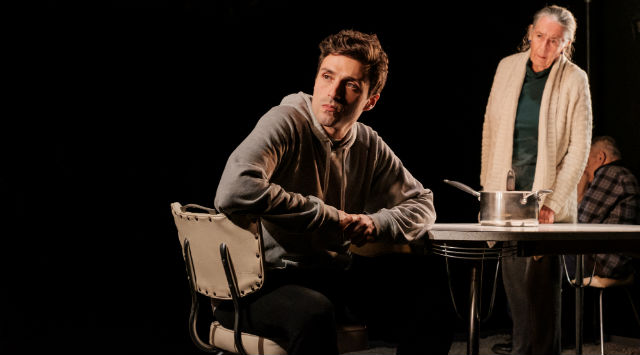
Society’s hatred for fat bodies is placed under scrutiny, in Alana Valentine’s Made To Measure. Ashleigh, our protagonist, is preparing for her wedding, and the process of getting a gown made, is provoking tremendous anguish and frustration. Her dress designer Monica is nice enough, but it seems neither is able to talk about Ashleigh’s large figure, without turning it into a problem. We see an insidious prejudice in operation, a pervasive attitude of disrespect that constantly subjects fat people to criticism and chastisement. Not only does Monica struggle to avoid comments that make her client feel bad, Ashleigh herself often believes those degrading remarks to be true. Society is her worst enemy, but Ashleigh’s own opinions about her own body, are not much better.

The playwright’s elucidations are detailed and often very powerful. With an important agenda to push, Valentine’s play has a tendency to be didactic and slightly dry, but Made To Measure is ultimately highly effective, in pointing out the objectionable nature of our fatphobia, and may even succeed, over its ninety minutes, to change the way we think and act. The production is beautifully assembled, with Melanie Liertz’s set and Verity Hampson’s lights particularly delightful and well-considered. Director Tim Jones’ straightforward approach imbues the work with a sense of integrity, but a more imaginative use of space could provide an improved theatrical experience.

Leading lady Megan Wilding brings to the stage, an exceptional vulnerability that does at least as much as the writing, to help us understand the gravity of the issue at hand. Her depiction of pain is thoroughly convincing, with a potency that defies any audience member to regard the play with even a minutiae of scepticism. Also impressive is Tracy Mann, whose multi-faceted interpretation of Monica prevents the show from oversimplification. It is an authentic performance that encourages us to appreciate the story’s themes with complexity and humanity. Sam O’Sullivan plays a variety of roles with admirable gusto, able to represent both the best and worst of our community, with charm and humour.

It seems that very few of us in capitalist societies are able to be satisfied with our physical appearance. The free market takes aim at our self-esteem, relentless in its attempts to make us insatiable consumers, by ensuring that we feel eternally inadequate. The issue is not whether there is anything wrong with Ashleigh’s body. The problem is that we think we have a right to an opinion about it. We routinely remove bodily autonomy from fat people, always allowing that transgression to occur under the pretence of concern and compassion. When we know to bestow genuine kindness upon one another, differences between persons fade away. When there is no capacity for kindness, even the most perfect creature can be made a monster.

www.seymourcentre.com

Review: Playlist (PYT Fairfield)

Venue: Sydney Opera House (Sydney NSW), May 16 – 19, 2019
Director: Karen Therese
Cast: Mara Knezevic, Tasha O’Brien, Neda Taha, May Tran, Ebube Uba
Images by Daniel Boud

Theatre review
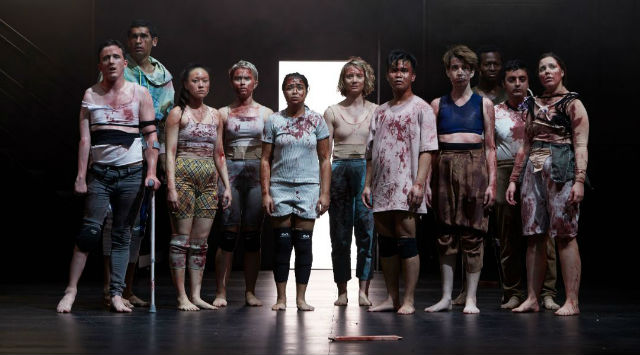
Five young women from Western Sydney take the stage, talking about themselves, driving home the point that their stories are not only valid, they are essential, should we wish to examine our lives as egalitarian Australians. For too long, these voices have been subsumed. Not white enough, not middle class enough, and not masculine enough, they have long been relegated to secondary importance in the way our national identity is construed and represented. This is not about a faded mythology; Ned Kelly, Don Bradman and Crocodile Dundee they are not. In Playlist, we encounter a devised work of theatre, that offers a refreshing and pertinent reflection of who we are, in the here and now. It is about creating a new vision of a future that addresses the social imbalances, and injustices, that have plagued us since European settlement. In Playlist, we see ourselves learning to become unapologetic women, more spice than sugar, able to occupy any space we deem appropriate.

The personalities bond through music and dance. It is a cultural discussion that requires each to talk about heritage. With roots in various continents, they gather to connect with traditions that are unfamiliar, and find commonality in popular music, alongside their shared experience of misogyny. Their bodies contain a multitude of meanings, and in Playlist, intersectionality is explicitly discussed, in words and in movement, to interrogate who we are as women, so that we may form progressive and propulsive intentions, to get us, collectively, somewhere better.

Larissa McGowan’s work as choreographer is invaluable in making the show dynamic and entertaining. She allows the expression of spirit to occur powerfully within structures that look disciplined but that feel simultaneously organic. Director Karen Therese does marvellously to bring cohesion to a diverse group of performers, with disparate styles and individual principles. An inspiring sisterhood is established through the harnessing of both similarity and difference, effective in conveying the possibilities that could arise from unions of this nature.

An extraordinarily well-rehearsed cast takes us through an entirely unpretentious theatrical exploration of a modern feminism, one that is useful today, for all Australians. They are humorous, but also disarmingly earnest with their propositions. There is great honesty on this stage, and as a consequence, we regard all they say with open hearts and minds. An immense energy pervades, physical and soulful, aided by a team of designers that join in on the conspiracy of a political presentation. Lights by Verity Hampson, and sound by Gail Priest and Jasmine Guffond ensure that Playlist makes its point every time, whether it chooses to hit us hard or to persuade gently. Also noteworthy are costumes and set by Zanny Berg, whose contemporary simplicity proves effective in helping us elicit a sense of visual resonance, to reach a deeper understanding of the nuances on display.

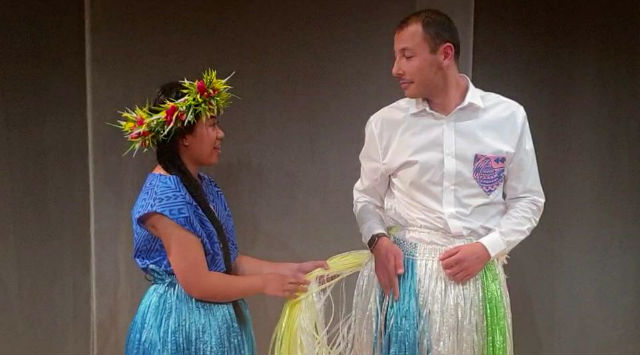
As migrant women of colour, we have learned to compromise our true essence, in efforts to survive a system that has us positioned low on its hierarchy of priorities. We have had to set aside our authenticity, in order that we can turn ourselves nonthreatening, and be deemed tolerable by the mainstream. In our maturity, we discover that these sacrifices have paid few dividends, so when Playlist stakes its claim on a self-determined womanhood, we can only respond with joy. These artists show us who they are, and in their revelations, we find answers to our own conundrums.

www.pyt.com.au

Review: Winyanboga Yurringa (Belvoir St Theatre)

Venue: Belvoir St Theatre (Surry Hills NSW), May 4 – 26, 2019
Playwright: Andrea James
Director: Anthea Williams
Cast: Roxanne McDonald, Tuuli Narkle, Angeline Penrith, Tasma Walton, Dalara Williams, Dubs Yunupingu
Images by Brett Boardman

Theatre review
A group of Koori women are in the bush, gathered together for a camping trip on the bank of a great river. In Andrea James’ Winyanboga Yurringa, six city slickers take time off to get in touch with one another, with nature, and with tradition. They are a family, but individuals grow apart, and we watch the effort required, to firm up those bonds again, and to rediscover that which is truly important.

The play begins with a sense of ambiguity, very gradual in the way it divulges its raison d’être. The playwright insists that the audience too, takes time off from our hustle and bustle, to fall into a plot that is languid, perhaps slightly disorientating, but trusting that the journey will ultimately be a rewarding one. When its climax arrives, we are surprised by the depth of its poignancy.

Director Anthea Williams’ approach is not obviously sentimental, but she catches us unawares with a quiet power, to deliver a moving work about our Australian heritage. The show communicates differently to people of varying backgrounds, but it is evident that whether or not one is indigenous to this land, Winyanboga Yurringa says a lot that is meaningful about our relationship with it.

Lights by Verity Hampson emanate a disarming warmth, and along with Isabel Hudson’s evocative set design, the familiarity of our landscape is intuitively established on this stage. It is a romantic vision, perfectly partnered by music and sound design from Steve Francis and Brendon Boney, who are called upon to introduce a dimension of melancholic soulfulness to the production. The cast is uniformly accomplished, with Roxanne McDonald particularly impressive as Neecy, the maternal figure through which the play dispenses all its wisdom. McDonald is a sublime performer, with a potency and an intricacy to her style that has us enthralled and firmly won over.

In Winyanboga Yurringa we are reminded that there is so much to love about this place we call home. Regardless of our sins, this terra is and always will be divine; we can cause harm to it, and to one another, but it is the human race that will ultimately and certainly face extinction, before the earth can ever succumb. On Aboriginal land, it is Aboriginal knowledge that is our surest hope for sustainability, yet those voices are routinely subdued and trivialised, in a colonised culture that refuses to listen to solutions that exist right on our doorstep. The characters in Winyanboga Yurringa are the eponymous women of the sun, but they will only shine their light when invited. If we choose to dwell in darkness, the price is ours to pay.

www.belvoir.com.au

Review: Cat On A Hot Tin Roof (Sydney Theatre Company)

Venue: Roslyn Packer Theatre at Walsh Bay (Sydney NSW), Apr 29 – Jun 8, 2019
Playwright: Tennessee Williams
Director: Kip Williams
Cast: Addison Bourke, Tristan Bowes, Peter Carroll, Harry Greenwood, Emily Harriss, Jye McCallum, Josh McConville, Zahra Newman, Pamela Rabe, Holly Simon, Nikki Shiels, Lila Artemise Tapper, Arie Trajcevski, Hugo Weaving, Anthony Brandon Wong, Jerra Wright-Smith
Images by Daniel Boud

Theatre review
Characters in Tennesse Williams’ Cat On A Hot Tin Roof suffer immense anguish. Regardless of where they happen to reside in the hierarchy of their social order, powerful or powerless, Maggie, Brick and Big Daddy are each unable to escape a torturous existence. A result perhaps of the family’s wealth, or maybe the American deep south in 1950s had truly been indiscriminately stifling, or life is simply unbearable no matter one’s choices and orientations; the beauty of Williams’ play is that it explains little. In its exhaustive excavations of human emotion however, we identify the truths of our beings at their deepest, but Williams leaves us to draw our own conclusions, on the causes of, and the resolutions for, all the pain that inevitably befalls us.

There is a lot that is sublime in director Kip Williams’ vision. A momentary glimpse of sitting Vice President Mike Pence on Brick’s television set, is a powerful suggestion of the play’s timelessness. Oppressive aspects of Western values, rooted in white patriarchy, is the undercurrent disquiet that drives the action. The production manifests a sense of hopelessness appropriate to the playwright’s pessimism, one that is masochistically gratifying, as is typical of classic melodrama, but also undeniably thought-provoking.

Brick and Maggie’s bedroom is sleek and modern in style, with dark colours and hard edges representing a masculine space in which Maggie’s lack of status is evident. Designed by David Fleischer, the stage is visually seductive, but arguably ineffectual with invisible doors, for a play that repeatedly involves itself with notions of intrusion. Stefan Gregory’s music takes its cues from film noir, nostalgically evocative and very pleasurable. Lights by Nick Schlieper are cold, almost menacing in their depiction of emotional torment. The many instances of fireworks in Act II are controversially manufactured, each time overwhelming our senses for several seconds, with their cacophonous, and repetitive, disruptions into Brick and Big Daddy’s long confrontation.

Actor Zahra Newman is entirely splendid as Maggie, dejected but determined, a broken woman hanging on to the little that she has, to turn a living hell into something coherent. Newman’s extraordinary instinct and artistic inventiveness, along with an uncompromising vigour, make Act I of Cat On A Hot Tin Roof a personal tour de force that has us hopelessly exhilarated. Big Daddy is masterfully performed by Hugo Weaving, who although brings to the role nothing that is unexpected, demonstrates his unparalleled stage presence and a searing conviction that absolutely captivates. The exaggerated theatricality he employs is riveting, with a psychological accuracy that allows us to perceive complicated dimensions of human nature, as we luxuriate in the sumptuousness of his delivery. Also very resonant, is Harry Greenwood as Brick, who overcomes his physical dissimilarity to the character, for a convincing portrayal of a defeated man who retreats into self-abuse. Greenwood’s approach is restrained by comparison, but he adds dynamism and texture to how the story is conveyed, on what is often a very loud stage.

Brick’s indulgence in alcoholism looks as though he is willing himself to die. Maggie on the other hand, who has much less to live for, can be seen maniacally scrambling for survival at every moment. Those are the extremes of how we can be, when facing the worst. The people in Cat On A Hot Tin Roof are all left to their own devices. Although under one roof, this is a family whose bonds are weak, with relationships built on mendacious foundations (the word “mendacity” is mentioned multiple times). Unable to locate anything honest and real, what they have can only feel empty; distracted by material riches, it is loneliness that is left unnoticed and festering. We see no love in this household, and realise that no peace or happiness could ever come their way.

www.sydneytheatre.com.au

Review: Pygmalion (New Theatre)

Venue: New Theatre (Newtown NSW), Apr 23 – May 25, 2019
Playwright: George Bernard Shaw
Director: Deborah Mulhall
Cast: Colleen Cook, Steve Corner, Tiffany Hoy, Lisa Kelly, Emilia Kriketos, Natasha McDonald, Mark Norton, Robert Snars, Shan-Ree Tan, Sean Taylor, Vitas Varnas, Emma Wright, Tricia Youlden
Images by Bob Seary

Theatre review
The most gratifying aspect of Eliza Doolittle’s story is her refusal to be content with a life of misery, no matter what form it takes. Whether an impoverished flower girl, or a faux aristocrat, she is compelled to break free of shackles, as soon as she identifies an opportunity to do so. George Bernard Shaw’s Pygmalion talks about independence, and dares to place a feminine figure at the centre of speculations, in a work that tries to unpack the implications of class in British society, along with twentieth century notions of personal autonomy. Having coincided with the suffragette movement of the 1910’s, Pygmalion can be seen as a remnant of early feminism, with a female lead determined to discover the conditions for freedom, even if the playwright does put her through an unyielding series of torturous circumstances.

It is a wordy script, that Deborah Mulhall tries to overcome as director, by injecting speed and energy into its rendering. There are no indulgent pauses and few languid moments of sentimentality, resulting in a show full of vim and vigour. Intellectual complexities are occasionally compromised, in the absence of space for meaningful rumination, but the production holds our attention adequately for the duration, perhaps trusting that we would attain some degree of poignancy in the hours thereafter. Mulhall’s steampunk costumes, although well executed, are a curious addition, for a narrative not of any science-fiction or fantasy genre. Tom Bannerman’s remarkable set design is stylish, and cleverly conceived to facilitate dynamic stage action.

Actor Emma Wright is a strong Eliza, playful but firm in her interpretation of the classic role. Technically accomplished, yet an instinctual presence and emotionally rich, Wright’s modern approach is a wonderfully refreshing take of that familiar persona. An impassioned Steve Corner elevates the Henry Higgins character, to someone much more vulnerable than is conventionally depicted, for unexpected layers to the story that prove highly rewarding. Colonel Pickering is less surprising, but nonetheless effectively portrayed by Shan-Ree Tan, who impresses with one of the more sturdy performances from its supporting cast.

At the end, we understand that Eliza wants to be her own person, unbeholden to anyone. We also realise that in England a hundred years ago, spaces for women to thrive independently are not yet widely established. Eliza’s fate was not an optimistic one. With the passage of time, we certainly feel more able to operate in accordance with our individual sovereign wishes. Women are gainfully employed like never before, in areas of work unimaginable a century ago, and access continues to widen as we persist with the dismantlement of barriers. Progress is undeniable. If only we would stop our prejudice and judgement on women who look and sound different.

www.newtheatre.org.au

Review: Rabbit Hole (Chippen Street Theatre)

Venue: Chippen Street Theatre (Chippendale NSW), Apr 18 – 27, 2019
Playwright: David Lindsay-Abaire
Director: Christie Koppe
Cast: Alison Chambers, Rachel Giddens, Peter-William Jamieson, Imogen Morgan, Sam Wallace

Images by Benjamin Ryan
Theatre review
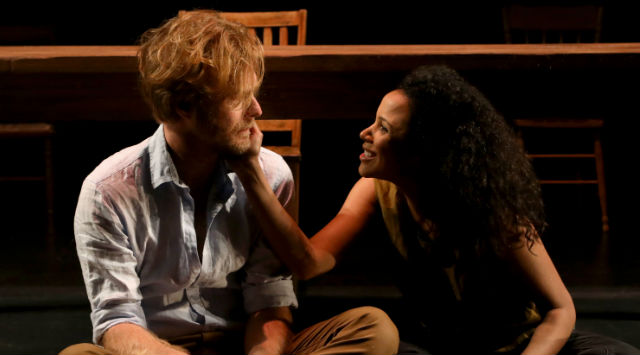
We meet Becca and Howie just months after the death of their small child. It is disconcerting that Becca seems unable to mourn her loss in a predictable way, and we wonder how her strategy of avoidance is going to pan out. David Lindsay-Abaire’s Rabbit Hole talks about the complex nature of grief, and the different things people have to do, in response to trauma. Positioned next to her husband’s more obvious approach, Becca looks frighteningly detached, refusing to speak of her pain, and only occasionally able to acknowledge the calamity that had befallen her home.

It is an energetic show, with a good amount of dramatic intensity, established by director Christie Koppe, to keep us engaged. Imogen Morgan portrays Becca as an animated personality but also, appropriately, emotionally stunted. The coldness of her exterior is articulated well by Morgan, but the true depths of Becca’s sorrow is often missing as a result. Her denial of her own suffering, is a fundamental ingredient of the story, but when the audience loses contact with that sense of torment, the show accordingly loses its sense of authenticity.

Howie the husband is played by Peter-William Jamieson, who delivers a convincing interpretation of bereavement inside his personal suburban living hell. The charming Alison Chambers is a genuine presence that makes everything she does for Becca’s mother, Nat, seem natural and believable. Rachel Giddens and Sam Wallace are compelling performers, both able to secure our attention whenever their supporting parts take centre stage.

Theatre about trauma is mesmerising. We gawk at people and their suffering, hoping to find salvation for our own unresolved troubles, even if only via a distant proxy. There is something liberating about Rabbit Hole‘s contrasting representations of the mourning experience. We are individuals who navigate the world in different ways, absorbing shocks as we go along, trying to stay in one piece until the inevitable end. It is naive to want to leave this existence unscathed, but to start each morning hopeful for a good day, whatever that may look like, must surely be a reasonable expectation, no matter one’s circumstances.

www.chippenstreet.com | www.facebook.com/RabbitHole2019

Review: Appropriation (Fledgling Theatre Company)

Venue: Studio Blueprint (Surry Hills NSW), Apr 17 – 27, 2019
Playwright: Paul Gilchrist
Director: Chris Huntly-Turner
Cast: William Bartolo, Damien Carr, Tara Clark, Clay Crighton, Alex Daly, Marcella Franco, Nick O’Regan, Angus Mills, Asalemo Tofete, Alex Rowe, Shannon Ryan, Sonya Kerr

Theatre review
Fortinbras steps into the limelight, now that Hamlet is dead. In Paul Gilchrist’s Appropriation, Fortinbras the Norwegian crown prince, has to work out a strategy so that he can take over Denmark. We learn that the prince likes to think of himself as a ruthless warrior, the type that distrusts the use of words and all things artistic. His wife Gabrielle is on a mission to convince him, that the most efficient way to conquer the Danish is not through violence, but by deception. The narrative of Appropriation is provocative, and passionately conveyed, even if its plot structure is frustratingly tangential. There is philosophy everywhere we look, which can be disorienting, but this is certainly not a piece of writing that can be accused of underestimating its audience.

The production is energised by Chris Huntly-Turner’s exuberant direction. Emotional intensity is built into every scene, with a cast of twelve bringing excellent conviction to the stage. Nick O’Regan is full of vigour as Fortinbras, and convincing as the sixteenth-century brute. Gabrielle is a more complex character, with Sonya Kerr effectively portraying her contradictory qualities, and proving adept at raising the drama to fever pitch, in the play’s final moments when she manipulates the populace into submission. Also noteworthy is the compelling Asalemo Tofete, in the role of Player, refreshingly honest as the persecuted artist fighting for the right to tell stories.

In the era of “alternative facts”, it is no longer expression that comes under fire, but the very notion of truth that is being threatened. We seem to find ourselves in a strange quandary, with consensus trumping evidence, and realities being created out of collective delusion and deliberate ignorance. If we believe that those who shirk their responsibility to tell the truth are not only unpunished, but are in fact rewarded, our social fabric can only deteriorate. We have to be vigilant, not only with the information we receive, but also in the way we defend what we believe to be right. Any way the wind blows, it is always a virtue, to question everything, including and especially the self. It is crucial that we continue to believe in the truth that will set us free, even if the truth seems never to stop shifting.

www.fledglingtheatre.com

Review: Mosquitoes (Sydney Theatre Company)

Venue: Sydney Opera House (Sydney NSW), Apr 8 – May 18, 2019
Playwright: Lucy Kirkwood
Director: Jessica Arthur
Cast: Annie Byron, Jason Chong, Mandy McElhinney, Jacqueline McKenzie, Angela Nica Sullen, Louis Seguier, Nikita Waldron, Charles Wu
Images by Daniel Boud

Theatre review
The two sisters could not be more different. Alice is a high-achieving scientist, and Jenny is an anti-vaxxer; it would seem that all the brains had gone to one sibling, leaving the other quite the imbecile by comparison. Lucy Kirkwood’s Mosquitoes sets up a dynamic that tempts us to think in binary terms, but guides us away from forming false equivalences in our estimation of its characters. Although we see good and bad, smart and stupid, the play is able to convince us that people are people, that to determine some life as more valuable than others, would always be tenuous and quite indecent.

After one very big mistake, Jenny’s messy life appears to be going resolutely downhill. The reverberations of her self-destruction are felt by Alice, whose own existence begins to unravel, perhaps as a result of her sister’s chaotic proximity. Playwright Kirkwood sets the family drama against a backdrop of science and nature, with Alice’s career in physics providing context for us to ruminate on both the separateness and inseparable-ness of things. We isolate things to understand them, but forget their indissolubility in the bigger scheme. Our minds are able to conceive of distinct particles, but none exists in absolute detachment. Families are made of individuals, who are at once autonomous and conjoined.

Mosquitoes‘ small domestic scenes are not an easy fit on this vast stage, and although production designer Elizabeth Gadsby and lighting designer Nick Shlieper do not always succeed at containing and concentrating our vision, there is an alluring quality in the elegance that they do achieve. Some very big acting by Annie Byron, Louis Seguier and Charles Wu in supporting roles, are risky choices that prove helpful, and satisfying, in getting us involved. Director Jessica Arthur brings excellent amplification to personal emotions for the characters we meet, but her show is insufficiently provocative, able to communicate effectively only on surface levels. We want more insight into our contemporary times, and more philosophy in general, from a piece of writing that seems to promise so much intellectual rigour.

Jenny is played by Mandy McElhinney, whose humour is a striking feature, full of confidence and impressive verve. Jacqueline McKenzie’s Alice is appropriately high-strung, with an admirable intensity, although slightly one-note in her approach. Their work is assisted by James Brown’s music and sound design, who does marvellous work when tensions are rising, but is occasionally deflating, when in contradiction with the comedy being presented by the cast.

When we find Alice at the end of her tether, rationality turns her ironically monstrous, almost fascistic in attitude, as she tries to put order back into life. At that moment, the shiny appeal of her intelligence and sophistication, reveals something inhumane, and we begin to perceive Jenny’s prior weaknesses with disarming empathy. It is a magical instance of equalisation that transpires, if only in our irresistible urge to place judgement. At these times of extraordinary factiousness, there is perhaps no greater need than the urgency to look for similarities in between. In our efforts to make things better, we identify problems, and relegate them to imagined groups of others, and forget the ultimately inextricable culpability of the self. It is easy to think of the cosmos as one, but to prevent it from falling to pieces, in this day and age, looks to be impossible.

www.sydneytheatre.com.au

Review: Venus In Fur (107 Projects)

Venue: 107 Projects (Redfern NSW), Apr 10 – 13, 2019
Playwright: David Ives
Director: Emma Burns
Cast: Zach Selmes, Caitlin Williams
Images by Andrea Mudbidri

Theatre review
Thomas is casting for his play, a new rendition of Leopold von Sacher-Masoch’s novella Venus In Furs from 1870, about a man who is so infatuated that he asks to be the woman’s slave. Vanda arrives late, but is exceedingly well-prepared for her audition; it begins to look as though the actor knows the work better than its author. In David Ives’ marvellous reinvention entitled Venus In Fur, Thomas’ misogyny is exposed from the very start, as a sort of commentary on the hypocrisy of American liberalism, where the straight white male often fools no one but himself, with his twenty-first century wokeness.

Thomas argues that he writes about a man’s surrender, but Vanda understands all the manipulations involved, not only in the role she is charged to play, but also as it pertains her status in the rehearsal room. Ives’ play is dark and delightful, especially scintillating for those with a penchant for BDSM and sapiosexuality. It is smart, playful and dangerous, constantly teasing us with its language and plot, beguiling as it cajoles us into asking “who is the master”, and “who is the slave.”

Splendid direction by Emma Burns keeps us hopelessly enthralled. Intensely mysterious, but saliently expounded, Venus In Fur is made to feel as delicious as it is complex. Design elements are rudimentary, but Burns ensures that the action is always intriguing, and also deeply satisfying. Actor Caitlin Williams is wonderful as Vanda, aggressively intelligent with her interpretation of the enigmatic female. She makes the dialogue come to glorious life. Zach Selmes is similarly powerful, and convincing as the reprehensible Thomas. The performance is thoroughly rehearsed, and although not particularly inventive with what they bring to the stage, their show is unequivocally captivating.

Thomas is taught the important lesson, that to present himself as a feminist on his own terms, is a disgraceful transgression. He imagines that to put his fictive heroine in a position of power, absolves his neglect of her own desires. His slave’s submission is entirely conditional and self-serving; we learn that it is the slave and Thomas’ desires that come first. The world does not need a feminism that simply focuses on shifting power from one gender to another. We must learn to conceive of new societies in which hierarchies that require anyone to be positioned at the bottom, burdened with disadvantage, are no longer acceptable. In the bedroom, however, we can play with more sadistic parameters, as long as nobody gets hurt, and everybody gets what they want.

www.facebook.com/…