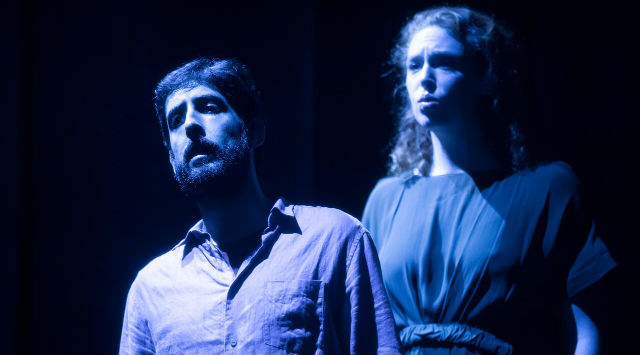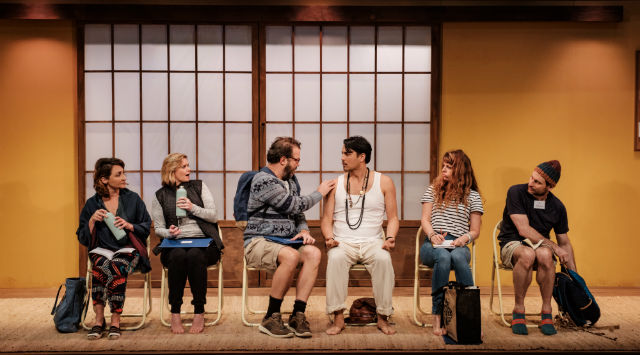
Review: Small Mouth Sounds (Darlinghurst Theatre Company)

Venue: Eternity Playhouse (Darlinghurst NSW), May 3 – 26, 2019
Playwright: Bess Wohl
Director: Jo Turner
Cast: Amber McMahon, Sharon Millerchip, Yalin Ozucelik, Jane Phegan, Justin Smith, Dorje Swallow, Jo Turner
Images by Robert Catto

Theatre review
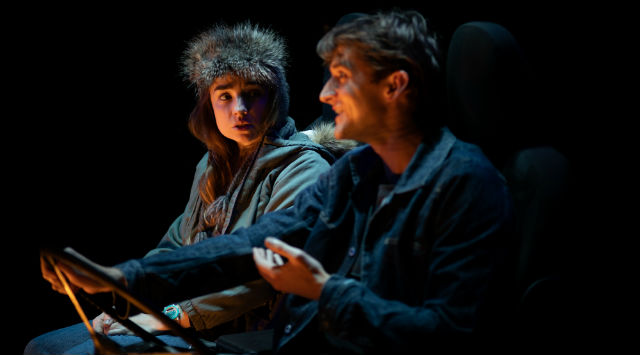
The story takes place at one of those spiritual retreats, where people spend days not talking, trying to access a state of deep meditation. Six characters in Bess Wohl’s Small Mouth Sounds gather at one such facility, each with their own set of problems, seeking prodigious revelations that could mean an instant moment of salvation, to release them from considerable pain. These personal tragedies, with all their human vulnerability and desperation, form the basis of Wohl’s comedy. Cynical but also honest, the play is distinctive for its scant dialogue, relying instead on actors’ physical capacities to chart a journey, through their amusing presentation of sequences that alternate between absurd and meaningful.

The show is often funny, always intriguing with its creative renderings of a unique theatrical concept. A clever cast works exhaustively for our entertainment, offering up personalities that are endearing, familiar and believable. While a cohesive team, each performer delivers their own memorable nuances, for a result that is surprisingly textured. Slightly less effective is Jo Turner’s voice playing the part of the unseen Guru, perhaps a tinge too obvious with his humour. As director, Turner’s enthusiasm is more well placed. There is an effervescence to the production that appeals, even if it does take some time to turn persuasive. Early sections have a tendency to feel forced, but our engagement improves incrementally over time, and when it wins us over, Small Mouth Sounds proves an enjoyable ride.

Jeremy Allen’s set and Jasmine Rizk’s lights make for a visually vibrant staging, but it is Tegan Nicholls’ work as sound designer and composer that truly impresses. In the absence of the usual voices that occupy our auditory attention, Nicholls fills ninety minutes with an intricate mix of sounds from nature, as well as an assortment of music and effects, to help manufacture a rich and magical experience of theatre. Our imagination is guided by her detailed ear, for subconscious manipulations that take us through a gamut of emotional responses.

The seekers in Small Mouth Sounds have big issues to wrestle with, but there is little poignancy to be found in their respective narratives. No great transformations occur as a result of their fleeting commitment in the countryside. It is a realistic conclusion to the tale, one that can feel somewhat empty, although its insistent refusal of a happy ending in the form of outlandish miracles, is admirable. There is great value in keeping silent and looking inward, but to expect enlightenment in an instant, is naive. When we hope to heal, we think about returning to an idealistic state of being, before the infliction of damage. It may be however, that all we can ask for, is to be able to move forward, with the minimum of encumbrance, even whilst bearing a soul full of scars.

www.darlinghursttheatre.com

Review: Russian Transport (Darlinghurst Theatre Company)

Venue: Eternity Playhouse (Darlinghurst NSW), Mar 9 – 31, 2019
Playwright: Erika Sheffer
Director: Joseph Uchitel
Cast: Ryan Carter, Rebecca Rocheford Davies, Nathan Sapsford, Hayley Sullivan, Berynn Schwerdt
Images by Jeremy Ghali, Nino Tamburri

Theatre review
The lives of a Russian family in Brooklyn are turned upside down, when a relative comes to stay. Ex-crim Boris’ arrival leads us to question if turning a new leaf can ever be a simple proposition, for those who have spent all their lives exposed to immorality. Erika Sheffer’s Russian Transport is a slow burn, with drama that starts to engage late in the piece. Its themes are intriguing, but the promise of philosophical resonance is subsumed by a narrative that can feel somewhat hesitant, with perspectives that are inadequately critical. The characters we encounter are fiery, but the play is oddly short of passion.

Designed by Anna Gardiner, the production bears a striking appearance, with a robustness that keeps our eyes active and involved. Joseph Uchitel’s direction ensures an energetic, quite raucous stage, but struggles to achieve meaningful cohesion between his actors for their story to really captivate. Rebecca Rocheford Davies and Berynn Schwerdt play mother and father, both actors imposing and dynamic, but are ultimately insufficiently convincing with their portrayals of two very complex personalities. Troublemaker Boris is on the other hand, a more obvious role, given appropriate vigour by Nathan Sapsford. The show is stolen by Ryan Carter and Hayley Sullivan, who bring life to teenage parts in Russian Transport. Sullivan’s ability to inject nuance into her 14 year-old Mira is commendable, and Carter’s exceptional fastidiousness and intensity as Alex, is responsible for the show’s most powerful moments.

The loss of innocence is eternally fascinating. In migrant families, that process of a teenager having to emerge into adulthood is additionally complicated, with influences and expectations coming from disparate sources, all simultaneously insisting on adherence. Alex and Mira are American kids, but Russia is in their blood. The play allows us to see the extent to which cultural heritage can dominate the development of our young. Even when we have the privilege of choosing where to raise your children, it seems inevitable that the baggage we had intended to leave behind, can so easily return to materially affect future generations. We have ghosts that are both good and bad. The challenge is our own ability to discern, before having them unleashed on our nearest and dearest.

www.fishyproductions.com | www.darlinghursttheatre.com

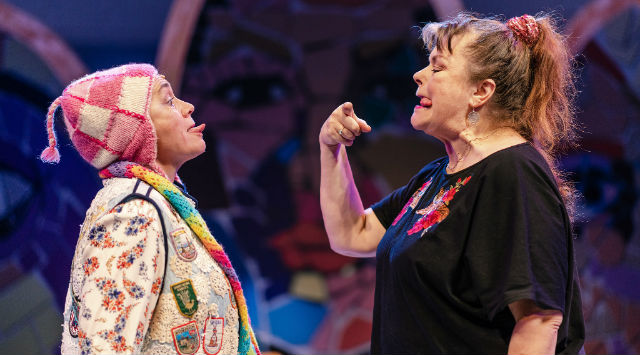
Review: The Rise & Fall Of Little Voice (Darlinghurst Theatre Company)

Venue: Eternity Playhouse (Darlinghurst NSW), Feb 1 – 24, 2019
Playwright: Jim Cartwright
Director: Shaun Rennie
Cast: Kip Chapman, Joseph Del Re, Geraldine Hakewill, Caroline O’Connor, Bishanyia Vincent, Charles Wu
Images by Robert Catto

Theatre review
Little Voice is the name of a young woman who spends her days and nights cooped up in a bedroom, listening to old records left behind by a father who had gone too soon. Her mother Mari too, has been unable to get over that death, hitting the bottle hard, and neglecting her all her responsibilities at home and in life. When it is discovered that Little Voice has an extraordinary ability to mimic the torch singers whom she obsesses over, we wonder if commercial success can finally lift the women out of their perpetual state of mourning.

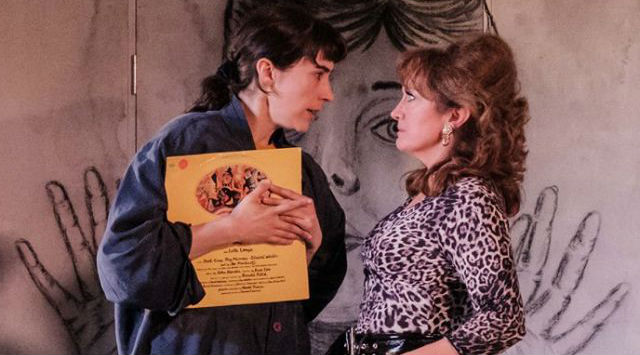
In Jim Cartwright’s The Rise & Fall Of Little Voice, colourful personalities deliver an amusing plot, buoyed by witty dialogue and the alluring promise of spiritual transformation. Actor Caroline O’Connor is scintillating as Mari, a lost but energetic soul, determined to find a man to rescue her from misery. O’Connor’s magnetism is the highlight of the piece, detailed and humorous; she keeps us totally engrossed. Geraldine Hakewill plays the eponymous role with an admirable intensity, particularly charming in her impersonations of Judy Garland, Marilyn Monroe and Billie Holiday, but it is arguable if her narrative arc is conveyed with sufficient power, for the show to sing with poignancy.

Ray Say is a pivotal character, the dastardly male who brings out the worst of Mari, and the best of Little Voice. Performed by an irrepressible Joseph Del Re, who makes his part vibrant yet surprisingly authentic, with a confident presence that never fails to secure our undivided attention. Also captivating is Kip Chapman, who takes on jester duties as Lou Boo, a club manager of disrepute, brilliantly quirky and very funny. Bishanyia Vincent and Charles Wu shine in their quiet roles (as Sadie and Billy, respectively), both tugging at our heartstrings with gentle restraint.

It is a sumptuously designed production. Isabel Hudson’s striking set cleverly addresses the play’s various requirements for locations, memorable for the use of obsolete audio tape in its rendition of a tinselled backdrop. Lights by Trent Suidgeest are often spectacular, appropriately splashy in this tale of show business and poverty. Sound design is thoroughly explored by Kingsley Reeve, who makes rich and enjoyable, the show’s important auditory dimensions. All these immense talents are brought to an elegant harmony by director Shaun Rennie, for a show that is perhaps less than the sum of its parts, but he does manage to create a consistently entertaining night of theatre, out of a lightweight piece of nostalgic writing.

We find it hard to be moved by Little Voice’s final realisation that she needs courage, because this revelation is of course, no revelation at all. It is true that a woman needs to learn how to roar, in a place that routinely robs you of your worth, but revenge is not the essence of Little Voice’s story. We become great, not because of bad men (or women), but in spite of them. The talents that she possesses had always existed, and to give her nemesis any credit for her burgeoning, is simply uninspired storytelling. The playwright insists that Little Voice is nothing without her father, her talent agent and her love interest. We know otherwise.

www.darlinghursttheatre.com

Review: Love (Darlinghurst Theatre Company)

Venue: Eternity Playhouse (Darlinghurst NSW), Nov 17 – Dec 9, 2018
Playwright: Patricia Cornelius
Director: Rachel Chant
Cast: Rose Riley, Anna Samson, Hoa Xuande
Images by Robert Catto

Theatre review
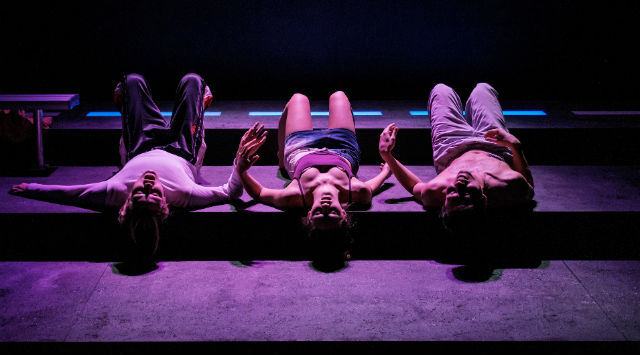
In a polyamorous relationship and loved by two, Annie can sometimes feel like the happiest girl in the world. Often, however, things can get very rough for this nineteen year-old. Both her lovers are addicts, and money from Annie’s sex work seems to go only toward their drug habits. Patricia Cornelius’ Love is a portrait of broken lives failing to find salvation from romantic union. It dispels the myth that love will save the day, revealing instead the way we bring our damage into relationships, more likely to tarnish the other, than to attain a miraculous harmony that we all crave.

We watch as flaws of the three compound, each person bringing increasing misery to the others, with Annie’s suffering especially severe as a result of this toxic merger of lost souls. Magnificent direction by Rachel Chant turns this desolate tale into incredibly compelling theatre; even if the personalities feel far removed from our middle class realities, Chant’s exhilarating rigour from beginning to end, insists on our engagement. Design elements are cleverly imagined, by the wonderfully concordant trio of Ella Butler (set), Nate Edmondson (sound) and Sian James-Holland (lights), for a production rich and sophisticated in its impact.

Actor Rose Riley is sensational as Annie, bold and very powerful in her depiction of premature womanhood. No longer naive but still heartbreakingly innocent, Riley’s ability to convey dignity for a character suffering piteous circumstances, is remarkable. The morally confused Tanya is given palpable complexity by Anna Samson, who convinces us quite astonishingly, of a destructive nature that seems unaware of its own capacity for evil. Lorenzo is a user with no real redeeming features, a simpler role performed with brilliant exuberance, and made thoroughly entertaining, by Hoa Xuande. Timing and chemistry between all performers, whether as a “throuple” or in assorted pairs, are marvellously harnessed for a relentlessly provocative show.

There is no right way to be in love, no matter what religions or other experts might say. We watch Annie, Tanya and Lorenzo go about their painful business, wondering if they had been better off separate, but we arrive at no conclusive answer. As the saying goes, “hurt people hurt people,” and when we think nothing good can come out of dysfunctional partnerships, we have to remember that loneliness is by definition unbearable, and most of us will enter into arrangements against better judgement, for no other reason than that we are human. The mind is rarely a match for the heart, or to coin another cliché “the heart wants what the heart wants”. Romance will make us suffer its consequences, but to deprive oneself of it, is no less tormenting.

www.darlinghursttheatre.com

Review: Maggie Stone (Darlinghurst Theatre Company)

Venue: Eternity Playhouse (Darlinghurst NSW), Sep 30 – Oct 21, 2018
Playwright: Caleb Lewis
Director: Sandra Eldridge
Cast: Kate Bookallil, Branden Christine, Alan Dukes, Anna Lee, Thuso Lekwape, Eliza Logan
Images by Robert Catto

Theatre review
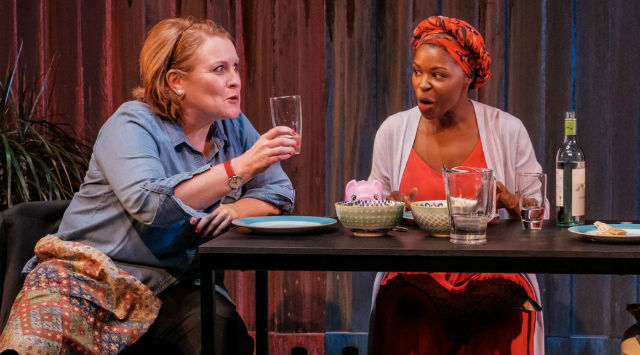
Maggie is a racist. We know this not only because we see her make racial insults about black people to their faces, but she also admits to not approving loans at the bank where she works, when encountering applicants who are of African descent. Maggie does not feel bad or embarrassed about her behaviour, and part of the pleasure of Caleb Lewis’ Maggie Stone, is to see white Australians being upfront about their racism. The main focus of the play however, is Maggie’s accidental embroilment in Amath’s life, after begrudgingly approving the latter’s loan application. Amath is a recent migrant from Sudan, struggling to make ends meet after the sudden death of her husband. When Maggie begins to see Amath as a real person deserving of compassion, the story turns into one of redemption and reconciliation.

It is hard not to see Maggie Stone as a play suffering tediously from white saviour complex, when a substantial portion of it features the unlikely heroine running around kicking down doors to help fix a black family’s problems, but its central message about white people having to transcend racial ignorance is never out of fashion. The themes are undoubtedly pertinent, but the mediocrity of its perspectives makes the show a predictable one. Everything about it feels derivative, and for a subject matter that is so much a part of our daily consciousness, its inability to proffer fresh or more sophisticated ideas, is disappointing.

The production is adequately assembled, and Sandra Eldridge’s direction, although lacking in innovation, keeps the action moving along swiftly. As Maggie, actor Eliza Logan is a very endearing presence, able to prevent us feeling too alienated by her character’s unforgivable qualities. Branden Christine brings conviction and integrity to her interpretation of Amath, a less than meaty role that has a tendency to feel perfunctorily, or maybe too cautiously, written.

Amath’s story is likely a better one to tell than Maggie’s, but Australian writers who can speak appropriately to that experience, are perhaps still in the process of being nurtured and discovered. When talking about race, it is not often that a white person can present something new to help make meaningful progress. Abolitionists of racism do not all have to be people of colour, but this is a job that cannot be done with black and brown people on the outside. It is a crucial point that none of the white characters in Maggie Stone prove themselves able to satisfactorily acquiesce space, in symbolic or practical ways, in this discussion about racial relations on this colonised land. There is an obvious desire for a clear conscience, but the hard work required of all of us, is not yet invested.

www.darlinghursttheatre.com

Review: The Secret Singer (Darlinghurst Theatre Company)

Venue: Eternity Playhouse (Darlinghurst NSW), Aug 28 – Sep 9, 2018
Playwright: Joanna Weinberg
Songs: Joanna Weinberg
Director: Joanna Weinberg
Cast: Genevieve Lemon, Kate Mannix
Images by Stephen Reinhardt

Theatre review
Jenny wants to sing in seven different choirs, one for each day of the week. It is a particularly unusual ambition, considering she has been unable to vocalise a single note in public, for the last ten years. When she reaches out to singing teacher Emjay for help, a deep connection instantly develops between the two, in Joanna Weinberg’s The Secret Singer, for a meaningful story about the fragile yet resilient human spirit.

Weinberg’s style as writer and director, is naive but tender, and her show, while not glossy with polish, is an uplifting and soulful work, that resonates with our indomitable capacity for hope. In the role of Emjay, performer Genevieve Lemon brings great warmth to the production; her earnest approach has the ability to convert any sceptic. Kate Mannix plays Jenny, with a gentle but effective humour, capturing our imagination with her confident interpretation of a very likeable character. Also noteworthy is Matthew Reid’s musical accompaniment on keyboard, impressive with its technical accuracy and emotional sensitivity.

To sing out loud, is to assert one’s position in the world. There are many who will want to silence others, and in that figurative stealing of voices, people are rendered powerless. It takes courage to sing, just as it takes courage to live with authenticity and joyfulness. Our communities can be supportive, but they can also be stifling. When choirs do their job well, all voices are heard, and no one is allowed to be drowned out. Harmony is not easy to achieve, but it is what our social selves must always strive for.

www.darlinghursttheatre.com

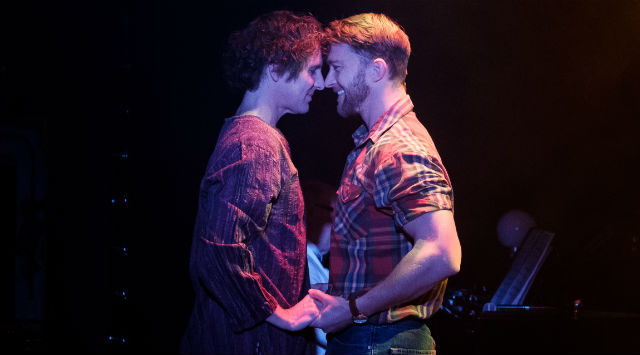
Review: Torch Song Trilogy (Darlinghurst Theatre Company)

Venue: Eternity Playhouse (Darlinghurst NSW), Aug 1 – 26, 2018
Playwright: Harvey Fierstein
Director: Stephen Colyer
Cast: Hilary Cole, Simon Corfield, Imraan Daniels, Tim Draxl, Stephen Madsen, Kate Raison, Phil Scott
Images by Clare Hawley

Theatre review
It is the perfect time to revisit Harvey Fierstein’s Torch Song Trilogy. The play premiered in New York 1982, right before the AIDS crisis crippled the LGBT community. Fierstein’s vision was full of hope, daring to see queer people break into the mainstream, with portrayals of gay men in serious monogamous relationships, thriving in family units that incorporate legally adopted children.

Almost immediately after the completion of this work, the LGBT movement experienced a setback of at least thirty years, finding itself in a new fight, in many ways even harder than before, with the world laying the blame of AIDS entirely on us. What had been a burgeoning era of equality post-Stonewall was all but decimated. Today’s revival is an appropriate resumption of progress; much of the West has now succumbed to the demand for marriage equality, and that discussion about marginalised identities gaining parity not only of rights, but also respect, can now once again be sincerely salient.

Actor Simon Corfield plays Arnold, a gay Jewish New Yorker, whose resilience forms the centrepiece of this saga. Corfield’s performance is often very moving; his depictions of suffering are absolutely enthralling, ensuring that the show’s politics remain foregrounded. Comedy aspects, however, are less consistently rendered. Kate Raison offers a redemptive energy boost, with her potent entrance in the third act as Arnold’s mother, restoring lustre to the play’s humour. Incidental songs are magnificently presented by Hilary Cole and Tim Draxl, accompanied by Phil Scott’s exquisite piano playing. Both singers use music to their magical advantage and leave remarkable impressions, enhanced by strong acting in their roles as Laurel and Ed.

The production can at times be insufficiently ebullient, but an authentic soulful quality permeates, and sustains, all the action. It is a visually sumptuous staging, boldly lit by Benjamin Brockman, whose extravagant approach for Torch Song Trilogy imbues it with a captivating sense of theatricality. There is a beautiful melancholy to director Stephen Colyer’s style that adds a richness to the play’s concerns; Arnold never dwells on his pain, but Colyer insists that we see all of it.

Back in the day, the idea that gay men could start their own normative family lives, was a completely subversive notion. Today, it can still be a surprising thought, although some of us are more taken aback, by the fact that any queer person would choose an existence that seems so ordinary. For LGBT people in places with adequate legal protection, our choices are broader than ever before. Some want to emulate their parents, others wish to break new ground, and most would probably find their peace somewhere in between the extremes. The whole point of this long battle, is so that people can become whomever they desire. Love thy neighbour as you love thyself, no matter how different they appear to be.

www.darlinghursttheatre.com

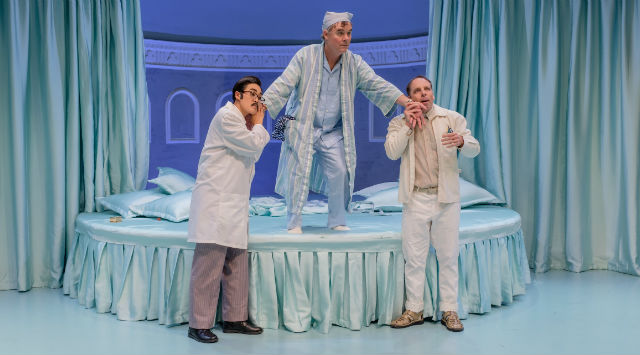
Review: The Hypochondriac (Darlinghurst Theatre Company)

Venue: Eternity Playhouse (Darlinghurst NSW), Jun 9 – Jul 1, 2018
Playwright: Molière (a new version by Hilary Bell)
Director: Jo Turner
Cast: Gabriel Fancourt, Darren Gilshenan, Sophie Gregg, Emma Harvie, Lucia Mastrantone, Jamie Oxenbould, Monica Sayers
Images by Robert Catto

Theatre review
Argan is convinced that he is riddled with disease. His wife Beline, has heard it all before, and tired of waiting for his death, is now plotting to steal his entire estate without the help of sickness to deliver the goods. Molière’s The Hypochondriac is given new interpretation by Hilary Bell, who makes adjustments to the language and story for yet another generation. The essence of Molière’s farce is retained, and it proves still to be effective and very enjoyable, but a more modern sensibility is introduced, most notably in terms of its women characters, who are now full of nerve and agency.

First glimpse of the production is impressive. Designer Michael Hankin’s set is an opulent creation, gloriously lit by Verity Hampson to convey both the wealth at the centre of Argan’s story, and the traditions from which it is derived. The show however, is slow to start. Energies are subdued, and a misplaced hush pervades much of the action, even if the cast looks to be raring to go. Things do fall into place however, when an air of chaotic ruckus that so defines the genre, eventually kicks in, to replace the strange tentativeness of its beginnings.

Performer Darren Gilshenan’s marvellous comedic presence makes him the perfect candidate for Argan; he brings to the role a rare combination of precision and raw impulse, keeping us firmly on track with the plot, but always feeling as though anything could happen, as is crucial in this style of live comedy. It is a thoroughly accomplished ensemble that takes the stage, and although chemistry in-between is not yet at perfection on opening night, each player is as enthused and skilled as the next, and we find ourselves fawning over all of their colourful characterisations.

Marriage is increasingly strange a phenomenon. As we move towards ever more rational forms of existence, the fact that people hold on to that ancient practice, is quite curious. Young ones in The Hypochondriac wish to have marriage legitimise their love, whilst their older counterparts think of marriage in direct accordance with the possession of property. Love and property can exist today independent of that institution, but we cannot help returning to it, maybe for its symbolism, or maybe we are simply always in search of something to make ourselves feel better.

www.darlinghursttheatre.com

Review: The Sound Of Waiting (Darlinghurst Theatre Company)

Venue: Eternity Playhouse (Darlinghurst NSW), Mar 31 – Apr 22, 2018
Playwright: Mary Anne Butler
Director: Suzanne Pereira
Cast: Reza Momenzada, Gabrielle Scawthorn
Images by Phil Erbacher

Theatre review
Hamed is stranded at sea with his small daughter, after having lost the rest of their family to explosives in their war-torn home. Escape is the only option, but with no apparent destination, their scurry can only be treacherous and agonising. Mary Anne Butler’s The Sound Of Waiting gives voice to those we term asylum seekers, whose stories are routinely exploited by politicians and media outlets for selfish gain. Here, however, we attempt to hear from the source, a first-person narrator untarnished by intrusions of our prejudice.

Also present is the Angel of Death, a mystical creature and a force of nature, but at times also a human enemy, who pursues Hamed, determined to annihilate. Both are in fierce opposition, but they speak almost in tandem, sharing a rhythm that drives the plot and action. Although in sync, the two characters develop in divergent trajectories, with Death always pulling attention away from our concern for Hamed. It is appropriate that they are not telling a cohesive story, and perhaps revealing, in the way director Suzanne Pereira allows a degree of distraction from the real tragedy.

Pereira’s work is powerful in its treatment of atmospherics. Together with Samuel James’ video projections and Tegan Nicholls’ sound and music, it is a spectacular collaboration that enchants the senses. Also very strong are both performers, Reza Momenzada and Gabrielle Scawthorn, who bring depth and intensity to the production. Momenzada’s ability in conveying authenticity is particularly valuable in this very contemporary tale of loss and hope.

Australia’s reaction to Hamed’s adversity is not explicitly written into The Sound Of Waiting. The audience is given a plain version of facts, so that our mettle is tested. It wants us to rise to the challenge of a compassionate response, which it accomplishes successfully. The consequences of war, as we see here, are undoubtedly bleak, but more significant is the play’s implication that compassion has become a challenge of our times, and although pervasive and banal, our cruelty is deplorable and deeply shameful.

www.darlinghursttheatre.com

Review: An Act Of God (Darlinghurst Theatre Company)

Venue: Eternity Playhouse (Darlinghurst NSW), Feb 2 – 25, 2018
Playwright: David Javerbaum
Directors: Mitchell Butel, Richard Carroll
Cast: Mitchell Butel, Alan Flower, Laura Murphy
Image by Phil Erbacher

Theatre review
The Christian God comes to deliver a new set of ten commandments in David Javerbaum’s An Act Of God. It is an intriguing proposition, that God would admit to being imperfect. He remains omnipotent, fret not, but this version of the Almighty concedes he had made some very big mistakes, and has decided that it is perhaps time, finally, to rectify two millennium worth of erroneous beliefs.

The play is a fascinating evaluation of religion, and its impact on all of us, regardless of where our faiths reside. It shapes our values, as they stand today, in contrast with outdated precepts that many still insist on upholding. The transformation of God into something closer to a modern day being, as opposed to a purely idealistic creature of fantasy, pushes Javerbaum’s humanist arguments with great efficacy, although the humour of An Act Of God can be inconsistently compelling. Directed by Mitchell Butel and Richard Carroll, the show is relentlessly effervescent, with a flamboyance that sustains our attention confidently, but the writing offers punchlines that seem overly polite within its raucous atmosphere.

Leading man Butel is near faultless in his portrayal of the big man himself, meticulous in approach, with expert timing in his delivery of every line, even when the jokes struggle to meet their comedic objective. Exposed and vulnerable, Butel has nothing to hide behind, in this very immediate staging of God’s presence, and the actor emerges triumphant with a brilliant display of sheer skill and grit. Also noteworthy are the many significant adaptations to the script, in its transposition from America to Australia. Presenting an Aussie version of the Lord above is a shrewd decision, proving so popular, one could hardly imagine any viable alternative.

An Act Of God does not attempt to change our minds about His existence, but it urges us to take responsibility for life on earth regardless. It wants us to give up any notion that the faults of the world are of hallowed design; we have to take charge no matter what we believe about prayer. There may not be any controversial or new ideas in the play, but it provides clarity to secular and religious conceptions of our being, that are often entangled and rarely identified with sufficient veracity. Whatever we wish to happen in the hereafter, our part in the now can never be taken lightly. If humanity is made in God’s image, what we are able to accomplish, must never be underestimated.

www.darlinghursttheatre.com