Review: Educating Rita (The Depot Theatre)

Venue: The Depot Theatre (Marrickville NSW), May 10 – 20, 2017
Playwright: Willy Russell
Director: Julie Baz
Cast: David Jeffrey, Emily McGowan
Image by Katy Green Loughrey

Theatre review
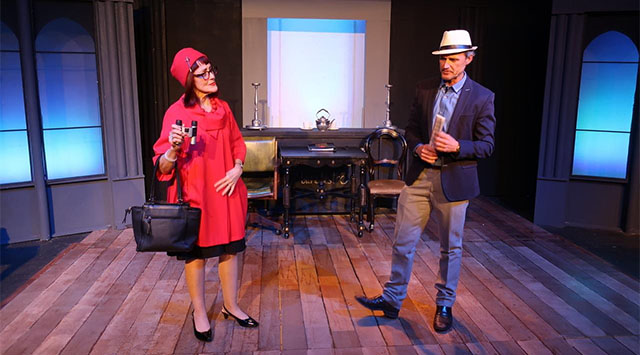
We meet Rita as she begins to realise her discontentment with banality. Going back to school, she wishes to make improvements to her life, although not entirely sure what a better existence should look like. Her tutor Frank on the other hand, is an alcoholic, and a poet who no longer writes. Both are subconsciously thinking “anywhere but here,” but only Rita knows to seek for answers in a productive way.

Willy Russell’s Educating Rita is about aspirations, and also, in its very British way, about class distinctions. Its humour relies on Rita’s lack of sophistication as a Liverpudlian hairdresser, but under Julie Baz’s direction, the characters speak as Australians, with our Rita in a broader, shall we say, working class type accent.

It is a bold decision that proves to be at times effective, and at others, quite awkward. The text mentions a slew of British places and personalities, and talks of Australia as a faraway country, so the production’s ability to assist with our suspension of disbelief tends to be inconsistent. However, the show remains otherwise attentive to the spirit of Russell’s writing, and we always feel that its heart is kept in the right place.

The actors take a couple of scenes to warm up, but when Emily McGowan gets comfortable in her role, Rita’s endearing qualities shine through, allowing us to engage with the play’s ideas and sentimentality. Both actors, McGowan and David Jeffrey, can on occasion slip into an unfortunate reticence with their parts, but when confident, their scenes become involving and quite amusing. Also noteworthy is Tim Linghaus’ music providing an air of melancholy appropriate to the characters’ inner worlds.

Rita and Frank cross paths, as they both embark on new trajectories. Life is change, but we do not have to think of moving up as the only meaningful way to achieve progress. We have to value the sense of surprise in all our narratives, just as we know to enjoy the simple straightforward increments in things we usually pursue. The universe will take us places, whether we like it or not. It is how we choose to understand them and delight in them, that makes all the difference.

www.thedepottheatre.com

Review: Black Is The New White (Sydney Theatre Company)

Venue: Wharf 1 Sydney Theatre Company (Walsh Bay NSW), May 5 – Jun 17, 2017
Playwright: Nakkiah Lui
Director: Paige Rattray
Cast: James Bell, Kylie Bracknell [Kaarljilba Kaardn], Tony Briggs, Luke Carroll, Vanessa Downing, Geoff Morrell, Melodie Reynolds-Diarra, Shari Sebbens, Anthony Taufa
Image by Prudence Upton

Theatre review
Charlotte worries about being too white, or to be more accurate, she carries shame about her life not being black enough. The blood in her veins is Aboriginal, but having been born into great privilege, she can only observe, what she considers an authentic black experience, from afar. In Nakkiah Lui’s Black Is The New White, we visit a wealthy black home, through what could be the whitest of storytelling genres possible, the Christmas family comedy.

The show is very funny. Indeed, the jokes do at times, sit on a level of superficiality characteristic of the format, but Lui’s relentless need to interrogate the state of Aboriginal politics allows her show to speak in any tone it wishes, while always retaining a gravity that justifies the exercise, along with providing an extraordinary level of intellectual involvement that keeps us firmly engaged. The work has a specificity that feels completely of the moment; its language, its concerns and its ideas are thoroughly modern. It articulates what we are thinking, but have hitherto been unable to discuss with great fluency. It allows the convoluted disarray of contemporary Aboriginal perspectives surrounding issues of colonialism, be magnificently displayed in all its unresolved vexations. The play is an important timestamp that chronicles the discontent inherent in today’s social dynamics, and a fantastic piece of entertainment with a surprisingly wide appeal.

Paige Rattray demonstrates excellent flair for the sardonic with Black Is The New White. Very pointed observations are made agreeable, and dark subject matter is turned satirical; we are all compelled to have a sense of humour, at Rattray’s insistence. Big conversations between its characters about Australian morality are finely gauged, so that we receive the full impact of what each person is saying. We analyse their upper-middle class lives as their stories unfold before us, but cannot escape shades of complicity, while we inevitably recognise ourselves in so much of the blistering dialogue.

A spectacular cast of nine is fiercely present, determined to enthral and educate. Each vibrant actor offers up a personality that is detailed and authentic, and we get to know them with extraordinary familiarity. Not all are picture perfect and several prove themselves to be quite nasty people, but we fall head over heels nonetheless. They are all very charming.

Charlotte is played by Shari Sebbens, a performer especially effective when things gets politically combative. The conviction she brings is impressive, leaving no room to doubt her very edifying intentions and desires. Melodie Reynolds-Diarra is commanding in her maternal role, incisive with her humour, but adoringly warm as leader of her pack. Remarkably elegant, she delivers some of the play’s biggest laughs with what looks to be little effort. The narrative’s pivotal parts of duelling fathers, are played mischievously by Tony Briggs and Geoff Morrell, both imaginative and effervescently confident with what they introduce to the stage. Their bickering is hilarious, and the actors’ chemistry as an unexpected pairing, is a highlight.

Set design is brilliantly conceived by Renee Mulder, who establishes five separate performance spaces within the interiors of a very glamorous house. Aesthetically refined and superbly functional (without relying on moving parts), it presents comfortable aspects to all seats in the auditorium, although decoration and costumes could benefit from a bolder, more adventurous style.

There are many ways to talk about race and Indigenous experiences, and in Black Is The New White, we find several of them co-existing. The joy of being able to partake in its pluralist approach to these difficult matters, makes the play uniquely refreshing. The people we meet have differing views, but they are all likeable. As audience, we are then given permission to agree with contradictory points of view, or at least, are encouraged to take moments to appreciate what our adversaries value. It is a messy affair at the Gibson household (complete with an epic food fight), and although the stories all conclude nicely, à la Hollywood (and Bollywood), the issues that had been brought up do not diminish. Money can solve many problems, as we witness at this spirited Christmas gathering, but it is how we move our rich resources around that will bring about the improvements we desperately need.

www.sydneytheatre.com.au

Review: Perhaps, Perhaps… Quizás (The Old 505 Theatre)

Venue: Old 505 Theatre (Newtown NSW), May 2 – 13, 2017
Playwright: Gabriela Munoz
Director: Gabriela Munoz
Cast: Gabriela Munoz
Image by Ricardo Castillo Cuevas

Theatre review
It is so sad when a woman is unable to find a man to marry her. When a man stays single however, the situation is not nearly as dire. In Perhaps, Perhaps… Quizás, Greta spends all her time lamenting her spinsterhood, and goes about creating fantasy weddings to escape her misery. It is a woeful context for a show, but when coming face to face with a sad clown, we discover the unique discipline that conflates depression with comedy, and makes everything work.

In art, we have to be careful about the messages we send, but we must also be authentic with how lived experience is represented. Gabriela Munoz’s work may be highly stylised, but the accuracy at which she presents her character’s feelings, persuades us to connect with the unquestionably real human emotion that is being recreated. For a moment, we put judgement aside and share in her melancholy.

Munoz is a funny lady, and her show is often hilarious. We laugh because we recognise the struggles she face, and also because so much of what she does, makes us feel uneasy. A significant segment involves audience participation, and one lucky viewer gets to be on stage for more than a few minutes to help Greta indulge in her craziest delusions. It is as unnerving as it sounds.

The best of theatre happens when safety nets are removed, and everything comes to life. Munoz’s face might be hiding under chalk white pancake, but she opens herself up to our incontrovertible presence, accepting and encouraging our input into her performance. The vulnerability is moving, and the fragility is beautiful.

The truth is that we are sad about Greta’s sadness, rather than her failure to find a mate. Some of us wish that she gets her man some day, and some of us wish that she finds something else more meaningful on which to expend her energy. Life promises so much, but for most of us, it gives so little. There is always more to want, but to be in love with what we do have, is how the days become a bit sweeter.

www.old505theatre.com

Review: Smurf In Wanderland (National Theatre Of Parramatta / Griffin Theatre Company)

>Venue: SBW Stables Theatre (Kings Cross NSW), May 2 – 13, 2017
Playwright: David Williams
Director: Lee Lewis
Cast: David Williams
Image by Brett Boardman

Theatre review
Life means little without passion. David Williams loves football, and he is here to tell us all about it, whether we like it or not. Smurf In Wanderland offers us more than a glimpse into the world of a football tragic, and while it may often be tedious for those of us who are sport-averse, Williams’ more general observations about Sydney life are truly valuable. He talks about modern city tribes, and all the silly things we do to feel belonged. There are attempts at explaining desire, the most potent yet bewildering of human qualities, looking at why we do the things we do, and the bizarreness of us all as a species.

There are moments of poignancy, fleeting yet memorable, including a sequence about the discontentment of those in Western Sydney, and our habitual postcode bias against those perceived to be less metropolitan. We delve into the fundamental masochism involved in rooting for teams when games will always insist on having losers. There is a lot to relish about Smurf In Wanderland, but it all lies beneath the surface. We are given an opportunity to understand our community better, but it is not always an enjoyable process. Sifting through Williams’ obsessive detailing of soccer fandom is fun for some, but exasperating for others. It is a story about us and them, told in a way that makes the ostracism it is concerned about, feel very genuine indeed.

As performer, Williams is charismatic and engaging., with a determination that forbids our attention from straying. His enthusiasm for the Sydney Football Club is a propulsive force that fills the stage with energy, and we must respond with anything but ambivalence. At the end of the piece, there will be individuals who experience fulfilment, and those who will feel worse for wear, but it is likely that all will share a fondness for the personality we had met.

The presentation breaks through the superficial walls we erect between one another. We imagine people to be different, as a way to validate our own existences, but we all exist in undeniable parallels. Our values may be different, but the lenses through which we view the world do not alter the world as it is. If art and sport are in opposition, then Smurf In Wanderland forces us out of our echo chambers and disrupts the silo effect, at least for one night. To love thy neighbour is easier said than done, but few things are as worthwhile an exercise.

www.riversideparramatta.com.au/NTofP | www.griffintheatre.com.au

Review: Big Fish (RPG Productions)

Venue: Hayes Theatre Co (Potts Point NSW), Apr 18 – May 14, 2017
Book: John August (based on the novel by Daniel Wallace and the screenplay by John August)
Music & Lyrics: Andrew Lippa
Director: Tyran Parke
Choreographer: Cameron Mitchell
Cast: Kirby Burgess, Seth Drury, Joel Granger, Brendan Godwin, Zoe Ioannou, Brenden Lovett, Phillip Lowe, Alessandra Merlo, Adam Rennie, Katrina Retallick, Brittanie Shipway, Aaron Tsindos, Zachary Webster
Image by Kate Williams

Theatre review
Edward Bloom spins yarns that only he can believe. He deals with reality using outrageous embellishment, but these tall tales have alienated his son Will, who struggles to connect with the man behind the illusions. Big Fish is about life and death, love and family, all the emotional stuff that make musicals work. A formula exists because it is effective, and here, we see all the obvious manipulations that get us to a predictable sentimental peak, yet we cannot help getting ourselves entangled in all of the Bloom family’s drama.

Dubbed the “12 Chairs Version”, this rendition may be streamlined, but director Tyran Parke brings a richness to the staging, with simple but exciting visuals that live up, surprisingly, to the story’s imaginative landscapes. The cast is buoyant and bubbly, determined to entertain. Leading man Phillip Lowe is fabulously charming, but problems with a throat infection seriously impair his ability to deliver the show’s many very grand showtunes. Instead, on hand to offer vocal magic is Adam Rennie in the role of Will, who is nothing less than sensational when the songs get chipper and stirring.

Women characters in Big Fish are often pathetically conceived, but the players do their best to bring life to their parts. Katrina Retallick takes the role of an embarrassingly docile mother, and turns her into a memorable figure; warm, generous and full of spirit. Her delivery of the heartbreaking “I Don’t Need A Roof” is a highlight, with Retallick’s performing talent proving to be the most captivating feature of the production. Also delightful is Brenden Lovett, simultaneously grotesque and adorable as circus ringmaster Calloway. The most over-the-top of Edward’s fantasies is also one of the most moving, when given the Lovett treatment.

We all know that our lives are finite, but we rarely think about how our deaths affect the way we live. We go about our daily business as though there is always tomorrow to worry about, but the unassailable truth is that death will come too soon. Edward was offered, as a child, a glimpse of his final moments, and what he saw was joyful. If we can all believe that what we eventually leave behind is going to be good, then our experience of today, must surely be replete with contentment.

www.bigfishaustralia.com.au

Review: Sex Object (Jackrabbit Theatre / The Depot Theatre)

Venue: The Depot Theatre (Marrickville NSW), Apr 19 – 29, 2017
Playwright: Charlie Falkner
Director: Michael Abercromby
Cast: Charlotte Devenport, Charlie Falkner, Andrew Hearle, Grace Victoria
Image by Omnes Photography

Theatre review
Ben is addicted to pornography, an increasingly widespread problem resulting from recent technological advancements, that have allowed unprecedented access to explicit sexual content. Unable to conduct a healthy relationship with his girlfriend, he decides to break things off, but Ron’s father has just passed away, and timing is a real issue. Charlie Falkner’s Sex Object may not be very sure about what it wishes to say, but its dialogue and characters are certainly amusing. We go on a delightful ride with the youthful foursome, entertained by the things they say and do, and even though we end up at a place quite unexceptional, the journey is ultimately a pleasing one.

The show is energetic, full of effervescence, and we are kept engrossed in each of its very chatty sequences. Director Michael Abercromby is determined to have interchanges occur with great exuberance, which holds the audience’s attention well, but it is doubtful if we ever find an opportunity to invest anything deeper than cheerful laughter. Falkner’s own performance as Ben is charmingly idiosyncratic, like a Millennial Woody Allen, struggling to make sense of his own world, while exposing the dysfunctions that we all share. Playing Gustav is the very funny Andrew Hearle, long-limbed and manic, prancing around the stage with uncontainable enthusiasm, and proving himself to be an awfully infectious presence.

The play beats about the bush, wishing to talk about sex in the modern era, but is unable to get deep and dirty with its ideas. Taboo subjects are by definition seldom discussed, and as such, we often lack the ability for their articulation. Not only do we lack the language, we lack the philosophy, because silence hampers how we communicate and how we think. It is clear that Sex Object wishes to interrogate something contemporary about our sexualities, at a time when technology and commerce are allowed to penetrate all that is intimate and private, but what it actually does say is insubstantial. In its inevitable and unintended prudishness, we receive instead a barrage of jokes, like children discovering sex, unable to appreciate it for its profundity, indulging instead in its many awkward and silly, although not unenjoyable, thrills and spills.

www.jackrabbittheatre.comwww.thedepottheatre.com

Review: The Sylph (Harlos Productions / The Old 505 Theatre)

Venue: Old 505 Theatre (Newtown NSW), Apr 18 – 29, 2017
Playwright: Jodi Rose
Director: Colleen Cook
Cast: Gertraud Ingeborg

Theatre review
The legacy left behind by the celebrated 19th century ballerina Marie Taglioni, can be found in the world of dance, but in Jodi Rose’s The Sylph, we come to meet with her in a play. Stories from her life are relayed directly, to an audience curious about Taglioni’s biography. When we see dancers, they are picture perfect. What we see is effortless, often sublime, with all that happens behind the scenes kept tightly under wraps.

The monologue provides information about Taglioni’s history, but there is little in terms of drama that could be gleaned. There are no great eruptions of emotion, no spicy scandals, and few dark secrets. It is a meaningful existence from a distant past, discussed with a simplicity that is perhaps underwhelming for a generation accustom to much more outrageous tales of unrelenting impropriety by famous types.

Gertraud Ingeborg is in the starring role, impressive and convincing with her physical expressions as ballet expert. The graceful beauty she brings to the piece is commendable, along with an undeniable strength in her presence that keeps us engaged. It is a flattering image of both actor and character that the show presents, under the directorship of Colleen Cook, who demonstrates an elegant and effective use of space, but the plot structure would benefit from greater effort in manufacturing a sense of tension for The Sylph‘s storytelling.

Female geniuses are consistently obliterated from our history books and our consciousness. Works like The Sylph are important in finding redress to this injustice. To know that women have achieved as much as, or more than, our male counterparts, is crucial to how we see ourselves today and how future generations will be able to live out their potentials. For women who wish to be great mothers and wives, there are plenty of success stories, but for the rest of us who desire anything else, we need every opportunity to encounter our predecessors.

www.old505theatre.com

Review: The Dog / The Cat (Belvoir St Theatre)

Venue: Belvoir St Theatre (Surry Hills NSW), Apr 13 – May 7, 2017
Playwrights: Brendan Cowell (The Dog), Lally Katz (The Cat)
Directors: Ralph Myers, Anthea Williams
Cast: Sheridan Harbridge, Benedict Hardie, Xavier Samuel
Image by Brett Boardman

Theatre review
We like to subscribe to the notion that there are cat people, and in a separate category there are dog people. This either/or dynamic could easily be applied to this double bill. Brendan Cowell’s The Dog and Lally Katz’s The Cat are both contemporary Australian comedies, but there is little in their respective senses of humour that unites them. Not to say that one is funnier than the other, for that judgement can only be a subjective one, but the probability of individuals enjoying one half of the presentation, and not the other (are you a cat person or a dog person?) is highly likely.

While Cowell’s work is a naturalistic exploration of today’s personalities and relationships, Katz’s approach is highly stylised, relying on surreal elements for its laughs. Both are filled with frothy, inconsequential observations that tell us nothing surprising, but there is certainly a lot of entertainment to be found in their dual presentation. Some of its jokes are genuinely funny, and when they are less than effective, the flamboyant cast invariably finds ways to make things work.

Benedict Hardie is wonderful, and perfect, in all three of his roles, determined that every word of dialogue is served with flair and purpose. Sheridan Harbridge and Xavier Samuel too, are delightful in the more outrageous comedy of The Cat, both in their element, and unimaginably creative with their artistic choices. On this stage, it is the acting that makes all the difference. Often, we could hardly care about what is being said, when enthralled in the masterful comedic performances so diligently bestowed upon us.

Laughing together in an auditorium beings us closer. We discover where we are similar, and remember that we are a community, sharing in life as compatriots and neighbours. So much of current discourse is about separation and hostilities. Even though the enemy is always abstract, we fall every day, for the allure of convenient condemnation. Theatre is essentially about camaraderie. We have to forsake our phones and isolation, just for a couple of hours, to sit, watch and listen, as one body, to react as one body to what is usually a reflection of ourselves. The Dog / The Cat brings us parts of being human that are silly, and in all that silliness, we are moved to recognise that the vulnerabilities of people are the same, and realise we can so easily just be there, and be good with one another.

www.belvoir.com.au

Review: Down An Alley Filled With Cats (Throwing Shade Theatre Company)

Venue: King Street Theatre (Newtown NSW), Apr 25 – May 8, 2017
Playwright: Warwick Moss
Director: Tom Richards
Cast: Gabriel Egan, William Jordan
Image by Andrew Langcake

Theatre review
Simon and Timothy are a couple of dishonest types, who let greed take control of their destinies. It is true that most of us use material gain as a guiding force to navigate through daily life; many of our decisions are made with monetary benefit in mind, and little else is allowed to interfere. Down An Alley Filled With Cats by Warwick Moss takes place in a bookshop, where knowledge and intellect occupy physical space but the printed pages fail to form a positive influence on the men who read them.

The play is interested in the relationship between philosophy and the actualities of existence, but that idea is a mere suggestion that backs down from the show’s need to be a straightforward comedy about crooks trying to outsmart each other. The production is tentative and under-rehearsed, but its players, Gabriel Egan and William Jordan demonstrate a strong conviction that sustains our attention, with Jordan’s more nuanced approach providing much needed texture to an often unimaginative staging of the work. Laughs are delivered sparingly, but the narrative, and its several plot twists, are relayed with sufficient clarity.

Good and bad are simple dichotomies, presented as absolute oppositions that demand our moral propriety. When we choose right from wrong however, grey areas are discovered, or perhaps manufactured, and one person’s morality becomes another’s transgression. Evil exists, but they are always in other people. Bad people are never ourselves. The way we justify any action is always completely reasonable at the time, and in order to satisfy selfish desires, conscience is easily brushed aside. In Down An Alley Filled With Cats, even the learned do sin. When all the books in the world offer us no salvation, humanity must be at a point beyond hope and repair.

www.throwingshade.com.au

Review: Trade (Hurrah Hurrah / The Old 505 Theatre)

Venue: Old 505 Theatre (Newtown NSW), Apr 4 – 15, 2017
Director: Alison Bennett
Cast/Devisers: Alison Bennett, Dymphna Carew, Alicia Gonzalez, Mathias Olofsson, Melissa Hume
Image by Maria Hansson

Theatre review
Corporations exist to make money for its stakeholders, that much is clear. Everything else they claim to do, are undertakings that must be taken with a pinch of salt. In Trade, we examine the nature of these organisations, and their perennial pretensions around social responsibility. If the point of their existence is to maximise profit, we must always hold a sceptical attitude toward their altruistic proclamations. It is a culture that defines itself by taking more than it gives, so our interactions with businesses should always be cautious, and if their people are anything like the vile characters in Trade‘s fictitious world, then the state of our affairs is very grim indeed.

The piece looks exaggerated, but what it communicates feels absolutely real. Its theatrical language is inventive, absurd and hyperbolic; the story is told with faces and bodies in a completely anti-naturalistic way, and through its performance art approach, we discover a surprising accuracy in its grotesque portrayal of greed and megalomania.

Alison Bennett’s direction is spectacularly entertaining while maintaining a raw unconventionality. In the absence of a complex narrative, details are located instead, in all the deliberate gestures of the five flamboyant players, each one presenting their own version of the unhinged corporate cannibal. Elaborate sequences involving an energetic ensemble and its strange movement vocabulary, keeps us fascinated and thoroughly amused. Their cohesiveness is deeply impressive, and the most persuasive element of the show.

It is a strong message that Trade wishes to impart, but for all its passionate assertions, what we do eventually leave with, is a simple and unoriginal idea about the darker sides of humanity. Also less satisfying, is the deficiency in commitment to visual design of the production. The audience’s eyes are thoroughly engaged in this dance of anthropological ugliness, but little is on offer when our sight shifts beyond the performers.

It is easy to want to participate in life with the principle of “eat or be eaten”. We can think of our capitalism as being fundamentally and inevitably cruel, and then allow ourselves to do harm unto others, to keep from falling prey to those who run faster. The fear of not succeeding can be overwhelming, and the voracious appetite for an unending more, is a force that few of us can hide from, but surely there must exist something more generous and compassionate, if not entirely more blissful, in a way of life that is abundantly honest and, dare we say, pure.

www.hurrahhurrah.com.au