Review: Revolt. She Said. Revolt Again. (House Of Sand)

Venue: The Old 505 Theatre (Newtown NSW), May 2 – 19, 2018
Playwright: Alice Birch
Director: Charles Sanders
Cast: Violette Ayad, Anna Cheney, Enya Daly, Richard Hilliar, Moreblessing Maturure, Eliza Sanders
Images by Jasmin Simmons

Theatre review
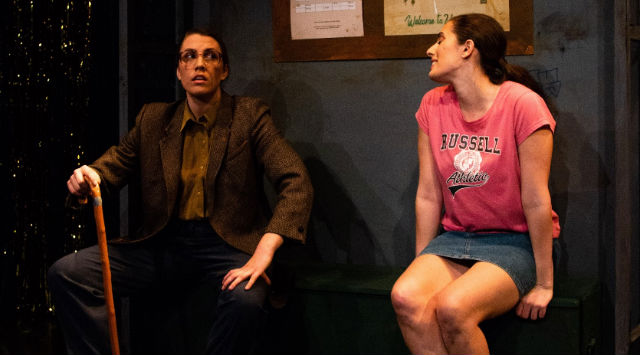
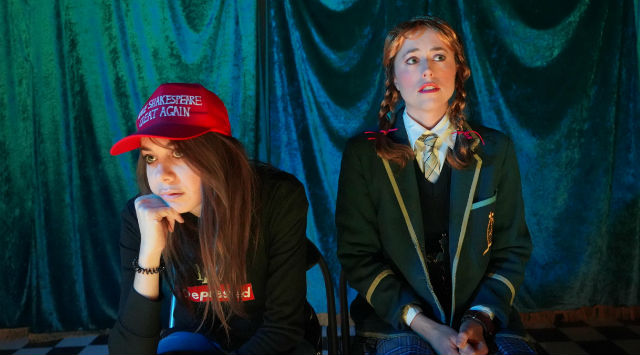
The play begins as though a manual providing instruction on becoming a radical feminist, offering steps of revolutionary action to attain some kind of ideal state of being. For those who understand their subjugation, the idea of taking down the powerful is always appealing, but the truth remains, that vacuums are nonviable and breaking something down requires the installation of something new. Alice Birch’s Revolt. She Said. Revolt Again. is a thrilling ride for anyone with a taste for rebellion. Its militant spirit is seductive, with powerful declarations that will excite those similarly inclined. The piece evolves unexpectedly, introducing in later portions, complexities that confront its own passionate proclamations of earlier scenes. Birch wants us mobilised, but in a smart way. Activism cannot thrive only on impulse. Long term strategies must accompany courses of action, or we risk ending up at a place worse than before.

The show speaks resonantly, with director Charles Sanders’ intellect a fortifying authority that establishes clarity for all its arguments. The politics in Revolt. She Said. Revolt Again. are made compelling by Sanders’ palpable enthusiasm for the subject matter, and their insistence that we hear its messages, translates into excellent drama. Design style is fairly simple for the production, with Joanne Joy’s visual projections particularly effective in helping to assert some of the highly provocative concepts.

All six performers for the piece are impressive, each one given ample opportunity to put on display their individual talents, as well as a unifying and admirable conviction pertaining to the material at hand. Eliza Sanders imbues her lines with authenticity and precision, delivering a delightful acerbity with every utterance, and equally memorable for her disciplined physical expressions. The imposing figure of Moreblessing Maturure is accompanied with a tender vulnerability, especially convincing in a maternal role, conveying unassailable qualities of our humanity with beautiful restraint and confidence. The lone thorn among the roses is Richard Hilliar, whose comedy hits all the right notes, whether understated, madcap or frighteningly bombastic. Violette Ayad and Enya Daly bring emotion when we least expect it, creating additional dimensions to an already rich work, and Anna Cheney’s ability to oscillate between realism and the flamboyantly bizarre, has us fascinated and entertained.

Anarchy may not be the answer we need, but the power of resistance must never be underestimated. Revolt. She Said. Revolt Again. is full of inspiration, for those of us who recognise the concerns that it raises. Revolutions must start somewhere, and the personal can be the site on which we begin positioning the battleground. Warriors have the capacity for long, hard slogs, and they understand that to suffer the pains of combat, far surpasses the unbearable torment of injustice. Fights are best undertaken when there is light at the end of tunnel. In the business of social activism, soldiers will get beaten down every day, but a resilient optimism is the key conspirator, to the ability to know right from wrong.

www.houseofsand.org

Review: Youth And Destination (Manifesto Theatre Company)

Venue: Kings Cross Theatre (Kings Cross NSW), Apr 27 – May 12, 2018
Playwright: James Raggatt
Director: James Raggatt
Cast: Jack Angwin, Georgia Blizzard, Gloria Bose, Julia Christensen, Maree Cole, Skyler Ellis, Alex Malone, Bardiya McKinnon, Nikita Waldron, Ross Walker
Images by Emily Havea

Theatre review
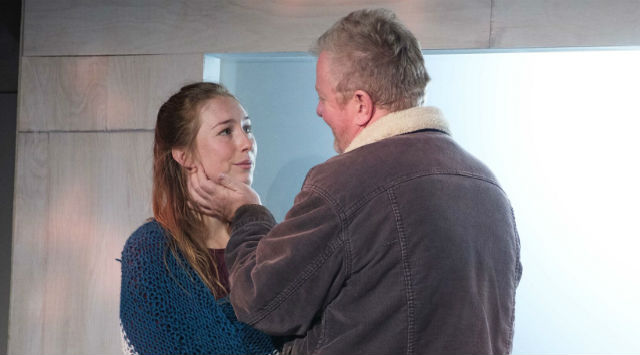
There is no conventional narrative in James Raggatt’s Youth And Destination, only a series of short sequences that offer insight into his young mind. The brevity of scenes allows the playwright to touch on a broad range of topics over the course of an hour, but the format prevents sufficient depth from being reached, aside from occasional dialogue that might inspire a sense of intrigue that encourages us to see beyond the mundane.

There is much to admire in the young; they are often inquisitive, passionate and fearless. Wisdom, although never restricted to the mature, can however be elusive. On this occasion, thoughts expressed are honest and very earnest, but the lack of life experience is evident, and Raggatt’s attempts at circumspection will not be able to satisfy every member of audience. Some nonetheless, will see themselves accurately reflected, in this work by young people, for young people.

An exceedingly pleasant group of actors prove themselves accomplished, with no fiction to perform but instead, putting on stage a convincing semblance of the self. In the absence of more complex story lines, their task is to make compelling, snippets of modernity, whether banal or extraordinary. Star of the show is not an actor, but lighting designer Martin Kinnane, whose aesthetic inventiveness and technical excellence, bring to the production a necessary polish, along with rigorous calibrations of mood, from scene to scene.

The young can tell us so much about the world, but pinning down the meaning of life, is not usually their strongest suit. Youth And Destination is a sensitive work, slightly overcautious with how it wishes to be perceived. Whether young or old, we all have to grapple with how others look upon us; we are so fundamentally social. It is incumbent on the artist however, to be courageous, and to always be revealing of their own truth, especially that which is unique and idiosyncratic in quality. Few can claim to speak for communities, but when we return to the individual in an exhaustive and meticulous way, what we say about the personal can become unimaginably significant.

www.kingsxtheatre.com.au

Review: Carmen, Live Or Dead (Oriel Entertainment Group)

Venue: Hayes Theatre Co (Potts Point NSW), Apr 28 – May 13, 2018
Music & Lyrics: iOTA
Book: Craig Harwood
Director: Shaun Rennie
Cast: Natalie Gamsu, Stefanie Jones, Andrew Kroenert
Images by David Hooley

Theatre review
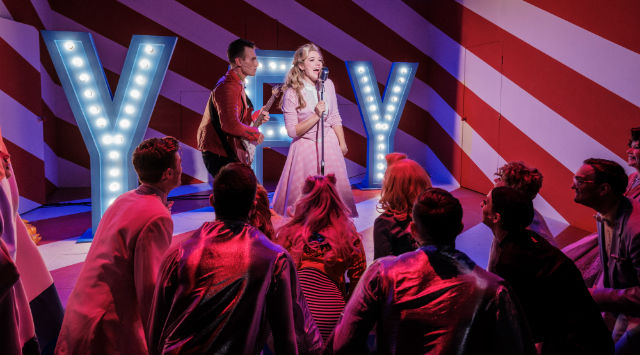
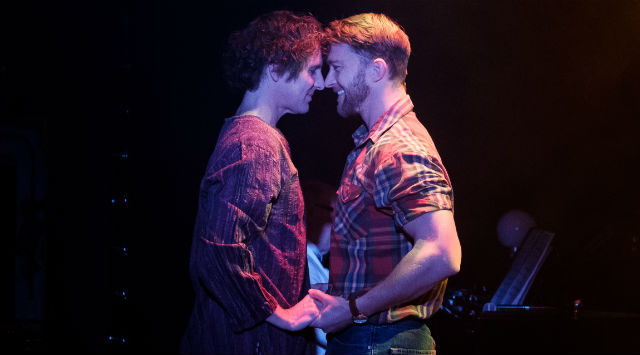
It is true that Frida Kahlo had had an affair with Soviet politician Leon Trotsky, but it is entirely fictional that a lovechild was born as a result of that brief relationship. Nonetheless, Craig Harwood’s vividly imagined Carmen, Live Or Dead almost has us believing in its fantasy, that Kahlo’s offspring does exist, and that Carmen Frida Leon Davidovich had once lived in Australia.

It is an appealing fabrication; the idea that Kahlo’s magnificence lives on beyond her legendary paintings, and Harwood does create a persona that is as colourful and spirited as any fan could wish for, even if the writer’s plot structure has a tendency to be unnecessarily convoluted. Prominent in the presentation, are eight original songs by iOTA, all of them charming, often very quirky in style, and thankfully not too derivative of the Broadway genre.

Visually sumptuous, the production features a whimsical set, exquisitely decorated and painted by designer Dann Barber, evoking quintessential Mexican beauty, alongside enchanting imagery that pays tribute to the art of Kahlo. Benjamin Brockman’s lights are sensual and alluring, providing a sensation of transcendence that convincingly elevates the theatrical experience, whilst retaining its delicious and unique aura of street-smart griminess.

Director Shaun Rennie manufactures a series of captivating moods, allowing every scene to intrigue, with moments of visceral engagement that leave an impression. Performer Natalie Gamsu is a warm presence who shines in each song, but the character being portrayed does not always feel authentic; her true emotions are elusive and the connections we make can feel tentative. Stefanie Jones and Andrew Kroenert provide musical accompaniment, as well as actorly support, both accomplished with their contributions, for a show memorable for the surprising effectiveness of its restrained approach to instrumentation.

Carmen announces her impending death early in the show, inviting us to partake in flashback summations of her life and times, that constitute this piece of musical theatre. We are also inspired to consider our own deaths, and how our individual stories will eventually be told. Footprints will fade, but nothing matters more than how much good we are able to leave behind.

www.carmenliveordead.com

Review: The Lieutenant Of Inishmore (New Theatre)

Venue: New Theatre (Newtown NSW), Apr 24 – May 26, 2018
Playwright: Martin McDonagh
Director: Deborah Mulhall
Cast: Lloyd Allison-Young, Michael Becker, Alice Birbara, Steve Corner, Angus Evans, Patrick Holman, James McCrudden, Nicholas Sinclair
Images by Bob Seary

Theatre review
It is 1993, and the threat of devastating violence in Northern Ireland is a daily reality. Groups are formed, and re-formed, in accordance with shifting political ideals that deliver little more than bloodshed and suffering. Martin McDonagh’s The Lieutenant Of Inishmore first appeared in 2001, only a few years after the abatement of conflict, when the memories of terror were still fresh, and the play’s comedy is therefore, predictably dark.

Also completely absurd and deeply ironic, a narrative is built around Padraic, a homicidal maniac who kills in the name of nationalism, and the very unlikely soft spot he has for Wee Thomas, the pet cat at home. Blisteringly funny, the sardonic The Lieutenant Of Inishmore deals with real life trauma, by channelling the senselessness of recent history through heightened humour, into a digestible form. Every time we laugh at a joke, we are required to reflect on the wounds to which it refers, and in that process find a way to reach an understanding, of things too difficult to find psychological and emotional resolution for.

Director Deborah Mulhall sets the tone perfectly, for an outrageous ride of a show. The bold comedy is as enjoyable as it is thought-provoking, and our communal laughter works to create a sense of unity around the play’s discussions of terrorism and war. A delightful cast keeps us amused from the very start, when the formidable duo of Patrick Holman and James McCrudden open the production with an energetic confidence and delightful eccentricity. Chemistry between the two is nuanced and tenacious, and thoroughly enjoyable to the bitter end. Lloyd Allison-Young is a very compelling leading man, incisive in his portrayal of Padraic. Inventive and charismatic, with an enviable knack for comic timing, he lands every punchline with finesse and flair.

The story is ridiculous, but we leave the theatre thinking its wild fiction is no stranger than the truth. As we grapple with the idea of children in foreign lands being bombed, and of our neighbours being arrested for charges of terrorism, we often experience disorientation and confusion, as though the world had been turned upside down. We try to install order into things to form a semblance of logic, because information must be arranged to cohere somehow, for the alternative of ignorance and apathy is unforgivable. So much of how we are is bizarre, and bizarrely inhumane, but even when we are unable to locate the reasons for our atrocities, to prevent them from occurring must always be fundamental to who we are.

www.newtheatre.org.au

Review: Still Point Turning: The Catherine McGregor Story (Sydney Theatre Company)

Venue: Wharf 1 Sydney Theatre Company (Walsh Bay NSW), Apr 21 – May 26, 2018
Playwright: Priscilla Jackman
Director: Priscilla Jackman
Cast: Nicholas Brown, Andrew Guy, Chantelle Jamieson, Ashley Lyons, Heather Mitchell, Georgina Symes
Images by Philip Erbacher

Theatre review
For those of us who are transgender, the experience of life is always a little bit extraordinary. Radically othered, by virtue of the fiercely homogenising quality of gender, there is a part of us that cannot help but perceive things from the periphery, whether we feel ourselves to be accepted or marginalised. Catherine McGregor is a media star, in many ways Australia’s answer to Caitlyn Jenner, both sixty-something, both extremely privileged and established in their professional fields, and both coming out as trans in spectacular fashion in the 2010s. They are not trailblazers by any means, for we have existed since the dawn of humankind (assuming gender had existed from the very beginning), but their stories coincide with a particular time in Western history, when being trans is suddenly a thing to celebrate.

This new interest in our identities contains unquestionably, a hint of the freak show; we often find ourselves a curiosity that everybody else feels as though they finally have license to poke and prod at. It can be argued however, that we are the ones who have demanded attention be paid to our difference, in this, for many, lifelong battle for approval and recognition. In Priscilla Jackman’s Still Point Turning, a delicious balance is struck, in which the object of our gaze is simultaneously accommodating and commanding. The audience is intrusive, but at the protagonist’s insistence. She proclaims to not want the responsibilities of being a poster-girl for the movement, but presents herself with blunt candidness and a fearless embrace of the prying spotlight. The work is “based on interviews with Catherine McGregor”, and she is very forthright with her disclosures.

It is a political and benevolent act, but also narcissistic (as she admits), and that seemingly dissonant combination provides a potent vitality for playwright and director Jackman, whose creation here proves to be a remarkably rich piece of theatre. The show satisfies our need for the sordid and gossipy, allowing us into the profoundly personal struggles of a public figure, whilst offering some of the most informative and thought-provoking content of any biographical account. For a play about a personality whose interests are in sport and the military, Still Point Turning is perhaps surprisingly entertaining, relentlessly so, but its true value is in its frank and unembellished, and thus rare, depiction of a transgender experience.

We may not have arrived at a point where a story of this nature does not bear the burden of having to make that desperate plea for understanding, and we find McGregor’s suffering often occupying front and centre of the stage (alongside her charming sense of humour) but it is noteworthy that the show does go quite a distance beyond an exploitative depiction of trans tragedy. Societal progress can be observed in its ability to discuss its issues inquisitively and genuinely, offering perspectives that are less emotional and more sincerely exploratory. For audiences of all persuasions, the play’s statements and contemplations about how each of us negotiates gender (and other identity markers or constraints) is a rewarding opportunity for deep reflections about our places in social life; who we think we are, how we wish to be perceived, and the things we do to create a persona that each can be personally content with.

The production is passionate and polished, with clever lighting by Nick Schlieper creating comfortable shifts between time and space, whilst helping contain an unnecessarily large performance area. Music and sound by Steve Francis are conventional but highly effective in their calibrations of atmosphere. Designer Michael Scott-Mitchell’s costumes are simple but very smart, with the lead’s pristine white Carla Zampatti suit a breathtaking, memorable design feature.

Actor Heather Mitchell delivers a brilliant performance in the starring role; intelligent and insightful with her dramaturgy, impressively precise, bold in presence, and gloriously funny. Eminently convincing and disarmingly charismatic, we cannot take our eyes off of her. Her Catherine is fascinating and delightful, and we almost wish for the show not to end, if only to retain her company. A supporting ensemble of five effervescent players add to the fun, each one independently compelling and endearing, but wonderfully cohesive as a team, thick as thieves and marvellously engaging.

Even though Catherine McGregor has accomplished a great deal in her illustrious life as journalist, cricket commentator and military officer, the woman presented in these 100 minutes of Still Point Turning is defined principally by her transness. Whether or not this is an accurate depiction of McGregor’s own truth, it is an intriguing proposition that one’s fundamental sense of identity can be so firmly attached to ideas of gender. It is perhaps a consequence of unyielding persecution, of oppression and cruel humiliation, that what should only be an incidental element of a person’s being, is turned into a subsuming component.

McGregor puts blame on no one, talking only about transphobia as a personal demon, but the undeniable truth remains, that when we harm ourselves, it is always a result of conditioning by the outside. It is easy to think of McGregor as a person who has it all, and as such, we require that she expresses only humility and gratitude. However, the prejudice that all trans people continue to be subject to, range from insidious to barbaric. It is pervasive, even in progressive regions, and there is no doubt that we must always take the opportunity, to step up to defend the rights of our transfolk. To be visibly trans is crucial to our progress, and Cate’s indomitable capacity for attention, is to be admired and more importantly, emulated.

www.sydneytheatre.com.au

Review: Get Her Outta Here (107)


Venue: 107 (Redfern NSW), Apr 19 – 21, 2018
Creator: Isabella Broccolini
Cast: Isabella Broccolini
Images by Phil Erbacher

Theatre review
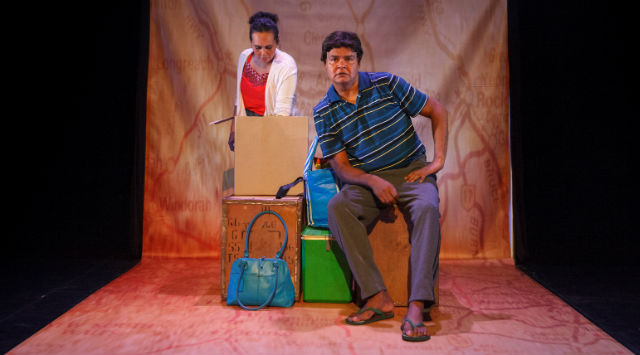
Isabella Broccolini is the lady in red, swathed in an uncompromising colour representative of all things fiery. We see a picture of obstinacy, a woman of dogged determination making single-minded statements about selfhood, and of identity in general. Her red suitcase never leaves her side, like a snail with her home attached, adding to the image of tenacity, but symbolising discontentment, in a performance piece that seems to talk a lot about the unexpected duality of perseverance and relocation.

Get Her Outta Here is wonderfully engrossing, fuelled by the inexorable presence of its creator. Broccolini’s physicality is confident and powerful, with an idiosyncratic style to its movement that has us captivated. Her body is untethered to the homogenising nature of dance training, but offers a clarity and strength to what it wishes to convey, as though disciplined in accordance with her own ideals.

The work is abstract, beautifully so, and audiences will interpret it how they wish. When art refuses to be obvious, it runs the risk of leaving us apathetic, but Broccolini’s enigmatic (and often very funny) approach is deeply alluring. We find ourselves opening up to her, allowing her obscure expressions to provoke and inspire. Music by Grace Huie Robbins moves the show through its various phases with excellent effect, creating shifts in dimensions that help enrich our imagination. Lights however, are under-explored and regretfully monotonous, for a production that is otherwise an aesthetic delight.

Broccolini’s speech is coy, but glimpses of honesty are revealed in her storytelling, to help our minds assemble a sense of truth for the red lady. Under the quirky and jokey, almost camp, deflecting exterior, lies a distinct rage, drenched in blood, perhaps too gory to expose unadorned. Get Her Outta Here is a woman’s fight with territory, even as she resists every place that she finds herself. Outsiders wish to be anywhere but here, and for us, the cliché is especially true, that it is the journey, and not the destination, that fulfils. Our project of reclaiming and redefining space, is not yet able to afford any room for complacency. For the time being at least, the red lady’s adventures with her red suitcase shall not cease.

www.107.org.au | www.isabellabroccolini.com

Review: The Flick (Outhouse Theatre)

Venue: Seymour Centre (Chippendale NSW), Apr 5 – 21, 2018
Playwright: Annie Baker
Director: Craig Baldwin
Cast: Justin Amankwah, Matthew Cheetham, Mia Lethbridge, Jeremy Waters
Images by Marnya Rothe

Theatre review
Almost every cinema in the world has completed the transition from analogue to digital, and with it comes aficionados bemoaning the loss of authenticity and tradition, in an art form that touches the lives of all. In Annie Baker’s The Flick, not only is celluloid under threat of annexation by blu-ray, the employees at a small picture house have friendships that are challenged by what they think to be real or illusory. They spend days together, becoming increasingly intimate, but always conscious of the distances between. They experience comfort in each others’ presence, but trust is never a certainty. When push comes to shove, the surprise of betrayal rears its ugly head, and like the technology in their projection room, convenience and cost takes precedence.

The play is beautiful in its sensitivity, and wonderfully humorous. Development of its characters and relationships, are cleverly written, replete with nuance and acuity. Dialogue is amusing and brilliantly observed, with contemporary colloquialisms thoughtfully utilised, for an accurate reflection of Western society at this very point in time. These people may or may not be familiar, but we always know exactly how they feel. For cinephiles, The Flick‘s obsessive enthusiasm with film culture, is a very big added bonus.

It is a glorious set, designed by Hugh O’Connor and constructed by Rodger Wishart, thrillingly realistic in its replication of the typical interiors of a movie theatre. Music paying tribute to genres of film, are meticulously crafted by Nate Edmondson, who also creates a variety of unmistakably unique sounds, in the form of whirrs and purrs to be heard emanating through the walls whenever we congregate for a movie. Martin Kinnane achieves a surprising range of atmospheric modifications with his lights, and has us transfixed with the unusual perspective offered by having us looking, wrong way round, into the projector lens, watching rays instead of images that have accompanied us hundreds, if not thousands, of times before. Led by stage manager Steph Kelly, technical aspects are remarkably well managed for this production of The Flick.

Directed by Craig Baldwin, the show is full of resonance; comical, whimsical and emotional. Chemistry between actors is masterfully harnessed, for a thoroughly honest and genuine depiction of social dynamics in The Flick. Actor Justin Amankwah is convincing, and very charming, in the role of Avery, the withdrawn youngster who loves movies more than he does any human being. His minimal, but precise approach gives depth and intrigue to the story, with a portrayal of mysterious qualities that has us captivated. Also very entertaining is Jeremy Waters as Sam, the Gen X slacker who finds himself suddenly older but not much wiser. It is an endearingly animated performance by Waters whose nuances are a joy to watch, and whose confidence with punchlines delivers some excellent laughs. Mia Lethbridge plays Rose the projectionist, with a delightful playfulness that prevents the less than agreeable character from becoming too alienating. The three form a tight partnership, and even though the show does extend to the three-hour mark, we never tire of their company.

The Flick is completely satisfying, but there is no question that in it, people are disappointing. Avery’s adoration of Hollywood is a reflection of his idealism, and his struggles in engaging with real life can be considered in terms of society’s deficiencies, or we can think of it as Avery having problems understanding the world as it actually is. Accompanying the cynicism in Annie Baker’s play, is our unambiguous desire for virtue. The stories we tell may not always be happy and uplifting, but they invariably contain our eternal faith in things that are good. Although new films no longer come to us on film, nothing will stop us from imagining better lives and better worlds, in all our arts and sciences. Of humanity’s many flaws, our naive belief in progress seems forever invincible.

www.outhousetheatre.org

Review: Sami In Paradise (Belvoir St Theatre)

Venue: Belvoir St Theatre (Surry Hills NSW), Apr 1 – 29, 2018
Playwright: Nikolai Erdman (adapted by Eamon Flack and the company)
Director: Eamon Flack
Cast: Paula Arundell, Fayssal Bazzi, Nancy Denis, Charlie Gerber, Victoria Haralabidou, Marta Kaczmarek, Mandela Mathia, Arky Michael, Yalin Ozucelik, Hazem Shammas, Vaishnavi Suryaprakash
Images by Clare Hawley

Theatre review
In a refugee camp, life is cheap. Its inhabitants are essentially stateless, treated like human waste; unwanted and despised by the world. When word goes out that Sami is contemplating suicide, a throng materialises, of groups suddenly taking interest in his existence, not to offer dissuasion or rescue, but to leverage his impending death for their own purposes. Nikolai Erdman’s deeply cynical The Suicide undergoes a wild adaptation by director Eamon Flack and the company of Sami In Paradise, updating the 90 year-old play so that it converges with concerns of the day. The ubiquitous but blasé digital activism being disseminated in developed nations, is juxtaposed against the dire plight of asylum seekers, to deliver a work that interrogates our social consciousness through some very acerbic humour.

A thoroughly entertaining production, Sami In Paradise engages cleverly with its audience, discussing the most serious of issues with a deceptively light touch. The many laughs that it provides requires that we pay attention to matters that many usually choose to turn a blind eye to; the only way to indulge in its comedy is to be engrossed in the dark tale that lies at the centre of all the jolly action. An effervescent carnival atmosphere is manufactured by Flack, who demonstrates extraordinary inventiveness in his use of space and talent. Jethro Woodward’s music plays an integral part in calibrating energy and mood for the piece, with musicians Mahan Ghobadi and Hamed Sadeghi proving invaluable to the show’s resounding success.

A motley crew of sprightly characters, inexhaustibly mischievous, take to the stage for an exceptionally well-rehearsed and creative theatrical experience. Their confident chemistry ensures that we enjoy every minute of their presentation; delightful and provocative in equal measure. Leading man Yalin Ozucelik’s glorious portrayal of the despondent and confused Sami, is a work of comic genius. Technically brilliant, but also undeniably soulful, his storytelling captivates and inspires, while keeping us endlessly amused. The cast’s ability to convey a sense of depth within each of its jokey manoeuvres, makes their show revelatory and meaningful.

Humans are capable of great atrocities, and it is important that art helps us understand the parts of ourselves that are reprehensible. It is easy to ignore the ugly ways in which we operate, and let comforting delusions lead us to believe that humanity is only benevolent. Art has to embody and reflect the truth, and the more that it is able to let us see who we actually are, the more it needs to be championed, even if the results are difficult. Sami acknowledges that we hold power over his destiny, and asks us point blank, if we wish to have him killed. Our answer should be simple, but all the evidence suggests that we are not capable of doing the right thing.

www.belvoir.com.au

Review: The Children (Sydney Theatre Company)

Venue: Sydney Opera House (Sydney NSW), Mar 29 – May 19, 2018
Playwright: Lucy Kirkwood
Director: Sarah Goodes
Cast: Sarah Peirse, Pamela Rabe, William Zappa
Image by Jeff Busby

Theatre review
Lucy Kirkwood’s The Children imagines what it would be like, if an all-consuming ecological disaster were to strike today. Instead of the pandemonium surrounding earthquakes and tsunamis, we see an aftermath involving three scientists who are partly responsible for the catastrophe. It is a story about technology, concerned with the way inhabitants of the developed world are failing to find harmony with our greater environment. Hazel, Robin and Rose are retirees approaching seventy years of age, but their work in nuclear power is an enduring legacy that has wreaked havoc to all of humankind.

The play takes on some of the most important themes of our times, not only in its bold discussions of climate change, but also with its ultramodern perspectives on ageing and death. Explored with remarkable sophistication, Kirkwood’s ideas are edgy but truthful, often confrontational in their dissection of responsibility and attribution of blame, as they pertain to the current state of our planet. Diligently crafted to provoke thought and to elicit benevolent responses, The Children tackles pressing issues with intelligence and splendid inventiveness. It is a gripping work, surprisingly entertaining, but is ultimately most valuable for its political statements.

Set inside a humble cottage (designed with minimal fuss by Elizabeth Gadsby), the action begins deceptively mundane as its three characters skirt the issue, trying to be cordial company, before a sense of security arrives that will allow floodgates to open. Everything feels precarious, even before the audience is let in on the severity of their situation. Director Sarah Goodes teases with an exquisite balance of the austere, banal and lighthearted aspects of the story. Tensions ebb and flow, but we are mesmerised, captivated by the extraordinary stakes of the fictional tale, and how they feel so immediately, and terrifyingly, applicable to our real lives.

Actor Pamela Rabe plays Hazel, a woman straining under delusions, surviving on a despairing combination of determination and feeble crutches. It is a wonderfully humorous performance, dark and sensitive, cleverly conveying the fragility of existence under the mercy of indomitable forces. Rose, performed by Sarah Peirse, appears out of the blue, complete with bleeding nose, to shake us into reality. A charismatic and powerful mouthpiece for the play’s central ideology, Peirse is eminently compelling and deeply persuasive. Robin is the thorn among the roses, entrusted with the plot’s more sentimental sections. William Zappa brings authenticity and warmth, and occasional levity, to what is essentially a caustic evaluation of our nature.

Our experts work ceaselessly to extend our lives, to have us live longer and more voraciously than ever before. We keep finding greater ways to devour the world, to satisfy an insatiable and ever-escalating list of wants, in a narcissistic experience that forever thinks of human as supreme. We plunder remorseless, even when faced with irrefutable evidence of our self-destruction, as though carnage can only be accepted as inevitable, and we persist in a race that feels too far gone to accommodate any idea of reversion. In The Children, characters figure out the best way to live by weighing between options of death. We can only bear witness to their calamity and hope to do better.

www.sydneytheatre.com.au | www.mtc.com.au

Review: Diplomacy (Ensemble Theatre)

Venue: Ensemble Theatre (Kirribilli NSW), Mar 23 – Apr 28, 2018
Playwright: Cyril Gély (translated and adapted by Julie Rose)
Director: John Bell
Cast: John Bell, John Gaden, Genevieve Lemon, James Lugton, Joseph Raggatt
Image by Prudence Upton

Theatre review
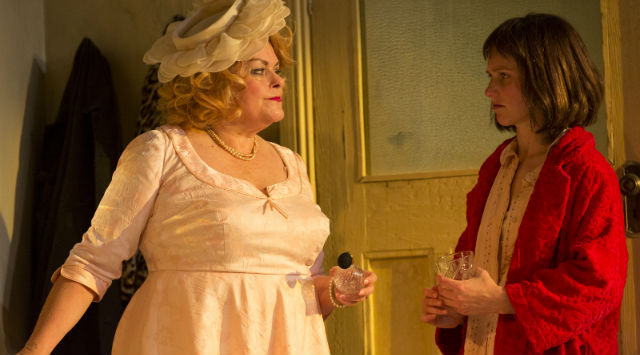
On the eve of Paris’ impending decimation by the Nazis, Raoul Nordling a Swedish diplomat, pays a surprise visit to the hotel suite of German military governor Dietrich von Choltitz. In Cyril Gély’s Diplomacy, we witness the intense negotiations that lead to Choltitz’s eventual surrender. We always knew how the play was going to conclude, so it is the dynamics between the two men that are crucial to the drama that ensues.

These historical facts, albeit amplified, are fascinating. The idea that one man could thwart an operation of such scale, should prove to be quite astonishing, but the production is tepid, unable to convey the tension of war, and the very serious stakes never become sufficiently persuasive.

It is a good looking show; Michael Scott-Mitchell’s set design is sophisticated and inventively functional, while Genevieve Graham’s costumes are detailed and impeccably tailored. Lights by Matt Cox and sound by Nate Edmondson, are elegant, both suitably restrained and minimal in approach.

As Choltitz, John Bell is appropriately imposing, but it is a portrayal that can feel surface and impenetrable. John Gaden plays up the charm of Nordling, and makes good use of comic opportunities, but chemistry between the two leads struggles for authenticity, and their story ends up being told with only grandiosity and no discernible nuance.

Stories of war will always be worth recounting, as long as we continue to undertake them. Histories repeat, as though human nature will forever be doomed to replicate all its mistakes. Some will consult the annals to try for improvements to our behaviour, but others it seems, will look to the past only to learn how to win at meaningless battles of our future.

www.ensemble.com.au