Review: Hello, Beautiful! (Performing Lines)

Venue: SBW Stables Theatre (Kings Cross NSW), Jul 9 – 14, 2018
Playwright: Hannie Rayson
Director: Matthew Lutton
Cast: Hannie Rayson
Images by Andrew Bott

Theatre review
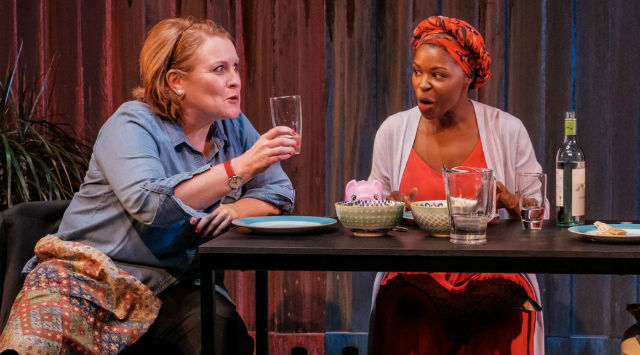
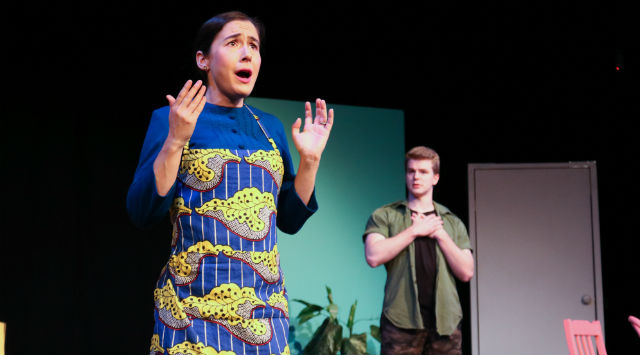
We live in a world determined to render the older woman invisible. Having exhausted her roles as sex object and mother, she is thought to have turned irrelevant, neither madonna nor whore, made to feel as though she has outstayed her welcome. With Hello, Beautiful! Hannie Rayson claims space as that grande dame, in a theatrical landscape that routinely excludes women of a certain age. Rayson represents only herself in this autobiographical work, but her presence is fundamentally political.

Rayson performs stories from her memoirs, beginning with her childhood in 60s suburbia, through to university, activism, parenthood and an ever-increasingly successful writing career. She offers glimpses of a charmed life, not particularly dramatic or eventful, but we find ourselves captivated by her delightful avidity, and share in the joys of her personal reflections. Staged with little fuss, Matthew Lutton’s direction places emphasis on Rayson’s talents and natural allure, for a simple production that achieves all that it sets out to do.

It is without exception, that societies benefit from knowledge and experience of their elders, yet in so much of Australia, we relegate our seniors to distant corners, anxious about the truths they will tell, and fearful of the mortality that they personify. Hannie Rayson’s contributions are significant and ongoing, and it is our privilege to be able to hear her speak. Bright, young things are dazzling to the senses, but it is at our own peril, that we ignore the only true repositories of wisdom.

www.performinglines.org.au | www.griffintheatre.com.au

Review: Permission To Spin (Apocalypse Theatre Company)

Venue: Old Fitzroy Theatre (Woolloomooloo NSW), Jul 3 – 28, 2018
Playwright: Mary Rachel Brown
Director: Mary Rachel Brown, Dino Dimitriadis
Cast: Yure Covich, Anna Houston, Arky Michael
Images by Robert Catto

Theatre review
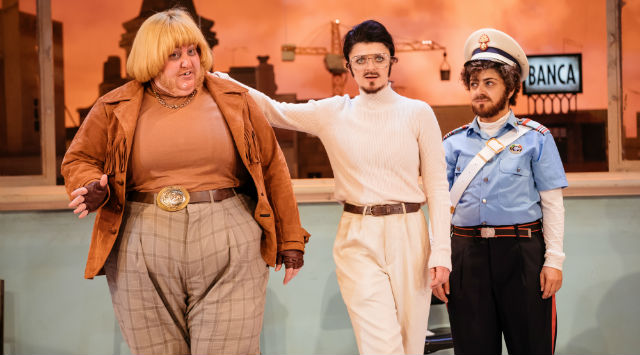
Cristobel is suffering an existential crisis, having learnt about her music being used for gravely nefarious purposes. After 14 years in the highly commercialised industry of children’s entertainment, her integrity is now unable to escape scrutiny, but corporate interests deny all her attempts to quit. Art and commerce are once again at loggerheads, in Mary Rachel Brown’s Permission To Spin, a dramedy that interrogates not only artistic purity, but also our general complicity and participation in the often ugly world of big money.

It begins with a big bang, two businessmen are snorting cocaine, in the midst of a lot of ruckus, wondering how to solve a problem like Cristobel. The laughs are loud and abundant, courtesy of Brown’s witty, often very incisive, dialogue. It is evident however, that the play is intent on seriously exploring our social, economic and political lives, and a gradual but marked change in tone occurs about midway through the hour-long presentation. Direction by Brown and Dino Dimitriadis provide good clarity to ideas, even when the writing turns dense. The contrast in mood, as the play crosses over from funny to heavy, involves an inevitable drop in energy levels, but we are kept attentive by some very resonant postulations.

Three excellent performers accompany us on this trip, helping us navigate the combative activity of Permisson To Spin, and in the process, locate a sense of our communal ethics. Anna Houston provides soul to the piece, simultaneously vulnerable and strong, with incredible nuance that speak volumes in her interpretation of Cristobel. Yure Covich is splendid as an obscene and irredeemably vile corporate asshole, powerful in his embodiment of our social ills and perfect as the show’s bad guy. Arky Michael is wonderfully comical, landing every punchline with remarkable precision and aplomb, displaying himself to be the kind of actor any production could rely on, for charm and interminable effervescence.

All our occupations contribute to greater consequences, even if we think them insignificant. Cristobel is meant to be creating music that is educational at best, innocuous at worst, but she is unable to stop her work from being repurposed in a manner that contradicts all that she believes in. There is a machine that absorbs and integrates us into its operations, to serve its purposes. We do not always have control over its desires, as is proven again and again, by the flaws and inadequacies of the way we execute our democracy. “It was music we were making here until they told us, all they wanted was a sound that could kill someone from a distance… I just pray that someone there can hit the switch.” Kate Bush, Experiment IV, 1986

www.apocalypsetheatrecompany.com

Review: Roomba Nation (Hurrah Hurrah / The Old 505 Theatre)

Venue: Old 505 Theatre (Newtown NSW), Jul 4 – 21, 2018
Cast/Devisors: Alison Bennett, Nick O’Regan, Kate Walder
Images by Stephen Reinhardt

Theatre review
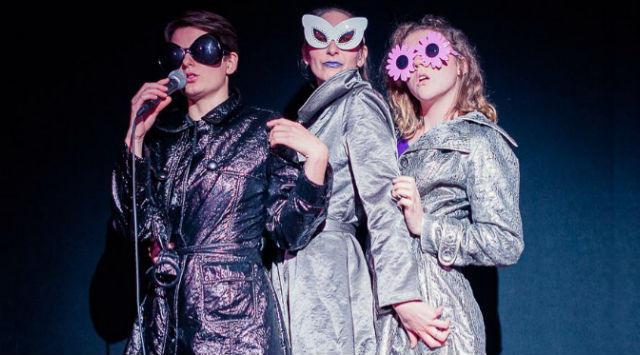
Pippi is in a medical facility, surrounded by technology and experts. A doctor and a nurse attend to her, although they demonstrate little care for their patient’s well-being, choosing instead to focus on the science and gadgetry purportedly designed to make us feel better. Roomba Nation is concerned with that disconnect between humans, in a modern age defined by personal independence and isolation, as an ironic result of human advancement. Looking at the way technology is able to take over our existence, the show foregrounds humanity, asking questions about our ever-changing relationship with nature.

Pippi says she is unwell, but her sickness is a mystery. Instead of showing any obvious symptoms of illness, what she presents is a need for attention and connection. The human touch it seems, is still necessary, in these times of virtual everything. Roomba Nation talks about neglect, and we wonder if in the pursuit of progress, our focus has abandoned that which is truly important. Values are constantly shifting, because we are constantly changing. The mortal flesh however, seems to retain a stubbornness, that disallows us from living only in highly evolved states of mind. No matter how clever we think ourselves to be, the reality of bodies, keeps us humble.

Production design by Duncan Maurice is pristine, delightfully and humorously so, to reflect the septic quality of the world being explored. The three characters are absurd and abstract manifestations of people in hospitals, performed by Alison Bennett, Nick O’Regan and Kate Walder, an invigorating ensemble as fascinating they are funny. In accompaniment are three automated vacuum cleaners, dressed up as robots to symbolise the dehumanisation of society, but are otherwise underwhelming with what they bring to the stage. It is a charming piece of theatre, perhaps insufficiently incisive with what it communicates, but an eccentric spirit makes up for its shortcomings.

Resistance may be futile, but when we submit to technology, in our very participation of it, opportunities for ethical choices can still be found. Technology never exists separate from us. It comes from us, and continues to depend upon us. As long as we remain indispensable, we have to believe that it is within our power, to shape the future in accordance with the best of our nature. Efforts to make life easier are inseparable from all that we do, but complacency will only deliver the exact opposite.

www.hurrahhurrah.com.au

Review: Toby Schmitz Live (Old Fitz Theatre)

Venue: Old Fitzroy Theatre (Woolloomooloo NSW), Jun 26 – 29, 2018
Playwright: Toby Schmitz
Cast: Toby Schmitz

Theatre review
It is a convention in autobiographies that they involve vignettes of major significance, with important occurrences that have shaped a person’s being, occupying centre stage. Typically, one gives a recount in chronology, from a childhood that reveals background and ancestry, through to career highlights and personal triumphs, always with a healthy dose of trauma placed strategically, to elicit some sort of poignancy from its audience. In Toby Schmitz Live, an actor-slash-playwright talks about himself in a disarmingly casual manner, rejecting the obvious constraints of aforementioned assumptions, to paint a self-portrait using rules of his own determination. We obtain an impression of the artist, entirely accurate and immediate, but secrets remain undisclosed.

There might be no dirty laundry to speak of, but Schmitz’s presentation is not devoid of vulnerability. The complete absence of a fourth wall exposes the performer to intense scrutiny. We watch him manifest a mode of presentation extraordinary with its degree of naturalism; as actor, Schmitz’s ability to render invisible the devices of theatre is deeply fascinating. Early sequences seek to explore the unpredictable nature of the live form. We are reminded of its title Toby Schmitz Live, and the show seems intent on delivering just that; Toby Schmitz is live, and anything can happen. There is a degree of daring and confidence that will no doubt impress, even if Australian audiences are guaranteed to always be excessively polite.

Much of the piece feels no different to genres of stand up comedy, but Schmitz’s penchant for theatricality often rears its head. It is an effective technique, to have us let down our guard in the presence of his spontaneity, then be met subsequently, with a more dramatic approach that he so cunningly, and effortlessly, weaves through unsuspectingly. The yarns that our star spins, are thoroughly amusing, although largely inconsequential. It is his charisma, and undeniable skill, that has us invested in the storytelling, but it is unclear if many of us will find lasting relevance in what he has to share. Ultimately, it is a personal, albeit slightly surface, representation of Schmitz’s life as he knows it. We are invited to come in contact with his world for a confined moment, and we go on our separate ways, none of us transformed.

www.redlineproductions.com.au/underground

Review: Unqualified (Ensemble Theatre)

Venue: Ensemble Theatre (Kirribilli NSW), Jun 22 – Jul 21, 2018
Playwrights: Genevieve Hegney, Catherine Moore
Director: Janine Watson
Cast: Genevieve Hegney, Catherine Moore
Images by Phil Erbacher

Theatre review
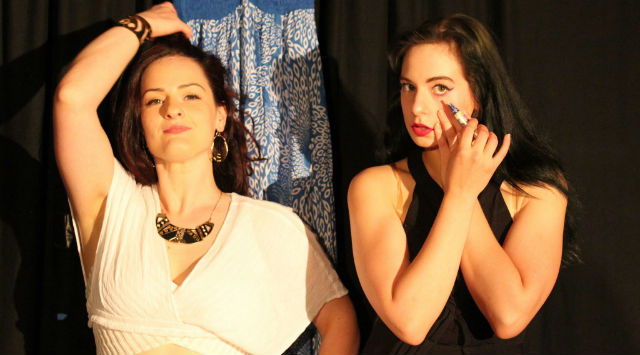
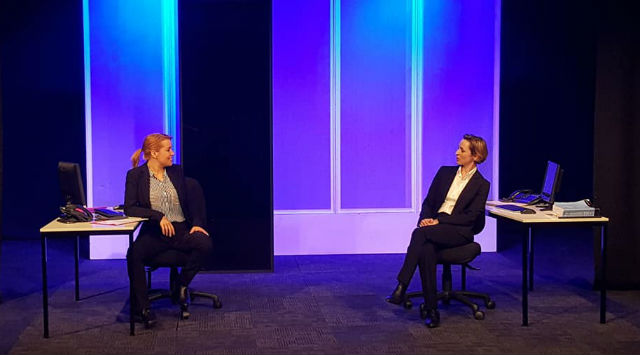
Centrelink offices are not generally considered places of serendipity, but when Felicity and Joanne meet, an unlikely and fortuitous union occurs. They join forces to set up a temping agency, creating opportunities for themselves, to leave the past behind and to become gainfully employed in a manner that gives them a new independence. Finding your own feet, however, is never an easy task. The women fly before they walk, and with a hilarity derived from their naivety, we watch them in Unqualified, fumbling and learning to come into their own.

Genevieve Hegney and Catherine Moore’s play contains a suite of excellent jokes, all stemming from a meaningful concept, involving women resisting their societal obligations as wives and daughters. Its general plot is insufficiently taut, but the show is a successful expansion of the skit format, with speedy exchanges between the two designed to provide what seems an endless amount of very clever punchlines.

The writers present their own creation, both impressive with the detail that they bring on stage, along with a sensational display of chemistry determined to hold us captive. Moore is particularly delightful as the jovial Felicity, delivering a comic performance astonishing in its efficacy, precision and inventiveness. Director Janine Watson orchestrates the action so that there is plenty of colour and movement to occupy our attention. Even when the story stagnates, we find ourselves luxuriating in the laughs that come through incessantly, and effortlessly.

Few people seem to be able go through life never having to make any sacrifices; many of us look as though we are never capable of putting ourselves first. Unqualified is a work celebrating the discovery, when it finally dawns upon us, that there is a finite amount to what we can owe, and that true fulfilment requires an individual to understand what it is that will realise their true potential. Felicity and Joanne spent many years cultivating a sense of worth, by following prescribed rules. It is satisfying to witness their moment of self-determination, as they make the decision to break free. Humour can help us through anything, but emancipation is ultimately the biggest reward.

www.ensemble.com.au

Review: Estelle Astaire’s Woes & Wares (Blood Moon Theatre)

Venue: Blood Moon Theatre (Potts Point NSW), Jun 13 – 16, 2018
Playwright: Bianca Seminara
Director: Bianca Seminara
Cast: Bianca Seminara

Theatre review
It is a Tupperware party, and our host is doing her best to keep us entertained. Estelle Astaire’s Woes & Wares is a one-woman show, in which a recent immigrant from New York relays the journey that had got her here. The challenges of a child living with a difficult mother, and failed love affairs of an ingenue, form an amusing biography of someone trying to come into her own. Estelle is great company, and her mother is a splendidly colourful creature, both witty and spirited, in this uncomplicated but cleverly written play, by Bianca Seminara.

For the production, Seminara serves also as actor and director, for which her abilities are evidently less accomplished. There is a charm and attractive quirkiness to the presence she brings on stage, but the lack of dynamism and drama in the performance, makes for a monotonous experience, albeit a tenaciously endearing one. Nevertheless, the hour-long show is fairly rewarding, made memorably novel by the circulation of a large number of fascinating plastic containers among the audience.

Estelle has a horrible husband, whom she tolerates in a way similar to how she had dealt with her mother. The big difference of course, is that Estelle is no longer a child, and can leave her appalling circumstances at will. Independence is essential, but to acquire the skills that will help one attain it, is always a tricky ordeal. When mothers are unable to fulfil their duty as role models, daughters often have to learn things the hard way. Estelle has yet to find her path, but we are glad to see that she is on the right track.

www.bloodmoontheatre.com

Review: Air (Old 505 Theatre)

Venue: The Old 505 Theatre (Newtown NSW), Jun 13 – 30, 2018
Playwright: Joanna Erskine
Director: Anthony Skuse
Cast: Tel Benjamin, David Lynch, Diana McLean, Suzanne Pereira, Eloise Snape
Images by Mansoor Noor

Theatre review
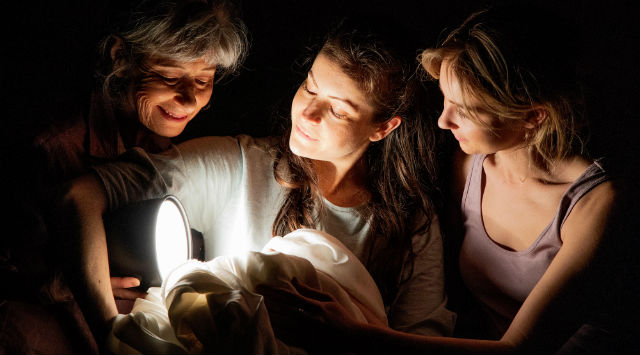
Annabel works the graveyard shift at a community radio station, reading out obituary entries from the day’s newspaper. Usually an intensely solitary endeavour, interruptions begin to occur, as the phone starts ringing, and as visitors decide to drop by. Joanna Erskine’s Air is part supernatural thriller, and part family drama. It is an intriguing plot, if slightly too meandering, with some genuinely funny touches and moments of melancholy that are quite enthralling.

The play builds to a slightly underwhelming conclusion, but the journey is on the whole, a satisfying one. Director Anthony Skuse’s delicate approach casts a transformative spell over the space, allowing us to luxuriate in the hazy intimacy of the broadcast studio, where a sense of the metaphysical can come and go as it pleases. Eloise Snape is a very endearing Annabel, thoroughly authentic with the naturalism that her acting style embodies, especially delightful when presenting the subtle comedy of the piece. Tel Benjamin and Diana McLean are also on hand for further amusement, eliciting some very cheeky, and surprising, laughs when we least expect them.

Much of Air is a meditation on loneliness and isolation. That which provides safety to Annabel, involves the company of the deceased, and the shunning of the living. It is true that people are tiresome, often unbearable, so we understand the voluntary exile some might choose, over the difficult social responsibilities that are routinely thrust upon us. There is however, little that is rewarding in a life made invulnerable. To let the self be open, will inevitably incur hurt, but without obstacles, we might as well be dead. Annabel’s growth requires that she learns to care and protect, not just for herself, but also for others. It also requires that she makes decisions only with circumspection and not fear.

www.old505theatre.com

Review: The Hypochondriac (Darlinghurst Theatre Company)

Venue: Eternity Playhouse (Darlinghurst NSW), Jun 9 – Jul 1, 2018
Playwright: Molière (a new version by Hilary Bell)
Director: Jo Turner
Cast: Gabriel Fancourt, Darren Gilshenan, Sophie Gregg, Emma Harvie, Lucia Mastrantone, Jamie Oxenbould, Monica Sayers
Images by Robert Catto

Theatre review
Argan is convinced that he is riddled with disease. His wife Beline, has heard it all before, and tired of waiting for his death, is now plotting to steal his entire estate without the help of sickness to deliver the goods. Molière’s The Hypochondriac is given new interpretation by Hilary Bell, who makes adjustments to the language and story for yet another generation. The essence of Molière’s farce is retained, and it proves still to be effective and very enjoyable, but a more modern sensibility is introduced, most notably in terms of its women characters, who are now full of nerve and agency.

First glimpse of the production is impressive. Designer Michael Hankin’s set is an opulent creation, gloriously lit by Verity Hampson to convey both the wealth at the centre of Argan’s story, and the traditions from which it is derived. The show however, is slow to start. Energies are subdued, and a misplaced hush pervades much of the action, even if the cast looks to be raring to go. Things do fall into place however, when an air of chaotic ruckus that so defines the genre, eventually kicks in, to replace the strange tentativeness of its beginnings.

Performer Darren Gilshenan’s marvellous comedic presence makes him the perfect candidate for Argan; he brings to the role a rare combination of precision and raw impulse, keeping us firmly on track with the plot, but always feeling as though anything could happen, as is crucial in this style of live comedy. It is a thoroughly accomplished ensemble that takes the stage, and although chemistry in-between is not yet at perfection on opening night, each player is as enthused and skilled as the next, and we find ourselves fawning over all of their colourful characterisations.

Marriage is increasingly strange a phenomenon. As we move towards ever more rational forms of existence, the fact that people hold on to that ancient practice, is quite curious. Young ones in The Hypochondriac wish to have marriage legitimise their love, whilst their older counterparts think of marriage in direct accordance with the possession of property. Love and property can exist today independent of that institution, but we cannot help returning to it, maybe for its symbolism, or maybe we are simply always in search of something to make ourselves feel better.

www.darlinghursttheatre.com

Review: Bliss (Belvoir St Theatre)

Venue: Belvoir St Theatre (Surry Hills NSW), Jun 9 – Jul 15, 2018
Playwright: Peter Carey (adapted for the stage by Tom Wright)
Director: Matthew Lutton
Cast: Marco Chiappi, Mark Coles Smith, Will McDonald, Amber McMahon, Charlotte Nicdao, Susan Prior, Anna Samson, Toby Truslove
Images by Pia Johnson

Theatre review
Harry Joy escapes a narrow death, but in the return to consciousness, he is no longer the same. Peter Carey’s 1981 novel Bliss is the story of an archetypal ad man, exemplary only in the mediocrity that he embodies, coming to the realisation that the hell he endures is in fact present in the here and now, and not a figment about a foreboded afterlife. Tom Wright’s adaptation for the stage is appropriately surreal, as Joy begins to see the absurdity of the world that he inhabits. Scenes are whimsically comedic, with a flamboyant sense of neurosis that makes for amusing theatre, but its tale of redemption feels surprisingly distant. The central concerns in Bliss remain relevant, but 37 years is a long while for us to retain meaningful identification with its plot and people.

Although little of the content has been updated for our times, director Matthew Lutton’s stylistic choices are undeniably au courant, inventive and imaginative. Sprightly, with a little acerbity, it is an energetic production, spouting clever ideas at every turn. The moral of its story can seem too basic, and obvious, but the show’s structural complexities keep us attentive. Marg Horwell’s set is a simple concept that proves highly effective in shifting dimensions, thereby conveying time and space in a dynamic manner. Paul Jackson’s big, blunt lighting transformations give us lots of delicious drama, and Stefan Gregory’s music has a quirky edge that is delightfully unpredictable.

Actor Toby Truslove is a credible leading man, especially persuasive in moments of melancholy. His quiet but confident interpretation of the play’s humour, brings a subtlety that offers refreshing juxtaposition against a lot of theatrical commotion. As Bettina Joy, Amber McMahon’s rigorous elucidations are as illuminating as they are entertaining. The performer is to be admired for the integrity she is able to introduce, to a character who is destroyed for daring to follow her bliss. Marco Chiappi and Susan Prior are memorable for the boldness of their satire, both personalities radiant and irresistibly funny on this stage.

There can never be enough stories warning us about the single-minded pursuit of money. The seductive powers of materialism seem to grow ever so exponentially, no matter how much we are told of its dangers. The all-or-nothing propositions of Bliss however, give it a quality of the parable, the kind that conclude with unrealistic resolutions that will struggle to deliver inspiration. It is easy to say that the root of all evil is money, but much harder to find an alternate undertaking, when one is deeply entrenched in the deceptive glory of gold.

www.belvoir.com.au | www.malthousetheatre.com.au

Review: August: Osage County (New Theatre)

Venue: New Theatre (Newtown NSW), Jun 6 – Jul 7, 2018
Playwright: Tracy Letts
Director: Louise Fischer
Cast: Adrian Adam, James Bean, Kirra Farquharson, Peter Flett, Jake Fryer-Hornsby, Brett Heath, Lynden Jones, Sonya Kerr, Alice Livingstone, Amy Scott-Smith, Helen Stuart, Emilia Stubbs Grigoriou, Emily Weare
Image by Bob Seary

Theatre review
The Westons are a dysfunctional family, of troubled individuals with a penchant for intoxication. There are no real problems that we can deduce, except that their home seems loveless, and each person bears, with great reluctance, a sense of onerous responsibility, where genuine care and affection are often conspicuously missing. There is also the issue of wealth in their story. Unlike the rest of us, these personalities seem to have no cares in the real world. Without any worries about putting food on tables, or securing roofs over heads, it begins to make sense that their anxieties are centred, and inflated, around their dissatisfaction with one another.

Tracy Letts’ August:Osage County is an entertaining work, that offers sadistic pleasures through its flamboyant portrayals, of women suffering emotional torment. Its low stakes give us permission to indulge in their dramatic exchanges, allowing us to watch gleefully, as rich white folk scream at each other, over not very much at all. While not altogether vapid, the play is ultimately lightweight, in spite of the incessant anguish that it endeavours to explore.

Directed by Louise Fischer, the production is appropriately extravagant with its histrionics, and memorable for the intensity it is able to manufacture, for the play’s unique brand of comic depressiveness. There is little in the Weston household that we can easily empathise with, but opportunities for derision abound. Actors Alice Livingstone and Helen Stuart play the bigger parts, both larger than life and very delightful, with the sensational hysteria that they bring to the stage. Also very charming is Kirra Farquharson whose refreshing naturalism introduces a quotient of valuable authenticity to proceedings, and Emily Weare whose nuances are as pertinent as they are captivating.

August:Osage County may not be an instalment of the Real Housewives franchise, but like the best in the tv genre of “scripted reality”, it delivers a series of spectacular conflict that undeniably amuses and enthrals. It may not be at its most satisfying when it attempts to offer depth and insight to the human condition, but the theatrical thrills that it provides, is quite remarkable.

www.newtheatre.org.au